Human Embryology I
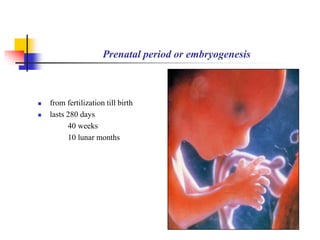
Prenatal period or embryogenesis 
 from fertilization till birth 
 lasts 280 days 
40 weeks 
10 lunar months
Embryogenesis periods 
 Initial period – the 1st week of development 
 Embryonic period – from the 2nd week until the 8th weeks 
 Fetal period – from the 8th weeks up to the birth 
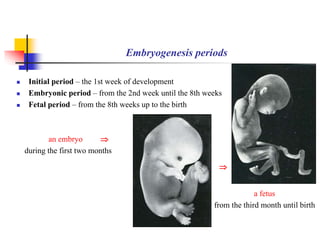
an embryo  
during the first two months 
a fetus 
 
from the third month until birth
Embryonic development stages 
 Fertilization 
 Cleavage 
 Gastrulation 
 Germ layer initial differentiation 
and axial organ formation 
 Histogenesis and organogenesis 
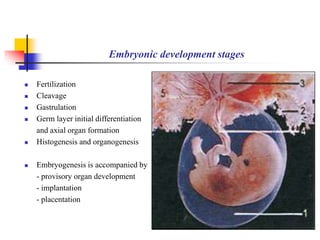
 Embryogenesis is accompanied by 
- provisory organ development 
- implantation 
- placentation
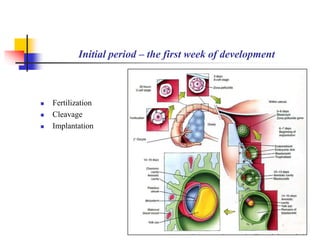
Initial period – the first week of development 
 Fertilization 
 Cleavage 
 Implantation
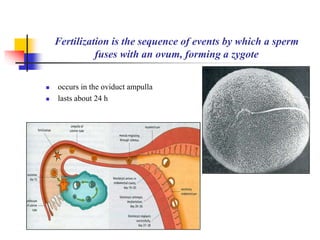
Fertilization is the sequence of events by which a sperm 
fuses with an ovum, forming a zygote 
 occurs in the oviduct ampulla 
 lasts about 24 h
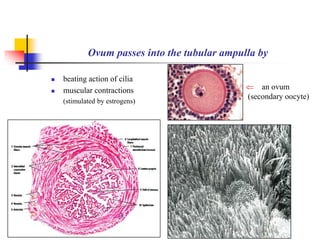
Ovum passes into the tubular ampulla by 
 beating action of cilia 
 muscular contractions 
(stimulated by estrogens) 
 an ovum 
(secondary oocyte)
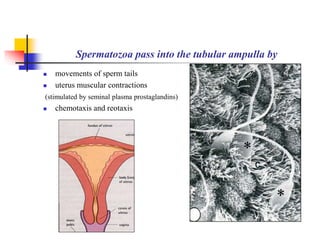
Spermatozoa pass into the tubular ampulla by 
 movements of sperm tails 
 uterus muscular contractions 
(stimulated by seminal plasma prostaglandins) 
 chemotaxis and reotaxis
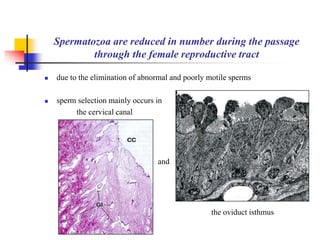
Spermatozoa are reduced in number during the passage 
through the female reproductive tract 
 due to the elimination of abnormal and poorly motile sperms 
 sperm selection mainly occurs in 
the cervical canal 
the oviduct isthmus 
and
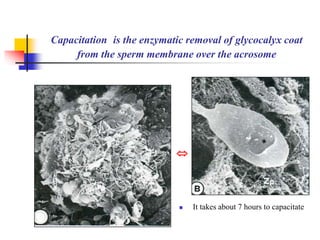
Capacitation is the enzymatic removal of glycocalyx coat 
from the sperm membrane over the acrosome 
 
 It takes about 7 hours to capacitate
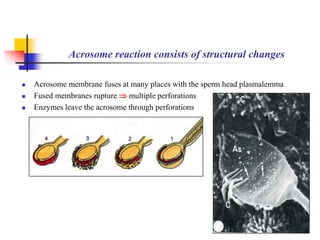
Acrosome reaction consists of structural changes 
 Acrosome membrane fuses at many places with the sperm head plasmalemma 
 Fused membranes rupture  multiple perforations 
 Enzymes leave the acrosome through perforations
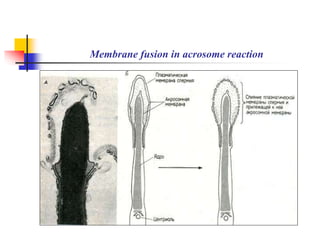
Membrane fusion in acrosome reaction
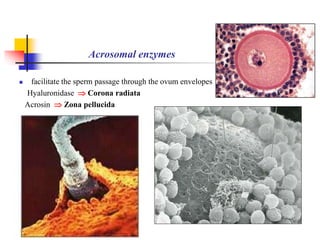
Acrosomal enzymes 
 facilitate the sperm passage through the ovum envelopes 
Hyaluronidase  Corona radiata 
Acrosin  Zona pellucida
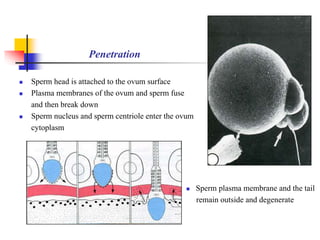
Penetration 
 Sperm head is attached to the ovum surface 
 Plasma membranes of the ovum and sperm fuse 
and then break down 
 Sperm nucleus and sperm centriole enter the ovum 
cytoplasm 
 Sperm plasma membrane and the tail 
remain outside and degenerate
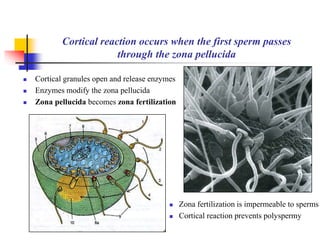
Cortical reaction occurs when the first sperm passes 
through the zona pellucida 
 Cortical granules open and release enzymes 
 Enzymes modify the zona pellucida 
 Zona pellucida becomes zona fertilization 
 Zona fertilization is impermeable to sperms 
 Cortical reaction prevents polyspermy
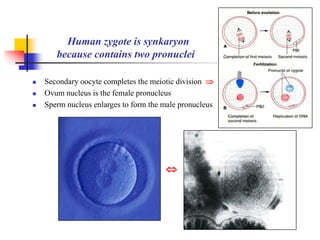
Human zygote is synkaryon 
because contains two pronuclei 
 Secondary oocyte completes the meiotic division  
 Ovum nucleus is the female pronucleus 
 Sperm nucleus enlarges to form the male pronucleus 

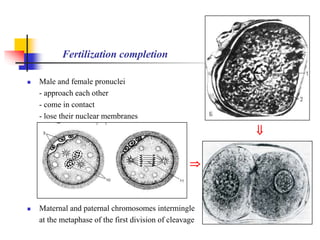
Fertilization completion 
 Male and female pronuclei 
- approach each other 
- come in contact 
- lose their nuclear membranes 
 Maternal and paternal chromosomes intermingle 
at the metaphase of the first division of cleavage 
 

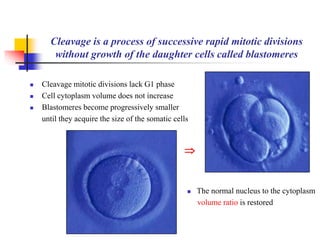
Cleavage is a process of successive rapid mitotic divisions 
without growth of the daughter cells called blastomeres 
 Cleavage mitotic divisions lack G1 phase 
 Cell cytoplasm volume does not increase 
 Blastomeres become progressively smaller 
until they acquire the size of the somatic cells 
 The normal nucleus to the cytoplasm 
volume ratio is restored 

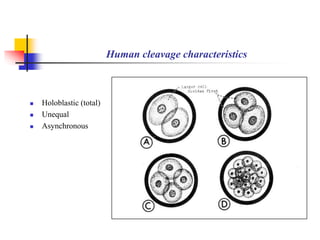
Human cleavage characteristics 
 Holoblastic (total) 
 Unequal 
 Asynchronous
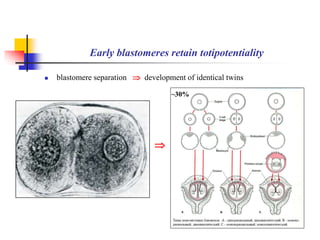
Early blastomeres retain totipotentiality 
 blastomere separation  development of identical twins 
 
~30%
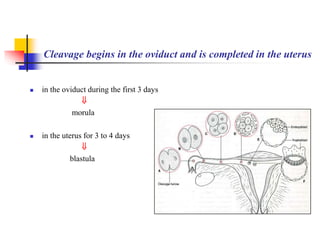
Cleavage begins in the oviduct and is completed in the uterus 
 in the oviduct during the first 3 days 
 
morula 
 in the uterus for 3 to 4 days 
 
blastula
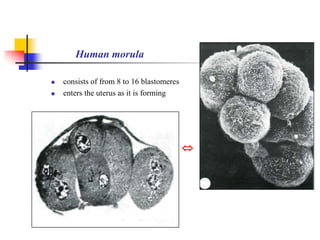
Human morula 
 consists of from 8 to 16 blastomeres 
 enters the uterus as it is forming 

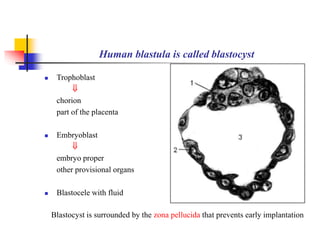
Human blastula is called blastocyst 
 Trophoblast 
 
chorion 
part of the placenta 
 Embryoblast 
 
embryo proper 
other provisional organs 
 Blastocele with fluid 
Blastocyst is surrounded by the zona pellucida that prevents early implantation
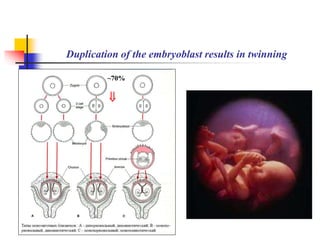
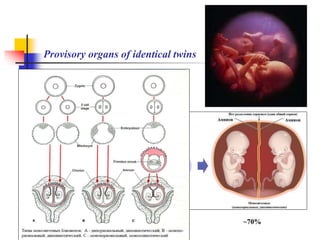
Duplication of the embryoblast results in twinning 
~70% 

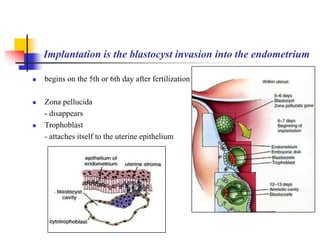
Implantation is the blastocyst invasion into the endometrium 
 begins on the 5th or 6th day after fertilization 
 Zona pellucida 
- disappears 
 Trophoblast 
- attaches itself to the uterine epithelium
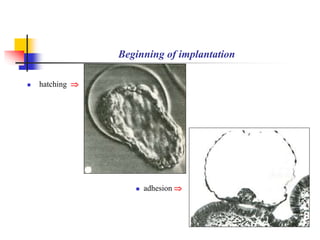
Beginning of implantation 
 hatching  
 adhesion 
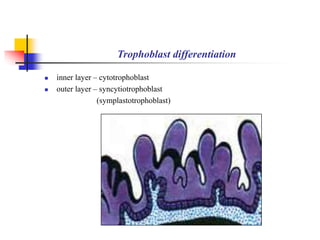
Trophoblast differentiation 
 inner layer – cytotrophoblast 
 outer layer – syncytiotrophoblast 
(symplastotrophoblast)
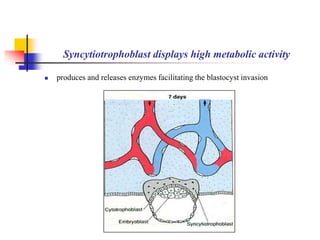
Syncytiotrophoblast displays high metabolic activity 
 produces and releases enzymes facilitating the blastocyst invasion
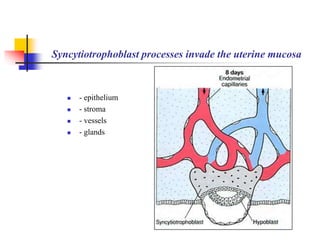
Syncytiotrophoblast processes invade the uterine mucosa 
 - epithelium 
 - stroma 
 - vessels 
 - glands
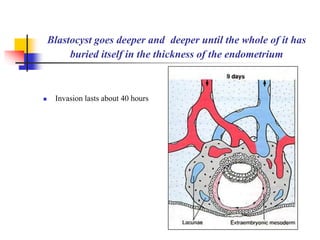
Blastocyst goes deeper and deeper until the whole of it has 
buried itself in the thickness of the endometrium 
 Invasion lasts about 40 hours
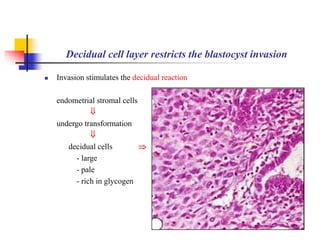
Decidual cell layer restricts the blastocyst invasion 
 Invasion stimulates the decidual reaction 
endometrial stromal cells 
 
undergo transformation 
 
decidual cells  
- large 
- pale 
- rich in glycogen
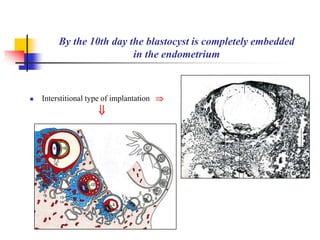
By the 10th day the blastocyst is completely embedded 
in the endometrium 
 Interstitional type of implantation  

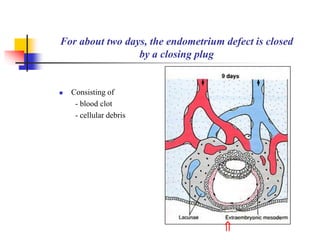
For about two days, the endometrium defect is closed 
by a closing plug 
 Consisting of 
- blood clot 
- cellular debris 
 

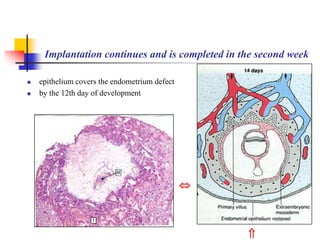
Implantation continues and is completed in the second week 
 epithelium covers the endometrium defect 
 by the 12th day of development 
 

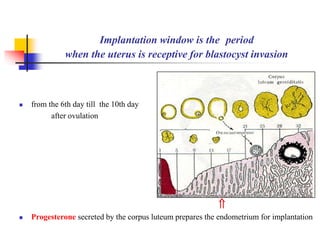
Implantation window is the period 
when the uterus is receptive for blastocyst invasion 
 from the 6th day till the 10th day 
after ovulation 
 
 Progesterone secreted by the corpus luteum prepares the endometrium for implantation
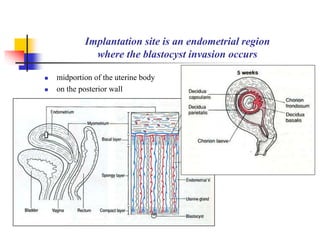
Implantation site is an endometrial region 
where the blastocyst invasion occurs 
 midportion of the uterine body 
 on the posterior wall
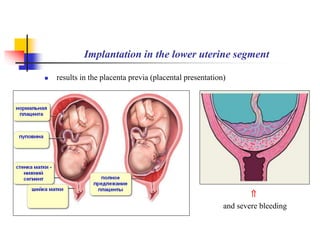
Implantation in the lower uterine segment 
 results in the placenta previa (placental presentation) 
 
and severe bleeding
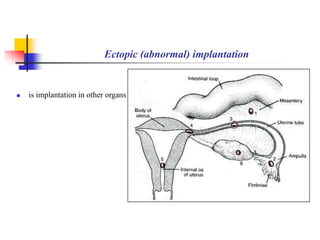
Ectopic (abnormal) implantation 
 is implantation in other organs
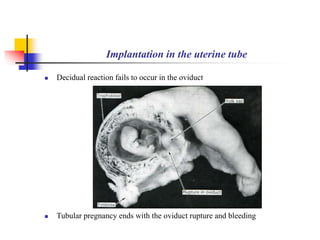
Implantation in the uterine tube 
 Decidual reaction fails to occur in the oviduct 
 Tubular pregnancy ends with the oviduct rupture and bleeding
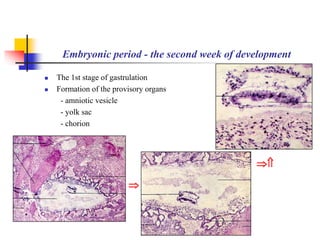
Embryonic period - the second week of development 
 The 1st stage of gastrulation 
 Formation of the provisory organs 
- amniotic vesicle 
- yolk sac 
- chorion 
 

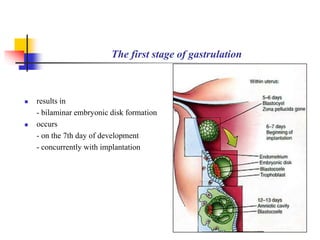
The first stage of gastrulation 
 results in 
- bilaminar embryonic disk formation 
 occurs 
- on the 7th day of development 
- concurrently with implantation
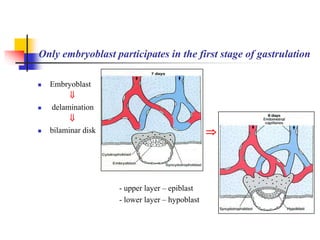
Only embryoblast participates in the first stage of gastrulation 
 Embryoblast 
 
 delamination 
 
 bilaminar disk  
- upper layer – epiblast 
- lower layer – hypoblast
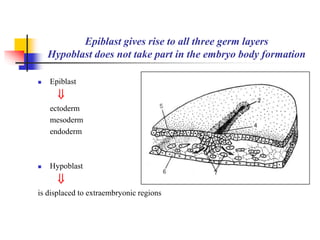
Epiblast gives rise to all three germ layers 
Hypoblast does not take part in the embryo body formation 
 Epiblast 
 
ectoderm 
mesoderm 
endoderm 
 Hypoblast 
 
is displaced to extraembryonic regions
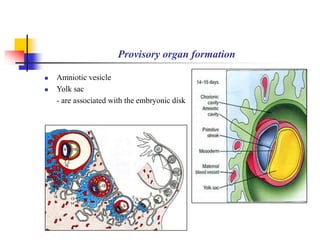
Provisory organ formation 
 Amniotic vesicle 
 Yolk sac 
- are associated with the embryonic disk
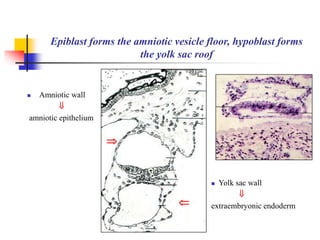
Epiblast forms the amniotic vesicle floor, hypoblast forms 
the yolk sac roof 
 Amniotic wall 
 
amniotic epithelium 
 Yolk sac wall 
 
extraembryonic endoderm  

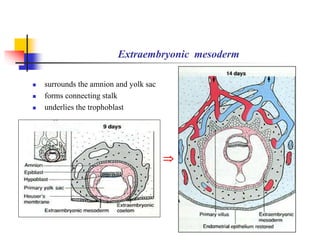
Extraembryonic mesoderm 
 surrounds the amnion and yolk sac 
 forms connecting stalk 
 underlies the trophoblast 

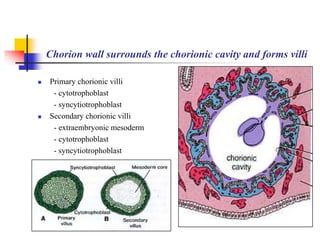
Chorion wall surrounds the chorionic cavity and forms villi 
 Primary chorionic villi 
- cytotrophoblast 
- syncytiotrophoblast 
 Secondary chorionic villi 
- extraembryonic mesoderm 
- cytotrophoblast 
- syncytiotrophoblast
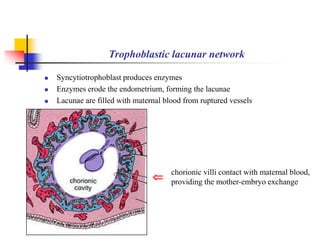
Trophoblastic lacunar network 
 Syncytiotrophoblast produces enzymes 
 Enzymes erode the endometrium, forming the lacunae 
 Lacunae are filled with maternal blood from ruptured vessels 
chorionic villi contact with maternal blood, 
providing the mother-embryo exchange 

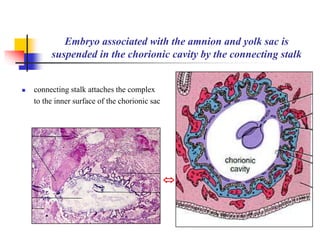
Embryo associated with the amnion and yolk sac is 
suspended in the chorionic cavity by the connecting stalk 
 connecting stalk attaches the complex 
to the inner surface of the chorionic sac 

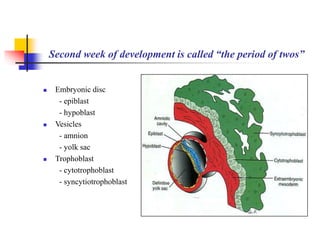
Second week of development is called “the period of twos” 
 Embryonic disc 
- epiblast 
- hypoblast 
 Vesicles 
- amnion 
- yolk sac 
 Trophoblast 
- cytotrophoblast 
- syncytiotrophoblast
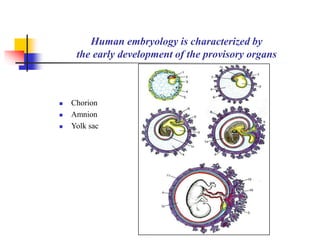
Human embryology is characterized by 
the early development of the provisory organs 
 Chorion 
 Amnion 
 Yolk sac
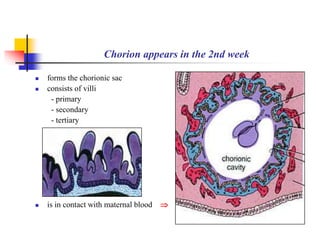
Chorion appears in the 2nd week 
 forms the chorionic sac 
 consists of villi 
- primary 
- secondary 
- tertiary 
 is in contact with maternal blood 
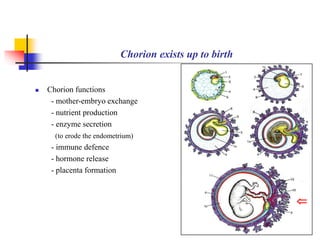
Chorion exists up to birth 
 Chorion functions 
- mother-embryo exchange 
- nutrient production 
- enzyme secretion 
(to erode the endometrium) 
- immune defence 
- hormone release 
- placenta formation 

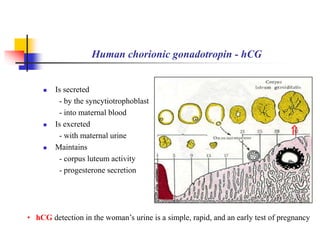
Human chorionic gonadotropin - hCG 
 Is secreted 
- by the syncytiotrophoblast 
- into maternal blood 
 Is excreted 
- with maternal urine 
 Maintains 
- corpus luteum activity 
- progesterone secretion 
 
• hCG detection in the woman’s urine is a simple, rapid, and an early test of pregnancy
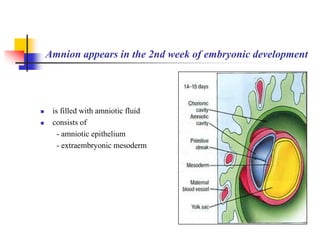
Amnion appears in the 2nd week of embryonic development 
 is filled with amniotic fluid 
 consists of 
- amniotic epithelium 
- extraembryonic mesoderm 

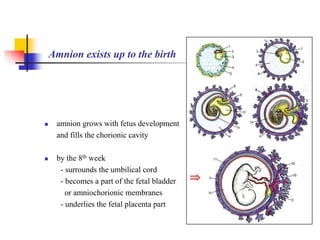
Amnion exists up to the birth 
 amnion grows with fetus development 
and fills the chorionic cavity 
 by the 8th week 
- surrounds the umbilical cord 
- becomes a part of the fetal bladder 
or amniochorionic membranes 
- underlies the fetal placenta part 

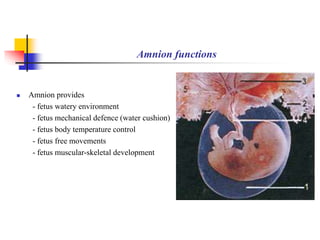
Amnion functions 
 Amnion provides 
- fetus watery environment 
- fetus mechanical defence (water cushion) 
- fetus body temperature control 
- fetus free movements 
- fetus muscular-skeletal development
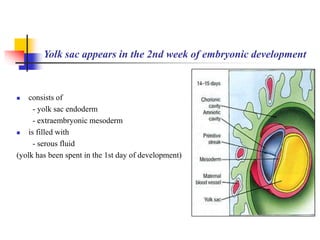
Yolk sac appears in the 2nd week of embryonic development 
 consists of 
- yolk sac endoderm 
- extraembryonic mesoderm 
 is filled with 
- serous fluid 
(yolk has been spent in the 1st day of development)
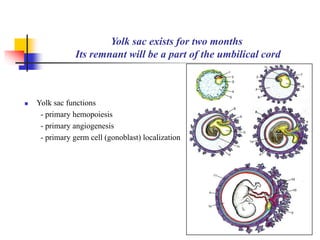
Yolk sac exists for two months 
Its remnant will be a part of the umbilical cord 
 Yolk sac functions 
- primary hemopoiesis 
- primary angiogenesis 
- primary germ cell (gonoblast) localization
Provisory organs of identical twins 
~70%
The End 
Thank you for attention!

Human Embryology I

  • 1.
  • 2.
    Prenatal period orembryogenesis  from fertilization till birth  lasts 280 days 40 weeks 10 lunar months
  • 3.
    Embryogenesis periods Initial period – the 1st week of development  Embryonic period – from the 2nd week until the 8th weeks  Fetal period – from the 8th weeks up to the birth an embryo  during the first two months a fetus  from the third month until birth
  • 4.
    Embryonic development stages  Fertilization  Cleavage  Gastrulation  Germ layer initial differentiation and axial organ formation  Histogenesis and organogenesis  Embryogenesis is accompanied by - provisory organ development - implantation - placentation
  • 5.
    Initial period –the first week of development  Fertilization  Cleavage  Implantation
  • 6.
    Fertilization is thesequence of events by which a sperm fuses with an ovum, forming a zygote  occurs in the oviduct ampulla  lasts about 24 h
  • 7.
    Ovum passes intothe tubular ampulla by  beating action of cilia  muscular contractions (stimulated by estrogens)  an ovum (secondary oocyte)
  • 8.
    Spermatozoa pass intothe tubular ampulla by  movements of sperm tails  uterus muscular contractions (stimulated by seminal plasma prostaglandins)  chemotaxis and reotaxis
  • 9.
    Spermatozoa are reducedin number during the passage through the female reproductive tract  due to the elimination of abnormal and poorly motile sperms  sperm selection mainly occurs in the cervical canal the oviduct isthmus and
  • 10.
    Capacitation is theenzymatic removal of glycocalyx coat from the sperm membrane over the acrosome   It takes about 7 hours to capacitate
  • 11.
    Acrosome reaction consistsof structural changes  Acrosome membrane fuses at many places with the sperm head plasmalemma  Fused membranes rupture  multiple perforations  Enzymes leave the acrosome through perforations
  • 12.
    Membrane fusion inacrosome reaction
  • 13.
    Acrosomal enzymes facilitate the sperm passage through the ovum envelopes Hyaluronidase  Corona radiata Acrosin  Zona pellucida
  • 14.
    Penetration  Spermhead is attached to the ovum surface  Plasma membranes of the ovum and sperm fuse and then break down  Sperm nucleus and sperm centriole enter the ovum cytoplasm  Sperm plasma membrane and the tail remain outside and degenerate
  • 15.
    Cortical reaction occurswhen the first sperm passes through the zona pellucida  Cortical granules open and release enzymes  Enzymes modify the zona pellucida  Zona pellucida becomes zona fertilization  Zona fertilization is impermeable to sperms  Cortical reaction prevents polyspermy
  • 16.
    Human zygote issynkaryon because contains two pronuclei  Secondary oocyte completes the meiotic division   Ovum nucleus is the female pronucleus  Sperm nucleus enlarges to form the male pronucleus 
  • 17.
    Fertilization completion Male and female pronuclei - approach each other - come in contact - lose their nuclear membranes  Maternal and paternal chromosomes intermingle at the metaphase of the first division of cleavage  
  • 18.
    Cleavage is aprocess of successive rapid mitotic divisions without growth of the daughter cells called blastomeres  Cleavage mitotic divisions lack G1 phase  Cell cytoplasm volume does not increase  Blastomeres become progressively smaller until they acquire the size of the somatic cells  The normal nucleus to the cytoplasm volume ratio is restored 
  • 19.
    Human cleavage characteristics  Holoblastic (total)  Unequal  Asynchronous
  • 20.
    Early blastomeres retaintotipotentiality  blastomere separation  development of identical twins  ~30%
  • 21.
    Cleavage begins inthe oviduct and is completed in the uterus  in the oviduct during the first 3 days  morula  in the uterus for 3 to 4 days  blastula
  • 22.
    Human morula consists of from 8 to 16 blastomeres  enters the uterus as it is forming 
  • 23.
    Human blastula iscalled blastocyst  Trophoblast  chorion part of the placenta  Embryoblast  embryo proper other provisional organs  Blastocele with fluid Blastocyst is surrounded by the zona pellucida that prevents early implantation
  • 24.
    Duplication of theembryoblast results in twinning ~70% 
  • 25.
    Implantation is theblastocyst invasion into the endometrium  begins on the 5th or 6th day after fertilization  Zona pellucida - disappears  Trophoblast - attaches itself to the uterine epithelium
  • 26.
    Beginning of implantation  hatching   adhesion 
  • 27.
    Trophoblast differentiation inner layer – cytotrophoblast  outer layer – syncytiotrophoblast (symplastotrophoblast)
  • 28.
    Syncytiotrophoblast displays highmetabolic activity  produces and releases enzymes facilitating the blastocyst invasion
  • 29.
    Syncytiotrophoblast processes invadethe uterine mucosa  - epithelium  - stroma  - vessels  - glands
  • 30.
    Blastocyst goes deeperand deeper until the whole of it has buried itself in the thickness of the endometrium  Invasion lasts about 40 hours
  • 31.
    Decidual cell layerrestricts the blastocyst invasion  Invasion stimulates the decidual reaction endometrial stromal cells  undergo transformation  decidual cells  - large - pale - rich in glycogen
  • 32.
    By the 10thday the blastocyst is completely embedded in the endometrium  Interstitional type of implantation  
  • 33.
    For about twodays, the endometrium defect is closed by a closing plug  Consisting of - blood clot - cellular debris  
  • 34.
    Implantation continues andis completed in the second week  epithelium covers the endometrium defect  by the 12th day of development  
  • 35.
    Implantation window isthe period when the uterus is receptive for blastocyst invasion  from the 6th day till the 10th day after ovulation   Progesterone secreted by the corpus luteum prepares the endometrium for implantation
  • 36.
    Implantation site isan endometrial region where the blastocyst invasion occurs  midportion of the uterine body  on the posterior wall
  • 37.
    Implantation in thelower uterine segment  results in the placenta previa (placental presentation)  and severe bleeding
  • 38.
    Ectopic (abnormal) implantation  is implantation in other organs
  • 39.
    Implantation in theuterine tube  Decidual reaction fails to occur in the oviduct  Tubular pregnancy ends with the oviduct rupture and bleeding
  • 40.
    Embryonic period -the second week of development  The 1st stage of gastrulation  Formation of the provisory organs - amniotic vesicle - yolk sac - chorion  
  • 41.
    The first stageof gastrulation  results in - bilaminar embryonic disk formation  occurs - on the 7th day of development - concurrently with implantation
  • 42.
    Only embryoblast participatesin the first stage of gastrulation  Embryoblast   delamination   bilaminar disk  - upper layer – epiblast - lower layer – hypoblast
  • 43.
    Epiblast gives riseto all three germ layers Hypoblast does not take part in the embryo body formation  Epiblast  ectoderm mesoderm endoderm  Hypoblast  is displaced to extraembryonic regions
  • 44.
    Provisory organ formation  Amniotic vesicle  Yolk sac - are associated with the embryonic disk
  • 45.
    Epiblast forms theamniotic vesicle floor, hypoblast forms the yolk sac roof  Amniotic wall  amniotic epithelium  Yolk sac wall  extraembryonic endoderm  
  • 46.
    Extraembryonic mesoderm surrounds the amnion and yolk sac  forms connecting stalk  underlies the trophoblast 
  • 47.
    Chorion wall surroundsthe chorionic cavity and forms villi  Primary chorionic villi - cytotrophoblast - syncytiotrophoblast  Secondary chorionic villi - extraembryonic mesoderm - cytotrophoblast - syncytiotrophoblast
  • 48.
    Trophoblastic lacunar network  Syncytiotrophoblast produces enzymes  Enzymes erode the endometrium, forming the lacunae  Lacunae are filled with maternal blood from ruptured vessels chorionic villi contact with maternal blood, providing the mother-embryo exchange 
  • 49.
    Embryo associated withthe amnion and yolk sac is suspended in the chorionic cavity by the connecting stalk  connecting stalk attaches the complex to the inner surface of the chorionic sac 
  • 50.
    Second week ofdevelopment is called “the period of twos”  Embryonic disc - epiblast - hypoblast  Vesicles - amnion - yolk sac  Trophoblast - cytotrophoblast - syncytiotrophoblast
  • 51.
    Human embryology ischaracterized by the early development of the provisory organs  Chorion  Amnion  Yolk sac
  • 52.
    Chorion appears inthe 2nd week  forms the chorionic sac  consists of villi - primary - secondary - tertiary  is in contact with maternal blood 
  • 53.
    Chorion exists upto birth  Chorion functions - mother-embryo exchange - nutrient production - enzyme secretion (to erode the endometrium) - immune defence - hormone release - placenta formation 
  • 54.
    Human chorionic gonadotropin- hCG  Is secreted - by the syncytiotrophoblast - into maternal blood  Is excreted - with maternal urine  Maintains - corpus luteum activity - progesterone secretion  • hCG detection in the woman’s urine is a simple, rapid, and an early test of pregnancy
  • 55.
    Amnion appears inthe 2nd week of embryonic development  is filled with amniotic fluid  consists of - amniotic epithelium - extraembryonic mesoderm 
  • 56.
    Amnion exists upto the birth  amnion grows with fetus development and fills the chorionic cavity  by the 8th week - surrounds the umbilical cord - becomes a part of the fetal bladder or amniochorionic membranes - underlies the fetal placenta part 
  • 57.
    Amnion functions Amnion provides - fetus watery environment - fetus mechanical defence (water cushion) - fetus body temperature control - fetus free movements - fetus muscular-skeletal development
  • 58.
    Yolk sac appearsin the 2nd week of embryonic development  consists of - yolk sac endoderm - extraembryonic mesoderm  is filled with - serous fluid (yolk has been spent in the 1st day of development)
  • 59.
    Yolk sac existsfor two months Its remnant will be a part of the umbilical cord  Yolk sac functions - primary hemopoiesis - primary angiogenesis - primary germ cell (gonoblast) localization
  • 60.
    Provisory organs ofidentical twins ~70%
  • 61.
    The End Thankyou for attention!