Understanding
Liver Function Tests
in diagnosis and
management of
Kamala
KAMAL KISHORE
Post Graduate Scholar
Dept. of PG studies in Kayachiktsa
SKAMCH&RC Bangalore0
Contents
• Introduction
• Functions of Liver
• Liver Function Tests
• Liver Disease Classification
• Pre Hepatic Jaundice
• Koshtashakhasrita Kamala
• LFT in Koshtashakhasrita Kamala
1
2
• Management of Koshtashakhasrita Kamala
• Hepatic Jaundice
• Shakhasrita Kamala
• LFT in Shakhasrita Kamala
• Alcoholic Liver Disease
• Management of Shakhasrita Kamala
• Post hepatic jaundice
• Ruddhapatha kamala
• Kumbhakamala
• Limitations of LFT
• Discussion
• Conclusion
 The liver is the second largest organ in the
body which plays central role in the
digestion & metabolism of proteins,
carbohydrates & lipids.
 The disease of the liver are a major cause for
the morbidity & mortality worldwide.
 One in forty deaths are due to liver diseases.3
 Liver function tests (LFTs) are group of
blood tests that give information about the
state of a patient's liver.
 These tests can be used to detect the
presence of liver disease, distinguish among
different types of liver disorders, gauge the
extent of known liver damage, and follow the
response to treatment.
4
 Most of the liver diseases cause only mild
symptoms initially, but these diseases must
be detected early
 Jaundice is a clinical sign of most of the
liver diseases.
 Medical Jaundice refers to any type of
Jaundice that can be managed by non-
surgical conservative measures.
5
 The liver disorders are seen in Ayurveda
mainly through the windows of Kamala.
6
 Liver is mainly responsible for the
production of bile (Bilirubin) and synthesis
of serum proteins (Albumin & Globulin).
 Breakdown of RBC in spleen leads to
unconjugated bilirubin production which is
transported to liver through blood where it
is converted to conjugated bilirubin.
7
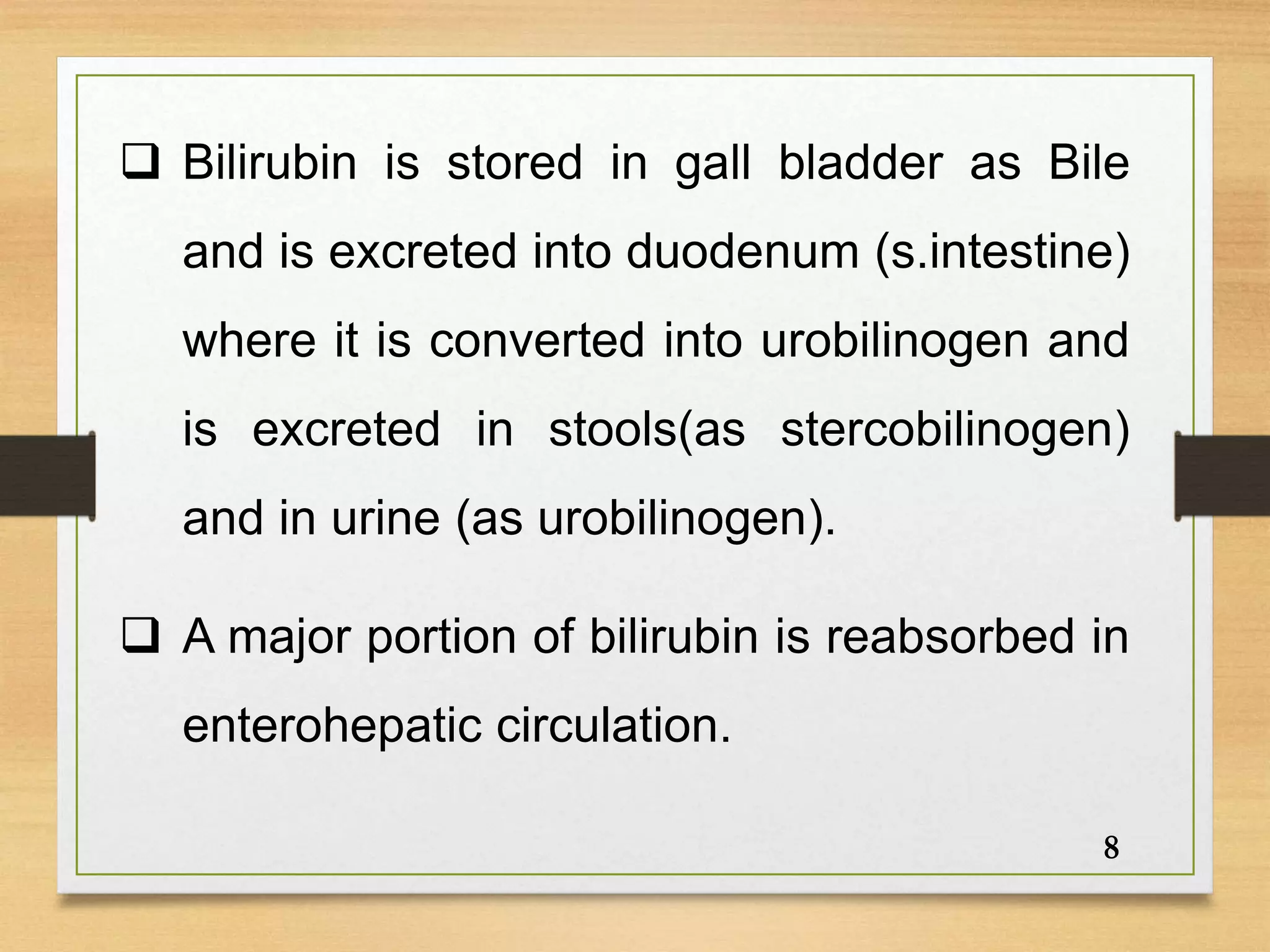
 Bilirubin is stored in gall bladder as Bile
and is excreted into duodenum (s.intestine)
where it is converted into urobilinogen and
is excreted in stools(as stercobilinogen)
and in urine (as urobilinogen).
 A major portion of bilirubin is reabsorbed in
enterohepatic circulation.
8
Test Normal Values
Total Bilirubin 0.3 – 1.0 mg/dl
Conjugated B. (DB) < 0.3 mg/dl
Alkaline Phosphatase 30 – 120 mg/dl
Aspartate Transaminase (AST/SGOT) 5 – 40 IU/L
Alanine Transaminase (ALT/SGPT) 5 – 35 IU/L
S. Albumin 3.5 – 5.0 g/dl
S. Globulin 2.0 – 3.5 g/dl
A/G ratio 1.2 – 1.5
Prothrombin Time 12 – 15 sec
9
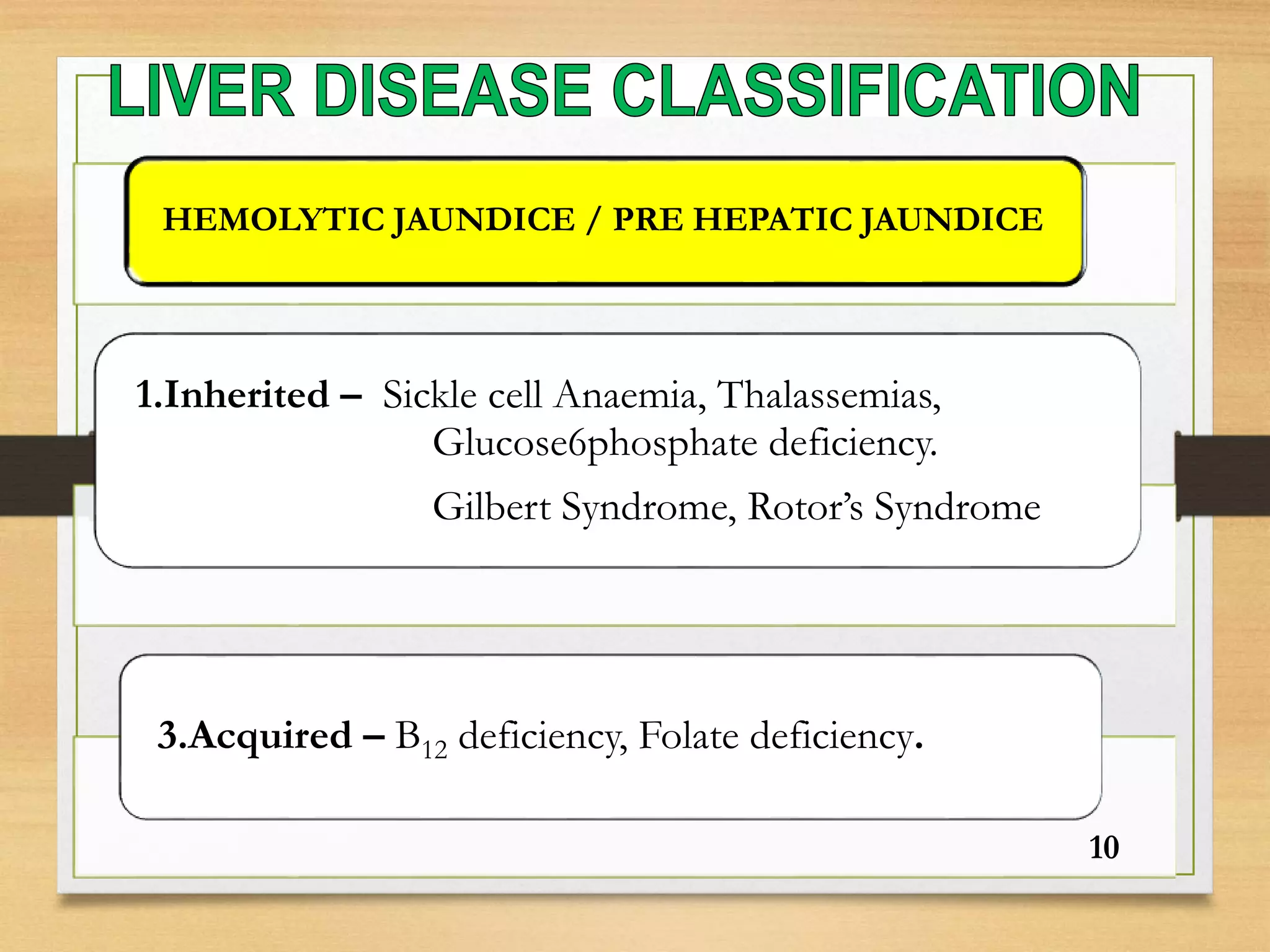
HEMOLYTIC JAUNDICE / PRE HEPATIC JAUNDICE
1.Inherited – Sickle cell Anaemia, Thalassemias,
Glucose6phosphate deficiency.
Gilbert Syndrome, Rotor’s Syndrome
3.Acquired – B12 deficiency, Folate deficiency.
10
HEPATOCELLULAR JAUNDICE / HEPATIC JAUNDICE
1.Viral Hepatitis – A, B, C, D, E
2.Parasitic Hepatitis – E. Histolytica
3.Autoimmune Hepatitis
4.Toxic Hepatitis – Drugs, Alcohol
11
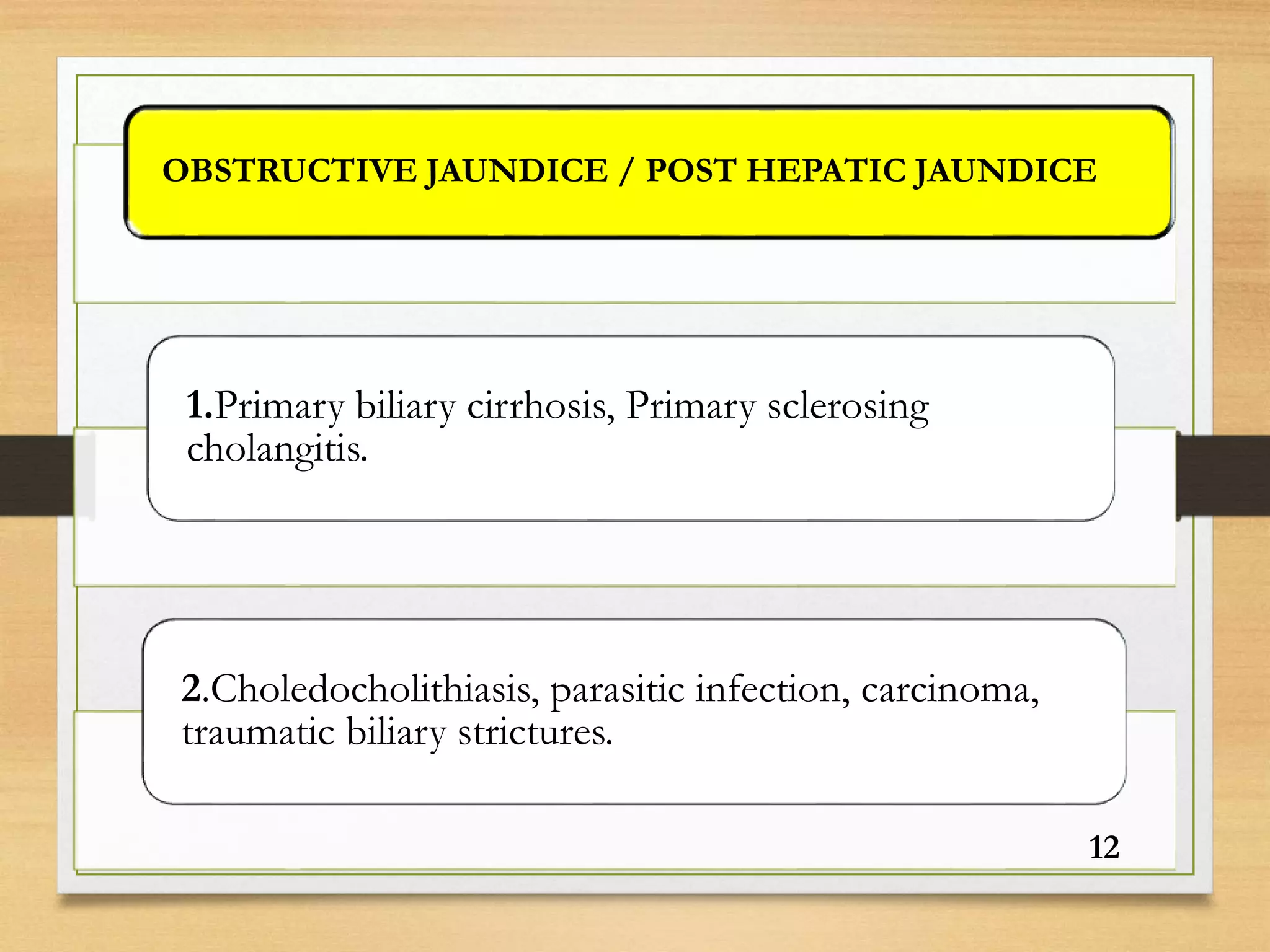
OBSTRUCTIVE JAUNDICE / POST HEPATIC JAUNDICE
1.Primary biliary cirrhosis, Primary sclerosing
cholangitis.
2.Choledocholithiasis, parasitic infection, carcinoma,
traumatic biliary strictures.
12
PRE HEPATIC/
HEMOLYTIC JAUNDICE
Clinical
Features
Abdominal pain Only present in Crisis
Itching Absent
Past history
Drugs, Blood
transfusion
On
Examination
Icterus - color Lemon yellow
Pallor Present
Palpable gall bladder Absent
Splenomegaly Present
Bleeding tendency Absent 13
PRE HEPATIC/
HEMOLYTIC JAUNDICE
Liver
Function
Tests
Unconjugated/
Indirect Bilirubin
Raised
Conjugated/Direct Normal
AST or ALT Normal
A:G A>G (N)
Alkaline phos.& GGT Normal
Bile Salts & Bile Pigments Absent
14
Often associated with Pandu (Anaemia)
Pitta kara ahara & vihara leading to dagdhata of pitta
asrik & mamsa.
Chronic & slow onset.
Haridra Netra Twak Nakhaanana
Raktha Peeta Shakrit Mootra
Bheka Varna, Krusha & Durbala
Indriya daurbalya
Daha ,Aruchi Avipaaka,
Clinical Features
15
Total Bilirubin ranges btw 4-6 mg/dl
Usually Unconjugated B. > Conjugated B.
Here liver enzymes may not be affected.
Bile Salts & Bile Pigments are absent in urine.
As Pandu is associated = Complete Blood picture required.
16
Mridu Shodhana
(Virechana)
Shamana Rx
17
 Samsarjana krama (3 – 5 days)
 Pathya Sevana & continuation with Shamana aushadhi.
 Snehapana for a max of 3 - 4 days with
 Mahatiktaka gritha
 Kalyanaka gritha
 Panchagavya gritha
 Indukantha gritha
 Vishrama kala – 3 days (Ushanajala snana for swedana)
 Virechana karma with
 Trivrut lehya ( 30gms) + Draksa / Triphala kashaya
 Manibhadra guda ( 30gms )
 Katuki churna ( 10gms )
18
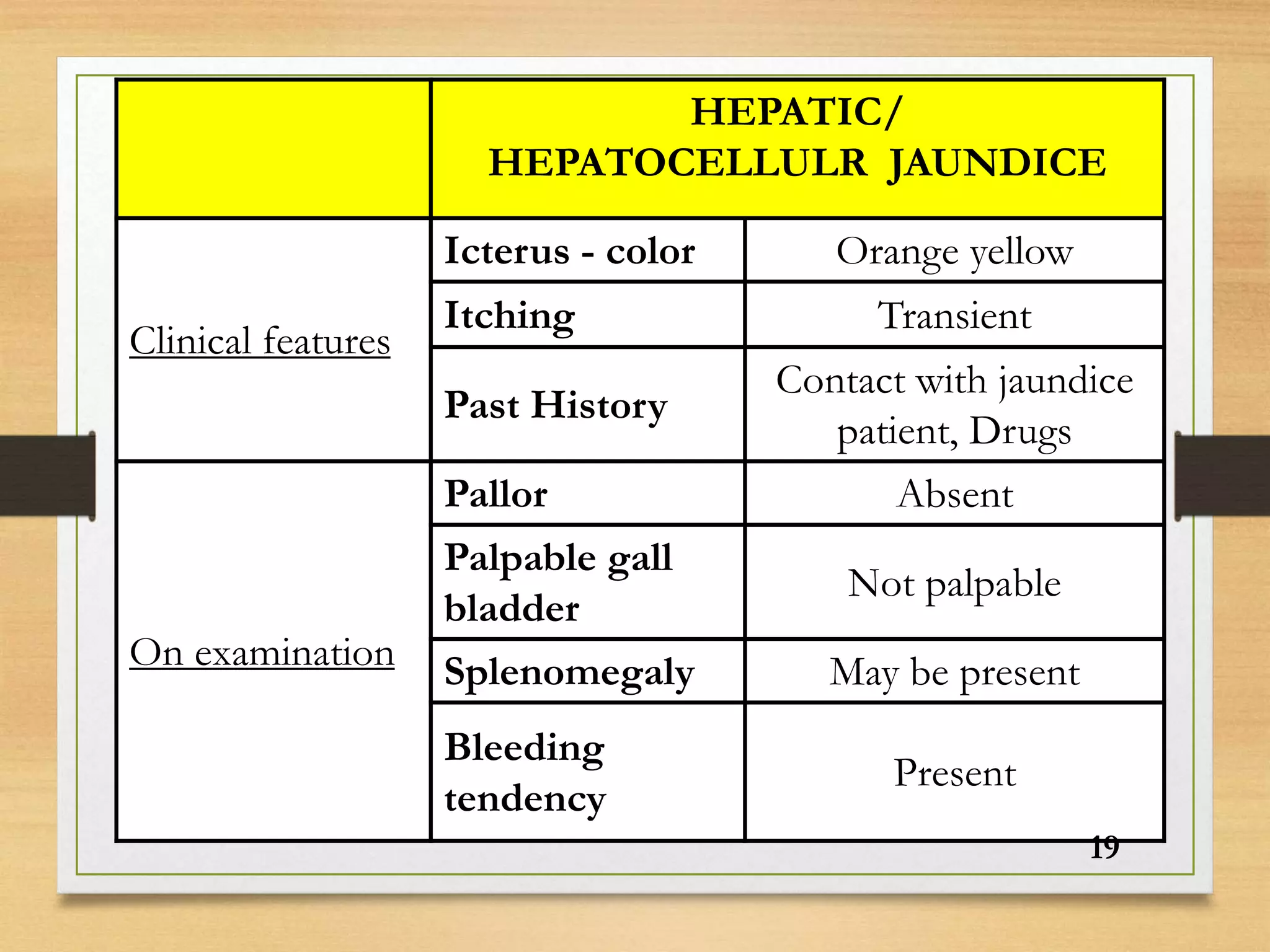
HEPATIC/
HEPATOCELLULR JAUNDICE
Clinical features
Icterus - color Orange yellow
Itching Transient
Past History
Contact with jaundice
patient, Drugs
On examination
Pallor Absent
Palpable gall
bladder
Not palpable
Splenomegaly May be present
Bleeding
tendency
Present
19
HEPATIC/
HEPATOCELLULR JAUNDICE
Liver
Function
Test
Unconjugated/
Indirect Bilirubin
Normal
Conjugated/Direct Increased
AST or ALT Markedly Raised
ALP & GGT Normal
A:G G>A (Chronic diseases)
Bile Salts & Bile Pigments Present
20
 Haridra Netra Mutra Twak
 Tila Pista Nibha Varchas
 Jwara. Aruchi
 Alpa Agni, Atopa
 Hrut Gaurava
 Daurbalya
 Hikka,Swaasa
• Acute in onset.
• Ashayapakarshaka hetu
Clinical Features
21
AST & ALT is raised in hepato - cellular
conditions/infective hepatitis.
ALT is generally greater raised than AST.
Usually ALP is raised in cholestatic/malignant
infiltrations
Usually Conjugated B. > Unconjugated B.
Bile Salts & Bile Pigments are present
Serological testing needed for – Hepatitis A, B, C, D, E
22
AST & ALT is raised in Alcoholic Hepatitis.
AST is greater raised than ALT.
Usually ALP is raised.
Usually Conjugated B. > Unconjugated B.
Albumin : Globulin ratio reversed
GGT is raised and is important marker of alcoholic
hepatitis.
23
Kaphahara chikitsa
Mridu Shodhana
(Virechana)
Shamana chikitsa
24
Kaphahara chikitsa
Katu, Teekshna, Ushna, Lavana, Amla Rasa
Pradhana dravyas like
 Kulattha yusha, Mulaka yusha
 Lemon juice + maricha (long & black) + Ardraka
swarasa with madhu
 Trikatu choorna with Madhu/Ardraka swrasa
25
Once the Mala Ranjana occurs
 Swasthaanam Aagatam Pittam
(Bile Pigments & Bile Salts Negative)
 Vayuscha Prashamam Bhavet
 Nivrutha Upadrava- jwara, atopa, vistamba,
hrit gaurva, daurbhalya, alpagni, aruchi.
Go for Mridu Shodana
26
Mridu Shodana
 Snehana
 Mrudu Abhyanga & Usna Jala Snana
 Virechana Yogas like Gomutra Hareetaki
 Samsarjana Krama
 Pathya sevana
 Continuation of the Shamana till vyadhi shamana.
27
POSTHEPATIC /
OBSTRUCTIVE JAUNDICE
Clinical features
Icterus - color Greenish yellow
Itching Present
Past History
Pain(stones), weight
loss(neoplasm, surgery
(strictures)
On examination
Pallor Absent
Palpable gall
bladder
Palpable
Splenomegaly Absent
Bleeding
tendency
Absent
28
POSTHEPATIC /
OBSTRUCTIVE JAUNDICE
Liver
Function
Test
Unconjugated/
Indirect Bilirubin
Normal
Conjugated/Direct Increased
AST or ALT Increased
ALP & GGT Markedly increased
A:G G>A (Chronic diseases)
Bile Salts & Bile Pigments Present
29
 Common causes for Post hepatic
jaundice/obstructive jaundice are choledocholithiasis,
biliary strictures, tumors and after LFT, USG
abdomen is the usual choice of investigation.
 It is managed surgically.
30
Kalantarat kharibhoota
Shoona/ Shootha
Krishna peeta shakrit mootra, Rakta netra
Tandra, Moha
Aruchi, Nashtagni
Advanced liver diseases like cirrhosis,
encephalopathy etc has similar signs & symptoms as
that of Kumbhakamala like oedema, ascites, mental
confusions, coma, anorexia etc
31
 False positive
 False negative
 Rarely suggest a specific diagnosis
 Assess limited number of functions
 One testing = no diagnosis
 Misnomer
 Battery testing
 Repeated testing
32
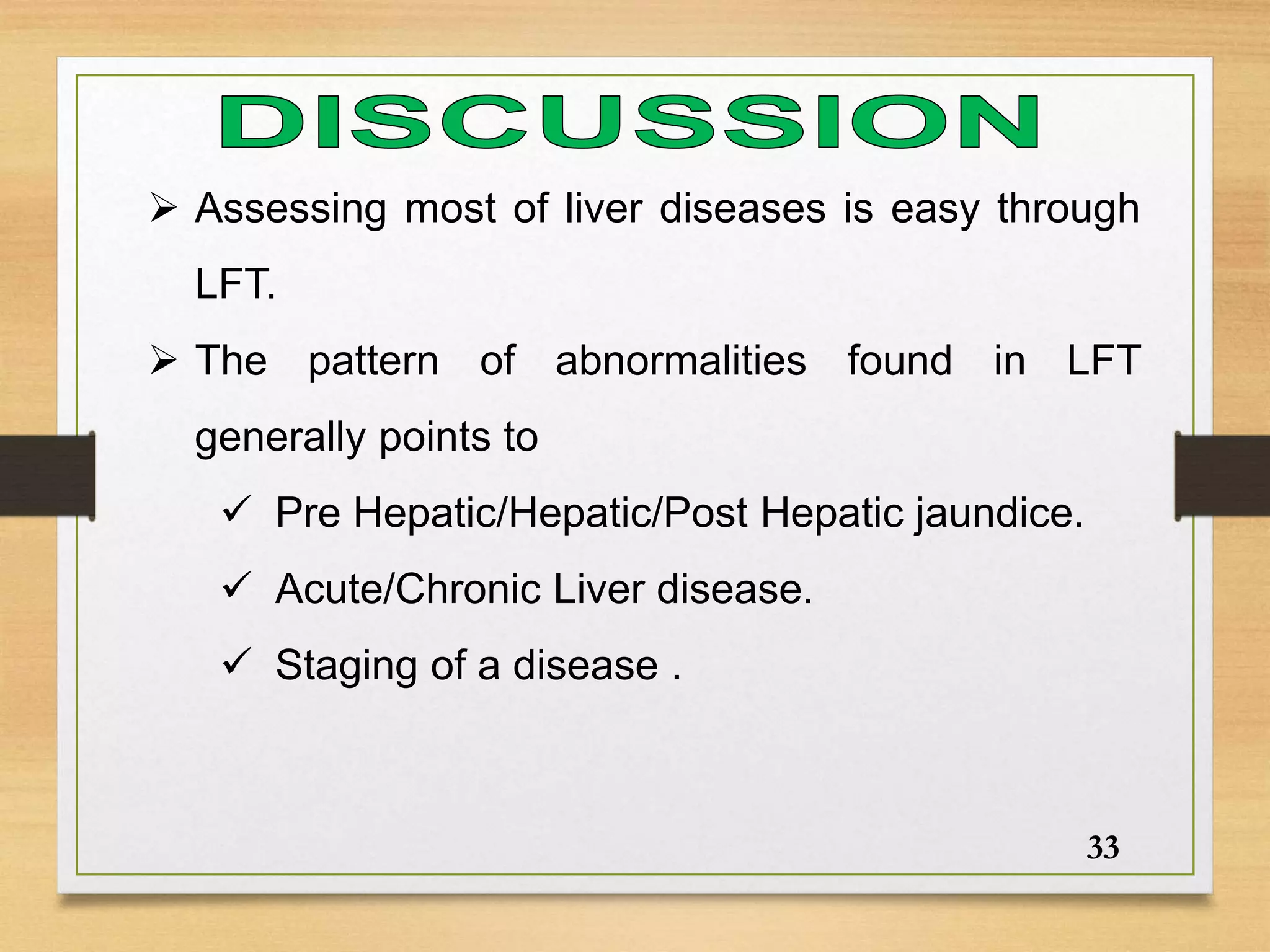
 Assessing most of liver diseases is easy through
LFT.
 The pattern of abnormalities found in LFT
generally points to
 Pre Hepatic/Hepatic/Post Hepatic jaundice.
 Acute/Chronic Liver disease.
 Staging of a disease .
33
 Despite of bahupaittika nature of the
koshtashakhasrita kamala, the amount of
pitta/bilirubin that comes to settle in shakha/skin
and conjunctiva is far minimal. Therefore it
becomes reasonable to interpret and treat the
conditions associated with haemolytic jaundice on
the lines of koshtashakhasrita kamala where
pandu/anaemia is the pre stage for it.
34
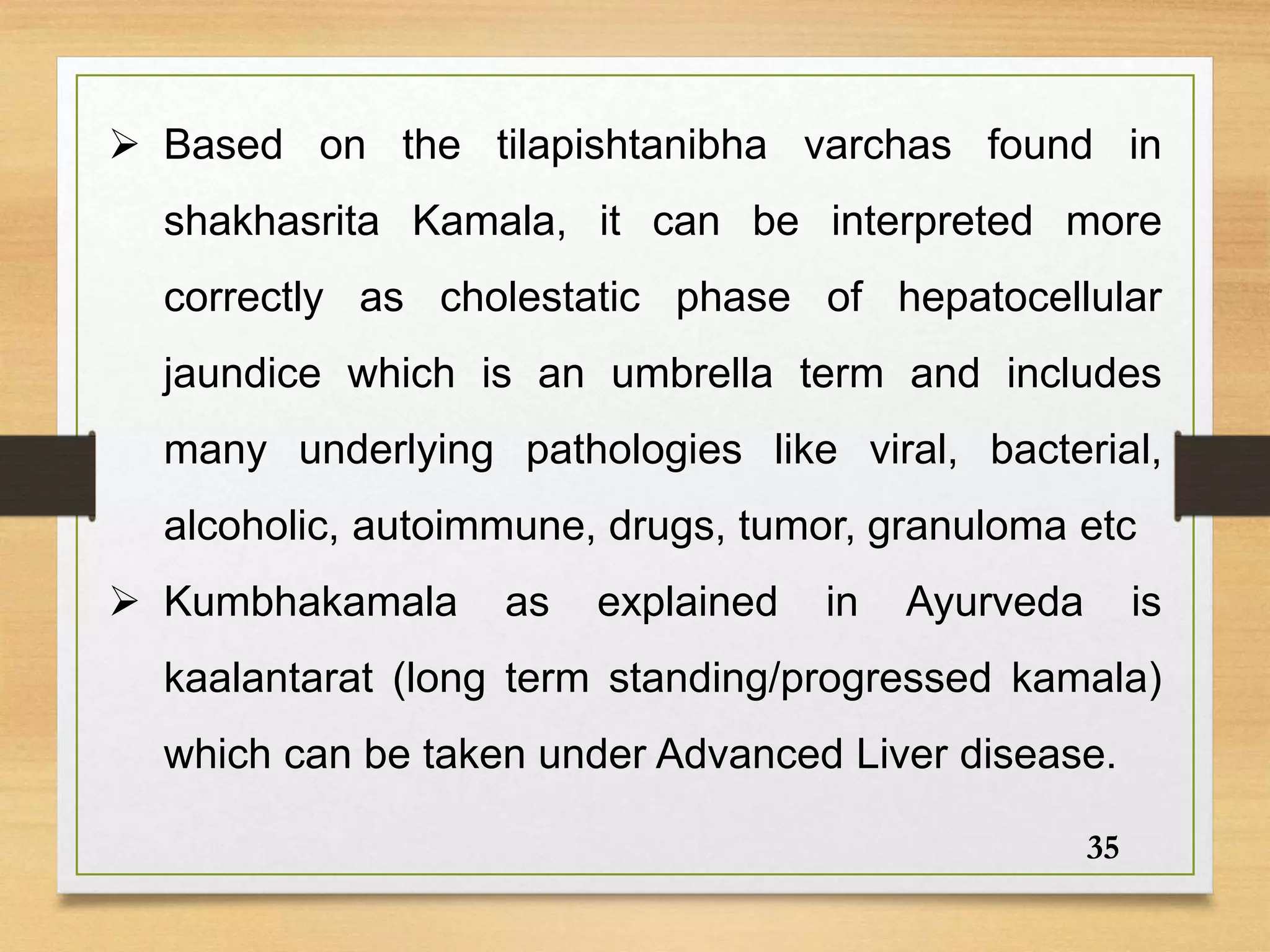
 Based on the tilapishtanibha varchas found in
shakhasrita Kamala, it can be interpreted more
correctly as cholestatic phase of hepatocellular
jaundice which is an umbrella term and includes
many underlying pathologies like viral, bacterial,
alcoholic, autoimmune, drugs, tumor, granuloma etc
 Kumbhakamala as explained in Ayurveda is
kaalantarat (long term standing/progressed kamala)
which can be taken under Advanced Liver disease.
35
 Based on LFT, nidana & samprapti can be better
understood and vighatana can be planned
accordingly.
 LFT are very important as a documentation part to
assess the disease progression or regression.
36
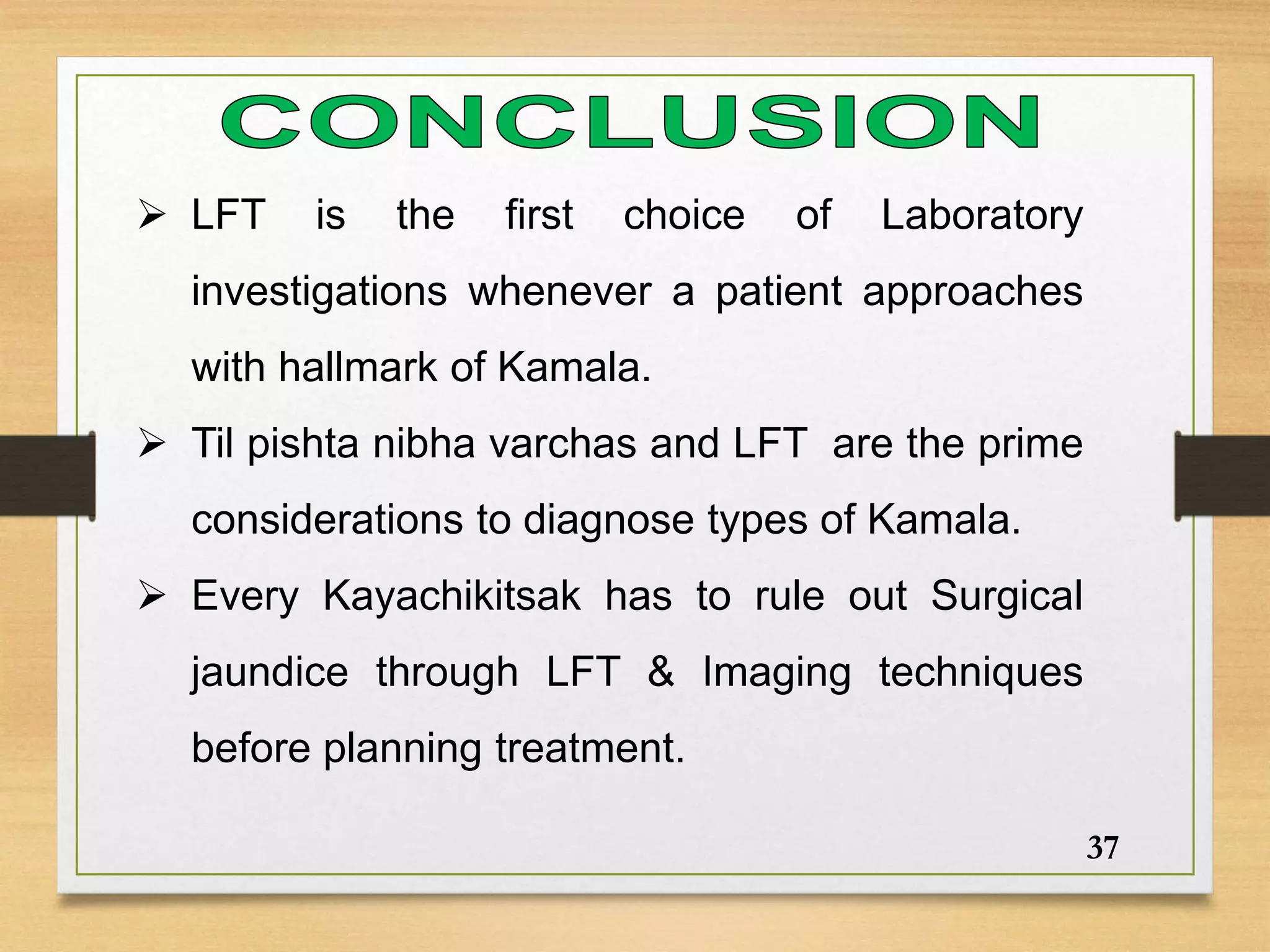
 LFT is the first choice of Laboratory
investigations whenever a patient approaches
with hallmark of Kamala.
 Til pishta nibha varchas and LFT are the prime
considerations to diagnose types of Kamala.
 Every Kayachikitsak has to rule out Surgical
jaundice through LFT & Imaging techniques
before planning treatment.
37
38
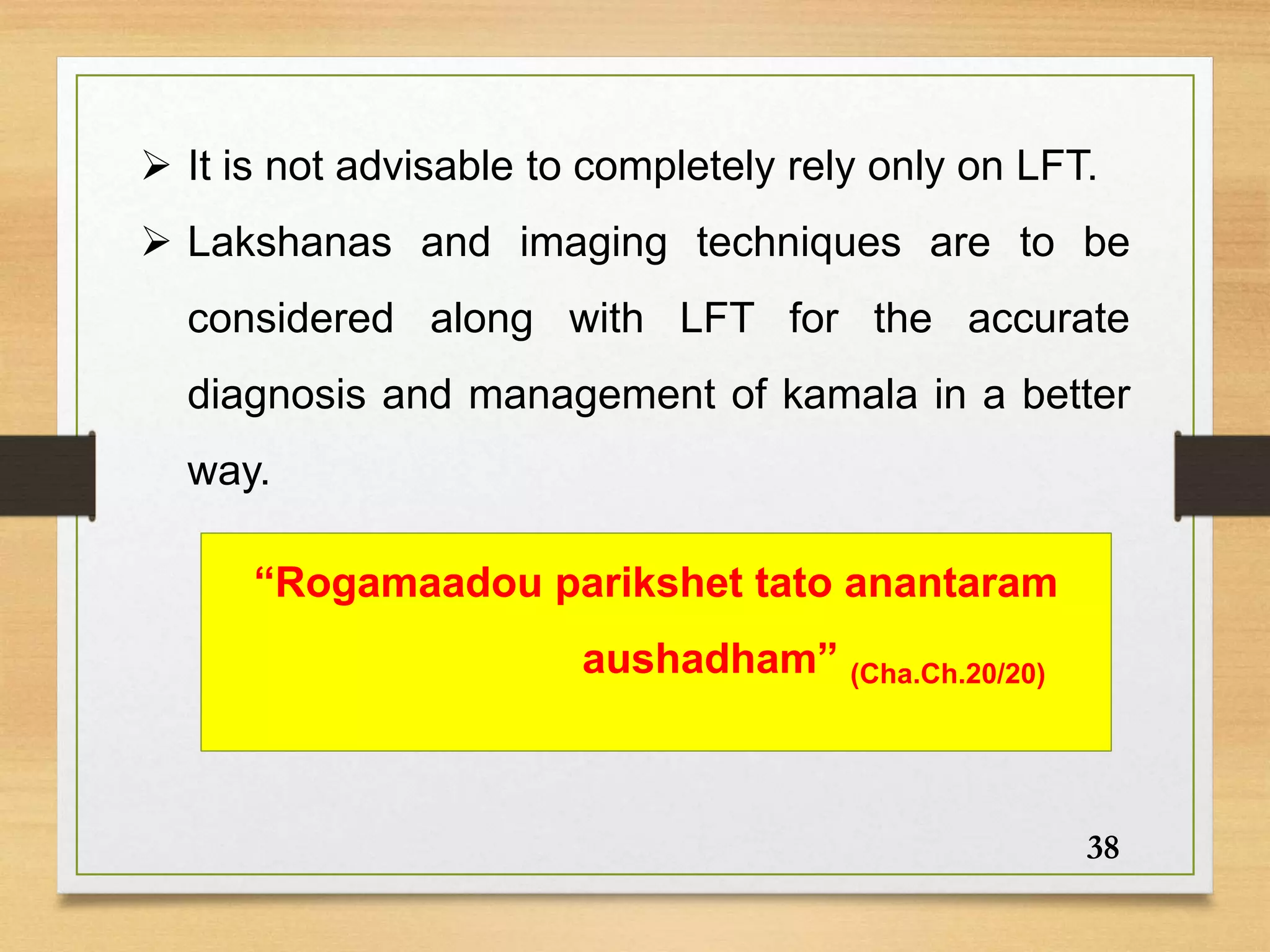
 It is not advisable to completely rely only on LFT.
 Lakshanas and imaging techniques are to be
considered along with LFT for the accurate
diagnosis and management of kamala in a better
way.
“Rogamaadou parikshet tato anantaram
aushadham” (Cha.Ch.20/20)
THANK YOU39

understanding LFT in the diagnosis and management of kamala

  • 1.
    Understanding Liver Function Tests indiagnosis and management of Kamala KAMAL KISHORE Post Graduate Scholar Dept. of PG studies in Kayachiktsa SKAMCH&RC Bangalore0
  • 2.
    Contents • Introduction • Functionsof Liver • Liver Function Tests • Liver Disease Classification • Pre Hepatic Jaundice • Koshtashakhasrita Kamala • LFT in Koshtashakhasrita Kamala 1
  • 3.
    2 • Management ofKoshtashakhasrita Kamala • Hepatic Jaundice • Shakhasrita Kamala • LFT in Shakhasrita Kamala • Alcoholic Liver Disease • Management of Shakhasrita Kamala • Post hepatic jaundice • Ruddhapatha kamala • Kumbhakamala • Limitations of LFT • Discussion • Conclusion
  • 4.
     The liveris the second largest organ in the body which plays central role in the digestion & metabolism of proteins, carbohydrates & lipids.  The disease of the liver are a major cause for the morbidity & mortality worldwide.  One in forty deaths are due to liver diseases.3
  • 5.
     Liver functiontests (LFTs) are group of blood tests that give information about the state of a patient's liver.  These tests can be used to detect the presence of liver disease, distinguish among different types of liver disorders, gauge the extent of known liver damage, and follow the response to treatment. 4
  • 6.
     Most ofthe liver diseases cause only mild symptoms initially, but these diseases must be detected early  Jaundice is a clinical sign of most of the liver diseases.  Medical Jaundice refers to any type of Jaundice that can be managed by non- surgical conservative measures. 5
  • 7.
     The liverdisorders are seen in Ayurveda mainly through the windows of Kamala. 6
  • 8.
     Liver ismainly responsible for the production of bile (Bilirubin) and synthesis of serum proteins (Albumin & Globulin).  Breakdown of RBC in spleen leads to unconjugated bilirubin production which is transported to liver through blood where it is converted to conjugated bilirubin. 7
  • 9.
     Bilirubin isstored in gall bladder as Bile and is excreted into duodenum (s.intestine) where it is converted into urobilinogen and is excreted in stools(as stercobilinogen) and in urine (as urobilinogen).  A major portion of bilirubin is reabsorbed in enterohepatic circulation. 8
  • 10.
    Test Normal Values TotalBilirubin 0.3 – 1.0 mg/dl Conjugated B. (DB) < 0.3 mg/dl Alkaline Phosphatase 30 – 120 mg/dl Aspartate Transaminase (AST/SGOT) 5 – 40 IU/L Alanine Transaminase (ALT/SGPT) 5 – 35 IU/L S. Albumin 3.5 – 5.0 g/dl S. Globulin 2.0 – 3.5 g/dl A/G ratio 1.2 – 1.5 Prothrombin Time 12 – 15 sec 9
  • 11.
    HEMOLYTIC JAUNDICE /PRE HEPATIC JAUNDICE 1.Inherited – Sickle cell Anaemia, Thalassemias, Glucose6phosphate deficiency. Gilbert Syndrome, Rotor’s Syndrome 3.Acquired – B12 deficiency, Folate deficiency. 10
  • 12.
    HEPATOCELLULAR JAUNDICE /HEPATIC JAUNDICE 1.Viral Hepatitis – A, B, C, D, E 2.Parasitic Hepatitis – E. Histolytica 3.Autoimmune Hepatitis 4.Toxic Hepatitis – Drugs, Alcohol 11
  • 13.
    OBSTRUCTIVE JAUNDICE /POST HEPATIC JAUNDICE 1.Primary biliary cirrhosis, Primary sclerosing cholangitis. 2.Choledocholithiasis, parasitic infection, carcinoma, traumatic biliary strictures. 12
  • 14.
    PRE HEPATIC/ HEMOLYTIC JAUNDICE Clinical Features Abdominalpain Only present in Crisis Itching Absent Past history Drugs, Blood transfusion On Examination Icterus - color Lemon yellow Pallor Present Palpable gall bladder Absent Splenomegaly Present Bleeding tendency Absent 13
  • 15.
    PRE HEPATIC/ HEMOLYTIC JAUNDICE Liver Function Tests Unconjugated/ IndirectBilirubin Raised Conjugated/Direct Normal AST or ALT Normal A:G A>G (N) Alkaline phos.& GGT Normal Bile Salts & Bile Pigments Absent 14
  • 16.
    Often associated withPandu (Anaemia) Pitta kara ahara & vihara leading to dagdhata of pitta asrik & mamsa. Chronic & slow onset. Haridra Netra Twak Nakhaanana Raktha Peeta Shakrit Mootra Bheka Varna, Krusha & Durbala Indriya daurbalya Daha ,Aruchi Avipaaka, Clinical Features 15
  • 17.
    Total Bilirubin rangesbtw 4-6 mg/dl Usually Unconjugated B. > Conjugated B. Here liver enzymes may not be affected. Bile Salts & Bile Pigments are absent in urine. As Pandu is associated = Complete Blood picture required. 16
  • 18.
  • 19.
     Samsarjana krama(3 – 5 days)  Pathya Sevana & continuation with Shamana aushadhi.  Snehapana for a max of 3 - 4 days with  Mahatiktaka gritha  Kalyanaka gritha  Panchagavya gritha  Indukantha gritha  Vishrama kala – 3 days (Ushanajala snana for swedana)  Virechana karma with  Trivrut lehya ( 30gms) + Draksa / Triphala kashaya  Manibhadra guda ( 30gms )  Katuki churna ( 10gms ) 18
  • 20.
    HEPATIC/ HEPATOCELLULR JAUNDICE Clinical features Icterus- color Orange yellow Itching Transient Past History Contact with jaundice patient, Drugs On examination Pallor Absent Palpable gall bladder Not palpable Splenomegaly May be present Bleeding tendency Present 19
  • 21.
    HEPATIC/ HEPATOCELLULR JAUNDICE Liver Function Test Unconjugated/ Indirect Bilirubin Normal Conjugated/DirectIncreased AST or ALT Markedly Raised ALP & GGT Normal A:G G>A (Chronic diseases) Bile Salts & Bile Pigments Present 20
  • 22.
     Haridra NetraMutra Twak  Tila Pista Nibha Varchas  Jwara. Aruchi  Alpa Agni, Atopa  Hrut Gaurava  Daurbalya  Hikka,Swaasa • Acute in onset. • Ashayapakarshaka hetu Clinical Features 21
  • 23.
    AST & ALTis raised in hepato - cellular conditions/infective hepatitis. ALT is generally greater raised than AST. Usually ALP is raised in cholestatic/malignant infiltrations Usually Conjugated B. > Unconjugated B. Bile Salts & Bile Pigments are present Serological testing needed for – Hepatitis A, B, C, D, E 22
  • 24.
    AST & ALTis raised in Alcoholic Hepatitis. AST is greater raised than ALT. Usually ALP is raised. Usually Conjugated B. > Unconjugated B. Albumin : Globulin ratio reversed GGT is raised and is important marker of alcoholic hepatitis. 23
  • 25.
  • 26.
    Kaphahara chikitsa Katu, Teekshna,Ushna, Lavana, Amla Rasa Pradhana dravyas like  Kulattha yusha, Mulaka yusha  Lemon juice + maricha (long & black) + Ardraka swarasa with madhu  Trikatu choorna with Madhu/Ardraka swrasa 25
  • 27.
    Once the MalaRanjana occurs  Swasthaanam Aagatam Pittam (Bile Pigments & Bile Salts Negative)  Vayuscha Prashamam Bhavet  Nivrutha Upadrava- jwara, atopa, vistamba, hrit gaurva, daurbhalya, alpagni, aruchi. Go for Mridu Shodana 26
  • 28.
    Mridu Shodana  Snehana Mrudu Abhyanga & Usna Jala Snana  Virechana Yogas like Gomutra Hareetaki  Samsarjana Krama  Pathya sevana  Continuation of the Shamana till vyadhi shamana. 27
  • 29.
    POSTHEPATIC / OBSTRUCTIVE JAUNDICE Clinicalfeatures Icterus - color Greenish yellow Itching Present Past History Pain(stones), weight loss(neoplasm, surgery (strictures) On examination Pallor Absent Palpable gall bladder Palpable Splenomegaly Absent Bleeding tendency Absent 28
  • 30.
    POSTHEPATIC / OBSTRUCTIVE JAUNDICE Liver Function Test Unconjugated/ IndirectBilirubin Normal Conjugated/Direct Increased AST or ALT Increased ALP & GGT Markedly increased A:G G>A (Chronic diseases) Bile Salts & Bile Pigments Present 29
  • 31.
     Common causesfor Post hepatic jaundice/obstructive jaundice are choledocholithiasis, biliary strictures, tumors and after LFT, USG abdomen is the usual choice of investigation.  It is managed surgically. 30
  • 32.
    Kalantarat kharibhoota Shoona/ Shootha Krishnapeeta shakrit mootra, Rakta netra Tandra, Moha Aruchi, Nashtagni Advanced liver diseases like cirrhosis, encephalopathy etc has similar signs & symptoms as that of Kumbhakamala like oedema, ascites, mental confusions, coma, anorexia etc 31
  • 33.
     False positive False negative  Rarely suggest a specific diagnosis  Assess limited number of functions  One testing = no diagnosis  Misnomer  Battery testing  Repeated testing 32
  • 34.
     Assessing mostof liver diseases is easy through LFT.  The pattern of abnormalities found in LFT generally points to  Pre Hepatic/Hepatic/Post Hepatic jaundice.  Acute/Chronic Liver disease.  Staging of a disease . 33
  • 35.
     Despite ofbahupaittika nature of the koshtashakhasrita kamala, the amount of pitta/bilirubin that comes to settle in shakha/skin and conjunctiva is far minimal. Therefore it becomes reasonable to interpret and treat the conditions associated with haemolytic jaundice on the lines of koshtashakhasrita kamala where pandu/anaemia is the pre stage for it. 34
  • 36.
     Based onthe tilapishtanibha varchas found in shakhasrita Kamala, it can be interpreted more correctly as cholestatic phase of hepatocellular jaundice which is an umbrella term and includes many underlying pathologies like viral, bacterial, alcoholic, autoimmune, drugs, tumor, granuloma etc  Kumbhakamala as explained in Ayurveda is kaalantarat (long term standing/progressed kamala) which can be taken under Advanced Liver disease. 35
  • 37.
     Based onLFT, nidana & samprapti can be better understood and vighatana can be planned accordingly.  LFT are very important as a documentation part to assess the disease progression or regression. 36
  • 38.
     LFT isthe first choice of Laboratory investigations whenever a patient approaches with hallmark of Kamala.  Til pishta nibha varchas and LFT are the prime considerations to diagnose types of Kamala.  Every Kayachikitsak has to rule out Surgical jaundice through LFT & Imaging techniques before planning treatment. 37
  • 39.
    38  It isnot advisable to completely rely only on LFT.  Lakshanas and imaging techniques are to be considered along with LFT for the accurate diagnosis and management of kamala in a better way. “Rogamaadou parikshet tato anantaram aushadham” (Cha.Ch.20/20)
  • 40.

Editor's Notes

  • #35 (Higher S.bilirubin = greater hepatocellular damage in viral hepatitis )
  • #36 (Higher S.bilirubin = greater hepatocellular damage in viral hepatitis )
  • #38 (Higher S.bilirubin = greater hepatocellular damage in viral hepatitis )