VATA DOSHA BHEDA
D r. A n i k e t A n i l S h i l w a n t
BAMS, MD (Ayurveda Physiology)
ayuraniket18@gmail.com
TABLE OF CONTENTS
1 . P R A N A VAY U
2 . U D A N A VAY U
3 . V YA N A VAY U
4 . S A M A N A VAY U
5 . A PA N A VAY U
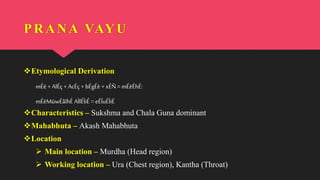
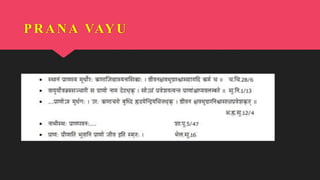
PRANA VAYU
Etymological Derivation
mÉë +AlÉç +AcÉç + bÉgÉè +xÉÑ= mÉëÉhÉ:
mÉëMüwÉåïhÉ AÌlÉÌiÉ = eÉÏuÉÌiÉ
Characteristics – Sukshma and Chala Guna dominant
Mahabhuta – Akash Mahabhuta
Location
 Main location – Murdha (Head region)
 Working location – Ura (Chest region), Kantha (Throat)
PRANA VAYU
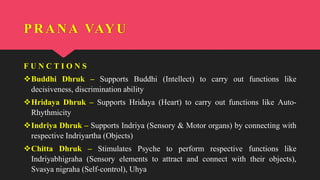
F U N C T I O N S
Buddhi Dhruk – Supports Buddhi (Intellect) to carry out functions like
decisiveness, discrimination ability
Hridaya Dhruk – Supports Hridaya (Heart) to carry out functions like Auto-
Rhythmicity
Indriya Dhruk – Supports Indriya (Sensory & Motor organs) by connecting with
respective Indriyartha (Objects)
Chitta Dhruk – Stimulates Psyche to perform respective functions like
Indriyabhigraha (Sensory elements to attract and connect with their objects),
Svasya nigraha (Self-control), Uhya
PRANA VAYU
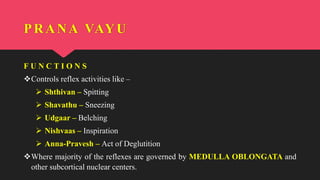
F U N C T I O N S
Controls reflex activities like –
 Shthivan – Spitting
 Shavathu – Sneezing
 Udgaar – Belching
 Nishvaas – Inspiration
 Anna-Pravesh – Act of Deglutition
Where majority of the reflexes are governed by MEDULLA OBLONGATA and
other subcortical nuclear centers.
PRANA VAYU
M O D E R N P H Y S I O L O G I C A L U N D E R S T A N D I N G O F
F U N C T I O N S
 Intelligence, Cognitive ability
 Auto rhythmicity, properties associated with conductive system of Heart
 Excitability, Nerve impulse transmission
 Emotional stability
 Reflex actions – Spitting, Sneezing, Belching, Vomiting, Hiccoughing, etc.
 Act of Deglutition, Peristalsis, Cephalic phase of Digestion
PRANA VAYU
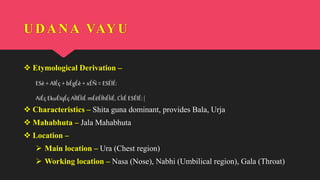
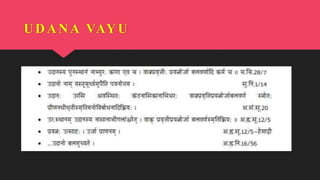
 Etymological Derivation –
ESè +AlÉç +bÉgÉè + xÉÑ= ESÉlÉ:
AiÉç EkuÉïqÉç AÌlÉÌiÉ mÉëÉÍhÉÌiÉ, CÌiÉ ESÉlÉ: |
 Characteristics – Shita guna dominant, provides Bala, Urja
 Mahabhuta – Jala Mahabhuta
 Location –
 Main location – Ura (Chest region)
 Working location – Nasa (Nose), Nabhi (Umbilical region), Gala (Throat)
UDANA VAYU
UDANA VAYU
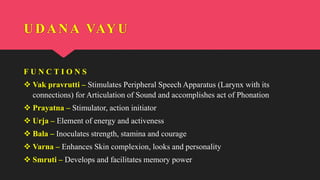
F U N C T I O N S
 Vak pravrutti – Stimulates Peripheral Speech Apparatus (Larynx with its
connections) for Articulation of Sound and accomplishes act of Phonation
 Prayatna – Stimulator, action initiator
 Urja – Element of energy and activeness
 Bala – Inoculates strength, stamina and courage
 Varna – Enhances Skin complexion, looks and personality
 Smruti – Develops and facilitates memory power
UDANA VAYU
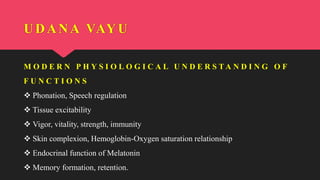
M O D E R N P H Y S I O L O G I C A L U N D E R S T A N D I N G O F
F U N C T I O N S
 Phonation, Speech regulation
 Tissue excitability
 Vigor, vitality, strength, immunity
 Skin complexion, Hemoglobin-Oxygen saturation relationship
 Endocrinal function of Melatonin
 Memory formation, retention.
UDANA VAYU
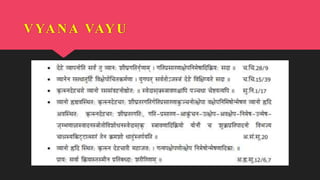
VYANA VAYU
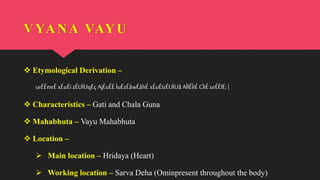
 Etymological Derivation –
urÉÉmrÉ xÉuÉï zÉUÏUqÉç AjÉuÉÉ ÌuÉzÉåwÉåhÉ xÉuÉïzÉUÏUå AÌlÉÌiÉ CÌiÉ urÉÉlÉ: |
 Characteristics – Gati and Chala Guna
 Mahabhuta – Vayu Mahabhuta
 Location –
 Main location – Hridaya (Heart)
 Working location – Sarva Deha (Ominpresent throughout the body)
VYANA VAYU
VYANA VAYU
F U N C T I O N S
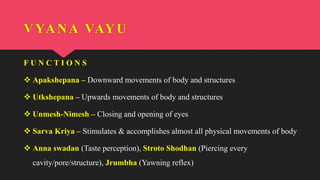
 Apakshepana – Downward movements of body and structures
 Utkshepana – Upwards movements of body and structures
 Unmesh-Nimesh – Closing and opening of eyes
 Sarva Kriya – Stimulates & accomplishes almost all physical movements of body
 Anna swadan (Taste perception), Stroto Shodhan (Piercing every
cavity/pore/structure), Jrumbha (Yawning reflex)
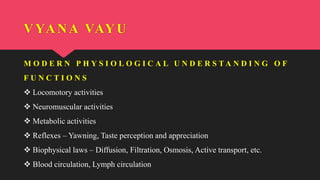
M O D E R N P H Y S I O L O G I C A L U N D E R S T A N D I N G O F
F U N C T I O N S
 Locomotory activities
 Neuromuscular activities
 Metabolic activities
 Reflexes – Yawning, Taste perception and appreciation
 Biophysical laws – Diffusion, Filtration, Osmosis, Active transport, etc.
 Blood circulation, Lymph circulation
VYANA VAYU
SAMANA VAYU
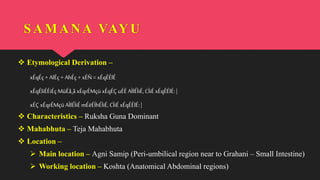
 Etymological Derivation –
xÉqÉç + AlÉç + AhÉç + xÉÑ= xÉqÉÉlÉ
xÉqÉliÉÉiÉçMüÉå¸å xÉqrÉMçü xÉqÉÇ uÉÉ AÌlÉÌiÉ,CÌiÉxÉqÉÉlÉ:|
xÉÇxÉqrÉMçü AÌlÉÌiÉmÉëÉÍhÉÌiÉ,CÌiÉxÉqÉÉlÉ:|
 Characteristics – Ruksha Guna Dominant
 Mahabhuta – Teja Mahabhuta
 Location –
 Main location – Agni Samip (Peri-umbilical region near to Grahani – Small Intestine)
 Working location – Koshta (Anatomical Abdominal regions)
SAMANA VAYU
SAMANA VAYU
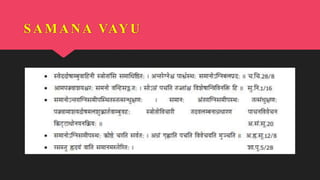
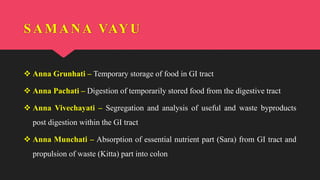
 Anna Grunhati – Temporary storage of food in GI tract
 Anna Pachati – Digestion of temporarily stored food from the digestive tract
 Anna Vivechayati – Segregation and analysis of useful and waste byproducts
post digestion within the GI tract
 Anna Munchati – Absorption of essential nutrient part (Sara) from GI tract and
propulsion of waste (Kitta) part into colon
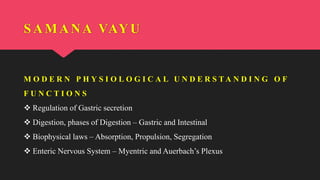
M O D E R N P H Y S I O L O G I C A L U N D E R S T A N D I N G O F
F U N C T I O N S
 Regulation of Gastric secretion
 Digestion, phases of Digestion – Gastric and Intestinal
 Biophysical laws – Absorption, Propulsion, Segregation
 Enteric Nervous System – Myentric and Auerbach’s Plexus
SAMANA VAYU
APANA VAYU
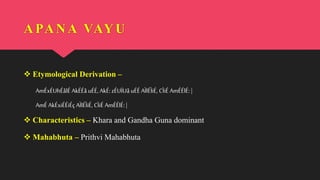
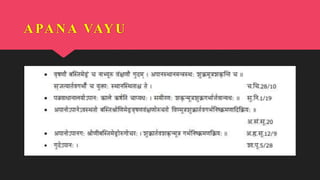
 Etymological Derivation –
AmÉxÉUhÉålÉ AkÉÉå uÉÉ, AkÉ: zÉUÏUå uÉÉ AÌlÉÌiÉ, CÌiÉ AmÉÉlÉ: |
AmÉ AkÉxiÉÉiÉç AÌlÉÌiÉ, CÌiÉ AmÉÉlÉ: |
 Characteristics – Khara and Gandha Guna dominant
 Mahabhuta – Prithvi Mahabhuta
APANA VAYU
APANA VAYU
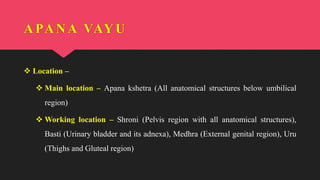
 Location –
 Main location – Apana kshetra (All anatomical structures below umbilical
region)
 Working location – Shroni (Pelvis region with all anatomical structures),
Basti (Urinary bladder and its adnexa), Medhra (External genital region), Uru
(Thighs and Gluteal region)
APANA VAYU
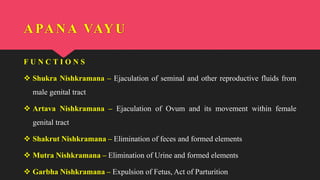
F U N C T I O N S
 Shukra Nishkramana – Ejaculation of seminal and other reproductive fluids from
male genital tract
 Artava Nishkramana – Ejaculation of Ovum and its movement within female
genital tract
 Shakrut Nishkramana – Elimination of feces and formed elements
 Mutra Nishkramana – Elimination of Urine and formed elements
 Garbha Nishkramana – Expulsion of Fetus, Act of Parturition
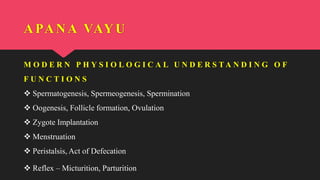
M O D E R N P H Y S I O L O G I C A L U N D E R S T A N D I N G O F
F U N C T I O N S
 Spermatogenesis, Spermeogenesis, Spermination
 Oogenesis, Follicle formation, Ovulation
 Zygote Implantation
 Menstruation
 Peristalsis, Act of Defecation
 Reflex – Micturition, Parturition
APANA VAYU
SUBTYPES OF VATA DOSHA
Name Guna Mahabhuta Location Function
Prana
Sukshma
Chala
Akash
Murdha – Head, Ura – Chest region,
Kantha – Throat
Buddhi-Hridaya-Indriya-Chitta dhruk
Shthivan, Shavathu, Udgar, Ni shvas,
Anna pravesh
Udana Shita Jala
Ura – Chest region, Nasa – Nose, Nabhi
– Umbilical region, Gala – Throat region
Vaka pravrutti, Prayatna, Urja, Bala,
Varna, Smruti
Vyana
Gati
Chala
Vayu
Hridaya – Heart, Sarva deha –
Omnipresent throughout body
Apakshepan, Utkshepan, Unmesh,
Nimesh, Sarva Chesta
Samana Ruksha Agni
Agni Samip – Lateral flanks of
Abdomen, Koshta – Entire GI tract
Anna Grunhati, Anna pachati, Anna
Vivechayati, Anna Munchati
Apana
Khara
Gandha
Prithvi
Shroni – Pelvis with all anatomical
structures, Basti – Urinary Bladder ,
Medhra – External genital organs , Uru
– Thighs & Gluteal region
Shukra-Artava-Shakrut-Mutra-
Garbha Nishkramana
Tha nk Yo u !!!
Dr. Aniket A. Shilwant
BAMS, MD (Ayurveda Physiology)
ayuraniket18@gmail.com

VATA DOSHA BHEDA.pptx

  • 1.
    VATA DOSHA BHEDA Dr. A n i k e t A n i l S h i l w a n t BAMS, MD (Ayurveda Physiology) ayuraniket18@gmail.com
  • 2.
    TABLE OF CONTENTS 1. P R A N A VAY U 2 . U D A N A VAY U 3 . V YA N A VAY U 4 . S A M A N A VAY U 5 . A PA N A VAY U
  • 3.
    PRANA VAYU Etymological Derivation mÉë+AlÉç +AcÉç + bÉgÉè +xÉÑ= mÉëÉhÉ: mÉëMüwÉåïhÉ AÌlÉÌiÉ = eÉÏuÉÌiÉ Characteristics – Sukshma and Chala Guna dominant Mahabhuta – Akash Mahabhuta Location  Main location – Murdha (Head region)  Working location – Ura (Chest region), Kantha (Throat)
  • 4.
  • 5.
    F U NC T I O N S Buddhi Dhruk – Supports Buddhi (Intellect) to carry out functions like decisiveness, discrimination ability Hridaya Dhruk – Supports Hridaya (Heart) to carry out functions like Auto- Rhythmicity Indriya Dhruk – Supports Indriya (Sensory & Motor organs) by connecting with respective Indriyartha (Objects) Chitta Dhruk – Stimulates Psyche to perform respective functions like Indriyabhigraha (Sensory elements to attract and connect with their objects), Svasya nigraha (Self-control), Uhya PRANA VAYU
  • 6.
    F U NC T I O N S Controls reflex activities like –  Shthivan – Spitting  Shavathu – Sneezing  Udgaar – Belching  Nishvaas – Inspiration  Anna-Pravesh – Act of Deglutition Where majority of the reflexes are governed by MEDULLA OBLONGATA and other subcortical nuclear centers. PRANA VAYU
  • 7.
    M O DE R N P H Y S I O L O G I C A L U N D E R S T A N D I N G O F F U N C T I O N S  Intelligence, Cognitive ability  Auto rhythmicity, properties associated with conductive system of Heart  Excitability, Nerve impulse transmission  Emotional stability  Reflex actions – Spitting, Sneezing, Belching, Vomiting, Hiccoughing, etc.  Act of Deglutition, Peristalsis, Cephalic phase of Digestion PRANA VAYU
  • 8.
     Etymological Derivation– ESè +AlÉç +bÉgÉè + xÉÑ= ESÉlÉ: AiÉç EkuÉïqÉç AÌlÉÌiÉ mÉëÉÍhÉÌiÉ, CÌiÉ ESÉlÉ: |  Characteristics – Shita guna dominant, provides Bala, Urja  Mahabhuta – Jala Mahabhuta  Location –  Main location – Ura (Chest region)  Working location – Nasa (Nose), Nabhi (Umbilical region), Gala (Throat) UDANA VAYU
  • 9.
  • 10.
    F U NC T I O N S  Vak pravrutti – Stimulates Peripheral Speech Apparatus (Larynx with its connections) for Articulation of Sound and accomplishes act of Phonation  Prayatna – Stimulator, action initiator  Urja – Element of energy and activeness  Bala – Inoculates strength, stamina and courage  Varna – Enhances Skin complexion, looks and personality  Smruti – Develops and facilitates memory power UDANA VAYU
  • 11.
    M O DE R N P H Y S I O L O G I C A L U N D E R S T A N D I N G O F F U N C T I O N S  Phonation, Speech regulation  Tissue excitability  Vigor, vitality, strength, immunity  Skin complexion, Hemoglobin-Oxygen saturation relationship  Endocrinal function of Melatonin  Memory formation, retention. UDANA VAYU
  • 12.
    VYANA VAYU  EtymologicalDerivation – urÉÉmrÉ xÉuÉï zÉUÏUqÉç AjÉuÉÉ ÌuÉzÉåwÉåhÉ xÉuÉïzÉUÏUå AÌlÉÌiÉ CÌiÉ urÉÉlÉ: |  Characteristics – Gati and Chala Guna  Mahabhuta – Vayu Mahabhuta  Location –  Main location – Hridaya (Heart)  Working location – Sarva Deha (Ominpresent throughout the body)
  • 13.
  • 14.
    VYANA VAYU F UN C T I O N S  Apakshepana – Downward movements of body and structures  Utkshepana – Upwards movements of body and structures  Unmesh-Nimesh – Closing and opening of eyes  Sarva Kriya – Stimulates & accomplishes almost all physical movements of body  Anna swadan (Taste perception), Stroto Shodhan (Piercing every cavity/pore/structure), Jrumbha (Yawning reflex)
  • 15.
    M O DE R N P H Y S I O L O G I C A L U N D E R S T A N D I N G O F F U N C T I O N S  Locomotory activities  Neuromuscular activities  Metabolic activities  Reflexes – Yawning, Taste perception and appreciation  Biophysical laws – Diffusion, Filtration, Osmosis, Active transport, etc.  Blood circulation, Lymph circulation VYANA VAYU
  • 16.
    SAMANA VAYU  EtymologicalDerivation – xÉqÉç + AlÉç + AhÉç + xÉÑ= xÉqÉÉlÉ xÉqÉliÉÉiÉçMüÉå¸å xÉqrÉMçü xÉqÉÇ uÉÉ AÌlÉÌiÉ,CÌiÉxÉqÉÉlÉ:| xÉÇxÉqrÉMçü AÌlÉÌiÉmÉëÉÍhÉÌiÉ,CÌiÉxÉqÉÉlÉ:|  Characteristics – Ruksha Guna Dominant  Mahabhuta – Teja Mahabhuta  Location –  Main location – Agni Samip (Peri-umbilical region near to Grahani – Small Intestine)  Working location – Koshta (Anatomical Abdominal regions)
  • 17.
  • 18.
    SAMANA VAYU  AnnaGrunhati – Temporary storage of food in GI tract  Anna Pachati – Digestion of temporarily stored food from the digestive tract  Anna Vivechayati – Segregation and analysis of useful and waste byproducts post digestion within the GI tract  Anna Munchati – Absorption of essential nutrient part (Sara) from GI tract and propulsion of waste (Kitta) part into colon
  • 19.
    M O DE R N P H Y S I O L O G I C A L U N D E R S T A N D I N G O F F U N C T I O N S  Regulation of Gastric secretion  Digestion, phases of Digestion – Gastric and Intestinal  Biophysical laws – Absorption, Propulsion, Segregation  Enteric Nervous System – Myentric and Auerbach’s Plexus SAMANA VAYU
  • 20.
    APANA VAYU  EtymologicalDerivation – AmÉxÉUhÉålÉ AkÉÉå uÉÉ, AkÉ: zÉUÏUå uÉÉ AÌlÉÌiÉ, CÌiÉ AmÉÉlÉ: | AmÉ AkÉxiÉÉiÉç AÌlÉÌiÉ, CÌiÉ AmÉÉlÉ: |  Characteristics – Khara and Gandha Guna dominant  Mahabhuta – Prithvi Mahabhuta
  • 21.
  • 22.
    APANA VAYU  Location–  Main location – Apana kshetra (All anatomical structures below umbilical region)  Working location – Shroni (Pelvis region with all anatomical structures), Basti (Urinary bladder and its adnexa), Medhra (External genital region), Uru (Thighs and Gluteal region)
  • 23.
    APANA VAYU F UN C T I O N S  Shukra Nishkramana – Ejaculation of seminal and other reproductive fluids from male genital tract  Artava Nishkramana – Ejaculation of Ovum and its movement within female genital tract  Shakrut Nishkramana – Elimination of feces and formed elements  Mutra Nishkramana – Elimination of Urine and formed elements  Garbha Nishkramana – Expulsion of Fetus, Act of Parturition
  • 24.
    M O DE R N P H Y S I O L O G I C A L U N D E R S T A N D I N G O F F U N C T I O N S  Spermatogenesis, Spermeogenesis, Spermination  Oogenesis, Follicle formation, Ovulation  Zygote Implantation  Menstruation  Peristalsis, Act of Defecation  Reflex – Micturition, Parturition APANA VAYU
  • 25.
    SUBTYPES OF VATADOSHA Name Guna Mahabhuta Location Function Prana Sukshma Chala Akash Murdha – Head, Ura – Chest region, Kantha – Throat Buddhi-Hridaya-Indriya-Chitta dhruk Shthivan, Shavathu, Udgar, Ni shvas, Anna pravesh Udana Shita Jala Ura – Chest region, Nasa – Nose, Nabhi – Umbilical region, Gala – Throat region Vaka pravrutti, Prayatna, Urja, Bala, Varna, Smruti Vyana Gati Chala Vayu Hridaya – Heart, Sarva deha – Omnipresent throughout body Apakshepan, Utkshepan, Unmesh, Nimesh, Sarva Chesta Samana Ruksha Agni Agni Samip – Lateral flanks of Abdomen, Koshta – Entire GI tract Anna Grunhati, Anna pachati, Anna Vivechayati, Anna Munchati Apana Khara Gandha Prithvi Shroni – Pelvis with all anatomical structures, Basti – Urinary Bladder , Medhra – External genital organs , Uru – Thighs & Gluteal region Shukra-Artava-Shakrut-Mutra- Garbha Nishkramana
  • 26.
    Tha nk You !!! Dr. Aniket A. Shilwant BAMS, MD (Ayurveda Physiology) ayuraniket18@gmail.com