








RHEUMATOID
ARTHRITIS
Dr. Kamal Kishore
M.D.(AYU)
RA results in joint damage
and physical disability.
It is a systemic disease with
extrarticular manifestations as
well.
Familial history.
25-55 age more prone.
Smoking.
More common in females.
Inflammation of joints tendons and bursae.
Early morning stiffness > 1 hour which eases with
physical activity.
Symmetrical small joints of hands and feet are
involved may be mono, oligo or polyarticular.
Wrists, MCP and PIP are frequently involved joints.
TRIGGER FINGER (flexor tendon synovitis)
ULNAR DEVIATION (subluxation of MCP joint)
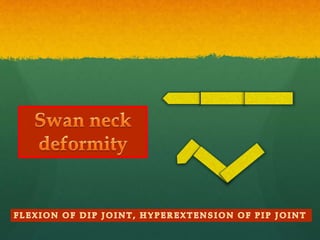
SWAN NECK DEFORMITY (flexion of DIP joint,
hyperextension of PIP joint)
BOUTONNIERS DEFORMITY (flexion of PIP joint,
hyperextension of DIP joint)
Z-LINE DEFORMITY OF THUMB (flexion of 1ST MCP,
hyperextension of 1st IP joint)
EXTRA ARTICULAR MANIFESTATIONS:-
 Fatigue, wt loss, fever, malaise, depression, cachexia.
 Subcutaneous nodules.
 Pleuritis, pleural effusion, ILD, Pulmonary nodules.
 Pericarditis, MR etc
 Peripheral neuropathy
 Vasculitis. petechiae, purpura, gangerene.
 Anaemia
Most common cause of death
is Cardio vascular disease.
Osteoporosis is commonly
seen.
Hypoandrogenism.
 Epidemiology = 0.5 – 1% of adult population.
 First degree relative = 2-10 times more than normal.
 HLADRB1 gene .
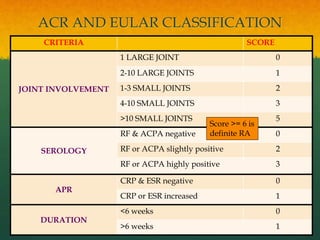
ACR AND EULAR CLASSIFICATION
CRITERIA SCORE
JOINT INVOLVEMENT
1 LARGE JOINT 0
2-10 LARGE JOINTS 1
1-3 SMALL JOINTS 2
4-10 SMALL JOINTS 3
>10 SMALL JOINTS 5
SEROLOGY
RF & ACPA negative 0
RF or ACPA slightly positive 2
RF or ACPA highly positive 3
APR
CRP & ESR negative 0
CRP or ESR increased 1
DURATION
<6 weeks 0
>6 weeks 1
Score >= 6 is
definite RA
Rheumatoid factor (RF)
RF is positive in many cases :-
 RA
 SLE
 Sjogren’s Syndrome
 Polymyositis/ dermatomyositis
RF is positive in Non Rheumatic condition as well :-
 Viral infections e.g hepatitis
 T.B , Leprosy, Syphilis
 Chronic Liver disease
 Elderly
 Relative of patients with RA
 RF has prognostic value and is positive in 70 percent
of cases.
 Anti CCP is more specific than RF.
 Joint fluid evaluation shows 2000-5000 wbc per mm
cube, wheras in septic arthritis it exceeds this value.
Treatment
REST
DMARDS
 Methotrexate 7.5mg/week with folic acid 1mg/day
(can be increased upto 30mg/week and LFT, Chest Xray,
Blood count is necessary every month)
TAB. ONCOTREX 7.5MG
 Hydroxychloroquinine 200-400mg/day (eye checkup)
 Sulfasalazine 500mg/day (can be increased upto 2-
3gm/day) TAB. SAZO EN 500mg
 Leflonomide10-20mg/day (TAB. ARAVA)
Treatment
Steroids
 In acute phase tab. Prednisolone 40-60mg/day for 2-4
weeks and taper down.
 If for longer duration then 5-10mg/day.
 Intrarticular injections.
BIOLOGICAL DMARDS/ ANTI CYTOKINE AGENTS
 Infliximab
 Etanercept
SYNOVECTOMY/ PHYSIOTHERAPY
Rheumatoid arthritis

Rheumatoid arthritis

  • 1.
  • 3.
    RA results injoint damage and physical disability. It is a systemic disease with extrarticular manifestations as well.
  • 4.
    Familial history. 25-55 agemore prone. Smoking. More common in females.
  • 5.
    Inflammation of jointstendons and bursae. Early morning stiffness > 1 hour which eases with physical activity. Symmetrical small joints of hands and feet are involved may be mono, oligo or polyarticular.
  • 6.
    Wrists, MCP andPIP are frequently involved joints. TRIGGER FINGER (flexor tendon synovitis) ULNAR DEVIATION (subluxation of MCP joint) SWAN NECK DEFORMITY (flexion of DIP joint, hyperextension of PIP joint) BOUTONNIERS DEFORMITY (flexion of PIP joint, hyperextension of DIP joint) Z-LINE DEFORMITY OF THUMB (flexion of 1ST MCP, hyperextension of 1st IP joint)
  • 7.
    EXTRA ARTICULAR MANIFESTATIONS:- Fatigue, wt loss, fever, malaise, depression, cachexia.  Subcutaneous nodules.  Pleuritis, pleural effusion, ILD, Pulmonary nodules.  Pericarditis, MR etc  Peripheral neuropathy  Vasculitis. petechiae, purpura, gangerene.  Anaemia
  • 11.
    Most common causeof death is Cardio vascular disease. Osteoporosis is commonly seen. Hypoandrogenism.
  • 12.
     Epidemiology =0.5 – 1% of adult population.  First degree relative = 2-10 times more than normal.  HLADRB1 gene .
  • 13.
    ACR AND EULARCLASSIFICATION CRITERIA SCORE JOINT INVOLVEMENT 1 LARGE JOINT 0 2-10 LARGE JOINTS 1 1-3 SMALL JOINTS 2 4-10 SMALL JOINTS 3 >10 SMALL JOINTS 5 SEROLOGY RF & ACPA negative 0 RF or ACPA slightly positive 2 RF or ACPA highly positive 3 APR CRP & ESR negative 0 CRP or ESR increased 1 DURATION <6 weeks 0 >6 weeks 1 Score >= 6 is definite RA
  • 14.
    Rheumatoid factor (RF) RFis positive in many cases :-  RA  SLE  Sjogren’s Syndrome  Polymyositis/ dermatomyositis RF is positive in Non Rheumatic condition as well :-  Viral infections e.g hepatitis  T.B , Leprosy, Syphilis  Chronic Liver disease  Elderly  Relative of patients with RA
  • 15.
     RF hasprognostic value and is positive in 70 percent of cases.  Anti CCP is more specific than RF.  Joint fluid evaluation shows 2000-5000 wbc per mm cube, wheras in septic arthritis it exceeds this value.
  • 16.
    Treatment REST DMARDS  Methotrexate 7.5mg/weekwith folic acid 1mg/day (can be increased upto 30mg/week and LFT, Chest Xray, Blood count is necessary every month) TAB. ONCOTREX 7.5MG  Hydroxychloroquinine 200-400mg/day (eye checkup)  Sulfasalazine 500mg/day (can be increased upto 2- 3gm/day) TAB. SAZO EN 500mg  Leflonomide10-20mg/day (TAB. ARAVA)
  • 17.
    Treatment Steroids  In acutephase tab. Prednisolone 40-60mg/day for 2-4 weeks and taper down.  If for longer duration then 5-10mg/day.  Intrarticular injections. BIOLOGICAL DMARDS/ ANTI CYTOKINE AGENTS  Infliximab  Etanercept SYNOVECTOMY/ PHYSIOTHERAPY