RAS DHATU
Dr. Arun Chhajer
M.D. (Kayachikitsa)
Ras dhatu - Etymology, derivation, location,
properties, functions and Praman of Rasa-dhatu.
Physiology of Rasavaha Srotas, Formation of Rasa
Dhatu from Aahara Rasa, circulation of Rasa
(Rasa-Samvahana), role of Vyana Vayu and
Samana Vayu in Rasa Samvahana. Description of
functioning of Hridaya. Ashtavidha Sara (8 types
of Sara), characteristics of Tvakasara Purusha,
conceptual study of mutual interdependence
(Aashraya-Aashrayi Bhaava) and its relation to
Rasa and Kapha. Manifestations of kshaya and
Vriddhi of Rasa.
ETYMOLOGY & DERIVATION


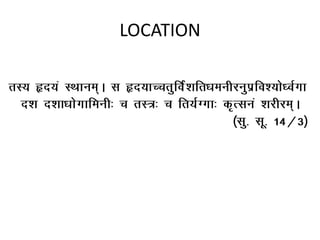
LOCATION
PROPERTIES


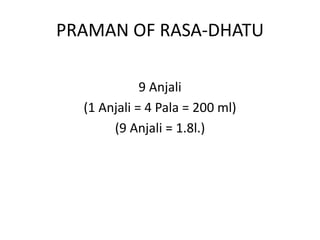
PRAMAN OF RASA-DHATU
9 Anjali
(1 Anjali = 4 Pala = 200 ml)
(9 Anjali = 1.8l.)
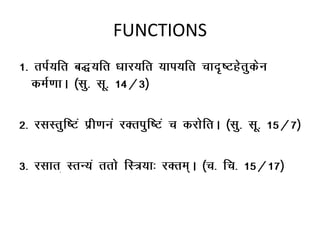
FUNCTIONS
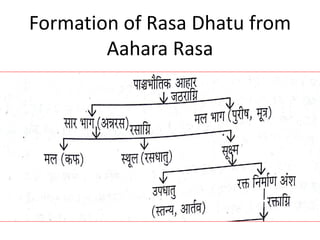
Formation of Rasa Dhatu from
Aahara Rasa
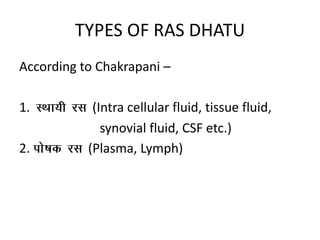
TYPES OF RAS DHATU
According to Chakrapani –
1. (Intra cellular fluid, tissue fluid,
synovial fluid, CSF etc.)
2. (Plasma, Lymph)
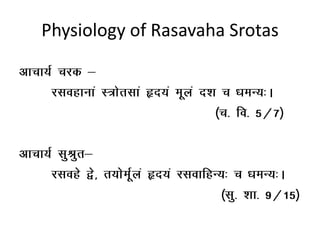
Physiology of Rasavaha Srotas
Circulation of Rasa (Rasa-Samvahana)
Role of Vyana Vayu and Samana Vayu
in Rasa Samvahana
Description of functioning of Hridaya
ASHTAVIDHA SARA
Characteristics of Tvakasara Purusha
RASA KSHAYA
RAS VRIDDHI
Aashraya - Aashrayi Bhaava
1 ------
2
3
LYMPHATIC SYSTEM
It is a part of circulatory system.
A system of blind vessels (lymphatics) that drains lymph from
all over body into blood stream known as lymph system.
This system consists of –
Lymph- colourless fluid
Lymphatics- Lymph capillaries,
vessels & ducts
Lymph nodes.
Its also includes Thymus, tonsils, and some patches of tissues
in vermiform appendix and small intestine.
What is lymph & hoW it’s formed
• When blood passes through the capillaries, some
blood components (except RBCs and some
plasma proteins) leave the capillaries and enter in
intercellular space to form Intercellular fluid or
interstitial. 85% of tissue fluid returns to blood at
the venous end of capillaries.
• Rest 15% tissue fluid enters the lymph capillaries
as a LYMPH that can not penetrate the lymph
capillaries.
• Lymph – colorless fluid that contains
lymphocytes, small proteins, fats, cell debris,
micro organism etc.
• Lymphatic system starts at lymph capillaries.
• Lymph capillaries start from tissue spaces as enlarged
blind – ended terminals called capillary buds.
• Lymph capillaries are thin walled anastomosing
microscopic vessels merge into lymph vessels. The
lymph vessels converge into collecting ducts (Right
lymphatic duct and thoracic duct) which empty into sub
clavian vein. Thoracic duct drains the lymph from more
than two third of the tissue spaces in the body.
• Lymph vessels contains valves to prevent back flow of
lymph and it circulates by the contraction of
surrounding skeletal muscle and other body part
movement.
• Rate of lymph flow – 120 mL per hour.
Lymph nodes
• Lymph nodes are smaller glandular structures
located in the course of lymphatics.
• Size- from microscopic to one inch
• Each node has an outer capsule of connective
tissue and an inner mass known as lymphoid
tissue that contains antibodies, lymphocytes and
macrophages.
• Lymph nodes are mostly present in neck, armpits
and groin.
• Several afferent vessels enter the lymph node
which drain single Efferent vessels.
Functions of lymph nodes
• Filters the lymph by removing microbes,
cellular debris and foreign particles in the
lymph.
• Lymphocytes neutralize the microbes,
macrophages engulf the microbes.
• Lymph node can detect and destroy the cancer
cell also.
Functions of Lymphatic system
• 1. Drainage system
• 2. Defense of body
• 3. Absorption and deliveries of fats – Lymph
capillaries in the villi of small intestine called
Lacteals which absorb and deliver fats to
circulatory system.
Ras dhatu
Ras dhatu

Ras dhatu

  • 1.
    RAS DHATU Dr. ArunChhajer M.D. (Kayachikitsa)
  • 2.
    Ras dhatu -Etymology, derivation, location, properties, functions and Praman of Rasa-dhatu. Physiology of Rasavaha Srotas, Formation of Rasa Dhatu from Aahara Rasa, circulation of Rasa (Rasa-Samvahana), role of Vyana Vayu and Samana Vayu in Rasa Samvahana. Description of functioning of Hridaya. Ashtavidha Sara (8 types of Sara), characteristics of Tvakasara Purusha, conceptual study of mutual interdependence (Aashraya-Aashrayi Bhaava) and its relation to Rasa and Kapha. Manifestations of kshaya and Vriddhi of Rasa.
  • 3.
  • 4.
  • 5.
  • 6.
    PRAMAN OF RASA-DHATU 9Anjali (1 Anjali = 4 Pala = 200 ml) (9 Anjali = 1.8l.)
  • 7.
  • 8.
    Formation of RasaDhatu from Aahara Rasa
  • 9.
    TYPES OF RASDHATU According to Chakrapani – 1. (Intra cellular fluid, tissue fluid, synovial fluid, CSF etc.) 2. (Plasma, Lymph)
  • 10.
  • 11.
    Circulation of Rasa(Rasa-Samvahana)
  • 12.
    Role of VyanaVayu and Samana Vayu in Rasa Samvahana
  • 13.
  • 14.
  • 15.
  • 16.
  • 17.
  • 18.
    Aashraya - AashrayiBhaava 1 ------ 2 3
  • 19.
    LYMPHATIC SYSTEM It isa part of circulatory system. A system of blind vessels (lymphatics) that drains lymph from all over body into blood stream known as lymph system. This system consists of – Lymph- colourless fluid Lymphatics- Lymph capillaries, vessels & ducts Lymph nodes. Its also includes Thymus, tonsils, and some patches of tissues in vermiform appendix and small intestine.
  • 20.
    What is lymph& hoW it’s formed • When blood passes through the capillaries, some blood components (except RBCs and some plasma proteins) leave the capillaries and enter in intercellular space to form Intercellular fluid or interstitial. 85% of tissue fluid returns to blood at the venous end of capillaries. • Rest 15% tissue fluid enters the lymph capillaries as a LYMPH that can not penetrate the lymph capillaries. • Lymph – colorless fluid that contains lymphocytes, small proteins, fats, cell debris, micro organism etc.
  • 21.
    • Lymphatic systemstarts at lymph capillaries. • Lymph capillaries start from tissue spaces as enlarged blind – ended terminals called capillary buds. • Lymph capillaries are thin walled anastomosing microscopic vessels merge into lymph vessels. The lymph vessels converge into collecting ducts (Right lymphatic duct and thoracic duct) which empty into sub clavian vein. Thoracic duct drains the lymph from more than two third of the tissue spaces in the body. • Lymph vessels contains valves to prevent back flow of lymph and it circulates by the contraction of surrounding skeletal muscle and other body part movement. • Rate of lymph flow – 120 mL per hour.
  • 22.
    Lymph nodes • Lymphnodes are smaller glandular structures located in the course of lymphatics. • Size- from microscopic to one inch • Each node has an outer capsule of connective tissue and an inner mass known as lymphoid tissue that contains antibodies, lymphocytes and macrophages. • Lymph nodes are mostly present in neck, armpits and groin. • Several afferent vessels enter the lymph node which drain single Efferent vessels.
  • 23.
    Functions of lymphnodes • Filters the lymph by removing microbes, cellular debris and foreign particles in the lymph. • Lymphocytes neutralize the microbes, macrophages engulf the microbes. • Lymph node can detect and destroy the cancer cell also.
  • 24.
    Functions of Lymphaticsystem • 1. Drainage system • 2. Defense of body • 3. Absorption and deliveries of fats – Lymph capillaries in the villi of small intestine called Lacteals which absorb and deliver fats to circulatory system.