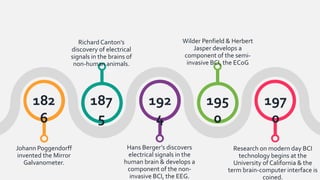
Research on modern day BCI
technology begins at the
University of California & the
term brain-computer interface is
coined.
Wilder Penfield & Herbert
Jasper develops a
component of the semi-
invasive BCI, the ECoG
Hans Berger’s discovers
electrical signals in the
human brain & develops a
component of the non-
invasive BCI, the EEG.
Richard Canton’s
discovery of electrical
signals in the brains of
non-human animals.
Johann Poggendorff
invented the Mirror
Galvanometer.
182
6
187
5
192
4
195
0
197
0
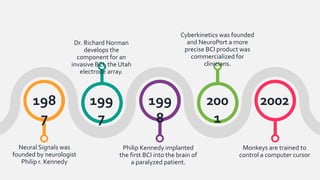
Monkeys are trained to
control a computer cursor
Philip Kennedy implanted
the first BCI into the brain of
a paralyzed patient.
Dr. Richard Norman
develops the
component for an
invasive BCI, the Utah
electrode array.
199
7
199
8
200
1
2002
Cyberkinetics was founded
and NeuroPort a more
precise BCI product was
commercialized for
clinicians.
Neural Signals was
founded by neurologist
Philip r. Kennedy
198
7
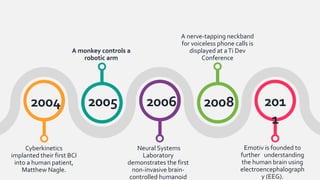
Emotiv is founded to
further understanding
the human brain using
electroencephalograph
y (EEG).
A nerve-tapping neckband
for voiceless phone calls is
displayed at aTi Dev
Conference
Neural Systems
Laboratory
demonstrates the first
non-invasive brain-
controlled humanoid
A monkey controls a
robotic arm
Cyberkinetics
implanted their first BCI
into a human patient,
Matthew Nagle.
201
1
2008200620052004
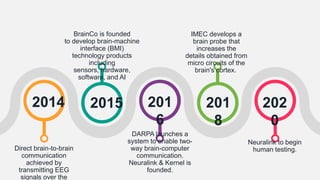
DARPA launches a
system to enable two-
way brain-computer
communication.
Neuralink & Kernel is
founded.
Direct brain-to-brain
communication
achieved by
transmitting EEG
signals over the
202
0
201
8
Neuralink to begin
human testing.
IMEC develops a
brain probe that
increases the
details obtained from
micro circuits of the
brain's cortex.
201
6
2015
BrainCo is founded
to develop brain-machine
interface (BMI)
technology products
including
sensors, hardware,
software, and AI
2014

Timeline of Brain-computer interfaces

  • 1.
    Research on modernday BCI technology begins at the University of California & the term brain-computer interface is coined. Wilder Penfield & Herbert Jasper develops a component of the semi- invasive BCI, the ECoG Hans Berger’s discovers electrical signals in the human brain & develops a component of the non- invasive BCI, the EEG. Richard Canton’s discovery of electrical signals in the brains of non-human animals. Johann Poggendorff invented the Mirror Galvanometer. 182 6 187 5 192 4 195 0 197 0
  • 2.
    Monkeys are trainedto control a computer cursor Philip Kennedy implanted the first BCI into the brain of a paralyzed patient. Dr. Richard Norman develops the component for an invasive BCI, the Utah electrode array. 199 7 199 8 200 1 2002 Cyberkinetics was founded and NeuroPort a more precise BCI product was commercialized for clinicians. Neural Signals was founded by neurologist Philip r. Kennedy 198 7
  • 3.
    Emotiv is foundedto further understanding the human brain using electroencephalograph y (EEG). A nerve-tapping neckband for voiceless phone calls is displayed at aTi Dev Conference Neural Systems Laboratory demonstrates the first non-invasive brain- controlled humanoid A monkey controls a robotic arm Cyberkinetics implanted their first BCI into a human patient, Matthew Nagle. 201 1 2008200620052004
  • 4.
    DARPA launches a systemto enable two- way brain-computer communication. Neuralink & Kernel is founded. Direct brain-to-brain communication achieved by transmitting EEG signals over the 202 0 201 8 Neuralink to begin human testing. IMEC develops a brain probe that increases the details obtained from micro circuits of the brain's cortex. 201 6 2015 BrainCo is founded to develop brain-machine interface (BMI) technology products including sensors, hardware, software, and AI 2014