Classification Chapter 18
The idea of classification Classification-  is the grouping of objects or information based on similarities. When things are classified they are separated in to large groups then those large groups are separated in to smaller groups or sub-groups Scientists needed to develop this method in order to organize the over 2 million species on Earth
Taxonomy This is the branch of Biology that deals with the grouping and naming of organisms Biologists who study taxonomy are called  taxonomist…
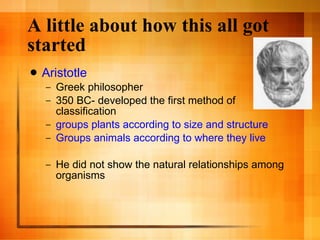
A little about how this all got started Aristotle Greek philosopher 350 BC- developed the first method of classification groups plants according to size and structure Groups animals according to where they live He did not show the natural relationships among organisms
A little on Linnaeus Swedish naturalist Developed classification system that is used today Analyzed physical characteristics of organisms and classified them based on close relationships binomial nomenclature classifies each organism using two Latin names
Binomial Nomenclature each organism is assigned  two  names The  first name  identifies the  Genus  of the organism A genus is a group of closely related species The  second name  identifies the  species  of the organisms The species names usually describes the organisms
Example Example–  Canis familiaris  = DOG Genus  species
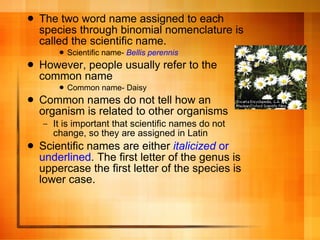
The two word name assigned to each species through binomial nomenclature is called the scientific name. Scientific name-  Bellis perennis However, people usually refer to the common name Common name- Daisy Common names do not tell how an organism is related to other organisms It is important that scientific names do not change, so they are assigned in Latin Scientific names are either  italicized  or underlined . The first letter of the genus is uppercase the first letter of the species is lower case.
Taxonomic Categories In taxonomy, organisms are grouped into a series of categories called  taxa When we are classifying an organism, biologists place the organism in a broad group know as a kingdom The organism is then placed in a series of sub-groups (taxa) that become increasingly specific until it is uniquely identifiable
Taxonomical categories  Kingdom  (least specific) Phylum Class Order Family Genus Species (Most specific)  Bobcat   Lynx Animalia Animalia Chordata Chordata Mammalia Mammalia Carnivora Carnivora Felidae Felidae Lynx Lynx rufus  canadenis
Determining Relationships There are four main ways to determine relationships between organisms Evolutionary History Development Behavior Biochemical Relationships
Evolutionary History Taxonomists compare structures of modern-day life form with those found in fossils to determine evolutionary histories.  The evolutionary history of species is  called phylogeny .
Development Similarities in the developmental stages of animals help determine relationships, and can help determine if two animals have common origins.
Biochemical Relationships Closely related species have similar DNA sequences and therefore, similar proteins. The more amino acid sequences two species have in common, the more closely related they are to each other Example: Human and Chimpanzees
Behavior Even though two species may look similar, distinct differences in their behaviors may identify them as different species Example: Mating calls of frogs
Cladogram
 
 
Kingdoms Section 18.3
History of it Classification for many years was based on 5 kingdoms Bacteria was in one category (Moneria) After careful studies they found bacteria were very different in morphology and properties This led to the six kingdoms we now know
6 Kingdoms of life Archaebacteria Eubacteria Protista Fungi Plantae Animalia
Kingdom Cell Type Number of cells Nutrition Archaebacteria Prokaryotic Unicellular Autotrophy & Heterotrophy Eubacteria Prokaryotic Unicellular Autotrophy & Heterotrophy Protista Eukaryotic Unicellular & multicellular Autotrophy & Heterotrophy Fungi Eukaryotic Unicellular & Multicellular Heterotrophy Plantae Eukaryotic Multicellular Autotrophy & (rare) Heterotrophy Animalia Eukaryotic Multicellular Heterotrophy
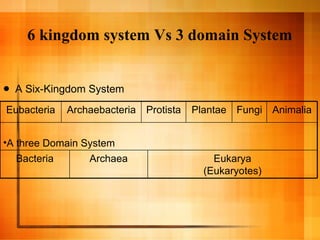
6 kingdom system Vs 3 domain System A Six-Kingdom System Eubacteria Archaebacteria Protista Plantae Fungi Animalia A three Domain System Bacteria Archaea Eukarya (Eukaryotes)
A little on each Kingdom
Archaeabacteria Prokaryotes One-celled organisms Many of which do not require oxygen or sunlight to live
Archaeabacteria Often live in extreme conditions  Some archaeabacteria live in deep-sea hydrothermal vents in the Pacific Ocean.  Located at depths of 3 km (2 mi), the hot vents provide a dark environment with extremely high temperature and pressure where few creatures can survive.  Use chemosynthesis to harvest energy from chemical reactions involving hydrogen sulfide and other inorganic compounds. .
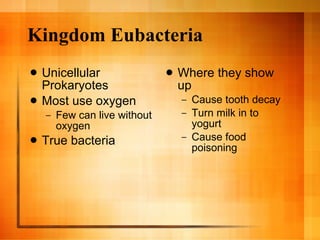
Kingdom Eubacteria Unicellular Prokaryotes Most use oxygen Few can live without oxygen True bacteria Where they show up Cause tooth decay Turn milk in to yogurt Cause food poisoning
 
Kingdom Protista Protista, group of comparatively simple organisms, called protists, that have characteristics of both plants and animals. Mostly single celled organisms Some are multicellular Most look like plants Lack specialized tissue Eukaryotes
 
Amoeba Engulfing a Paramecium
Dinoflagellate
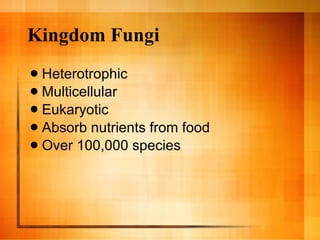
Kingdom Fungi Heterotrophic Multicellular Eukaryotic Absorb nutrients from food Over 100,000 species
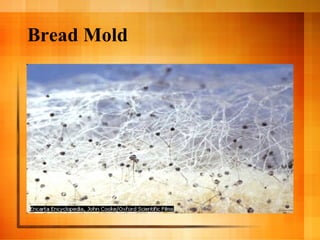
Bread Mold
Sulfur Fungi  Chanterelle mushroom
Bread Yeast
Kingdom Plantae Multicellular Mostly autotrophic Use photosynthesis for energy Most live on land Over 350, 000 species Mosses, ferns, conifers, flowering plants
 
Kingdom Animalia Eukaryotic Multicellular Heterotrophic Largest kingdom
 

Sandel classification

  • 1.
  • 2.
    The idea ofclassification Classification- is the grouping of objects or information based on similarities. When things are classified they are separated in to large groups then those large groups are separated in to smaller groups or sub-groups Scientists needed to develop this method in order to organize the over 2 million species on Earth
  • 3.
    Taxonomy This isthe branch of Biology that deals with the grouping and naming of organisms Biologists who study taxonomy are called taxonomist…
  • 4.
    A little abouthow this all got started Aristotle Greek philosopher 350 BC- developed the first method of classification groups plants according to size and structure Groups animals according to where they live He did not show the natural relationships among organisms
  • 5.
    A little onLinnaeus Swedish naturalist Developed classification system that is used today Analyzed physical characteristics of organisms and classified them based on close relationships binomial nomenclature classifies each organism using two Latin names
  • 6.
    Binomial Nomenclature eachorganism is assigned two names The first name identifies the Genus of the organism A genus is a group of closely related species The second name identifies the species of the organisms The species names usually describes the organisms
  • 7.
    Example Example– Canis familiaris = DOG Genus species
  • 8.
    The two wordname assigned to each species through binomial nomenclature is called the scientific name. Scientific name- Bellis perennis However, people usually refer to the common name Common name- Daisy Common names do not tell how an organism is related to other organisms It is important that scientific names do not change, so they are assigned in Latin Scientific names are either italicized or underlined . The first letter of the genus is uppercase the first letter of the species is lower case.
  • 9.
    Taxonomic Categories Intaxonomy, organisms are grouped into a series of categories called taxa When we are classifying an organism, biologists place the organism in a broad group know as a kingdom The organism is then placed in a series of sub-groups (taxa) that become increasingly specific until it is uniquely identifiable
  • 10.
    Taxonomical categories Kingdom (least specific) Phylum Class Order Family Genus Species (Most specific) Bobcat Lynx Animalia Animalia Chordata Chordata Mammalia Mammalia Carnivora Carnivora Felidae Felidae Lynx Lynx rufus canadenis
  • 11.
    Determining Relationships Thereare four main ways to determine relationships between organisms Evolutionary History Development Behavior Biochemical Relationships
  • 12.
    Evolutionary History Taxonomistscompare structures of modern-day life form with those found in fossils to determine evolutionary histories. The evolutionary history of species is called phylogeny .
  • 13.
    Development Similarities inthe developmental stages of animals help determine relationships, and can help determine if two animals have common origins.
  • 14.
    Biochemical Relationships Closelyrelated species have similar DNA sequences and therefore, similar proteins. The more amino acid sequences two species have in common, the more closely related they are to each other Example: Human and Chimpanzees
  • 15.
    Behavior Even thoughtwo species may look similar, distinct differences in their behaviors may identify them as different species Example: Mating calls of frogs
  • 16.
  • 17.
  • 18.
  • 19.
  • 20.
    History of itClassification for many years was based on 5 kingdoms Bacteria was in one category (Moneria) After careful studies they found bacteria were very different in morphology and properties This led to the six kingdoms we now know
  • 21.
    6 Kingdoms oflife Archaebacteria Eubacteria Protista Fungi Plantae Animalia
  • 22.
    Kingdom Cell TypeNumber of cells Nutrition Archaebacteria Prokaryotic Unicellular Autotrophy & Heterotrophy Eubacteria Prokaryotic Unicellular Autotrophy & Heterotrophy Protista Eukaryotic Unicellular & multicellular Autotrophy & Heterotrophy Fungi Eukaryotic Unicellular & Multicellular Heterotrophy Plantae Eukaryotic Multicellular Autotrophy & (rare) Heterotrophy Animalia Eukaryotic Multicellular Heterotrophy
  • 23.
    6 kingdom systemVs 3 domain System A Six-Kingdom System Eubacteria Archaebacteria Protista Plantae Fungi Animalia A three Domain System Bacteria Archaea Eukarya (Eukaryotes)
  • 24.
    A little oneach Kingdom
  • 25.
    Archaeabacteria Prokaryotes One-celledorganisms Many of which do not require oxygen or sunlight to live
  • 26.
    Archaeabacteria Often livein extreme conditions Some archaeabacteria live in deep-sea hydrothermal vents in the Pacific Ocean. Located at depths of 3 km (2 mi), the hot vents provide a dark environment with extremely high temperature and pressure where few creatures can survive. Use chemosynthesis to harvest energy from chemical reactions involving hydrogen sulfide and other inorganic compounds. .
  • 27.
    Kingdom Eubacteria UnicellularProkaryotes Most use oxygen Few can live without oxygen True bacteria Where they show up Cause tooth decay Turn milk in to yogurt Cause food poisoning
  • 28.
  • 29.
    Kingdom Protista Protista,group of comparatively simple organisms, called protists, that have characteristics of both plants and animals. Mostly single celled organisms Some are multicellular Most look like plants Lack specialized tissue Eukaryotes
  • 30.
  • 31.
  • 32.
  • 33.
    Kingdom Fungi HeterotrophicMulticellular Eukaryotic Absorb nutrients from food Over 100,000 species
  • 34.
  • 35.
    Sulfur Fungi Chanterelle mushroom
  • 36.
  • 37.
    Kingdom Plantae MulticellularMostly autotrophic Use photosynthesis for energy Most live on land Over 350, 000 species Mosses, ferns, conifers, flowering plants
  • 38.
  • 39.
    Kingdom Animalia EukaryoticMulticellular Heterotrophic Largest kingdom
  • 40.