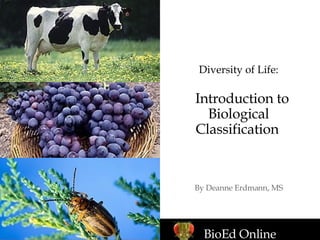
Diversity of Life:   Introduction to Biological Classification   By Deanne Erdmann, MS BioEd Online
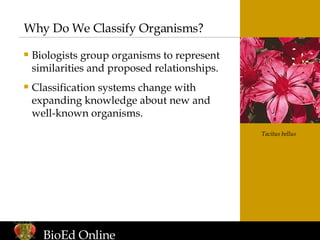
Why Do We Classify Organisms? Biologists group organisms to represent similarities and proposed relationships. Classification systems change with expanding knowledge about new and well-known organisms. Tacitus bellus BioEd Online
Why Do We Classify Organisms? To understand how and why organisms function the way they do, and how they interact with one another, we must observe patterns in development and evolution. Think about the scope of the Life Science Content Standards: understanding the cell; molecular basis of heredity; biological evolution; interdependence of organisms, matter, and energy; organization in living systems; and behavior of organisms.  Classification is a scientific approach to grouping organisms based on current knowledge gathered from all of these fields. It is more important to understand how and why classification systems are organized than to memorize each individual level.  Classification systems encompass a wide, dynamic body of knowledge that is being modified continually.
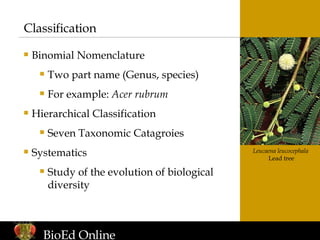
Classification Binomial Nomenclature Two part name (Genus, species) For example:  Acer rubrum  Hierarchical Classification Seven Taxonomic Catagroies Systematics Study of the evolution of biological diversity Leucaena leucocephala   Lead tree BioEd Online
Classification  Classification systems attempt to solve the problem of providing meaningful groupings of organisms.  The Swedish scientist, Carolus von Linnaeus, is credited with introducing binomial nomenclature and hierarchical classification as an organized way of naming and describing organisms and their relationships to one another.  Binomial nomenclature refers to the use of a two-part name for each species (one name designating genus and one designating species).
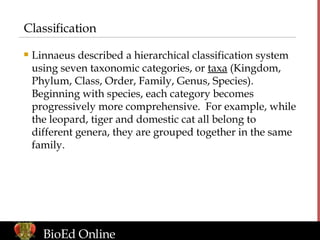
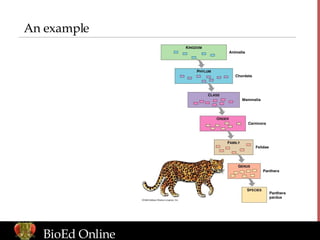
Classification Linnaeus described a hierarchical classification system using seven taxonomic categories, or  taxa  (Kingdom, Phylum, Class, Order, Family, Genus, Species).  Beginning with species, each category becomes progressively more comprehensive.  For example, while the leopard, tiger and domestic cat all belong to different genera, they are grouped together in the same family.
Taxonomy Taxonomy is the science of classification.  When taxonomic systems include hypothesized evolutionary relationships among groups, the field generally is referred to as Phylogenetics.  Systematics is a larger field involving classifying organisms based on their phylogenetic relationships.  Systematics can be thought of as the study of biological diversity and how that diversity evolved.  In a sense, Charles Darwin introduced systematics in his revolutionary work,  The Origin of Species .  He wrote, “The natural system is founded on descent with modification; that the characters which naturalists consider as showing true affinity between any two or more species, are those which have been inherited from a common parent, and, in so far, all true classification is genealogical” (Darwin, 1859).
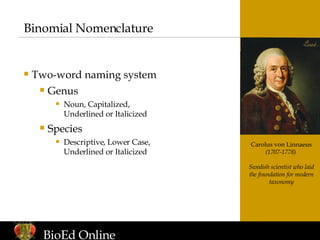
Binomial Nomenclature Two-word naming system Genus Noun, Capitalized,  Underlined or Italicized Species Descriptive, Lower Case,  Underlined or Italicized Carolus von Linnaeus (1707-1778)  Swedish scientist who laid the foundation for modern taxonomy BioEd Online
Binomial Nomenclature Early naturalists identified plants and animals by observable structural similarities and referred to organisms using long complicated phrases.  This was known as the “polynomial system.”  In this system, a plant might be described by phrases of 12 or more words.  It is not surprising that polynomial names could become very complex and were often misinterpreted when translated from one language to another .
Linnaeus In the 1700s, Carolus von Linnaeus, sometimes referred to as the Father of Classification, described a binomial system, which was published in his early work,  System Naturae  (1735).  Although he created the two-word system as a short-cut for users of this work, the system was rapidly adopted as a manageable way of naming species.
Genus & Species In the binomial nomenclature system,  genus  and  species —just two names—replace the long string of words used in the polynomial system.  The meaning of words can differ from language to language and from country to country.  For example, in Great Britain, the word “buzzard” refers to an organism Americans call a hawk.  For this reason, scientific names are written in Latin to maintain a uniform system of naming across all languages.
Scientific Naming In the binomial system,  genus  is always a noun, underlined (or italicized), and capitalized;  species  is a descriptive term, underlined (or italicized), and not capitalized.  Some examples of binomial names include:  Quercus   rubra  (red oak),  Panthera   pardus  (leopard), or  Homo   sapiens  (human).
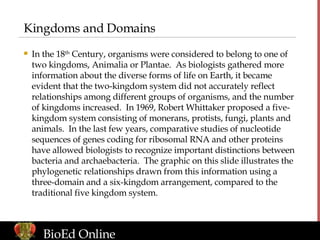
Kingdoms and Domains: Scientists debate how many kingdoms there are. Bacteria Archaea Eukarya Bacteria Archaea Protista Plantae Fungi Animalia Monera Protista Plantae Fungi Animalia The three-domain system The six-kingdom system The traditional five-kingdom system BioEd Online
Kingdoms and Domains In the 18 th  Century, organisms were considered to belong to one of two kingdoms, Animalia or Plantae.  As biologists gathered more information about the diverse forms of life on Earth, it became evident that the two-kingdom system did not accurately reflect relationships among different groups of organisms, and the number of kingdoms increased.  In 1969, Robert Whittaker proposed a five-kingdom system consisting of monerans, protists, fungi, plants and animals.  In the last few years, comparative studies of nucleotide sequences of genes coding for ribosomal RNA and other proteins have allowed biologists to recognize important distinctions between bacteria and archaebacteria.  The graphic on this slide illustrates the phylogenetic relationships drawn from this information using a three-domain and a six-kingdom arrangement, compared to the traditional five kingdom system.
Hierarchical Classification Taxonomic categories Kingdom   K ing Phylum P hilip Class C ame Order O ver Family F or Genus G reen Species S oup BioEd Online
An example
Systematics: Evolutionary Classification of Organisms Systematics is the study of the evolution of biological diversity, and combines data from the following areas. Fossil record Comparative homologies Cladistics Comparative sequencing of DNA/RNA among organisms Molecular clocks BioEd Online
Taxonomic Diagrams Mammals Turtles Lizards and Snakes Crocodiles Birds Mammals Turtles Lizards and Snakes Crocodiles Birds Cladogram Phylogenetic Tree Each circle  represents a  speciation event. BioEd Online
Taxonomic Diagrams Sometimes, biologists group organisms into categories that represent common ancestries, not just physical similarities.  Early naturalists used physical characteristics and later, fossil data, attempting to represent evolutionary relationships among organisms.  Today, modern classification systems use fossil data, physical characteristics and DNA/RNA information to draw increasingly more accurate branching diagrams. Phylogenetic trees, or phylogenies, represent hypothesized evolutionary relationships among organisms and may include extinct as well as modern species. Cladograms are based only on characteristics observable in existing species. The branching patterns in a cladogram are defined by the presence of unique, evolving innovations (derived characteristics) shared by all members of the group.
Classification

  • 1.
    Diversity of Life: Introduction to Biological Classification By Deanne Erdmann, MS BioEd Online
  • 2.
    Why Do WeClassify Organisms? Biologists group organisms to represent similarities and proposed relationships. Classification systems change with expanding knowledge about new and well-known organisms. Tacitus bellus BioEd Online
  • 3.
    Why Do WeClassify Organisms? To understand how and why organisms function the way they do, and how they interact with one another, we must observe patterns in development and evolution. Think about the scope of the Life Science Content Standards: understanding the cell; molecular basis of heredity; biological evolution; interdependence of organisms, matter, and energy; organization in living systems; and behavior of organisms. Classification is a scientific approach to grouping organisms based on current knowledge gathered from all of these fields. It is more important to understand how and why classification systems are organized than to memorize each individual level. Classification systems encompass a wide, dynamic body of knowledge that is being modified continually.
  • 4.
    Classification Binomial NomenclatureTwo part name (Genus, species) For example: Acer rubrum Hierarchical Classification Seven Taxonomic Catagroies Systematics Study of the evolution of biological diversity Leucaena leucocephala Lead tree BioEd Online
  • 5.
    Classification Classificationsystems attempt to solve the problem of providing meaningful groupings of organisms. The Swedish scientist, Carolus von Linnaeus, is credited with introducing binomial nomenclature and hierarchical classification as an organized way of naming and describing organisms and their relationships to one another. Binomial nomenclature refers to the use of a two-part name for each species (one name designating genus and one designating species).
  • 6.
    Classification Linnaeus describeda hierarchical classification system using seven taxonomic categories, or taxa (Kingdom, Phylum, Class, Order, Family, Genus, Species). Beginning with species, each category becomes progressively more comprehensive. For example, while the leopard, tiger and domestic cat all belong to different genera, they are grouped together in the same family.
  • 7.
    Taxonomy Taxonomy isthe science of classification. When taxonomic systems include hypothesized evolutionary relationships among groups, the field generally is referred to as Phylogenetics. Systematics is a larger field involving classifying organisms based on their phylogenetic relationships. Systematics can be thought of as the study of biological diversity and how that diversity evolved. In a sense, Charles Darwin introduced systematics in his revolutionary work, The Origin of Species . He wrote, “The natural system is founded on descent with modification; that the characters which naturalists consider as showing true affinity between any two or more species, are those which have been inherited from a common parent, and, in so far, all true classification is genealogical” (Darwin, 1859).
  • 8.
    Binomial Nomenclature Two-wordnaming system Genus Noun, Capitalized, Underlined or Italicized Species Descriptive, Lower Case, Underlined or Italicized Carolus von Linnaeus (1707-1778) Swedish scientist who laid the foundation for modern taxonomy BioEd Online
  • 9.
    Binomial Nomenclature Earlynaturalists identified plants and animals by observable structural similarities and referred to organisms using long complicated phrases. This was known as the “polynomial system.” In this system, a plant might be described by phrases of 12 or more words. It is not surprising that polynomial names could become very complex and were often misinterpreted when translated from one language to another .
  • 10.
    Linnaeus In the1700s, Carolus von Linnaeus, sometimes referred to as the Father of Classification, described a binomial system, which was published in his early work, System Naturae (1735). Although he created the two-word system as a short-cut for users of this work, the system was rapidly adopted as a manageable way of naming species.
  • 11.
    Genus & SpeciesIn the binomial nomenclature system, genus and species —just two names—replace the long string of words used in the polynomial system. The meaning of words can differ from language to language and from country to country. For example, in Great Britain, the word “buzzard” refers to an organism Americans call a hawk. For this reason, scientific names are written in Latin to maintain a uniform system of naming across all languages.
  • 12.
    Scientific Naming Inthe binomial system, genus is always a noun, underlined (or italicized), and capitalized; species is a descriptive term, underlined (or italicized), and not capitalized. Some examples of binomial names include: Quercus rubra (red oak), Panthera pardus (leopard), or Homo sapiens (human).
  • 13.
    Kingdoms and Domains:Scientists debate how many kingdoms there are. Bacteria Archaea Eukarya Bacteria Archaea Protista Plantae Fungi Animalia Monera Protista Plantae Fungi Animalia The three-domain system The six-kingdom system The traditional five-kingdom system BioEd Online
  • 14.
    Kingdoms and DomainsIn the 18 th Century, organisms were considered to belong to one of two kingdoms, Animalia or Plantae. As biologists gathered more information about the diverse forms of life on Earth, it became evident that the two-kingdom system did not accurately reflect relationships among different groups of organisms, and the number of kingdoms increased. In 1969, Robert Whittaker proposed a five-kingdom system consisting of monerans, protists, fungi, plants and animals. In the last few years, comparative studies of nucleotide sequences of genes coding for ribosomal RNA and other proteins have allowed biologists to recognize important distinctions between bacteria and archaebacteria. The graphic on this slide illustrates the phylogenetic relationships drawn from this information using a three-domain and a six-kingdom arrangement, compared to the traditional five kingdom system.
  • 15.
    Hierarchical Classification Taxonomiccategories Kingdom K ing Phylum P hilip Class C ame Order O ver Family F or Genus G reen Species S oup BioEd Online
  • 16.
  • 17.
    Systematics: Evolutionary Classificationof Organisms Systematics is the study of the evolution of biological diversity, and combines data from the following areas. Fossil record Comparative homologies Cladistics Comparative sequencing of DNA/RNA among organisms Molecular clocks BioEd Online
  • 18.
    Taxonomic Diagrams MammalsTurtles Lizards and Snakes Crocodiles Birds Mammals Turtles Lizards and Snakes Crocodiles Birds Cladogram Phylogenetic Tree Each circle represents a speciation event. BioEd Online
  • 19.
    Taxonomic Diagrams Sometimes,biologists group organisms into categories that represent common ancestries, not just physical similarities. Early naturalists used physical characteristics and later, fossil data, attempting to represent evolutionary relationships among organisms. Today, modern classification systems use fossil data, physical characteristics and DNA/RNA information to draw increasingly more accurate branching diagrams. Phylogenetic trees, or phylogenies, represent hypothesized evolutionary relationships among organisms and may include extinct as well as modern species. Cladograms are based only on characteristics observable in existing species. The branching patterns in a cladogram are defined by the presence of unique, evolving innovations (derived characteristics) shared by all members of the group.
Editor's Notes

  • #2 Image References Weller, K. Dairy Cow. USDA Agricultural Research Service. Retrieved 12-11-2006 from http://www.ars.usda.gov/is/graphics/photos/ Nichols, B. Seedless grapes. USDA Agricultural Research Service. Retrieved 12-11-2006 from http://www.ars.usda.gov/is/graphics/photos/ Richard, B. Leaf Beetle. USDA Agricultural Research Service, APHS. Retrieved 12-11-2006 from http://www.ars.usda.gov/is/graphics/photos/