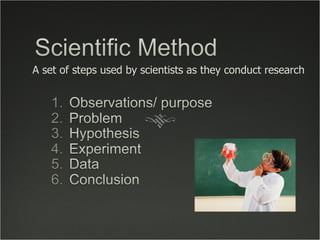
A set of steps used by scientists as they conduct research
Observations The process of obtaining information by using the senses This is when you look at what is around you and take note
Problem The question you are trying to answer A question raised for consideration or solution.
Hypothesis An educated guess Predict the answer to the problem Phrased “If…then…” (Example:  If  the plants are exposed to sunlight  then  they will grow.)
Experiment A procedure to test the hypothesis.
Experiment continued:  Variables  -  factors that can change Manipulating/ independent variable     variable that is deliberately changed Or the one you have control over Responding/ dependent variable    variable that is observed and that changes in response to the manipulated variable This is what you are measuring Controlled variables    variables that remain the same in all the experiments
Experiment continued:  Control Group The control group acts as a reference point or measuring stick to compare with the variable group.  Any  difference between the two groups can  only  be due to the one experimental factor that is being tested.
Data Results of the experiment. Can be: Quantitative  – numerical in nature (think “quantity”; ex: 5 cm, 9 seconds) Qualitative  – descriptive in nature (ex: color changes, odors, other observations made by senses)
Data Reporting Data can be reported both in narrative form and through diagrams, tables and graphs.
Conclusion The answer to the hypothesis, once it has been tested is often called a “theory”.
Retest In order to verify the results, experiments must be  repeatable . If they cannot be produced through repeating the experiment again, then they are not valid.
Got it? Let’s see…
For example… Let’s say I wanted to see whether Miracle Grow or cow manure would make my tomato plants produce the largest tomatoes. (On a piece of paper, jot down your answers to these questions.) What would be my independent variable? What would be my dependent variable? What would be my controlled variables? What would be my control group?
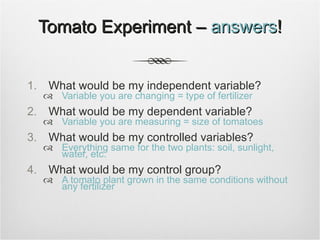
Tomato Experiment –  answers ! What would be my independent variable? Variable you are changing = type of fertilizer What would be my dependent variable? Variable you are measuring = size of tomatoes What would be my controlled variables? Everything same for the two plants: soil, sunlight, water, etc. What would be my control group? A tomato plant grown in the same conditions without any fertilizer

Bcr scientific method power point

  • 1.
    A set ofsteps used by scientists as they conduct research
  • 2.
    Observations The processof obtaining information by using the senses This is when you look at what is around you and take note
  • 3.
    Problem The questionyou are trying to answer A question raised for consideration or solution.
  • 4.
    Hypothesis An educatedguess Predict the answer to the problem Phrased “If…then…” (Example: If the plants are exposed to sunlight then they will grow.)
  • 5.
    Experiment A procedureto test the hypothesis.
  • 6.
    Experiment continued: Variables - factors that can change Manipulating/ independent variable  variable that is deliberately changed Or the one you have control over Responding/ dependent variable  variable that is observed and that changes in response to the manipulated variable This is what you are measuring Controlled variables  variables that remain the same in all the experiments
  • 7.
    Experiment continued: Control Group The control group acts as a reference point or measuring stick to compare with the variable group. Any difference between the two groups can only be due to the one experimental factor that is being tested.
  • 8.
    Data Results ofthe experiment. Can be: Quantitative – numerical in nature (think “quantity”; ex: 5 cm, 9 seconds) Qualitative – descriptive in nature (ex: color changes, odors, other observations made by senses)
  • 9.
    Data Reporting Datacan be reported both in narrative form and through diagrams, tables and graphs.
  • 10.
    Conclusion The answerto the hypothesis, once it has been tested is often called a “theory”.
  • 11.
    Retest In orderto verify the results, experiments must be repeatable . If they cannot be produced through repeating the experiment again, then they are not valid.
  • 12.
  • 13.
    For example… Let’ssay I wanted to see whether Miracle Grow or cow manure would make my tomato plants produce the largest tomatoes. (On a piece of paper, jot down your answers to these questions.) What would be my independent variable? What would be my dependent variable? What would be my controlled variables? What would be my control group?
  • 14.
    Tomato Experiment – answers ! What would be my independent variable? Variable you are changing = type of fertilizer What would be my dependent variable? Variable you are measuring = size of tomatoes What would be my controlled variables? Everything same for the two plants: soil, sunlight, water, etc. What would be my control group? A tomato plant grown in the same conditions without any fertilizer