Organic Compounds The BIG Four
Before we talk about the “Big 4”, let’s define a few terms…  Macro Polymer Monomer
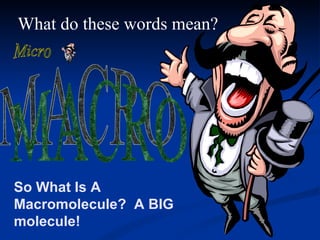
MACRO Micro What do these words mean? So What Is A Macromolecule?  A BIG molecule!
What does  “Mono”  mean? 1
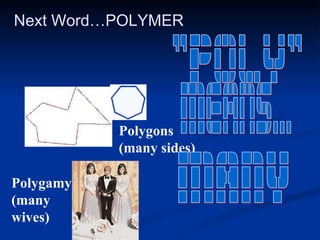
Polygons (many sides) Polygamy (many  wives) Means... "Poly" Next Word…POLYMER MANY
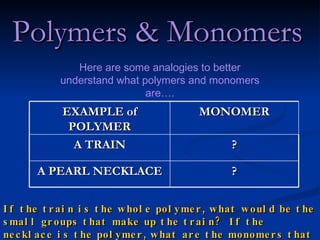
Polymers & Monomers Here are some analogies to better understand what polymers and monomers are…. If the train is the whole polymer, what would be the small groups that make up the train?  If the necklace is the polymer, what are the monomers that make up the necklace? EXAMPLE of POLYMER MONOMER A TRAIN ? A PEARL NECKLACE ?
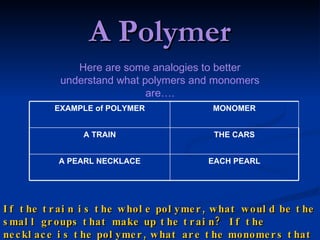
A Polymer Here are some analogies to better understand what polymers and monomers are…. If the train is the whole polymer, what would be the small groups that make up the train?  If the necklace is the polymer, what are the monomers that make up the necklace? EXAMPLE of POLYMER MONOMER A TRAIN THE CARS A PEARL NECKLACE EACH PEARL
The Big Four Now we are ready to  begin our study of... There are FOUR important biochemical molecules
When studying these biochemical molecules, we are interested in finding out….. what they do for living things. what they generally look like. what their monomers are. and how they may help the body gain energy to sustain life.
CARBOHYDRATES
CARBOHYDRATES They are the main source for the body  to gain energy .  They are our fuel! They function in  short-term energy storage for animals and plants WHAT THEY DO:
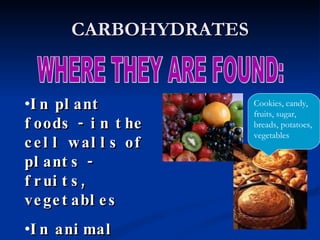
CARBOHYDRATES WHERE THEY ARE FOUND: In plant foods - in the cell walls of plants - fruits, vegetables In animal products - in milk Cookies, candy, fruits, sugar, breads, potatoes, vegetables
CARBOHYDRATES AT THE ATOM LEVEL Each carbohydrate is made up of… Carbon, Hydrogen, and Oxygen THINK: “CHO”
CARBOHYDRATES MADE UP OF... Carbohydrates are chains (polymers) made of monomers. The most common monomer of carbohydrates is… Glucose is called a monosaccharide GLUCOSE
LIPIDS
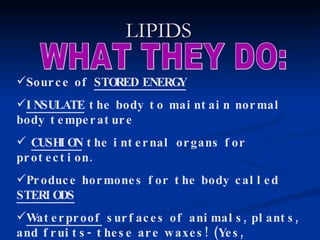
LIPIDS Source of  STORED ENERGY   INSULATE  the body to maintain normal body temperature  CUSHION  the internal organs for protection. Produce hormones for the body called  STERIODS Waterproof  surfaces of animals, plants, and fruits- these are waxes! (Yes, beeswax and your earwax too!) WHAT THEY DO:
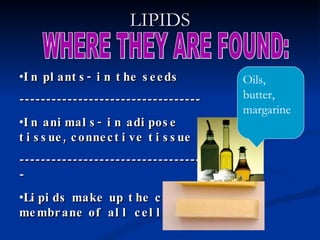
LIPIDS WHERE THEY ARE FOUND: In plants- in the seeds ---------------------------------- In animals- in adipose tissue, connective tissue ----------------------------------- Lipids make up the cell membrane of all cells.  Oils, butter, margarine
LIPIDS AT THE ATOM LEVEL Each lipid is made up of… Carbon, Hydrogen, and Oxygen THINK: “CHO”
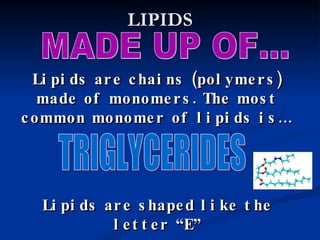
LIPIDS MADE UP OF... Lipids are chains (polymers) made of monomers. The most common monomer of lipids is… Lipids are shaped like the letter “E” TRIGLYCERIDES
PROTEINS
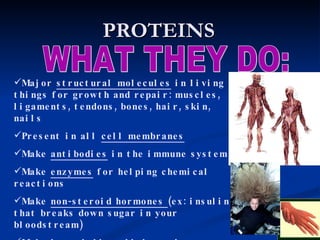
PROTEINS Major  structural molecules  in living things for growth and repair: muscles, ligaments, tendons, bones, hair, skin, nails Present in all  cell membranes   Make  antibodies  in the immune system Make  enzymes  for helping chemical reactions Make  non-steroid hormones  (ex: insulin that breaks down sugar in your bloodstream) Make  hemoglobin , which carries oxygen in your blood WHAT THEY DO:
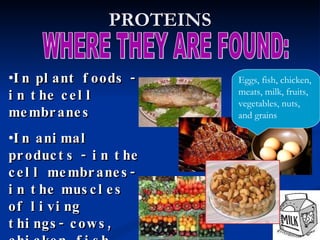
PROTEINS WHERE THEY ARE FOUND: In plant foods - in the cell membranes  In animal products - in the cell membranes- in the muscles of living things- cows, chicken, fish… Eggs, fish, chicken, meats, milk, fruits, vegetables, nuts, and grains
PROTEINS AT THE ATOM LEVEL Each protein is made up of… Carbon, Hydrogen, and Oxygen, Nitrogen and sometimes Sulfur THINK: “CHONS”
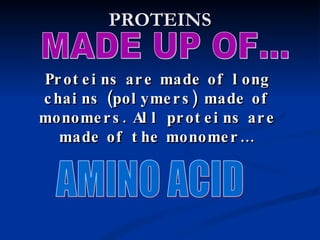
PROTEINS MADE UP OF... Proteins are made of long chains (polymers) made of monomers. All proteins are made of the monomer… AMINO ACID
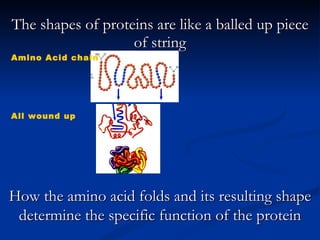
The shapes of proteins are like a balled up piece of string Amino Acid chain  All wound up How the amino acid folds and its resulting shape determine the specific function of the protein
Enzymes…a special protein example Enzymes speed up chemical reactions (catalysts) They are required for all biochemical reactions Stay tuned…We will learn more about enzymes later in this week!
NUCLEIC ACIDS
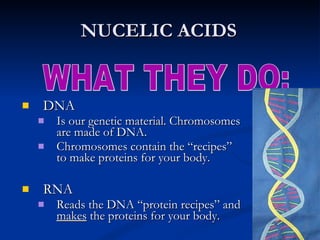
NUCELIC ACIDS DNA Is our genetic material. Chromosomes are made of DNA. Chromosomes contain the “recipes” to make proteins for your body. RNA Reads the DNA “protein recipes” and  makes  the proteins for your body. WHAT THEY DO:
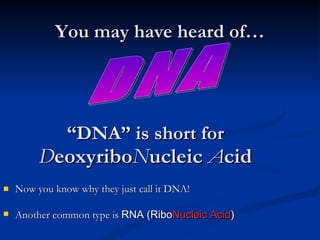
“ DNA” is short for  D eoxyribo N ucleic  A cid Now you know why they just call it DNA!  Another common type is  RNA (Ribo Nucleic Acid ) DNA You may have heard of…
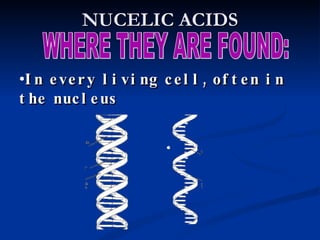
NUCELIC ACIDS WHERE THEY ARE FOUND: In every living cell, often in the nucleus
NUCLEIC ACIDS AT THE ATOM LEVEL Each nucleic acid is made up of… Carbon, Hydrogen, and Oxygen, Nitrogen and Phosphorus THINK: “CHONP”
NUCLEIC ACIDS MADE UP OF... Nucleic Acids are chains (polymers) made of monomers. Nucleic acids are made up of  Nucleotides Something we will learn more about when we study DNA
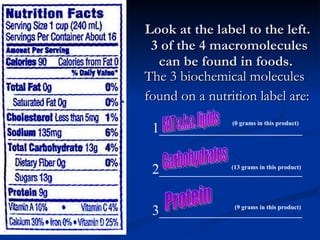
In interesting point…three out of the 4 types of biochemical macromolecules  can be found on food  nutrition labels…
Look at the label to the left.  3 of the 4 macromolecules can be found in foods.  The 3 biochemical molecules found on a nutrition label are: 1____________________ 2____________________ 3____________________ (0 grams in this product) (13 grams in this product) (9 grams in this product) FAT a.k.a. lipids Carbohydrates Protein
Resources www.bio.kimunity.com www.slideshare.net/guest13161d/big-4-macromolecules Repacholi, Stephen.  www.slideshare.net/chalkie28/biological-molecules Mr. J. Willis, science teacher, Hibriten High School Miller, Ken and Joe Levine.  Prentice hall Biology . Pearson Education Inc. New Jersey, 2005.

Organic compounds Module 3 notes

  • 1.
  • 2.
    Before we talkabout the “Big 4”, let’s define a few terms… Macro Polymer Monomer
  • 3.
    MACRO Micro Whatdo these words mean? So What Is A Macromolecule? A BIG molecule!
  • 4.
    What does “Mono” mean? 1
  • 5.
    Polygons (many sides)Polygamy (many wives) Means... "Poly" Next Word…POLYMER MANY
  • 6.
    Polymers & MonomersHere are some analogies to better understand what polymers and monomers are…. If the train is the whole polymer, what would be the small groups that make up the train? If the necklace is the polymer, what are the monomers that make up the necklace? EXAMPLE of POLYMER MONOMER A TRAIN ? A PEARL NECKLACE ?
  • 7.
    A Polymer Hereare some analogies to better understand what polymers and monomers are…. If the train is the whole polymer, what would be the small groups that make up the train? If the necklace is the polymer, what are the monomers that make up the necklace? EXAMPLE of POLYMER MONOMER A TRAIN THE CARS A PEARL NECKLACE EACH PEARL
  • 8.
    The Big FourNow we are ready to begin our study of... There are FOUR important biochemical molecules
  • 9.
    When studying thesebiochemical molecules, we are interested in finding out….. what they do for living things. what they generally look like. what their monomers are. and how they may help the body gain energy to sustain life.
  • 10.
  • 11.
    CARBOHYDRATES They arethe main source for the body to gain energy . They are our fuel! They function in short-term energy storage for animals and plants WHAT THEY DO:
  • 12.
    CARBOHYDRATES WHERE THEYARE FOUND: In plant foods - in the cell walls of plants - fruits, vegetables In animal products - in milk Cookies, candy, fruits, sugar, breads, potatoes, vegetables
  • 13.
    CARBOHYDRATES AT THEATOM LEVEL Each carbohydrate is made up of… Carbon, Hydrogen, and Oxygen THINK: “CHO”
  • 14.
    CARBOHYDRATES MADE UPOF... Carbohydrates are chains (polymers) made of monomers. The most common monomer of carbohydrates is… Glucose is called a monosaccharide GLUCOSE
  • 15.
  • 16.
    LIPIDS Source of STORED ENERGY INSULATE the body to maintain normal body temperature CUSHION the internal organs for protection. Produce hormones for the body called STERIODS Waterproof surfaces of animals, plants, and fruits- these are waxes! (Yes, beeswax and your earwax too!) WHAT THEY DO:
  • 17.
    LIPIDS WHERE THEYARE FOUND: In plants- in the seeds ---------------------------------- In animals- in adipose tissue, connective tissue ----------------------------------- Lipids make up the cell membrane of all cells. Oils, butter, margarine
  • 18.
    LIPIDS AT THEATOM LEVEL Each lipid is made up of… Carbon, Hydrogen, and Oxygen THINK: “CHO”
  • 19.
    LIPIDS MADE UPOF... Lipids are chains (polymers) made of monomers. The most common monomer of lipids is… Lipids are shaped like the letter “E” TRIGLYCERIDES
  • 20.
  • 21.
    PROTEINS Major structural molecules in living things for growth and repair: muscles, ligaments, tendons, bones, hair, skin, nails Present in all cell membranes Make antibodies in the immune system Make enzymes for helping chemical reactions Make non-steroid hormones (ex: insulin that breaks down sugar in your bloodstream) Make hemoglobin , which carries oxygen in your blood WHAT THEY DO:
  • 22.
    PROTEINS WHERE THEYARE FOUND: In plant foods - in the cell membranes In animal products - in the cell membranes- in the muscles of living things- cows, chicken, fish… Eggs, fish, chicken, meats, milk, fruits, vegetables, nuts, and grains
  • 23.
    PROTEINS AT THEATOM LEVEL Each protein is made up of… Carbon, Hydrogen, and Oxygen, Nitrogen and sometimes Sulfur THINK: “CHONS”
  • 24.
    PROTEINS MADE UPOF... Proteins are made of long chains (polymers) made of monomers. All proteins are made of the monomer… AMINO ACID
  • 25.
    The shapes ofproteins are like a balled up piece of string Amino Acid chain All wound up How the amino acid folds and its resulting shape determine the specific function of the protein
  • 26.
    Enzymes…a special proteinexample Enzymes speed up chemical reactions (catalysts) They are required for all biochemical reactions Stay tuned…We will learn more about enzymes later in this week!
  • 27.
  • 28.
    NUCELIC ACIDS DNAIs our genetic material. Chromosomes are made of DNA. Chromosomes contain the “recipes” to make proteins for your body. RNA Reads the DNA “protein recipes” and makes the proteins for your body. WHAT THEY DO:
  • 29.
    “ DNA” isshort for D eoxyribo N ucleic A cid Now you know why they just call it DNA! Another common type is RNA (Ribo Nucleic Acid ) DNA You may have heard of…
  • 30.
    NUCELIC ACIDS WHERETHEY ARE FOUND: In every living cell, often in the nucleus
  • 31.
    NUCLEIC ACIDS ATTHE ATOM LEVEL Each nucleic acid is made up of… Carbon, Hydrogen, and Oxygen, Nitrogen and Phosphorus THINK: “CHONP”
  • 32.
    NUCLEIC ACIDS MADEUP OF... Nucleic Acids are chains (polymers) made of monomers. Nucleic acids are made up of Nucleotides Something we will learn more about when we study DNA
  • 33.
    In interesting point…threeout of the 4 types of biochemical macromolecules can be found on food nutrition labels…
  • 34.
    Look at thelabel to the left. 3 of the 4 macromolecules can be found in foods. The 3 biochemical molecules found on a nutrition label are: 1____________________ 2____________________ 3____________________ (0 grams in this product) (13 grams in this product) (9 grams in this product) FAT a.k.a. lipids Carbohydrates Protein
  • 35.
    Resources www.bio.kimunity.com www.slideshare.net/guest13161d/big-4-macromoleculesRepacholi, Stephen. www.slideshare.net/chalkie28/biological-molecules Mr. J. Willis, science teacher, Hibriten High School Miller, Ken and Joe Levine. Prentice hall Biology . Pearson Education Inc. New Jersey, 2005.