Meteorological Environment
Dr Rupesh Sahu, M.D.
Assistant Professor
Department of Community Medicine
BMC, Sagar
Objectives
• To know about various Meteorological
elements
• To know how are they measured
• To know what are their effects on health
Meteorology
• the branch of science concerned with the
processes and phenomena of the
atmosphere, especially as a means of
forecasting the weather.
Meteorological Environment
• Following Elements comprise
Meteorological Environment
1. Atmospheric pressure
2. Air Temperature
3. Humidity
4. Rainfall
5. Direction & speed of wind
6. Movement of clouds & character of weather
‘Climate’
• A geographical concept representing a
summation of the whole range of
meteorological environment
Measurement
• By Barometer.
• 3 types
– Fortins b
– Kew pattern station b: used in Indian Meteorological
dept
– Barograph
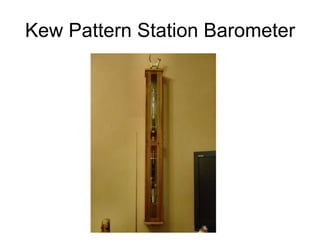
Kew Pattern Station Barometer
Effect of exposure to High Altitude
(Low Pressure)
• Human is physiologically adapted to live at
One atm pressure.
• Air is less dense- partial pressure of O2 is
also less.
• Physiological Effects
– Increase in respiration
– Increase in concentration of Hb
– Increase in Cardiac output.
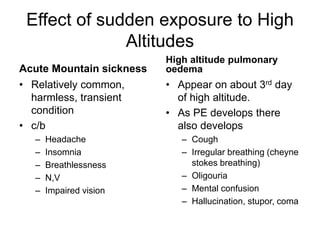
Effect of sudden exposure to High
Altitudes
Acute Mountain sickness
• Relatively common,
harmless, transient
condition
• c/b
– Headache
– Insomnia
– Breathlessness
– N,V
– Impaired vision
High altitude pulmonary
oedema
• Appear on about 3rd day
of high altitude.
• As PE develops there
also develops
– Cough
– Irregular breathing (cheyne
stokes breathing)
– Oligouria
– Mental confusion
– Hallucination, stupor, coma
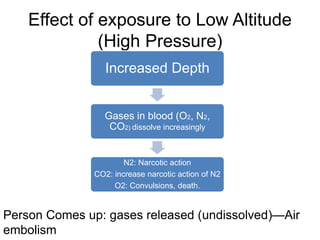
Effect of exposure to Low Altitude
(High Pressure)
Increased Depth
Gases in blood (O2, N2,
CO2) dissolve increasingly
N2: Narcotic action
CO2: increase narcotic action of N2
O2: Convulsions, death.
Person Comes up: gases released (undissolved)—Air
embolism
2. Air Temperature
• Represents Degree of hot/coldness of air.
• Influenced by
– Latitude of place
– Altitude
– Direction of wind
– Proximity to sea
Air Temperature
• Measurement : Thermometer
• Commonly used are Mercury thermometers
– Boils at high temperature (356.73 degree celcius)
– Has regular expansion
– Levels can be seen easily.
• Alcohol thermometer used at many places
since it has advantage of not solidifying even
at lowest known temperatures.(*freezing
point of mercury: -38.83 degree celcius)
Air Temperature
• Essential conditions for use of
thermometers:
– Air should have free access to the bulb
– Should be protected against radiant heat.
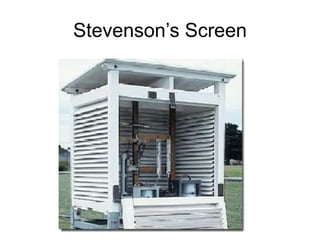
Stevenson screen
Used in all meteorological observatories in India
Stevenson’s Screen
Types of Thermometers
1. Dry bulb thermometer
2. Wet bulb thermometer
3. Maximum thermometer
4. Minimum thermometer
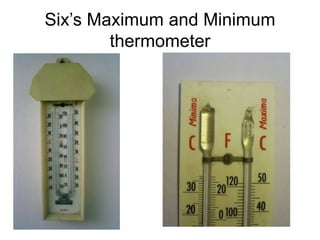
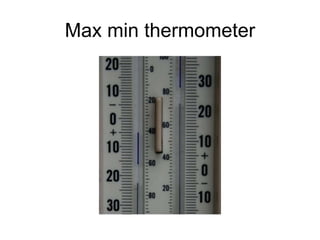
5. Six’s maximum and minimum thermometer
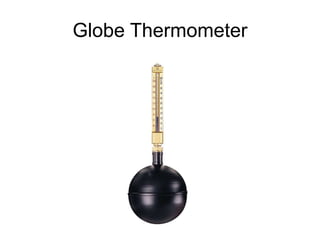
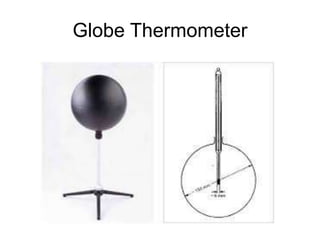
6. Globe thermometer
7. Wet globe thermometer
8. Silvered thermometer
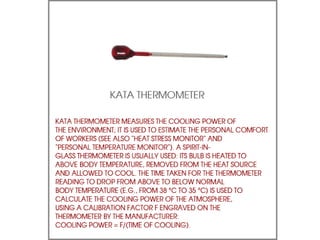
9. Kata thermometer
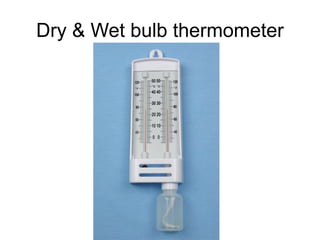
Dry & Wet bulb thermometer
Six’s Maximum and Minimum
thermometer
Max min thermometer
Globe Thermometer
Globe Thermometer
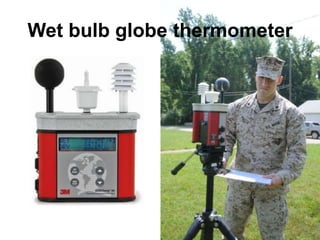
Wet bulb globe thermometer
Wet Bulb Globe Temperature
• It is used by industrial hygienists, athletes, and
the military to determine appropriate exposure
levels to high temperatures.
• In hot areas, some US military installations display a
flag to indicate the heat category based on the
WBGT.
• The military publishes guidelines for water intake
and physical activity level for acclimated and
unacclimated individuals in different uniforms based
on the heat category.
Heat stress indices
• Include
– Equatorial comfort index
– Heat stress index
– Predicted four hour sweat rate
Effects of Heat stress
1. Heat stroke
2. Heat hyperpyrexia
3. Heat exhaustion
4. Heat cramps
5. Heat syncope
Preventive measures
– Replacement of water
– Regulation of work
– Clothing
– Protective devices
– Work environment
Effects of Cold stress
• Hypothermia :
– c/b numbness, loss of sensation, muscular
weakness, desire for sleep, coma and death.
• Immersion/ trench foot
• Frostbite
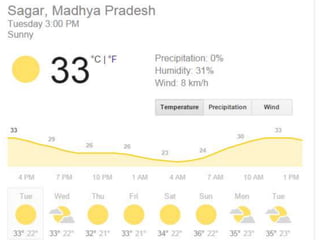
3. Humidity
• Moisture
• Amount of moisture which air can hold
depends upon its temperature.
• Humans are very sensitive to humidity, as
the skin relies on the air to get rid of
moisture.
• Expressed as
– Absolute humidity
– Relative humidity
Absolute humidity
• Weight of water vapor in a unit volume of
air
• Expressed as gms per cubic meter of air
Relative humidity
• Most common way of describing atmospheric
moisture.
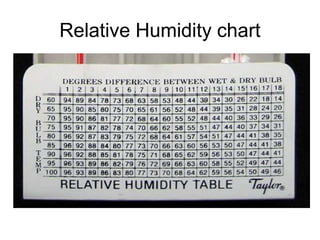
• Relative humidity is the ratio of the amount of
water vapour actually in the air to the
maximum amount of water vapour for
saturation at that particular temp & pressure.
• A reading of 100 percent relative humidity
means that the air is totally saturated with
water vapor and cannot hold any more,
creating the possibility of rain.
Relative humidity
• The process of sweating is our body's attempt to keep
cool and maintain its current temperature.
• If the air is at 100-percent relative humidity, sweat will
not evaporate into the air. As a result, we feel much
hotter than the actual temperature when the relative
humidity is high.
• If the relative humidity is low, we can feel much cooler
than the actual temperature because our sweat
evaporates easily, cooling us off.
• Very low RH causes skin cracks, dry flakes, itch, irritates
mucous membrane in nose, throat (itchy throat).
• Dry nasal passages permit bacteria to incubate causing
persistent infection.
Dew point
• Represents TEMPERATURE to which air
would have to be cooled (with no change
in pressure/moisture) for saturation to
occur.
• High Dew point indicates high water
vapour content and low dew point indicate
low water vapour content.
• Frost point
Measurement of Humidity
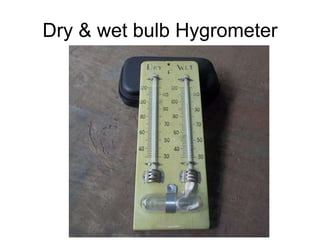
• Dry & wet bulb Hygrometer
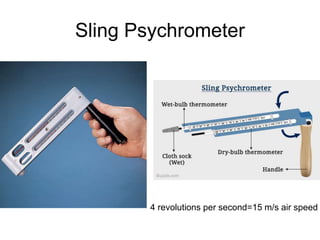
• Sling Psychrometer
• Assmann Psychrometer
Dry & wet bulb Hygrometer
Relative Humidity chart
Sling Psychrometer
4 revolutions per second=15 m/s air speed
4. Precipitation
• Collective term used for rain, snow, hail,
dew, and frost i.e. all forms of water
precipitated from the atmosphere.
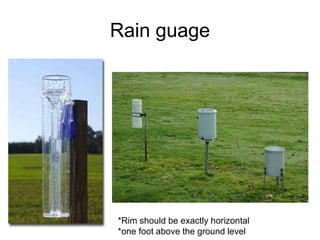
• Measured by rain guages
Rain guage
*Rim should be exactly horizontal
*one foot above the ground level
5. Air velocity
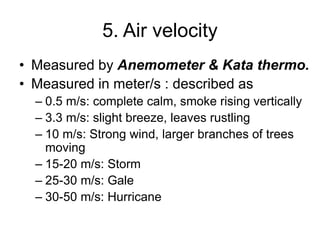
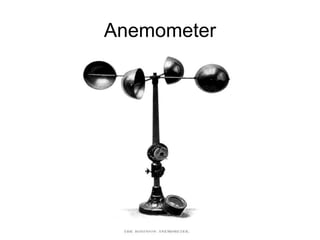
• Measured by Anemometer & Kata thermo.
• Measured in meter/s : described as
– 0.5 m/s: complete calm, smoke rising vertically
– 3.3 m/s: slight breeze, leaves rustling
– 10 m/s: Strong wind, larger branches of trees
moving
– 15-20 m/s: Storm
– 25-30 m/s: Gale
– 30-50 m/s: Hurricane
Anemometer
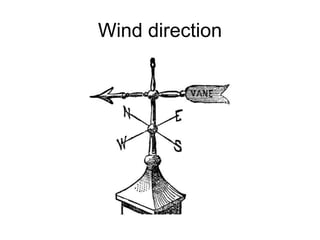
Wind direction
6. Clouds
• Are observed for their form, amount,
direction, height.
• Gives insight into sequence of weather.
• From the state of sky and evolution of
clouds, weather is described as fine, fair,
unsettled, bad, thunderous.

Meteorological environment

  • 1.
    Meteorological Environment Dr RupeshSahu, M.D. Assistant Professor Department of Community Medicine BMC, Sagar
  • 2.
    Objectives • To knowabout various Meteorological elements • To know how are they measured • To know what are their effects on health
  • 3.
    Meteorology • the branchof science concerned with the processes and phenomena of the atmosphere, especially as a means of forecasting the weather.
  • 4.
    Meteorological Environment • FollowingElements comprise Meteorological Environment 1. Atmospheric pressure 2. Air Temperature 3. Humidity 4. Rainfall 5. Direction & speed of wind 6. Movement of clouds & character of weather
  • 5.
    ‘Climate’ • A geographicalconcept representing a summation of the whole range of meteorological environment
  • 6.
    Measurement • By Barometer. •3 types – Fortins b – Kew pattern station b: used in Indian Meteorological dept – Barograph
  • 7.
  • 8.
    Effect of exposureto High Altitude (Low Pressure) • Human is physiologically adapted to live at One atm pressure. • Air is less dense- partial pressure of O2 is also less. • Physiological Effects – Increase in respiration – Increase in concentration of Hb – Increase in Cardiac output.
  • 9.
    Effect of suddenexposure to High Altitudes Acute Mountain sickness • Relatively common, harmless, transient condition • c/b – Headache – Insomnia – Breathlessness – N,V – Impaired vision High altitude pulmonary oedema • Appear on about 3rd day of high altitude. • As PE develops there also develops – Cough – Irregular breathing (cheyne stokes breathing) – Oligouria – Mental confusion – Hallucination, stupor, coma
  • 10.
    Effect of exposureto Low Altitude (High Pressure) Increased Depth Gases in blood (O2, N2, CO2) dissolve increasingly N2: Narcotic action CO2: increase narcotic action of N2 O2: Convulsions, death. Person Comes up: gases released (undissolved)—Air embolism
  • 11.
    2. Air Temperature •Represents Degree of hot/coldness of air. • Influenced by – Latitude of place – Altitude – Direction of wind – Proximity to sea
  • 12.
    Air Temperature • Measurement: Thermometer • Commonly used are Mercury thermometers – Boils at high temperature (356.73 degree celcius) – Has regular expansion – Levels can be seen easily. • Alcohol thermometer used at many places since it has advantage of not solidifying even at lowest known temperatures.(*freezing point of mercury: -38.83 degree celcius)
  • 13.
    Air Temperature • Essentialconditions for use of thermometers: – Air should have free access to the bulb – Should be protected against radiant heat. Stevenson screen Used in all meteorological observatories in India
  • 14.
  • 15.
    Types of Thermometers 1.Dry bulb thermometer 2. Wet bulb thermometer 3. Maximum thermometer 4. Minimum thermometer 5. Six’s maximum and minimum thermometer 6. Globe thermometer 7. Wet globe thermometer 8. Silvered thermometer 9. Kata thermometer
  • 16.
    Dry & Wetbulb thermometer
  • 17.
    Six’s Maximum andMinimum thermometer
  • 18.
  • 19.
  • 20.
  • 22.
    Wet bulb globethermometer
  • 23.
    Wet Bulb GlobeTemperature • It is used by industrial hygienists, athletes, and the military to determine appropriate exposure levels to high temperatures. • In hot areas, some US military installations display a flag to indicate the heat category based on the WBGT. • The military publishes guidelines for water intake and physical activity level for acclimated and unacclimated individuals in different uniforms based on the heat category.
  • 24.
    Heat stress indices •Include – Equatorial comfort index – Heat stress index – Predicted four hour sweat rate
  • 25.
    Effects of Heatstress 1. Heat stroke 2. Heat hyperpyrexia 3. Heat exhaustion 4. Heat cramps 5. Heat syncope
  • 26.
    Preventive measures – Replacementof water – Regulation of work – Clothing – Protective devices – Work environment
  • 27.
    Effects of Coldstress • Hypothermia : – c/b numbness, loss of sensation, muscular weakness, desire for sleep, coma and death. • Immersion/ trench foot • Frostbite
  • 28.
    3. Humidity • Moisture •Amount of moisture which air can hold depends upon its temperature. • Humans are very sensitive to humidity, as the skin relies on the air to get rid of moisture. • Expressed as – Absolute humidity – Relative humidity
  • 29.
    Absolute humidity • Weightof water vapor in a unit volume of air • Expressed as gms per cubic meter of air
  • 30.
    Relative humidity • Mostcommon way of describing atmospheric moisture. • Relative humidity is the ratio of the amount of water vapour actually in the air to the maximum amount of water vapour for saturation at that particular temp & pressure. • A reading of 100 percent relative humidity means that the air is totally saturated with water vapor and cannot hold any more, creating the possibility of rain.
  • 31.
    Relative humidity • Theprocess of sweating is our body's attempt to keep cool and maintain its current temperature. • If the air is at 100-percent relative humidity, sweat will not evaporate into the air. As a result, we feel much hotter than the actual temperature when the relative humidity is high. • If the relative humidity is low, we can feel much cooler than the actual temperature because our sweat evaporates easily, cooling us off. • Very low RH causes skin cracks, dry flakes, itch, irritates mucous membrane in nose, throat (itchy throat). • Dry nasal passages permit bacteria to incubate causing persistent infection.
  • 33.
    Dew point • RepresentsTEMPERATURE to which air would have to be cooled (with no change in pressure/moisture) for saturation to occur. • High Dew point indicates high water vapour content and low dew point indicate low water vapour content. • Frost point
  • 34.
    Measurement of Humidity •Dry & wet bulb Hygrometer • Sling Psychrometer • Assmann Psychrometer
  • 35.
    Dry & wetbulb Hygrometer
  • 36.
  • 37.
    Sling Psychrometer 4 revolutionsper second=15 m/s air speed
  • 38.
    4. Precipitation • Collectiveterm used for rain, snow, hail, dew, and frost i.e. all forms of water precipitated from the atmosphere. • Measured by rain guages
  • 39.
    Rain guage *Rim shouldbe exactly horizontal *one foot above the ground level
  • 40.
    5. Air velocity •Measured by Anemometer & Kata thermo. • Measured in meter/s : described as – 0.5 m/s: complete calm, smoke rising vertically – 3.3 m/s: slight breeze, leaves rustling – 10 m/s: Strong wind, larger branches of trees moving – 15-20 m/s: Storm – 25-30 m/s: Gale – 30-50 m/s: Hurricane
  • 41.
  • 42.
  • 43.
    6. Clouds • Areobserved for their form, amount, direction, height. • Gives insight into sequence of weather. • From the state of sky and evolution of clouds, weather is described as fine, fair, unsettled, bad, thunderous.