Air Conditioning
Air conditioning is the process of
treating air to control its
temperature, humidity,
cleanliness and distribution to
meet the space requirement.
 Merely lowering or raising the temperature does
not provide comfort in general to the machines or its
components and living beings in particular.
 In case of the machine components, along with
temperature, humidity(moisture content in the air) also
has to be controlled and for the comfort of human beings
along with these two important parameters, air motion and
cleanliness also play a vital role.
 Air conditioning, therefore, is a broader aspect which
looks into the simultaneous control of all parameters
which are essential for the comfort of human beings or
animals or for the proper performance of some industrial
or scientific process.
 Simultaneous control the big industrial difficulty
Therefore
Air conditioning is the process of simultaneous
control of temperature, humidity, cleanliness and
air motion.
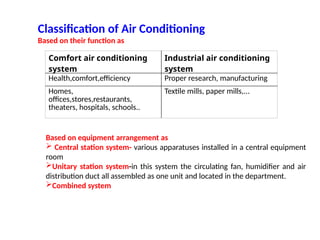
Classification of Air Conditioning
Based on their function as
Comfort air conditioning
system
Industrial air conditioning
system
Health,comfort,efficiency Proper research, manufacturing
Homes,
offices,stores,restaurants,
theaters, hospitals, schools..
Textile mills, paper mills,...
Based on equipment arrangement as
 Central station system- various apparatuses installed in a central equipment
room
Unitary station system-in this system the circulating fan, humidifier and air
distribution duct all assembled as one unit and located in the department.
Combined system
The atmospheric conditions with respect to temperature and
humidity play very important part in the manufacutring
process of textile yarns and fabrics.
The properties like dimensions, weight, tensile strength,
elastic recovery, electrical resistance, rigidity etc. of all textile
fibre whether natural or synthetic are influenced by Moisture
Regain.
Moisture regain is the ratio of the moisture to the bone-dry
weight of the material expressed as a percentage.
Many properties of textile materials vary considerably with
moisture regain, which in turn is affected by the ambient
Relative Humidity (RH) and Temparature.
Strength of COTTON goes up when R.H.% goes up
Strength of VISCOSE goes down when R.H.% goes up
Elongation %ge goes up with increased R.H.% for most
textile fibres
the tendency for generation of static electricity due to
friction decreases as RH goes up
At higher levels of RH , there is also a tendency of the fibres
to stick together
Some physical properties of textile materials which is
affected by RH are:
PSYCHROMETRY:
psychrometrics is the study of the thermodynamic
properties of air and water vapour mixture or simply the
study of solubility of moisture in air at different
temperatures , the associated heat contents and the
method of controlling the thermal properties of air.
In order to study, describe, and understand the events
that occur within the atmosphere, measuring the
physical characteristics of the air within which these
events take place is a common duty.
Air can primarily be described in terms of its
composition, -temperature, -
pressure, -Humidity
- precipitation
Physical Properties of Air
Air Composition
The earth’s atmosphere is a mixture of gases, mainly
N2 and oxygen O2, that are held to the earth by
gravity.
 Near the earth’s surface, air is composed of about
78% N2and 21% O2.
 Small amounts of other gases, such as CO2, argon
(Ar), methane (CH4), nitrous oxide (N2O), and water
vapor (H2O), are also present.
The concentration of the invisible water vapor
varies from place to place and from time to time.
 Near the ground in warm tropical locations, the
concentration of water vapor may reach 4%, while in polar
areas its concentrations may be only a small fraction.
Air molecules are in constant motion.
The speed of air molecules corresponds to their
kinetic energy, which in turn corresponds to the
amount of heat energy in the air.
Air temperature is a measure of the average speed
at which air molecules are moving;
high speeds correspond to higher temperatures.
Air Temperature
Air Pressure
Air is held to the earth by gravity. This strong invisible force
pulls the air downward, giving air molecules weight. The
weight of the air molecules exerts a force upon the earth and
everything on it.
The air pressure at any level in the atmosphere can be
expressed as the total weight of air above.
Higher in the atmosphere, there are fewer air molecules
pressing down from above.
Consequently, air pressure always decreases with increasing
height above the ground /the density of the air is greatest at the
ground and decreases at higher altitudes.
A column of air 1 sq cm in area, extending from the ocean
surface up to the top of the atmosphere would contain slightly
more than 1 kg of air.
Air Humidity
Humidity refers to the air’s water vapor content.
Hygrometers are instruments that measures humidity.
The maximum amount of water vapor that the air can hold
depends on the air temperature; warm air is capable of
holding more water vapor than cold air.
Specific humidity is the actual weight of water vapour
mixed in a unit mass of air.
Relative humidity is the ratio of the amount of water vapor
in the air compared to the maximum amount of water vapor
that the air could hold at that particular temperature.
When the air is holding all of the moisture possible at a
particular temperature, the air is said to be saturated.
Relative humidity and dew-point temperature (the
temperature to which air would have to be cooled for
saturation to occur) are often obtained with a device called a
psychrometer.
By looking up the dry and wet bulb temperatures on a
humidity tables, it is possible to find the corresponding
relative humidity and dew-point temperature.
Heat Contents of Air
Air contains sensible and latent heat
 Sensible heat is heat which when supplied to or
removed from a substance, produces a sensible effect on the
substance i.e a change of temperature but not the moisture
content of the substance.
Latent heat is heat which when supplied to or removed
from a substance, produces a change of state without any
change in temperature.
T-H (temperature heat diagram)
END

Presentation1.pptx for textile engineering

  • 1.
  • 2.
    Air conditioning isthe process of treating air to control its temperature, humidity, cleanliness and distribution to meet the space requirement.
  • 3.
     Merely loweringor raising the temperature does not provide comfort in general to the machines or its components and living beings in particular.  In case of the machine components, along with temperature, humidity(moisture content in the air) also has to be controlled and for the comfort of human beings along with these two important parameters, air motion and cleanliness also play a vital role.  Air conditioning, therefore, is a broader aspect which looks into the simultaneous control of all parameters which are essential for the comfort of human beings or animals or for the proper performance of some industrial or scientific process.  Simultaneous control the big industrial difficulty
  • 4.
    Therefore Air conditioning isthe process of simultaneous control of temperature, humidity, cleanliness and air motion.
  • 5.
    Classification of AirConditioning Based on their function as Comfort air conditioning system Industrial air conditioning system Health,comfort,efficiency Proper research, manufacturing Homes, offices,stores,restaurants, theaters, hospitals, schools.. Textile mills, paper mills,... Based on equipment arrangement as  Central station system- various apparatuses installed in a central equipment room Unitary station system-in this system the circulating fan, humidifier and air distribution duct all assembled as one unit and located in the department. Combined system
  • 6.
    The atmospheric conditionswith respect to temperature and humidity play very important part in the manufacutring process of textile yarns and fabrics. The properties like dimensions, weight, tensile strength, elastic recovery, electrical resistance, rigidity etc. of all textile fibre whether natural or synthetic are influenced by Moisture Regain. Moisture regain is the ratio of the moisture to the bone-dry weight of the material expressed as a percentage. Many properties of textile materials vary considerably with moisture regain, which in turn is affected by the ambient Relative Humidity (RH) and Temparature.
  • 7.
    Strength of COTTONgoes up when R.H.% goes up Strength of VISCOSE goes down when R.H.% goes up Elongation %ge goes up with increased R.H.% for most textile fibres the tendency for generation of static electricity due to friction decreases as RH goes up At higher levels of RH , there is also a tendency of the fibres to stick together Some physical properties of textile materials which is affected by RH are:
  • 8.
    PSYCHROMETRY: psychrometrics is thestudy of the thermodynamic properties of air and water vapour mixture or simply the study of solubility of moisture in air at different temperatures , the associated heat contents and the method of controlling the thermal properties of air.
  • 9.
    In order tostudy, describe, and understand the events that occur within the atmosphere, measuring the physical characteristics of the air within which these events take place is a common duty. Air can primarily be described in terms of its composition, -temperature, - pressure, -Humidity - precipitation Physical Properties of Air
  • 10.
    Air Composition The earth’satmosphere is a mixture of gases, mainly N2 and oxygen O2, that are held to the earth by gravity.  Near the earth’s surface, air is composed of about 78% N2and 21% O2.  Small amounts of other gases, such as CO2, argon (Ar), methane (CH4), nitrous oxide (N2O), and water vapor (H2O), are also present. The concentration of the invisible water vapor varies from place to place and from time to time.  Near the ground in warm tropical locations, the concentration of water vapor may reach 4%, while in polar areas its concentrations may be only a small fraction.
  • 11.
    Air molecules arein constant motion. The speed of air molecules corresponds to their kinetic energy, which in turn corresponds to the amount of heat energy in the air. Air temperature is a measure of the average speed at which air molecules are moving; high speeds correspond to higher temperatures. Air Temperature
  • 12.
    Air Pressure Air isheld to the earth by gravity. This strong invisible force pulls the air downward, giving air molecules weight. The weight of the air molecules exerts a force upon the earth and everything on it. The air pressure at any level in the atmosphere can be expressed as the total weight of air above. Higher in the atmosphere, there are fewer air molecules pressing down from above. Consequently, air pressure always decreases with increasing height above the ground /the density of the air is greatest at the ground and decreases at higher altitudes. A column of air 1 sq cm in area, extending from the ocean surface up to the top of the atmosphere would contain slightly more than 1 kg of air.
  • 13.
    Air Humidity Humidity refersto the air’s water vapor content. Hygrometers are instruments that measures humidity. The maximum amount of water vapor that the air can hold depends on the air temperature; warm air is capable of holding more water vapor than cold air. Specific humidity is the actual weight of water vapour mixed in a unit mass of air. Relative humidity is the ratio of the amount of water vapor in the air compared to the maximum amount of water vapor that the air could hold at that particular temperature. When the air is holding all of the moisture possible at a particular temperature, the air is said to be saturated.
  • 14.
    Relative humidity anddew-point temperature (the temperature to which air would have to be cooled for saturation to occur) are often obtained with a device called a psychrometer. By looking up the dry and wet bulb temperatures on a humidity tables, it is possible to find the corresponding relative humidity and dew-point temperature.
  • 15.
    Heat Contents ofAir Air contains sensible and latent heat  Sensible heat is heat which when supplied to or removed from a substance, produces a sensible effect on the substance i.e a change of temperature but not the moisture content of the substance. Latent heat is heat which when supplied to or removed from a substance, produces a change of state without any change in temperature. T-H (temperature heat diagram)
  • 16.