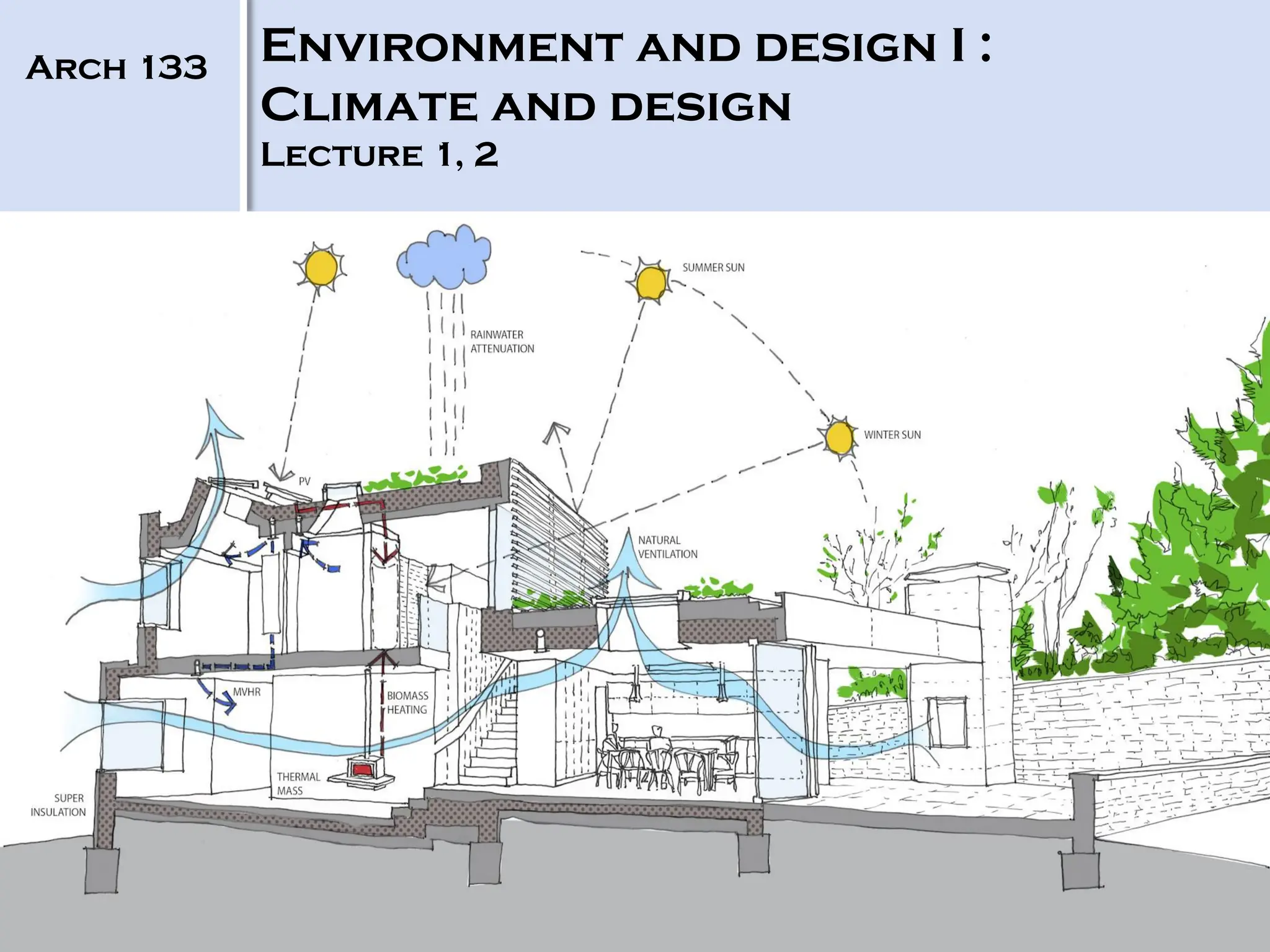
Course Content:
Study ofexternal and internal climatic condition of built forms. Behavior and
performance of built forms and its components as a climatic modifier to provide comfort
and energy savings through climate and architectural design. Factors of climate, site
climate, human comfort criteria and ranges. Thermal design criteria, principles of
thermal design and natural ventilation and its application in architectural design.
Environ-
mental
Design
Course content
3.
Environ-
mental
Design
What is environmental
design?
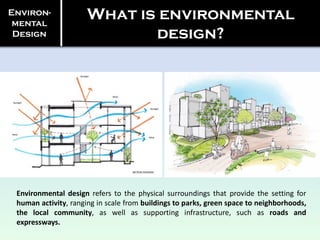
Environmentaldesign refers to the physical surroundings that provide the setting for
human activity, ranging in scale from buildings to parks, green space to neighborhoods,
the local community, as well as supporting infrastructure, such as roads and
expressways.
4.
Environ-
mental
Design
What is environmental
design?
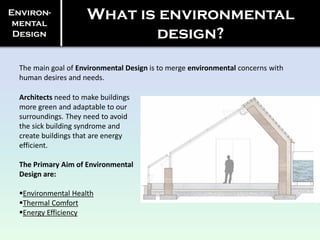
Themain goal of Environmental Design is to merge environmental concerns with
human desires and needs.
Architects need to make buildings
more green and adaptable to our
surroundings. They need to avoid
the sick building syndrome and
create buildings that are energy
efficient.
The Primary Aim of Environmental
Design are:
Environmental Health
Thermal Comfort
Energy Efficiency
• Architects designfor people - comfortable
buildings, user satisfaction, comfort and
productivity.
• Climate interaction with buildings creates a
thermal environment.
• Thermal environment consists of all those
features of the building and its surrounds
that affect the environment in terms of local
temperature, humidity, and air velocity.
• Thermal Environment within buildings
determines how a person feels (thermal
comfort: cold, hot, warm, 'sticky' etc.) and
their responses
• Awareness of these helps to design for
energy efficiency.
Environ-
mental
Design
architect’s involvement
with energy issue
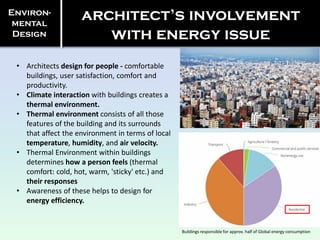
Buildings responsible for approx. half of Global energy consumption
7.
Environ-
mental
Design
Danger’s for ignoring
climaterelated issues
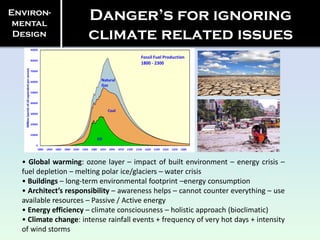
• Global warming: ozone layer – impact of built environment – energy crisis –
fuel depletion – melting polar ice/glaciers – water crisis
• Buildings – long-term environmental footprint –energy consumption
• Architect’s responsibility – awareness helps – cannot counter everything – use
available resources – Passive / Active energy
• Energy efficiency – climate consciousness – holistic approach (bioclimatic)
• Climate change: intense rainfall events + frequency of very hot days + intensity
of wind storms
8.
WEATHER
AND
CLIMATE
Are Weather andClimate
the Same?
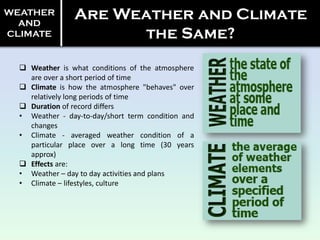
Weather is what conditions of the atmosphere
are over a short period of time
Climate is how the atmosphere "behaves" over
relatively long periods of time
Duration of record differs
• Weather - day-to-day/short term condition and
changes
• Climate - averaged weather condition of a
particular place over a long time (30 years
approx)
Effects are:
• Weather – day to day activities and plans
• Climate – lifestyles, culture
9.
CLIMATE
Elements of climate
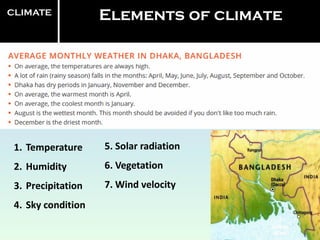
1.Temperature
2. Humidity
3. Precipitation
4. Sky condition
5. Solar radiation
6. Vegetation
7. Wind velocity
10.
temperature
Elements of climate
Temperature
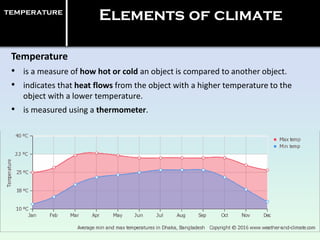
•is a measure of how hot or cold an object is compared to another object.
• indicates that heat flows from the object with a higher temperature to the
object with a lower temperature.
• is measured using a thermometer.
11.
11
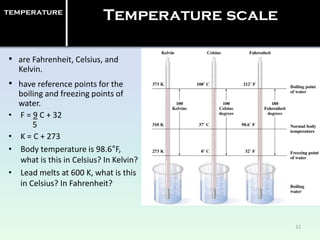
• are Fahrenheit,Celsius, and
Kelvin.
• have reference points for the
boiling and freezing points of
water.
• F = 9 C + 32
5
• K = C + 273
• Body temperature is 98.6°F,
what is this in Celsius? In Kelvin?
• Lead melts at 600 K, what is this
in Celsius? In Fahrenheit?
temperature
Temperature scale
12.
temperature Temperature measurement
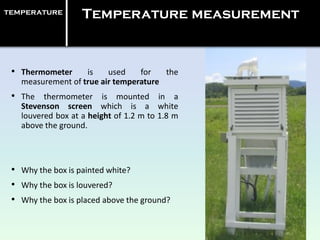
•Thermometer is used for the
measurement of true air temperature
• The thermometer is mounted in a
Stevenson screen which is a white
louvered box at a height of 1.2 m to 1.8 m
above the ground.
• Why the box is painted white?
• Why the box is louvered?
• Why the box is placed above the ground?
13.
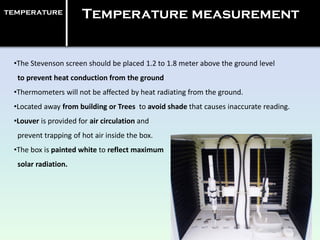
•The Stevenson screenshould be placed 1.2 to 1.8 meter above the ground level
to prevent heat conduction from the ground
•Thermometers will not be affected by heat radiating from the ground.
•Located away from building or Trees to avoid shade that causes inaccurate reading.
•Louver is provided for air circulation and
prevent trapping of hot air inside the box.
•The box is painted white to reflect maximum
solar radiation.
temperature Temperature measurement
14.
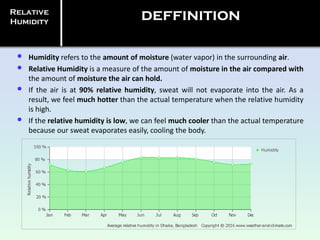
• Humidity refersto the amount of moisture (water vapor) in the surrounding air.
• Relative Humidity is a measure of the amount of moisture in the air compared with
the amount of moisture the air can hold.
• If the air is at 90% relative humidity, sweat will not evaporate into the air. As a
result, we feel much hotter than the actual temperature when the relative humidity
is high.
• If the relative humidity is low, we can feel much cooler than the actual temperature
because our sweat evaporates easily, cooling the body.
Relative
Humidity
deffinition
15.
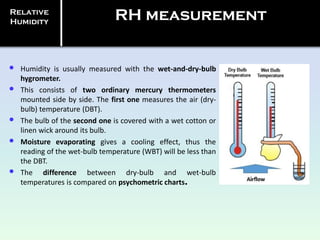
• Humidity isusually measured with the wet-and-dry-bulb
hygrometer.
• This consists of two ordinary mercury thermometers
mounted side by side. The first one measures the air (dry-
bulb) temperature (DBT).
• The bulb of the second one is covered with a wet cotton or
linen wick around its bulb.
• Moisture evaporating gives a cooling effect, thus the
reading of the wet-bulb temperature (WBT) will be less than
the DBT.
• The difference between dry-bulb and wet-bulb
temperatures is compared on psychometric charts.
Relative
Humidity
RH measurement
16.
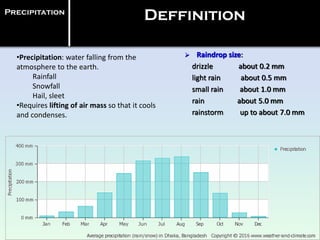
•Precipitation: water fallingfrom the
atmosphere to the earth.
Rainfall
Snowfall
Hail, sleet
•Requires lifting of air mass so that it cools
and condenses.
Precipitation
Deffinition
Raindrop size:
drizzle about 0.2 mm
light rain about 0.5 mm
small rain about 1.0 mm
rain about 5.0 mm
rainstorm up to about 7.0 mm
17.
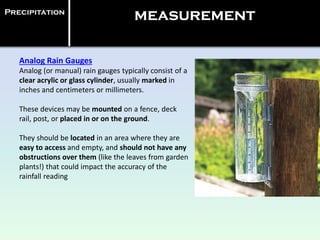
Analog Rain Gauges
Analog(or manual) rain gauges typically consist of a
clear acrylic or glass cylinder, usually marked in
inches and centimeters or millimeters.
These devices may be mounted on a fence, deck
rail, post, or placed in or on the ground.
They should be located in an area where they are
easy to access and empty, and should not have any
obstructions over them (like the leaves from garden
plants!) that could impact the accuracy of the
rainfall reading
Precipitation
measurement
18.
Sky conditions areusually described in
terms of presence or absence of clouds.
The proportion of sky covered by cloud is
expressed as a percentage e.g. 50%.
Usually overcast skies are used as design
criteria because they represent worst-
case scenarios.
However, for buildings near the equator,
uniform skies may be more accurate.
Sky condition
measurement
19.
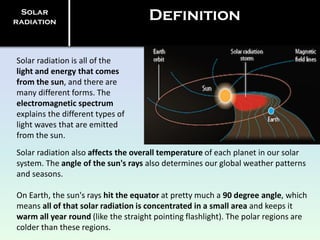
Solar radiation alsoaffects the overall temperature of each planet in our solar
system. The angle of the sun's rays also determines our global weather patterns
and seasons.
On Earth, the sun's rays hit the equator at pretty much a 90 degree angle, which
means all of that solar radiation is concentrated in a small area and keeps it
warm all year round (like the straight pointing flashlight). The polar regions are
colder than these regions.
Solar
radiation
Definition
Solar radiation is all of the
light and energy that comes
from the sun, and there are
many different forms. The
electromagnetic spectrum
explains the different types of
light waves that are emitted
from the sun.
20.
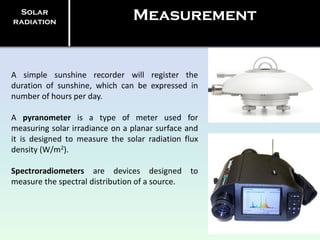
A simple sunshinerecorder will register the
duration of sunshine, which can be expressed in
number of hours per day.
A pyranometer is a type of meter used for
measuring solar irradiance on a planar surface and
it is designed to measure the solar radiation flux
density (W/m2).
Spectroradiometers are devices designed to
measure the spectral distribution of a source.
Solar
radiation
Measurement
21.
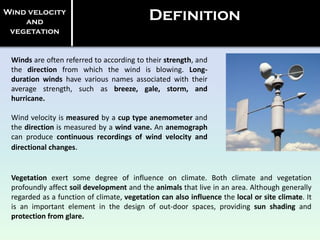
Winds are oftenreferred to according to their strength, and
the direction from which the wind is blowing. Long-
duration winds have various names associated with their
average strength, such as breeze, gale, storm, and
hurricane.
Wind velocity is measured by a cup type anemometer and
the direction is measured by a wind vane. An anemograph
can produce continuous recordings of wind velocity and
directional changes.
Wind velocity
and
vegetation
Definition
Vegetation exert some degree of influence on climate. Both climate and vegetation
profoundly affect soil development and the animals that live in an area. Although generally
regarded as a function of climate, vegetation can also influence the local or site climate. It
is an important element in the design of out-door spaces, providing sun shading and
protection from glare.
22.
Psycrometric
chart
Definition
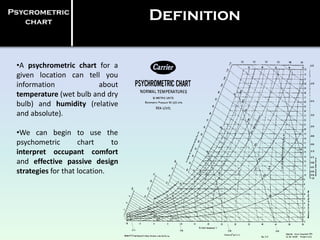
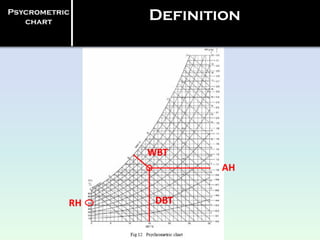
•A psychrometric chartfor a
given location can tell you
information about
temperature (wet bulb and dry
bulb) and humidity (relative
and absolute).
•We can begin to use the
psychometric chart to
interpret occupant comfort
and effective passive design
strategies for that location.
23.
Psycrometric
chart
Definition
DBT
WBT
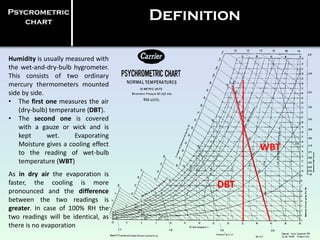
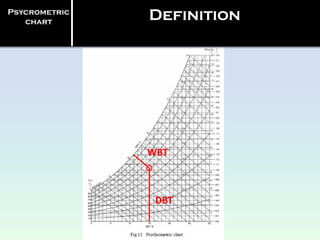
Humidity is usuallymeasured with
the wet-and-dry-bulb hygrometer.
This consists of two ordinary
mercury thermometers mounted
side by side.
• The first one measures the air
(dry-bulb) temperature (DBT).
• The second one is covered
with a gauze or wick and is
kept wet. Evaporating
Moisture gives a cooling effect
to the reading of wet-bulb
temperature (WBT)
As in dry air the evaporation is
faster, the cooling is more
pronounced and the difference
between the two readings is
greater. In case of 100% RH the
two readings will be identical, as
there is no evaporation
24.
Psycrometric
chart
Definition
AH
RH
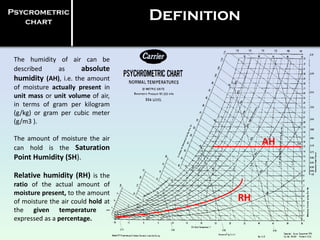
The humidity ofair can be
described as absolute
humidity (AH), i.e. the amount
of moisture actually present in
unit mass or unit volume of air,
in terms of gram per kilogram
(g/kg) or gram per cubic meter
(g/m3 ).
The amount of moisture the air
can hold is the Saturation
Point Humidity (SH).
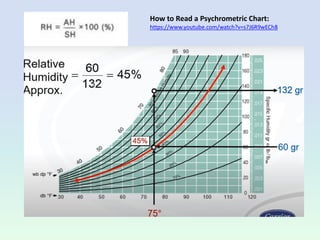
Relative humidity (RH) is the
ratio of the actual amount of
moisture present, to the amount
of moisture the air could hold at
the given temperature –
expressed as a percentage.