BIOLOGICAL DISASTERS
Dr. Hemraj Soni
Paediatrician
SMS medical College, Jaipur
DEFINATION-
o Biological disasters are scenarios involving disease,
disability or death on a large scale among humans, animals
and plants due to toxins or disease caused by live organisms
or their products.
Such disasters may be natural in the form of epidemics or
pandemics of existing, emerging or reemerging diseases and
pestilences or man-made by the intentional use of disease
causing agents in Biological Warfare (BW) operations or
incidents of Bioterrorism (BT).
• Anthrax - spore dispersal in the air
• Small pox - aerosols
• Typhus & plague - lice, fleas, rodents, etc.
BIO- TERRORISM(BIOLOGICAL WARFARE)
 Bio- Terrorism -A bioterrorism attack is the deliberate release
of viruses, bacteria, or other germs (agents) used to cause
illness or death in people, animals, or plants
eg- Japan used plauge bacilli in china during 1932-1945
causing 260000 death.
TRENDS FAVORING BIOLOGICAL WEAPONS
• Low cost and widespread availability
• More efficient in terms of coverage/Kg of payload
• Advances in biotechnology have made production easy
• Agents are largely natural pathogens and simulate
existing diseases.
• Have an unmatched destructive potential
• Technology for dispersing biological agents
sophisticated.
• The lag time between infection and appearance of
symptoms is longer than with chemical exposures.
• Lethal biological agents can be produced easily and
cheaply
• Difficult to detect
METHODS OF DISSEMINATION/DELIVERY
• Aerosols - biological agents are dispersed into the air, forming
a fine mist that may drift for miles.
• Animals – fleas, mice, flies, mosquitoes, and livestock.
• Food and water contamination - some pathogenic organisms
and toxins may persist in food and water supplies.
• Person-to-person : Smallpox, Plague, and the Lassa
CATEGORIES OF BIOLOGICAL AGENTS
• There are three categories of biological agents potential
enough to cause mass casualties (Center for Disease Control
& Prevention).
• Category A, B & C • Those in category A have the greatest
potential for fear and disruption and most significant public
health impacts
CATEGORY- A
• Easily disseminated or transmitted person-to-person
• High mortality
• Require special action for public health preparedness
• Viruses: Variola major (SmallPox), Filo viruses (Ebola,
Marburg), Arenaviruses (Lassa, Junin)
• Bacteria: Bacillus anthracis (anthrax), Yersinia pestis
(plague), Francisella tularensis (tularemia)
• Toxins: Clostridium botulinum toxin (botulism)
CATEGORY B
• Moderately easy to disseminate
• Moderate morbidity and low mortality
• Require improved diagnostic capacity & enhanced
surveillance
• Viruses: Alphaviruses . eg.Chikungunya virus
• Bacteria: Coxiella burnetii (Q fever), Brucella spp.
(brucellosis), Burkholderia mallei (glanders)
• Toxins: Ricinus communis(caster beans) ricin toxin,
Clostridium perfringens episolon toxin, Staphylococcus
enterotoxin B
• Food/waterborne pathogens: Salmonella spp., Vibrio
cholerae, E. coli O157:H7, Shigella dysenteriae,
Cryptosporidium parvum, etc.
CATEGORY C
These third highest priority agents include emerging pathogens
that could be engineered for mass spread in the future
because:
• Easily available
• Easily produced and spread
• Have potential for high morbidity and mortality rates and major
health impact.
• Viruses: Nipah, hantaviruses, tick borne hemorrhagic fever
viruses, tick borne encephalitis viruses, yellow fever
• Bacteria: Multi-drug resistant Mycobacterium tuberculosis
HISTORY: MAJOR EVENTS ACROSS THE GLOBE
Biological warfare has a long history of mass destruction -
epidemic and pandemic diseases.
• Limited biological warfare is reported to have been carried out
by Japan during World War-II
• Mycotoxins have been reported to be used in Afghanisthan
• The Red Indians in North America were given the smallpox
infected blankets
• 2001, the USA experienced biological attacks involving the
intentional distribution of bacillus anthracis spores through
the postal system.
DOCUMENTED INTENTIONAL USE OF BIOLOGICALS
• Japan used plague bacilli in China during 1932-1945 causing
260,000 deaths.
• Dispersal of anthrax spores due to accident in production unit
in USSR (Sverdlovsk) caused 68 deaths in 1979.
• In 1984, Osho followers used Salmonella typhimurium in
salad in a restaurant in Oregaon, USA leading to 751 cases.
• Shigella dysenteriae Type 2 used in Texas, USA in 1996
• Anthrax spores through postal envelopes in USA in Oct-Nov
2001, leading to 22 cases and 5 deaths
PREVENTION OF BIOLOGICAL DISASTERS
 Vulnerability Analysis and Risk Assessment
 Environmental Management
i. Water supply
ii. Personal hygiene
iii. Vector control
iv. Burial/disposal of the dead
 Prevention of Post-disaster Epidemics
 Integrated Disease Surveillance Systems
 Pharmaceutical Interventions: Chemoprophylaxis,
Immunisation and Other Preventive Measures
 Non-pharmaceutical Interventions
I. Social Distancing Measures
II. Disease Containment by Isolation and
Quarantine Methodologies
 Biosafety and Biosecurity Measures
IMPACTS
• Even a small-scale biological attack with a weapon
grade agent on an urban center could cause
massive morbidity and mortality, rapidly
overwhelming the local medical capabilities.
• For example, an aerosolized release of little as
100kg of anthrax spores upwind of a metro city of a
size of Washington DC has been estimated to have
the potential to cause up to three millions of deaths.
PREVENTION AND MITIGATION MEASURES:
GENERAL MEASURES OF PROTECTION
1. The general population should be educated and made
aware of the threats and risks associated with it.
2. Only cooked food and boiled/chlorinated/filtered water
should be consumed.
3. Insects and rodents control measures must be initiated
immediately.
4. An early accurate diagnosis is the key to manage casualties
of biological warfare.
5. Mass immunization programme in the suspected area has
been more vigorously followed up.
ACTION PLAN FOR BIOLOGICAL DISASTER IN
INDIA
Biological Disaster could arise from a source located either
inside the country or outside the country (warfare).
Management of such a situation could be dealt effectively only if
there is a disaster plan well integrated in the system and also
there is mechanism of post disaster evaluation.
Action plan has following elements:
One of the simplest & easy method to suspect is to take notice
of a situation during which more patients with similar ailments
from a particular locality start consulting health guide at village
level.
(A) Constitution of a Crisis Management
Structure-
• Identification of Nodal Officers for Crisis Management at
District, State & Central Level.
• Identification of Focal points for control of epidemic at
District,State & Central Level.
• Constitution of advisory committees - Administrative and
Technical
• Preparation of contingecy plan including Standing Operating
Procedure (SOP) at District, State & Central Level.
(B) System of Surveillance
• System of information collection at District, State &
Central Level.
• System of data analysis
• System for flow of information from District to State and to
Central Level during crisis period.
• Establishment of control rooms at District, State & Central
Level.
(C) System of Epidemiological Investigation
• System of field investigation
• System of active surveillance
• Arrangement for support facilities
PRE IMPACT STAGE OF WARNING (EARLY DETECTION):
Early warning signals-
• Early identification of an outbreak of disease of
international public health .Some of the suggested early
warning signals which must command quick
investigation by professionals may include followings:
• Sudden high mortality or morbidity following acute
infection with short incubation period.
• Acute fever with haemorrhagic manifestations.
• Acute fever with altered sensorium and malaria in
endemic areas.
• Occurrence of cases which are difficult to diagnose
with available
 clinical and laboratory support and their non-
responsive to conventional
 Therapies.
• Clustering of cases/deaths in time and space with
high case fatality
 Rate.
• Unusual clinical or laboratory presentations.
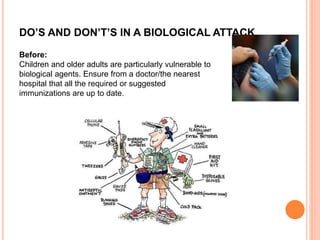
DO’S AND DON’T’S IN A BIOLOGICAL ATTACK
Before:
Children and older adults are particularly vulnerable to
biological agents. Ensure from a doctor/the nearest
hospital that all the required or suggested
immunizations are up to date.
DURING:
• In the event of a biological attack, Close the doors
and windows when a biological attack is imminent.
• Watch television, listen to radio, or check the
Internet for official news and information ,you
should seek medical attention if you become ill.
• The first evidence of an attack may be when you
notice symptoms of the disease caused by
exposure to an agent.
• Be suspicious of any symptoms you notice, but do
not assume that any illness is a result of the
attack.
• Use common sense and practice good hygiene.
 However, if you notice of an unusual and
suspicious substance nearby:
• Move away quickly.
• Cover your head and nose.
• Listen to the media for official instructions.
• Seek medical attention if you become sick.
 If you are exposed to a biological agent:
• Ultra efficient filter masks can be used.
• Follow official instructions for disposal of contaminated items
such as bag and cloths.
• Take bath with soap and put on clean clothes.
• Seek medical assistance.
• If required and advised, stay away from others or even
quarantined.
AFTER:
• Pay close attention to all official warnings and instructions on
how to proceed.
• The delivery of medical services for a biological event may be
handled differently to respond to increased demand.
• The basic public health procedures and medical protocols for
handling exposure to biological agents are the same as for
any infectious disease.
• It is important for you to pay attention to official instructions via
radio, television, and emergency alert systems.

Biological disater

  • 1.
    BIOLOGICAL DISASTERS Dr. HemrajSoni Paediatrician SMS medical College, Jaipur
  • 2.
    DEFINATION- o Biological disastersare scenarios involving disease, disability or death on a large scale among humans, animals and plants due to toxins or disease caused by live organisms or their products. Such disasters may be natural in the form of epidemics or pandemics of existing, emerging or reemerging diseases and pestilences or man-made by the intentional use of disease causing agents in Biological Warfare (BW) operations or incidents of Bioterrorism (BT). • Anthrax - spore dispersal in the air • Small pox - aerosols • Typhus & plague - lice, fleas, rodents, etc.
  • 3.
    BIO- TERRORISM(BIOLOGICAL WARFARE) Bio- Terrorism -A bioterrorism attack is the deliberate release of viruses, bacteria, or other germs (agents) used to cause illness or death in people, animals, or plants eg- Japan used plauge bacilli in china during 1932-1945 causing 260000 death.
  • 4.
    TRENDS FAVORING BIOLOGICALWEAPONS • Low cost and widespread availability • More efficient in terms of coverage/Kg of payload • Advances in biotechnology have made production easy • Agents are largely natural pathogens and simulate existing diseases. • Have an unmatched destructive potential • Technology for dispersing biological agents sophisticated. • The lag time between infection and appearance of symptoms is longer than with chemical exposures. • Lethal biological agents can be produced easily and cheaply • Difficult to detect
  • 5.
    METHODS OF DISSEMINATION/DELIVERY •Aerosols - biological agents are dispersed into the air, forming a fine mist that may drift for miles. • Animals – fleas, mice, flies, mosquitoes, and livestock. • Food and water contamination - some pathogenic organisms and toxins may persist in food and water supplies. • Person-to-person : Smallpox, Plague, and the Lassa
  • 6.
    CATEGORIES OF BIOLOGICALAGENTS • There are three categories of biological agents potential enough to cause mass casualties (Center for Disease Control & Prevention). • Category A, B & C • Those in category A have the greatest potential for fear and disruption and most significant public health impacts
  • 7.
    CATEGORY- A • Easilydisseminated or transmitted person-to-person • High mortality • Require special action for public health preparedness • Viruses: Variola major (SmallPox), Filo viruses (Ebola, Marburg), Arenaviruses (Lassa, Junin) • Bacteria: Bacillus anthracis (anthrax), Yersinia pestis (plague), Francisella tularensis (tularemia) • Toxins: Clostridium botulinum toxin (botulism)
  • 8.
    CATEGORY B • Moderatelyeasy to disseminate • Moderate morbidity and low mortality • Require improved diagnostic capacity & enhanced surveillance • Viruses: Alphaviruses . eg.Chikungunya virus • Bacteria: Coxiella burnetii (Q fever), Brucella spp. (brucellosis), Burkholderia mallei (glanders) • Toxins: Ricinus communis(caster beans) ricin toxin, Clostridium perfringens episolon toxin, Staphylococcus enterotoxin B • Food/waterborne pathogens: Salmonella spp., Vibrio cholerae, E. coli O157:H7, Shigella dysenteriae, Cryptosporidium parvum, etc.
  • 9.
    CATEGORY C These thirdhighest priority agents include emerging pathogens that could be engineered for mass spread in the future because: • Easily available • Easily produced and spread • Have potential for high morbidity and mortality rates and major health impact. • Viruses: Nipah, hantaviruses, tick borne hemorrhagic fever viruses, tick borne encephalitis viruses, yellow fever • Bacteria: Multi-drug resistant Mycobacterium tuberculosis
  • 10.
    HISTORY: MAJOR EVENTSACROSS THE GLOBE Biological warfare has a long history of mass destruction - epidemic and pandemic diseases. • Limited biological warfare is reported to have been carried out by Japan during World War-II • Mycotoxins have been reported to be used in Afghanisthan • The Red Indians in North America were given the smallpox infected blankets • 2001, the USA experienced biological attacks involving the intentional distribution of bacillus anthracis spores through the postal system.
  • 11.
    DOCUMENTED INTENTIONAL USEOF BIOLOGICALS • Japan used plague bacilli in China during 1932-1945 causing 260,000 deaths. • Dispersal of anthrax spores due to accident in production unit in USSR (Sverdlovsk) caused 68 deaths in 1979. • In 1984, Osho followers used Salmonella typhimurium in salad in a restaurant in Oregaon, USA leading to 751 cases. • Shigella dysenteriae Type 2 used in Texas, USA in 1996 • Anthrax spores through postal envelopes in USA in Oct-Nov 2001, leading to 22 cases and 5 deaths
  • 12.
    PREVENTION OF BIOLOGICALDISASTERS  Vulnerability Analysis and Risk Assessment  Environmental Management i. Water supply ii. Personal hygiene iii. Vector control iv. Burial/disposal of the dead  Prevention of Post-disaster Epidemics  Integrated Disease Surveillance Systems
  • 13.
     Pharmaceutical Interventions:Chemoprophylaxis, Immunisation and Other Preventive Measures  Non-pharmaceutical Interventions I. Social Distancing Measures II. Disease Containment by Isolation and Quarantine Methodologies  Biosafety and Biosecurity Measures
  • 14.
    IMPACTS • Even asmall-scale biological attack with a weapon grade agent on an urban center could cause massive morbidity and mortality, rapidly overwhelming the local medical capabilities. • For example, an aerosolized release of little as 100kg of anthrax spores upwind of a metro city of a size of Washington DC has been estimated to have the potential to cause up to three millions of deaths.
  • 15.
    PREVENTION AND MITIGATIONMEASURES: GENERAL MEASURES OF PROTECTION 1. The general population should be educated and made aware of the threats and risks associated with it. 2. Only cooked food and boiled/chlorinated/filtered water should be consumed. 3. Insects and rodents control measures must be initiated immediately. 4. An early accurate diagnosis is the key to manage casualties of biological warfare. 5. Mass immunization programme in the suspected area has been more vigorously followed up.
  • 16.
    ACTION PLAN FORBIOLOGICAL DISASTER IN INDIA Biological Disaster could arise from a source located either inside the country or outside the country (warfare). Management of such a situation could be dealt effectively only if there is a disaster plan well integrated in the system and also there is mechanism of post disaster evaluation. Action plan has following elements: One of the simplest & easy method to suspect is to take notice of a situation during which more patients with similar ailments from a particular locality start consulting health guide at village level.
  • 17.
    (A) Constitution ofa Crisis Management Structure- • Identification of Nodal Officers for Crisis Management at District, State & Central Level. • Identification of Focal points for control of epidemic at District,State & Central Level. • Constitution of advisory committees - Administrative and Technical • Preparation of contingecy plan including Standing Operating Procedure (SOP) at District, State & Central Level.
  • 18.
    (B) System ofSurveillance • System of information collection at District, State & Central Level. • System of data analysis • System for flow of information from District to State and to Central Level during crisis period. • Establishment of control rooms at District, State & Central Level. (C) System of Epidemiological Investigation • System of field investigation • System of active surveillance • Arrangement for support facilities
  • 19.
    PRE IMPACT STAGEOF WARNING (EARLY DETECTION): Early warning signals- • Early identification of an outbreak of disease of international public health .Some of the suggested early warning signals which must command quick investigation by professionals may include followings: • Sudden high mortality or morbidity following acute infection with short incubation period. • Acute fever with haemorrhagic manifestations. • Acute fever with altered sensorium and malaria in endemic areas.
  • 20.
    • Occurrence ofcases which are difficult to diagnose with available  clinical and laboratory support and their non- responsive to conventional  Therapies. • Clustering of cases/deaths in time and space with high case fatality  Rate. • Unusual clinical or laboratory presentations.
  • 21.
    DO’S AND DON’T’SIN A BIOLOGICAL ATTACK Before: Children and older adults are particularly vulnerable to biological agents. Ensure from a doctor/the nearest hospital that all the required or suggested immunizations are up to date.
  • 22.
    DURING: • In theevent of a biological attack, Close the doors and windows when a biological attack is imminent. • Watch television, listen to radio, or check the Internet for official news and information ,you should seek medical attention if you become ill. • The first evidence of an attack may be when you notice symptoms of the disease caused by exposure to an agent. • Be suspicious of any symptoms you notice, but do not assume that any illness is a result of the attack. • Use common sense and practice good hygiene.
  • 23.
     However, ifyou notice of an unusual and suspicious substance nearby: • Move away quickly. • Cover your head and nose. • Listen to the media for official instructions. • Seek medical attention if you become sick.  If you are exposed to a biological agent: • Ultra efficient filter masks can be used. • Follow official instructions for disposal of contaminated items such as bag and cloths. • Take bath with soap and put on clean clothes. • Seek medical assistance. • If required and advised, stay away from others or even quarantined.
  • 24.
    AFTER: • Pay closeattention to all official warnings and instructions on how to proceed. • The delivery of medical services for a biological event may be handled differently to respond to increased demand. • The basic public health procedures and medical protocols for handling exposure to biological agents are the same as for any infectious disease. • It is important for you to pay attention to official instructions via radio, television, and emergency alert systems.