Understanding The Population


Dan Toyinbo, MPA
PHC 401- Introduction to Community Health
2/26/2012
Goal
     This presentation was made in hopes of teaching
students how to properly evaluate their community
population in order to better asses community health
issues.
Objectives
Upon completion of this presentation, students would be able to:


 Define community health and related terms.


 Identify the three main factors effecting community health.


 Understand the steps necessary for community organizing.
Understanding Your Community
 Community: a group of people who have
  common characteristics definable by
  location, race, ethnicity, age, occupation,
  interests in particular problems or
  outcomes, or common bonds.
  (Source: McKenzie, Pinger, Kotecki, 2012).


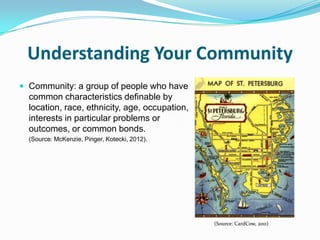
                                                (Source: CardCow, 2011)
Determinants of Population
 Race                    Black, White, Hispancic

 Nationality/Ethnicity   German, Haitian, Iranian, American

 Sexual Orientation      Male or Female (Strait, Gay, Lesbian)

 Age or Age Group        2yrs, 15yrs, 65yrs (Toddler, Teen, Elderly)

 Geographic locality     St. Petersburg Florida
Population Chart: St. Pete


                             White                    66.5%
                             Black                    24.9%
                             American Indian          0.4%
                             Asian                    3.7%
                             Pacific Islander         0.12%
                             Hispanic                 7.1%
                             Two or More Races        2.9%
                             Other Race Origin        1.6%
                             (Source: Stpete, 2011)


    (Source: Stpete, 2011)
What is Community Health?
 Community Health: is the status of a defined group
 of people and the actions and conditions to promote,
 protect, and preserve their health.

 Population Health: is the health status of persons
 not organized and without identity as a group or
 locality.
Understanding a Community
 In order to evaluate one’s community, one must understand the factors
  that effect the health of a community. The three main factors and
  determinants of community health are as follows:


    1. Physical            Factors

    2. Social and Cultural Factors


    3. Individual Behaviors

   (Source: McKenzie, Pinger, Kotecki, 2012)
Factors of Community Health
 Physical Factors:          Examples:

   Geography                Dry,Tropical

   Environment              Smoggy, (polluted)

   Community Size           244,000

   Industrial Development   Metropolitan, Rural
Factors of Community Health Contd.
 Social and Cultural Factors:

   Traditions, Prejudices, Beliefs


   Economy


   Politics


   Socioeconomic Status
Business and Education Charts
 Average Household              $58,711
 Income
                                           Income     Education
 Median Household               $45,903
 Income
 Per Capita Income (PCI)        $26,130
 (Source: Stpete, 2011)


 Arts, Culture, Events, Tourism    564
 Marine Science                   1,842
 Manufacturing                     5,278
                                           Industry
 Hospitality (Food & Lodging)      7,810
 Information Technology            8,200
 Financial Services               16,054
 Medical Technologies &           18,778
 Healthcare Services
 (Source: Stpete, 2011)                               (Source: Stpete, 2011)
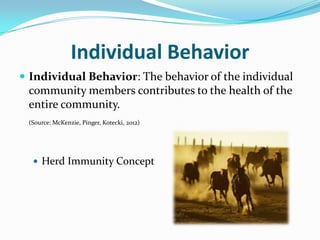
Individual Behavior
 Individual Behavior: The behavior of the individual
 community members contributes to the health of the
 entire community.
 (Source: McKenzie, Pinger, Kotecki, 2012)


   Herd Immunity Concept
Community Organizing
 Community organizing: To find methods and
 procedures to help deal with social issues within the
 community.

 Example: Cancer from tobacco use is a social health issue in St.
 Petersburg. Therefore community organizing would involve
 methods and procedures to deal with the issue such as canvasing
 or an awareness campaign.
Community Organizing Process
 Recognize the Issue

 Gain Community Entry

 Organize People

 Asses the Community

 Set Goals and Priorities

 Arriving at a Solution
(Source: McKenzie, Pinger, Kotecki, 2012).
Community Organizing Process
               Contd.
 Selecting Strategies


 Implementing Plans


 Evaluating outcomes


 Maintaining outcomes


 Looping Back
(Source: McKenzie, Pinger, Kotecki, 2012).
Questions
1. Which of these Determinates of Population are based on one’s place of
birth or home country?

A. Race
B. Geography
C. Age
D. Nationality
E. Sexual Orientation

Nationality is usually determined by one’s place of birth or at least the
country they consider home. Race is not an issue because a person of
Haitian or German decent could be born in any country. A Black, White,
and Hispanic American all have the same nationality.
2. According to the US Census Bureau (2010), the population of the
community of the city of St. Petersburg is approximately 244,000
consisting of roughly 70% white, 24% black, and 5% Hispanic. The
Industry section inside the Business and Education Chart states the
number of Medical Technologies & Healthcare Services personnel in
St. Petersburg, FL. What is the percentage of the population that is in
that industry?

A. About to 7.5 %
B. .0812
C. .0647
D. About to 6.8 %
E. .0711

The correct answer is 0.0769590163934426 or about to 7.5%.
18,778 / 244,000 = 0.0769590163934426
3. Which of these are NOT considered part of the community
organizing process?

A. Gain Community Entry
B. Set Goals and Priorities
C. Conduct a Debate
D. Asses the Community
E. Recognize the Issue

Conducting a debate is a way in which one may asses the community.
The debate may bring up views and needs of community members.
However, debates can also dismantle one’s cause or agenda due to the
uncontrollable nature of debates. Debates can cause even the most
gifted speaker to take defensive standpoint that may deter listeners
from aligning with the agenda.
Conducting an open discussion with community members give the
community organizer more control of the flow of the conversation.
4. Community health is the health status of persons not
organized and without identity as a group or locality.

T/F

False: Community health is the status of a defined group of
people and the actions and conditions to promote, protect, and
preserve their health.
Public health is the health status of persons not organized and
without identity as a group or locality.
5. From the information about past racial tension of St. Petersburg
presented in the Social and Cultural Factor section how would this
influence your community organizing process?

My community organizing process would be affected by this in that
as I gain community entry and organize people, I am aware of
notions, beliefs and prejudices that may arise. I may decide to ask
local historical authorities or research the events that took place.
From examining how the Uhuru, local police and businesses
clashed, I would make certain that I do not offend any party with
the community organizing.
References
Fager, W. (2003, October 18). Untitled

          Document. Sembler's Straight

          program. Retrieved October 10, 2011,

          from

          http://thestraights.com/articles/sembler-naacp-

          coalition.htm

Florida QuickFacts from the US Census Bureau. (2011, June 3). State

          and County QuickFacts. Retrieved October 10, 2011, from

          http://quickfacts.census.gov/qfd/states
References
Map Of St. Petersburg. (n.d.). CardCow Vintage Postcards –

           Old Antique Post Cards. Retrieved October 10, 2011,

           from http://www.cardcow.com/42251/map-st-

           petersburg-florida/


McKenzie, J. F., Pinger, R. R., & Kotecki, J. E. (2012). An

           Introduction to Community

           Health (7th Ed.). Sudbury, MA: Jones and Bartlett

           Publishers.
References
St. Petersburg: Economy - Major Industries and

         Commercial Activity. (2011). Stats about all

         US cities - real estate, relocation info, house

         prices, home value estimator, recent sales, cost of

         living, crime, race, income, photos, education, maps,

         weather, houses, schools, neighborhoods, and more.

         Retrieved October 10, 2011, from http://www.city-

         data.com/us-cities/The-South/St-Petersburg-Economy.html
References
Statistical Market Data. (2011, January 4).

      Welcome to StPete.org. Retrieved

      October 10, 2011, from

      http://www.stpete.org/economic_developm

      ent_dept/statistical_market_data/demographics.asp

Community health

  • 1.
    Understanding The Population DanToyinbo, MPA PHC 401- Introduction to Community Health 2/26/2012
  • 2.
    Goal This presentation was made in hopes of teaching students how to properly evaluate their community population in order to better asses community health issues.
  • 3.
    Objectives Upon completion ofthis presentation, students would be able to:  Define community health and related terms.  Identify the three main factors effecting community health.  Understand the steps necessary for community organizing.
  • 4.
    Understanding Your Community Community: a group of people who have common characteristics definable by location, race, ethnicity, age, occupation, interests in particular problems or outcomes, or common bonds. (Source: McKenzie, Pinger, Kotecki, 2012). (Source: CardCow, 2011)
  • 5.
    Determinants of Population Race Black, White, Hispancic  Nationality/Ethnicity German, Haitian, Iranian, American  Sexual Orientation Male or Female (Strait, Gay, Lesbian)  Age or Age Group 2yrs, 15yrs, 65yrs (Toddler, Teen, Elderly)  Geographic locality St. Petersburg Florida
  • 6.
    Population Chart: St.Pete White 66.5% Black 24.9% American Indian 0.4% Asian 3.7% Pacific Islander 0.12% Hispanic 7.1% Two or More Races 2.9% Other Race Origin 1.6% (Source: Stpete, 2011) (Source: Stpete, 2011)
  • 7.
    What is CommunityHealth?  Community Health: is the status of a defined group of people and the actions and conditions to promote, protect, and preserve their health.  Population Health: is the health status of persons not organized and without identity as a group or locality.
  • 8.
    Understanding a Community In order to evaluate one’s community, one must understand the factors that effect the health of a community. The three main factors and determinants of community health are as follows:  1. Physical Factors  2. Social and Cultural Factors  3. Individual Behaviors (Source: McKenzie, Pinger, Kotecki, 2012)
  • 9.
    Factors of CommunityHealth  Physical Factors: Examples:  Geography Dry,Tropical  Environment Smoggy, (polluted)  Community Size 244,000  Industrial Development Metropolitan, Rural
  • 10.
    Factors of CommunityHealth Contd.  Social and Cultural Factors:  Traditions, Prejudices, Beliefs  Economy  Politics  Socioeconomic Status
  • 11.
    Business and EducationCharts Average Household $58,711 Income Income Education Median Household $45,903 Income Per Capita Income (PCI) $26,130 (Source: Stpete, 2011) Arts, Culture, Events, Tourism 564 Marine Science 1,842 Manufacturing 5,278 Industry Hospitality (Food & Lodging) 7,810 Information Technology 8,200 Financial Services 16,054 Medical Technologies & 18,778 Healthcare Services (Source: Stpete, 2011) (Source: Stpete, 2011)
  • 12.
    Individual Behavior  IndividualBehavior: The behavior of the individual community members contributes to the health of the entire community. (Source: McKenzie, Pinger, Kotecki, 2012)  Herd Immunity Concept
  • 13.
    Community Organizing  Communityorganizing: To find methods and procedures to help deal with social issues within the community. Example: Cancer from tobacco use is a social health issue in St. Petersburg. Therefore community organizing would involve methods and procedures to deal with the issue such as canvasing or an awareness campaign.
  • 14.
    Community Organizing Process Recognize the Issue  Gain Community Entry  Organize People  Asses the Community  Set Goals and Priorities  Arriving at a Solution (Source: McKenzie, Pinger, Kotecki, 2012).
  • 15.
    Community Organizing Process Contd.  Selecting Strategies  Implementing Plans  Evaluating outcomes  Maintaining outcomes  Looping Back (Source: McKenzie, Pinger, Kotecki, 2012).
  • 16.
    Questions 1. Which ofthese Determinates of Population are based on one’s place of birth or home country? A. Race B. Geography C. Age D. Nationality E. Sexual Orientation Nationality is usually determined by one’s place of birth or at least the country they consider home. Race is not an issue because a person of Haitian or German decent could be born in any country. A Black, White, and Hispanic American all have the same nationality.
  • 17.
    2. According tothe US Census Bureau (2010), the population of the community of the city of St. Petersburg is approximately 244,000 consisting of roughly 70% white, 24% black, and 5% Hispanic. The Industry section inside the Business and Education Chart states the number of Medical Technologies & Healthcare Services personnel in St. Petersburg, FL. What is the percentage of the population that is in that industry? A. About to 7.5 % B. .0812 C. .0647 D. About to 6.8 % E. .0711 The correct answer is 0.0769590163934426 or about to 7.5%. 18,778 / 244,000 = 0.0769590163934426
  • 18.
    3. Which ofthese are NOT considered part of the community organizing process? A. Gain Community Entry B. Set Goals and Priorities C. Conduct a Debate D. Asses the Community E. Recognize the Issue Conducting a debate is a way in which one may asses the community. The debate may bring up views and needs of community members. However, debates can also dismantle one’s cause or agenda due to the uncontrollable nature of debates. Debates can cause even the most gifted speaker to take defensive standpoint that may deter listeners from aligning with the agenda. Conducting an open discussion with community members give the community organizer more control of the flow of the conversation.
  • 19.
    4. Community healthis the health status of persons not organized and without identity as a group or locality. T/F False: Community health is the status of a defined group of people and the actions and conditions to promote, protect, and preserve their health. Public health is the health status of persons not organized and without identity as a group or locality.
  • 20.
    5. From theinformation about past racial tension of St. Petersburg presented in the Social and Cultural Factor section how would this influence your community organizing process? My community organizing process would be affected by this in that as I gain community entry and organize people, I am aware of notions, beliefs and prejudices that may arise. I may decide to ask local historical authorities or research the events that took place. From examining how the Uhuru, local police and businesses clashed, I would make certain that I do not offend any party with the community organizing.
  • 21.
    References Fager, W. (2003,October 18). Untitled Document. Sembler's Straight program. Retrieved October 10, 2011, from http://thestraights.com/articles/sembler-naacp- coalition.htm Florida QuickFacts from the US Census Bureau. (2011, June 3). State and County QuickFacts. Retrieved October 10, 2011, from http://quickfacts.census.gov/qfd/states
  • 22.
    References Map Of St.Petersburg. (n.d.). CardCow Vintage Postcards – Old Antique Post Cards. Retrieved October 10, 2011, from http://www.cardcow.com/42251/map-st- petersburg-florida/ McKenzie, J. F., Pinger, R. R., & Kotecki, J. E. (2012). An Introduction to Community Health (7th Ed.). Sudbury, MA: Jones and Bartlett Publishers.
  • 23.
    References St. Petersburg: Economy- Major Industries and Commercial Activity. (2011). Stats about all US cities - real estate, relocation info, house prices, home value estimator, recent sales, cost of living, crime, race, income, photos, education, maps, weather, houses, schools, neighborhoods, and more. Retrieved October 10, 2011, from http://www.city- data.com/us-cities/The-South/St-Petersburg-Economy.html
  • 24.
    References Statistical Market Data.(2011, January 4). Welcome to StPete.org. Retrieved October 10, 2011, from http://www.stpete.org/economic_developm ent_dept/statistical_market_data/demographics.asp

Editor's Notes

  • #5  Examples of communities include: the people of the city of Madrid (location), the Black community of South Carolina (race), the Italian community of New York (ethnicity), teens in high school (age), members of Face book (social network).(Source: McKenzie, Pinger, Kotecki, 2012).
  • #6  According to the US Census Bureau (2010), the population of the community of the city of St. Petersburg is approximately 244,000 consisting of roughly 70% white, 24% black, and 5% Hispanic. The Office of Management and Budget in 1978 created Directive 15 which categorized race into four groups which was then modified in 1997 to five categories which are: “Asian, American Indian, Native Hawaiian or Pacific Islander, Black or African American, and White.” Two ethnic categories are also divided into “of Hispanic origin and not of Hispanic origin” which are usually determined before the others (McKenzie, Pinger, Kotecki, 2012). According to McKenzie, Pinger and Kotecki (2012) race is known to be more accurately characterized as a social category changing with time across societies and cultures. With that being said, it is important to keep in mind that racial disparities in health generally do not mirror biologically determined differences in these groups. For example; the health of persons of an impoverished country generally is affected be their environment (sanitation, temperature, precipitation, government involvement, diet, level of modernization) rather than their race.
  • #8 Population andCommunity Health are all parts of the Public Health which is “actions that society takes collectively to ensure that the conditions in which people can be healthy can occur”(McKenzie, Pinger, Kotecki, pg 7. 2012).Examples of population health include: famers, medical personnel, teen girls, hunters, women under 60.
  • #9 Once a person understands the dynamic of their community or the community of interest, assess and or aid the community in regards to the health of its population.
  • #10  A community’s health can be influenced by a variable as simple as the weather. Climate and geography can determine community health in that elements such as heat, elevation, precipitation, and soil status effect the health and well being of the population. For example; in a tropical rainforest environment, persons may be more vulnerable to malaria due to the overabundance of rain. Environment can also be a factor in that it determines the lifestyle and health of the people in the community. For example; persons living in a mountainous region may be in better physical shape due to the rugged terrain they encounter on a daily basis, than persons living in a plains environment. Community size can determine the access to care as well as spread of disease in a community. The population of St. Petersburg is approximately 244,000. Its important to keep in mind that a community’s size can have a positive or negative impact on that community’s health. “the ability for a community to effectively plan, organize, and utilize its resources can determine whether its size can be used to good advantage”(McKenzie, Pinger, Kotecki, pg 9. 2012). Industrial development can also play a positive or negative role in the makeup of a community’s health. According to McKenzie, Pinger, and Kotecki (2012), this provides a community with added resources for community health programs, however, this can bring about environmental pollution.
  • #11  Traditions, beliefs, and prejudices can play an instrumental role in the health of a community in that they greatly effect lifestyle choices, diet, mindset, behaviors and reactions towards others. The city of St. Petersburg arguably has a high level of racial tension. Numerous situations and problems have risen from racism, the lack of accountability of public officials, and favoritism. Unfortunately, many of these situations have resulted in violence and death even as recently as 2011. Some may feel as though it may be a contributing factor to the amount of racial disparities amongst minorities. In order to effectively assess and serve the community in regards to health, one must understand the numerous mindsets and attitudes associated with the community. The is an excerpt in regards to the St. Petersburg community and issues regarding prejudice taken from online news source, The Straits, by Wesley Fager in 2003: “On Oct. 24, 1996 St. Petersburg Police Officers James Knight and Sandra Min stopped a car for speeding in a black section of Saint Petersburg known as Midtown. There are conflicting accounts of what happened but the result is that Officer Knight tragically shot and killed the driver of the vehicle, a young black man named TyRon Lewis. A subsequent grand jury investigation absolved Officer Knight of any wrong doing which set off a race riot in Saint Petersburg that resulted in $6 million worth of damage and almost cost then Mayor David Fischer his mayor ship. Many feel that the Uhuru, a political party seeking social justice for blacks, was at the heart of the protests. A subsequent report by the U.S. Civil Rights Commission found that, among other causes, the destruction of black neighborhoods in order to build Tropicana Field to lure major league baseball to St. Petersburg compounded the frustrations of the rioters. Tropicana Field is sponsored by The St. Petersburg Times (renamed Tampa Bay Times) which seems nowadays more interested in becoming a big business than a news agency. (The Uhuru claim that the Times sides with the police in its issues with law enforcement.) In February two Uhuru men including a man named Keith Stewart, nephew of the local Uhuru leader, were arrested in a scuffle with the police at an apartment complex formerly named Bethel Community Heights” (Fager, 2003). Economy: “St. Petersburg's economy has traditionally been fueled by tourism. More than 4 million visitors flock to the greater Suncoast area annually, generating more than $2 billion in direct revenue. But the city's economy is actually more broad-based. Major growth industries in the metropolitan area include financial services, manufacturing, medical technologies, information technology, and marine sciences”(City-Data, 2011). See chart on next page* Politics: According to McKenzie, Pinger and Kotecki (2012) those who happen to be in political office have the power to improve or jeopardize the health of their communities based on their decisions and political and or personal agendas. Socio-economic status: According to US Census Bureau (2011), St. Petersburg FL had a Median household income in 2009 of $44,755 with 17% percent of the population below poverty level.
  • #13 According to McKenzie, Pinger and Kotecki (2012), herd immunity is the resistance of a population or community to the spread of effects of an infectious agent based on the immunity of a high proportion of individuals. The authors to the Community Health text go on to say that a good example of herd immunity would be that the more people that get immunized against a specific disease, the slower the disease may spread.
  • #14 Community Organizing: “the process through which communities are helped to identify common problems of goals, mobilize resources, and in other ways develop and implement strategies for reaching their goals they have collectively set” (McKenzie, Pinger, Kotecki, 2012).
  • #15 Community organizing involves numerous steps which ensure that community health is adequately evaluated and addresses. In order to find information on a community, one may use census information or educational resources. Speaking with local news or historical authorities can also help one understand the social dynamic of a community. One must also identify “Gate keepers” within the community such as city council members, unions or social group leaders, business leaders, or even church leaders (McKenzie, Pinger, Kotecki, 2012).
  • #16 According to McKenzie, Pinger and Kotecki (2012), maintaining outcomes is the most difficult part of community organizing in that one must reassess and loop back the information gathered in order to make the best decision in regards to organizing the community and dealing with a social issue.Closing statement: The evaluation community health can be a complex task, however, with the correct procedures, one may impact the health of one’s community.