WELCOM
E
HEAT WAVES
COLD WAVES
FOG
SARANYA.S
M.Tech Food processing
KCAET,Tavanur
HEAT WAVES
 It is a prolonged period of excessive heat, often accompanied by
excessive humidity.
 The weather is noticeably warmer than normal for the time of year
and climate.
 Develop slowly and kills(& injure many more) animals and people
nationwide in average year…more than any other disaster
 “silent disaster”
 As temperature rises people animals and plants suffer
from heat stress
 Apart from death more and more people are admitted with
suffering sunstroke , severe dehydration, with vomiting
and high fever.
 The condition become more severe in May and June in
India.
What causes heat wave?
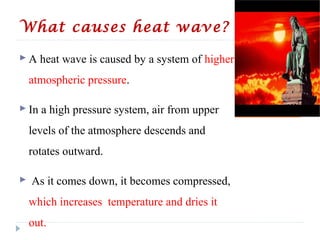
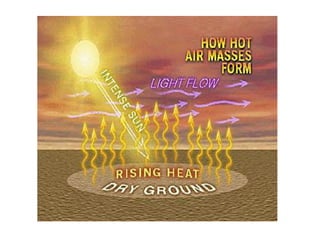
 A heat wave is caused by a system of higher
atmospheric pressure.
 In a high pressure system, air from upper
levels of the atmosphere descends and
rotates outward.
 As it comes down, it becomes compressed,
which increases temperature and dries it
out.
Effects- Human beings
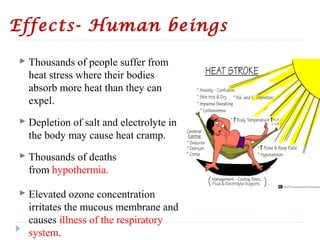
 Thousands of people suffer from
heat stress where their bodies
absorb more heat than they can
expel.
 Depletion of salt and electrolyte in
the body may cause heat cramp.
 Thousands of deaths
from hypothermia.
 Elevated ozone concentration
irritates the mucous membrane and
causes illness of the respiratory
system.
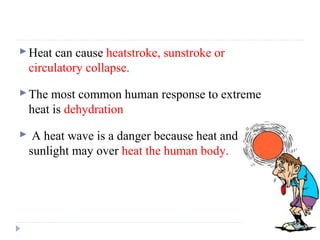
Heat can cause heatstroke, sunstroke or
circulatory collapse.
The most common human response to extreme
heat is dehydration
 A heat wave is a danger because heat and
sunlight may over heat the human body.
Heat stress -livestock
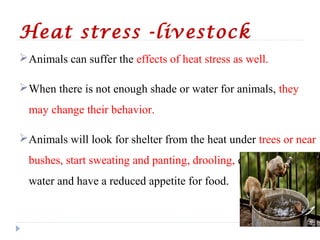
Animals can suffer the effects of heat stress as well.
When there is not enough shade or water for animals, they
may change their behavior.
Animals will look for shelter from the heat under trees or near
bushes, start sweating and panting, drooling, drink more
water and have a reduced appetite for food.
Agriculture and crop
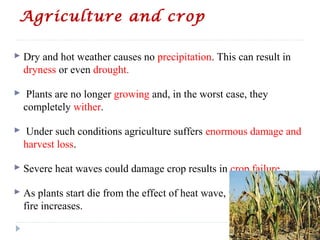
 Dry and hot weather causes no precipitation. This can result in
dryness or even drought.
 Plants are no longer growing and, in the worst case, they
completely wither.
 Under such conditions agriculture suffers enormous damage and
harvest loss.
 Severe heat waves could damage crop results in crop failure.
 As plants start die from the effect of heat wave, the threat of bush
fire increases.
Psychological and sociological
effects
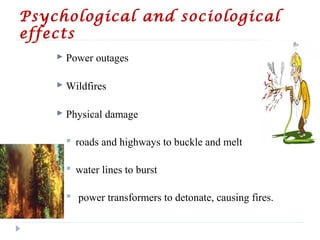
 Power outages
 Wildfires
 Physical damage
 roads and highways to buckle and melt
 water lines to burst
 power transformers to detonate, causing fires.
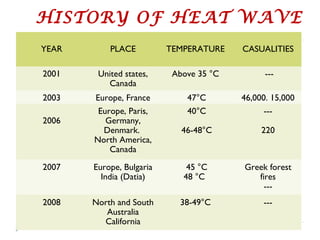
YEAR PLACE TEMPERATURE CASUALITIES
2001 United states,
Canada
Above 35 °C ---
2003 Europe, France 47°C 46,000. 15,000
2006
Europe, Paris,
Germany,
Denmark.
North America,
Canada
40°C
46-48°C
---
220
2007 Europe, Bulgaria
India (Datia)
45 °C
48 °C
Greek forest
fires
---
2008 North and South
Australia
California
38-49°C ---
HISTORY OF HEAT WAVE
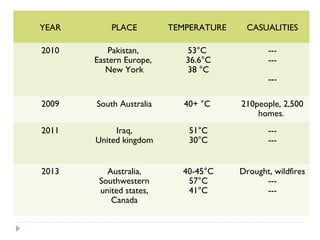
YEAR PLACE TEMPERATURE CASUALITIES
2010 Pakistan,
Eastern Europe,
New York
53°C
36.6°C
38 °C
---
---
---
2009 South Australia 40+ °C 210people, 2,500
homes.
2011 Iraq,
United kingdom
51°C
30°C
---
---
2013 Australia,
Southwestern
united states,
Canada
40-45°C
57°C
41°C
Drought, wildfires
---
---
Click to edit the outline
text format
Second Outline Level
− Third Outline
Level
Fourth
Outline Level
−Fifth Outline
Level
−Sixth
Outline
Level
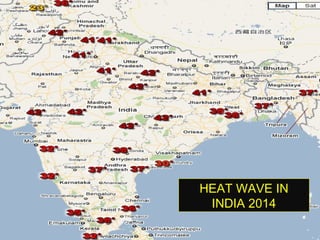
Heat waves in India
-2014
HEAT WAVE IN
INDIA 2014
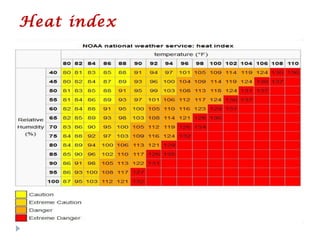
Heat index
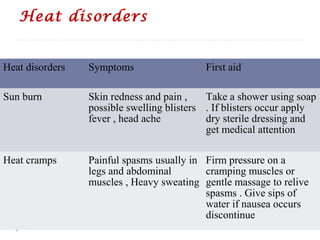
Heat disorders
Heat disorders Symptoms First aid
Sun burn Skin redness and pain ,
possible swelling blisters
fever , head ache
Take a shower using soap
. If blisters occur apply
dry sterile dressing and
get medical attention
Heat cramps Painful spasms usually in
legs and abdominal
muscles , Heavy sweating
Firm pressure on a
cramping muscles or
gentle massage to relive
spasms . Give sips of
water if nausea occurs
discontinue
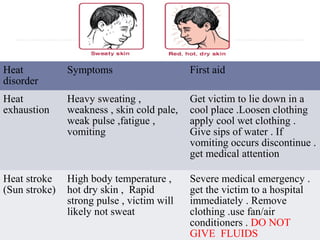
Heat
disorder
Symptoms First aid
Heat
exhaustion
Heavy sweating ,
weakness , skin cold pale,
weak pulse ,fatigue ,
vomiting
Get victim to lie down in a
cool place .Loosen clothing
apply cool wet clothing .
Give sips of water . If
vomiting occurs discontinue .
get medical attention
Heat stroke
(Sun stroke)
High body temperature ,
hot dry skin , Rapid
strong pulse , victim will
likely not sweat
Severe medical emergency .
get the victim to a hospital
immediately . Remove
clothing .use fan/air
conditioners . DO NOT
GIVE FLUIDS
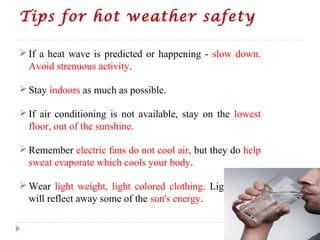
Tips for hot weather safety
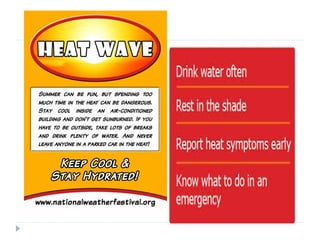
If a heat wave is predicted or happening - slow down.
Avoid strenuous activity.
Stay indoors as much as possible.
If air conditioning is not available, stay on the lowest
floor, out of the sunshine.
Remember electric fans do not cool air, but they do help
sweat evaporate which cools your body.
Wear light weight, light colored clothing. Light colors
will reflect away some of the sun's energy.
COLD WAVE
Cold waves
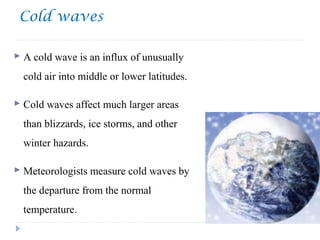
 A cold wave is an influx of unusually
cold air into middle or lower latitudes.
 Cold waves affect much larger areas
than blizzards, ice storms, and other
winter hazards.
 Meteorologists measure cold waves by
the departure from the normal
temperature.
Formation of Cold Waves
 A cold wave develops when cold air masses over large areas are brought in.
 The cold air masses transport only little moisture. Precipitation occurs as
snow or sleet due to temperatures below freezing point.
 Cold waves can also be accompanied by strong wind. Such a phenomenon
is called winter storm.
 Cold polar or Arctic air masses are relatively shallow, extending one to
several km above the surface.
Effect on persons and economic
activity
 Exposure to extreme and especially unexpected cold can lead to
hypothermia and frostbite. Which require medical attention due to the
hazards of tissue damage and organ failure.
 They can cause death and injury to livestock and wildlife.
 Exposure to cold mandates greater caloric intake for all animals, including
humans.
 If a cold wave is accompanied by heavy and persistent snow, grazing
animals may be unable to reach needed food and die of hypothermia or
starvation.
 They often necessitate the purchase of foodstuffs at considerable cost to
farmers to feed livestock . Such cold waves have caused famines.
 .
 At times as deadly to plants as drought, cold waves can leave a
land in danger of later brush and forest fires that consume dead
biomass.
 Water mains may break and water supplies may become
unreliable, making fire fighting more difficult.
 People can stock up on food, water, and other necessities before a
cold wave.
 Some may even choose to migrate to places of milder climates, at
least during the winter.
Effects of cold wave on other
sectors
 Deaths caused by cold weather in comparison to hot weather is true as a
result of the after effects of these temperatures
 Demand for electrical power and fuels rises dramatically during such times
 Some metals may become brittle at low temperatures.
 Motor vehicles may fail as antifreeze fails and motor oil gels, resulting even
in the failure of the transportation system.
 Fires become even more of a hazard during extreme cold.
Cold Weather Injuries
28
Non Freezing
 Hypothermia
 Chilblains
 Trench/Immersion Foot
Associated Injuries
− Snow Blindness
− Dehydration
Freezing
− Frost nip
− Frostbite
Frostbite
29
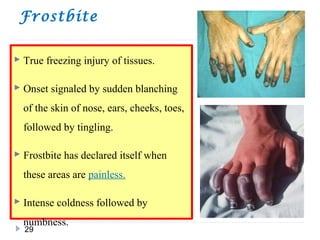
 True freezing injury of tissues.
 Onset signaled by sudden blanching
of the skin of nose, ears, cheeks, toes,
followed by tingling.
 Frostbite has declared itself when
these areas are painless.
 Intense coldness followed by
numbness.
Frostbite Treatment
30
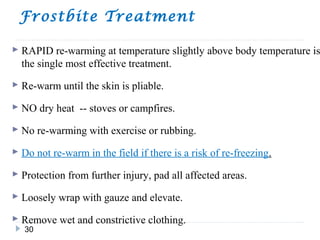
 RAPID re-warming at temperature slightly above body temperature is
the single most effective treatment.
 Re-warm until the skin is pliable.
 NO dry heat -- stoves or campfires.
 No re-warming with exercise or rubbing.
 Do not re-warm in the field if there is a risk of re-freezing.
 Protection from further injury, pad all affected areas.
 Loosely wrap with gauze and elevate.
 Remove wet and constrictive clothing.
Snow Blindness
31
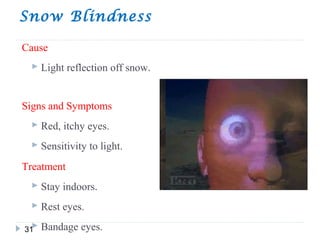
Cause
 Light reflection off snow.
Signs and Symptoms
 Red, itchy eyes.
 Sensitivity to light.
Treatment
 Stay indoors.
 Rest eyes.
 Bandage eyes.
Dehydration
32
 Cause - loss of body moisture
 Dry air.
 Cold diuresis.
 Not enough fluid intake.
 Signs/symptoms
 Dry lips and mouth.
 Dark yellow or orange urine.
 Fatigue.
 Treatment/prevention
 Drink frequently.
 Timed drinking.
Hypothermia
33
Number One Killer
 Loss of 4 0 F or more body temperature.
 Wet body contributes.
Cause
 Continued Exposure.
 Depleted energy supply.
Symptoms
 Shivering.
 Slow and Shallow Breathing.
 Slow Speech.
Click to edit the outline
text format
Second Outline Level
− Third Outline
Level
Fourth
Outline Level
−Fifth Outline
Level
−Sixth
Outline
Level
Hypothermia
34
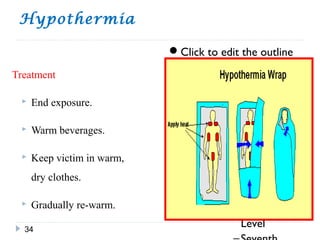
Treatment
 End exposure.
 Warm beverages.
 Keep victim in warm,
dry clothes.
 Gradually re-warm.
Chilblain
35
Cause
 Repeated, chronic exposure of bare skin ( 32 ºF- 60 ºF).
Sign/Symptoms
 Appear as swollen, tender, papules.
 Complaint of burning or prickly sensation.
 Redness.
Treatment
 Passive warming at room temperature.
 No rubbing.
 Protect from trauma and secondary infection.
Trench/Immersion Foot
36
 Cause
Wet conditions, low temperature.
Prolonged contact with moisture at tempetarures between 32º-50ºF
 Signs / Symptoms
 Numbness and pain.
 Swelling, tingling, itching.
 Pale waxy skin.
 Blistering.
− Treatment
− Elevate, wrap in loose dressing.
− Passive re-warming at room temp.
− No massages or rubbing.
Cold Weather Injury Prevention
Tips
37
 Principles of Care Need to maintain body heat
 Frequent sock changes
In WW1, the Brits decreased trench foot cases from
29,000 in 1915 to 443 in 1917 by sock changes.
 Cover head and neck, 80% of heat loss.
 Use synthetic fibers, natural fibers retain moisture and have
poor wicking ability.
 Modification of Risk Factors
Adequate nutrition: 3000-4000 cal/day.
Adequate hydration and rest.
Adequate clothing: loose, layered, windproof and changed
often.
Previous cold weather exposure and experience.
Dressing for the C O L D
39
 Keep Clothing -Clean
Dirt and grease block up the air spaces in your clothing and reduce
the insulation value.
 Avoid-Overheating
Sweat can freeze on outer layers. Stay dry, moisture will decrease
the insulating ability of your clothing.
 Wear Clothing in -Layers
Loose clothing allows air spaces to help trap warm air without
restricting blood circulation. Good blood circulation helps to
prevent frostbite.
Cold Weather Survival Kit
40
 Waterproof matches and fire starter (eg . Candle, magnesium match, lighter).
 Signaling devices (eg . Mirror and whistle).
 Knife.
 Pressure bandage, cold-climate lip balm, sunglasses.
 Compass.
 Water container (metal for use in fire).
 Small amount of concentrated food
 Foil survival blanket.
FOG
FOG
 Fog is a collection of liquid water droplets or ice crystals
suspended in the air at or near the Earth's surface.
 Fog can be considered a type of low-lying cloud, and is
heavily influenced by nearby bodies of water, topography,
wind conditions, and even human activities.
 In turn, fog has affected many human activities, such as
shipping and transport, warfare, and culture.
 Fog forms when the difference between air temperature and
dew point is generally less than 2.5 °C or 4 °F.
 Fog begins to form when water vapor condenses into tiny
liquid water droplets suspended in the air
 Water vapor normally begins to condense on condensation
nuclei such as dust, ice, and salt in order to form clouds
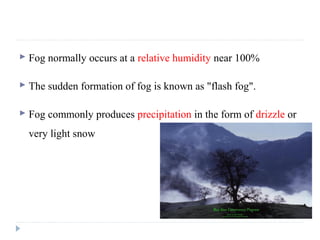
 Fog normally occurs at a relative humidity near 100%
 The sudden formation of fog is known as "flash fog".
 Fog commonly produces precipitation in the form of drizzle or
very light snow
Types
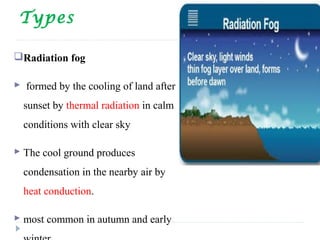
Radiation fog
 formed by the cooling of land after
sunset by thermal radiation in calm
conditions with clear sky
 The cool ground produces
condensation in the nearby air by
heat conduction.
 most common in autumn and early
 Ground fog
 fog that obscures less than 60% of the sky and does not
extend to the base of any overhead clouds.
 Precipitation fog
 forms as precipitation falls into drier air below the cloud,
the liquid droplets evaporate into water vapor. The water
vapor cools and at the dew point it condenses and fog
forms.
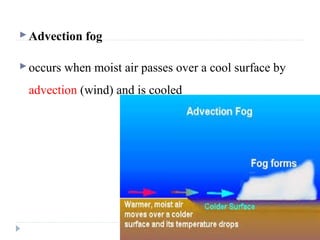
Advection fog
occurs when moist air passes over a cool surface by
advection (wind) and is cooled
Hail fog
 occurs in the vicinity of significant hail accumulations due to
decreased temperature and increased moisture leading to
saturation in a very shallow layer near the surface.
Freezing conditions
 Freezing fog
 occurs when liquid fog droplets freeze to surfaces, forming white soft
or hard rime
 Frozen fog
 ice fog
 kind of fog where the droplets have frozen into extremely tiny
crystals of ice in midair
 Generally this requires temperatures at or below −35 °C , common
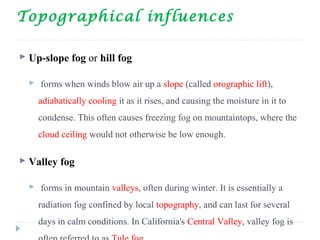
Topographical influences
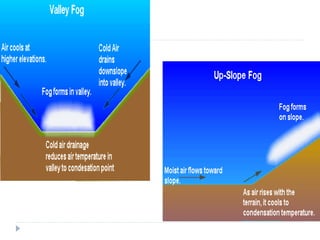
 Up-slope fog or hill fog
 forms when winds blow air up a slope (called orographic lift),
adiabatically cooling it as it rises, and causing the moisture in it to
condense. This often causes freezing fog on mountaintops, where the
cloud ceiling would not otherwise be low enough.
 Valley fog
 forms in mountain valleys, often during winter. It is essentially a
radiation fog confined by local topography, and can last for several
days in calm conditions. In California's Central Valley, valley fog is
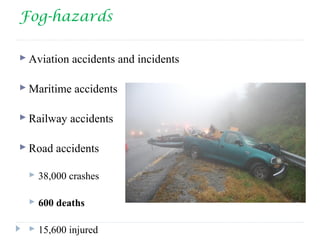
Fog-hazards
 Aviation accidents and incidents
 Maritime accidents
 Railway accidents
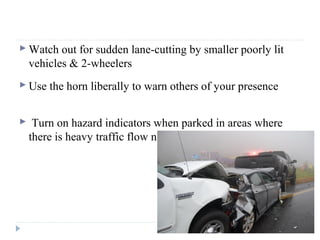
 Road accidents
 38,000 crashes
 600 deaths
 15,600 injured
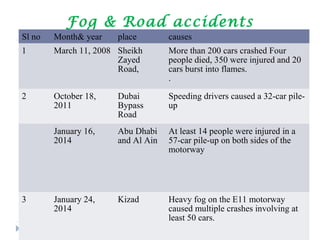
Fog & Road accidents
Sl no Month& year place causes
1 March 11, 2008 Sheikh
Zayed
Road,
More than 200 cars crashed Four
people died, 350 were injured and 20
cars burst into flames.
.
2 October 18,
2011
Dubai
Bypass
Road
Speeding drivers caused a 32-car pile-
up
January 16,
2014
Abu Dhabi
and Al Ain
At least 14 people were injured in a
57-car pile-up on both sides of the
motorway
3 January 24,
2014
Kizad Heavy fog on the E11 motorway
caused multiple crashes involving at
least 50 cars.
Fog and boat collision
 Heavy fog causes a collision of boats on the St. Lawrence
River in Canada that kills 1,073 people on this day in
1914. Caused by a horrible series of blunders, this was
one of the worst maritime disasters in history.
Causes of Accidents in Mist/Fog
 Reduced visibility as road users struggle to see with any
clarity.
 Failure by drivers to change their driving habits for the
inclement conditions.
 Insufficient following distances as cars tend to follow each
other a little too close.
 Some drivers tend to drive too fast believing they can escape
the fog sooner if they go faster.
Safe Driving Advice and
Recommendations
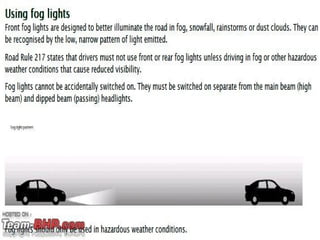
 Switch on low beams as well as front & rear fog lamps
Keep your wind shields and mirrors clean.
Use wash-wipe and defoggers liberally
Drive slower than the speed limit if necessary
Switch off fog lamps when fog lightens. Switch them on again
when you enter zones with dense fog
Do not brake sharply unless it is unavoidable
 Watch out for sudden lane-cutting by smaller poorly lit
vehicles & 2-wheelers
 Use the horn liberally to warn others of your presence
 Turn on hazard indicators when parked in areas where
there is heavy traffic flow next to your car
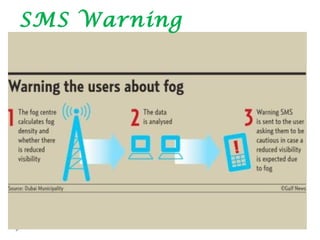
SMS Warning
THANK
YOU

Heat waves,cold waves,fog

  • 1.
  • 2.
    HEAT WAVES COLD WAVES FOG SARANYA.S M.TechFood processing KCAET,Tavanur
  • 4.
    HEAT WAVES  Itis a prolonged period of excessive heat, often accompanied by excessive humidity.  The weather is noticeably warmer than normal for the time of year and climate.  Develop slowly and kills(& injure many more) animals and people nationwide in average year…more than any other disaster  “silent disaster”
  • 5.
     As temperaturerises people animals and plants suffer from heat stress  Apart from death more and more people are admitted with suffering sunstroke , severe dehydration, with vomiting and high fever.  The condition become more severe in May and June in India.
  • 6.
    What causes heatwave?  A heat wave is caused by a system of higher atmospheric pressure.  In a high pressure system, air from upper levels of the atmosphere descends and rotates outward.  As it comes down, it becomes compressed, which increases temperature and dries it out.
  • 9.
    Effects- Human beings Thousands of people suffer from heat stress where their bodies absorb more heat than they can expel.  Depletion of salt and electrolyte in the body may cause heat cramp.  Thousands of deaths from hypothermia.  Elevated ozone concentration irritates the mucous membrane and causes illness of the respiratory system.
  • 10.
    Heat can causeheatstroke, sunstroke or circulatory collapse. The most common human response to extreme heat is dehydration  A heat wave is a danger because heat and sunlight may over heat the human body.
  • 11.
    Heat stress -livestock Animalscan suffer the effects of heat stress as well. When there is not enough shade or water for animals, they may change their behavior. Animals will look for shelter from the heat under trees or near bushes, start sweating and panting, drooling, drink more water and have a reduced appetite for food.
  • 12.
    Agriculture and crop Dry and hot weather causes no precipitation. This can result in dryness or even drought.  Plants are no longer growing and, in the worst case, they completely wither.  Under such conditions agriculture suffers enormous damage and harvest loss.  Severe heat waves could damage crop results in crop failure.  As plants start die from the effect of heat wave, the threat of bush fire increases.
  • 13.
    Psychological and sociological effects Power outages  Wildfires  Physical damage  roads and highways to buckle and melt  water lines to burst  power transformers to detonate, causing fires.
  • 14.
    YEAR PLACE TEMPERATURECASUALITIES 2001 United states, Canada Above 35 °C --- 2003 Europe, France 47°C 46,000. 15,000 2006 Europe, Paris, Germany, Denmark. North America, Canada 40°C 46-48°C --- 220 2007 Europe, Bulgaria India (Datia) 45 °C 48 °C Greek forest fires --- 2008 North and South Australia California 38-49°C --- HISTORY OF HEAT WAVE
  • 15.
    YEAR PLACE TEMPERATURECASUALITIES 2010 Pakistan, Eastern Europe, New York 53°C 36.6°C 38 °C --- --- --- 2009 South Australia 40+ °C 210people, 2,500 homes. 2011 Iraq, United kingdom 51°C 30°C --- --- 2013 Australia, Southwestern united states, Canada 40-45°C 57°C 41°C Drought, wildfires --- ---
  • 16.
    Click to editthe outline text format Second Outline Level − Third Outline Level Fourth Outline Level −Fifth Outline Level −Sixth Outline Level Heat waves in India -2014 HEAT WAVE IN INDIA 2014
  • 17.
  • 18.
    Heat disorders Heat disordersSymptoms First aid Sun burn Skin redness and pain , possible swelling blisters fever , head ache Take a shower using soap . If blisters occur apply dry sterile dressing and get medical attention Heat cramps Painful spasms usually in legs and abdominal muscles , Heavy sweating Firm pressure on a cramping muscles or gentle massage to relive spasms . Give sips of water if nausea occurs discontinue
  • 19.
    Heat disorder Symptoms First aid Heat exhaustion Heavysweating , weakness , skin cold pale, weak pulse ,fatigue , vomiting Get victim to lie down in a cool place .Loosen clothing apply cool wet clothing . Give sips of water . If vomiting occurs discontinue . get medical attention Heat stroke (Sun stroke) High body temperature , hot dry skin , Rapid strong pulse , victim will likely not sweat Severe medical emergency . get the victim to a hospital immediately . Remove clothing .use fan/air conditioners . DO NOT GIVE FLUIDS
  • 20.
    Tips for hotweather safety If a heat wave is predicted or happening - slow down. Avoid strenuous activity. Stay indoors as much as possible. If air conditioning is not available, stay on the lowest floor, out of the sunshine. Remember electric fans do not cool air, but they do help sweat evaporate which cools your body. Wear light weight, light colored clothing. Light colors will reflect away some of the sun's energy.
  • 22.
  • 23.
    Cold waves  Acold wave is an influx of unusually cold air into middle or lower latitudes.  Cold waves affect much larger areas than blizzards, ice storms, and other winter hazards.  Meteorologists measure cold waves by the departure from the normal temperature.
  • 24.
    Formation of ColdWaves  A cold wave develops when cold air masses over large areas are brought in.  The cold air masses transport only little moisture. Precipitation occurs as snow or sleet due to temperatures below freezing point.  Cold waves can also be accompanied by strong wind. Such a phenomenon is called winter storm.  Cold polar or Arctic air masses are relatively shallow, extending one to several km above the surface.
  • 25.
    Effect on personsand economic activity  Exposure to extreme and especially unexpected cold can lead to hypothermia and frostbite. Which require medical attention due to the hazards of tissue damage and organ failure.  They can cause death and injury to livestock and wildlife.  Exposure to cold mandates greater caloric intake for all animals, including humans.  If a cold wave is accompanied by heavy and persistent snow, grazing animals may be unable to reach needed food and die of hypothermia or starvation.  They often necessitate the purchase of foodstuffs at considerable cost to farmers to feed livestock . Such cold waves have caused famines.  .
  • 26.
     At timesas deadly to plants as drought, cold waves can leave a land in danger of later brush and forest fires that consume dead biomass.  Water mains may break and water supplies may become unreliable, making fire fighting more difficult.  People can stock up on food, water, and other necessities before a cold wave.  Some may even choose to migrate to places of milder climates, at least during the winter.
  • 27.
    Effects of coldwave on other sectors  Deaths caused by cold weather in comparison to hot weather is true as a result of the after effects of these temperatures  Demand for electrical power and fuels rises dramatically during such times  Some metals may become brittle at low temperatures.  Motor vehicles may fail as antifreeze fails and motor oil gels, resulting even in the failure of the transportation system.  Fires become even more of a hazard during extreme cold.
  • 28.
    Cold Weather Injuries 28 NonFreezing  Hypothermia  Chilblains  Trench/Immersion Foot Associated Injuries − Snow Blindness − Dehydration Freezing − Frost nip − Frostbite
  • 29.
    Frostbite 29  True freezinginjury of tissues.  Onset signaled by sudden blanching of the skin of nose, ears, cheeks, toes, followed by tingling.  Frostbite has declared itself when these areas are painless.  Intense coldness followed by numbness.
  • 30.
    Frostbite Treatment 30  RAPIDre-warming at temperature slightly above body temperature is the single most effective treatment.  Re-warm until the skin is pliable.  NO dry heat -- stoves or campfires.  No re-warming with exercise or rubbing.  Do not re-warm in the field if there is a risk of re-freezing.  Protection from further injury, pad all affected areas.  Loosely wrap with gauze and elevate.  Remove wet and constrictive clothing.
  • 31.
    Snow Blindness 31 Cause  Lightreflection off snow. Signs and Symptoms  Red, itchy eyes.  Sensitivity to light. Treatment  Stay indoors.  Rest eyes.  Bandage eyes.
  • 32.
    Dehydration 32  Cause -loss of body moisture  Dry air.  Cold diuresis.  Not enough fluid intake.  Signs/symptoms  Dry lips and mouth.  Dark yellow or orange urine.  Fatigue.  Treatment/prevention  Drink frequently.  Timed drinking.
  • 33.
    Hypothermia 33 Number One Killer Loss of 4 0 F or more body temperature.  Wet body contributes. Cause  Continued Exposure.  Depleted energy supply. Symptoms  Shivering.  Slow and Shallow Breathing.  Slow Speech.
  • 34.
    Click to editthe outline text format Second Outline Level − Third Outline Level Fourth Outline Level −Fifth Outline Level −Sixth Outline Level Hypothermia 34 Treatment  End exposure.  Warm beverages.  Keep victim in warm, dry clothes.  Gradually re-warm.
  • 35.
    Chilblain 35 Cause  Repeated, chronicexposure of bare skin ( 32 ºF- 60 ºF). Sign/Symptoms  Appear as swollen, tender, papules.  Complaint of burning or prickly sensation.  Redness. Treatment  Passive warming at room temperature.  No rubbing.  Protect from trauma and secondary infection.
  • 36.
    Trench/Immersion Foot 36  Cause Wetconditions, low temperature. Prolonged contact with moisture at tempetarures between 32º-50ºF  Signs / Symptoms  Numbness and pain.  Swelling, tingling, itching.  Pale waxy skin.  Blistering. − Treatment − Elevate, wrap in loose dressing. − Passive re-warming at room temp. − No massages or rubbing.
  • 37.
    Cold Weather InjuryPrevention Tips 37  Principles of Care Need to maintain body heat  Frequent sock changes In WW1, the Brits decreased trench foot cases from 29,000 in 1915 to 443 in 1917 by sock changes.  Cover head and neck, 80% of heat loss.  Use synthetic fibers, natural fibers retain moisture and have poor wicking ability.
  • 38.
     Modification ofRisk Factors Adequate nutrition: 3000-4000 cal/day. Adequate hydration and rest. Adequate clothing: loose, layered, windproof and changed often. Previous cold weather exposure and experience.
  • 39.
    Dressing for theC O L D 39  Keep Clothing -Clean Dirt and grease block up the air spaces in your clothing and reduce the insulation value.  Avoid-Overheating Sweat can freeze on outer layers. Stay dry, moisture will decrease the insulating ability of your clothing.  Wear Clothing in -Layers Loose clothing allows air spaces to help trap warm air without restricting blood circulation. Good blood circulation helps to prevent frostbite.
  • 40.
    Cold Weather SurvivalKit 40  Waterproof matches and fire starter (eg . Candle, magnesium match, lighter).  Signaling devices (eg . Mirror and whistle).  Knife.  Pressure bandage, cold-climate lip balm, sunglasses.  Compass.  Water container (metal for use in fire).  Small amount of concentrated food  Foil survival blanket.
  • 41.
  • 42.
    FOG  Fog isa collection of liquid water droplets or ice crystals suspended in the air at or near the Earth's surface.  Fog can be considered a type of low-lying cloud, and is heavily influenced by nearby bodies of water, topography, wind conditions, and even human activities.  In turn, fog has affected many human activities, such as shipping and transport, warfare, and culture.
  • 43.
     Fog formswhen the difference between air temperature and dew point is generally less than 2.5 °C or 4 °F.  Fog begins to form when water vapor condenses into tiny liquid water droplets suspended in the air  Water vapor normally begins to condense on condensation nuclei such as dust, ice, and salt in order to form clouds
  • 44.
     Fog normallyoccurs at a relative humidity near 100%  The sudden formation of fog is known as "flash fog".  Fog commonly produces precipitation in the form of drizzle or very light snow
  • 45.
    Types Radiation fog  formedby the cooling of land after sunset by thermal radiation in calm conditions with clear sky  The cool ground produces condensation in the nearby air by heat conduction.  most common in autumn and early
  • 46.
     Ground fog fog that obscures less than 60% of the sky and does not extend to the base of any overhead clouds.  Precipitation fog  forms as precipitation falls into drier air below the cloud, the liquid droplets evaporate into water vapor. The water vapor cools and at the dew point it condenses and fog forms.
  • 47.
    Advection fog occurs whenmoist air passes over a cool surface by advection (wind) and is cooled
  • 48.
    Hail fog  occursin the vicinity of significant hail accumulations due to decreased temperature and increased moisture leading to saturation in a very shallow layer near the surface.
  • 49.
    Freezing conditions  Freezingfog  occurs when liquid fog droplets freeze to surfaces, forming white soft or hard rime  Frozen fog  ice fog  kind of fog where the droplets have frozen into extremely tiny crystals of ice in midair  Generally this requires temperatures at or below −35 °C , common
  • 50.
    Topographical influences  Up-slopefog or hill fog  forms when winds blow air up a slope (called orographic lift), adiabatically cooling it as it rises, and causing the moisture in it to condense. This often causes freezing fog on mountaintops, where the cloud ceiling would not otherwise be low enough.  Valley fog  forms in mountain valleys, often during winter. It is essentially a radiation fog confined by local topography, and can last for several days in calm conditions. In California's Central Valley, valley fog is
  • 52.
    Fog-hazards  Aviation accidentsand incidents  Maritime accidents  Railway accidents  Road accidents  38,000 crashes  600 deaths  15,600 injured
  • 53.
    Fog & Roadaccidents Sl no Month& year place causes 1 March 11, 2008 Sheikh Zayed Road, More than 200 cars crashed Four people died, 350 were injured and 20 cars burst into flames. . 2 October 18, 2011 Dubai Bypass Road Speeding drivers caused a 32-car pile- up January 16, 2014 Abu Dhabi and Al Ain At least 14 people were injured in a 57-car pile-up on both sides of the motorway 3 January 24, 2014 Kizad Heavy fog on the E11 motorway caused multiple crashes involving at least 50 cars.
  • 54.
    Fog and boatcollision  Heavy fog causes a collision of boats on the St. Lawrence River in Canada that kills 1,073 people on this day in 1914. Caused by a horrible series of blunders, this was one of the worst maritime disasters in history.
  • 55.
    Causes of Accidentsin Mist/Fog  Reduced visibility as road users struggle to see with any clarity.  Failure by drivers to change their driving habits for the inclement conditions.  Insufficient following distances as cars tend to follow each other a little too close.  Some drivers tend to drive too fast believing they can escape the fog sooner if they go faster.
  • 56.
    Safe Driving Adviceand Recommendations  Switch on low beams as well as front & rear fog lamps Keep your wind shields and mirrors clean. Use wash-wipe and defoggers liberally Drive slower than the speed limit if necessary Switch off fog lamps when fog lightens. Switch them on again when you enter zones with dense fog Do not brake sharply unless it is unavoidable
  • 57.
     Watch outfor sudden lane-cutting by smaller poorly lit vehicles & 2-wheelers  Use the horn liberally to warn others of your presence  Turn on hazard indicators when parked in areas where there is heavy traffic flow next to your car
  • 59.
  • 60.

Editor's Notes