Devanshi Maharana
2022-11-128
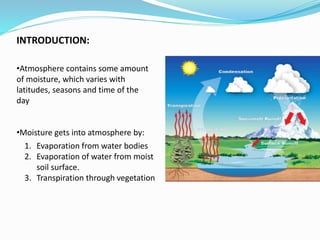
1. Evaporation from water bodies
2. Evaporation of water from moist
soil surface.
3. Transpiration through vegetation
INTRODUCTION:
•Atmosphere contains some amount
of moisture, which varies with
latitudes, seasons and time of the
day
•Moisture gets into atmosphere by:
What is HUMIDITY?
•Humidity is the amount of water vapour content of air suspended in the
atmosphere at any place and time
•Since water vapour is dry like any other gas, it has nothing to do with wetness
or dryness of atmosphere
•Although there is spatial and temporal variation in the quantity of water
vapour present in the atmosphere, the total amount of water vapour remains
nearly constant.
•Among various components of atmosphere, water vapour constitutes only a
small fraction varying from 0-4% by volume.
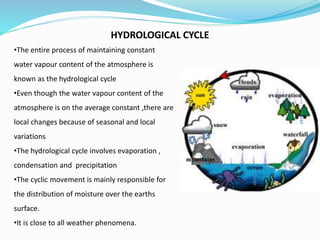
HYDROLOGICAL CYCLE
•The entire process of maintaining constant
water vapour content of the atmosphere is
known as the hydrological cycle
•Even though the water vapour content of the
atmosphere is on the average constant ,there are
local changes because of seasonal and local
variations
•The hydrological cycle involves evaporation ,
condensation and precipitation
•The cyclic movement is mainly responsible for
the distribution of moisture over the earths
surface.
•It is close to all weather phenomena.
TRANSFER OF HUMIDITY
LAND SEA MOISTURE EXCHANGE
•Continous exchange of moisture taking place between the continents and the ocean
•Amount of moisture gained through precipitation on the continents is more than
lost through evapo transpiration
•Ocean loose more moisture through evaporation than receive through precipitation
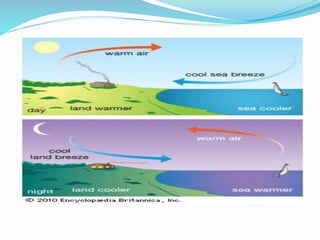
•This can be seen in a daily phenomenon in the form of land breeze and sea breeze.
•The phenomenon of el nino and la nina is also due to this.
LAND SEA MOISTURE EXCHANGE
MERIDIONAL MOISTURE EXCHANGE
Winds carry
moisture to
continents
Water vapour
condenses and
precipitates
Water returns to
ocean by Surface
run off or ground
water seepage
Off shore moisture
laden winds from
lands moves to
oceans and
precipitates
Evaporation from
ocean
MERIDIONAL MOISTURE EXCHANGE
•Transfer of moisture between different latitude belts on the earth
•Why it happens?
Precipitation exceeds evaporation Evaporation exceeds precipitation
40°-70° North and South latitude
(middle latitude zones)
10°-40° North and south
latitude(equatorial zones)
Gain of energy through latent heat of
condensation
Energy transformed into latent heat of
evaporation
•Latitudinal imbalance produced requires a meridional exchange of moisture as well as
energy between dry and wet zones.
•This naturally upsets the latitudinal heat balance.
•However planetary winds, cyclones, anticyclones, and atmospheric disturbances play a
significant role in removing the latitudinal imbalances
MEASUREMENT OF HUMIDITY
1. ABSOLUTE HUMIDITY
2. SPECIFIC HUMIDITY
3. RELATIVE HUMIDITY
4. MIXING RATIO
5. VAPOUR PRESSURE
6. DEW POINT TEMPERATURE
ABSOLUTE HUMIDITY
•The weight of water vapour per unit volume of air.
•Expressed as grams of water vapour per cubic metre of air(g/cm3).
•It is seldom used by meteorologists because it varies with expansion and
contraction of air even if the amount of water vapour is constant.
Temperature (°C) Water vapour(g/m3)
0 4.80
10 9.41
20 17.31
30 30.4
40 51.2
50 83.0
SPECIFIC HUMIDITY
•Weight of water vapour per weight of a given mass of air(including water
vapour)
•Expressed as grams of water vapour per kilogram of air (g/kg)
•Most commonly used as it represents quantity of water vapour(more constant
property)
•It changes only as the quantity of water vapour undergoes change
•Specific humidity is not affected by changes in pressure or temperature of air
•It is directly proportional to the vapour pressure of air and inversely
proportional to air pressure
CONTD..
•Maximum amount of specific humidity is found in the equatorial zones and
minimum at the poles.
•Capacity of air depends on its temperature.
•Amount of water vapour present near the equator is much more than polar
region
•Specific humidity in a particular region is much higher during summer than in
winter.
•It is also higher on the oceans than the continents.
Relative Humidity Specific Humidity (g/kg)
10% 1.7
20% 3.5
30% 5.3
40% 7.1
50% 9.0
60% 11.0
70% 13.1
80% 15.3
90% 17.7
100% 20.2
RELATIVE HUMIDITY
•It is the ratio of the amount of water vapour in the
air to the amount of air can hold at that
temperature.(or its capacity)
•RH is the ratio of the air’s water vapour content to
its water vapour capacity
•RH= Vapour pressure*100
Saturation vapour pressure
•RH is expressed in terms of percentages
•RH increases with the increase in evaporation, as
vapour pressure is directly proportional to the
amount of water vapour present in the air.
•RH= e/es
(e-vapour pressure;es-saturation vapour pressure)
MIXING RATIO
•Weight of water vapour per unit weight of dry air
•Expressed in grams of water vapour per kilogram of dry air(not the
moist air i.e dry air +water vapour)
•This value is used in weather forecasting analysis
•Equation: mixing ratio = 622*e/(p-e)
w- mixing ratio
e-vapour pressure
p-total air pressure
•It is the part of total atmospheric pressure
which is attributable to its water vapour
contents
•Water vapour that rises up into the
atmosphere , leads to a small increase in
pressure in the air
•This increase is the result of the motion of
the water vapour molecules supplied to air
through evaporation
VAPOUR PRESSURE
SATURATED VAPOUR PRESSURE
•Saturated vapor pressure refers to the
maximum pressure of the water vapor that
can exist in equilibrium with its liquid phase,
at a particular temperature
•At this point, the rate of evaporation of the
liquid is equal to the rate of condensation of
the vapor
•The saturation vapour pressure is a function
of temperature.
•They are logarithmically related
Log10es = 0.02604T+0.82488
•The dew point temperature is the temperature at
which air becomes saturated with water vapor,
leading to the formation of dew, fog, or clouds
• At this point, the air cannot hold any more
moisture, and any additional moisture will
condense into water droplets.
•The dew point temperature is an important metric
for meteorologists, as it helps to determine the
likelihood of precipitation, as well as the potential
for fog or dew formation
•Higher dew point temperatures indicate higher
humidity levels, while lower dew point
temperatures indicate drier air.
DEW POINT TEMPERATURE
INSTRUMENTS MEASURING HUMIDITY
•The Chinese used charcoal and a lump of earth:-the dry weight of the
charcoal and a lump of earth was compared to their damp weight after
exposure to the air
•Based on the differences in weight, the humidity level was calculated
•In 1480, Leonardo da Vinci invented the first crude hygrometer
•Francesco Folli created a more practical version of the device during the
1600s
• Robert Hooke improved several meteorological instruments including the
hygrometer
•In 1783, Swiss physicist and geologist Horace Benedict de Saussure invented
the first hygrometer that measured humidity utilizing human hair
HISTORY OF INSTRUMENTS
STATION HYGROMETER
Working principle
concept of evaporative cooling.
•The wet bulb thermometer has a wick
wrapped around its bulb which is saturated
with distilled water
•When air is passed over this wet wick, some
of the water evaporates, which causes the
temperature of the wet bulb thermometer to
drop due to the cooling effect of evaporation
•The dry bulb thermometer, on the other
hand, measures the ambient air temperature
•The amount of cooling of the wet bulb
thermometer is dependent on the amount
of moisture in the air
•If the air is already saturated with
moisture, the evaporation of water from
the wet bulb will be slower, and therefore
the temperature difference between the
two thermometers will be lower
•On the other hand, if the air is dry, the
water will evaporate more quickly, leading
to a greater temperature difference
between the two thermometers
HAIR HYGROMETER
Working principle:
Expansion and contraction of hair
with change in moisture content
•A bunch of hair is used in a socket.
•On moisture absorption, the hair
strands expand
•Slight change increase in the volume
of hair is magnified by a lever
mechanism.
•A pointer attached to the lever mechanism
moves on a graduated scale from 1-100 %
•The pointer on the contraction or
expansion of hair points at the relative
humidity directly.
HAIR HYGROMETER
HAIR HYGROGRAPH
Working principle:
based on the fact that human hair
changes its length and shape as the
moisture content in the air changes
•It measures the continuous changes
in RH on graph paper throughout the
day.
•A recording mechanism is used for
that.
•A band of hair is fixed on the levers
and slight increase in volume is
transmitted to pen arm.
•A caliberated chart is wrapped around
a rotating drum which works on clock
mechanism.
•The X-axis represents time and Y-axis
represents relative humidity
•This instrument is place in a double
stevenson screen
WHY IS DEOILED HUMAN HAIR USED?
•When air is humid ,the space between
the cells absorb water vapour and hair
thickens and lengthens.
•The contraction and expansion is thus
used to measure the moisture content.
Working principle
similar to that of a regular
psychrometer, with the difference
being the method of air circulation
•As the sling psychrometer is swung
around in the air, the wet bulb
thermometer is moistened with
distilled water, and the air passes
over the wet wick, causing the water
to evaporate and cool the
thermometer
Sling Psychrometer
•The dry bulb thermometer, on the other
hand, measures the ambient air
temperature
•The amount of cooling of the wet bulb
thermometer is dependent on the amount
of moisture in the air, which can be used to
determine the relative humidity
•Once the readings from both
thermometers are stabilized, the
temperature difference between the two
thermometers is used to calculate the
relative humidity of the air using
psychrometric tables or formulas
ASSMANN PSYCHROMETER(Aspiration psychrometer)
Working principle:
its working is based on the concept of
evaporative cooling, which is used to determine
the humidity of the air
•Two thermometers i.e wet and dry
thermometers are enclosed in a double walled
radiation screen.
•Nickel plated coaxial tubes are are used to
minimise the radiation effects.
•To ensure proper evaporation from the
wick of the wet bulb ,the psychrometer is
aspirated by a clock work motor housed in
the casing.
•The wet bulb is kept on the downstream
side of the dry bulb i.e near the fan
•This is done to prevent the cold air from
the wet bulb coming in contact with the dry
bulb
•The temperature difference is used to
calculate the relative humidity of the air
using psychrometric tables.
HYGROMETRIC TABLES
Working principle: When the humidity or
moisture content in the surrounding
environment changes, it affects the dielectric
constant of the dielectric material between the
sensor plates which in turn affects the
capacitance.
•The capacitive hygrometer measures the
capacitance of the sensor, which is the ability of
the sensor to store electrical charge
•The capacitance is typically measured using an
AC signal, which is applied to the sensor plates.
CAPACITATIVE HYGROMETER
•The dielectric constant is a measure of the
ability of a material to store electrical charge,
and it changes with humidity
•Materials with dielectric constant ranging
from 2-15 are used
•As the humidity increases, the dielectric
constant of the humidity-sensitive material
also increases, resulting in an increase in
capacitance
C=1.418 RH+ 29.139
Advantages
high accuracy, fast response time, and wide
measurement range.
Working principles
changes in electrical resistance with varying moisture
levels
•A resistive hygrometer is constructed by placing the
moisture-sensitive material between two conductive
electrodes
•Moisture-sensitive material such as ceramic,
polymer, or organic materials that is used as the
sensing element and connected in a circuit to
measure the resistance changes
•Salts and polymers with conductive properties are
typical materials
RESISTIVE HYGROMETER
•When the humidity level changes, the
sensing material absorbs or releases
moisture, which leads to a change in its
electrical resistance
•This resistance change can be measured
using a Wheatstone bridge circuit or other
types of circuitry to determine the
humidity level
Working principle
It is based on the fact that the dew point
temperature of a gas is directly related to its
moisture content
When the gas temperature is lowered to the
dew point temperature, the moisture in the
gas condenses on a surface, forming dew or
frost.
•In this method, a small mirror is cooled
using a thermoelectric cooler or a
refrigeration unit.
DEW POINT HYGROMETERS -CHILLED MIRROR HYGROMETER
•Cooling methods, including dry ice,
compressed carbon dioxide, mechanical
refrigeration, and liquid air
•The mirror is exposed to the air being
measured, and the temperature of the
mirror is gradually lowered until moisture
starts to condense on its surface
•The temperature of the mirror at which
condensation occurs is measured using a
sensor
•This temperature corresponds to the dew
point temperature of the air being
measured
OPTICAL HYGROMETER
Working principle
•Absorption or reflection of light depends upon
the amount of water molecules in the air
•The amount of light that is scattered by tiny
water droplets or ice crystals in the air is
measured
•Types of optical hygrometers
-chilled mirror dew point hygrometer
-infrared absorption hygrometer
-Raman scattering hygrometer
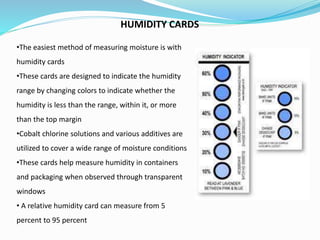
•The easiest method of measuring moisture is with
humidity cards
•These cards are designed to indicate the humidity
range by changing colors to indicate whether the
humidity is less than the range, within it, or more
than the top margin
•Cobalt chlorine solutions and various additives are
utilized to cover a wide range of moisture conditions
•These cards help measure humidity in containers
and packaging when observed through transparent
windows
• A relative humidity card can measure from 5
percent to 95 percent
HUMIDITY CARDS
Working principle
hygroscopic materials tend to absorb moisture
from the surrounding air until they reach a
state of equilibrium
measuring the change in weight of a
hygroscopic material as it absorbs or releases
water vapour
•Components of a gravimetric hygrometer
include a sample chamber, a hygroscopic
material, a balance, and a temperature and
pressure sensor
GRAVIMETRIC HYGROMETER
•The sample chamber is used to hold the gas or air sample to be
measured
•The hygroscopic material is usually a salt or a silica gel that has a high
affinity for water vapor.
•The balance is used to measure the weight of the hygroscopic material
before and after exposure to the gas or air sample
•Weight of the hygroscopic material is then measured using the balance,
and the change in weight is used to calculate the amount of moisture
present in the gas or air sample
•Gravimetric hygrometers are highly accurate and expensive, and they are
used to set standards throughout the United States, United Kingdom,
European Union, and Japan
HUMIDITY.pptx

HUMIDITY.pptx

  • 1.
  • 2.
    1. Evaporation fromwater bodies 2. Evaporation of water from moist soil surface. 3. Transpiration through vegetation INTRODUCTION: •Atmosphere contains some amount of moisture, which varies with latitudes, seasons and time of the day •Moisture gets into atmosphere by:
  • 3.
    What is HUMIDITY? •Humidityis the amount of water vapour content of air suspended in the atmosphere at any place and time •Since water vapour is dry like any other gas, it has nothing to do with wetness or dryness of atmosphere •Although there is spatial and temporal variation in the quantity of water vapour present in the atmosphere, the total amount of water vapour remains nearly constant. •Among various components of atmosphere, water vapour constitutes only a small fraction varying from 0-4% by volume.
  • 4.
    HYDROLOGICAL CYCLE •The entireprocess of maintaining constant water vapour content of the atmosphere is known as the hydrological cycle •Even though the water vapour content of the atmosphere is on the average constant ,there are local changes because of seasonal and local variations •The hydrological cycle involves evaporation , condensation and precipitation •The cyclic movement is mainly responsible for the distribution of moisture over the earths surface. •It is close to all weather phenomena.
  • 5.
    TRANSFER OF HUMIDITY LANDSEA MOISTURE EXCHANGE •Continous exchange of moisture taking place between the continents and the ocean •Amount of moisture gained through precipitation on the continents is more than lost through evapo transpiration •Ocean loose more moisture through evaporation than receive through precipitation •This can be seen in a daily phenomenon in the form of land breeze and sea breeze. •The phenomenon of el nino and la nina is also due to this. LAND SEA MOISTURE EXCHANGE MERIDIONAL MOISTURE EXCHANGE
  • 6.
    Winds carry moisture to continents Watervapour condenses and precipitates Water returns to ocean by Surface run off or ground water seepage Off shore moisture laden winds from lands moves to oceans and precipitates Evaporation from ocean
  • 8.
    MERIDIONAL MOISTURE EXCHANGE •Transferof moisture between different latitude belts on the earth •Why it happens? Precipitation exceeds evaporation Evaporation exceeds precipitation 40°-70° North and South latitude (middle latitude zones) 10°-40° North and south latitude(equatorial zones) Gain of energy through latent heat of condensation Energy transformed into latent heat of evaporation •Latitudinal imbalance produced requires a meridional exchange of moisture as well as energy between dry and wet zones. •This naturally upsets the latitudinal heat balance. •However planetary winds, cyclones, anticyclones, and atmospheric disturbances play a significant role in removing the latitudinal imbalances
  • 10.
    MEASUREMENT OF HUMIDITY 1.ABSOLUTE HUMIDITY 2. SPECIFIC HUMIDITY 3. RELATIVE HUMIDITY 4. MIXING RATIO 5. VAPOUR PRESSURE 6. DEW POINT TEMPERATURE
  • 11.
    ABSOLUTE HUMIDITY •The weightof water vapour per unit volume of air. •Expressed as grams of water vapour per cubic metre of air(g/cm3). •It is seldom used by meteorologists because it varies with expansion and contraction of air even if the amount of water vapour is constant. Temperature (°C) Water vapour(g/m3) 0 4.80 10 9.41 20 17.31 30 30.4 40 51.2 50 83.0
  • 12.
    SPECIFIC HUMIDITY •Weight ofwater vapour per weight of a given mass of air(including water vapour) •Expressed as grams of water vapour per kilogram of air (g/kg) •Most commonly used as it represents quantity of water vapour(more constant property) •It changes only as the quantity of water vapour undergoes change •Specific humidity is not affected by changes in pressure or temperature of air •It is directly proportional to the vapour pressure of air and inversely proportional to air pressure
  • 13.
    CONTD.. •Maximum amount ofspecific humidity is found in the equatorial zones and minimum at the poles. •Capacity of air depends on its temperature. •Amount of water vapour present near the equator is much more than polar region •Specific humidity in a particular region is much higher during summer than in winter. •It is also higher on the oceans than the continents.
  • 14.
    Relative Humidity SpecificHumidity (g/kg) 10% 1.7 20% 3.5 30% 5.3 40% 7.1 50% 9.0 60% 11.0 70% 13.1 80% 15.3 90% 17.7 100% 20.2
  • 15.
    RELATIVE HUMIDITY •It isthe ratio of the amount of water vapour in the air to the amount of air can hold at that temperature.(or its capacity) •RH is the ratio of the air’s water vapour content to its water vapour capacity •RH= Vapour pressure*100 Saturation vapour pressure •RH is expressed in terms of percentages •RH increases with the increase in evaporation, as vapour pressure is directly proportional to the amount of water vapour present in the air. •RH= e/es (e-vapour pressure;es-saturation vapour pressure)
  • 17.
    MIXING RATIO •Weight ofwater vapour per unit weight of dry air •Expressed in grams of water vapour per kilogram of dry air(not the moist air i.e dry air +water vapour) •This value is used in weather forecasting analysis •Equation: mixing ratio = 622*e/(p-e) w- mixing ratio e-vapour pressure p-total air pressure
  • 18.
    •It is thepart of total atmospheric pressure which is attributable to its water vapour contents •Water vapour that rises up into the atmosphere , leads to a small increase in pressure in the air •This increase is the result of the motion of the water vapour molecules supplied to air through evaporation VAPOUR PRESSURE
  • 19.
    SATURATED VAPOUR PRESSURE •Saturatedvapor pressure refers to the maximum pressure of the water vapor that can exist in equilibrium with its liquid phase, at a particular temperature •At this point, the rate of evaporation of the liquid is equal to the rate of condensation of the vapor •The saturation vapour pressure is a function of temperature. •They are logarithmically related Log10es = 0.02604T+0.82488 Log10es = 0.02604T+0.82488
  • 20.
    •The dew pointtemperature is the temperature at which air becomes saturated with water vapor, leading to the formation of dew, fog, or clouds • At this point, the air cannot hold any more moisture, and any additional moisture will condense into water droplets. •The dew point temperature is an important metric for meteorologists, as it helps to determine the likelihood of precipitation, as well as the potential for fog or dew formation •Higher dew point temperatures indicate higher humidity levels, while lower dew point temperatures indicate drier air. DEW POINT TEMPERATURE
  • 21.
  • 22.
    •The Chinese usedcharcoal and a lump of earth:-the dry weight of the charcoal and a lump of earth was compared to their damp weight after exposure to the air •Based on the differences in weight, the humidity level was calculated •In 1480, Leonardo da Vinci invented the first crude hygrometer •Francesco Folli created a more practical version of the device during the 1600s • Robert Hooke improved several meteorological instruments including the hygrometer •In 1783, Swiss physicist and geologist Horace Benedict de Saussure invented the first hygrometer that measured humidity utilizing human hair HISTORY OF INSTRUMENTS
  • 23.
    STATION HYGROMETER Working principle conceptof evaporative cooling. •The wet bulb thermometer has a wick wrapped around its bulb which is saturated with distilled water •When air is passed over this wet wick, some of the water evaporates, which causes the temperature of the wet bulb thermometer to drop due to the cooling effect of evaporation •The dry bulb thermometer, on the other hand, measures the ambient air temperature
  • 24.
    •The amount ofcooling of the wet bulb thermometer is dependent on the amount of moisture in the air •If the air is already saturated with moisture, the evaporation of water from the wet bulb will be slower, and therefore the temperature difference between the two thermometers will be lower •On the other hand, if the air is dry, the water will evaporate more quickly, leading to a greater temperature difference between the two thermometers
  • 25.
    HAIR HYGROMETER Working principle: Expansionand contraction of hair with change in moisture content •A bunch of hair is used in a socket. •On moisture absorption, the hair strands expand •Slight change increase in the volume of hair is magnified by a lever mechanism.
  • 26.
    •A pointer attachedto the lever mechanism moves on a graduated scale from 1-100 % •The pointer on the contraction or expansion of hair points at the relative humidity directly. HAIR HYGROMETER
  • 27.
    HAIR HYGROGRAPH Working principle: basedon the fact that human hair changes its length and shape as the moisture content in the air changes •It measures the continuous changes in RH on graph paper throughout the day. •A recording mechanism is used for that. •A band of hair is fixed on the levers and slight increase in volume is transmitted to pen arm. •A caliberated chart is wrapped around a rotating drum which works on clock mechanism.
  • 28.
    •The X-axis representstime and Y-axis represents relative humidity •This instrument is place in a double stevenson screen WHY IS DEOILED HUMAN HAIR USED? •When air is humid ,the space between the cells absorb water vapour and hair thickens and lengthens. •The contraction and expansion is thus used to measure the moisture content.
  • 29.
    Working principle similar tothat of a regular psychrometer, with the difference being the method of air circulation •As the sling psychrometer is swung around in the air, the wet bulb thermometer is moistened with distilled water, and the air passes over the wet wick, causing the water to evaporate and cool the thermometer Sling Psychrometer
  • 30.
    •The dry bulbthermometer, on the other hand, measures the ambient air temperature •The amount of cooling of the wet bulb thermometer is dependent on the amount of moisture in the air, which can be used to determine the relative humidity •Once the readings from both thermometers are stabilized, the temperature difference between the two thermometers is used to calculate the relative humidity of the air using psychrometric tables or formulas
  • 31.
    ASSMANN PSYCHROMETER(Aspiration psychrometer) Workingprinciple: its working is based on the concept of evaporative cooling, which is used to determine the humidity of the air •Two thermometers i.e wet and dry thermometers are enclosed in a double walled radiation screen. •Nickel plated coaxial tubes are are used to minimise the radiation effects.
  • 32.
    •To ensure properevaporation from the wick of the wet bulb ,the psychrometer is aspirated by a clock work motor housed in the casing. •The wet bulb is kept on the downstream side of the dry bulb i.e near the fan •This is done to prevent the cold air from the wet bulb coming in contact with the dry bulb •The temperature difference is used to calculate the relative humidity of the air using psychrometric tables.
  • 33.
  • 34.
    Working principle: Whenthe humidity or moisture content in the surrounding environment changes, it affects the dielectric constant of the dielectric material between the sensor plates which in turn affects the capacitance. •The capacitive hygrometer measures the capacitance of the sensor, which is the ability of the sensor to store electrical charge •The capacitance is typically measured using an AC signal, which is applied to the sensor plates. CAPACITATIVE HYGROMETER
  • 35.
    •The dielectric constantis a measure of the ability of a material to store electrical charge, and it changes with humidity •Materials with dielectric constant ranging from 2-15 are used •As the humidity increases, the dielectric constant of the humidity-sensitive material also increases, resulting in an increase in capacitance C=1.418 RH+ 29.139 Advantages high accuracy, fast response time, and wide measurement range.
  • 36.
    Working principles changes inelectrical resistance with varying moisture levels •A resistive hygrometer is constructed by placing the moisture-sensitive material between two conductive electrodes •Moisture-sensitive material such as ceramic, polymer, or organic materials that is used as the sensing element and connected in a circuit to measure the resistance changes •Salts and polymers with conductive properties are typical materials RESISTIVE HYGROMETER
  • 37.
    •When the humiditylevel changes, the sensing material absorbs or releases moisture, which leads to a change in its electrical resistance •This resistance change can be measured using a Wheatstone bridge circuit or other types of circuitry to determine the humidity level
  • 38.
    Working principle It isbased on the fact that the dew point temperature of a gas is directly related to its moisture content When the gas temperature is lowered to the dew point temperature, the moisture in the gas condenses on a surface, forming dew or frost. •In this method, a small mirror is cooled using a thermoelectric cooler or a refrigeration unit. DEW POINT HYGROMETERS -CHILLED MIRROR HYGROMETER
  • 39.
    •Cooling methods, includingdry ice, compressed carbon dioxide, mechanical refrigeration, and liquid air •The mirror is exposed to the air being measured, and the temperature of the mirror is gradually lowered until moisture starts to condense on its surface •The temperature of the mirror at which condensation occurs is measured using a sensor •This temperature corresponds to the dew point temperature of the air being measured
  • 40.
    OPTICAL HYGROMETER Working principle •Absorptionor reflection of light depends upon the amount of water molecules in the air •The amount of light that is scattered by tiny water droplets or ice crystals in the air is measured •Types of optical hygrometers -chilled mirror dew point hygrometer -infrared absorption hygrometer -Raman scattering hygrometer
  • 41.
    •The easiest methodof measuring moisture is with humidity cards •These cards are designed to indicate the humidity range by changing colors to indicate whether the humidity is less than the range, within it, or more than the top margin •Cobalt chlorine solutions and various additives are utilized to cover a wide range of moisture conditions •These cards help measure humidity in containers and packaging when observed through transparent windows • A relative humidity card can measure from 5 percent to 95 percent HUMIDITY CARDS
  • 42.
    Working principle hygroscopic materialstend to absorb moisture from the surrounding air until they reach a state of equilibrium measuring the change in weight of a hygroscopic material as it absorbs or releases water vapour •Components of a gravimetric hygrometer include a sample chamber, a hygroscopic material, a balance, and a temperature and pressure sensor GRAVIMETRIC HYGROMETER
  • 43.
    •The sample chamberis used to hold the gas or air sample to be measured •The hygroscopic material is usually a salt or a silica gel that has a high affinity for water vapor. •The balance is used to measure the weight of the hygroscopic material before and after exposure to the gas or air sample •Weight of the hygroscopic material is then measured using the balance, and the change in weight is used to calculate the amount of moisture present in the gas or air sample •Gravimetric hygrometers are highly accurate and expensive, and they are used to set standards throughout the United States, United Kingdom, European Union, and Japan