CONTENTS
Introduction
Weather & Climate
Elements of Weather & Climate
 Green House Gases
Sources of Green House Gases
Diagrams & Green House Effects
Global Warming is a Burning Issue
Impacts of climate change over the world
Natural Disasters over the World ( Within the Last
Decade)
Details of Conference of Parties 28 or COP 28
INTRODUCTION
WHAT DOES IT MEAN?
Climate change refers to changes in the Earth’s climates, at local,
regional, or global scales, and is most commonly used to describe
anthropogenic caused.
These changes may be natural but human activities have been the main
driver of climate change, primarily due to the burning of fossil fuels (like
coal, oil, and gas) increasing heat-trapping greenhouse gas levels in the
Earth’s atmosphere.
Difference in Weather and Climate
 Weather: refers to short term of atmospheric
condition like today is hot day, cold, rainy, sunny,
cloudy weather etc.
 Climate: refers to average weather patterns over a
long period of time of 30 years.
Elements of Weather & Climate
Gases
Dust particles
Water vapors
Humidity
Clouds
Precipitation
Altitude
Latitude
Ocean currents
Sunshine duration
Temperature
Atmospheric pressure
Wind speed & direction
ANY GASES THAT CAUSE THE
“GREENHOUSE EFFECT!”
What are greenhouse gases?
GREEN HOUSE EFFECT
GREEN HOUSE EFFECT
GREEN HOUSE EFFECT
Factors of climate change
Natural Processes.
Anthropogenic Activities
Green House Gases
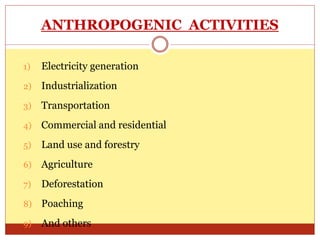
ANTHROPOGENIC ACTIVITIES
1) Electricity generation
2) Industrialization
3) Transportation
4) Commercial and residential
5) Land use and forestry
6) Agriculture
7) Deforestation
8) Poaching
9) And others
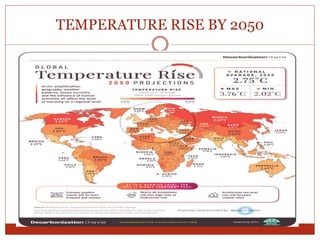
Globally temperature rises
TEMPERATURE RISE BY 2050
Meet an Ice Core Scientist
What does this graph mean?
LOOK AT THE BAR
Showing the Temperature Rises by Graph
Gases Emission by the Sectors
Impacts of Climate Change
 Warming and sea level rise will continue and will probably
occur more quickly than what we’ve already seen
 Even if greenhouse gases are stabilized, this will probably
continue to occur for centuries
 Some effects may be permanent
Impacts of Climate Change
Effects on Ecosystems
– Coral systems and other unique ecosystems cannot handle higher
temperatures well
– Wildfires will increase
– Up to 30% of species will be at increased risk for extinction due to
the rapid changes in their ecosystems
Effects in North America
 Warming in western mountains: several effects
 Increased rain: will actually help some crops
 Heat waves will increase in number, length, and intensity
 Coastal communities will be affected by increased
flooding and storms
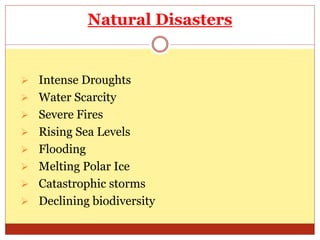
Natural Disasters
Types of Natural Disasters
NATURAL DISASTERS OVER THE WORLD
( WITHIN THE LAST DECADE)
1) Emergence of corona virus, Total death of people in
worldwide 6,963,000 (2019-2024) 1.USA 1,190,200
death and Pakistan 30,664 death
2) The deadliest tropical cyclone known as Typhoon Rai
which caused 410 fatalities
in Philippines, Estimated cost 75.25 billion USD(2021)
1) Pakistan floods, killed people 1,839, and caused Rs:
3.2 trillion, $ 14.8 billion (2022)
Natural Disasters
 Intense Droughts
 Water Scarcity
 Severe Fires
 Rising Sea Levels
 Flooding
 Melting Polar Ice
 Catastrophic storms
 Declining biodiversity
Conference of Parties 28
DETAILS OF COP 28
 Nov 30, 2023 to 13 Dec, 2023, the 28th meeting of the Conference of
the Parties mostly known as (COP28) or the United Nations Framework
Convention on Climate Change (UNFCCC) will be held at Expo City,
Dubai in the United Arab Emirates (UAE).
 The UAE has outlined four themes for COP28: technology and innovation,
inclusion, frontline communities, and finance.
 The Incoming Presidency of COP28 has outlined four key areas of focus
on during the conference: Fast-tracking the energy transition and reducing
emissions before 2030.
HOW TO PREVENT CLIMATE CHANGE ?!
 Switching to sustainable transportation
 Improving farming and encourage vegan diets
 Restoring nature ( Forestation) to absorb more carbon
 Protecting forests like the Amazon
 Protecting the oceans
 Reducing plastic
 Global partnership to obey climate laws
Climate Change.ppt

Climate Change.ppt

  • 2.
    CONTENTS Introduction Weather & Climate Elementsof Weather & Climate  Green House Gases Sources of Green House Gases Diagrams & Green House Effects Global Warming is a Burning Issue Impacts of climate change over the world Natural Disasters over the World ( Within the Last Decade) Details of Conference of Parties 28 or COP 28
  • 3.
    INTRODUCTION WHAT DOES ITMEAN? Climate change refers to changes in the Earth’s climates, at local, regional, or global scales, and is most commonly used to describe anthropogenic caused. These changes may be natural but human activities have been the main driver of climate change, primarily due to the burning of fossil fuels (like coal, oil, and gas) increasing heat-trapping greenhouse gas levels in the Earth’s atmosphere.
  • 4.
    Difference in Weatherand Climate  Weather: refers to short term of atmospheric condition like today is hot day, cold, rainy, sunny, cloudy weather etc.  Climate: refers to average weather patterns over a long period of time of 30 years.
  • 5.
    Elements of Weather& Climate Gases Dust particles Water vapors Humidity Clouds Precipitation Altitude Latitude Ocean currents Sunshine duration Temperature Atmospheric pressure Wind speed & direction
  • 6.
    ANY GASES THATCAUSE THE “GREENHOUSE EFFECT!” What are greenhouse gases?
  • 7.
  • 8.
  • 9.
  • 10.
    Factors of climatechange Natural Processes. Anthropogenic Activities
  • 11.
  • 12.
    ANTHROPOGENIC ACTIVITIES 1) Electricitygeneration 2) Industrialization 3) Transportation 4) Commercial and residential 5) Land use and forestry 6) Agriculture 7) Deforestation 8) Poaching 9) And others
  • 14.
  • 15.
  • 16.
    Meet an IceCore Scientist
  • 17.
    What does thisgraph mean? LOOK AT THE BAR
  • 18.
  • 19.
    Gases Emission bythe Sectors
  • 20.
  • 21.
     Warming andsea level rise will continue and will probably occur more quickly than what we’ve already seen  Even if greenhouse gases are stabilized, this will probably continue to occur for centuries  Some effects may be permanent Impacts of Climate Change
  • 22.
    Impacts of ClimateChange Effects on Ecosystems – Coral systems and other unique ecosystems cannot handle higher temperatures well – Wildfires will increase – Up to 30% of species will be at increased risk for extinction due to the rapid changes in their ecosystems
  • 23.
    Effects in NorthAmerica  Warming in western mountains: several effects  Increased rain: will actually help some crops  Heat waves will increase in number, length, and intensity  Coastal communities will be affected by increased flooding and storms
  • 24.
  • 25.
  • 26.
    NATURAL DISASTERS OVERTHE WORLD ( WITHIN THE LAST DECADE) 1) Emergence of corona virus, Total death of people in worldwide 6,963,000 (2019-2024) 1.USA 1,190,200 death and Pakistan 30,664 death 2) The deadliest tropical cyclone known as Typhoon Rai which caused 410 fatalities in Philippines, Estimated cost 75.25 billion USD(2021) 1) Pakistan floods, killed people 1,839, and caused Rs: 3.2 trillion, $ 14.8 billion (2022)
  • 27.
    Natural Disasters  IntenseDroughts  Water Scarcity  Severe Fires  Rising Sea Levels  Flooding  Melting Polar Ice  Catastrophic storms  Declining biodiversity
  • 29.
  • 30.
    DETAILS OF COP28  Nov 30, 2023 to 13 Dec, 2023, the 28th meeting of the Conference of the Parties mostly known as (COP28) or the United Nations Framework Convention on Climate Change (UNFCCC) will be held at Expo City, Dubai in the United Arab Emirates (UAE).  The UAE has outlined four themes for COP28: technology and innovation, inclusion, frontline communities, and finance.  The Incoming Presidency of COP28 has outlined four key areas of focus on during the conference: Fast-tracking the energy transition and reducing emissions before 2030.
  • 31.
    HOW TO PREVENTCLIMATE CHANGE ?!  Switching to sustainable transportation  Improving farming and encourage vegan diets  Restoring nature ( Forestation) to absorb more carbon  Protecting forests like the Amazon  Protecting the oceans  Reducing plastic  Global partnership to obey climate laws

Editor's Notes

  • #2 Discuss what students think they know about this word before diving deeper. Begin this section by setting up the lab described in the lesson plan to compare how heat is trapped in three tanks.
  • #7 What are greenhouse gases? Any gases that cause the greenhouse effect! Includes water, carbon dioxide, methane, nitrous oxide, and several other very long-named chemicals (generally only created by very specific industrial processes) NOTE – Water is definitely the major greenhouse gas. However, water is in a very set cycles, – what goes up, comes back down Thus far, human-produced greenhouse gases simply go up; very little is taking them back out
  • #9 What is the greenhouse effect? A greenhouse (or car) is generally warmer than the air outside it because sunlight and heat pass through the glass into the car, but heat is then trapped in the car, making it warmer
  • #10 In Earth terms: Sunlight enters our atmosphere (some rays don’t penetrate and are already lost to space) Some of the heat from the sun is absorbed by our planet, but much of it is reflected back Most of that heat should pass through the atmosphere back into space HOWEVER – greenhouse gases “trap” the heat and keep it in our atmosphere After completing this section, refer back to the lab set up and ask students to relate the parts of the lab to the parts of the Earth in the image above.
  • #11 What is it? Identifiable change in the climate of Earth as a whole that lasts for an extended period of time (decades or longer) When it occurs by natural processes – we call it climate variability Usually refers to changes caused by human activities Often referred to as global warming since the temp is increasing Compare that definition to ours created in class
  • #14 Now that we’ve created our own definition of this word, let’s look at it a little more closely.
  • #15 Ask students to examine the graphs and explain their meaning – you might assign different groups different parts and then discuss as a whole. Shows the combined land and ocean temperature increase over time in the past 162 years. Bottom shows the averages for an entire decade, so there’s less “noise” – also makes the recent rapid increase more evidence – the boxes aren’t even touching the temperature has increased so much. Shows the overall surface temperature increase over 100 years. In almost all areas, it has increased by at least a few degrees. Sea ice is dropping, partially in the Arctic ocean – the temperatures are warmer and so there is less ice in those regions. Sea level changes in past 110 years – also increasing. Changes in precipitation over land in past 59 years – this is a more variable change. Some areas are the same, while other areas are getting significally more rain and others significantly less.
  • #18  The levels of anthropogenic GHG are rising every year – especially CO2. (In the graph, CO2 FOLU stands for Forestry/Other Land Use.) The percent increases at the top are particularly interesting because we have increased the amounts even more in the first decade of this century than in the 30 years prior.
  • #22 It is very likely that warming and sea level rise will continue and will very likely be larger than those already seen Even if greenhouse gases are stabilized, warming and rising sea levels may continue to occur for centuries – we started rolling a really big ball downhill, it will take a while for it to stop now, even if we’re not pushing it anymore. Some effects of warming (such as loss of glaciers) may be permanent. That’s not to say that more glaciers can’t form. But with the uneven distribution of warming on our planet, some areas will most likely have their climates altered for the foreseeable future (within many generations of human life).
  • #23 These are model predictions of what happens to ecosystems with greater increased temperatures and sea levels – only effects seen with a 1-2°C temp rise and sea levels rising at their current rate are included Effects on ecosystems: Many coral systems will collapse due to bleaching (coral death) Wildfires will increase; increased heat and decreased precipitation in some areas Up to 30% of species will be at increased risk of extinction due to climate change in their ecosystems
  • #24 Effects in North America: Warming in Cascade and Rocky Mountains would cause less snow pack, increased winter flooding, and reduce water in summer (less snow to melt and run down the mts) In certain areas, rain-fed crops will actually increase (decreased rain in one area is generally going to mean increased rain in others, though this may increase flooding in some areas, too) Heat waves will likely increase in number, length, and intensity Coastal communities and ecosystems will be affected by rising sea levels (increased floods and storms) (NOTE – This will be a much bigger problem in poorer countries with few resources to move populations or adapt to changes)
  • #29 It’s a pretty big problem, and it’s easy and tempting to simply throw our hands up and say, “It’s too late! There’s nothing we can do now!” But it’s not true! Even small changes, multiplied by everyone, can make a big difference. And we can make some big changes too with help! So… what can we do? Ask students to brainstorm ideas – the next slide shows where the majority of GHG emissions from from by sector.