Dr Pallavi Potdar
Associate Prof.,
Community Medicine
D.Y. Patil Medical College Kolhapur
Contents
Introduction
Sources of air pollution
Indoor air pollution
Effects of air pollution
Prevention and Control
Summary and Conclusion
Introduction
Constant & menacing problem throughout
the world.
Threatens the very existence of man on
planet.
Deserves a sustained attention at national
& international level.
Sources of air pollution
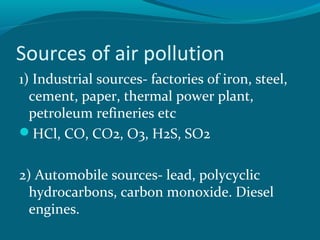
1) Industrial sources- factories of iron, steel,
cement, paper, thermal power plant,
petroleum refineries etc
HCl, CO, CO2, O3, H2S, SO2
2) Automobile sources- lead, polycyclic
hydrocarbons, carbon monoxide. Diesel
engines.
Sources of air pollution
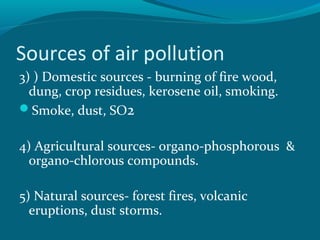
3) ) Domestic sources - burning of fire wood,
dung, crop residues, kerosene oil, smoking.
Smoke, dust, SO2
4) Agricultural sources- organo-phosphorous &
organo-chlorous compounds.
5) Natural sources- forest fires, volcanic
eruptions, dust storms.
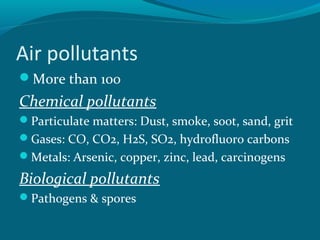
Air pollutants
More than 100
Chemical pollutants
Particulate matters: Dust, smoke, soot, sand, grit
Gases: CO, CO2, H2S, SO2, hydrofluoro carbons
Metals: Arsenic, copper, zinc, lead, carcinogens
Biological pollutants
Pathogens & spores
Hazards of air pollution
Individual effects
Global effects
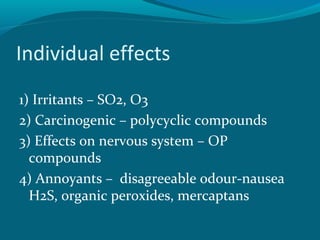
Individual effects
1) Irritants – SO2, O3
2) Carcinogenic – polycyclic compounds
3) Effects on nervous system – OP
compounds
4) Annoyants – disagreeable odour-nausea
H2S, organic peroxides, mercaptans
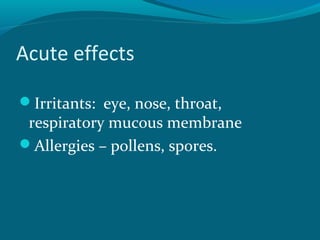
Acute effects
Irritants: eye, nose, throat,
respiratory mucous membrane
Allergies – pollens, spores.
Chronic effects
Chronic bronchitis
 Bronchiectasis
Emphysema
COPD
Bronchial asthma
Lung cancer
Global effects
1) Ozone depletion
2) Global warming
3) Acid rain
Global effects
Ozone depletion
Oxides of nitrogen, chlorofluorocarbons
Increased penetration of UV- rays
Skin cancer, cataract, reduced immunity.
Global effects
Global warming
Green house effect- Normally seen.
CO2, methane, CFC , ozone - elevate
temperature.
Global warming
Drynessofclimate
Reductioninworldfoodproduction
Meltingofpolaricecaps
Acid rain
Sulphur dioxide- sulphuric acid
Carbon dioxide- carbonic acid
Nitrogen dioxide-nitric acid
Leads to acidification of soil, water
Damage to plants, fish
Decreased food production
Effects on animals
Weakness, cachexia
Miscellaneous
Damage to buildings like old monuments
Damage to metals, textiles, rubber & works
on wood, stone, bronze etc
Indoor air pollution
Exposes more people world wide than
outdoor air pollution
More among rural people
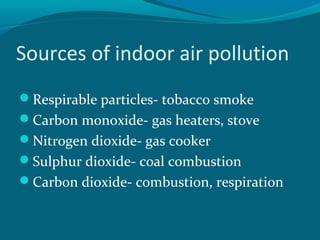
Sources of indoor air pollution
Respirable particles- tobacco smoke
Carbon monoxide- gas heaters, stove
Nitrogen dioxide- gas cooker
Sulphur dioxide- coal combustion
Carbon dioxide- combustion, respiration
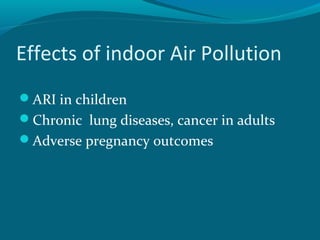
Effects of indoor Air Pollution
ARI in children
Chronic lung diseases, cancer in adults
Adverse pregnancy outcomes
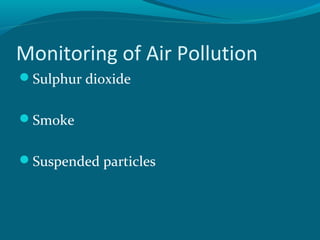
Monitoring of Air Pollution
Sulphur dioxide
Smoke
Suspended particles
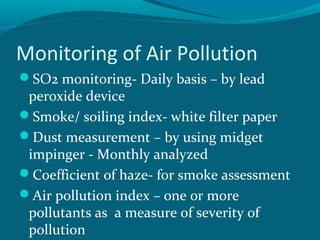
Monitoring of Air Pollution
SO2 monitoring- Daily basis – by lead
peroxide device
Smoke/ soiling index- white filter paper
Dust measurement – by using midget
impinger - Monthly analyzed
Coefficient of haze- for smoke assessment
Air pollution index – one or more
pollutants as a measure of severity of
pollution
Prevention and Control
Location of industries
Containment
Replacement
Dilution- green belts
Legislation
International action
Disinfection of air
1. Mechanical ventilation – reduces
vitiated air, bacterial density
2. U-V radiation – OT & infectitious
disease wards
3. Chemical mists – triethylene glucol
4. Dust control – oil
Summary & conclusion
Hazards of air pollution
Prevention and control

Air pollution

  • 1.
    Dr Pallavi Potdar AssociateProf., Community Medicine D.Y. Patil Medical College Kolhapur
  • 2.
    Contents Introduction Sources of airpollution Indoor air pollution Effects of air pollution Prevention and Control Summary and Conclusion
  • 3.
    Introduction Constant & menacingproblem throughout the world. Threatens the very existence of man on planet. Deserves a sustained attention at national & international level.
  • 4.
    Sources of airpollution 1) Industrial sources- factories of iron, steel, cement, paper, thermal power plant, petroleum refineries etc HCl, CO, CO2, O3, H2S, SO2 2) Automobile sources- lead, polycyclic hydrocarbons, carbon monoxide. Diesel engines.
  • 5.
    Sources of airpollution 3) ) Domestic sources - burning of fire wood, dung, crop residues, kerosene oil, smoking. Smoke, dust, SO2 4) Agricultural sources- organo-phosphorous & organo-chlorous compounds. 5) Natural sources- forest fires, volcanic eruptions, dust storms.
  • 6.
    Air pollutants More than100 Chemical pollutants Particulate matters: Dust, smoke, soot, sand, grit Gases: CO, CO2, H2S, SO2, hydrofluoro carbons Metals: Arsenic, copper, zinc, lead, carcinogens Biological pollutants Pathogens & spores
  • 7.
    Hazards of airpollution Individual effects Global effects
  • 8.
    Individual effects 1) Irritants– SO2, O3 2) Carcinogenic – polycyclic compounds 3) Effects on nervous system – OP compounds 4) Annoyants – disagreeable odour-nausea H2S, organic peroxides, mercaptans
  • 9.
    Acute effects Irritants: eye,nose, throat, respiratory mucous membrane Allergies – pollens, spores.
  • 10.
    Chronic effects Chronic bronchitis Bronchiectasis Emphysema COPD Bronchial asthma Lung cancer
  • 11.
    Global effects 1) Ozonedepletion 2) Global warming 3) Acid rain
  • 12.
    Global effects Ozone depletion Oxidesof nitrogen, chlorofluorocarbons Increased penetration of UV- rays Skin cancer, cataract, reduced immunity.
  • 13.
    Global effects Global warming Greenhouse effect- Normally seen. CO2, methane, CFC , ozone - elevate temperature.
  • 14.
  • 15.
    Acid rain Sulphur dioxide-sulphuric acid Carbon dioxide- carbonic acid Nitrogen dioxide-nitric acid Leads to acidification of soil, water Damage to plants, fish Decreased food production
  • 16.
  • 17.
    Miscellaneous Damage to buildingslike old monuments Damage to metals, textiles, rubber & works on wood, stone, bronze etc
  • 18.
    Indoor air pollution Exposesmore people world wide than outdoor air pollution More among rural people
  • 19.
    Sources of indoorair pollution Respirable particles- tobacco smoke Carbon monoxide- gas heaters, stove Nitrogen dioxide- gas cooker Sulphur dioxide- coal combustion Carbon dioxide- combustion, respiration
  • 20.
    Effects of indoorAir Pollution ARI in children Chronic lung diseases, cancer in adults Adverse pregnancy outcomes
  • 21.
    Monitoring of AirPollution Sulphur dioxide Smoke Suspended particles
  • 22.
    Monitoring of AirPollution SO2 monitoring- Daily basis – by lead peroxide device Smoke/ soiling index- white filter paper Dust measurement – by using midget impinger - Monthly analyzed Coefficient of haze- for smoke assessment Air pollution index – one or more pollutants as a measure of severity of pollution
  • 23.
    Prevention and Control Locationof industries Containment Replacement Dilution- green belts Legislation International action
  • 24.
    Disinfection of air 1.Mechanical ventilation – reduces vitiated air, bacterial density 2. U-V radiation – OT & infectitious disease wards 3. Chemical mists – triethylene glucol 4. Dust control – oil
  • 25.
    Summary & conclusion Hazardsof air pollution Prevention and control