UPPER & LOWER
MOTOR NEURON
LESIONS
Prepared by: Anish Dhakal
MBBS 3rd Year
anishdhakal718@gmail.com
OBJECTIVES
• To define Upper motor neurons and Lower motor neurons
• To describe and differentiate between Upper and Lower
motor neuron lesions
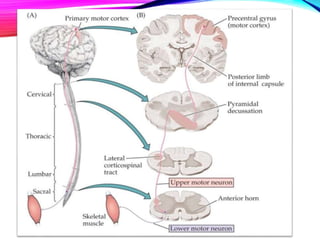
• Lower Motor Neurons:
Ventral horn of spinal cord and in cranial nerve nuclei in
brain stem
Integral motor component of the spinal reflexes
• Upper Motor Neurons:
Cerebral cortex and brain stem
Direct the activity of lower motor neurons
A least two neuron pathway needed for skeletal muscle
contraction
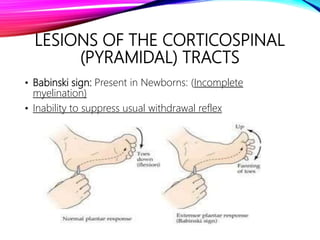
LESIONS OF THE CORTICOSPINAL
(PYRAMIDAL) TRACTS
• Babinski sign: Present in Newborns: (Incomplete
myelination)
• Inability to suppress usual withdrawal reflex
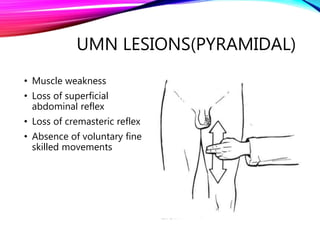
UMN LESIONS(PYRAMIDAL)
• Muscle weakness
• Loss of superficial
abdominal reflex
• Loss of cremasteric reflex
• Absence of voluntary fine
skilled movements
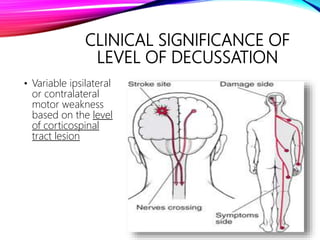
CLINICAL SIGNIFICANCE OF
LEVEL OF DECUSSATION
• Variable ipsilateral
or contralateral
motor weakness
based on the level
of corticospinal
tract lesion
LESIONS OF THE
EXTRAPYRAMIDAL TRACTS
• Severe paralysis
• Spasticity
• Exaggerated deep muscle reflex
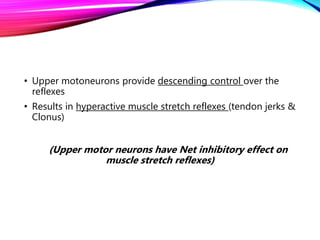
• Upper motoneurons provide descending control over the
reflexes
• Results in hyperactive muscle stretch reflexes (tendon jerks &
Clonus)
(Upper motor neurons have Net inhibitory effect on
muscle stretch reflexes)
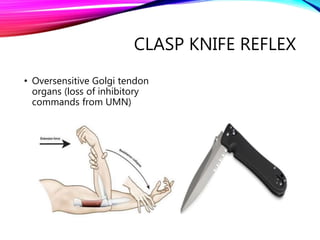
CLASP KNIFE REFLEX
• Oversensitive Golgi tendon
organs (loss of inhibitory
commands from UMN)
LOWER MOTOR NEURON
LESIONS
• Flaccid paralysis
• Loss of reflexes
• Muscular contracture
• Reaction of degeneration
LOWER MOTOR NEURON
LESIONS
• Muscular fasciculation & fibrillations (denervation super
sensitivity)
• Atrophy secondary to denervation of LMN
(Neither stretch reflex nor voluntary contraction)
In UMN lesions, can still be contracted by stretch reflexes
Disuse atrophy may be evident
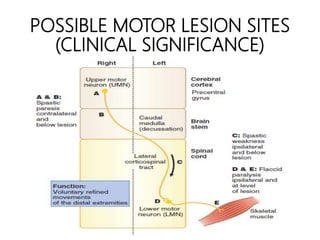
POSSIBLE MOTOR LESION SITES
(CLINICAL SIGNIFICANCE)
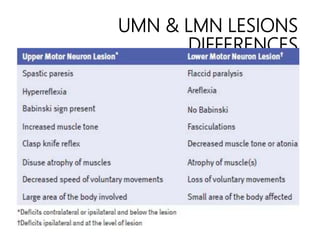
UMN & LMN LESIONS
DIFFERENCES
Upper and Lower motor neuron lesions

Upper and Lower motor neuron lesions

  • 1.
    UPPER & LOWER MOTORNEURON LESIONS Prepared by: Anish Dhakal MBBS 3rd Year anishdhakal718@gmail.com
  • 2.
    OBJECTIVES • To defineUpper motor neurons and Lower motor neurons • To describe and differentiate between Upper and Lower motor neuron lesions
  • 3.
    • Lower MotorNeurons: Ventral horn of spinal cord and in cranial nerve nuclei in brain stem Integral motor component of the spinal reflexes • Upper Motor Neurons: Cerebral cortex and brain stem Direct the activity of lower motor neurons A least two neuron pathway needed for skeletal muscle contraction
  • 5.
    LESIONS OF THECORTICOSPINAL (PYRAMIDAL) TRACTS • Babinski sign: Present in Newborns: (Incomplete myelination) • Inability to suppress usual withdrawal reflex
  • 6.
    UMN LESIONS(PYRAMIDAL) • Muscleweakness • Loss of superficial abdominal reflex • Loss of cremasteric reflex • Absence of voluntary fine skilled movements
  • 7.
    CLINICAL SIGNIFICANCE OF LEVELOF DECUSSATION • Variable ipsilateral or contralateral motor weakness based on the level of corticospinal tract lesion
  • 8.
    LESIONS OF THE EXTRAPYRAMIDALTRACTS • Severe paralysis • Spasticity • Exaggerated deep muscle reflex
  • 9.
    • Upper motoneuronsprovide descending control over the reflexes • Results in hyperactive muscle stretch reflexes (tendon jerks & Clonus) (Upper motor neurons have Net inhibitory effect on muscle stretch reflexes)
  • 10.
    CLASP KNIFE REFLEX •Oversensitive Golgi tendon organs (loss of inhibitory commands from UMN)
  • 11.
    LOWER MOTOR NEURON LESIONS •Flaccid paralysis • Loss of reflexes • Muscular contracture • Reaction of degeneration
  • 12.
    LOWER MOTOR NEURON LESIONS •Muscular fasciculation & fibrillations (denervation super sensitivity) • Atrophy secondary to denervation of LMN (Neither stretch reflex nor voluntary contraction) In UMN lesions, can still be contracted by stretch reflexes Disuse atrophy may be evident
  • 13.
    POSSIBLE MOTOR LESIONSITES (CLINICAL SIGNIFICANCE)
  • 14.
    UMN & LMNLESIONS DIFFERENCES