 HAFSA KHALID
 LAIBA ROOP PAUL
 AQSA MUSHTAQ
 MARYAM KHALID
 LAREB SATTAR
 SABIHA MANZOOR
 NOOR FAIZA
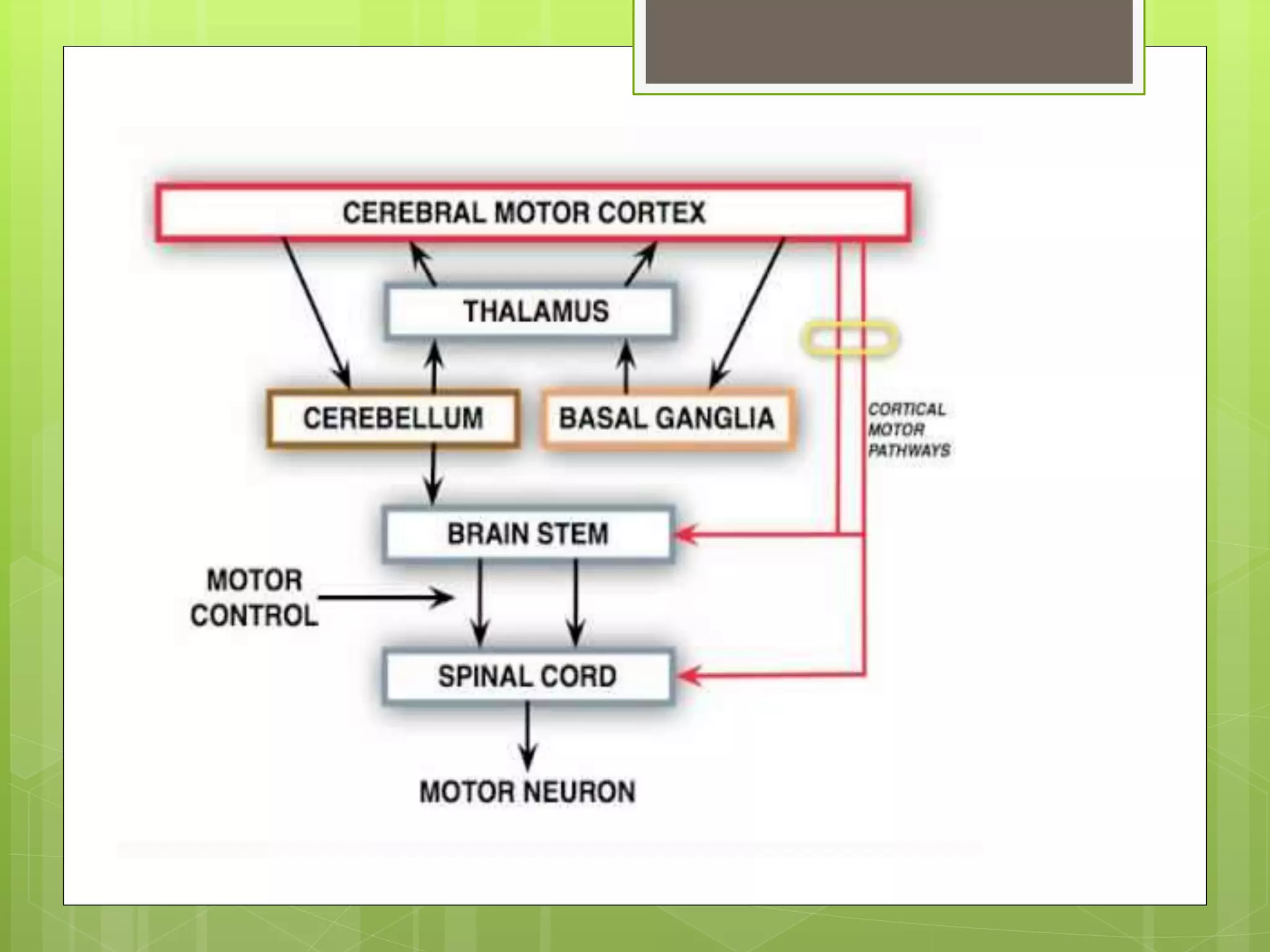
The motor system is the part of the central nervous
system that is involved with movement.
 It consists of :
 Pyramidal and extrapyramidal system tracts from
UMN & LMN
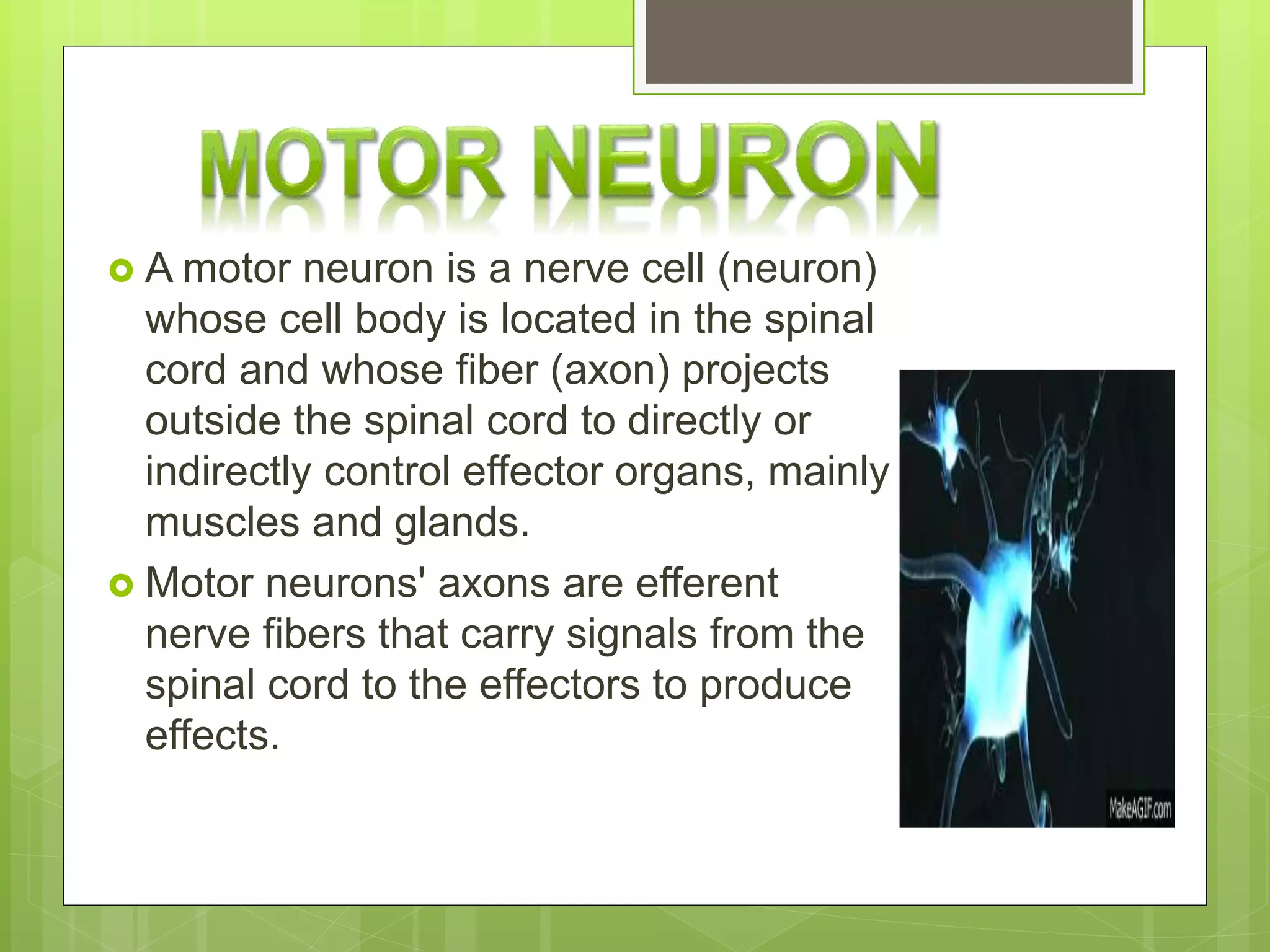
 A motor neuron is a nerve cell (neuron)
whose cell body is located in the spinal
cord and whose fiber (axon) projects
outside the spinal cord to directly or
indirectly control effector organs, mainly
muscles and glands.
 Motor neurons' axons are efferent
nerve fibers that carry signals from the
spinal cord to the effectors to produce
effects.
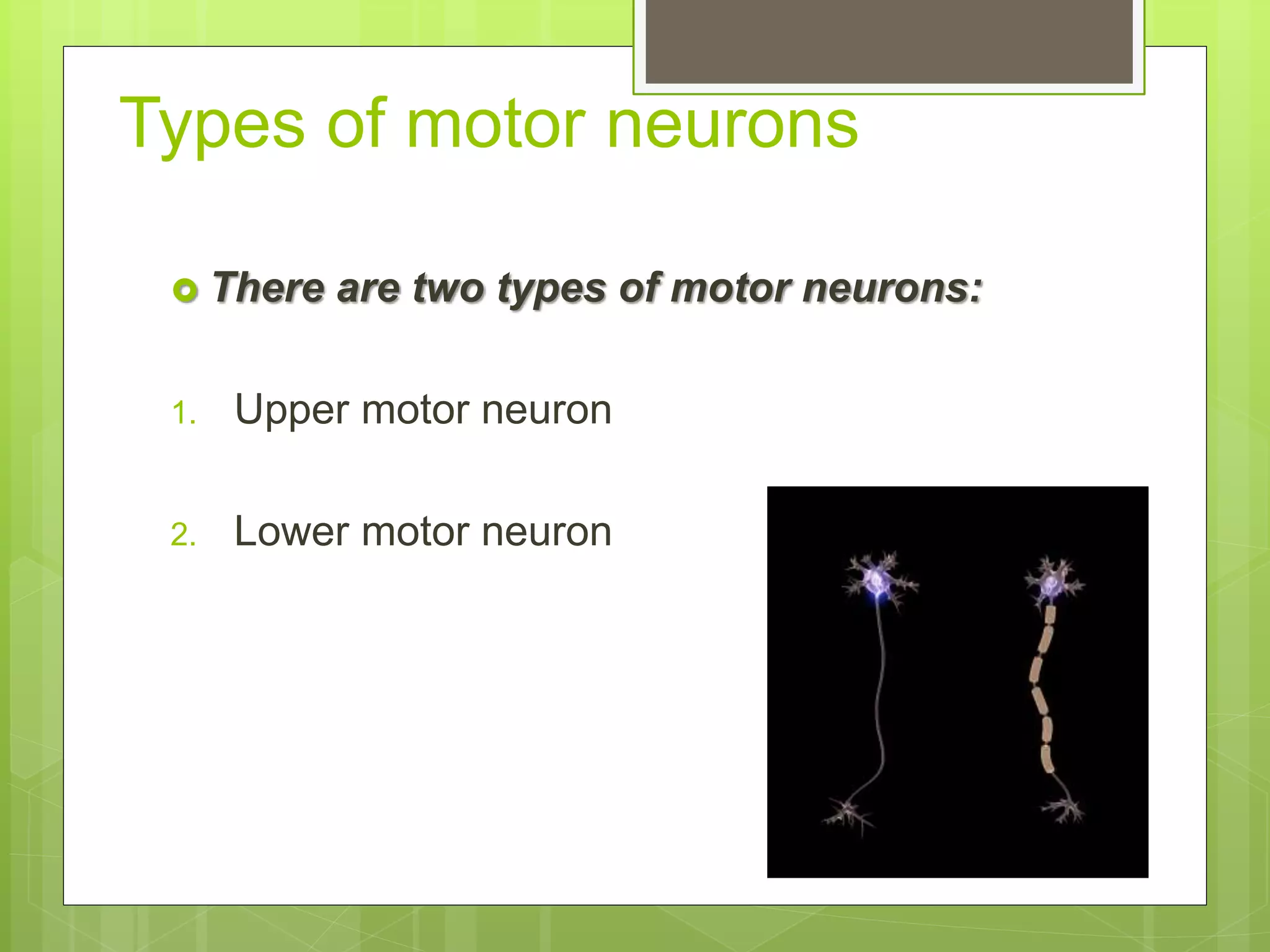
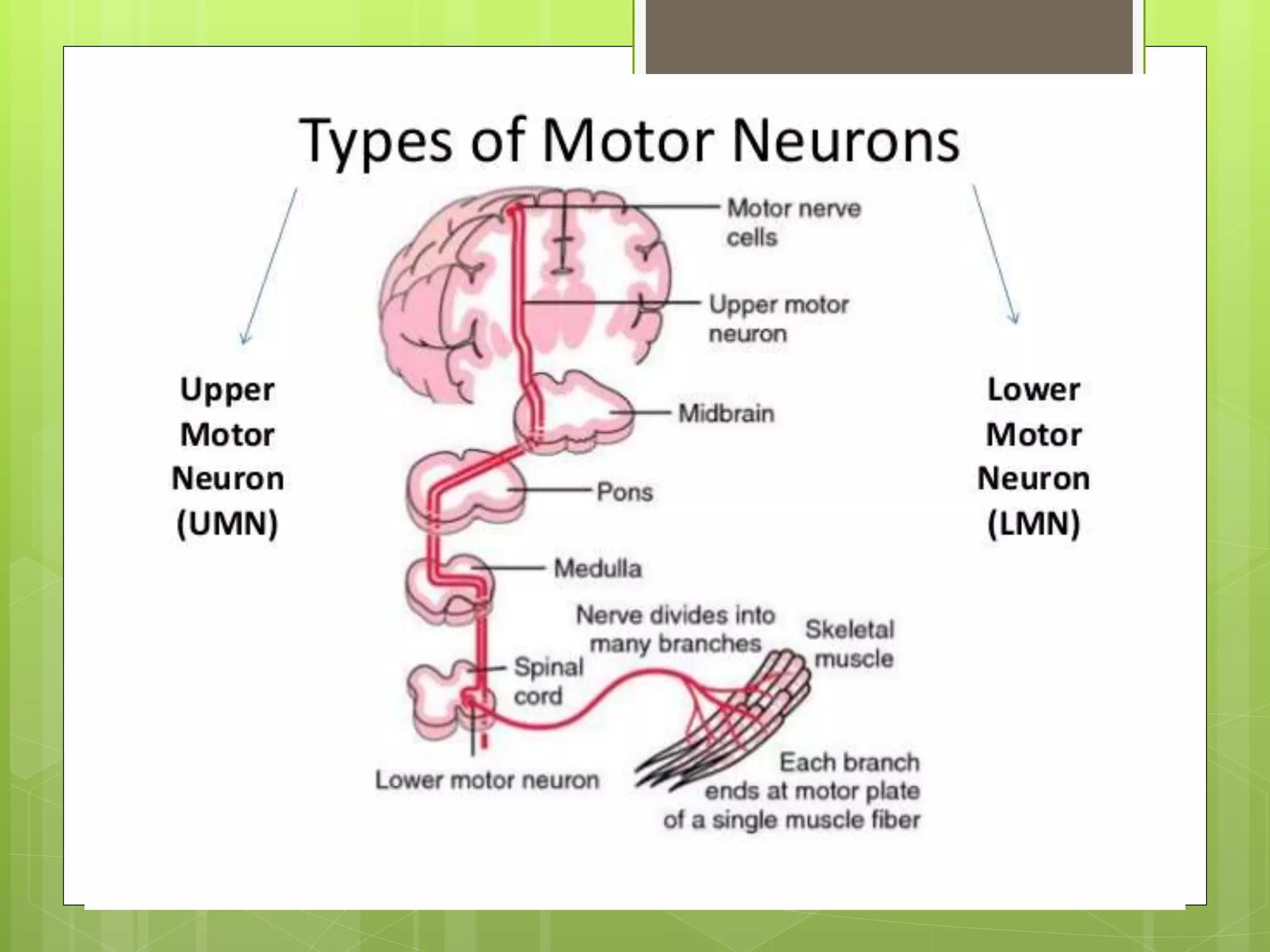
Types of motor neurons
 There are two types of motor neurons:
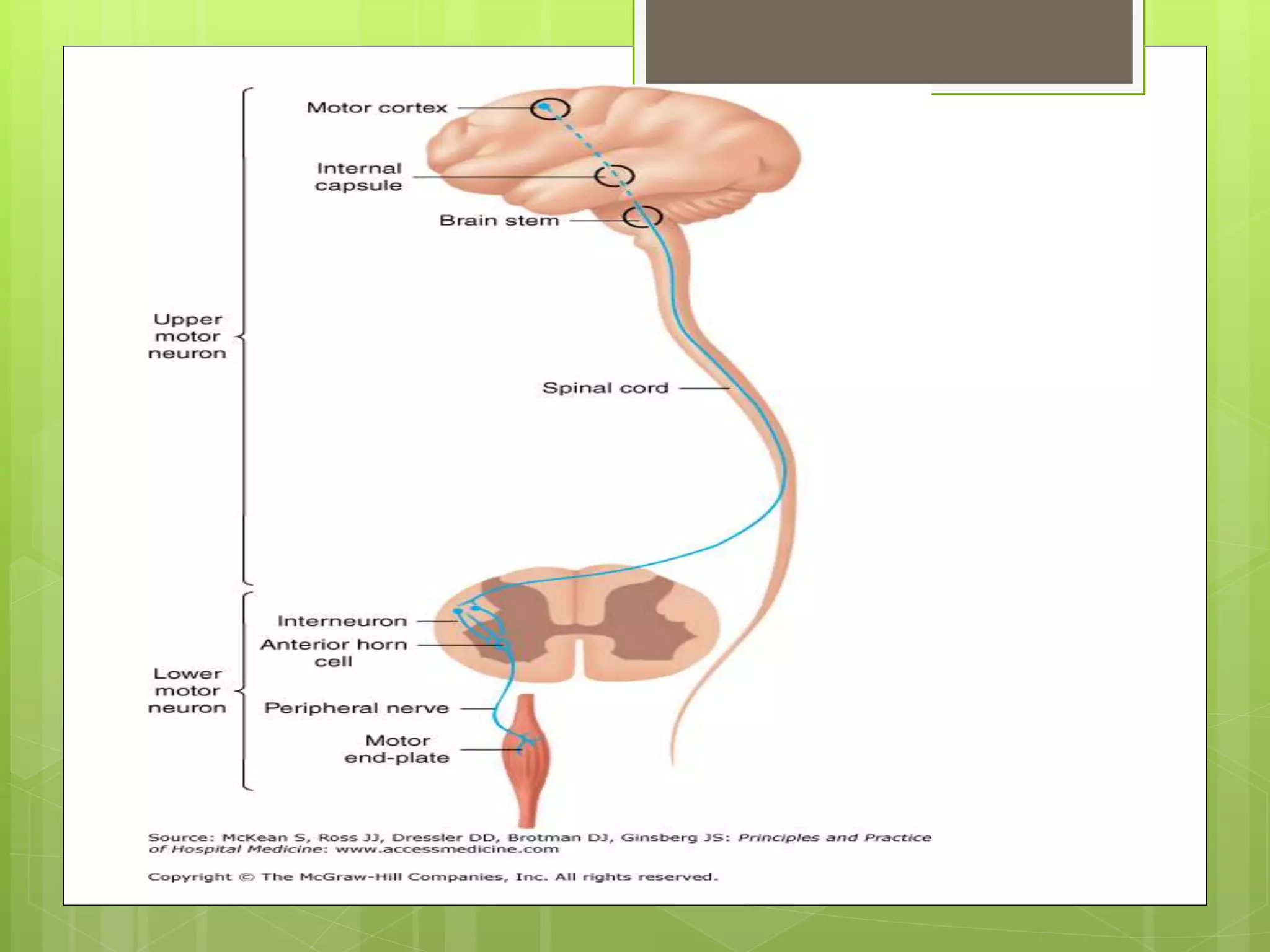
1. Upper motor neuron
2. Lower motor neuron
Upper motor neurons (UMNs)
 are motor neurons that originate either in
the motor region of the cerebral cortex or in
the brain stem and carry motor information
down to the lower motor neurons.
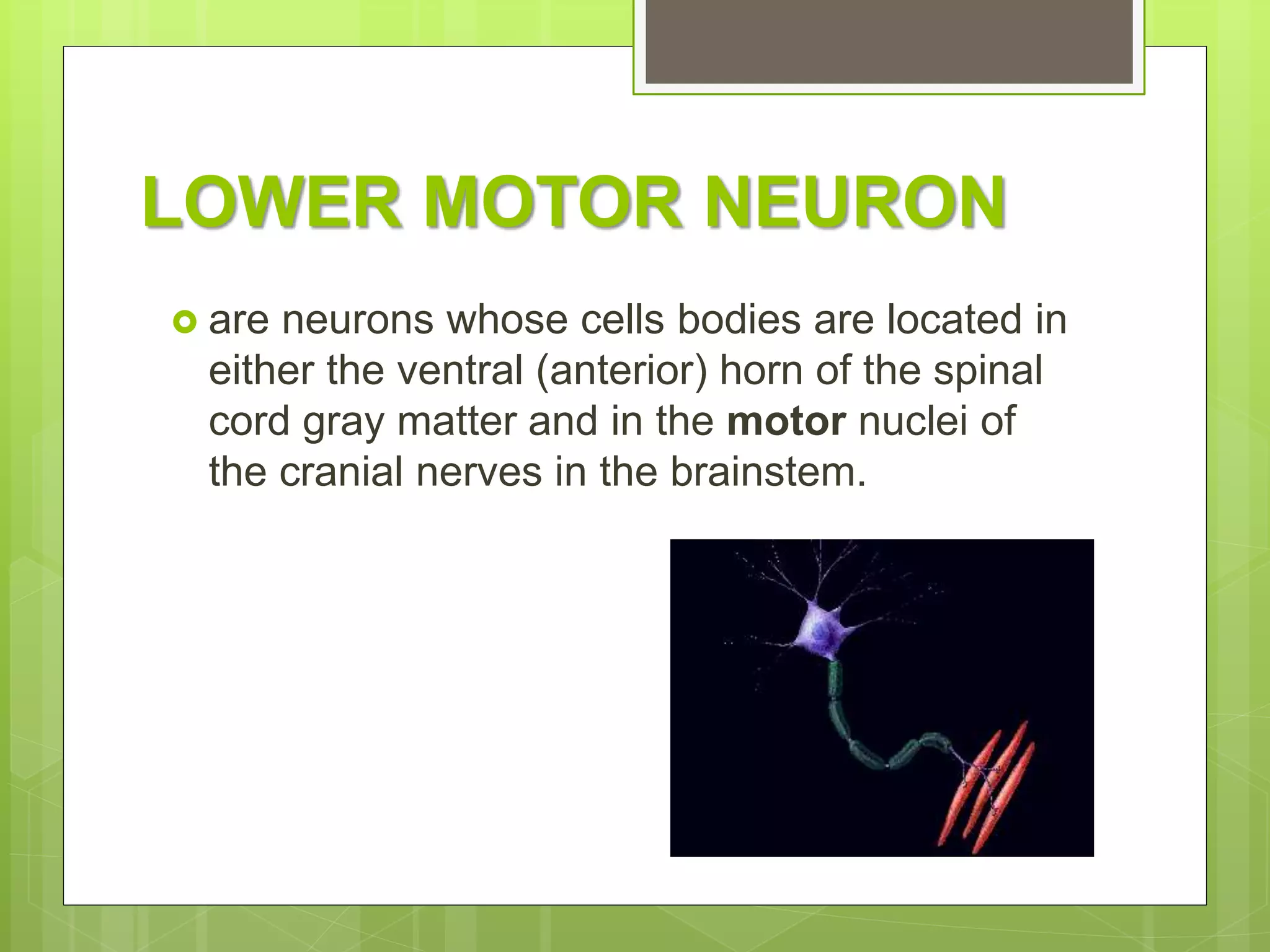
LOWER MOTOR NEURON
 are neurons whose cells bodies are located in
either the ventral (anterior) horn of the spinal
cord gray matter and in the motor nuclei of
the cranial nerves in the brainstem.
 All voluntary movement depend
upon excitation of lower motor
neuron by upper motor neuron .
 These are the only neurons that
innervate the skeletal muscle
fibers, they function as the final
common pathway, the final link
between the CNS and skeletal
muscles
 A lesion is any abnormal
damage or change in the
tissue of an organism,
usually caused by disease
or trauma.
 Lesion is derived from the
Latin word laesio meaning
injury.
 Destruction of motors
which supply the
muscles.
 It starts from anterior
horn cell ends at the
muscles.
 Lower motor neurons are classified based on
the type of muscle fiber they innervate:
 Alpha motor neurons (α-MNs)
 Gamma motor neurons (γ-MNs)
Alpha motor neurons (α-MNs)
 Alpha motor neurons (α-MNs)
innervate extra fusal muscle
fibers, the most numerous type
of muscle fiber and the one
involved in muscle contraction.
Gamma motor neurons
(γ-MNs)
 Gamma motor neurons (γ-MNs)
innervate intrafusal muscle fibers,
which together with sensory
afferents compose muscle
spindles.
 These are part of the system for
sensing body position
(proprioception)
1. Destruction in the anterior horn
cell : Poliomyelitis, motor neuron
diseases
2. Motor nerve (peripheral) is affected
: Traumatic stress, peripheral
neuropathy.
3. Abnormal stimulation at
Neuromuscular junction:
Myasthenia gravis
4. Myomatous for muscles : Neoplasm
"Truma“, muscular dystrophies.
1- Motor affection:
2- Reflex affection in LMNL:
3- Reaction of degeneration (Electric
current):
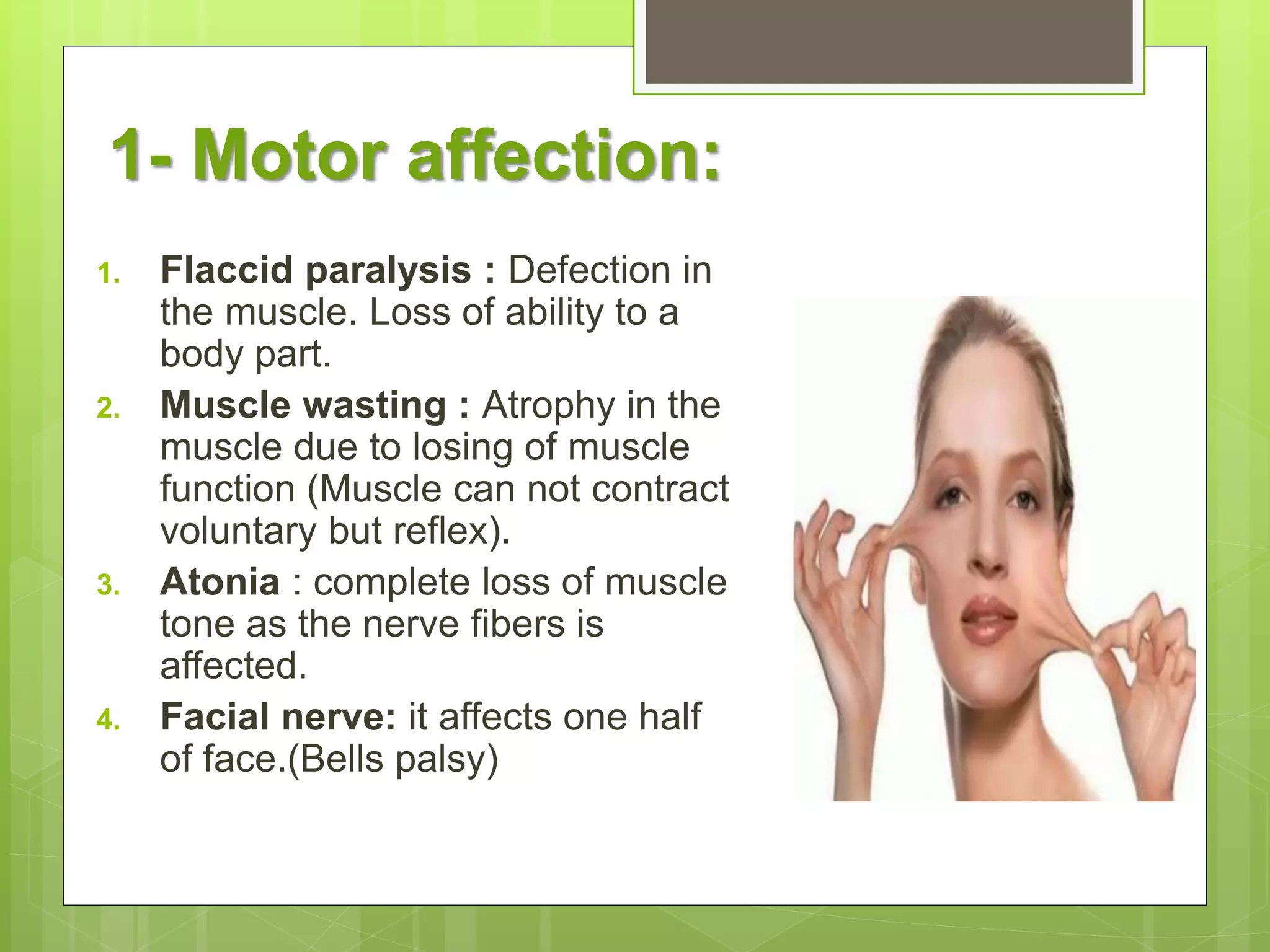
1- Motor affection:
1. Flaccid paralysis : Defection in
the muscle. Loss of ability to a
body part.
2. Muscle wasting : Atrophy in the
muscle due to losing of muscle
function (Muscle can not contract
voluntary but reflex).
3. Atonia : complete loss of muscle
tone as the nerve fibers is
affected.
4. Facial nerve: it affects one half
of face.(Bells palsy)
Bell's palsy
 Bell's palsy is a condition in
which the muscles on one side of
your face become weak or
paralyzed.
 It affects only one side of the face
at a time, causing it to droop or
become stiff on that side.
 It's caused by some kind of
trauma to the seventh cranial
nerve. This is also called the
“facial nerve.”
 The electrotherapy modalities included:
 Electrical stimulation (ES),
 Ultrasound,
 Electromyography
 No evidence support electrical
stimulation benefit for acute
facial paralysis but it's effective
for chronic condition
 Ultrasound can be beneficial for
acute conditions
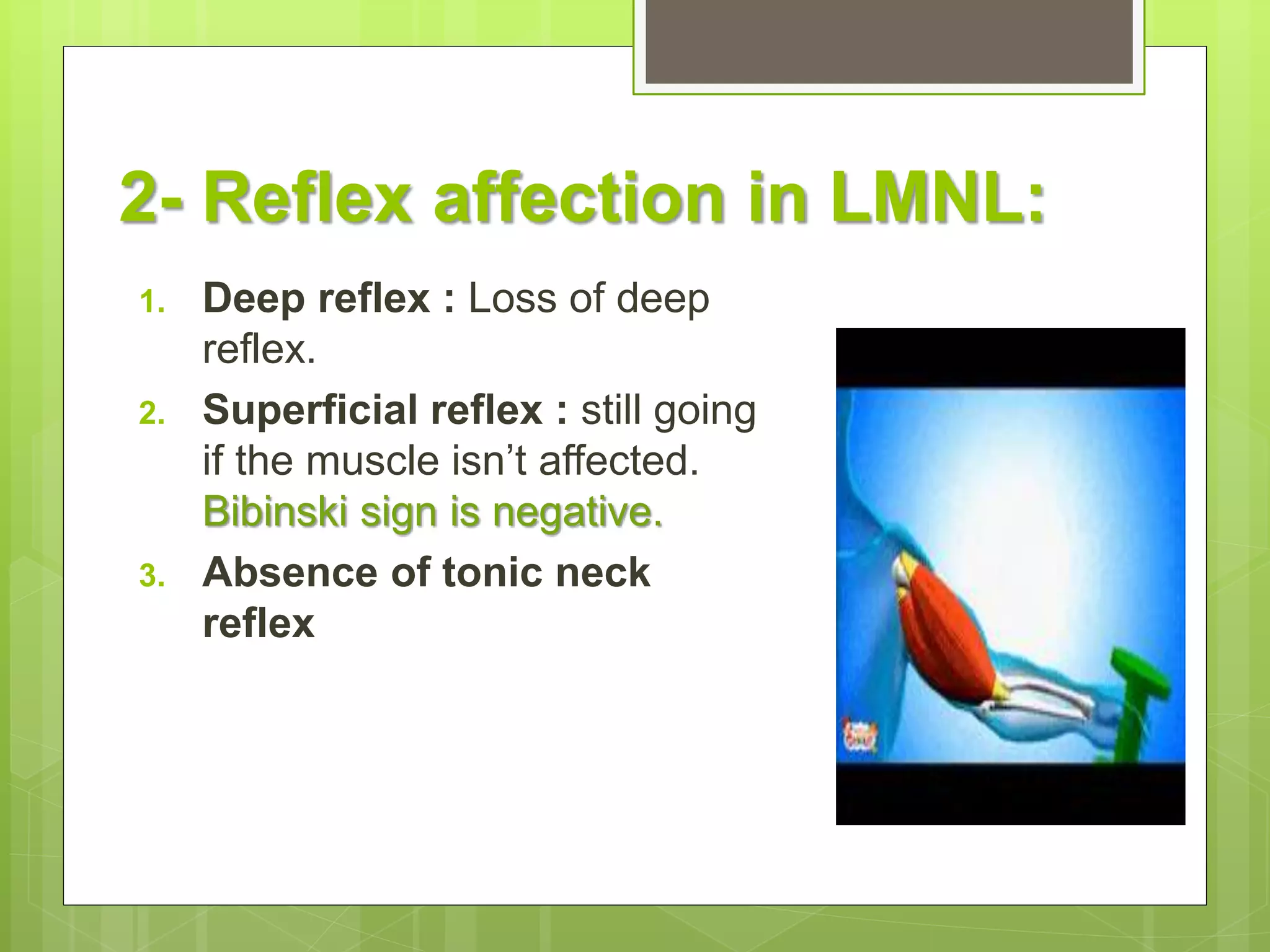
2- Reflex affection in LMNL:
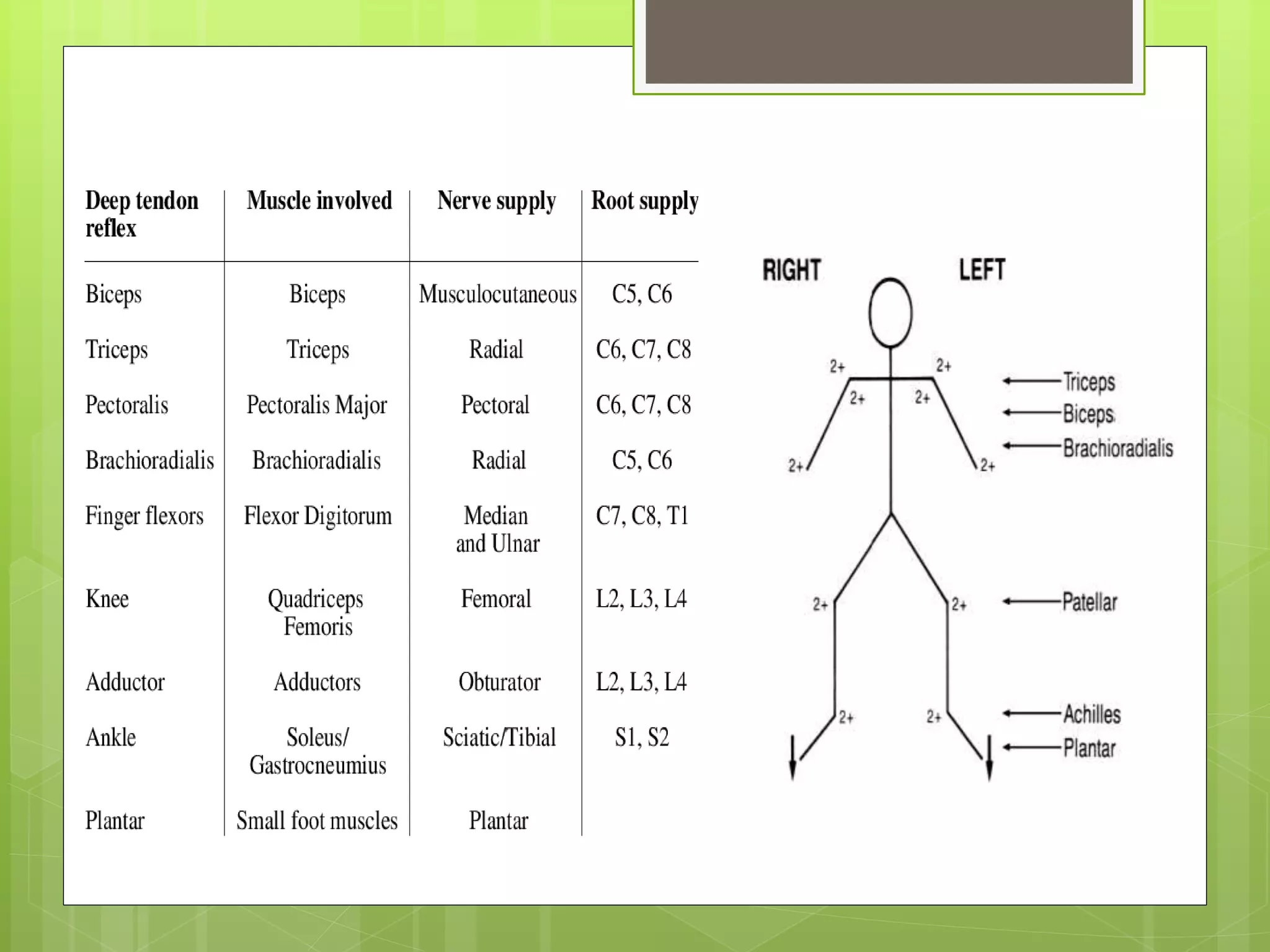
1. Deep reflex : Loss of deep
reflex.
2. Superficial reflex : still going
if the muscle isn’t affected.
Bibinski sign is negative.
3. Absence of tonic neck
reflex
Tonic neck reflex Fencing
posture
 When newborn lie on their backs,
their head usually turn to one side or
the other.
 The arm and the legs on the side
toward which the head turns extend,
and the opposite arm and leg
contract.
 This is also called the boxer or
fencing reflex.
 The reflex disappears between the
second and third months of life
3- Reaction of degeneration
(Electric current):
1. Prolonged chronaxie "Time
to get stimulation“
2. Respond to faraday current
only without galvanic
current.
3. Fibrillation: Irregular
unorganized invisible
spontaneous contraction of
muscle.
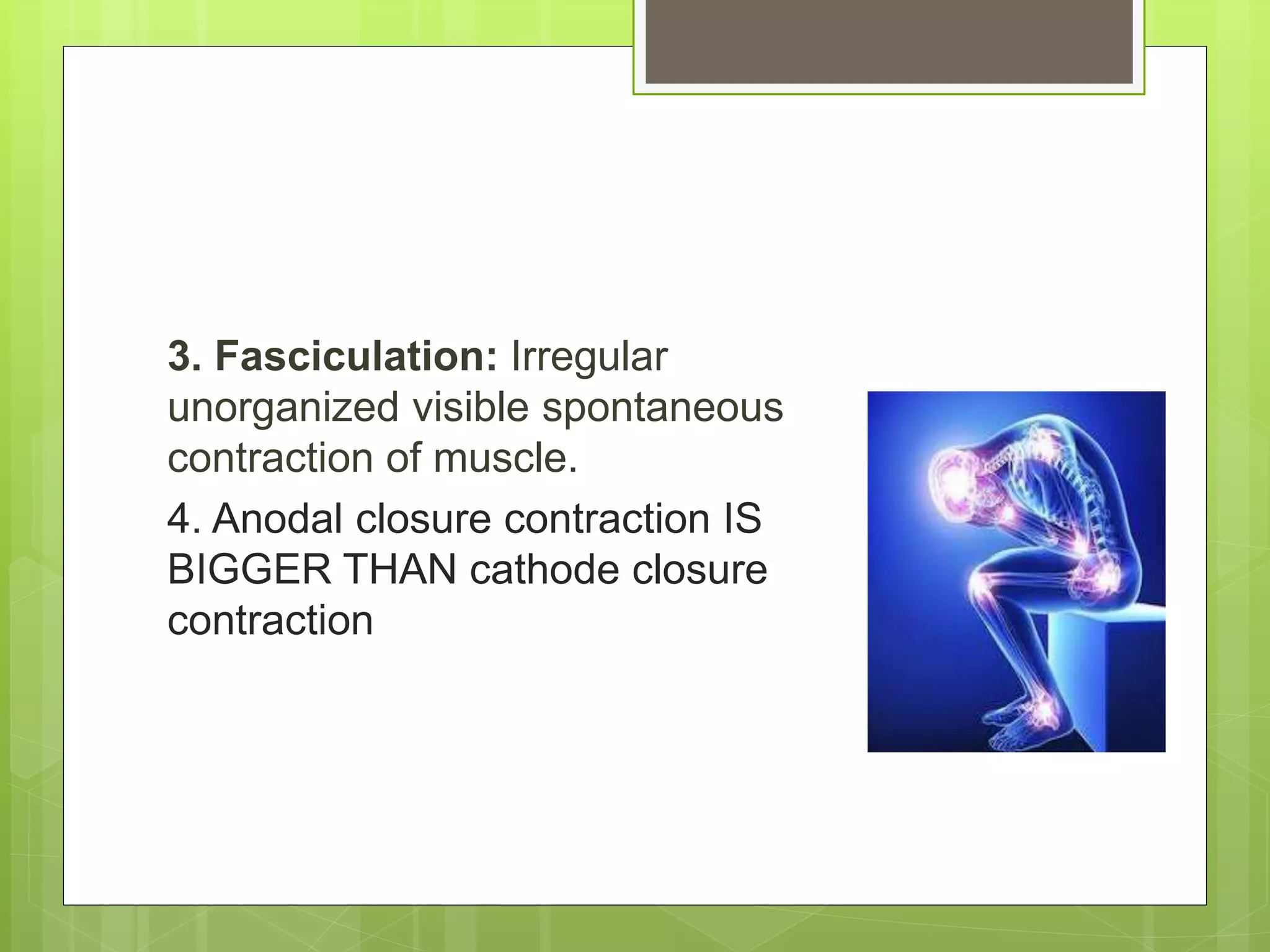
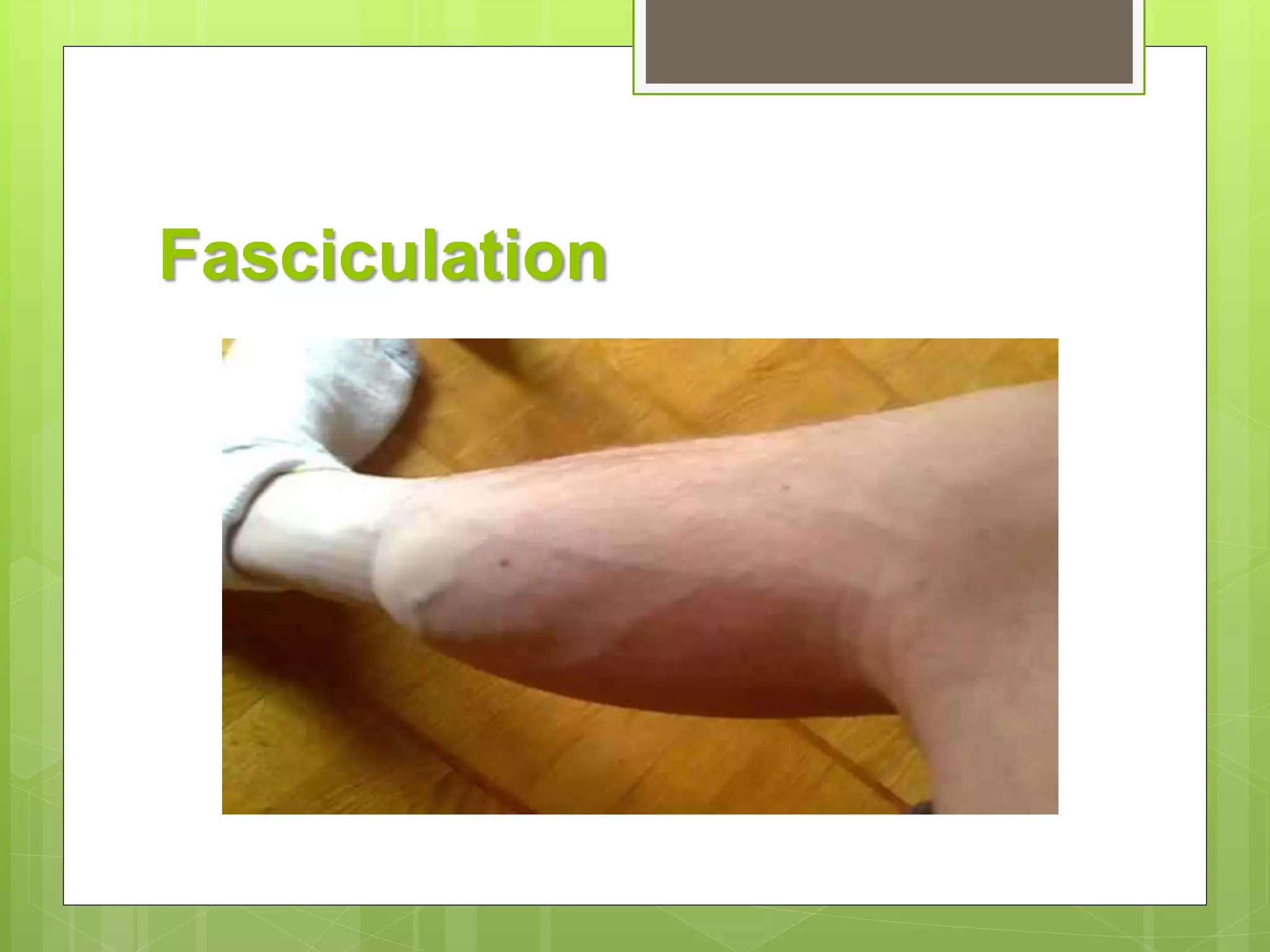
3. Fasciculation: Irregular
unorganized visible spontaneous
contraction of muscle.
4. Anodal closure contraction IS
BIGGER THAN cathode closure
contraction
Fasciculation
Anodal closure contraction IS BIGGER
THAN cathode closure contraction
 Flaccid paralysis
 Dec. tone,
 focal muscle atrophy
 Focal muscle weakness
 Dec. or absent reflexes
 Fasciculations
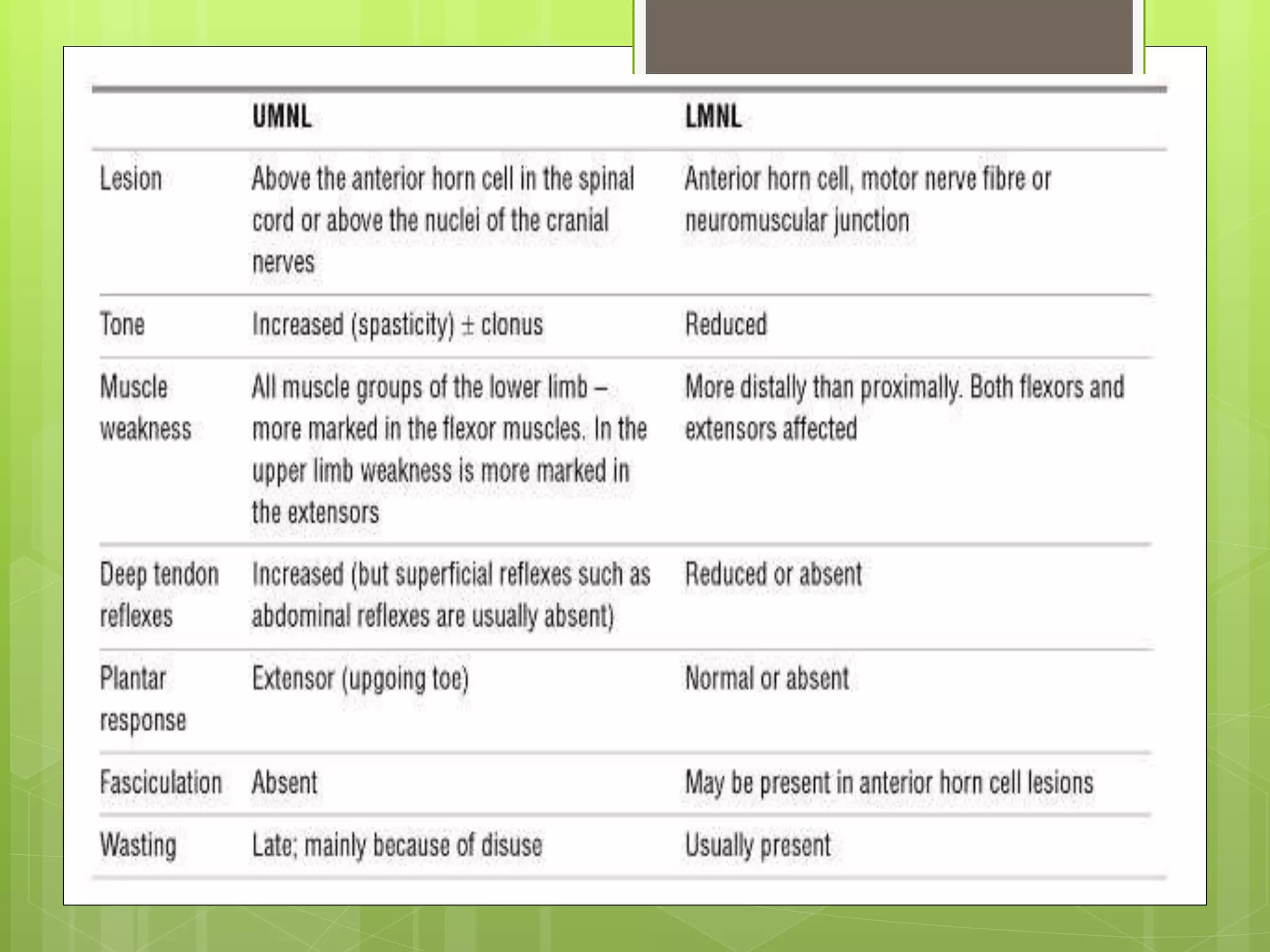
lower motor neuron lesion (LMNL)

lower motor neuron lesion (LMNL)

  • 2.
     HAFSA KHALID LAIBA ROOP PAUL  AQSA MUSHTAQ  MARYAM KHALID  LAREB SATTAR  SABIHA MANZOOR  NOOR FAIZA
  • 4.
    The motor systemis the part of the central nervous system that is involved with movement.  It consists of :  Pyramidal and extrapyramidal system tracts from UMN & LMN
  • 5.
     A motorneuron is a nerve cell (neuron) whose cell body is located in the spinal cord and whose fiber (axon) projects outside the spinal cord to directly or indirectly control effector organs, mainly muscles and glands.  Motor neurons' axons are efferent nerve fibers that carry signals from the spinal cord to the effectors to produce effects.
  • 7.
    Types of motorneurons  There are two types of motor neurons: 1. Upper motor neuron 2. Lower motor neuron
  • 8.
    Upper motor neurons(UMNs)  are motor neurons that originate either in the motor region of the cerebral cortex or in the brain stem and carry motor information down to the lower motor neurons.
  • 10.
    LOWER MOTOR NEURON are neurons whose cells bodies are located in either the ventral (anterior) horn of the spinal cord gray matter and in the motor nuclei of the cranial nerves in the brainstem.
  • 11.
     All voluntarymovement depend upon excitation of lower motor neuron by upper motor neuron .  These are the only neurons that innervate the skeletal muscle fibers, they function as the final common pathway, the final link between the CNS and skeletal muscles
  • 13.
     A lesionis any abnormal damage or change in the tissue of an organism, usually caused by disease or trauma.  Lesion is derived from the Latin word laesio meaning injury.
  • 14.
     Destruction ofmotors which supply the muscles.  It starts from anterior horn cell ends at the muscles.
  • 15.
     Lower motorneurons are classified based on the type of muscle fiber they innervate:  Alpha motor neurons (α-MNs)  Gamma motor neurons (γ-MNs)
  • 16.
    Alpha motor neurons(α-MNs)  Alpha motor neurons (α-MNs) innervate extra fusal muscle fibers, the most numerous type of muscle fiber and the one involved in muscle contraction.
  • 17.
    Gamma motor neurons (γ-MNs) Gamma motor neurons (γ-MNs) innervate intrafusal muscle fibers, which together with sensory afferents compose muscle spindles.  These are part of the system for sensing body position (proprioception)
  • 18.
    1. Destruction inthe anterior horn cell : Poliomyelitis, motor neuron diseases 2. Motor nerve (peripheral) is affected : Traumatic stress, peripheral neuropathy. 3. Abnormal stimulation at Neuromuscular junction: Myasthenia gravis 4. Myomatous for muscles : Neoplasm "Truma“, muscular dystrophies.
  • 19.
    1- Motor affection: 2-Reflex affection in LMNL: 3- Reaction of degeneration (Electric current):
  • 20.
    1- Motor affection: 1.Flaccid paralysis : Defection in the muscle. Loss of ability to a body part. 2. Muscle wasting : Atrophy in the muscle due to losing of muscle function (Muscle can not contract voluntary but reflex). 3. Atonia : complete loss of muscle tone as the nerve fibers is affected. 4. Facial nerve: it affects one half of face.(Bells palsy)
  • 21.
    Bell's palsy  Bell'spalsy is a condition in which the muscles on one side of your face become weak or paralyzed.  It affects only one side of the face at a time, causing it to droop or become stiff on that side.  It's caused by some kind of trauma to the seventh cranial nerve. This is also called the “facial nerve.”
  • 22.
     The electrotherapymodalities included:  Electrical stimulation (ES),  Ultrasound,  Electromyography
  • 23.
     No evidencesupport electrical stimulation benefit for acute facial paralysis but it's effective for chronic condition  Ultrasound can be beneficial for acute conditions
  • 24.
    2- Reflex affectionin LMNL: 1. Deep reflex : Loss of deep reflex. 2. Superficial reflex : still going if the muscle isn’t affected. Bibinski sign is negative. 3. Absence of tonic neck reflex
  • 26.
    Tonic neck reflexFencing posture  When newborn lie on their backs, their head usually turn to one side or the other.  The arm and the legs on the side toward which the head turns extend, and the opposite arm and leg contract.  This is also called the boxer or fencing reflex.  The reflex disappears between the second and third months of life
  • 27.
    3- Reaction ofdegeneration (Electric current): 1. Prolonged chronaxie "Time to get stimulation“ 2. Respond to faraday current only without galvanic current. 3. Fibrillation: Irregular unorganized invisible spontaneous contraction of muscle.
  • 28.
    3. Fasciculation: Irregular unorganizedvisible spontaneous contraction of muscle. 4. Anodal closure contraction IS BIGGER THAN cathode closure contraction
  • 29.
  • 30.
    Anodal closure contractionIS BIGGER THAN cathode closure contraction
  • 31.
     Flaccid paralysis Dec. tone,  focal muscle atrophy  Focal muscle weakness  Dec. or absent reflexes  Fasciculations

Editor's Notes

  • #5 Pyramidal tract • the pyramidal tract or the corticospinal tract, start in the motor center of the cerebral cortex i.e: precentral gyrus of cerebral cortex . • The axons of these cells pass in the cerebral cortex to internal capsule and continue to the midbrain and the medulla oblongata. In the lower part of Medulla oblongata 80 to 85% of these fibers (pass to the opposite side) and descend in the white matter of the spinal cord on the opposite side. The remaining 15 to 20% pass to the same side. 4. • The fibers of the corticospinal tract terminate at different levels in the anterior horn of the grey matter of the spinal cord. Here the lower motor neurons (LMN) of the corticospinal cord are located. Peripheral motor nerves carry the motor impulses from the anterior horn to the voluntary muscles. • Extrapyramidal motor system : consists of motor-modulation systems, particularly the basal ganglia and cerebellum.
  • #8 beta motor neurons, and alpha motor neurons, gamma motor neurons
  • #20 LOWER MOTOR NEURON LESION• Flaccid paralesis• Muscle atrophy and Hyporeflexia• Muscle hypotonicity• Fasciculations • BULBAR PALSY• is a similar disorder as psedobulbar palsy but is caused by lower motor neuron lesions• It consists of LMN signs in regions innervated by the facial (VII), glossopharyngeal (IX), Vagus (X) and hypoglossal (XII
  • #23 Biofeedback is more effective when muscle activity presents