Motor Lesions
UMNL & LMNL
Motor system
• The motor system is the part of the central
nervous system that is involved with
movement.
• It consists of :pyramidal and extrapyramidal
system tracts from UMN & LMN .
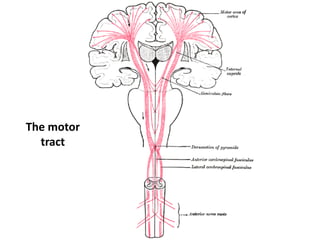
Pyramidal tract
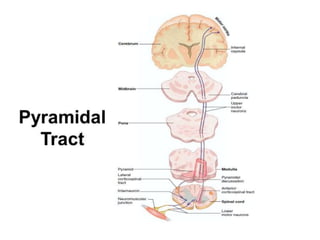
• the pyramidal tract or the corticospinal tract, start
in the motor center of the cerebral cortex i.e:
precentral gyrus of cerebral cortex .
• The axons of these cells pass in the cerebral cortex
to internal capsule and continue to the midbrain
and the medulla oblongata. In the lower part of
Medulla oblongata 80 to 85% of these fibers (pass
to the opposite side) and descend in the white
matter of the spinal cord on the opposite side. The
remaining 15 to 20% pass to the same side.
• The fibers of the corticospinal tract terminate
at different levels in the anterior horn of the
grey matter of the spinal cord. Here the lower
motor neurons (LMN) of the corticospinal cord
are located. Peripheral motor nerves carry the
motor impulses from the anterior horn to the
voluntary muscles.
• Extrapyramidal motor system : consists of
motor-modulation systems, particularly the
basal ganglia and cerebellum.
Motor Neuron
• A motor neuron is a nerve cell (neuron) whose
cell body is located in the spinal cord and whose
fiber (axon) projects outside the spinal cord to
directly or indirectly control effector organs,
mainly muscles and glands.
• Motor neurons' axons are efferent nerve fibers
that carry signals from the spinal cord to the
effectors to produce effects.
• Types of motor neurons are alpha motor
neurons, beta motor neurons, and gamma motor
neurons
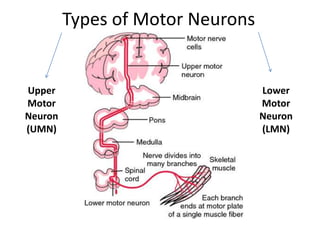
Types of Motor Neurons
Upper
Motor
Neuron
(UMN)
Lower
Motor
Neuron
(LMN)
Upper Motor Neuron
• Upper motor neurons originate in the motor
region of the cerebral cortex or in the brain
stem and carry motor information down to
the lower motor neurons.
• The main effector or motor neurons for
voluntary movement lie in the primary motor
cortex and are a type of giant pyramidal cell
called Betz cells.
The motor
tract
Lower Motor Neuron
• (LMNs) are motor neurons located in either
the anterior grey column, anterior nerve roots
(spinal lower motor neurons) or the cranial
nerve nuclei of the brain stem and cranial
nerve lower motor neurons.
• The motor cranial nuclei and their axons i.e.
Motor fibers of “3-12” cranial nerves.
What is Lesion ?
• A lesion is any abnormal damage or change in
the tissue of an organism, usually caused by
disease or trauma.
• Lesion is derived from the Latin word laesio
meaning injury.
lower Motor neuron lesion
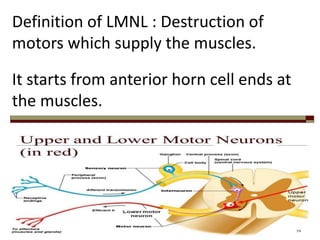
Definition of LMNL : Destruction of
motors which supply the muscles.
It starts from anterior horn cell ends at
the muscles.
Causes of LMNL:
• Destruction in the anterior horn cell : Poliomyelitis.
• Motor nerve is affected : Traumatic stress.
• Abnormal stimulation at Neuromuscular junction.
• Myomatous for muscles : Neoplasm "Truma".
Features and manifestation of LMNL :
1- Motor affection:
- Flaccid paralysis : Defection in the muscle.
- Muscle wasting : Atrophy in the muscle due to losing of
muscle function (Muscle can not contract voluntary but
reflex).
- Atonia : complete loss of muscle tone as the
nerve fibers is affected.
- Facial nerve: it affects one half of face.
2- Reflex affection in LMNL:
- Deep reflex : Loss of deep reflex.
-superficial reflex : still going if the
muscle isn’t affected.
-Absence of tonic neck reflex.
3- Reaction of degeneration (Electric current):
- prolonged chronaxie "Time to get stimulation"
- Respond to faraday current only without galvanic
current.
- Fibrillation: Irregular unorganized invisible
spontaneous contraction of muscle.
-Fasciculation: Irregular unorganized visible
spontaneous contraction of muscle.
-Anodal closure contraction IS BIGGER THAN
cathode closure contraction.
Upper Motor Neuron Lesion
• An upper motor neuron lesion (also known as
pyramidal insufficiency) is a lesion of the
neural pathway above the anterior horn cell of
the spinal cord or motor nuclei of the cranial
nerves. This is in contrast to a lower motor
neuron lesion, which affects nerve fibers
traveling from the anterior horn of the spinal
cord or the cranial motor nuclei to the
relevant muscle(s)
:Common Causes
• Upper motor neuron lesions occur in
conditions affecting motor neurons in the
brain or spinal cord such as
• stroke, traumatic brain injury
• also cerebral palsy.
Symptoms
• Muscle weakness. A pattern of weakness in the
extensors (upper limbs) or flexors (lower limbs), is
known as 'pyramidal weakness‘
• Decreased control of active movement,
particularly slowness.
• Spasticity, a velocity-dependent change in muscle
tone
• Clasp-knife response where initial higher
resistance to movement is followed by a lesser
resistance
Babinski Sign
• Babinski sign is present, where the big toe is
raised (extended) rather than curled downwards
(flexed) upon appropriate stimulation of the sole
of the foot.
• The presence of the Babinski sign is an abnormal
response in adulthood. Normally, during the
plantar reflex, it causes plantar flexion and the
adduction of the toes. In Babinski's sign, there is
dorsiflexion of the big toe and abduction of the
other toes.
• Physiologically, it is normally present in infants
from birth to 12 months. The presence of the
Babinski sign after 12 months is the sign of a
non-specific upper motor neuron lesion.
Upper motor neuron syndrome
• Upper motor neuron syndrome (UMNS) is the motor
control changes that can occur in skeletal muscle after
an upper motor neuron lesion.
• Following upper motor neuron lesions, affected
muscles potentially have many features of altered
performance including:
• weakness (decreased ability for the muscle to
generate force)
• decreased motor control including decreased
speed and accuracy.
• altered muscle tone (hypotonia or hypertonia)
a decrease or increase in the baseline level of
muscle activity
• exaggerated deep tendon reflexes including
spasticity, and clonus (a series of involuntary
rapid muscle contractions)
Treatment
• Treatment should be based on assessment by
the relevant health professionals.
• For muscles with mild-to-moderate
impairment, exercise should be the mainstay
of management, and is likely to need to be
prescribed by a physiotherapist or other
health professional skilled in neurological
rehabilitation.
• Muscles with severe impairment are more
limited in their ability to exercise, and may
require help to do this.
• They may require additional interventions.
• These interventions may include serial
casting, flexibility exercise such as sustained
positioning programs, and medical
interventions.
• the degree of muscle weakness makes
developing an exercise programme difficult.
• For muscles that lack any volitional control,
such as after complete spinal cord injury,
exercise may be assisted, and may require
equipment, such as using a standing frame to
sustain a standing position.
• Often, muscles require specific stimulation to
achieve small amounts of activity, which is
most often achieved by weight-bearing (e.g.
positioning and supporting a limb such that it
supports body weight) or by stimulation to the
muscle belly (such as electrical stimulation or
vibration).
• Medical interventions may include
medications as baclofen, diazepam,
dantrolene, or clonazepam. Phenol injections
into the muscle belly can be used to attempt
to dampen the signals between nerve and
muscle. The effectiveness of medications
varies between individuals, and varies based
on location of the upper motor neuron lesion
(in the brain or the spinal cord).

Motor neuron lesions ( UMNL & LMNL )

  • 1.
  • 2.
    Motor system • Themotor system is the part of the central nervous system that is involved with movement. • It consists of :pyramidal and extrapyramidal system tracts from UMN & LMN .
  • 3.
    Pyramidal tract • thepyramidal tract or the corticospinal tract, start in the motor center of the cerebral cortex i.e: precentral gyrus of cerebral cortex . • The axons of these cells pass in the cerebral cortex to internal capsule and continue to the midbrain and the medulla oblongata. In the lower part of Medulla oblongata 80 to 85% of these fibers (pass to the opposite side) and descend in the white matter of the spinal cord on the opposite side. The remaining 15 to 20% pass to the same side.
  • 5.
    • The fibersof the corticospinal tract terminate at different levels in the anterior horn of the grey matter of the spinal cord. Here the lower motor neurons (LMN) of the corticospinal cord are located. Peripheral motor nerves carry the motor impulses from the anterior horn to the voluntary muscles. • Extrapyramidal motor system : consists of motor-modulation systems, particularly the basal ganglia and cerebellum.
  • 6.
    Motor Neuron • Amotor neuron is a nerve cell (neuron) whose cell body is located in the spinal cord and whose fiber (axon) projects outside the spinal cord to directly or indirectly control effector organs, mainly muscles and glands. • Motor neurons' axons are efferent nerve fibers that carry signals from the spinal cord to the effectors to produce effects. • Types of motor neurons are alpha motor neurons, beta motor neurons, and gamma motor neurons
  • 7.
    Types of MotorNeurons Upper Motor Neuron (UMN) Lower Motor Neuron (LMN)
  • 8.
    Upper Motor Neuron •Upper motor neurons originate in the motor region of the cerebral cortex or in the brain stem and carry motor information down to the lower motor neurons. • The main effector or motor neurons for voluntary movement lie in the primary motor cortex and are a type of giant pyramidal cell called Betz cells.
  • 9.
  • 10.
    Lower Motor Neuron •(LMNs) are motor neurons located in either the anterior grey column, anterior nerve roots (spinal lower motor neurons) or the cranial nerve nuclei of the brain stem and cranial nerve lower motor neurons. • The motor cranial nuclei and their axons i.e. Motor fibers of “3-12” cranial nerves.
  • 11.
    What is Lesion? • A lesion is any abnormal damage or change in the tissue of an organism, usually caused by disease or trauma. • Lesion is derived from the Latin word laesio meaning injury.
  • 12.
  • 13.
    Definition of LMNL: Destruction of motors which supply the muscles. It starts from anterior horn cell ends at the muscles.
  • 14.
    Causes of LMNL: •Destruction in the anterior horn cell : Poliomyelitis. • Motor nerve is affected : Traumatic stress. • Abnormal stimulation at Neuromuscular junction. • Myomatous for muscles : Neoplasm "Truma".
  • 15.
    Features and manifestationof LMNL : 1- Motor affection: - Flaccid paralysis : Defection in the muscle. - Muscle wasting : Atrophy in the muscle due to losing of muscle function (Muscle can not contract voluntary but reflex). - Atonia : complete loss of muscle tone as the nerve fibers is affected. - Facial nerve: it affects one half of face.
  • 16.
    2- Reflex affectionin LMNL: - Deep reflex : Loss of deep reflex. -superficial reflex : still going if the muscle isn’t affected. -Absence of tonic neck reflex.
  • 17.
    3- Reaction ofdegeneration (Electric current): - prolonged chronaxie "Time to get stimulation" - Respond to faraday current only without galvanic current. - Fibrillation: Irregular unorganized invisible spontaneous contraction of muscle.
  • 18.
    -Fasciculation: Irregular unorganizedvisible spontaneous contraction of muscle. -Anodal closure contraction IS BIGGER THAN cathode closure contraction.
  • 19.
    Upper Motor NeuronLesion • An upper motor neuron lesion (also known as pyramidal insufficiency) is a lesion of the neural pathway above the anterior horn cell of the spinal cord or motor nuclei of the cranial nerves. This is in contrast to a lower motor neuron lesion, which affects nerve fibers traveling from the anterior horn of the spinal cord or the cranial motor nuclei to the relevant muscle(s)
  • 20.
    :Common Causes • Uppermotor neuron lesions occur in conditions affecting motor neurons in the brain or spinal cord such as • stroke, traumatic brain injury • also cerebral palsy.
  • 21.
    Symptoms • Muscle weakness.A pattern of weakness in the extensors (upper limbs) or flexors (lower limbs), is known as 'pyramidal weakness‘ • Decreased control of active movement, particularly slowness. • Spasticity, a velocity-dependent change in muscle tone • Clasp-knife response where initial higher resistance to movement is followed by a lesser resistance
  • 22.
    Babinski Sign • Babinskisign is present, where the big toe is raised (extended) rather than curled downwards (flexed) upon appropriate stimulation of the sole of the foot. • The presence of the Babinski sign is an abnormal response in adulthood. Normally, during the plantar reflex, it causes plantar flexion and the adduction of the toes. In Babinski's sign, there is dorsiflexion of the big toe and abduction of the other toes.
  • 23.
    • Physiologically, itis normally present in infants from birth to 12 months. The presence of the Babinski sign after 12 months is the sign of a non-specific upper motor neuron lesion.
  • 24.
    Upper motor neuronsyndrome • Upper motor neuron syndrome (UMNS) is the motor control changes that can occur in skeletal muscle after an upper motor neuron lesion. • Following upper motor neuron lesions, affected muscles potentially have many features of altered performance including: • weakness (decreased ability for the muscle to generate force)
  • 25.
    • decreased motorcontrol including decreased speed and accuracy. • altered muscle tone (hypotonia or hypertonia) a decrease or increase in the baseline level of muscle activity • exaggerated deep tendon reflexes including spasticity, and clonus (a series of involuntary rapid muscle contractions)
  • 26.
    Treatment • Treatment shouldbe based on assessment by the relevant health professionals. • For muscles with mild-to-moderate impairment, exercise should be the mainstay of management, and is likely to need to be prescribed by a physiotherapist or other health professional skilled in neurological rehabilitation.
  • 27.
    • Muscles withsevere impairment are more limited in their ability to exercise, and may require help to do this. • They may require additional interventions. • These interventions may include serial casting, flexibility exercise such as sustained positioning programs, and medical interventions.
  • 28.
    • the degreeof muscle weakness makes developing an exercise programme difficult. • For muscles that lack any volitional control, such as after complete spinal cord injury, exercise may be assisted, and may require equipment, such as using a standing frame to sustain a standing position.
  • 29.
    • Often, musclesrequire specific stimulation to achieve small amounts of activity, which is most often achieved by weight-bearing (e.g. positioning and supporting a limb such that it supports body weight) or by stimulation to the muscle belly (such as electrical stimulation or vibration).
  • 30.
    • Medical interventionsmay include medications as baclofen, diazepam, dantrolene, or clonazepam. Phenol injections into the muscle belly can be used to attempt to dampen the signals between nerve and muscle. The effectiveness of medications varies between individuals, and varies based on location of the upper motor neuron lesion (in the brain or the spinal cord).