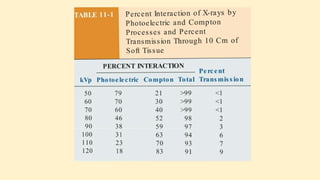
X-Ray: Interactions with
matter
Presented by: Dr. Anish Dhakal
Resident
MD Radiodiagnosis, KUSMS
20th
May, 2024
X-rays generation: Basics atoms
The nucleus of an atom is made up of several types of
elementary particles, termed nucleons
The proton has a positive electric charge numerically equal to
the charge of the electron, while the neu­
tron has zero electrical
charge
The number of protons in the nu­
cleus is called the atomic
number of the atoms, and is given the symbol “Z”
The total number of protons and neutrons in the nu­
cleus of an
atom is called the mass number and is symbolized by the letter
“A”
The atomic system allows 2 electrons in the first orbit, up to 8 in
the second, up to 18 in the third, up to 32 in the fourth, and up
to 50 in the fifth. The electron orbits are designated by letters: K,
L, M, N, O, and so on.
The Concept of Binding force
The attractive force between the positively charged nu­
cleus
and the negatively charged electron is the force that keeps
the electrons in the atom
This force is called the "binding force" of the electron and is
inversely proportional to the square of the distance be­
tween
the nucleus and electron.
Therefore, a K electron has a greater binding force than an L
electron.
X-rays generation: Basics atoms
Bound particles always have negative energy. To free an electron
from an atom, the energy must be raised to zero or to a positive
value
The energy that an electron in a shell must be given to raise the
energy value to zero is called the binding energy of the electron.
Bound Vs. Free electrons
Bound electrons: Orbit the nucleus on the inner
rings. Bound electrons have a strong magnetic
attraction to the nucleus.
Free electrons: Orbit on the outermost ring which is
known as the valance ring
Tungsten has a K-shell energy of 70 keV and an L-shell
energy of 11 keV. To free a K electron from tungsten, the
electron must be given 70 keV of energy , while only 11 keV
are required to free an L electron. The L electron has 59 keV
more energy than the K electron.
The production of X-rays makes use of three properties of
the tungsten atoms in the target of the X-ray tube:
• Electric field of the nucleus
• Binding energy of orbital electrons
• Need of the atom to exist in its lowest energy state
X-ray production process
(1)General radiation/Bremsstrah­
lung radiation: Occurs with
high atomic number and high kVp. Reaction of the
electrons with the nucleus of the tungsten atoms.
(2)Characteristic radiation: Occurs with low kVp and low
atomic number as in mammography. Collision between
the high-speed electrons and the electrons in the inner
shell of the target tungsten atoms.
General/Bremsstrahlung Radiation
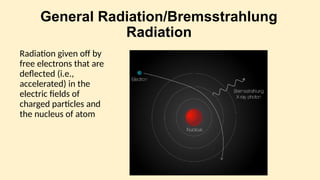
When an electron passes near the nucleus of a tungsten atom, the positive
charge of the nucleus acts on the negative charge of the electron.
The electron is attracted to­
wards the nucleus and is thus deflected from its
original direction.
The electron may lose energy and be slowed down when its di­
rection
changes.
The kinetic energy lost by the electron is emitted directly in the form of a
photon of radiation. The radiation produced by this process is called general
radiation or bremsstrahlung (from the German for "braking radiation").
Most electrons that strike the target give up their energy by
interactions with a num­
ber of atoms. The electron gives up only
part of its energy in the form of radiation each time it is "braked."
Most of the radiation will have little energy, and will appear as
heat. Few X-rays will ap­
pear because over 99% of all reactions
produce heat.
The energy of the radiation is the amount of energy lost by the
electrons.
General Radiation/Bremsstrahlung
Radiation
Radiation given off by
free electrons that are
deflected (i.e.,
accelerated) in the
electric fields of
charged particles and
the nucleus of atom
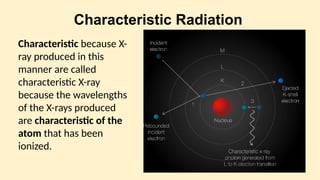
Characteristic Radiation
Characteris­
tic radiation results when the electrons bombarding
the target eject electrons from the inner orbits of the target atoms
Removal of an electron from a tungsten atom causes the atom to
have an excess positive charge, and the atom thus becomes a
positive ion
In the process of returning to its normal state, the ionized atom of
tungsten may get rid of excess energy in one of two ways.
Fate of the positive ion
I. An additional electron (called an Auger electron) may be expelled by
the atom and carry off the excess energy. The ejection of Auger
electrons does not produce X-rays.
II. An alternative way to get rid of excess energy is for the atom to emit
radiation that has wavelengths within the X-ray range
A tungsten atom with an inner shell vacancy is much more likely to produce an x-ray than
to expel an electron
Characteristic Radiation
Characteristic because X-
ray produced in this
manner are called
characteristic X-ray
because the wavelengths
of the X-rays produced
are characteristic of the
atom that has been
ionized.
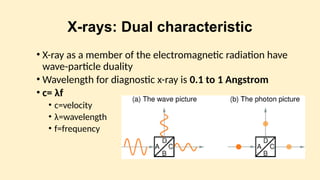
X-rays: Dual characteristic
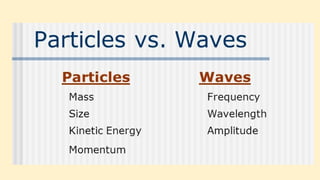
• X-ray as a member of the electromagnetic radiation have
wave-particle duality
• Wavelength for diagnostic x-ray is 0.1 to 1 Angstrom
• c= λf
• c=velocity
• λ=wavelength
• f=frequency
X-rays as a Particle
X-rays predominant react with matter in the form of particle rather
than wave.
Quantum or Photon:
• Discrete bundle or packets of energy.
The amount of energy carried by each photon:
• E=hf
• E= energy of photon
• h=plank’s constant 6.6 *10-34
Joule-seconds
• f= frequency
Photon energy in Diagnostic Radiology
10-150 keV (1 ev =1.602 *10-19
J)
1% of the energy from bombarding electrons converts to X-ray
1% of X-ray incident on a patient reach the image receptor
Less than 0.5% actually interact to form an image
Differential Absorption
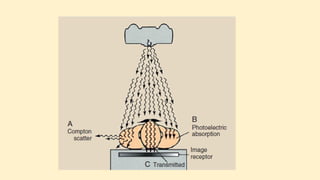
X-ray image results from the difference between
those x-rays absorbed photoelectrically in the patient
and those transmitted to the image receptor
This difference in x-ray interaction is called
differential absorption.
Controls contrast of an X-ray image
Depends on: Atomic Number and Mass Density
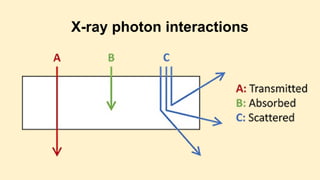
X-ray photon interactions
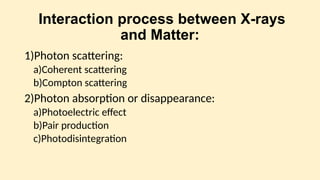
Interaction process between X-rays
and Matter:
1)Photon scattering:
a)Coherent scattering
b)Compton scattering
2)Photon absorption or disappearance:
a)Photoelectric effect
b)Pair production
c)Photodisintegration
Coherent/Classical/Elastic/
Thompson/Rayleigh scattering
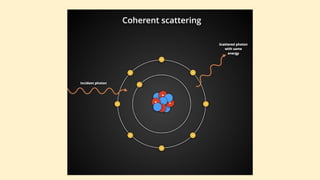
 Also known as unmodified scattering
 Interaction where radiation undergoes change in
direction without change in wavelength/energy
 Usually occurs in low energy range when incident atom
is smaller than the wavelength of the incident X-ray
 Only type of interaction where no ionization occurs
 Does not contribute to patient dose
Incident X-ray interact with all of the electrons in the atom and
makes them oscillate
When those electrons stop vibrating, they release electromagnetic
radiation identical to the incident X-ray at an angle
The scatter angle is independent of the incident X-ray energy
At 70 kVp, a small percent of the X-rays undergo coherent scattering
which contributes to image noise (general graying of the image that
reduces image contrast)
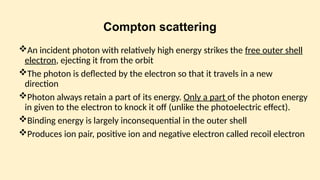
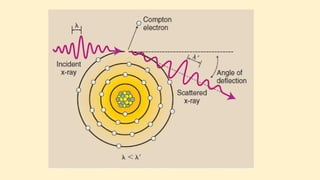
Compton scattering
An incident photon with relatively high energy strikes the free outer shell
electron, ejecting it from the orbit
The photon is deflected by the electron so that it travels in a new
direction
Photon always retain a part of its energy. Only a part of the photon energy
in given to the electron to knock it off (unlike the photoelectric effect).
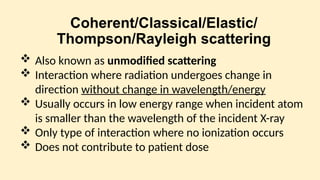
Binding energy is largely inconsequential in the outer shell
Produces ion pair, positive ion and negative electron called recoil electron
Compton scattering
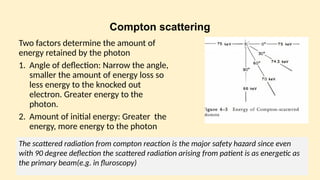
Two factors determine the amount of
energy retained by the photon
1. Angle of deflection: Narrow the angle,
smaller the amount of energy loss so
less energy to the knocked out
electron. Greater energy to the
photon.
2. Amount of initial energy: Greater the
energy, more energy to the photon
The scattered radiation from compton reaction is the major safety hazard since even
with 90 degree deflection the scattered radiation arising from patient is as energetic as
the primary beam(e.g. in fluroscopy)
Probability of occurrence
The probability of a Compton reaction depends on the total
number of electrons in an absorber, which in turn depends on its
density and the number of electrons per gram
But all elements contain approximately the same number of
electrons per gram, regardless of their atomic number.
Therefore, the number of Compton reactions is independent of
the atomic number of the absorber.
The likelihood of a reaction, however, does depend on the
energy of the radiation and mainly on the density of the
absorber.
Disadvantages of Compton scattering
:
The photons are scattered at a narrow angles have chance of
reaching the x ray film and producing fog, thus reduce contrast
of image
Exceedingly difficult to remove:
• By filters because they are too energetic
• By grids because of very narrow angle of deflection
Since even after major deflection, nearly original energy is still
retained as primary, it is a safety hazard for medical
professionals and the patients
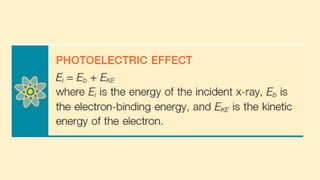
Photoelectric effect
Primary effect to provide anatomical details in our radiograph
by the travelling photoelectrons
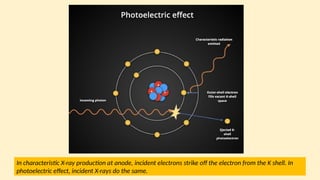
Incident photon with a little more energy than binding energy of
inner shell electron
Encounters an electron, all energy of X-ray photon deposits into
the electron and ejects it out from the shell
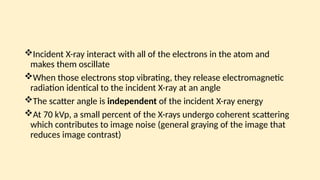
Photon disappears
The electron flies off into the space as photoelectron which
becomes a negative ion that infers the dose to the patient through
linear energy transfer
In characteristic X-ray production at anode, incident electrons strike off the electron from the K shell. In
photoelectric effect, incident X-rays do the same.
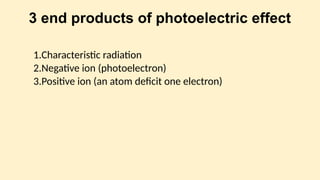
3 end products of photoelectric effect
1.Characteristic radiation
2.Negative ion (photoelectron)
3.Positive ion (an atom deficit one electron)
Characteristic radiation as a result of
Photoelectric effect?
Ejection of a K-shell photoelectron by the incident x-ray results in a
vacancy in the K shell.
Unnatural state is immediately corrected when an outer shell
electron, usually from the L shell, drops into the vacancy
Emission of an x-ray whose energy is equal to the difference between
binding energies of the shells involved
These characteristic x-rays consist of secondary radiation and behave
in the same manner as scattered radiation
They contribute nothing of diagnostic value and fortunately have
sufficiently low energy that they do not penetrate to the image
receptor and are attenuated by body tissues
Probability of occurrence of
photoelectric effect
1. The incidence photon must have sufficient energy to
overcome the binding energy of the electron
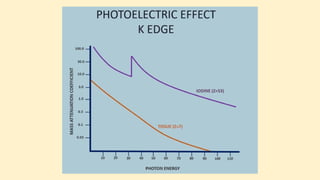
• For eg: K shell electrons of iodine have binding energy of 33.2 keV
• So, x-ray photon of energy 33.0 keV cannot eject then from their
shell but 33.3 keV can.
2. The photoelectric reaction is most likely to occur when the
photon energy and electron binding energy are nearly same and
greater.
• For eg: : K shell electrons of iodine have binding energy of 33.2 keV
• So a 34 keV photon is more likely to react with these K shell electrons
than a 100 keV photon.
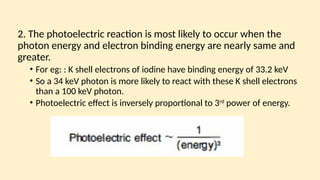
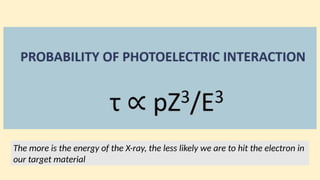
• Photoelectric effect is inversely proportional to 3rd
power of energy.
Probability of occurrence
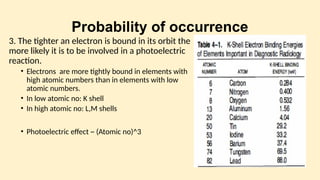
3. The tighter an electron is bound in its orbit the
more likely it is to be involved in a photoelectric
reaction.
• Electrons are more tightly bound in elements with
high atomic numbers than in elements with low
atomic numbers.
• In low atomic no: K shell
• In high atomic no: L,M shells
• Photoelectric effect ~ (Atomic no)^3
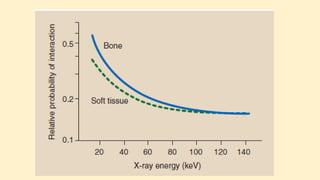
The more is the energy of the X-ray, the less likely we are to hit the electron in
our target material
Photelectric effect:
Application in Diagnostic Radiology
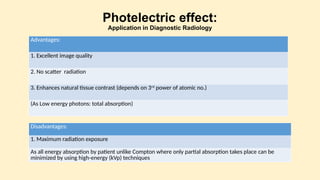
Advantages:
1. Excellent image quality
2. No scatter radiation
3. Enhances natural tissue contrast (depends on 3rd
power of atomic no.)
(As Low energy photons: total absorption)
Disadvantages:
1. Maximum radiation exposure
As all energy absorption by patient unlike Compton where only partial absorption takes place can be
minimized by using high-energy (kVp) techniques
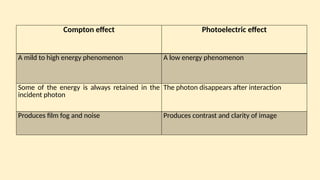
Compton effect Photoelectric effect
A mild to high energy phenomenon A low energy phenomenon
Some of the energy is always retained in the
incident photon
The photon disappears after interaction
Produces film fog and noise Produces contrast and clarity of image
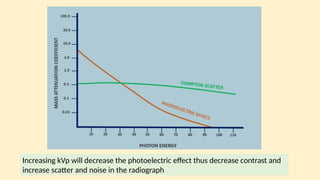
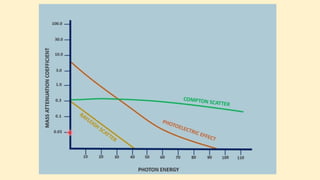
Increasing kVp will decrease the photoelectric effect thus decrease contrast and
increase scatter and noise in the radiograph
Pair production
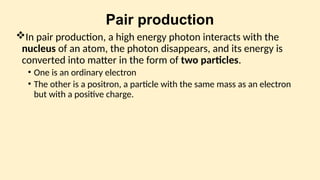
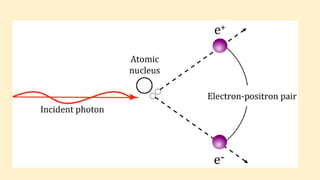
In pair production, a high energy photon interacts with the
nucleus of an atom, the photon disappears, and its energy is
converted into matter in the form of two particles.
• One is an ordinary electron
• The other is a positron, a particle with the same mass as an electron
but with a positive charge.
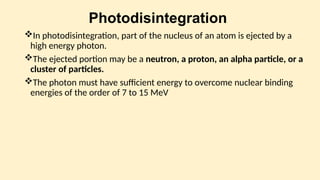
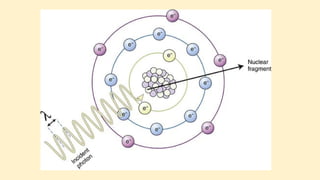
Photodisintegration
In photodisintegration, part of the nucleus of an atom is ejected by a
high energy photon.
The ejected portion may be a neutron, a proton, an alpha particle, or a
cluster of particles.
The photon must have sufficient energy to overcome nuclear binding
energies of the order of 7 to 15 MeV
Significance of pair production and
photodisintegration
We rarely use energies above 150 keV.
Pair production does not occur with photon energies less than 1.02
MeV (0.51 MeV + 0.51 MeV).
Photodisintegration does not occur with energies less than 7 MeV.
Thus, neither of these interactions is of any importance in diagnostic
radiology
References:
Christensen’s Physics of Diagnostic Radiology, 4th
edition
Radiologic Science for Technologists, SC Bushong, 11th
edition
Thank you

X-ray interactions with matter by Dr. Aryan

  • 1.
    X-Ray: Interactions with matter Presentedby: Dr. Anish Dhakal Resident MD Radiodiagnosis, KUSMS 20th May, 2024
  • 2.
    X-rays generation: Basicsatoms The nucleus of an atom is made up of several types of elementary particles, termed nucleons The proton has a positive electric charge numerically equal to the charge of the electron, while the neu­ tron has zero electrical charge The number of protons in the nu­ cleus is called the atomic number of the atoms, and is given the symbol “Z”
  • 3.
    The total numberof protons and neutrons in the nu­ cleus of an atom is called the mass number and is symbolized by the letter “A” The atomic system allows 2 electrons in the first orbit, up to 8 in the second, up to 18 in the third, up to 32 in the fourth, and up to 50 in the fifth. The electron orbits are designated by letters: K, L, M, N, O, and so on.
  • 4.
    The Concept ofBinding force The attractive force between the positively charged nu­ cleus and the negatively charged electron is the force that keeps the electrons in the atom This force is called the "binding force" of the electron and is inversely proportional to the square of the distance be­ tween the nucleus and electron. Therefore, a K electron has a greater binding force than an L electron.
  • 5.
    X-rays generation: Basicsatoms Bound particles always have negative energy. To free an electron from an atom, the energy must be raised to zero or to a positive value The energy that an electron in a shell must be given to raise the energy value to zero is called the binding energy of the electron.
  • 6.
    Bound Vs. Freeelectrons Bound electrons: Orbit the nucleus on the inner rings. Bound electrons have a strong magnetic attraction to the nucleus. Free electrons: Orbit on the outermost ring which is known as the valance ring
  • 7.
    Tungsten has aK-shell energy of 70 keV and an L-shell energy of 11 keV. To free a K electron from tungsten, the electron must be given 70 keV of energy , while only 11 keV are required to free an L electron. The L electron has 59 keV more energy than the K electron. The production of X-rays makes use of three properties of the tungsten atoms in the target of the X-ray tube: • Electric field of the nucleus • Binding energy of orbital electrons • Need of the atom to exist in its lowest energy state
  • 8.
    X-ray production process (1)Generalradiation/Bremsstrah­ lung radiation: Occurs with high atomic number and high kVp. Reaction of the electrons with the nucleus of the tungsten atoms. (2)Characteristic radiation: Occurs with low kVp and low atomic number as in mammography. Collision between the high-speed electrons and the electrons in the inner shell of the target tungsten atoms.
  • 9.
    General/Bremsstrahlung Radiation When anelectron passes near the nucleus of a tungsten atom, the positive charge of the nucleus acts on the negative charge of the electron. The electron is attracted to­ wards the nucleus and is thus deflected from its original direction. The electron may lose energy and be slowed down when its di­ rection changes. The kinetic energy lost by the electron is emitted directly in the form of a photon of radiation. The radiation produced by this process is called general radiation or bremsstrahlung (from the German for "braking radiation").
  • 10.
    Most electrons thatstrike the target give up their energy by interactions with a num­ ber of atoms. The electron gives up only part of its energy in the form of radiation each time it is "braked." Most of the radiation will have little energy, and will appear as heat. Few X-rays will ap­ pear because over 99% of all reactions produce heat. The energy of the radiation is the amount of energy lost by the electrons.
  • 11.
    General Radiation/Bremsstrahlung Radiation Radiation givenoff by free electrons that are deflected (i.e., accelerated) in the electric fields of charged particles and the nucleus of atom
  • 12.
    Characteristic Radiation Characteris­ tic radiationresults when the electrons bombarding the target eject electrons from the inner orbits of the target atoms Removal of an electron from a tungsten atom causes the atom to have an excess positive charge, and the atom thus becomes a positive ion In the process of returning to its normal state, the ionized atom of tungsten may get rid of excess energy in one of two ways.
  • 13.
    Fate of thepositive ion I. An additional electron (called an Auger electron) may be expelled by the atom and carry off the excess energy. The ejection of Auger electrons does not produce X-rays. II. An alternative way to get rid of excess energy is for the atom to emit radiation that has wavelengths within the X-ray range A tungsten atom with an inner shell vacancy is much more likely to produce an x-ray than to expel an electron
  • 14.
    Characteristic Radiation Characteristic becauseX- ray produced in this manner are called characteristic X-ray because the wavelengths of the X-rays produced are characteristic of the atom that has been ionized.
  • 16.
    X-rays: Dual characteristic •X-ray as a member of the electromagnetic radiation have wave-particle duality • Wavelength for diagnostic x-ray is 0.1 to 1 Angstrom • c= λf • c=velocity • λ=wavelength • f=frequency
  • 17.
    X-rays as aParticle X-rays predominant react with matter in the form of particle rather than wave. Quantum or Photon: • Discrete bundle or packets of energy. The amount of energy carried by each photon: • E=hf • E= energy of photon • h=plank’s constant 6.6 *10-34 Joule-seconds • f= frequency
  • 18.
    Photon energy inDiagnostic Radiology 10-150 keV (1 ev =1.602 *10-19 J) 1% of the energy from bombarding electrons converts to X-ray 1% of X-ray incident on a patient reach the image receptor Less than 0.5% actually interact to form an image
  • 19.
    Differential Absorption X-ray imageresults from the difference between those x-rays absorbed photoelectrically in the patient and those transmitted to the image receptor This difference in x-ray interaction is called differential absorption. Controls contrast of an X-ray image Depends on: Atomic Number and Mass Density
  • 20.
  • 22.
    Interaction process betweenX-rays and Matter: 1)Photon scattering: a)Coherent scattering b)Compton scattering 2)Photon absorption or disappearance: a)Photoelectric effect b)Pair production c)Photodisintegration
  • 23.
    Coherent/Classical/Elastic/ Thompson/Rayleigh scattering  Alsoknown as unmodified scattering  Interaction where radiation undergoes change in direction without change in wavelength/energy  Usually occurs in low energy range when incident atom is smaller than the wavelength of the incident X-ray  Only type of interaction where no ionization occurs  Does not contribute to patient dose
  • 24.
    Incident X-ray interactwith all of the electrons in the atom and makes them oscillate When those electrons stop vibrating, they release electromagnetic radiation identical to the incident X-ray at an angle The scatter angle is independent of the incident X-ray energy At 70 kVp, a small percent of the X-rays undergo coherent scattering which contributes to image noise (general graying of the image that reduces image contrast)
  • 26.
    Compton scattering An incidentphoton with relatively high energy strikes the free outer shell electron, ejecting it from the orbit The photon is deflected by the electron so that it travels in a new direction Photon always retain a part of its energy. Only a part of the photon energy in given to the electron to knock it off (unlike the photoelectric effect). Binding energy is largely inconsequential in the outer shell Produces ion pair, positive ion and negative electron called recoil electron
  • 28.
    Compton scattering Two factorsdetermine the amount of energy retained by the photon 1. Angle of deflection: Narrow the angle, smaller the amount of energy loss so less energy to the knocked out electron. Greater energy to the photon. 2. Amount of initial energy: Greater the energy, more energy to the photon The scattered radiation from compton reaction is the major safety hazard since even with 90 degree deflection the scattered radiation arising from patient is as energetic as the primary beam(e.g. in fluroscopy)
  • 29.
    Probability of occurrence Theprobability of a Compton reaction depends on the total number of electrons in an absorber, which in turn depends on its density and the number of electrons per gram But all elements contain approximately the same number of electrons per gram, regardless of their atomic number. Therefore, the number of Compton reactions is independent of the atomic number of the absorber. The likelihood of a reaction, however, does depend on the energy of the radiation and mainly on the density of the absorber.
  • 31.
    Disadvantages of Comptonscattering : The photons are scattered at a narrow angles have chance of reaching the x ray film and producing fog, thus reduce contrast of image Exceedingly difficult to remove: • By filters because they are too energetic • By grids because of very narrow angle of deflection Since even after major deflection, nearly original energy is still retained as primary, it is a safety hazard for medical professionals and the patients
  • 32.
    Photoelectric effect Primary effectto provide anatomical details in our radiograph by the travelling photoelectrons Incident photon with a little more energy than binding energy of inner shell electron Encounters an electron, all energy of X-ray photon deposits into the electron and ejects it out from the shell Photon disappears The electron flies off into the space as photoelectron which becomes a negative ion that infers the dose to the patient through linear energy transfer
  • 34.
    In characteristic X-rayproduction at anode, incident electrons strike off the electron from the K shell. In photoelectric effect, incident X-rays do the same.
  • 35.
    3 end productsof photoelectric effect 1.Characteristic radiation 2.Negative ion (photoelectron) 3.Positive ion (an atom deficit one electron)
  • 36.
    Characteristic radiation asa result of Photoelectric effect? Ejection of a K-shell photoelectron by the incident x-ray results in a vacancy in the K shell. Unnatural state is immediately corrected when an outer shell electron, usually from the L shell, drops into the vacancy Emission of an x-ray whose energy is equal to the difference between binding energies of the shells involved These characteristic x-rays consist of secondary radiation and behave in the same manner as scattered radiation They contribute nothing of diagnostic value and fortunately have sufficiently low energy that they do not penetrate to the image receptor and are attenuated by body tissues
  • 37.
    Probability of occurrenceof photoelectric effect 1. The incidence photon must have sufficient energy to overcome the binding energy of the electron • For eg: K shell electrons of iodine have binding energy of 33.2 keV • So, x-ray photon of energy 33.0 keV cannot eject then from their shell but 33.3 keV can.
  • 38.
    2. The photoelectricreaction is most likely to occur when the photon energy and electron binding energy are nearly same and greater. • For eg: : K shell electrons of iodine have binding energy of 33.2 keV • So a 34 keV photon is more likely to react with these K shell electrons than a 100 keV photon. • Photoelectric effect is inversely proportional to 3rd power of energy.
  • 39.
    Probability of occurrence 3.The tighter an electron is bound in its orbit the more likely it is to be involved in a photoelectric reaction. • Electrons are more tightly bound in elements with high atomic numbers than in elements with low atomic numbers. • In low atomic no: K shell • In high atomic no: L,M shells • Photoelectric effect ~ (Atomic no)^3
  • 40.
    The more isthe energy of the X-ray, the less likely we are to hit the electron in our target material
  • 43.
    Photelectric effect: Application inDiagnostic Radiology Advantages: 1. Excellent image quality 2. No scatter radiation 3. Enhances natural tissue contrast (depends on 3rd power of atomic no.) (As Low energy photons: total absorption) Disadvantages: 1. Maximum radiation exposure As all energy absorption by patient unlike Compton where only partial absorption takes place can be minimized by using high-energy (kVp) techniques
  • 45.
    Compton effect Photoelectriceffect A mild to high energy phenomenon A low energy phenomenon Some of the energy is always retained in the incident photon The photon disappears after interaction Produces film fog and noise Produces contrast and clarity of image
  • 46.
    Increasing kVp willdecrease the photoelectric effect thus decrease contrast and increase scatter and noise in the radiograph
  • 48.
    Pair production In pairproduction, a high energy photon interacts with the nucleus of an atom, the photon disappears, and its energy is converted into matter in the form of two particles. • One is an ordinary electron • The other is a positron, a particle with the same mass as an electron but with a positive charge.
  • 50.
    Photodisintegration In photodisintegration, partof the nucleus of an atom is ejected by a high energy photon. The ejected portion may be a neutron, a proton, an alpha particle, or a cluster of particles. The photon must have sufficient energy to overcome nuclear binding energies of the order of 7 to 15 MeV
  • 52.
    Significance of pairproduction and photodisintegration We rarely use energies above 150 keV. Pair production does not occur with photon energies less than 1.02 MeV (0.51 MeV + 0.51 MeV). Photodisintegration does not occur with energies less than 7 MeV. Thus, neither of these interactions is of any importance in diagnostic radiology
  • 53.
    References: Christensen’s Physics ofDiagnostic Radiology, 4th edition Radiologic Science for Technologists, SC Bushong, 11th edition
  • 54.

Editor's Notes

  • #5 M shell – 9keV.
  • #12 AUGER Electron? Tungsten – Wolfram (W) – 3342degrees.
  • #26 The energy of incident photon is distributed in two ways one to recoil elctron as kineric energuy and rest is retained by the deflected photon Unlike PEE where most energy is expended in freeingrht ephotoelectron from its bond
  • #28 Therefore at narrower angle of deflection the scattered photon retain almost all original energy and has excellent chance o freaching th e xray film producing the fog so there is dificulty to remove from xray film and decreases the quallity of image This scatterd radidation from compton reaction is the mahot saferty hazard sine=ce even with 90 degree deflection the scattered radaition arising from patien tis as energetic as the primary beam
  • #32 Giving all the energy to electron. This photon energy overcomes the binding energy of the electron and gives kinetic energy to the electron