Contents:
 Reflex?
 Reflex arc?
 Components of reflex arc
 Classification of reflexes
 Superficial reflexes and deep reflexes
 Muscle spindle
 Muscle tone & its types
 Disorders of muscle tone
 Summary
 References
Reflex
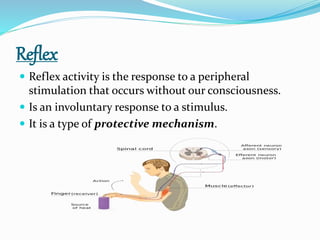
 Reflex activity is the response to a peripheral
stimulation that occurs without our consciousness.
 Is an involuntary response to a stimulus.
 It is a type of protective mechanism.
Reflex arc
 A reflex arc is the neural pathway that mediates a
reflex action.
“OR”
 Reflex actions are mediated via the reflex arc.
 A simple reflex arc includes five components.
Components of reflex arc
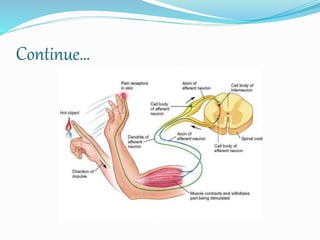
Receptor: site of stimulus
Afferent nerve: transmit sensory impulses from
the receptor to stimulus.
Center: Center recieves the sensory impulses an in
turn, it generates appropriate motor impulses.
Efferent nerve: transmit motor impulses from
the center to the effector organ.
Effector organ: muscle or gland that respond to
stimulus.
Continue…
CLASSIFICATION OF REFLEXES
 Reflexes are classified by six different methods depending
upon various factors as given below:
1. Depending upon whether inborn or acquired reflexes.
2. Depending upon situation – anatomical classification.
3. Depending upon purpose – physiological classification.
4. Depending upon no of synapse.
5. Depending upon whether visceral or somatic.
6. Depending upon clinical basis. (superficial and deep
reflexes).
Superficial reflexes
 Superficial reflexes are the reflexes, which are elicited
from the surface of the body.
 These reflexes are motor responses to scraping of the
skin.
 initiated by stimulating appropriate receptors of skin
or mucous membrane.
 Are usually multisynaptic or polysynaptic.
Continue…!
reflex Method of eliciting
the reflex
response
Corneal reflex Touching cornea with
cotton wisp.
Closure of the eye
(blinking).
Conjunctival reflex Touching conjunctiva
with cotton wisp.
Closure of the eye.
Nasal reflex (sneezing
reflex)
Irritiating the nasal
mucosa with a cottin
wasp.
Sneezing.
Planter reflex Stroking the sole Planter flexion and
adduction of toes.
Continue..!
deep reflex
 Deep reflex are elicited from deeper structures beneath the
skin like tendon.
 Also known as tendon reflexes.
Strech & Deep tendon reflexes:
 For skeletal muscles to perform normally:
• The Golgi tendon organs (proprioceptors) gives response to
the change in the force or tension developed in the
skeleton muscle during contraction.
• Stretch reflexes initiated by muscle spindles must
maintain healthy muscle tone.
Muscle spindles
 Are composed of a few intrafusal muscle fibers that
lack actin and myosin in their central regions, are
noncontractile, and serve as receptive surfaces.
 Muscle spindles are wrapped with two types of
afferent endings: primary sensory endings of type Ia
fibers and secondary sensory endings of type II
fibers.
 These regions are innervated by gamma efferent
 fibers.
 Note: contractile muscle fibers are extrafusal fibers
and are innervated by alpha efferent fibers.
Continue..!
How the muscle spindles works?
Muscle spindle reflex oppose (correct for) increase in
muscle length (stretch).
1. Sensory information about muscle length is received by
group Ia and group II afferent fibers.
2. When a muscle is stretched (lenghtened) , the muscle
spindle is also streched, stimulating group Ia and group II
afferent fibers.
3. Stimulation of group Ia afferents stimulates α-
motorneurons in theb spinal cord. The stimulation in
turn causes contraction and shortening of the muscle.
Thus, the original stretch is opposed & muscle length is
maintained.
Operation of the Muscle
Spindles
 Stretching the muscles activates the muscle spindle
 There is an increased rate of action potential in Ia
fibers
 Contracting the muscle reduces tension on the
muscle spindle
 There is a decreased rate of action potential on Ia
fibers
Continue…!
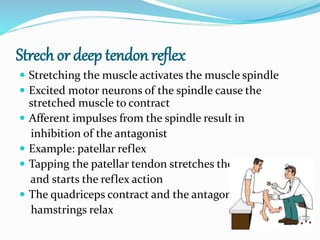
Strech or deep tendon reflex
 Stretching the muscle activates the muscle spindle
 Excited motor neurons of the spindle cause the
stretched muscle to contract
 Afferent impulses from the spindle result in
inhibition of the antagonist
 Example: patellar reflex
 Tapping the patellar tendon stretches the quadriceps
and starts the reflex action
 The quadriceps contract and the antagonistic
hamstrings relax
Continue…!
Golgi tendon reflex:
 The opposite of the stretch reflex.
 Contracting the muscle activates the Golgi tendon
organs.
 Afferent Golgi tendon neurons are stimulated,
neurons inhibit the contracting muscle, and the
antagonistic muscle is activated.
 As a result, the contracting muscle relaxes and the
antagonist muscle contracts
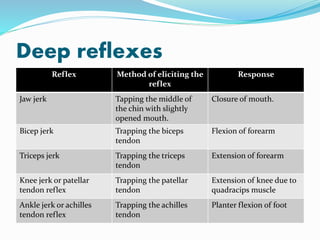
Deep reflexes
Reflex Method of eliciting the
reflex
Response
Jaw jerk Tapping the middle of
the chin with slightly
opened mouth.
Closure of mouth.
Bicep jerk Trapping the biceps
tendon
Flexion of forearm
Triceps jerk Trapping the triceps
tendon
Extension of forearm
Knee jerk or patellar
tendon reflex
Trapping the patellar
tendon
Extension of knee due to
quadracips muscle
Ankle jerk or achilles
tendon reflex
Trapping the achilles
tendon
Planter flexion of foot
Continue…!
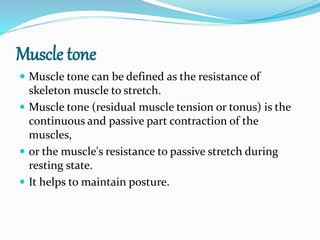
Muscle tone
 Muscle tone can be defined as the resistance of
skeleton muscle to stretch.
 Muscle tone (residual muscle tension or tonus) is the
continuous and passive part contraction of the
muscles,
 or the muscle's resistance to passive stretch during
resting state.
 It helps to maintain posture.
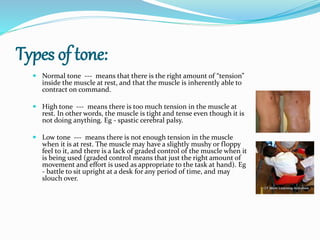
Types of tone:
 Normal tone --- means that there is the right amount of “tension”
inside the muscle at rest, and that the muscle is inherently able to
contract on command.
 High tone --- means there is too much tension in the muscle at
rest. In other words, the muscle is tight and tense even though it is
not doing anything. Eg - spastic cerebral palsy.
 Low tone --- means there is not enough tension in the muscle
when it is at rest. The muscle may have a slightly mushy or floppy
feel to it, and there is a lack of graded control of the muscle when it
is being used (graded control means that just the right amount of
movement and effort is used as appropriate to the task at hand). Eg
- battle to sit upright at a desk for any period of time, and may
slouch over.
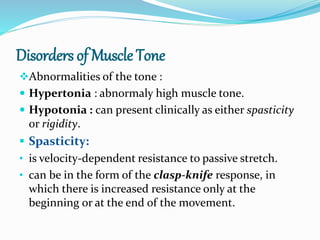
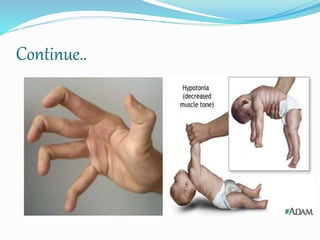
Disorders of Muscle Tone
Abnormalities of the tone :
 Hypertonia : abnormaly high muscle tone.
 Hypotonia : can present clinically as either spasticity
or rigidity.
 Spasticity:
• is velocity-dependent resistance to passive stretch.
• can be in the form of the clasp-knife response, in
which there is increased resistance only at the
beginning or at the end of the movement.
Continue..!
 Rigidity:
• is velocity-independent resistance to passive stretch
• can be of the lead pipe type, in which there is
resistance throughout to passive movement, or
• it may be of cogwheel type, in which the resistance to
passive movement is in a jerky manner.
Continue..
Summary:
 What are the reflexes?
 role of reflex arc. Its components
 How the reflexes are classified? Depending over some
various factors by different methods.
 What are the superficial and deep reflexes?
 Discussed about the muscle spindle, muscle tone & its
disorder (hypertonia and hypotonia).
References
 Essentials of medical physiology by k sembulingam
(jaypee, book).
 www.dartmouth.edu
 www.stanfordmedicine25.stanford.edu
Superficial and deep reflexes!

Superficial and deep reflexes!

  • 3.
    Contents:  Reflex?  Reflexarc?  Components of reflex arc  Classification of reflexes  Superficial reflexes and deep reflexes  Muscle spindle  Muscle tone & its types  Disorders of muscle tone  Summary  References
  • 4.
    Reflex  Reflex activityis the response to a peripheral stimulation that occurs without our consciousness.  Is an involuntary response to a stimulus.  It is a type of protective mechanism.
  • 5.
    Reflex arc  Areflex arc is the neural pathway that mediates a reflex action. “OR”  Reflex actions are mediated via the reflex arc.  A simple reflex arc includes five components.
  • 6.
    Components of reflexarc Receptor: site of stimulus Afferent nerve: transmit sensory impulses from the receptor to stimulus. Center: Center recieves the sensory impulses an in turn, it generates appropriate motor impulses. Efferent nerve: transmit motor impulses from the center to the effector organ. Effector organ: muscle or gland that respond to stimulus.
  • 7.
  • 8.
    CLASSIFICATION OF REFLEXES Reflexes are classified by six different methods depending upon various factors as given below: 1. Depending upon whether inborn or acquired reflexes. 2. Depending upon situation – anatomical classification. 3. Depending upon purpose – physiological classification. 4. Depending upon no of synapse. 5. Depending upon whether visceral or somatic. 6. Depending upon clinical basis. (superficial and deep reflexes).
  • 9.
    Superficial reflexes  Superficialreflexes are the reflexes, which are elicited from the surface of the body.  These reflexes are motor responses to scraping of the skin.  initiated by stimulating appropriate receptors of skin or mucous membrane.  Are usually multisynaptic or polysynaptic.
  • 10.
    Continue…! reflex Method ofeliciting the reflex response Corneal reflex Touching cornea with cotton wisp. Closure of the eye (blinking). Conjunctival reflex Touching conjunctiva with cotton wisp. Closure of the eye. Nasal reflex (sneezing reflex) Irritiating the nasal mucosa with a cottin wasp. Sneezing. Planter reflex Stroking the sole Planter flexion and adduction of toes.
  • 11.
  • 12.
    deep reflex  Deepreflex are elicited from deeper structures beneath the skin like tendon.  Also known as tendon reflexes. Strech & Deep tendon reflexes:  For skeletal muscles to perform normally: • The Golgi tendon organs (proprioceptors) gives response to the change in the force or tension developed in the skeleton muscle during contraction. • Stretch reflexes initiated by muscle spindles must maintain healthy muscle tone.
  • 13.
    Muscle spindles  Arecomposed of a few intrafusal muscle fibers that lack actin and myosin in their central regions, are noncontractile, and serve as receptive surfaces.  Muscle spindles are wrapped with two types of afferent endings: primary sensory endings of type Ia fibers and secondary sensory endings of type II fibers.  These regions are innervated by gamma efferent  fibers.  Note: contractile muscle fibers are extrafusal fibers and are innervated by alpha efferent fibers.
  • 14.
  • 15.
    How the musclespindles works? Muscle spindle reflex oppose (correct for) increase in muscle length (stretch). 1. Sensory information about muscle length is received by group Ia and group II afferent fibers. 2. When a muscle is stretched (lenghtened) , the muscle spindle is also streched, stimulating group Ia and group II afferent fibers. 3. Stimulation of group Ia afferents stimulates α- motorneurons in theb spinal cord. The stimulation in turn causes contraction and shortening of the muscle. Thus, the original stretch is opposed & muscle length is maintained.
  • 16.
    Operation of theMuscle Spindles  Stretching the muscles activates the muscle spindle  There is an increased rate of action potential in Ia fibers  Contracting the muscle reduces tension on the muscle spindle  There is a decreased rate of action potential on Ia fibers
  • 17.
  • 18.
    Strech or deeptendon reflex  Stretching the muscle activates the muscle spindle  Excited motor neurons of the spindle cause the stretched muscle to contract  Afferent impulses from the spindle result in inhibition of the antagonist  Example: patellar reflex  Tapping the patellar tendon stretches the quadriceps and starts the reflex action  The quadriceps contract and the antagonistic hamstrings relax
  • 19.
  • 20.
    Golgi tendon reflex: The opposite of the stretch reflex.  Contracting the muscle activates the Golgi tendon organs.  Afferent Golgi tendon neurons are stimulated, neurons inhibit the contracting muscle, and the antagonistic muscle is activated.  As a result, the contracting muscle relaxes and the antagonist muscle contracts
  • 22.
    Deep reflexes Reflex Methodof eliciting the reflex Response Jaw jerk Tapping the middle of the chin with slightly opened mouth. Closure of mouth. Bicep jerk Trapping the biceps tendon Flexion of forearm Triceps jerk Trapping the triceps tendon Extension of forearm Knee jerk or patellar tendon reflex Trapping the patellar tendon Extension of knee due to quadracips muscle Ankle jerk or achilles tendon reflex Trapping the achilles tendon Planter flexion of foot
  • 23.
  • 24.
    Muscle tone  Muscletone can be defined as the resistance of skeleton muscle to stretch.  Muscle tone (residual muscle tension or tonus) is the continuous and passive part contraction of the muscles,  or the muscle's resistance to passive stretch during resting state.  It helps to maintain posture.
  • 25.
    Types of tone: Normal tone --- means that there is the right amount of “tension” inside the muscle at rest, and that the muscle is inherently able to contract on command.  High tone --- means there is too much tension in the muscle at rest. In other words, the muscle is tight and tense even though it is not doing anything. Eg - spastic cerebral palsy.  Low tone --- means there is not enough tension in the muscle when it is at rest. The muscle may have a slightly mushy or floppy feel to it, and there is a lack of graded control of the muscle when it is being used (graded control means that just the right amount of movement and effort is used as appropriate to the task at hand). Eg - battle to sit upright at a desk for any period of time, and may slouch over.
  • 26.
    Disorders of MuscleTone Abnormalities of the tone :  Hypertonia : abnormaly high muscle tone.  Hypotonia : can present clinically as either spasticity or rigidity.  Spasticity: • is velocity-dependent resistance to passive stretch. • can be in the form of the clasp-knife response, in which there is increased resistance only at the beginning or at the end of the movement.
  • 27.
    Continue..!  Rigidity: • isvelocity-independent resistance to passive stretch • can be of the lead pipe type, in which there is resistance throughout to passive movement, or • it may be of cogwheel type, in which the resistance to passive movement is in a jerky manner.
  • 28.
  • 29.
    Summary:  What arethe reflexes?  role of reflex arc. Its components  How the reflexes are classified? Depending over some various factors by different methods.  What are the superficial and deep reflexes?  Discussed about the muscle spindle, muscle tone & its disorder (hypertonia and hypotonia).
  • 30.
    References  Essentials ofmedical physiology by k sembulingam (jaypee, book).  www.dartmouth.edu  www.stanfordmedicine25.stanford.edu