DR. SUMIT KAMBLE
SENIOR RESIDENT
DEPT. OF NEUROLOGY
GMC, KOTA
Spinal shock – phenomena surrounding physiologic
or anatomic transaction of the spinal cord that results
in temporary loss or depression of all or most spinal
reflex activity below the level of the lesion.
 Demonstrated only in settings of severe spinal cord
injury occurring during relative brief period.
HISTORY
 1750-Whytt first described phenomenon.
 1841- Hall introduced term spinal shock.
 1890- Bastian defined it as complete severance of the
spinal cord that results in total loss of motor and
sensory function below the level of the lesion, as well
as permanent extinction of tendon reflexes and
muscular tone despite the reflex arc remaining intact.
 Sherrington- 1. Replaced Bastian's use of the term
"permanent" with temporary extinction.
2. Polysynaptic reflexes are depressed for shorter
duration than monosynaptic.
PATHOPHYSIOLOGIC CHARACTERISTICS OF SPINAL
SHOCK
 Spinal shock may occur up to several hours after the
onset of injury.
 More severe the physiologic or anatomic transection of
the spinal cord, the more profound the state of spinal
shock.
 Isolated spinal cord closest to the disruption is the
most severely affected-loss of reflex function occurs.
 Spinal cord segment most distal to the transection
may be depressed later.
 Farther it is from the site of injury, more likely it will
retain some reflex capabilities.
 Patients with high-level cervical spinal cord injuries
are likely to retain distal sacral reflexes such as
bulbocavernosus and anal wink despite loss of all other
reflexes.
 Lower the spinal cord injury, more likely that all distal
reflexes will be absent.
 Reflex arcs at the level of spinal cord injury may
remain permanently absent if portions or all of the arc
components are permanently injured.
 Proximal spinal cord may also undergoes changes, and
these cephalad effects are known as Schiff
Sherrington phenomenon.
 Transient loss of upper extremity reflexes with upper
thoracic spinal cord lesions may be seen.
 Usually abates after a few hours or days.
 Tran section of the spinal cord as low as the third
lumbar segment affects the excitability of the
forelimbs.
DURATION OF SPINAL SHOCK
 Duration of spinal shock is proportionate to the degree of
encephalization in the various species.
 In frogs and rats it lasts for minutes; in dogs and cats it
lasts for 1 to 2 h; in monkeys it lasts for days; and in
humans it usually lasts for a minimum of 2 wk.
 It may be prolonged because of toxic or septic conditions
such as urinary tract infections or pressure sores and
malnutrition.
 Depends on age of the pateint.
 Higher or proximal the SCI lesion, shorter is the spinal
shock duration.
 Muscle spindle reflexes always return except at vertical
spinal cord injury levels, and they generally return in a
caudal to cephalad direction.
PROGNOSTIC SIGNIFICANCE-
 Spinal cord injury with concomitant spinal shock
usually has a worse associated prognosis than does the
same degree of spinal cord injury without spinal
shock.
 Patients with equivalent degrees of spinal cord injury
and spinal shock may do somewhat better if they have
early resumption of reflex spinal cord function.
CHARACTERISTIC OF SPINAL SHOCK
 Motor Effects – Paraplegia ,Quadriplegia
 Loss of tone -Muscles become flaccid
 Areflexia - All superficial and deep reflexes are lost
 Sensory Effects -All Sensations are lost below the level of
transection
 Complete lesions above T1 will eliminate all sympathetic
outflow.
 Lesions between T1 and T6 will preserve sympathetic tone
in head and upper extremities but deny it to the adrenals
and lower extremities.
 Lesions between T6 and the lumbar cord will preserve
adrenal innervation but denervate the lower extremities.
PHASES OF SPINAL SHOCK
PHASE POSSIBLE
MECHANISM
Phase 1 (0-1 days) Areflexia/ hyporeflexia Loss of descending
facilitation
Phase 2(1-3 days) Initial reflex return Denervation
supersensitivity
Phase 3 (1-4 weeks) Initial hyper-reflexia Axon supported synapse
growth
Phase 4 (1-12 months) Final hyper-reflexia Soma supported synapse
growth
PHASE 1-AREFLEXIA/HYPOREFLEXIA( 0-1DAY)
CLINICAL DESCRIPTION-
 Caudal to SCI, DTRs such as AJ and KJ are absent.
 Muscles are flaccid and paralysed.
 Cutaneous ( polysynaptic) reflexes such as BC, AW,
and CM begin to recover.
 Pathological reflex DPR is usually first reflex to return
(hours of injury) - Transient
 Bradyarrhythmias, AV block, and hypotension occurs
following cervical lessions due to impaired
sympathetic innervation.
 PHYSIOLOGY-
1. Lost normal background supraspinal excitation.
2. Increased spinal inhibition
3. Lost plateau potentials in spinal neurons due to 5HT
loss.
4. Reduced neuronal metabolism.
5. Retraction of dendrites and synapses.
PHASE 2-INITIAL REFLEX RETURN (1-3 DAYS)
CLINICAL DESCRIPTION-
 Cutaneous reflexes becomes stronger.
 DTRs are still absent, although tibial H-reflex returns
by about 24 h.
 In eldarly DTRs and Babinski sign can appear.
PHYSIOLOGY-
1. Denervation supersensitivity-
2. NMDA receptor upregulation.
3. Inactivity dependent receptor upregulation
4. NT and GF synthesis increases.
Denervation supersensitivity-
Supersensitivity to neurotransimitters
 (a) reduced excitory neurotransmitter reuptake,
 (b)increased synthesis and insertion of receptors into
postsynaptic membrane,
 (c) decreased removal and degradation of receptors
 (d) altered synthesis and composition of recepotor
subunits.
PHASE 3-EARLY HYPER-REFLEXIA (4 TO 30 DAYS)
CLINICAL DESCRIPTON-
 Most DTRs first reappear during this period, AJ usually
precedes KJ.
 Babinski sign follows recovery of AJ closely.
 Skeleton muscle tone than recovers slowely after 3-4
weeks.
 Only in 10% DPRs persists beyond a month.
 Improvement in vagally mediated bradyarrhythmias
and hypotension.
 Autonomic dysreflexia begin to emerge.
PHYSIOLOGY-
1. New synapse growth to occupy vacated synaptic
sites.
2. NT retrogrades signal to elicit synapse growth.
3. Competitive and activity dependent synapse growth.
4. Most synapse growth by short axoned interneurons
5. Limited synapse growth by long axoned neurons.
6. Plateau potentials , possibly via Ca channel synthesis
in spinal neurons.
PHASE 4- SPASTICITY/HYPERREFLEXIA (1-12 MONTHS)
CLINICAL DESCRIPTION-
 DPR disappear in majority cases.
 Cutaneous reflexes, DTRs and Babinski sign become
hyperactive and responds to minimal stimuli.
 Mass reflex can be elicited in some cases
 Time of bladder recovery ( 4-6 weeks).
 Vasovagal hypotension and bradyarrhythmias resolves by
3-6 weeks.
 Orthostatic hypotension may persists for 10-12 weeks or
longer.
 Autonomic dysreflexia may persists indefinately.
AUTONOMIC DYSREFLEXIA-
 Characterized by acute elevation in BP coupled with
bradycardia/ tachycardia.
 Usually occurs with injury at and above T6.
 Symptoms vary from mild headache, blurred vision to
life threatening intracranial /subarachnoid
hemorrhage, retinal detachment and death.
 Vasoconstriction from sympathetic activation-dry, pale
skin below lesion.
 Parasympathetic response responsible for sweating,
piloerection and flushing above level of injury.
Management-
 Monitoring heart rate and BP.
 Patient should be placed in supine position.
 Inspected for areas of constriction.
 Relieving bladder and bowel distension.
 Fast acting antihyertensive- nifedipine, nitrates,
captopril.
PHYSIOLOGY-
1. New synapse growth by long axoned neurons
2. Soma supplied synapse growth via axon transport.
3. Competitive and activity dependent synapse growth.
TIME COURSE AND PATTERN OF REFLEX RECOVERY
0-1 day 1-3 days 1-4 weeks 1-12 months
DPR +++ +++ +/- +/-
BC reflex +/- ++ ++ ++
AW reflex +/- ++ ++ ++
CM reflex +/- ++ ++ ++
Babinski sign - + ++ ++
Flexor withdrawal reflex - +/- ++ +++
DTR - +/- ++ +++
Tibial H- reflex - ++ ++ +++
Extensor spasm - - - +++
Reflex neurogenic bladder - - - +++
Autonomic hyperreflexia - - - +++
PROGNOSTIC FACTORS OF NEUROLOGICAL RECOVERY
Good prognostic factor
 1.Spinal shock of <24 hours and
 2.Early appearance of deep tendon reflexes
Poor prognostic factor
 1.Complete lesion
 2.Spinal shock for >1 week,
 3.Flexor spasms within three weeks
 4. Bedsore within one week
 5. Persistance of DPR beyond 7 days.
CLINICAL IMPLICATIONS OF SPINAL SHOCK
 Formation of new synapses could lead to both
desirable and undesirable clinical effects.
 With significant sparing of descending motor inputs,
descending axons can sprout, resulting in motor
recovery.
 With minimal sparing, growth of segmental reflexes
inputs leads to spasticity, neuropathic pain and less
voluntary motor recovery.
During recovery optimized conditions must be
provided for new synapse growth-
 1. Nutrition
 2. Optimal general health
 3. Minimizing medication use compromising new
synapse growth
 4. coordinating active exercise and functional training
to enhance the underlying synapse growth
 5.controlling interfering spasticity
 Selected activity and electric activation may lead to
selected desired synaptic growth.
 Exercise can increase NT synthesis and could be
molecular signal for activity dependant recovery.
 Functional electrical stimulation is alternative tool.
Additional intervention to enhance synapse formation-
 1. Medications to increase excitability of spinal
neurons (5-HTP, clonidine, TRH, Theophylline)
 2. Stimulants of axonal growth (inosine)
 3. Stimulants of axonal synthesis (clenbutorol)
 4. Inhibition of Glutamate Toxicity (dizocilpine)
 5. Cell Replacement Strategies
TIMING OF POTENTIAL INTERVENTIONS-
 Interventions targeted at promoting synapse growth
should be applied before available synapse space is
occupied by synapses from local segmental neurons
mediating spasticity and hyperreflexia.
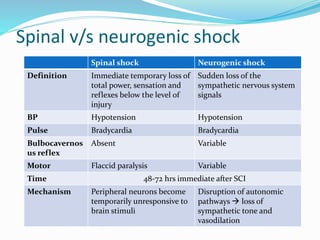
Spinal v/s neurogenic shock
Spinal shock Neurogenic shock
Definition Immediate temporary loss of
total power, sensation and
reflexes below the level of
injury
Sudden loss of the
sympathetic nervous system
signals
BP Hypotension Hypotension
Pulse Bradycardia Bradycardia
Bulbocavernos
us reflex
Absent Variable
Motor Flaccid paralysis Variable
Time 48-72 hrs immediate after SCI
Mechanism Peripheral neurons become
temporarily unresponsive to
brain stimuli
Disruption of autonomic
pathways  loss of
sympathetic tone and
vasodilation
REFERENCES
 Spinal shock revisited: a four phase model
International spinal cord society, march 2010
 Spinal shock review, Mayo clinic proc 1996
 Bradleys neurology in clinical practice, 6th edition

Spinal shock

  • 1.
    DR. SUMIT KAMBLE SENIORRESIDENT DEPT. OF NEUROLOGY GMC, KOTA
  • 2.
    Spinal shock –phenomena surrounding physiologic or anatomic transaction of the spinal cord that results in temporary loss or depression of all or most spinal reflex activity below the level of the lesion.  Demonstrated only in settings of severe spinal cord injury occurring during relative brief period.
  • 3.
    HISTORY  1750-Whytt firstdescribed phenomenon.  1841- Hall introduced term spinal shock.  1890- Bastian defined it as complete severance of the spinal cord that results in total loss of motor and sensory function below the level of the lesion, as well as permanent extinction of tendon reflexes and muscular tone despite the reflex arc remaining intact.  Sherrington- 1. Replaced Bastian's use of the term "permanent" with temporary extinction. 2. Polysynaptic reflexes are depressed for shorter duration than monosynaptic.
  • 4.
    PATHOPHYSIOLOGIC CHARACTERISTICS OFSPINAL SHOCK  Spinal shock may occur up to several hours after the onset of injury.  More severe the physiologic or anatomic transection of the spinal cord, the more profound the state of spinal shock.  Isolated spinal cord closest to the disruption is the most severely affected-loss of reflex function occurs.  Spinal cord segment most distal to the transection may be depressed later.
  • 5.
     Farther itis from the site of injury, more likely it will retain some reflex capabilities.  Patients with high-level cervical spinal cord injuries are likely to retain distal sacral reflexes such as bulbocavernosus and anal wink despite loss of all other reflexes.  Lower the spinal cord injury, more likely that all distal reflexes will be absent.  Reflex arcs at the level of spinal cord injury may remain permanently absent if portions or all of the arc components are permanently injured.
  • 6.
     Proximal spinalcord may also undergoes changes, and these cephalad effects are known as Schiff Sherrington phenomenon.  Transient loss of upper extremity reflexes with upper thoracic spinal cord lesions may be seen.  Usually abates after a few hours or days.  Tran section of the spinal cord as low as the third lumbar segment affects the excitability of the forelimbs.
  • 7.
    DURATION OF SPINALSHOCK  Duration of spinal shock is proportionate to the degree of encephalization in the various species.  In frogs and rats it lasts for minutes; in dogs and cats it lasts for 1 to 2 h; in monkeys it lasts for days; and in humans it usually lasts for a minimum of 2 wk.  It may be prolonged because of toxic or septic conditions such as urinary tract infections or pressure sores and malnutrition.
  • 8.
     Depends onage of the pateint.  Higher or proximal the SCI lesion, shorter is the spinal shock duration.  Muscle spindle reflexes always return except at vertical spinal cord injury levels, and they generally return in a caudal to cephalad direction.
  • 9.
    PROGNOSTIC SIGNIFICANCE-  Spinalcord injury with concomitant spinal shock usually has a worse associated prognosis than does the same degree of spinal cord injury without spinal shock.  Patients with equivalent degrees of spinal cord injury and spinal shock may do somewhat better if they have early resumption of reflex spinal cord function.
  • 10.
    CHARACTERISTIC OF SPINALSHOCK  Motor Effects – Paraplegia ,Quadriplegia  Loss of tone -Muscles become flaccid  Areflexia - All superficial and deep reflexes are lost  Sensory Effects -All Sensations are lost below the level of transection  Complete lesions above T1 will eliminate all sympathetic outflow.  Lesions between T1 and T6 will preserve sympathetic tone in head and upper extremities but deny it to the adrenals and lower extremities.  Lesions between T6 and the lumbar cord will preserve adrenal innervation but denervate the lower extremities.
  • 11.
    PHASES OF SPINALSHOCK PHASE POSSIBLE MECHANISM Phase 1 (0-1 days) Areflexia/ hyporeflexia Loss of descending facilitation Phase 2(1-3 days) Initial reflex return Denervation supersensitivity Phase 3 (1-4 weeks) Initial hyper-reflexia Axon supported synapse growth Phase 4 (1-12 months) Final hyper-reflexia Soma supported synapse growth
  • 12.
    PHASE 1-AREFLEXIA/HYPOREFLEXIA( 0-1DAY) CLINICALDESCRIPTION-  Caudal to SCI, DTRs such as AJ and KJ are absent.  Muscles are flaccid and paralysed.  Cutaneous ( polysynaptic) reflexes such as BC, AW, and CM begin to recover.  Pathological reflex DPR is usually first reflex to return (hours of injury) - Transient  Bradyarrhythmias, AV block, and hypotension occurs following cervical lessions due to impaired sympathetic innervation.
  • 13.
     PHYSIOLOGY- 1. Lostnormal background supraspinal excitation. 2. Increased spinal inhibition 3. Lost plateau potentials in spinal neurons due to 5HT loss. 4. Reduced neuronal metabolism. 5. Retraction of dendrites and synapses.
  • 14.
    PHASE 2-INITIAL REFLEXRETURN (1-3 DAYS) CLINICAL DESCRIPTION-  Cutaneous reflexes becomes stronger.  DTRs are still absent, although tibial H-reflex returns by about 24 h.  In eldarly DTRs and Babinski sign can appear.
  • 15.
    PHYSIOLOGY- 1. Denervation supersensitivity- 2.NMDA receptor upregulation. 3. Inactivity dependent receptor upregulation 4. NT and GF synthesis increases.
  • 16.
    Denervation supersensitivity- Supersensitivity toneurotransimitters  (a) reduced excitory neurotransmitter reuptake,  (b)increased synthesis and insertion of receptors into postsynaptic membrane,  (c) decreased removal and degradation of receptors  (d) altered synthesis and composition of recepotor subunits.
  • 17.
    PHASE 3-EARLY HYPER-REFLEXIA(4 TO 30 DAYS) CLINICAL DESCRIPTON-  Most DTRs first reappear during this period, AJ usually precedes KJ.  Babinski sign follows recovery of AJ closely.  Skeleton muscle tone than recovers slowely after 3-4 weeks.  Only in 10% DPRs persists beyond a month.  Improvement in vagally mediated bradyarrhythmias and hypotension.  Autonomic dysreflexia begin to emerge.
  • 18.
    PHYSIOLOGY- 1. New synapsegrowth to occupy vacated synaptic sites. 2. NT retrogrades signal to elicit synapse growth. 3. Competitive and activity dependent synapse growth. 4. Most synapse growth by short axoned interneurons 5. Limited synapse growth by long axoned neurons. 6. Plateau potentials , possibly via Ca channel synthesis in spinal neurons.
  • 19.
    PHASE 4- SPASTICITY/HYPERREFLEXIA(1-12 MONTHS) CLINICAL DESCRIPTION-  DPR disappear in majority cases.  Cutaneous reflexes, DTRs and Babinski sign become hyperactive and responds to minimal stimuli.  Mass reflex can be elicited in some cases  Time of bladder recovery ( 4-6 weeks).  Vasovagal hypotension and bradyarrhythmias resolves by 3-6 weeks.  Orthostatic hypotension may persists for 10-12 weeks or longer.  Autonomic dysreflexia may persists indefinately.
  • 20.
    AUTONOMIC DYSREFLEXIA-  Characterizedby acute elevation in BP coupled with bradycardia/ tachycardia.  Usually occurs with injury at and above T6.  Symptoms vary from mild headache, blurred vision to life threatening intracranial /subarachnoid hemorrhage, retinal detachment and death.  Vasoconstriction from sympathetic activation-dry, pale skin below lesion.  Parasympathetic response responsible for sweating, piloerection and flushing above level of injury.
  • 21.
    Management-  Monitoring heartrate and BP.  Patient should be placed in supine position.  Inspected for areas of constriction.  Relieving bladder and bowel distension.  Fast acting antihyertensive- nifedipine, nitrates, captopril.
  • 22.
    PHYSIOLOGY- 1. New synapsegrowth by long axoned neurons 2. Soma supplied synapse growth via axon transport. 3. Competitive and activity dependent synapse growth.
  • 23.
    TIME COURSE ANDPATTERN OF REFLEX RECOVERY 0-1 day 1-3 days 1-4 weeks 1-12 months DPR +++ +++ +/- +/- BC reflex +/- ++ ++ ++ AW reflex +/- ++ ++ ++ CM reflex +/- ++ ++ ++ Babinski sign - + ++ ++ Flexor withdrawal reflex - +/- ++ +++ DTR - +/- ++ +++ Tibial H- reflex - ++ ++ +++ Extensor spasm - - - +++ Reflex neurogenic bladder - - - +++ Autonomic hyperreflexia - - - +++
  • 24.
    PROGNOSTIC FACTORS OFNEUROLOGICAL RECOVERY Good prognostic factor  1.Spinal shock of <24 hours and  2.Early appearance of deep tendon reflexes Poor prognostic factor  1.Complete lesion  2.Spinal shock for >1 week,  3.Flexor spasms within three weeks  4. Bedsore within one week  5. Persistance of DPR beyond 7 days.
  • 25.
    CLINICAL IMPLICATIONS OFSPINAL SHOCK  Formation of new synapses could lead to both desirable and undesirable clinical effects.  With significant sparing of descending motor inputs, descending axons can sprout, resulting in motor recovery.  With minimal sparing, growth of segmental reflexes inputs leads to spasticity, neuropathic pain and less voluntary motor recovery.
  • 26.
    During recovery optimizedconditions must be provided for new synapse growth-  1. Nutrition  2. Optimal general health  3. Minimizing medication use compromising new synapse growth  4. coordinating active exercise and functional training to enhance the underlying synapse growth  5.controlling interfering spasticity
  • 27.
     Selected activityand electric activation may lead to selected desired synaptic growth.  Exercise can increase NT synthesis and could be molecular signal for activity dependant recovery.  Functional electrical stimulation is alternative tool.
  • 28.
    Additional intervention toenhance synapse formation-  1. Medications to increase excitability of spinal neurons (5-HTP, clonidine, TRH, Theophylline)  2. Stimulants of axonal growth (inosine)  3. Stimulants of axonal synthesis (clenbutorol)  4. Inhibition of Glutamate Toxicity (dizocilpine)  5. Cell Replacement Strategies
  • 29.
    TIMING OF POTENTIALINTERVENTIONS-  Interventions targeted at promoting synapse growth should be applied before available synapse space is occupied by synapses from local segmental neurons mediating spasticity and hyperreflexia.
  • 30.
    Spinal v/s neurogenicshock Spinal shock Neurogenic shock Definition Immediate temporary loss of total power, sensation and reflexes below the level of injury Sudden loss of the sympathetic nervous system signals BP Hypotension Hypotension Pulse Bradycardia Bradycardia Bulbocavernos us reflex Absent Variable Motor Flaccid paralysis Variable Time 48-72 hrs immediate after SCI Mechanism Peripheral neurons become temporarily unresponsive to brain stimuli Disruption of autonomic pathways  loss of sympathetic tone and vasodilation
  • 32.
    REFERENCES  Spinal shockrevisited: a four phase model International spinal cord society, march 2010  Spinal shock review, Mayo clinic proc 1996  Bradleys neurology in clinical practice, 6th edition