Degenerate Primers
• useful for searching out a part of similar genes
from a variety of species
• or only when the protein sequence of a gene
is known
• very powerful tool to find "new" genes or
gene families
The more distant those related organisms, the
more difficult it can be to design primers
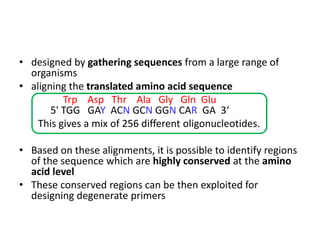
• designed by gathering sequences from a large range of
organisms
• aligning the translated amino acid sequence
Trp Asp Thr Ala Gly Gln Glu
5' TGG GAY ACN GCN GGN CAR GA 3‘
This gives a mix of 256 different oligonucleotides.
• Based on these alignments, it is possible to identify regions
of the sequence which are highly conserved at the amino
acid level
• These conserved regions can be then exploited for
designing degenerate primers
Two important things
• product length
• the degeneracy
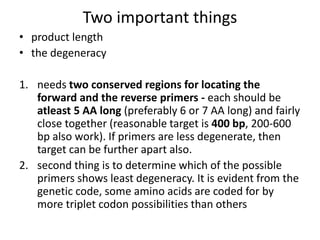
1. needs two conserved regions for locating the
forward and the reverse primers - each should be
atleast 5 AA long (preferably 6 or 7 AA long) and fairly
close together (reasonable target is 400 bp, 200-600
bp also work). If primers are less degenerate, then
target can be further apart also.
2. second thing is to determine which of the possible
primers shows least degeneracy. It is evident from the
genetic code, some amino acids are coded for by
more triplet codon possibilities than others
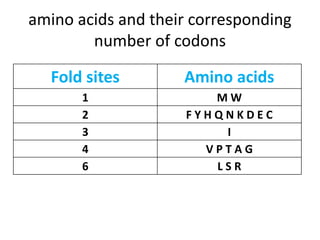
amino acids and their corresponding
number of codons
Fold sites Amino acids
1 M W
2 F Y H Q N K D E C
3 I
4 V P T A G
6 L S R
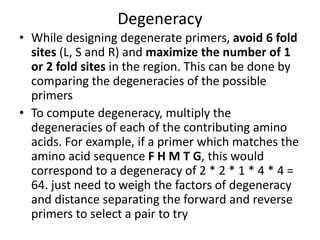
Degeneracy
• While designing degenerate primers, avoid 6 fold
sites (L, S and R) and maximize the number of 1
or 2 fold sites in the region. This can be done by
comparing the degeneracies of the possible
primers
• To compute degeneracy, multiply the
degeneracies of each of the contributing amino
acids. For example, if a primer which matches the
amino acid sequence F H M T G, this would
correspond to a degeneracy of 2 * 2 * 1 * 4 * 4 =
64. just need to weigh the factors of degeneracy
and distance separating the forward and reverse
primers to select a pair to try
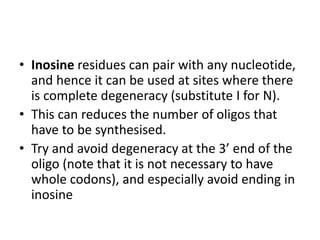
• Inosine residues can pair with any nucleotide,
and hence it can be used at sites where there
is complete degeneracy (substitute I for N).
• This can reduces the number of oligos that
have to be synthesised.
• Try and avoid degeneracy at the 3’ end of the
oligo (note that it is not necessary to have
whole codons), and especially avoid ending in
inosine
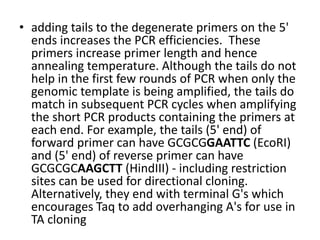
• adding tails to the degenerate primers on the 5'
ends increases the PCR efficiencies. These
primers increase primer length and hence
annealing temperature. Although the tails do not
help in the first few rounds of PCR when only the
genomic template is being amplified, the tails do
match in subsequent PCR cycles when amplifying
the short PCR products containing the primers at
each end. For example, the tails (5' end) of
forward primer can have GCGCGGAATTC (EcoRI)
and (5' end) of reverse primer can have
GCGCGCAAGCTT (HindIII) - including restriction
sites can be used for directional cloning.
Alternatively, they end with terminal G's which
encourages Taq to add overhanging A's for use in
TA cloning
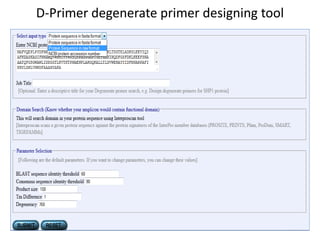
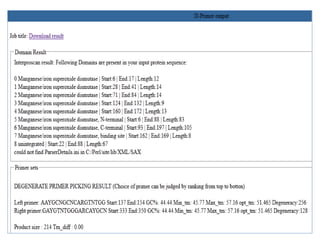
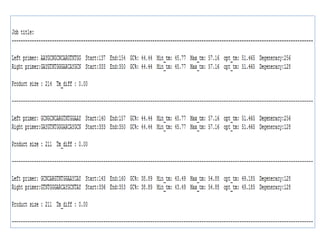
D-Primer degenerate primer designing tool
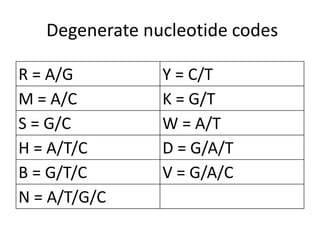
Degenerate nucleotide codes
R = A/G Y = C/T
M = A/C K = G/T
S = G/C W = A/T
H = A/T/C D = G/A/T
B = G/T/C V = G/A/C
N = A/T/G/C
• These would in fact be a set of primers which
have a number of options at several positions in
the sequence so as to allow annealing to and
amplification of a variety of related sequences.
• For example, in the primer GG{C,G}A{C,G,T}A, the
third position is C or G, and the fifth is C, G, or T.
• That is, if you do not know exactly the sequence
of the gene you are going to amplify, you insert
"wobbles" in the PCR primers where there is
more than one possibility
• Degeneracy obviously reduce the specificity
of the primer(s), meaning mismatch
opportunities are greater, and background
noise increases
• Also, increased degeneracy means
concentration of the individual primers
decreases; thus, greater than 512-fold
degeneracy should be avoided

Degenerate primers

  • 1.
    Degenerate Primers • usefulfor searching out a part of similar genes from a variety of species • or only when the protein sequence of a gene is known • very powerful tool to find "new" genes or gene families The more distant those related organisms, the more difficult it can be to design primers
  • 2.
    • designed bygathering sequences from a large range of organisms • aligning the translated amino acid sequence Trp Asp Thr Ala Gly Gln Glu 5' TGG GAY ACN GCN GGN CAR GA 3‘ This gives a mix of 256 different oligonucleotides. • Based on these alignments, it is possible to identify regions of the sequence which are highly conserved at the amino acid level • These conserved regions can be then exploited for designing degenerate primers
  • 3.
    Two important things •product length • the degeneracy 1. needs two conserved regions for locating the forward and the reverse primers - each should be atleast 5 AA long (preferably 6 or 7 AA long) and fairly close together (reasonable target is 400 bp, 200-600 bp also work). If primers are less degenerate, then target can be further apart also. 2. second thing is to determine which of the possible primers shows least degeneracy. It is evident from the genetic code, some amino acids are coded for by more triplet codon possibilities than others
  • 4.
    amino acids andtheir corresponding number of codons Fold sites Amino acids 1 M W 2 F Y H Q N K D E C 3 I 4 V P T A G 6 L S R
  • 5.
    Degeneracy • While designingdegenerate primers, avoid 6 fold sites (L, S and R) and maximize the number of 1 or 2 fold sites in the region. This can be done by comparing the degeneracies of the possible primers • To compute degeneracy, multiply the degeneracies of each of the contributing amino acids. For example, if a primer which matches the amino acid sequence F H M T G, this would correspond to a degeneracy of 2 * 2 * 1 * 4 * 4 = 64. just need to weigh the factors of degeneracy and distance separating the forward and reverse primers to select a pair to try
  • 6.
    • Inosine residuescan pair with any nucleotide, and hence it can be used at sites where there is complete degeneracy (substitute I for N). • This can reduces the number of oligos that have to be synthesised. • Try and avoid degeneracy at the 3’ end of the oligo (note that it is not necessary to have whole codons), and especially avoid ending in inosine
  • 7.
    • adding tailsto the degenerate primers on the 5' ends increases the PCR efficiencies. These primers increase primer length and hence annealing temperature. Although the tails do not help in the first few rounds of PCR when only the genomic template is being amplified, the tails do match in subsequent PCR cycles when amplifying the short PCR products containing the primers at each end. For example, the tails (5' end) of forward primer can have GCGCGGAATTC (EcoRI) and (5' end) of reverse primer can have GCGCGCAAGCTT (HindIII) - including restriction sites can be used for directional cloning. Alternatively, they end with terminal G's which encourages Taq to add overhanging A's for use in TA cloning
  • 8.
  • 11.
    Degenerate nucleotide codes R= A/G Y = C/T M = A/C K = G/T S = G/C W = A/T H = A/T/C D = G/A/T B = G/T/C V = G/A/C N = A/T/G/C
  • 12.
    • These wouldin fact be a set of primers which have a number of options at several positions in the sequence so as to allow annealing to and amplification of a variety of related sequences. • For example, in the primer GG{C,G}A{C,G,T}A, the third position is C or G, and the fifth is C, G, or T. • That is, if you do not know exactly the sequence of the gene you are going to amplify, you insert "wobbles" in the PCR primers where there is more than one possibility
  • 13.
    • Degeneracy obviouslyreduce the specificity of the primer(s), meaning mismatch opportunities are greater, and background noise increases • Also, increased degeneracy means concentration of the individual primers decreases; thus, greater than 512-fold degeneracy should be avoided