Polymerase Chain Reaction
 An in-vitro technique that takes specific sequence of DNA of
small amount and amplifies it to be used for further testing.
 Able to a identify and manipulate DNA,
 detect infectious organisms, including the viruses that cause
AIDS, hepatitis, tuberculosis
 Detect genetic variations, including mutations in human
genes
 Purpose:To amplify a lot of double-stranded DNA molecules
(fragments) with same (identical) size and sequence by
enzymatic method and cycling condition.
STEPS
I. Denaturation
II. Annealing
 Primers bind to their complementary sequences
 The primers dictate the part of the template that will be
amplified
 Temp: 50-70C (dependant on the melting temperature of the
expected duplex)
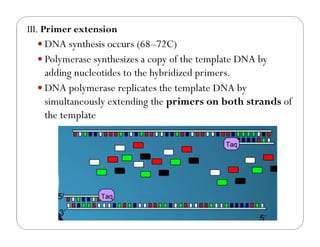
III. Primer extension
 DNA synthesis occurs (68–72C)
 Polymerase synthesizes a copy of the template DNA by
adding nucleotides to the hybridized primers.
 DNA polymerase replicates the template DNA by
simultaneously extending the primers on both strands of
the template
 Cycling
 3 Steps: One cycle  one copy of double-stranded DNA
has been replicated into two copies.
 DNA 1 copy
 After PCR
Components of PCR Reaction
Primers
 Critical component which determine the specificity of the PCR
 Primers are designed to have a sequence which is the reverse
compliment a region of template DNA to which we wish the
primer to anneal
 They are single- stranded DNA fragments, usually 20–30 bases in
length.
 The forward primer must bind to the target DNA sequence just 5′
to the sequences intended to be amplified.
 The reverse primer  5′ to the sequence to be amplified opposite
strand of the DNA.
PCR Primer Design Guidelines
 Primer Length: (proportional to annealing efficiency)
 Should be 17-28 bases in length.
 The longer the primer, the smaller the fraction of primed templates and
more inefficient the annealing
 Te shorter the primer, the more quickly it will anneal to target DNA
 Care has to be taken that the primers are not complementary to each
other, particularly at their 3' ends
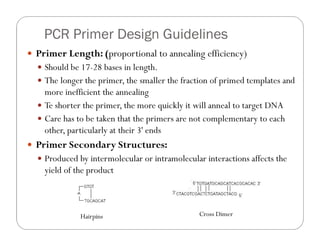
 Primer Secondary Structures:
 Produced by intermolecular or intramolecular interactions affects the
yield of the product
Hairpins Cross Dimer
 Primer melting temperature (Tm)
 Temperature at which one half of the DNA duplex will dissociate
to become single stranded and indicates the duplex stability.
 Primers with melting temperatures in the range of 52-58°C
should be preferred (increase the probability of primer
binding)
 temp > 60°C  Chances of secondary annealing
 The GC content of the sequence gives a fair indication of the
primerTm
 The formula for primerTm calculation:
Tm = 4(G + C) + 2(A +T)=°C
 [Base composition should be 50-60% (G+C)]
 Presence of G or C bases within the last five bases from the 3'
end, known as the GC clamp
 Promote specific binding at the 3' end due to the stronger bonding
of G and C bases.
 More than 3 G's or C's should be avoided in the last 5 bases at
the 3' end of the primer (promote mispriming)
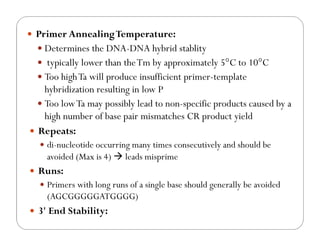
 Primer AnnealingTemperature:
 Determines the DNA-DNA hybrid stablity
 typically lower than theTm by approximately 5°C to 10°C
 Too highTa will produce insufficient primer-template
hybridization resulting in low P
 Too lowTa may possibly lead to non-specific products caused by a
high number of base pair mismatches CR product yield
 Repeats:
 di-nucleotide occurring many times consecutively and should be
avoided (Max is 4)  leads misprime
 Runs:
 Primers with long runs of a single base should generally be avoided
(AGCGGGGGATGGGG)
 3' End Stability:
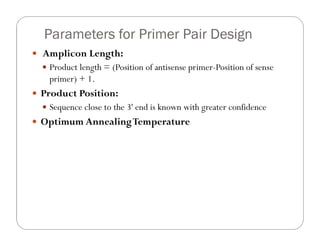
Parameters for Primer Pair Design
 Amplicon Length:
 Product length = (Position of antisense primer-Position of sense
primer) + 1.
 Product Position:
 Sequence close to the 3' end is known with greater confidence
 Optimum AnnealingTemperature

PCR and Primer design[604].pdf

  • 1.
  • 2.
     An in-vitrotechnique that takes specific sequence of DNA of small amount and amplifies it to be used for further testing.  Able to a identify and manipulate DNA,  detect infectious organisms, including the viruses that cause AIDS, hepatitis, tuberculosis  Detect genetic variations, including mutations in human genes  Purpose:To amplify a lot of double-stranded DNA molecules (fragments) with same (identical) size and sequence by enzymatic method and cycling condition.
  • 3.
  • 4.
    II. Annealing  Primersbind to their complementary sequences  The primers dictate the part of the template that will be amplified  Temp: 50-70C (dependant on the melting temperature of the expected duplex)
  • 5.
    III. Primer extension DNA synthesis occurs (68–72C)  Polymerase synthesizes a copy of the template DNA by adding nucleotides to the hybridized primers.  DNA polymerase replicates the template DNA by simultaneously extending the primers on both strands of the template
  • 6.
     Cycling  3Steps: One cycle  one copy of double-stranded DNA has been replicated into two copies.  DNA 1 copy  After PCR
  • 7.
  • 8.
    Primers  Critical componentwhich determine the specificity of the PCR  Primers are designed to have a sequence which is the reverse compliment a region of template DNA to which we wish the primer to anneal  They are single- stranded DNA fragments, usually 20–30 bases in length.  The forward primer must bind to the target DNA sequence just 5′ to the sequences intended to be amplified.  The reverse primer  5′ to the sequence to be amplified opposite strand of the DNA.
  • 9.
    PCR Primer DesignGuidelines  Primer Length: (proportional to annealing efficiency)  Should be 17-28 bases in length.  The longer the primer, the smaller the fraction of primed templates and more inefficient the annealing  Te shorter the primer, the more quickly it will anneal to target DNA  Care has to be taken that the primers are not complementary to each other, particularly at their 3' ends  Primer Secondary Structures:  Produced by intermolecular or intramolecular interactions affects the yield of the product Hairpins Cross Dimer
  • 10.
     Primer meltingtemperature (Tm)  Temperature at which one half of the DNA duplex will dissociate to become single stranded and indicates the duplex stability.  Primers with melting temperatures in the range of 52-58°C should be preferred (increase the probability of primer binding)  temp > 60°C  Chances of secondary annealing
  • 11.
     The GCcontent of the sequence gives a fair indication of the primerTm  The formula for primerTm calculation: Tm = 4(G + C) + 2(A +T)=°C  [Base composition should be 50-60% (G+C)]  Presence of G or C bases within the last five bases from the 3' end, known as the GC clamp  Promote specific binding at the 3' end due to the stronger bonding of G and C bases.  More than 3 G's or C's should be avoided in the last 5 bases at the 3' end of the primer (promote mispriming)
  • 12.
     Primer AnnealingTemperature: Determines the DNA-DNA hybrid stablity  typically lower than theTm by approximately 5°C to 10°C  Too highTa will produce insufficient primer-template hybridization resulting in low P  Too lowTa may possibly lead to non-specific products caused by a high number of base pair mismatches CR product yield  Repeats:  di-nucleotide occurring many times consecutively and should be avoided (Max is 4)  leads misprime  Runs:  Primers with long runs of a single base should generally be avoided (AGCGGGGGATGGGG)  3' End Stability:
  • 13.
    Parameters for PrimerPair Design  Amplicon Length:  Product length = (Position of antisense primer-Position of sense primer) + 1.  Product Position:  Sequence close to the 3' end is known with greater confidence  Optimum AnnealingTemperature