Massive MIMO
Mustafa Khaleel
APWC Course
(Advanced Wireless Telecommunications- Master Program)
Politehnica University of Bucharest
Contents
MIMO
Single user MIMO & Multi-user MIMO
What is Massive MIMO ?
Massive MIMO Key Features
Explanations
TDD and FDD mode
Pilot Contamination
Mitigation Pilot Contamination
Mm-wave and Massive
Facts
MIMO
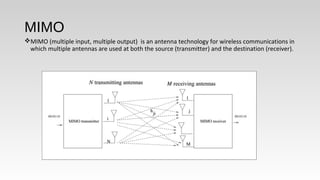
MIMO (multiple input, multiple output) is an antenna technology for wireless communications in
which multiple antennas are used at both the source (transmitter) and the destination (receiver).
Single user MIMO & Multi-user MIMO
SU-MIMO: the data of a single user is
transmitted simultaneously on several parallel
data streams (All streams to one user ).
MU-MIMO : the individual streams are
assigned to various users (Larger diversity gain
than single user MIMO)
What is Massive MIMO ?
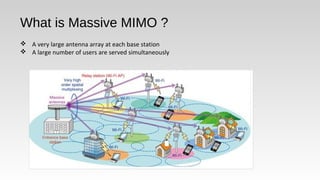
 A very large antenna array at each base station
 A large number of users are served simultaneously
Massive MIMO Key Features
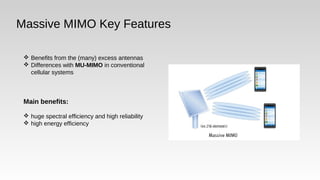
 Benefits from the (many) excess antennas
 Differences with MU-MIMO in conventional
cellular systems
Main benefits:
 huge spectral efficiency and high reliability
 high energy efficiency
Explanations
Wireless Communication suffers from attenuation in signal strength and Interference between users and MIMO
is well Known solution against
Massive MIMO promises additional advantage over standard solutions.
According to Shannon theorem the channel capacity :
Capacity (bits/sec )= Available spectrum (Hz)*spectral efficiency(dB)
Where C is known as capacity of channel, B is known as bandwidth of the signal, S/N is known as signal to noise
ratio. MT is the number of antennas used at the transmitter side & MR is the number of antennas used at receiver
side.
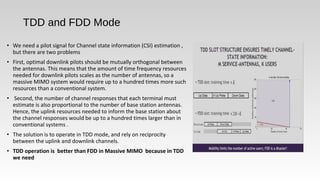
• We need a pilot signal for Channel state information (CSI) estimation ,
but there are two problems
• First, optimal downlink pilots should be mutually orthogonal between
the antennas. This means that the amount of time frequency resources
needed for downlink pilots scales as the number of antennas, so a
massive MIMO system would require up to a hundred times more such
resources than a conventional system.
• Second, the number of channel responses that each terminal must
estimate is also proportional to the number of base station antennas.
Hence, the uplink resources needed to inform the base station about
the channel responses would be up to a hundred times larger than in
conventional systems .
• The solution is to operate in TDD mode, and rely on reciprocity
between the uplink and downlink channels.
• TDD operation is better than FDD in Massive MIMO because in TDD
we need
TDD and FDD Mode
Pilot Contamination
In multi-cell systems, we cannot assign orthogonal pilot sequences for all users in all cells, due to the limitation
of the channel coherence interval. Orthogonal pilot sequences have to be reused from cell to cell. Therefore,
the channel estimate obtained in a given cell will be contaminated by pilots transmitted by users in other cells.
This effect, called “pilot contamination”, reduces the system performance, also the interference between users
The Pilot signals from resources are used for synchronization and equalization. Also estimate the channel state
information.
Mitigation Pilot Contamination
1.Pilot Open-Loop Power Control
2.Less Aggressive Pilot Reuse
3.Soft Pilot Reuse
Pilot Open-Loop Power Control
a pilot open loop power control (pilot OLPC) scheme that allows the terminal to adjust the transmit
power of its pilot signal .based on its estimate of the path loss to its serving BS
Less Aggressive Pilot Reuse
Pilot reuse is analogous to the traditional frequency reuse in the sense that terminals within the pilot
reuse area can utilize only a fraction of the time-frequency resources, during the channel estimation
phase.
The pilot reuse factor 1/U is the rate at which pilot resources may be reused in the network, where U is
the number of cells that are assigned orthogonal pilots .
Soft Pilot Reuse
mmWave and massive MIMO in cellular
Directivity of massive MIMO compensates for high mm-Wave attenuation, reduces multipath and
multiuser interference.
Mm-Wave frequencies reduce the size required for massive MIMO antenna arrays.
Massive MIMO testbed, Lund University, 2014
Facts
 
1.Distributed network densification is preferable over massive MIMO if the average throughput per UT should be increased.
2.More antenna increase the coverage probability ,but more BSs lead to linear increase in the area spectral efficiency.
3.If the cell radius will be decreased the data rate will increase and the users can be increased. Because the pilot contamination is
decreased.
4.Massive MIMO uses spatial-division multiplexing such that the different data streams occupy the same frequencies and time.
5.we can not increase the number of Antennas exponentially because the time spent acquiring CSI which grows with both the number of
service antennas and the number of users.
6.An advantage of matched filtering and conjugate beamforming is that the Massive MIMO signal processing can be performed locally at
each antenna, . This in turn permits a decentralized architecture for the antenna array, which lends great resilience to the system. For
example, if half the antennas are lost from a lightning strike, the remaining antennas do exactly what they did before. Likewise, during
periods of slack demand, some antennas can be put into sleep mode, for improved energy efficiency, without affecting the operations of
the others.
7.Massive MIMO a scalable technology: any number of base station antennas can be usefully employed with no tightening of array
tolerances. Extra antennas always help. Ins contrast, if an assumed channel response is used the technology is ultimately not scalable.
References
1.Division of Communication Systems Department of Electrical Engineering (ISY) Linköping University, SE-581
83 Linköping, Sweden
www.commsys.isy.liu.s
2.Nimay Ch. Giri1, Anwesha Sahoo2, J. R. Swain3, P. Kumar4, A. Nayak5, P. Debogoswami6 Lecturer,
Department of ECE, 2,3,4,5,6B.Tech Scholar, Centurion University of Technology and Management, Odisha,
India
3.http://www.researchgate.net/post/What_is_the_acheivable_Massive_MIMO_capacity(Emil Björnson)
4.http://www.hindawi.com/journals/ijap/2014/848071/
5.https://www.youtube.com/watch?v=zhncADqR9rg
6.Thomas L. Marzetta heads the LargeScale Antenna Systems Group in the
Network Energy Program at Bell Labs in Murray Hill
7.https://www.youtube.com/watch?v=imLiaLQGmB8

Massive mimo

  • 1.
    Massive MIMO Mustafa Khaleel APWCCourse (Advanced Wireless Telecommunications- Master Program) Politehnica University of Bucharest
  • 2.
    Contents MIMO Single user MIMO& Multi-user MIMO What is Massive MIMO ? Massive MIMO Key Features Explanations TDD and FDD mode Pilot Contamination Mitigation Pilot Contamination Mm-wave and Massive Facts
  • 3.
    MIMO MIMO (multiple input,multiple output) is an antenna technology for wireless communications in which multiple antennas are used at both the source (transmitter) and the destination (receiver).
  • 4.
    Single user MIMO& Multi-user MIMO SU-MIMO: the data of a single user is transmitted simultaneously on several parallel data streams (All streams to one user ). MU-MIMO : the individual streams are assigned to various users (Larger diversity gain than single user MIMO)
  • 5.
    What is MassiveMIMO ?  A very large antenna array at each base station  A large number of users are served simultaneously
  • 6.
    Massive MIMO KeyFeatures  Benefits from the (many) excess antennas  Differences with MU-MIMO in conventional cellular systems Main benefits:  huge spectral efficiency and high reliability  high energy efficiency
  • 7.
    Explanations Wireless Communication suffersfrom attenuation in signal strength and Interference between users and MIMO is well Known solution against Massive MIMO promises additional advantage over standard solutions. According to Shannon theorem the channel capacity : Capacity (bits/sec )= Available spectrum (Hz)*spectral efficiency(dB) Where C is known as capacity of channel, B is known as bandwidth of the signal, S/N is known as signal to noise ratio. MT is the number of antennas used at the transmitter side & MR is the number of antennas used at receiver side.
  • 8.
    • We needa pilot signal for Channel state information (CSI) estimation , but there are two problems • First, optimal downlink pilots should be mutually orthogonal between the antennas. This means that the amount of time frequency resources needed for downlink pilots scales as the number of antennas, so a massive MIMO system would require up to a hundred times more such resources than a conventional system. • Second, the number of channel responses that each terminal must estimate is also proportional to the number of base station antennas. Hence, the uplink resources needed to inform the base station about the channel responses would be up to a hundred times larger than in conventional systems . • The solution is to operate in TDD mode, and rely on reciprocity between the uplink and downlink channels. • TDD operation is better than FDD in Massive MIMO because in TDD we need TDD and FDD Mode
  • 9.
    Pilot Contamination In multi-cellsystems, we cannot assign orthogonal pilot sequences for all users in all cells, due to the limitation of the channel coherence interval. Orthogonal pilot sequences have to be reused from cell to cell. Therefore, the channel estimate obtained in a given cell will be contaminated by pilots transmitted by users in other cells. This effect, called “pilot contamination”, reduces the system performance, also the interference between users The Pilot signals from resources are used for synchronization and equalization. Also estimate the channel state information.
  • 10.
    Mitigation Pilot Contamination 1.PilotOpen-Loop Power Control 2.Less Aggressive Pilot Reuse 3.Soft Pilot Reuse
  • 11.
    Pilot Open-Loop PowerControl a pilot open loop power control (pilot OLPC) scheme that allows the terminal to adjust the transmit power of its pilot signal .based on its estimate of the path loss to its serving BS
  • 12.
    Less Aggressive PilotReuse Pilot reuse is analogous to the traditional frequency reuse in the sense that terminals within the pilot reuse area can utilize only a fraction of the time-frequency resources, during the channel estimation phase. The pilot reuse factor 1/U is the rate at which pilot resources may be reused in the network, where U is the number of cells that are assigned orthogonal pilots .
  • 13.
  • 14.
    mmWave and massiveMIMO in cellular Directivity of massive MIMO compensates for high mm-Wave attenuation, reduces multipath and multiuser interference. Mm-Wave frequencies reduce the size required for massive MIMO antenna arrays. Massive MIMO testbed, Lund University, 2014
  • 15.
    Facts   1.Distributed network densificationis preferable over massive MIMO if the average throughput per UT should be increased. 2.More antenna increase the coverage probability ,but more BSs lead to linear increase in the area spectral efficiency. 3.If the cell radius will be decreased the data rate will increase and the users can be increased. Because the pilot contamination is decreased. 4.Massive MIMO uses spatial-division multiplexing such that the different data streams occupy the same frequencies and time. 5.we can not increase the number of Antennas exponentially because the time spent acquiring CSI which grows with both the number of service antennas and the number of users. 6.An advantage of matched filtering and conjugate beamforming is that the Massive MIMO signal processing can be performed locally at each antenna, . This in turn permits a decentralized architecture for the antenna array, which lends great resilience to the system. For example, if half the antennas are lost from a lightning strike, the remaining antennas do exactly what they did before. Likewise, during periods of slack demand, some antennas can be put into sleep mode, for improved energy efficiency, without affecting the operations of the others. 7.Massive MIMO a scalable technology: any number of base station antennas can be usefully employed with no tightening of array tolerances. Extra antennas always help. Ins contrast, if an assumed channel response is used the technology is ultimately not scalable.
  • 16.
    References 1.Division of CommunicationSystems Department of Electrical Engineering (ISY) Linköping University, SE-581 83 Linköping, Sweden www.commsys.isy.liu.s 2.Nimay Ch. Giri1, Anwesha Sahoo2, J. R. Swain3, P. Kumar4, A. Nayak5, P. Debogoswami6 Lecturer, Department of ECE, 2,3,4,5,6B.Tech Scholar, Centurion University of Technology and Management, Odisha, India 3.http://www.researchgate.net/post/What_is_the_acheivable_Massive_MIMO_capacity(Emil Björnson) 4.http://www.hindawi.com/journals/ijap/2014/848071/ 5.https://www.youtube.com/watch?v=zhncADqR9rg 6.Thomas L. Marzetta heads the LargeScale Antenna Systems Group in the Network Energy Program at Bell Labs in Murray Hill 7.https://www.youtube.com/watch?v=imLiaLQGmB8