Physical Layer Security in Massive MIMO Systems
Ph.D. Departmental Exam
March 11, 2016
Jun Zhu
Þ Ù ÙÒ 
 ºÙ 
º
Ph.D. Supervisor: Prof. Robert Schober and Prof. Vijay K. Bhargava
Department of Electrical and Computer Engineering
University of British Columbia
Vancouver, B.C., V6T 1Z4, Canada
33
Physical Layer
Security in Massive
MIMO Systems
Jun Zhu
Introduction
Massive MIMO
Favorable Propagation
TDD and UL Training
DL Linear Precoding
Pilot Contamination
Hardware Impairments
Physical Layer Security
Classical Alice-Bob-Eve
Model
MIMO and AN
Motivations and
Contributions
Work Accomplished
AN-Aided MF
Linear Data and AN
Precoding
Hardware Impairments
Concluding Remarks
ECE,UBC
Outline
Introduction
Massive MIMO
Physical Layer Security
Motivations and Contributions
Work Accomplished
AN-Aided MF Precoding (Chapter 2)
Linear Data and AN Precoding (Chapter 3)
Hardware Impairments (Chapter 4)
Concluding Remarks
33
Physical Layer
Security in Massive
MIMO Systems
Jun Zhu
Introduction
2Massive MIMO
Favorable Propagation
TDD and UL Training
DL Linear Precoding
Pilot Contamination
Hardware Impairments
Physical Layer Security
Classical Alice-Bob-Eve
Model
MIMO and AN
Motivations and
Contributions
Work Accomplished
AN-Aided MF
Linear Data and AN
Precoding
Hardware Impairments
Concluding Remarks
ECE,UBC
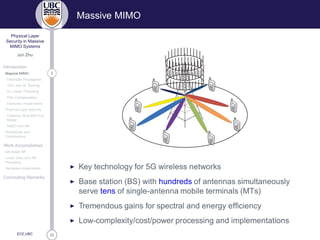
Massive MIMO
◮ Key technology for 5G wireless networks
◮ Base station (BS) with hundreds of antennas simultaneously
serve tens of single-antenna mobile terminals (MTs)
◮ Tremendous gains for spectral and energy efficiency
◮ Low-complexity/cost/power processing and implementations
33
Physical Layer
Security in Massive
MIMO Systems
Jun Zhu
Introduction
Massive MIMO
3Favorable Propagation
TDD and UL Training
DL Linear Precoding
Pilot Contamination
Hardware Impairments
Physical Layer Security
Classical Alice-Bob-Eve
Model
MIMO and AN
Motivations and
Contributions
Work Accomplished
AN-Aided MF
Linear Data and AN
Precoding
Hardware Impairments
Concluding Remarks
ECE,UBC
Massive MIMO
Favorable Propagation
◮ Given channel matrix G = [gH
1 , . . . , gH
K ]H
∈ CK×N
1
N
gk gH
j → 0,
1
N
gk gH
k → 1 (N → ∞, K/N → 0)
◮ Favorable propagation: (channel hardening)
C = log2 IK +γGGH
≤
K
k=1
log2 1 + γ gk
2
= K log2(1 + γN).
◮ Simple processing, e.g., maximum ratio transmission/combining
(MRT/MRC) achieves optimal throughput
33
Physical Layer
Security in Massive
MIMO Systems
Jun Zhu
Introduction
Massive MIMO
Favorable Propagation
4TDD and UL Training
DL Linear Precoding
Pilot Contamination
Hardware Impairments
Physical Layer Security
Classical Alice-Bob-Eve
Model
MIMO and AN
Motivations and
Contributions
Work Accomplished
AN-Aided MF
Linear Data and AN
Precoding
Hardware Impairments
Concluding Remarks
ECE,UBC
Massive MIMO
Time-Division Duplex (TDD) and Uplink Training
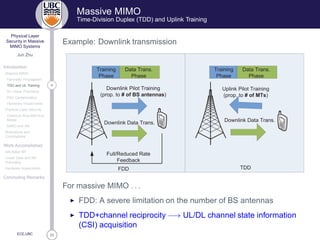
Example: Downlink transmission
Downlink Pilot Training
(prop. to # of BS antennas)
Downlink Data Trans.
Full/Reduced Rate
Feedback
Training
Phase
Data Trans.
Phase
Training
Phase
Data Trans.
Phase
Uplink Pilot Training
(prop. to # of MTs)
Downlink Data Trans.
FDD TDD
For massive MIMO . . .
◮ FDD: A severe limitation on the number of BS antennas
◮ TDD+channel reciprocity −→ UL/DL channel state information
(CSI) acquisition
33
Physical Layer
Security in Massive
MIMO Systems
Jun Zhu
Introduction
Massive MIMO
Favorable Propagation
TDD and UL Training
5DL Linear Precoding
Pilot Contamination
Hardware Impairments
Physical Layer Security
Classical Alice-Bob-Eve
Model
MIMO and AN
Motivations and
Contributions
Work Accomplished
AN-Aided MF
Linear Data and AN
Precoding
Hardware Impairments
Concluding Remarks
ECE,UBC
Massive MIMO
Downlink Linear Precoding
◮ Identical to those adopted in conventional MIMO, but in a large
scale, e.g., MF, selfish/collaborative Zero-Forcing (ZF)/Reg.
Channel Inversion (RCI)
◮ MF: capacity achieving for K ≪ N, performance loss for large K
◮ SZF/SRCI: suppress multiuser interference, require high
computational complexity for large N and K
◮ CZF/CRCI: suppress multi-cell multiuser interference, require
high computational complexity for large N, M, and K
◮ Polynomial (POLY): Adopt matrix polynomials to approach
inversion (0-order: MF, ∞-order: ZF/RCI)
Tradeoffs: performance vs. complexity, desired signal strength
vs. interference mitigation, etc.
33
Physical Layer
Security in Massive
MIMO Systems
Jun Zhu
Introduction
Massive MIMO
Favorable Propagation
TDD and UL Training
DL Linear Precoding
6Pilot Contamination
Hardware Impairments
Physical Layer Security
Classical Alice-Bob-Eve
Model
MIMO and AN
Motivations and
Contributions
Work Accomplished
AN-Aided MF
Linear Data and AN
Precoding
Hardware Impairments
Concluding Remarks
ECE,UBC
Massive MIMO
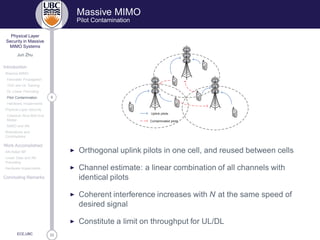
Pilot Contamination
Uplink pilots
Contaminated pilots
◮ Orthogonal uplink pilots in one cell, and reused between cells
◮ Channel estimate: a linear combination of all channels with
identical pilots
◮ Coherent interference increases with N at the same speed of
desired signal
◮ Constitute a limit on throughput for UL/DL
33
Physical Layer
Security in Massive
MIMO Systems
Jun Zhu
Introduction
Massive MIMO
Favorable Propagation
TDD and UL Training
DL Linear Precoding
Pilot Contamination
7Hardware Impairments
Physical Layer Security
Classical Alice-Bob-Eve
Model
MIMO and AN
Motivations and
Contributions
Work Accomplished
AN-Aided MF
Linear Data and AN
Precoding
Hardware Impairments
Concluding Remarks
ECE,UBC
Massive MIMO
Hardware Impairments
Filter
Low-Noise
Amplifier
Mixer
A/D
Converter
Filter
Low-Noise
Amplifier
Mixer
A/D
Converter
DSP
Local
Oscillator
Local
Oscillator
Receive
Antenna 1
Receive
Antenna N
Receiver
Circuit
Local
Oscillator
Local
Oscillator
Power
Amplifier
Power
Amplifier
Mixer
Mixer
D/A
Converter
D/A
Converter
DSP
Transmit
Antenna 1
Transmit
Antenna N
Transmitter
Circuit
Channel
◮ Hardware cost scales linearly with N
◮ Deploy low-cost transceivers to reduce total expenditure in
massive MIMO
◮ Cheap components are prone to hardware imperfections: e.g.,
amplifier nonlinearity, phase noise, quantization error
33
Physical Layer
Security in Massive
MIMO Systems
Jun Zhu
Introduction
Massive MIMO
Favorable Propagation
TDD and UL Training
DL Linear Precoding
Pilot Contamination
Hardware Impairments
Physical Layer Security
8Classical Alice-Bob-Eve
Model
MIMO and AN
Motivations and
Contributions
Work Accomplished
AN-Aided MF
Linear Data and AN
Precoding
Hardware Impairments
Concluding Remarks
ECE,UBC
Physical Layer Security
Classical Alice-Bob-Eve Model
Typical Scenario:
Alice
Bob
EveAlice-Bob-Eve Model
Multi-User Multi-Antenna Network
(Employing AN)
BSEve
MT Data
AN
CBob
CEve
Information Theory:
◮ Assume the channel between Alice and Bob is “better” than the
channel between Alice and Eve.
→ There are codes which allow Bob to decode error free while
Eve cannot extract any information about Alice’s message.
◮ Secrecy capacity:
C× 
 = [C Ó − C Ú ]+
Key question: How can we guarantee Bob’s channel is better
than Eve’s?
33
Physical Layer
Security in Massive
MIMO Systems
Jun Zhu
Introduction
Massive MIMO
Favorable Propagation
TDD and UL Training
DL Linear Precoding
Pilot Contamination
Hardware Impairments
Physical Layer Security
Classical Alice-Bob-Eve
Model
9MIMO and AN
Motivations and
Contributions
Work Accomplished
AN-Aided MF
Linear Data and AN
Precoding
Hardware Impairments
Concluding Remarks
ECE,UBC
Physical Layer Security
Multi-User MIMO and AN
Enhancing Bob’s channel/Degrading Eve’s channel
◮ The key is to have more degrees of freedom at Alice/Bob than at
Eve (multi-antenna at Alice)
◮ Alice knows Bob’s CSI but not Eve’s −→ Artificial Noise (invisible
to Bob)
Lower Bound on Achievable Secrecy Rate for MISOME Channel
◮ Multi-Input Single-Output Multi-Eavesdropper (MISOME)
R× 
 ≥ R× 
 = [R Ó − C Ú ]+
◮ Ergodic Secrecy Rate=Eh[R× 
] (span over many independent
channel realizations):
◮ Secrecy Outage Probability=Pr(R× 
 ≤ R0) (span only one
channel realization):
33
Physical Layer
Security in Massive
MIMO Systems
Jun Zhu
Introduction
Massive MIMO
Favorable Propagation
TDD and UL Training
DL Linear Precoding
Pilot Contamination
Hardware Impairments
Physical Layer Security
Classical Alice-Bob-Eve
Model
MIMO and AN
10Motivations and
Contributions
Work Accomplished
AN-Aided MF
Linear Data and AN
Precoding
Hardware Impairments
Concluding Remarks
ECE,UBC
Motivations and Contributions
Is Massive MIMO Secure?
Massive MIMO is secure . . .
◮ Narrow and directional beam from Alice to Bob −→ R Ó ≫ C Ú
◮ R Ó scales with N, while C Ú is independent of N
Massive MIMO is NOT secure . . .
◮ Eve employs massive MIMO
◮ Eve is arbitrarily close to Alice
◮ In a ultra-dense multi-cell network, Bob experiences a high level
of interference (pilot contam. and not contam.)−→ R Ó is
limited, while Eve removes all interference
◮ Low-cost transceivers equipped at Alice and Bob, while Eve has
perfect hardware
Massive MIMO is MORE UNsecure if Eve performs active
eavesdropping, e.g., pilot contam. attack, intentional jamming
33
Physical Layer
Security in Massive
MIMO Systems
Jun Zhu
Introduction
Massive MIMO
Favorable Propagation
TDD and UL Training
DL Linear Precoding
Pilot Contamination
Hardware Impairments
Physical Layer Security
Classical Alice-Bob-Eve
Model
MIMO and AN
11Motivations and
Contributions
Work Accomplished
AN-Aided MF
Linear Data and AN
Precoding
Hardware Impairments
Concluding Remarks
ECE,UBC
Motivations and Contributions
How to improve security in massive MIMO?
◮ Massive MIMO offers rich spatial dimensions.
◮ Emitting AN improves security, requiring extra spatial dimensions.
◮ A short answer: Massive MIMO + AN
Challenges and Open Problems:
◮ Pilot contamination’s impact on AN design and wireless security
(Ch.2,3)
◮ Whether sophisticated signal processing, e.g.
SZF/SRCI/CZF/CRCI are beneficial for security in a pilot
contaminated environment (Ch.3)
◮ Complexity required for null-space (NS) based AN (Ch.2,3,4)
◮ Hardware impairments’ effects on AN design and wireless
security (Ch.4)
33
Physical Layer
Security in Massive
MIMO Systems
Jun Zhu
Introduction
Massive MIMO
Favorable Propagation
TDD and UL Training
DL Linear Precoding
Pilot Contamination
Hardware Impairments
Physical Layer Security
Classical Alice-Bob-Eve
Model
MIMO and AN
12Motivations and
Contributions
Work Accomplished
AN-Aided MF
Linear Data and AN
Precoding
Hardware Impairments
Concluding Remarks
ECE,UBC
Motivations and Contributions
Originality and Innovations
This is the FIRST thesis in the topic of secure massive MIMO, which
provides the FIRST contributions on . . .
◮ introducing the idea of AN emission in massive MIMO systems
for security improvement, and proposing several practical AN
design methods applicable for massive MIMO systems with
perfect and imperfect hardware components
◮ deriving tight lower bound on ergodic secrecy rates in
closed-form expression with different combinations of data and
AN precoders for perfect and imperfect hardware components.
The bounds offer explicit relationship between system
performance and parameters.
33
Physical Layer
Security in Massive
MIMO Systems
Jun Zhu
Introduction
Massive MIMO
Favorable Propagation
TDD and UL Training
DL Linear Precoding
Pilot Contamination
Hardware Impairments
Physical Layer Security
Classical Alice-Bob-Eve
Model
MIMO and AN
Motivations and
Contributions
Work Accomplished
13AN-Aided MF
Linear Data and AN
Precoding
Hardware Impairments
Concluding Remarks
ECE,UBC
Chapter 2
AN-Aided MF Precoding in
Secure Massive MIMO Systems
◮ Introduce AN-aided massive MIMO transmission
◮ Derive a tight analytical lower bound for achievable secrecy rate
and upper bound for secrecy outage probability for AN-aided MF
[J1]: J. Zhu, R. Schober, and V. K. Bhargava, “Secure transmission in multicell massive
MIMO systems,” IEEE Trans. Wireless Commun., vol. 13, no. 9, pp. 4766-4781, Sept.
2014.
[C1]: J. Zhu, R. Schober, and V. K. Bhargava, “Secure transmission in multi-cell massive
MIMO systems,” in Proc. IEEE Globecom 2013, Atlanta, GA, Dec. 2013.
33
Physical Layer
Security in Massive
MIMO Systems
Jun Zhu
Introduction
Massive MIMO
Favorable Propagation
TDD and UL Training
DL Linear Precoding
Pilot Contamination
Hardware Impairments
Physical Layer Security
Classical Alice-Bob-Eve
Model
MIMO and AN
Motivations and
Contributions
Work Accomplished
14AN-Aided MF
Linear Data and AN
Precoding
Hardware Impairments
Concluding Remarks
ECE,UBC
AN-Aided MF
System Model (adopted in Chapter 2 and 3)
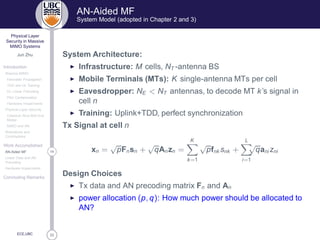
System Architecture:
◮ Infrastructure: M cells, NT -antenna BS
◮ Mobile Terminals (MTs): K single-antenna MTs per cell
◮ Eavesdropper: NE  NT antennas, to decode MT k’s signal in
cell n
◮ Training: Uplink+TDD, perfect synchronization
Tx Signal at cell n
xn =
√
pFnsn +
√
qAnzn =
K
k=1
√
pfnk snk +
L
i=1
√
qani zni
Design Choices
◮ Tx data and AN precoding matrix Fn and An
◮ power allocation (p, q): How much power should be allocated to
AN?
33
Physical Layer
Security in Massive
MIMO Systems
Jun Zhu
Introduction
Massive MIMO
Favorable Propagation
TDD and UL Training
DL Linear Precoding
Pilot Contamination
Hardware Impairments
Physical Layer Security
Classical Alice-Bob-Eve
Model
MIMO and AN
Motivations and
Contributions
Work Accomplished
15AN-Aided MF
Linear Data and AN
Precoding
Hardware Impairments
Concluding Remarks
ECE,UBC
AN-Aided MF
System Design
Options for Tx Data Precoding Matrix Fn
◮ MF: fnk = (ˆhk
nn)H
/ ˆhk
nn
◮ SZF/SRCI/CZF/CRCI
◮ POLY
Options for Tx AN Precoding Matrix An
◮ NS: ˆHnnAn = 0K×L
◮ Random: vni = ˜vni / ˜vni , ˜vni ∈ CN(0NT
, 1NT
)
◮ POLY
Power Allocation
◮ Define power allocation factor φ ∈ (0, 1] with
p =
φP
K
q =
(1 − φ)P
L
33
Physical Layer
Security in Massive
MIMO Systems
Jun Zhu
Introduction
Massive MIMO
Favorable Propagation
TDD and UL Training
DL Linear Precoding
Pilot Contamination
Hardware Impairments
Physical Layer Security
Classical Alice-Bob-Eve
Model
MIMO and AN
Motivations and
Contributions
Work Accomplished
16AN-Aided MF
Linear Data and AN
Precoding
Hardware Impairments
Concluding Remarks
ECE,UBC
AN-Aided MF
Performance Evaluation
Achievable Ergodic Secrecy Rate
R× 
nk = [Rnk − C Ú
nk ]+
with
◮ Rnk : Achievable ergodic rate of MT k in cell n
◮ C Ú
nk : Ergodic capacity of Eve with respect to message of MT k in
cell n
Tight Lower Bound on Achievable Ergodic Rate of MT k in cell n
Rnk ≥ Rnk = log2(1 + γnk )
where γnk =
desired signal
|E[
√
pgk
nnfnk ]|2
Ú Ö[
√
pgk
nnfnk ]
signal leakage
+
M
m=1
L
i=1
E[|
√
qgk
mnami |2
]
AN leakage
+
{m,l}={n,k}
E[|
√
pgk
mnfml |2
]
intra- and inter-cell interference
+ σ2
nk
33
Physical Layer
Security in Massive
MIMO Systems
Jun Zhu
Introduction
Massive MIMO
Favorable Propagation
TDD and UL Training
DL Linear Precoding
Pilot Contamination
Hardware Impairments
Physical Layer Security
Classical Alice-Bob-Eve
Model
MIMO and AN
Motivations and
Contributions
Work Accomplished
17AN-Aided MF
Linear Data and AN
Precoding
Hardware Impairments
Concluding Remarks
ECE,UBC
AN-Aided MF
Performance Evaluation
Achievable Ergodic Secrecy Rate
R× 
nk = [Rnk − C Ú
nk ]+
with
◮ Rnk : Achievable ergodic rate of MT k in cell n
◮ C Ú
nk : Ergodic capacity of Eve with respect to message of MT k in
cell n
Ergodic Capacity of Eve
C Ú
nk = E log2

1 + pfH
nk GH
nE q
M
m=1
AH
mGH
mE GmE Am
−1
GnE fnk


We make the following pessimistic assumptions
◮ Eve can decode and cancel all other MTs successfully
◮ Eve has perfect CSI of all BS-Eve channels
◮ AWGN at Eve is negligible
33
Physical Layer
Security in Massive
MIMO Systems
Jun Zhu
Introduction
Massive MIMO
Favorable Propagation
TDD and UL Training
DL Linear Precoding
Pilot Contamination
Hardware Impairments
Physical Layer Security
Classical Alice-Bob-Eve
Model
MIMO and AN
Motivations and
Contributions
Work Accomplished
18AN-Aided MF
Linear Data and AN
Precoding
Hardware Impairments
Concluding Remarks
ECE,UBC
AN-Aided MF
Performance Evaluation
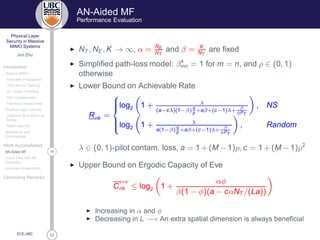
◮ NT , NE , K → ∞, α = NE
NT
and β = K
NT
are fixed
◮ Simplified path-loss model: βk
mn = 1 for m = n, and ρ ∈ (0, 1)
otherwise
◮ Lower Bound on Achievable Rate
Rnk =



log2 1 + λ
(a−cλ)(1−β)
q
p
+aβ+(c−1)λ+
β
φPT
, NS
log2 1 + λ
a(1−β)
q
p
+aβ+(c−1)λ+
β
φPT
, Random
λ ∈ (0, 1)-pilot contam. loss, a = 1 + (M − 1)ρ, c = 1 + (M − 1)ρ2
◮ Upper Bound on Ergodic Capacity of Eve
C
Ú
nk ≤ log2 1 +
αφ
β(1 − φ)(a − cαNT /(La))
◮ Increasing in α and φ
◮ Decreasing in L −→ An extra spatial dimension is always beneficial
33
Physical Layer
Security in Massive
MIMO Systems
Jun Zhu
Introduction
Massive MIMO
Favorable Propagation
TDD and UL Training
DL Linear Precoding
Pilot Contamination
Hardware Impairments
Physical Layer Security
Classical Alice-Bob-Eve
Model
MIMO and AN
Motivations and
Contributions
Work Accomplished
19AN-Aided MF
Linear Data and AN
Precoding
Hardware Impairments
Concluding Remarks
ECE,UBC
AN-Aided MF
Selected Numerical Examples
Ergodic secrecy rate and secrecy outage probability:
80 100 120 140 160
0.1
0.12
0.14
0.16
0.18
0.2
0.22
0.24
0.26
Number of BS antennas (NT )
Ergodicsecrecyrate(bps/Hz)
(a) Ergodic secrecy rate
Simulation
Lower bound I
Lower bound II
0 0.5 1
0
0.1
0.2
0.3
0.4
0.5
0.6
0.7
0.8
0.9
1
R0 (bps/Hz)
SecrecyOutageProbability
(b) Secrecy outage probability
Upper bound N
Simulation N
Upper bound R
Simulation R
N-method
R-method
NT = 80
NT = 100
NT = 120
◮ M = 7 cells, NT = 100, PT = 10 dB, τ = K, pτ = PT /K,
α = NE
NT
= 0.1, ρ = 0.1, and φ = 0.75 (pilot contam.)
◮ Performance does not always improve with NT
33
Physical Layer
Security in Massive
MIMO Systems
Jun Zhu
Introduction
Massive MIMO
Favorable Propagation
TDD and UL Training
DL Linear Precoding
Pilot Contamination
Hardware Impairments
Physical Layer Security
Classical Alice-Bob-Eve
Model
MIMO and AN
Motivations and
Contributions
Work Accomplished
20AN-Aided MF
Linear Data and AN
Precoding
Hardware Impairments
Concluding Remarks
ECE,UBC
AN-Aided MF
Selected Numerical Examples
Optimal power allocation:
0 0.1 0.2 0.3 0.4 0.5 0.6 0.7
0
0.1
0.2
0.3
0.4
0.5
0.6
0.7
0.8
0.9
φ
Ergodicsecrecyrate(bps/Hz)
N -method
R-method
α = 0.1, β = 0.05
α = 0.1, β = 0.5
◮ M = 7 cells, NT = 100, PT = 20 dB, τ = K, pτ = PT /K,
α = NE
NT
= 0.1, and ρ = 0.1.
◮ Optimization of power allocation factor φ is important
◮ Without AN (φ = 1) a positive secrecy rate cannot be achieved
◮ φ∗
decreases in α and increases in β = K
NT
33
Physical Layer
Security in Massive
MIMO Systems
Jun Zhu
Introduction
Massive MIMO
Favorable Propagation
TDD and UL Training
DL Linear Precoding
Pilot Contamination
Hardware Impairments
Physical Layer Security
Classical Alice-Bob-Eve
Model
MIMO and AN
Motivations and
Contributions
Work Accomplished
AN-Aided MF
21Linear Data and AN
Precoding
Hardware Impairments
Concluding Remarks
ECE,UBC
Chapter 3
Linear Data and AN Precoding in
Secure Massive MIMO Systems
◮ Derive a tight analytical lower bound for achievable secrecy rate
for different types of linear data and AN precoders
◮ Propose low-complexity POLY data and AN precoders
[J2]: J. Zhu, R. Schober, and V. K. Bhargava, “Linear precoding of data and artificial noise
in secure massive MIMO systems,” IEEE Trans. Wireless Commun., vol. 15, no. 3, pp.
2245-2261, Mar. 2016.
[C2]: J. Zhu, R. Schober, and V. K. Bhargava, “Secure downlink transmission in massive
MIMO system with zero-forcing precoding,” in Proc. IEEE EW 2014, Barcelona, Spain,
May 2014. (Invited Paper)
[C3]: J. Zhu, R. Schober, and V. K. Bhargava, “Secrecy analysis of multi-cell massive MIMO
systems with RCI precoding and artificial noise transmission,” in Proc. IEEE ISCCSP
2014, Athens, Greece, May 2014. (Invited Paper)
33
Physical Layer
Security in Massive
MIMO Systems
Jun Zhu
Introduction
Massive MIMO
Favorable Propagation
TDD and UL Training
DL Linear Precoding
Pilot Contamination
Hardware Impairments
Physical Layer Security
Classical Alice-Bob-Eve
Model
MIMO and AN
Motivations and
Contributions
Work Accomplished
AN-Aided MF
22Linear Data and AN
Precoding
Hardware Impairments
Concluding Remarks
ECE,UBC
Linear Data and AN Precoding
System Design
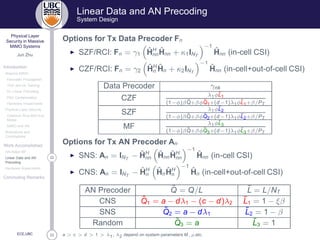
Options for Tx Data Precoder Fn
◮ SZF/RCI: Fn = γ1
ˆHH
nn
ˆHnn + κ1INT
−1
ˆHnn (in-cell CSI)
◮ CZF/RCI: Fn = γ2
ˆHH
n
ˆHn + κ2INT
−1
ˆHnn (in-cell+out-of-cell CSI)
Data Precoder γnk
CZF λ1φ˜L1
(1−φ)β ˜Q+βφ˜Q1+(d−1)λ1φ˜L1+β/PT
SZF λ1φ˜L2
(1−φ)β ˜Q+βφ˜Q2+(d−1)λ1φ˜L2+β/PT
MF λ1φ˜L3
(1−φ)β ˜Q+βφ˜Q3+(d−1)λ1φ˜L3+β/PT
Options for Tx AN Precoder An
◮ SNS: An = INT
− ˆHH
nn
ˆHnn
ˆHH
nn
−1
ˆHnn (in-cell CSI)
◮ CNS: An = INT
− ˆHH
n
ˆHn
ˆHH
n
−1
ˆHn (in-cell+out-of-cell CSI)
AN Precoder ˜Q = Q/L ˜L = L/NT
CNS ˜Q1 = a − dλ1 − (c − d)λ2
˜L1 = 1 − ξβ
SNS ˜Q2 = a − dλ1
˜L2 = 1 − β
Random ˜Q3 = a ˜L3 = 1
a  c  d  1  λ1, λ2 depend on system parameters M, ρ,etc.
33
Physical Layer
Security in Massive
MIMO Systems
Jun Zhu
Introduction
Massive MIMO
Favorable Propagation
TDD and UL Training
DL Linear Precoding
Pilot Contamination
Hardware Impairments
Physical Layer Security
Classical Alice-Bob-Eve
Model
MIMO and AN
Motivations and
Contributions
Work Accomplished
AN-Aided MF
23Linear Data and AN
Precoding
Hardware Impairments
Concluding Remarks
ECE,UBC
Linear Data and AN Precoding
System Design
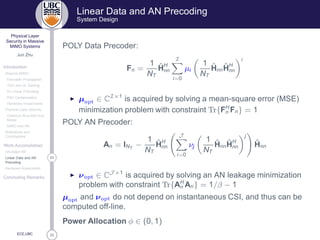
POLY Data Precoder:
Fn =
1
NT
ˆHH
nn
I
i=0
µi
1
NT
ˆHnn
ˆHH
nn
i
◮ µÓÔØ ∈ CI×1
is acquired by solving a mean-square error (MSE)
minimization problem with constraint ÌÖ{FH
n Fn} = 1
POLY AN Precoder:
An = INT
−
1
NT
ˆHH
nn
J
i=0
νj
1
NT
ˆHnn
ˆHH
nn
j
ˆHnn
◮ νÓÔØ ∈ CJ ×1
is acquired by solving an AN leakage minimization
problem with constraint ÌÖ{AH
n An} = 1/β − 1
µÓÔØ and νÓÔØ do not depend on instantaneous CSI, and thus can be
computed off-line.
Power Allocation φ ∈ (0, 1)
33
Physical Layer
Security in Massive
MIMO Systems
Jun Zhu
Introduction
Massive MIMO
Favorable Propagation
TDD and UL Training
DL Linear Precoding
Pilot Contamination
Hardware Impairments
Physical Layer Security
Classical Alice-Bob-Eve
Model
MIMO and AN
Motivations and
Contributions
Work Accomplished
AN-Aided MF
24Linear Data and AN
Precoding
Hardware Impairments
Concluding Remarks
ECE,UBC
Linear Data and AN Precoding
Selected Numerical Examples
Ergodic secrecy rate:
Lightly loaded ((ρ, M, K) = (0.1, 2, 10)) vs. Heavily loaded
((ρ, M, K) = (0.3, 7, 40))
200 250 300 350 400
3
3.5
4
4.5
5
5.5
6
Number of BS antennas NT
Ergodicsecrecyrate(bps/Hz)
CRCI sim.
CRCI ana.
CZF sim.
CZF ana.
SRCI sim.
SRCI ana.
SZF sim.
SZF ana.
MF ana.
200 250 300 350 400
0.2
0.3
0.4
0.5
0.6
0.7
0.8
0.9
Number of BS antennas NT
Ergodicsecrecyrate(bps/Hz)
CRCI sim.
CRCI ana.
CZF sim.
CZF ana.
SRCI sim.
SRCI ana.
SZF sim.
SZF ana.
MF ana.
◮ α = 0.1, φ = 0.75, τ = 2K, pτ = PT /τ, and PT = 10 dB
◮ Collaborative schemes are not always good, although with higher
complexity
◮ Trend prediction: When NT is large enough . . .
33
Physical Layer
Security in Massive
MIMO Systems
Jun Zhu
Introduction
Massive MIMO
Favorable Propagation
TDD and UL Training
DL Linear Precoding
Pilot Contamination
Hardware Impairments
Physical Layer Security
Classical Alice-Bob-Eve
Model
MIMO and AN
Motivations and
Contributions
Work Accomplished
AN-Aided MF
25Linear Data and AN
Precoding
Hardware Impairments
Concluding Remarks
ECE,UBC
Linear Data and AN Precoding
Selected Numerical Examples
Performance vs. Complexity: (NT = 1000, T − τ = 100)
100 200 300 400
1
1.5
2
2.5
3
3.5
4
4.5
5
Number of MTs in each cell, K
Ergodicsecrecyrate(bps/Hz)
Ergodic secrecy rate
100 200 300 400
0
0.5
1
1.5
2
2.5
3
3.5
Number of MTs in each cell, K
Computationalcomplexity(Giga−FLOP)
Computational complexity
CRCI
SRCI
POLY
MFI = 1, 3, 5
I = 1, 3, 5
100 200 300
1
1.5
2
2.5
3
3.5
Number of MTs in each cell, K
Ergodicsecrecyrate(bps/Hz)
Ergodic secrecy rate
100 200 300
0
0.5
1
1.5
2
2.5
3
Number of MTs in each cell, K
Computationalcomplexity(Giga−FLOP)
Computational complexity
CNS
SNS
POLY
Random
J = 1, 3, 5
J = 1, 3, 5
◮ τ = 2K, pτ = PT /τ, M = 2, ρ = 0.1, and PT = 10 dB
◮ For large K, POLY data has lower complexity than channel
inversion
◮ Even for small K, POLY data does not incur stability issue
◮ POLY AN has lower complexity than NS or even Random
POLY precoders are promising options for practical massive MIMO
design
33
Physical Layer
Security in Massive
MIMO Systems
Jun Zhu
Introduction
Massive MIMO
Favorable Propagation
TDD and UL Training
DL Linear Precoding
Pilot Contamination
Hardware Impairments
Physical Layer Security
Classical Alice-Bob-Eve
Model
MIMO and AN
Motivations and
Contributions
Work Accomplished
AN-Aided MF
Linear Data and AN
Precoding
26Hardware Impairments
Concluding Remarks
ECE,UBC
Chapter 4
Hardware Impairments in Secure
Massive MIMO Systems
◮ Introduce hardware impaired secure massive MIMO
◮ Derive a tight analytical lower bound for achievable secrecy rate
for generalized hardware impairment model for AN-aided MF with
general uplink pilots and downlink AN
[J3]: J. Zhu, D. W. K. Ng, N. Wang, R. Schober, and V. K. Bhargava, “Analysis and design of
secure massive MIMO systems in the presence of hardware impairments,” submitted
to possible journal, Feb. 2016.
[C4]: J. Zhu, R. Schober, and V. K. Bhargava, “Physical layer security for massive MIMO
systems impaired by phase noise,” submitted to possible conference, Feb. 2016.
33
Physical Layer
Security in Massive
MIMO Systems
Jun Zhu
Introduction
Massive MIMO
Favorable Propagation
TDD and UL Training
DL Linear Precoding
Pilot Contamination
Hardware Impairments
Physical Layer Security
Classical Alice-Bob-Eve
Model
MIMO and AN
Motivations and
Contributions
Work Accomplished
AN-Aided MF
Linear Data and AN
Precoding
27Hardware Impairments
Concluding Remarks
ECE,UBC
Hardware Impairments
System Model
Filter
Low-Noise
Amplifier
Mixer
A/D
Converter
Filter
Low-Noise
Amplifier
Mixer
A/D
Converter
DSP
Local
Oscillator
Local
Oscillator
Receive
Antenna 1
Receive
Antenna N
Receiver
Circuit
Local
Oscillator
Local
Oscillator
Power
Amplifier
Power
Amplifier
Mixer
Mixer
D/A
Converter
D/A
Converter
DSP
Transmit
Antenna 1
Transmit
Antenna N
Transmitter
Circuit
Channel
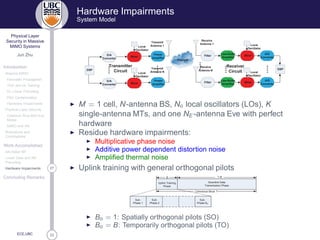
◮ M = 1 cell, N-antenna BS, No local oscillators (LOs), K
single-antenna MTs, and one NE -antenna Eve with perfect
hardware
◮ Residue hardware impairments:
◮ Multiplicative phase noise
◮ Additive power dependent distortion noise
◮ Amplified thermal noise
◮ Uplink training with general orthogonal pilots
Coherence Block T
Uplink Training
Phase
B
Downlink Data
Transmission Phase
T-B
Sub-
Phase 1
Sub-
Phase 2
Sub-
Phase Bo
◮ Bo = 1: Spatially orthogonal pilots (SO)
◮ Bo = B: Temporarily orthogonal pilots (TO)
33
Physical Layer
Security in Massive
MIMO Systems
Jun Zhu
Introduction
Massive MIMO
Favorable Propagation
TDD and UL Training
DL Linear Precoding
Pilot Contamination
Hardware Impairments
Physical Layer Security
Classical Alice-Bob-Eve
Model
MIMO and AN
Motivations and
Contributions
Work Accomplished
AN-Aided MF
Linear Data and AN
Precoding
28Hardware Impairments
Concluding Remarks
ECE,UBC
Hardware Impairments
Performance Evaluation
Achievable Ergodic Secrecy Rate
R× 
k =
1
T
t∈{B+1,...,T}
[Rk (t) − CE (t)]+
with
◮ Rk (t): Achievable ergodic rate of MT k at time t
◮ CE (t): Ergodic capacity of Eve w.r.t. message of MT k at time t
Tight Lower Bound on Achievable Ergodic Rate of MT k
Rk (t) ≥ Rk (t) = log2(1 + γk (t))
where γk (t) =
p E gH
k
ΘH
k
(t)fk
2
K
l=1
pE gH
k
ΘH
k
(t)fl
2
− p E gH
k
ΘH
k
(t)fk
2
+ E gH
k
ΘH
k
(t)(qAAH + Υ Ët
)ΘH
k
(t)gk + E υÅÌk,r
(t) + ξ Ä
33
Physical Layer
Security in Massive
MIMO Systems
Jun Zhu
Introduction
Massive MIMO
Favorable Propagation
TDD and UL Training
DL Linear Precoding
Pilot Contamination
Hardware Impairments
Physical Layer Security
Classical Alice-Bob-Eve
Model
MIMO and AN
Motivations and
Contributions
Work Accomplished
AN-Aided MF
Linear Data and AN
Precoding
29Hardware Impairments
Concluding Remarks
ECE,UBC
Hardware Impairments
Performance Evaluation
Achievable Ergodic Secrecy Rate
R× 
k =
1
T
t∈{B+1,...,T}
[Rk (t) − CE (t)]+
with
◮ Rk (t): Achievable ergodic rate of MT k at time t
◮ CE (t): Ergodic capacity of Eve w.r.t. message of MT k at time t
Ergodic Capacity of Eve
CE = E[log2(1 + pfk GE GH
E (qAAH
+ Υ Ë
t )GE
−1
(fk GE )H
)]
We make the following pessimistic assumptions
◮ Besides, Eve can completely remove the phase noise, and the
only remaining hardware impairment is additive distortion noise
at BS
33
Physical Layer
Security in Massive
MIMO Systems
Jun Zhu
Introduction
Massive MIMO
Favorable Propagation
TDD and UL Training
DL Linear Precoding
Pilot Contamination
Hardware Impairments
Physical Layer Security
Classical Alice-Bob-Eve
Model
MIMO and AN
Motivations and
Contributions
Work Accomplished
AN-Aided MF
Linear Data and AN
Precoding
30Hardware Impairments
Concluding Remarks
ECE,UBC
Hardware Impairments
Performance Evaluation
Lower Bound on Achievable Ergodic Secrecy Rate
R× 
k ≥ R× 
k =
1
T
t∈{B+1,...,T}
[Rk (t) − CE ]+
Lower Bound on Achievable Rate
Rk (t) = log2

1 +
λk e−(σ2
φ+σ2
ψ)|t−B|
φN
(ak + ck − βµk )φ + βµk + β(κÅÌr + κ Ë
t + ξ Ä/βk /PT )


◮ λk ∈ (0, 1)-desired signal
◮ ak -interference, scales with N, ck -signal leakage
◮ µk -AN leakage under Generalized-NS (G-NS) AN with Mo
◮ Mo = No −→ phase noise removed (L = N/No − K)
◮ Mo = 1 −→ reduce to NS (L = N − K)
Upper Bound on Eve’s Capacity
CE ≤ CE = log2 1 +
pNE
qL + κ Ë
t PT − χNE
q=0
−→ log2 1 +
α
κ Ë
t (β − α)
where χ depends on κ Ë
t , p, q, K, L.
33
Physical Layer
Security in Massive
MIMO Systems
Jun Zhu
Introduction
Massive MIMO
Favorable Propagation
TDD and UL Training
DL Linear Precoding
Pilot Contamination
Hardware Impairments
Physical Layer Security
Classical Alice-Bob-Eve
Model
MIMO and AN
Motivations and
Contributions
Work Accomplished
AN-Aided MF
Linear Data and AN
Precoding
31Hardware Impairments
Concluding Remarks
ECE,UBC
Hardware Impairments
Selected Numerical Examples
Optimal power allocation:
0 0.1 0.2 0.3 0.4 0.5 0.6 0.7 0.8 0.9
0
0.5
1
1.5
2
2.5
3
3.5
4
4.5
φ
AchievableSecrecyRate(bps/Hz)
Ideal
SO Pilots
TO Pilots
σψ = σφ = 0.6◦
σψ = σφ = 6◦
σψ = σφ = 12◦
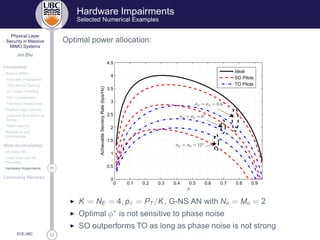
◮ K = NE = 4, pτ = PT /K, G-NS AN with No = Mo = 2
◮ Optimal φ∗
is not sensitive to phase noise
◮ SO outperforms TO as long as phase noise is not strong
33
Physical Layer
Security in Massive
MIMO Systems
Jun Zhu
Introduction
Massive MIMO
Favorable Propagation
TDD and UL Training
DL Linear Precoding
Pilot Contamination
Hardware Impairments
Physical Layer Security
Classical Alice-Bob-Eve
Model
MIMO and AN
Motivations and
Contributions
Work Accomplished
AN-Aided MF
Linear Data and AN
Precoding
32Hardware Impairments
Concluding Remarks
ECE,UBC
Hardware Impairments
Selected Numerical Examples
G-NS AN Precoder:
150 200 250
3
3.2
3.4
3.6
3.8
4
4.2
4.4
4.6
4.8
Number of BS Antennas, N
AchievableErgodicSecrecyRate(bps/Hz)
σψ = σφ = 0.6◦
150 200 250
0
0.2
0.4
0.6
0.8
1
1.2
1.4
Number of BS Antennas, N
AchievableErgodicSecrecyRate(bps/Hz)
σψ = σφ = 6◦
Simulation
Lower Bound
Mo = 16, 8, 4, 2, 1
Mo = 16, 8, 4, 2, 1
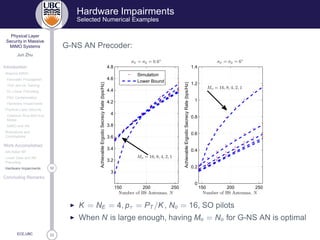
◮ K = NE = 4, pτ = PT /K, No = 16, SO pilots
◮ When N is large enough, having Mo = No for G-NS AN is optimal
33
Physical Layer
Security in Massive
MIMO Systems
Jun Zhu
Introduction
Massive MIMO
Favorable Propagation
TDD and UL Training
DL Linear Precoding
Pilot Contamination
Hardware Impairments
Physical Layer Security
Classical Alice-Bob-Eve
Model
MIMO and AN
Motivations and
Contributions
Work Accomplished
AN-Aided MF
Linear Data and AN
Precoding
Hardware Impairments
33Concluding Remarks
ECE,UBC
Concluding Remarks
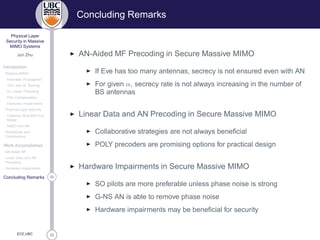
◮ AN-Aided MF Precoding in Secure Massive MIMO
◮ If Eve has too many antennas, secrecy is not ensured even with AN
◮ For given α, secrecy rate is not always increasing in the number of
BS antennas
◮ Linear Data and AN Precoding in Secure Massive MIMO
◮ Collaborative strategies are not always beneficial
◮ POLY precoders are promising options for practical design
◮ Hardware Impairments in Secure Massive MIMO
◮ SO pilots are more preferable unless phase noise is strong
◮ G-NS AN is able to remove phase noise
◮ Hardware impairments may be beneficial for security
Thank you for your attention!

PhySec_MassiveMIMO

  • 1.
    Physical Layer Securityin Massive MIMO Systems Ph.D. Departmental Exam March 11, 2016 Jun Zhu Þ Ù ÙÒ ºÙ º Ph.D. Supervisor: Prof. Robert Schober and Prof. Vijay K. Bhargava Department of Electrical and Computer Engineering University of British Columbia Vancouver, B.C., V6T 1Z4, Canada
  • 2.
    33 Physical Layer Security inMassive MIMO Systems Jun Zhu Introduction Massive MIMO Favorable Propagation TDD and UL Training DL Linear Precoding Pilot Contamination Hardware Impairments Physical Layer Security Classical Alice-Bob-Eve Model MIMO and AN Motivations and Contributions Work Accomplished AN-Aided MF Linear Data and AN Precoding Hardware Impairments Concluding Remarks ECE,UBC Outline Introduction Massive MIMO Physical Layer Security Motivations and Contributions Work Accomplished AN-Aided MF Precoding (Chapter 2) Linear Data and AN Precoding (Chapter 3) Hardware Impairments (Chapter 4) Concluding Remarks
  • 3.
    33 Physical Layer Security inMassive MIMO Systems Jun Zhu Introduction 2Massive MIMO Favorable Propagation TDD and UL Training DL Linear Precoding Pilot Contamination Hardware Impairments Physical Layer Security Classical Alice-Bob-Eve Model MIMO and AN Motivations and Contributions Work Accomplished AN-Aided MF Linear Data and AN Precoding Hardware Impairments Concluding Remarks ECE,UBC Massive MIMO ◮ Key technology for 5G wireless networks ◮ Base station (BS) with hundreds of antennas simultaneously serve tens of single-antenna mobile terminals (MTs) ◮ Tremendous gains for spectral and energy efficiency ◮ Low-complexity/cost/power processing and implementations
  • 4.
    33 Physical Layer Security inMassive MIMO Systems Jun Zhu Introduction Massive MIMO 3Favorable Propagation TDD and UL Training DL Linear Precoding Pilot Contamination Hardware Impairments Physical Layer Security Classical Alice-Bob-Eve Model MIMO and AN Motivations and Contributions Work Accomplished AN-Aided MF Linear Data and AN Precoding Hardware Impairments Concluding Remarks ECE,UBC Massive MIMO Favorable Propagation ◮ Given channel matrix G = [gH 1 , . . . , gH K ]H ∈ CK×N 1 N gk gH j → 0, 1 N gk gH k → 1 (N → ∞, K/N → 0) ◮ Favorable propagation: (channel hardening) C = log2 IK +γGGH ≤ K k=1 log2 1 + γ gk 2 = K log2(1 + γN). ◮ Simple processing, e.g., maximum ratio transmission/combining (MRT/MRC) achieves optimal throughput
  • 5.
    33 Physical Layer Security inMassive MIMO Systems Jun Zhu Introduction Massive MIMO Favorable Propagation 4TDD and UL Training DL Linear Precoding Pilot Contamination Hardware Impairments Physical Layer Security Classical Alice-Bob-Eve Model MIMO and AN Motivations and Contributions Work Accomplished AN-Aided MF Linear Data and AN Precoding Hardware Impairments Concluding Remarks ECE,UBC Massive MIMO Time-Division Duplex (TDD) and Uplink Training Example: Downlink transmission Downlink Pilot Training (prop. to # of BS antennas) Downlink Data Trans. Full/Reduced Rate Feedback Training Phase Data Trans. Phase Training Phase Data Trans. Phase Uplink Pilot Training (prop. to # of MTs) Downlink Data Trans. FDD TDD For massive MIMO . . . ◮ FDD: A severe limitation on the number of BS antennas ◮ TDD+channel reciprocity −→ UL/DL channel state information (CSI) acquisition
  • 6.
    33 Physical Layer Security inMassive MIMO Systems Jun Zhu Introduction Massive MIMO Favorable Propagation TDD and UL Training 5DL Linear Precoding Pilot Contamination Hardware Impairments Physical Layer Security Classical Alice-Bob-Eve Model MIMO and AN Motivations and Contributions Work Accomplished AN-Aided MF Linear Data and AN Precoding Hardware Impairments Concluding Remarks ECE,UBC Massive MIMO Downlink Linear Precoding ◮ Identical to those adopted in conventional MIMO, but in a large scale, e.g., MF, selfish/collaborative Zero-Forcing (ZF)/Reg. Channel Inversion (RCI) ◮ MF: capacity achieving for K ≪ N, performance loss for large K ◮ SZF/SRCI: suppress multiuser interference, require high computational complexity for large N and K ◮ CZF/CRCI: suppress multi-cell multiuser interference, require high computational complexity for large N, M, and K ◮ Polynomial (POLY): Adopt matrix polynomials to approach inversion (0-order: MF, ∞-order: ZF/RCI) Tradeoffs: performance vs. complexity, desired signal strength vs. interference mitigation, etc.
  • 7.
    33 Physical Layer Security inMassive MIMO Systems Jun Zhu Introduction Massive MIMO Favorable Propagation TDD and UL Training DL Linear Precoding 6Pilot Contamination Hardware Impairments Physical Layer Security Classical Alice-Bob-Eve Model MIMO and AN Motivations and Contributions Work Accomplished AN-Aided MF Linear Data and AN Precoding Hardware Impairments Concluding Remarks ECE,UBC Massive MIMO Pilot Contamination Uplink pilots Contaminated pilots ◮ Orthogonal uplink pilots in one cell, and reused between cells ◮ Channel estimate: a linear combination of all channels with identical pilots ◮ Coherent interference increases with N at the same speed of desired signal ◮ Constitute a limit on throughput for UL/DL
  • 8.
    33 Physical Layer Security inMassive MIMO Systems Jun Zhu Introduction Massive MIMO Favorable Propagation TDD and UL Training DL Linear Precoding Pilot Contamination 7Hardware Impairments Physical Layer Security Classical Alice-Bob-Eve Model MIMO and AN Motivations and Contributions Work Accomplished AN-Aided MF Linear Data and AN Precoding Hardware Impairments Concluding Remarks ECE,UBC Massive MIMO Hardware Impairments Filter Low-Noise Amplifier Mixer A/D Converter Filter Low-Noise Amplifier Mixer A/D Converter DSP Local Oscillator Local Oscillator Receive Antenna 1 Receive Antenna N Receiver Circuit Local Oscillator Local Oscillator Power Amplifier Power Amplifier Mixer Mixer D/A Converter D/A Converter DSP Transmit Antenna 1 Transmit Antenna N Transmitter Circuit Channel ◮ Hardware cost scales linearly with N ◮ Deploy low-cost transceivers to reduce total expenditure in massive MIMO ◮ Cheap components are prone to hardware imperfections: e.g., amplifier nonlinearity, phase noise, quantization error
  • 9.
    33 Physical Layer Security inMassive MIMO Systems Jun Zhu Introduction Massive MIMO Favorable Propagation TDD and UL Training DL Linear Precoding Pilot Contamination Hardware Impairments Physical Layer Security 8Classical Alice-Bob-Eve Model MIMO and AN Motivations and Contributions Work Accomplished AN-Aided MF Linear Data and AN Precoding Hardware Impairments Concluding Remarks ECE,UBC Physical Layer Security Classical Alice-Bob-Eve Model Typical Scenario: Alice Bob EveAlice-Bob-Eve Model Multi-User Multi-Antenna Network (Employing AN) BSEve MT Data AN CBob CEve Information Theory: ◮ Assume the channel between Alice and Bob is “better” than the channel between Alice and Eve. → There are codes which allow Bob to decode error free while Eve cannot extract any information about Alice’s message. ◮ Secrecy capacity: C× = [C Ó − C Ú ]+ Key question: How can we guarantee Bob’s channel is better than Eve’s?
  • 10.
    33 Physical Layer Security inMassive MIMO Systems Jun Zhu Introduction Massive MIMO Favorable Propagation TDD and UL Training DL Linear Precoding Pilot Contamination Hardware Impairments Physical Layer Security Classical Alice-Bob-Eve Model 9MIMO and AN Motivations and Contributions Work Accomplished AN-Aided MF Linear Data and AN Precoding Hardware Impairments Concluding Remarks ECE,UBC Physical Layer Security Multi-User MIMO and AN Enhancing Bob’s channel/Degrading Eve’s channel ◮ The key is to have more degrees of freedom at Alice/Bob than at Eve (multi-antenna at Alice) ◮ Alice knows Bob’s CSI but not Eve’s −→ Artificial Noise (invisible to Bob) Lower Bound on Achievable Secrecy Rate for MISOME Channel ◮ Multi-Input Single-Output Multi-Eavesdropper (MISOME) R× ≥ R× = [R Ó − C Ú ]+ ◮ Ergodic Secrecy Rate=Eh[R× ] (span over many independent channel realizations): ◮ Secrecy Outage Probability=Pr(R× ≤ R0) (span only one channel realization):
  • 11.
    33 Physical Layer Security inMassive MIMO Systems Jun Zhu Introduction Massive MIMO Favorable Propagation TDD and UL Training DL Linear Precoding Pilot Contamination Hardware Impairments Physical Layer Security Classical Alice-Bob-Eve Model MIMO and AN 10Motivations and Contributions Work Accomplished AN-Aided MF Linear Data and AN Precoding Hardware Impairments Concluding Remarks ECE,UBC Motivations and Contributions Is Massive MIMO Secure? Massive MIMO is secure . . . ◮ Narrow and directional beam from Alice to Bob −→ R Ó ≫ C Ú ◮ R Ó scales with N, while C Ú is independent of N Massive MIMO is NOT secure . . . ◮ Eve employs massive MIMO ◮ Eve is arbitrarily close to Alice ◮ In a ultra-dense multi-cell network, Bob experiences a high level of interference (pilot contam. and not contam.)−→ R Ó is limited, while Eve removes all interference ◮ Low-cost transceivers equipped at Alice and Bob, while Eve has perfect hardware Massive MIMO is MORE UNsecure if Eve performs active eavesdropping, e.g., pilot contam. attack, intentional jamming
  • 12.
    33 Physical Layer Security inMassive MIMO Systems Jun Zhu Introduction Massive MIMO Favorable Propagation TDD and UL Training DL Linear Precoding Pilot Contamination Hardware Impairments Physical Layer Security Classical Alice-Bob-Eve Model MIMO and AN 11Motivations and Contributions Work Accomplished AN-Aided MF Linear Data and AN Precoding Hardware Impairments Concluding Remarks ECE,UBC Motivations and Contributions How to improve security in massive MIMO? ◮ Massive MIMO offers rich spatial dimensions. ◮ Emitting AN improves security, requiring extra spatial dimensions. ◮ A short answer: Massive MIMO + AN Challenges and Open Problems: ◮ Pilot contamination’s impact on AN design and wireless security (Ch.2,3) ◮ Whether sophisticated signal processing, e.g. SZF/SRCI/CZF/CRCI are beneficial for security in a pilot contaminated environment (Ch.3) ◮ Complexity required for null-space (NS) based AN (Ch.2,3,4) ◮ Hardware impairments’ effects on AN design and wireless security (Ch.4)
  • 13.
    33 Physical Layer Security inMassive MIMO Systems Jun Zhu Introduction Massive MIMO Favorable Propagation TDD and UL Training DL Linear Precoding Pilot Contamination Hardware Impairments Physical Layer Security Classical Alice-Bob-Eve Model MIMO and AN 12Motivations and Contributions Work Accomplished AN-Aided MF Linear Data and AN Precoding Hardware Impairments Concluding Remarks ECE,UBC Motivations and Contributions Originality and Innovations This is the FIRST thesis in the topic of secure massive MIMO, which provides the FIRST contributions on . . . ◮ introducing the idea of AN emission in massive MIMO systems for security improvement, and proposing several practical AN design methods applicable for massive MIMO systems with perfect and imperfect hardware components ◮ deriving tight lower bound on ergodic secrecy rates in closed-form expression with different combinations of data and AN precoders for perfect and imperfect hardware components. The bounds offer explicit relationship between system performance and parameters.
  • 14.
    33 Physical Layer Security inMassive MIMO Systems Jun Zhu Introduction Massive MIMO Favorable Propagation TDD and UL Training DL Linear Precoding Pilot Contamination Hardware Impairments Physical Layer Security Classical Alice-Bob-Eve Model MIMO and AN Motivations and Contributions Work Accomplished 13AN-Aided MF Linear Data and AN Precoding Hardware Impairments Concluding Remarks ECE,UBC Chapter 2 AN-Aided MF Precoding in Secure Massive MIMO Systems ◮ Introduce AN-aided massive MIMO transmission ◮ Derive a tight analytical lower bound for achievable secrecy rate and upper bound for secrecy outage probability for AN-aided MF [J1]: J. Zhu, R. Schober, and V. K. Bhargava, “Secure transmission in multicell massive MIMO systems,” IEEE Trans. Wireless Commun., vol. 13, no. 9, pp. 4766-4781, Sept. 2014. [C1]: J. Zhu, R. Schober, and V. K. Bhargava, “Secure transmission in multi-cell massive MIMO systems,” in Proc. IEEE Globecom 2013, Atlanta, GA, Dec. 2013.
  • 15.
    33 Physical Layer Security inMassive MIMO Systems Jun Zhu Introduction Massive MIMO Favorable Propagation TDD and UL Training DL Linear Precoding Pilot Contamination Hardware Impairments Physical Layer Security Classical Alice-Bob-Eve Model MIMO and AN Motivations and Contributions Work Accomplished 14AN-Aided MF Linear Data and AN Precoding Hardware Impairments Concluding Remarks ECE,UBC AN-Aided MF System Model (adopted in Chapter 2 and 3) System Architecture: ◮ Infrastructure: M cells, NT -antenna BS ◮ Mobile Terminals (MTs): K single-antenna MTs per cell ◮ Eavesdropper: NE NT antennas, to decode MT k’s signal in cell n ◮ Training: Uplink+TDD, perfect synchronization Tx Signal at cell n xn = √ pFnsn + √ qAnzn = K k=1 √ pfnk snk + L i=1 √ qani zni Design Choices ◮ Tx data and AN precoding matrix Fn and An ◮ power allocation (p, q): How much power should be allocated to AN?
  • 16.
    33 Physical Layer Security inMassive MIMO Systems Jun Zhu Introduction Massive MIMO Favorable Propagation TDD and UL Training DL Linear Precoding Pilot Contamination Hardware Impairments Physical Layer Security Classical Alice-Bob-Eve Model MIMO and AN Motivations and Contributions Work Accomplished 15AN-Aided MF Linear Data and AN Precoding Hardware Impairments Concluding Remarks ECE,UBC AN-Aided MF System Design Options for Tx Data Precoding Matrix Fn ◮ MF: fnk = (ˆhk nn)H / ˆhk nn ◮ SZF/SRCI/CZF/CRCI ◮ POLY Options for Tx AN Precoding Matrix An ◮ NS: ˆHnnAn = 0K×L ◮ Random: vni = ˜vni / ˜vni , ˜vni ∈ CN(0NT , 1NT ) ◮ POLY Power Allocation ◮ Define power allocation factor φ ∈ (0, 1] with p = φP K q = (1 − φ)P L
  • 17.
    33 Physical Layer Security inMassive MIMO Systems Jun Zhu Introduction Massive MIMO Favorable Propagation TDD and UL Training DL Linear Precoding Pilot Contamination Hardware Impairments Physical Layer Security Classical Alice-Bob-Eve Model MIMO and AN Motivations and Contributions Work Accomplished 16AN-Aided MF Linear Data and AN Precoding Hardware Impairments Concluding Remarks ECE,UBC AN-Aided MF Performance Evaluation Achievable Ergodic Secrecy Rate R× nk = [Rnk − C Ú nk ]+ with ◮ Rnk : Achievable ergodic rate of MT k in cell n ◮ C Ú nk : Ergodic capacity of Eve with respect to message of MT k in cell n Tight Lower Bound on Achievable Ergodic Rate of MT k in cell n Rnk ≥ Rnk = log2(1 + γnk ) where γnk = desired signal |E[ √ pgk nnfnk ]|2 Ú Ö[ √ pgk nnfnk ] signal leakage + M m=1 L i=1 E[| √ qgk mnami |2 ] AN leakage + {m,l}={n,k} E[| √ pgk mnfml |2 ] intra- and inter-cell interference + σ2 nk
  • 18.
    33 Physical Layer Security inMassive MIMO Systems Jun Zhu Introduction Massive MIMO Favorable Propagation TDD and UL Training DL Linear Precoding Pilot Contamination Hardware Impairments Physical Layer Security Classical Alice-Bob-Eve Model MIMO and AN Motivations and Contributions Work Accomplished 17AN-Aided MF Linear Data and AN Precoding Hardware Impairments Concluding Remarks ECE,UBC AN-Aided MF Performance Evaluation Achievable Ergodic Secrecy Rate R× nk = [Rnk − C Ú nk ]+ with ◮ Rnk : Achievable ergodic rate of MT k in cell n ◮ C Ú nk : Ergodic capacity of Eve with respect to message of MT k in cell n Ergodic Capacity of Eve C Ú nk = E log2  1 + pfH nk GH nE q M m=1 AH mGH mE GmE Am −1 GnE fnk   We make the following pessimistic assumptions ◮ Eve can decode and cancel all other MTs successfully ◮ Eve has perfect CSI of all BS-Eve channels ◮ AWGN at Eve is negligible
  • 19.
    33 Physical Layer Security inMassive MIMO Systems Jun Zhu Introduction Massive MIMO Favorable Propagation TDD and UL Training DL Linear Precoding Pilot Contamination Hardware Impairments Physical Layer Security Classical Alice-Bob-Eve Model MIMO and AN Motivations and Contributions Work Accomplished 18AN-Aided MF Linear Data and AN Precoding Hardware Impairments Concluding Remarks ECE,UBC AN-Aided MF Performance Evaluation ◮ NT , NE , K → ∞, α = NE NT and β = K NT are fixed ◮ Simplified path-loss model: βk mn = 1 for m = n, and ρ ∈ (0, 1) otherwise ◮ Lower Bound on Achievable Rate Rnk =    log2 1 + λ (a−cλ)(1−β) q p +aβ+(c−1)λ+ β φPT , NS log2 1 + λ a(1−β) q p +aβ+(c−1)λ+ β φPT , Random λ ∈ (0, 1)-pilot contam. loss, a = 1 + (M − 1)ρ, c = 1 + (M − 1)ρ2 ◮ Upper Bound on Ergodic Capacity of Eve C Ú nk ≤ log2 1 + αφ β(1 − φ)(a − cαNT /(La)) ◮ Increasing in α and φ ◮ Decreasing in L −→ An extra spatial dimension is always beneficial
  • 20.
    33 Physical Layer Security inMassive MIMO Systems Jun Zhu Introduction Massive MIMO Favorable Propagation TDD and UL Training DL Linear Precoding Pilot Contamination Hardware Impairments Physical Layer Security Classical Alice-Bob-Eve Model MIMO and AN Motivations and Contributions Work Accomplished 19AN-Aided MF Linear Data and AN Precoding Hardware Impairments Concluding Remarks ECE,UBC AN-Aided MF Selected Numerical Examples Ergodic secrecy rate and secrecy outage probability: 80 100 120 140 160 0.1 0.12 0.14 0.16 0.18 0.2 0.22 0.24 0.26 Number of BS antennas (NT ) Ergodicsecrecyrate(bps/Hz) (a) Ergodic secrecy rate Simulation Lower bound I Lower bound II 0 0.5 1 0 0.1 0.2 0.3 0.4 0.5 0.6 0.7 0.8 0.9 1 R0 (bps/Hz) SecrecyOutageProbability (b) Secrecy outage probability Upper bound N Simulation N Upper bound R Simulation R N-method R-method NT = 80 NT = 100 NT = 120 ◮ M = 7 cells, NT = 100, PT = 10 dB, τ = K, pτ = PT /K, α = NE NT = 0.1, ρ = 0.1, and φ = 0.75 (pilot contam.) ◮ Performance does not always improve with NT
  • 21.
    33 Physical Layer Security inMassive MIMO Systems Jun Zhu Introduction Massive MIMO Favorable Propagation TDD and UL Training DL Linear Precoding Pilot Contamination Hardware Impairments Physical Layer Security Classical Alice-Bob-Eve Model MIMO and AN Motivations and Contributions Work Accomplished 20AN-Aided MF Linear Data and AN Precoding Hardware Impairments Concluding Remarks ECE,UBC AN-Aided MF Selected Numerical Examples Optimal power allocation: 0 0.1 0.2 0.3 0.4 0.5 0.6 0.7 0 0.1 0.2 0.3 0.4 0.5 0.6 0.7 0.8 0.9 φ Ergodicsecrecyrate(bps/Hz) N -method R-method α = 0.1, β = 0.05 α = 0.1, β = 0.5 ◮ M = 7 cells, NT = 100, PT = 20 dB, τ = K, pτ = PT /K, α = NE NT = 0.1, and ρ = 0.1. ◮ Optimization of power allocation factor φ is important ◮ Without AN (φ = 1) a positive secrecy rate cannot be achieved ◮ φ∗ decreases in α and increases in β = K NT
  • 22.
    33 Physical Layer Security inMassive MIMO Systems Jun Zhu Introduction Massive MIMO Favorable Propagation TDD and UL Training DL Linear Precoding Pilot Contamination Hardware Impairments Physical Layer Security Classical Alice-Bob-Eve Model MIMO and AN Motivations and Contributions Work Accomplished AN-Aided MF 21Linear Data and AN Precoding Hardware Impairments Concluding Remarks ECE,UBC Chapter 3 Linear Data and AN Precoding in Secure Massive MIMO Systems ◮ Derive a tight analytical lower bound for achievable secrecy rate for different types of linear data and AN precoders ◮ Propose low-complexity POLY data and AN precoders [J2]: J. Zhu, R. Schober, and V. K. Bhargava, “Linear precoding of data and artificial noise in secure massive MIMO systems,” IEEE Trans. Wireless Commun., vol. 15, no. 3, pp. 2245-2261, Mar. 2016. [C2]: J. Zhu, R. Schober, and V. K. Bhargava, “Secure downlink transmission in massive MIMO system with zero-forcing precoding,” in Proc. IEEE EW 2014, Barcelona, Spain, May 2014. (Invited Paper) [C3]: J. Zhu, R. Schober, and V. K. Bhargava, “Secrecy analysis of multi-cell massive MIMO systems with RCI precoding and artificial noise transmission,” in Proc. IEEE ISCCSP 2014, Athens, Greece, May 2014. (Invited Paper)
  • 23.
    33 Physical Layer Security inMassive MIMO Systems Jun Zhu Introduction Massive MIMO Favorable Propagation TDD and UL Training DL Linear Precoding Pilot Contamination Hardware Impairments Physical Layer Security Classical Alice-Bob-Eve Model MIMO and AN Motivations and Contributions Work Accomplished AN-Aided MF 22Linear Data and AN Precoding Hardware Impairments Concluding Remarks ECE,UBC Linear Data and AN Precoding System Design Options for Tx Data Precoder Fn ◮ SZF/RCI: Fn = γ1 ˆHH nn ˆHnn + κ1INT −1 ˆHnn (in-cell CSI) ◮ CZF/RCI: Fn = γ2 ˆHH n ˆHn + κ2INT −1 ˆHnn (in-cell+out-of-cell CSI) Data Precoder γnk CZF λ1φ˜L1 (1−φ)β ˜Q+βφ˜Q1+(d−1)λ1φ˜L1+β/PT SZF λ1φ˜L2 (1−φ)β ˜Q+βφ˜Q2+(d−1)λ1φ˜L2+β/PT MF λ1φ˜L3 (1−φ)β ˜Q+βφ˜Q3+(d−1)λ1φ˜L3+β/PT Options for Tx AN Precoder An ◮ SNS: An = INT − ˆHH nn ˆHnn ˆHH nn −1 ˆHnn (in-cell CSI) ◮ CNS: An = INT − ˆHH n ˆHn ˆHH n −1 ˆHn (in-cell+out-of-cell CSI) AN Precoder ˜Q = Q/L ˜L = L/NT CNS ˜Q1 = a − dλ1 − (c − d)λ2 ˜L1 = 1 − ξβ SNS ˜Q2 = a − dλ1 ˜L2 = 1 − β Random ˜Q3 = a ˜L3 = 1 a c d 1 λ1, λ2 depend on system parameters M, ρ,etc.
  • 24.
    33 Physical Layer Security inMassive MIMO Systems Jun Zhu Introduction Massive MIMO Favorable Propagation TDD and UL Training DL Linear Precoding Pilot Contamination Hardware Impairments Physical Layer Security Classical Alice-Bob-Eve Model MIMO and AN Motivations and Contributions Work Accomplished AN-Aided MF 23Linear Data and AN Precoding Hardware Impairments Concluding Remarks ECE,UBC Linear Data and AN Precoding System Design POLY Data Precoder: Fn = 1 NT ˆHH nn I i=0 µi 1 NT ˆHnn ˆHH nn i ◮ µÓÔØ ∈ CI×1 is acquired by solving a mean-square error (MSE) minimization problem with constraint ÌÖ{FH n Fn} = 1 POLY AN Precoder: An = INT − 1 NT ˆHH nn J i=0 νj 1 NT ˆHnn ˆHH nn j ˆHnn ◮ νÓÔØ ∈ CJ ×1 is acquired by solving an AN leakage minimization problem with constraint ÌÖ{AH n An} = 1/β − 1 µÓÔØ and νÓÔØ do not depend on instantaneous CSI, and thus can be computed off-line. Power Allocation φ ∈ (0, 1)
  • 25.
    33 Physical Layer Security inMassive MIMO Systems Jun Zhu Introduction Massive MIMO Favorable Propagation TDD and UL Training DL Linear Precoding Pilot Contamination Hardware Impairments Physical Layer Security Classical Alice-Bob-Eve Model MIMO and AN Motivations and Contributions Work Accomplished AN-Aided MF 24Linear Data and AN Precoding Hardware Impairments Concluding Remarks ECE,UBC Linear Data and AN Precoding Selected Numerical Examples Ergodic secrecy rate: Lightly loaded ((ρ, M, K) = (0.1, 2, 10)) vs. Heavily loaded ((ρ, M, K) = (0.3, 7, 40)) 200 250 300 350 400 3 3.5 4 4.5 5 5.5 6 Number of BS antennas NT Ergodicsecrecyrate(bps/Hz) CRCI sim. CRCI ana. CZF sim. CZF ana. SRCI sim. SRCI ana. SZF sim. SZF ana. MF ana. 200 250 300 350 400 0.2 0.3 0.4 0.5 0.6 0.7 0.8 0.9 Number of BS antennas NT Ergodicsecrecyrate(bps/Hz) CRCI sim. CRCI ana. CZF sim. CZF ana. SRCI sim. SRCI ana. SZF sim. SZF ana. MF ana. ◮ α = 0.1, φ = 0.75, τ = 2K, pτ = PT /τ, and PT = 10 dB ◮ Collaborative schemes are not always good, although with higher complexity ◮ Trend prediction: When NT is large enough . . .
  • 26.
    33 Physical Layer Security inMassive MIMO Systems Jun Zhu Introduction Massive MIMO Favorable Propagation TDD and UL Training DL Linear Precoding Pilot Contamination Hardware Impairments Physical Layer Security Classical Alice-Bob-Eve Model MIMO and AN Motivations and Contributions Work Accomplished AN-Aided MF 25Linear Data and AN Precoding Hardware Impairments Concluding Remarks ECE,UBC Linear Data and AN Precoding Selected Numerical Examples Performance vs. Complexity: (NT = 1000, T − τ = 100) 100 200 300 400 1 1.5 2 2.5 3 3.5 4 4.5 5 Number of MTs in each cell, K Ergodicsecrecyrate(bps/Hz) Ergodic secrecy rate 100 200 300 400 0 0.5 1 1.5 2 2.5 3 3.5 Number of MTs in each cell, K Computationalcomplexity(Giga−FLOP) Computational complexity CRCI SRCI POLY MFI = 1, 3, 5 I = 1, 3, 5 100 200 300 1 1.5 2 2.5 3 3.5 Number of MTs in each cell, K Ergodicsecrecyrate(bps/Hz) Ergodic secrecy rate 100 200 300 0 0.5 1 1.5 2 2.5 3 Number of MTs in each cell, K Computationalcomplexity(Giga−FLOP) Computational complexity CNS SNS POLY Random J = 1, 3, 5 J = 1, 3, 5 ◮ τ = 2K, pτ = PT /τ, M = 2, ρ = 0.1, and PT = 10 dB ◮ For large K, POLY data has lower complexity than channel inversion ◮ Even for small K, POLY data does not incur stability issue ◮ POLY AN has lower complexity than NS or even Random POLY precoders are promising options for practical massive MIMO design
  • 27.
    33 Physical Layer Security inMassive MIMO Systems Jun Zhu Introduction Massive MIMO Favorable Propagation TDD and UL Training DL Linear Precoding Pilot Contamination Hardware Impairments Physical Layer Security Classical Alice-Bob-Eve Model MIMO and AN Motivations and Contributions Work Accomplished AN-Aided MF Linear Data and AN Precoding 26Hardware Impairments Concluding Remarks ECE,UBC Chapter 4 Hardware Impairments in Secure Massive MIMO Systems ◮ Introduce hardware impaired secure massive MIMO ◮ Derive a tight analytical lower bound for achievable secrecy rate for generalized hardware impairment model for AN-aided MF with general uplink pilots and downlink AN [J3]: J. Zhu, D. W. K. Ng, N. Wang, R. Schober, and V. K. Bhargava, “Analysis and design of secure massive MIMO systems in the presence of hardware impairments,” submitted to possible journal, Feb. 2016. [C4]: J. Zhu, R. Schober, and V. K. Bhargava, “Physical layer security for massive MIMO systems impaired by phase noise,” submitted to possible conference, Feb. 2016.
  • 28.
    33 Physical Layer Security inMassive MIMO Systems Jun Zhu Introduction Massive MIMO Favorable Propagation TDD and UL Training DL Linear Precoding Pilot Contamination Hardware Impairments Physical Layer Security Classical Alice-Bob-Eve Model MIMO and AN Motivations and Contributions Work Accomplished AN-Aided MF Linear Data and AN Precoding 27Hardware Impairments Concluding Remarks ECE,UBC Hardware Impairments System Model Filter Low-Noise Amplifier Mixer A/D Converter Filter Low-Noise Amplifier Mixer A/D Converter DSP Local Oscillator Local Oscillator Receive Antenna 1 Receive Antenna N Receiver Circuit Local Oscillator Local Oscillator Power Amplifier Power Amplifier Mixer Mixer D/A Converter D/A Converter DSP Transmit Antenna 1 Transmit Antenna N Transmitter Circuit Channel ◮ M = 1 cell, N-antenna BS, No local oscillators (LOs), K single-antenna MTs, and one NE -antenna Eve with perfect hardware ◮ Residue hardware impairments: ◮ Multiplicative phase noise ◮ Additive power dependent distortion noise ◮ Amplified thermal noise ◮ Uplink training with general orthogonal pilots Coherence Block T Uplink Training Phase B Downlink Data Transmission Phase T-B Sub- Phase 1 Sub- Phase 2 Sub- Phase Bo ◮ Bo = 1: Spatially orthogonal pilots (SO) ◮ Bo = B: Temporarily orthogonal pilots (TO)
  • 29.
    33 Physical Layer Security inMassive MIMO Systems Jun Zhu Introduction Massive MIMO Favorable Propagation TDD and UL Training DL Linear Precoding Pilot Contamination Hardware Impairments Physical Layer Security Classical Alice-Bob-Eve Model MIMO and AN Motivations and Contributions Work Accomplished AN-Aided MF Linear Data and AN Precoding 28Hardware Impairments Concluding Remarks ECE,UBC Hardware Impairments Performance Evaluation Achievable Ergodic Secrecy Rate R× k = 1 T t∈{B+1,...,T} [Rk (t) − CE (t)]+ with ◮ Rk (t): Achievable ergodic rate of MT k at time t ◮ CE (t): Ergodic capacity of Eve w.r.t. message of MT k at time t Tight Lower Bound on Achievable Ergodic Rate of MT k Rk (t) ≥ Rk (t) = log2(1 + γk (t)) where γk (t) = p E gH k ΘH k (t)fk 2 K l=1 pE gH k ΘH k (t)fl 2 − p E gH k ΘH k (t)fk 2 + E gH k ΘH k (t)(qAAH + Υ Ët )ΘH k (t)gk + E υÅÌk,r (t) + ξ Ä
  • 30.
    33 Physical Layer Security inMassive MIMO Systems Jun Zhu Introduction Massive MIMO Favorable Propagation TDD and UL Training DL Linear Precoding Pilot Contamination Hardware Impairments Physical Layer Security Classical Alice-Bob-Eve Model MIMO and AN Motivations and Contributions Work Accomplished AN-Aided MF Linear Data and AN Precoding 29Hardware Impairments Concluding Remarks ECE,UBC Hardware Impairments Performance Evaluation Achievable Ergodic Secrecy Rate R× k = 1 T t∈{B+1,...,T} [Rk (t) − CE (t)]+ with ◮ Rk (t): Achievable ergodic rate of MT k at time t ◮ CE (t): Ergodic capacity of Eve w.r.t. message of MT k at time t Ergodic Capacity of Eve CE = E[log2(1 + pfk GE GH E (qAAH + Υ Ë t )GE −1 (fk GE )H )] We make the following pessimistic assumptions ◮ Besides, Eve can completely remove the phase noise, and the only remaining hardware impairment is additive distortion noise at BS
  • 31.
    33 Physical Layer Security inMassive MIMO Systems Jun Zhu Introduction Massive MIMO Favorable Propagation TDD and UL Training DL Linear Precoding Pilot Contamination Hardware Impairments Physical Layer Security Classical Alice-Bob-Eve Model MIMO and AN Motivations and Contributions Work Accomplished AN-Aided MF Linear Data and AN Precoding 30Hardware Impairments Concluding Remarks ECE,UBC Hardware Impairments Performance Evaluation Lower Bound on Achievable Ergodic Secrecy Rate R× k ≥ R× k = 1 T t∈{B+1,...,T} [Rk (t) − CE ]+ Lower Bound on Achievable Rate Rk (t) = log2  1 + λk e−(σ2 φ+σ2 ψ)|t−B| φN (ak + ck − βµk )φ + βµk + β(κÅÌr + κ Ë t + ξ Ä/βk /PT )   ◮ λk ∈ (0, 1)-desired signal ◮ ak -interference, scales with N, ck -signal leakage ◮ µk -AN leakage under Generalized-NS (G-NS) AN with Mo ◮ Mo = No −→ phase noise removed (L = N/No − K) ◮ Mo = 1 −→ reduce to NS (L = N − K) Upper Bound on Eve’s Capacity CE ≤ CE = log2 1 + pNE qL + κ Ë t PT − χNE q=0 −→ log2 1 + α κ Ë t (β − α) where χ depends on κ Ë t , p, q, K, L.
  • 32.
    33 Physical Layer Security inMassive MIMO Systems Jun Zhu Introduction Massive MIMO Favorable Propagation TDD and UL Training DL Linear Precoding Pilot Contamination Hardware Impairments Physical Layer Security Classical Alice-Bob-Eve Model MIMO and AN Motivations and Contributions Work Accomplished AN-Aided MF Linear Data and AN Precoding 31Hardware Impairments Concluding Remarks ECE,UBC Hardware Impairments Selected Numerical Examples Optimal power allocation: 0 0.1 0.2 0.3 0.4 0.5 0.6 0.7 0.8 0.9 0 0.5 1 1.5 2 2.5 3 3.5 4 4.5 φ AchievableSecrecyRate(bps/Hz) Ideal SO Pilots TO Pilots σψ = σφ = 0.6◦ σψ = σφ = 6◦ σψ = σφ = 12◦ ◮ K = NE = 4, pτ = PT /K, G-NS AN with No = Mo = 2 ◮ Optimal φ∗ is not sensitive to phase noise ◮ SO outperforms TO as long as phase noise is not strong
  • 33.
    33 Physical Layer Security inMassive MIMO Systems Jun Zhu Introduction Massive MIMO Favorable Propagation TDD and UL Training DL Linear Precoding Pilot Contamination Hardware Impairments Physical Layer Security Classical Alice-Bob-Eve Model MIMO and AN Motivations and Contributions Work Accomplished AN-Aided MF Linear Data and AN Precoding 32Hardware Impairments Concluding Remarks ECE,UBC Hardware Impairments Selected Numerical Examples G-NS AN Precoder: 150 200 250 3 3.2 3.4 3.6 3.8 4 4.2 4.4 4.6 4.8 Number of BS Antennas, N AchievableErgodicSecrecyRate(bps/Hz) σψ = σφ = 0.6◦ 150 200 250 0 0.2 0.4 0.6 0.8 1 1.2 1.4 Number of BS Antennas, N AchievableErgodicSecrecyRate(bps/Hz) σψ = σφ = 6◦ Simulation Lower Bound Mo = 16, 8, 4, 2, 1 Mo = 16, 8, 4, 2, 1 ◮ K = NE = 4, pτ = PT /K, No = 16, SO pilots ◮ When N is large enough, having Mo = No for G-NS AN is optimal
  • 34.
    33 Physical Layer Security inMassive MIMO Systems Jun Zhu Introduction Massive MIMO Favorable Propagation TDD and UL Training DL Linear Precoding Pilot Contamination Hardware Impairments Physical Layer Security Classical Alice-Bob-Eve Model MIMO and AN Motivations and Contributions Work Accomplished AN-Aided MF Linear Data and AN Precoding Hardware Impairments 33Concluding Remarks ECE,UBC Concluding Remarks ◮ AN-Aided MF Precoding in Secure Massive MIMO ◮ If Eve has too many antennas, secrecy is not ensured even with AN ◮ For given α, secrecy rate is not always increasing in the number of BS antennas ◮ Linear Data and AN Precoding in Secure Massive MIMO ◮ Collaborative strategies are not always beneficial ◮ POLY precoders are promising options for practical design ◮ Hardware Impairments in Secure Massive MIMO ◮ SO pilots are more preferable unless phase noise is strong ◮ G-NS AN is able to remove phase noise ◮ Hardware impairments may be beneficial for security
  • 35.
    Thank you foryour attention!