LOGO

WIRELESS SYSTEMS
Presented By :-

DANIEL GEORGE
BSc Computer science
ST.Thomas college
LOGO

CONTENTS

 INTRODUCTION
 1G TECHNOLOGY
 2G TECHNOLOGY
 MODELS OF 1G & 2G
 2.5 TECHNOLOGY
 3G TECHNOLOGY

 4G TECHNOLOGY
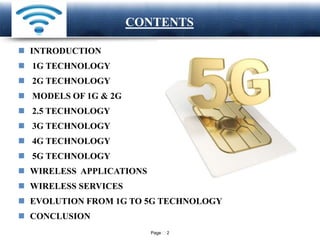
 5G TECHNOLOGY
 WIRELESS APPLICATIONS
 WIRELESS SERVICES

 EVOLUTION FROM 1G TO 5G TECHNOLOGY
 CONCLUSION
Page 2
LOGO

INTRODUCTION

WHAT IS WIRELESS ?
The word wireless in dictionary is defined“having no wires ” .
In networking terminology , wireless is the term used to
describe any computer network where there is no physical
wired connection between sender and receiver, but rather
the network is connected by radio waves and or microwaves
to maintain communications.
Wireless networking utilizes specific equipment such as
NICs and Routers in place of wires (copper or optical fibre).
Page 3
LOGO

1G TECHNOLOGY

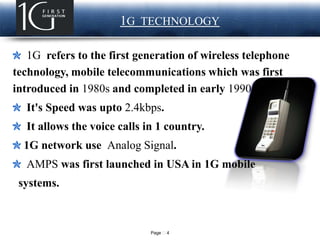
1G refers to the first generation of wireless telephone
technology, mobile telecommunications which was first
introduced in 1980s and completed in early 1990s.
It's Speed was upto 2.4kbps.
It allows the voice calls in 1 country.

1G network use Analog Signal.
AMPS was first launched in USA in 1G mobile
systems.

Page 4
LOGO

DRAWBACKS OF 1G

Poor Voice Quality

Poor Battery Life
Large Phone Size
No Security
Limited Capacity
Poor Handoff Reliability
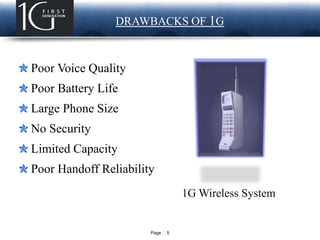
1G Wireless System

Page 5
LOGO

2G TECHNOLOGY

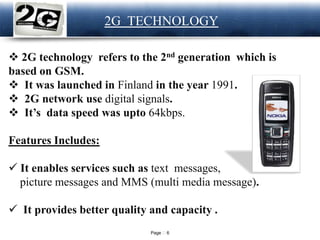
 2G technology refers to the 2nd generation which is
based on GSM.
 It was launched in Finland in the year 1991.
 2G network use digital signals.
 It’s data speed was upto 64kbps.
Features Includes:
 It enables services such as text messages,
picture messages and MMS (multi media message).
 It provides better quality and capacity .
Page 6
LOGO

DRAWBACKS OF 2G

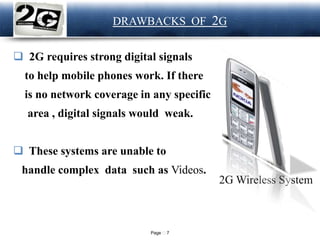
 2G requires strong digital signals
to help mobile phones work. If there
is no network coverage in any specific
area , digital signals would weak.

 These systems are unable to
handle complex data such as Videos.

Page 7

2G Wireless System
LOGO

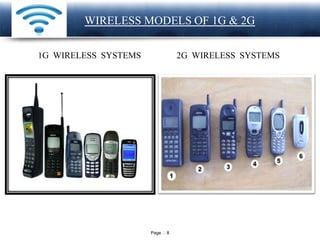
WIRELESS MODELS OF 1G & 2G

1G WIRELESS SYSTEMS

2G WIRELESS SYSTEMS

Page 8
LOGO

2.5G TECHNOLOGY

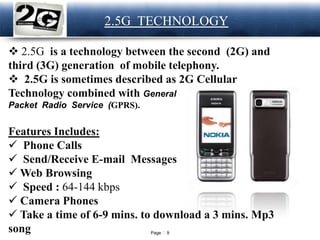
 2.5G is a technology between the second (2G) and
third (3G) generation of mobile telephony.
 2.5G is sometimes described as 2G Cellular
Technology combined with General
Packet Radio Service (GPRS).

Features Includes:
 Phone Calls
 Send/Receive E-mail Messages
 Web Browsing
 Speed : 64-144 kbps
 Camera Phones
 Take a time of 6-9 mins. to download a 3 mins. Mp3
song
Page 9
LOGO

3G TECHNOLOGY

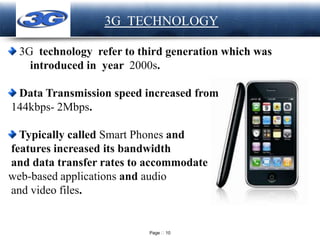
3G technology refer to third generation which was
introduced in year 2000s.
Data Transmission speed increased from
144kbps- 2Mbps.

Typically called Smart Phones and
features increased its bandwidth
and data transfer rates to accommodate
web-based applications and audio
and video files.

Page 10
LOGO

FEATURES OF 3G TECHNOLOGY

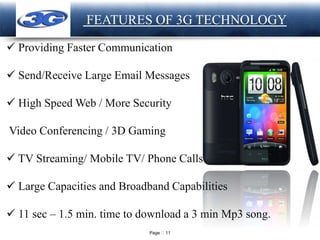
 Providing Faster Communication
 Send/Receive Large Email Messages
 High Speed Web / More Security
Video Conferencing / 3D Gaming
 TV Streaming/ Mobile TV/ Phone Calls
 Large Capacities and Broadband Capabilities

 11 sec – 1.5 min. time to download a 3 min Mp3 song.
Page 11
LOGO

DRAWBACKS OF 3G TECHNOLOGY

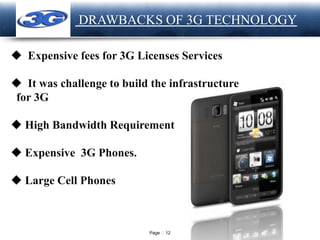
 Expensive fees for 3G Licenses Services

 It was challenge to build the infrastructure
for 3G
 High Bandwidth Requirement
 Expensive 3G Phones.
 Large Cell Phones

Page 12
LOGO

4G TECHNOLOGY

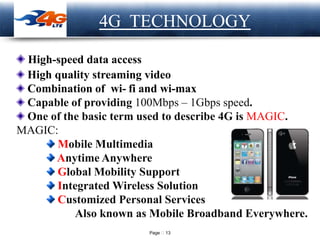
High-speed data access
High quality streaming video
Combination of wi- fi and wi-max
Capable of providing 100Mbps – 1Gbps speed.
One of the basic term used to describe 4G is MAGIC.
MAGIC:
Mobile Multimedia
Anytime Anywhere
Global Mobility Support
Integrated Wireless Solution
Customized Personal Services
Also known as Mobile Broadband Everywhere.
Page 13
LOGO

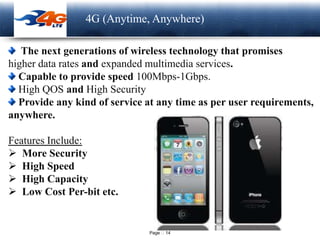
4G (Anytime, Anywhere)

The next generations of wireless technology that promises
higher data rates and expanded multimedia services.
Capable to provide speed 100Mbps-1Gbps.
High QOS and High Security
Provide any kind of service at any time as per user requirements,
anywhere.
Features Include:
 More Security
 High Speed
 High Capacity
 Low Cost Per-bit etc.

Page 14
LOGO

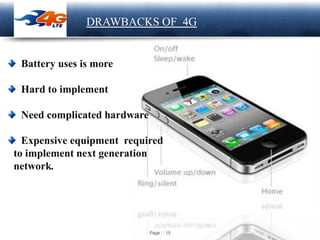
DRAWBACKS OF 4G

Battery uses is more
Hard to implement
Need complicated hardware
Expensive equipment required
to implement next generation
network.

Page 15
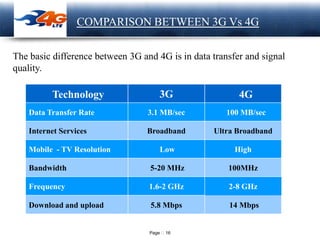
COMPARISON BETWEEN 3G Vs 4G

LOGO

The basic difference between 3G and 4G is in data transfer and signal
quality.

3G

4G

Data Transfer Rate

3.1 MB/sec

100 MB/sec

Internet Services

Broadband

Ultra Broadband

Low

High

Bandwidth

5-20 MHz

100MHz

Frequency

1.6-2 GHz

2-8 GHz

Download and upload

5.8 Mbps

14 Mbps

Technology

Mobile - TV Resolution

Page 16
LOGO

Countries Have 4-G

Except for the Scandinavian Countries (Northern Europe that
includes Denmark and two of the nations of Scandinavian , Norway
and Sweden. ), a few countries have started the 4G commercially.

In the US, Sprint Nextel and Others Germany , Spain, China , Japan
and England are also using the 4G services and mobiles .

Page 17
LOGO

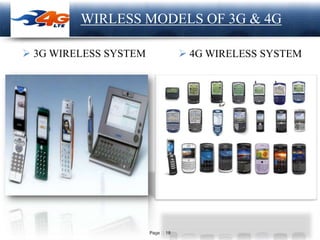
WIRLESS MODELS OF 3G & 4G

 3G WIRELESS SYSTEM

 4G WIRELESS SYSTEM

Page 18
LOGO

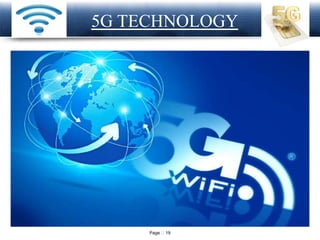
5G TECHNOLOGY

Page 19
LOGO

5G TECHNOLOGY

Page 20
LOGO

Page 21
LOGO

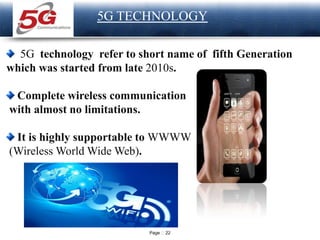
5G TECHNOLOGY

5G technology refer to short name of fifth Generation
which was started from late 2010s.
Complete wireless communication
with almost no limitations.
It is highly supportable to WWWW
(Wireless World Wide Web).

Page 22
LOGO

BENEFITS OF 5G TECHNOLOGY

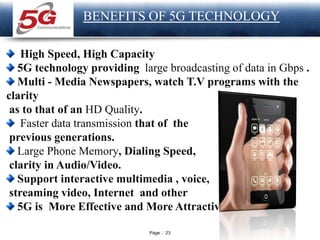
High Speed, High Capacity
5G technology providing large broadcasting of data in Gbps .
Multi - Media Newspapers, watch T.V programs with the
clarity
as to that of an HD Quality.
Faster data transmission that of the
previous generations.
Large Phone Memory, Dialing Speed,
clarity in Audio/Video.
Support interactive multimedia , voice,
streaming video, Internet and other
5G is More Effective and More Attractive.
Page 23
LOGO

COMPARISON BETWEEN 4G Vs 5G

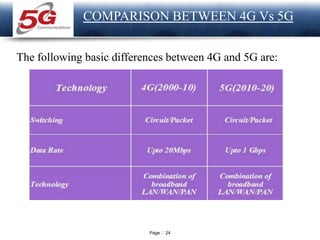
The following basic differences between 4G and 5G are:

Page 24
LOGO

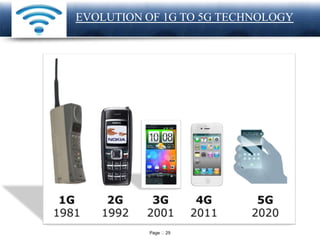
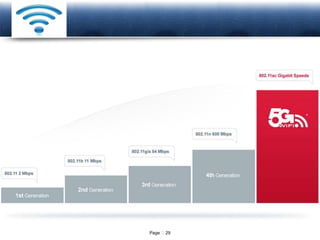
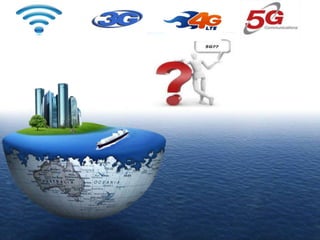
EVOLUTION OF 1G TO 5G TECHNOLOGY

Page 25
LOGO

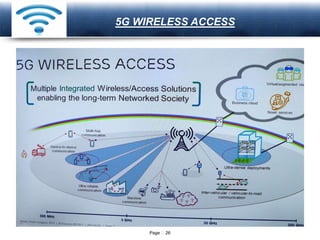
5G WIRELESS ACCESS

Page 26
LOGO

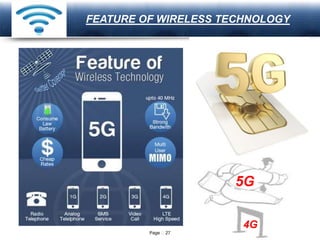
FEATURE OF WIRELESS TECHNOLOGY

5G
4G
Page 27
LOGO

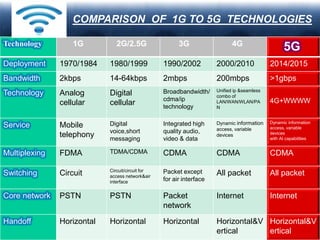
COMPARISON OF 1G TO 5G TECHNOLOGIES

Technology

1G

Deployment

1970/1984

Bandwidth
Technology

2G/2.5G

3G

4G

1980/1999

1990/2002

2000/2010

2014/2015

2kbps

14-64kbps

2mbps

200mbps

>1gbps

Analog
cellular

Digital
cellular

Broadbandwidth/
cdma/ip
technology

Unified ip &seamless
combo of
LAN/WAN/WLAN/PA
N

4G+WWWW

Service

Mobile
telephony

Digital
voice,short
messaging

Integrated high
quality audio,
video & data

Dynamic information
access, variable
devices

Dynamic information
access, variable
devices
with AI capabilities

Multiplexing

FDMA

TDMA/CDMA

CDMA

CDMA

CDMA

Switching

Circuit

Circuit/circuit for
access network&air
interface

Packet except
for air interface

All packet

All packet

Core network

PSTN

PSTN

Packet
network

Internet

Internet

Handoff

Horizontal

Horizontal

Horizontal

Horizontal&V Horizontal&V
ertical
ertical

Page 28

5G
LOGO

Page 29
LOGO

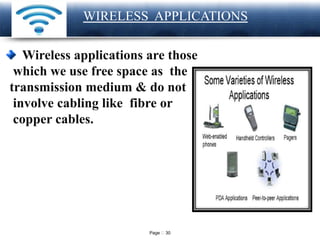
WIRELESS APPLICATIONS

Wireless applications are those
which we use free space as the
transmission medium & do not
involve cabling like fibre or
copper cables.

Page 30
LOGO

WIRELESS SERVICES

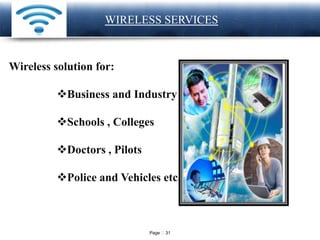
Wireless solution for:
Business and Industry
Schools , Colleges
Doctors , Pilots
Police and Vehicles etc.

Page 31
LOGO

CONCLUSION

 All totally the best way to help all users is to use 5G as the
next wireless system and in totally it is safety and secure
for public, this the need that demands the solution.

 Today’s wired society is going wireless and if it has
problem, 5G is answer.
 5G technology is going to give tough competition to
Computers and Laptops.
 It will be available in the market 2020 at affordable cost
with more reliability than previous mobiles.

Page 32
THANK
YOU
CONCLUSION