Vamsi Krishna. R
12ETMM10
Int. M.Tech / Ph.D
Materials Engineering
SEST, UoH
Overview Of Extrusion
contents
• Introduction
• Classification
• Extrusion Equipment
• Extrusion Pressure
• Extrusion Ratio
• Hydrostatic Extrusion
• Extrusion Defects
• Features Of Extrusion
Extrusion
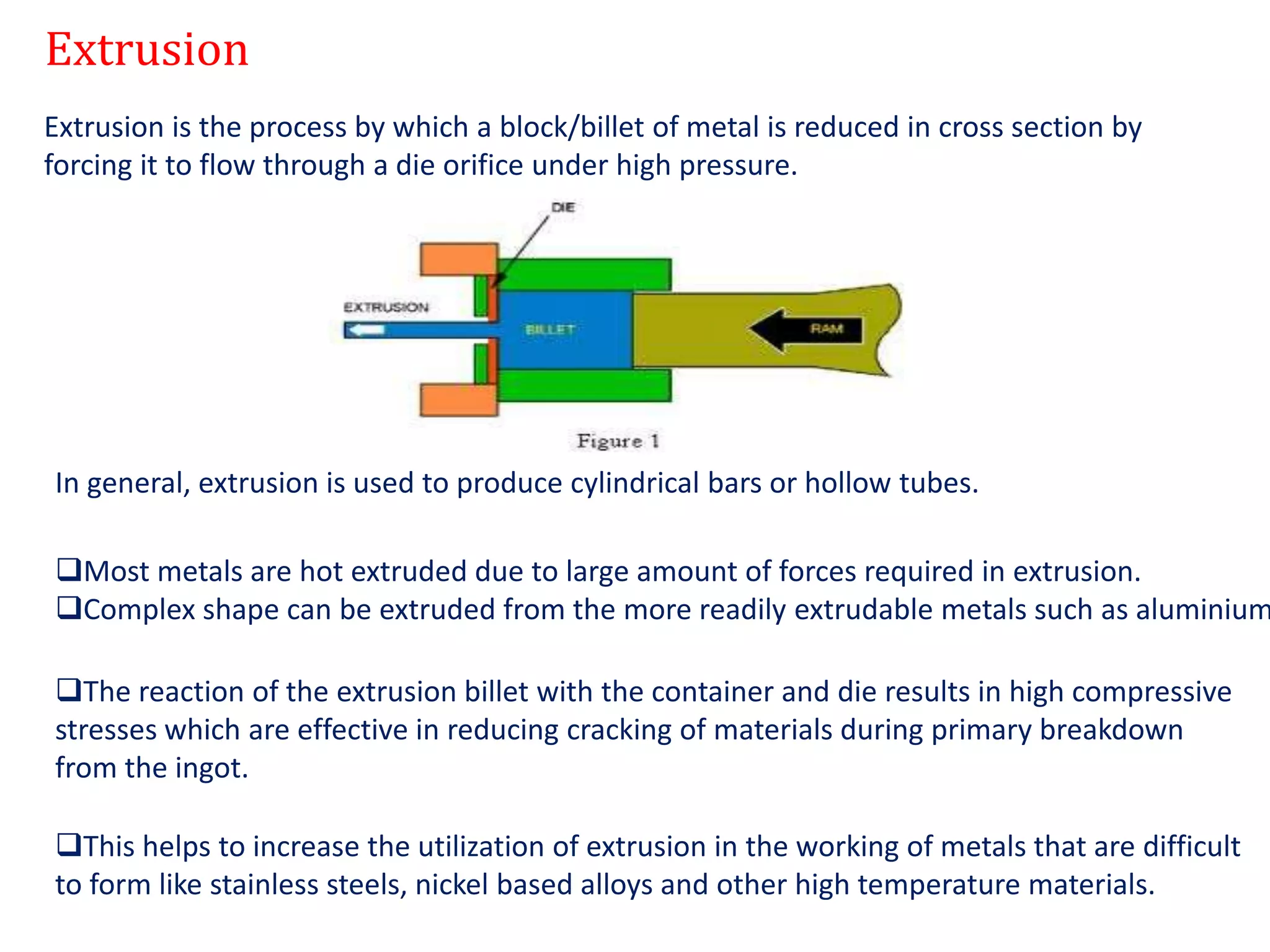
Extrusion is the process by which a block/billet of metal is reduced in cross section by
forcing it to flow through a die orifice under high pressure.
In general, extrusion is used to produce cylindrical bars or hollow tubes.
Most metals are hot extruded due to large amount of forces required in extrusion.
Complex shape can be extruded from the more readily extrudable metals such as aluminium
The reaction of the extrusion billet with the container and die results in high compressive
stresses which are effective in reducing cracking of materials during primary breakdown
from the ingot.
This helps to increase the utilization of extrusion in the working of metals that are difficult
to form like stainless steels, nickel based alloys and other high temperature materials.
Classification of extrusion processes
There are several ways to classify metal extrusion processes
By direction
direct or forward extrusion
indirect or backward extrusion
By operating temperature
hot extrusion
cold extrusion
By equipment
horizontal and vertical extrusion
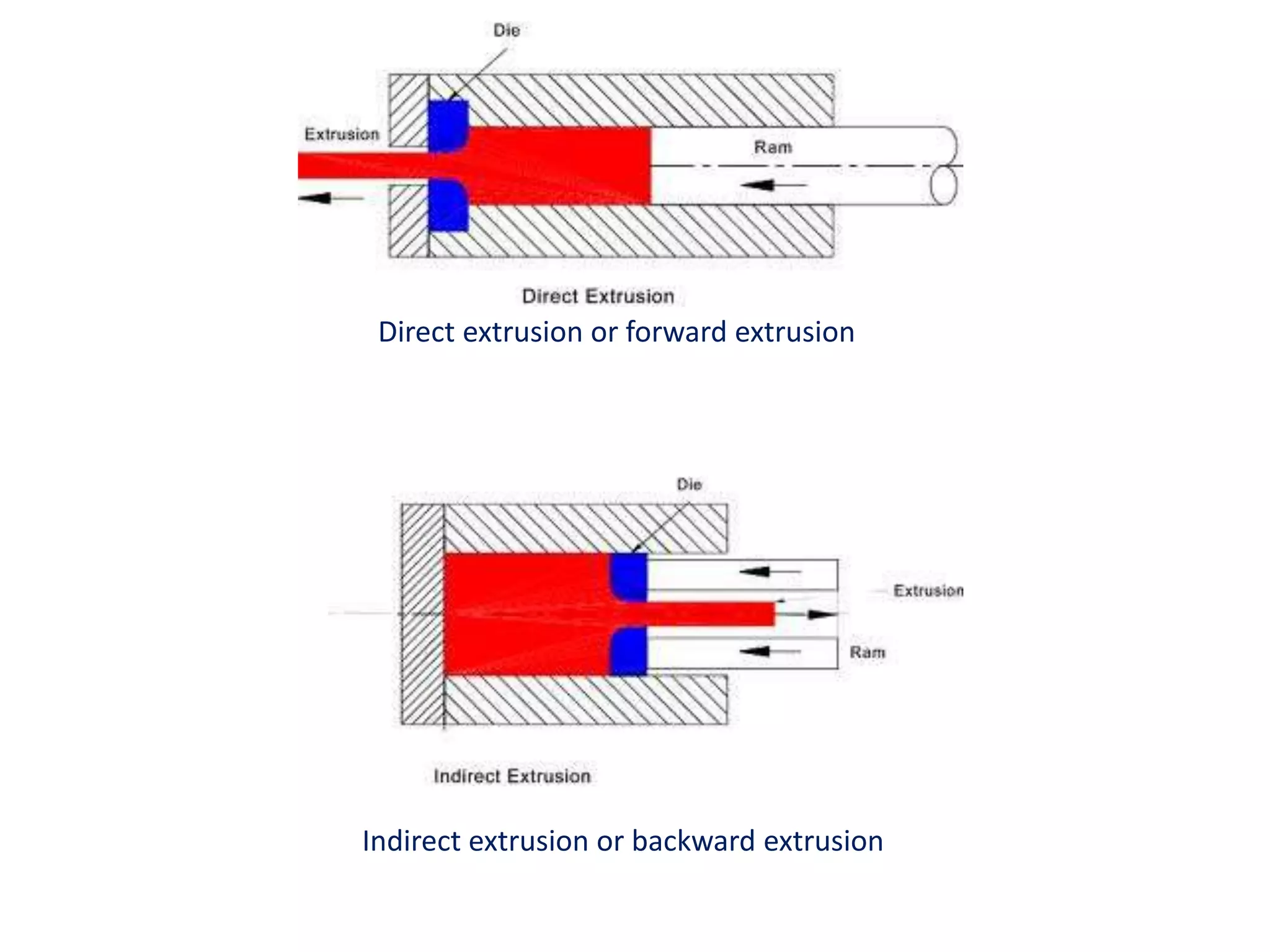
Direct extrusion or forward extrusion
Indirect extrusion or backward extrusion
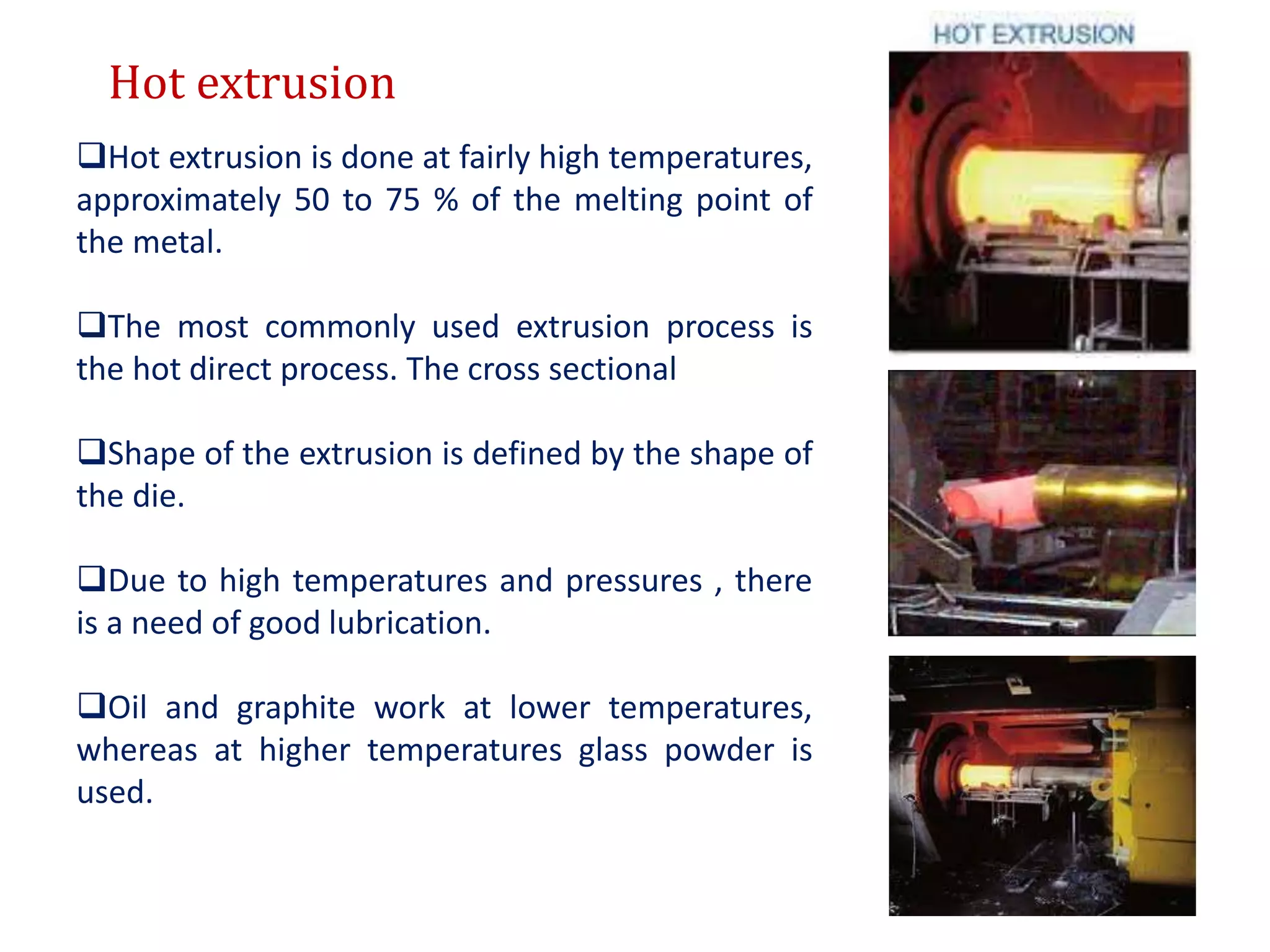
Hot extrusion
Hot extrusion is done at fairly high temperatures,
approximately 50 to 75 % of the melting point of
the metal.
The most commonly used extrusion process is
the hot direct process. The cross sectional
Shape of the extrusion is defined by the shape of
the die.
Due to high temperatures and pressures , there
is a need of good lubrication.
Oil and graphite work at lower temperatures,
whereas at higher temperatures glass powder is
used.
Cold extrusion
Cold extrusion is the process done at room temperature or slightly elevated temperatures.
This process can be used for most materials subject to designing robust enough tooling that
Can withstand the stresses created by extrusion.
Examples : lead , tin, aluminium alloys, copper.
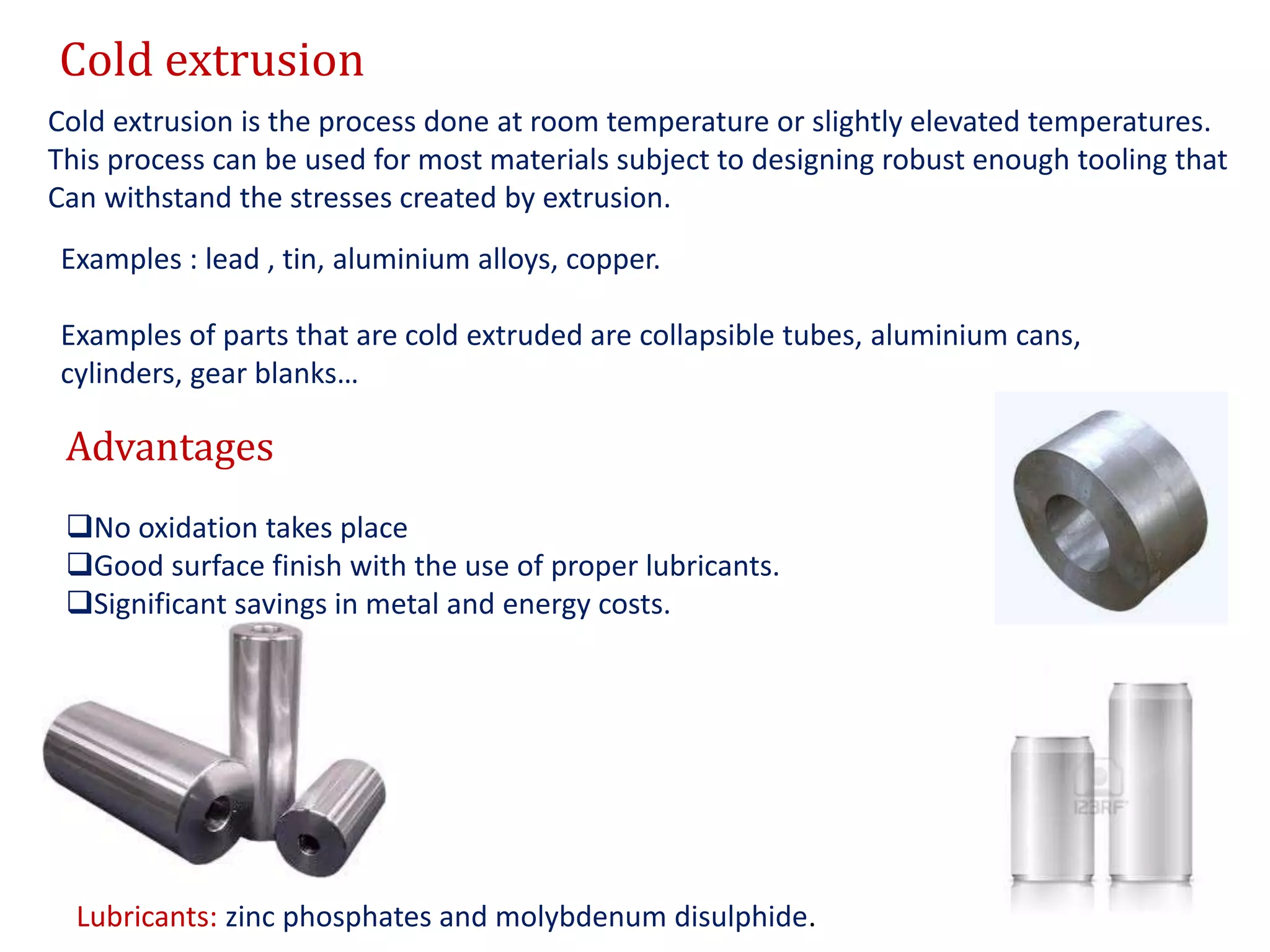
Examples of parts that are cold extruded are collapsible tubes, aluminium cans,
cylinders, gear blanks…
Advantages
No oxidation takes place
Good surface finish with the use of proper lubricants.
Significant savings in metal and energy costs.
Lubricants: zinc phosphates and molybdenum disulphide.
Extrusion equipment
(presses, dies and tools)
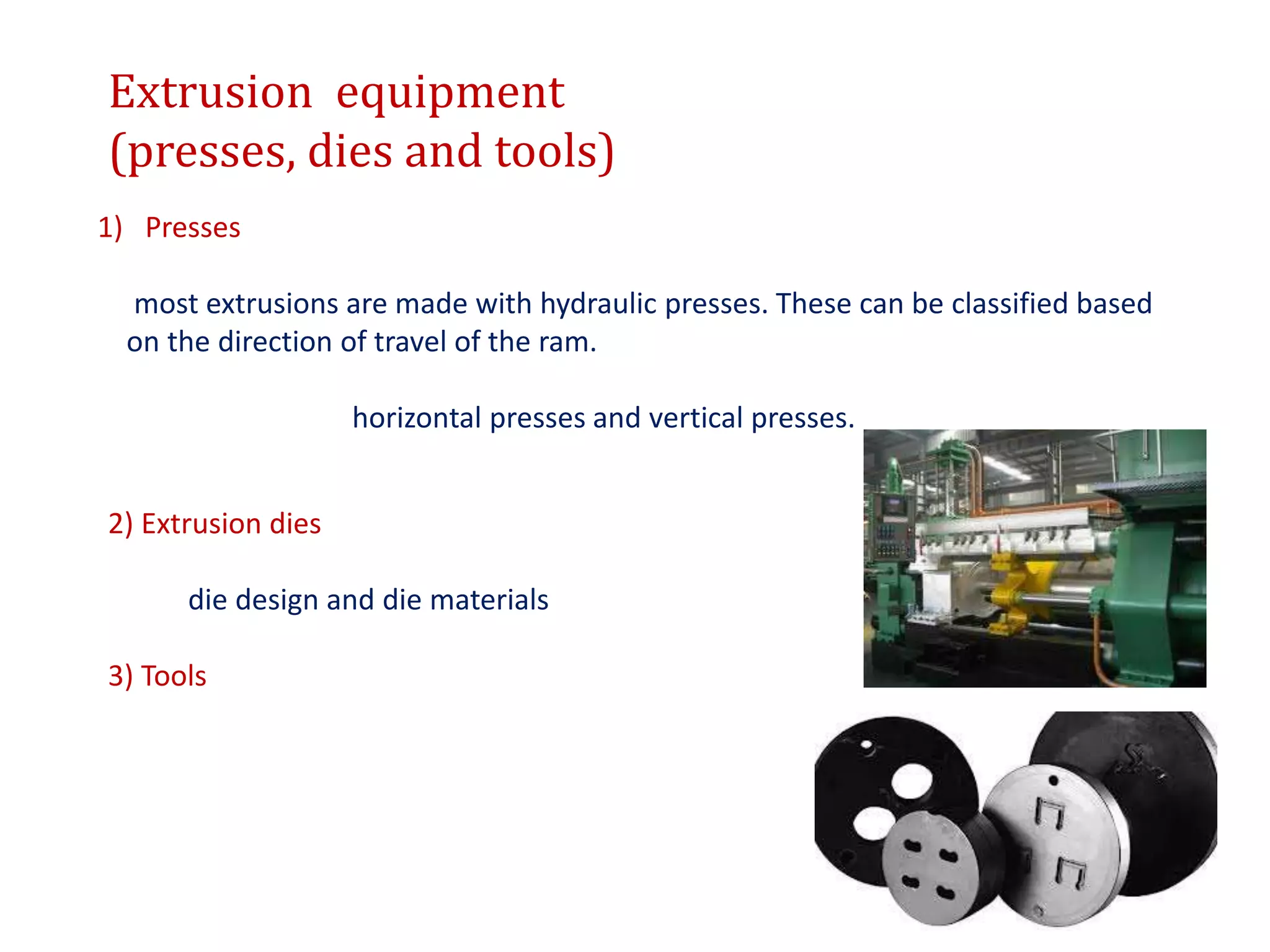
1) Presses
most extrusions are made with hydraulic presses. These can be classified based
on the direction of travel of the ram.
horizontal presses and vertical presses.
2) Extrusion dies
die design and die materials
3) Tools
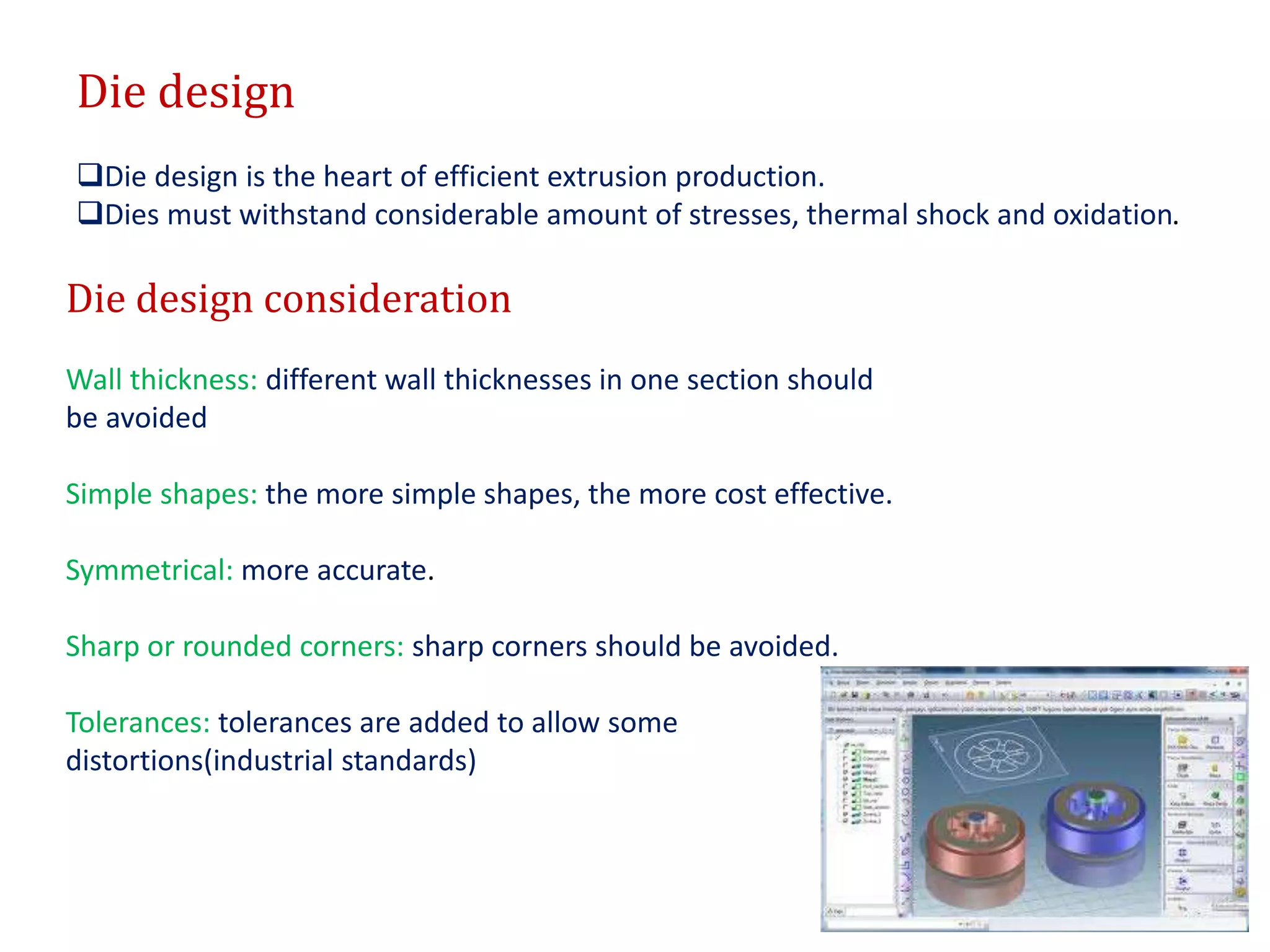
Die design
Die design is the heart of efficient extrusion production.
Dies must withstand considerable amount of stresses, thermal shock and oxidation.
Die design consideration
Wall thickness: different wall thicknesses in one section should
be avoided
Simple shapes: the more simple shapes, the more cost effective.
Symmetrical: more accurate.
Sharp or rounded corners: sharp corners should be avoided.
Tolerances: tolerances are added to allow some
distortions(industrial standards)
Die materials
Dies are made from high alloy tool steels or ceramics (zirconia,
Si3N4)
Heat treatments such as nitriding are required(several times) to
increase
hardness. This improves die life, avoiding unscheduled press
shutdown.
Wall thickness as small as 0.5 mm(on flat dies) or 0.7 mm(on
hollow dies) can be made for aluminium extrusion
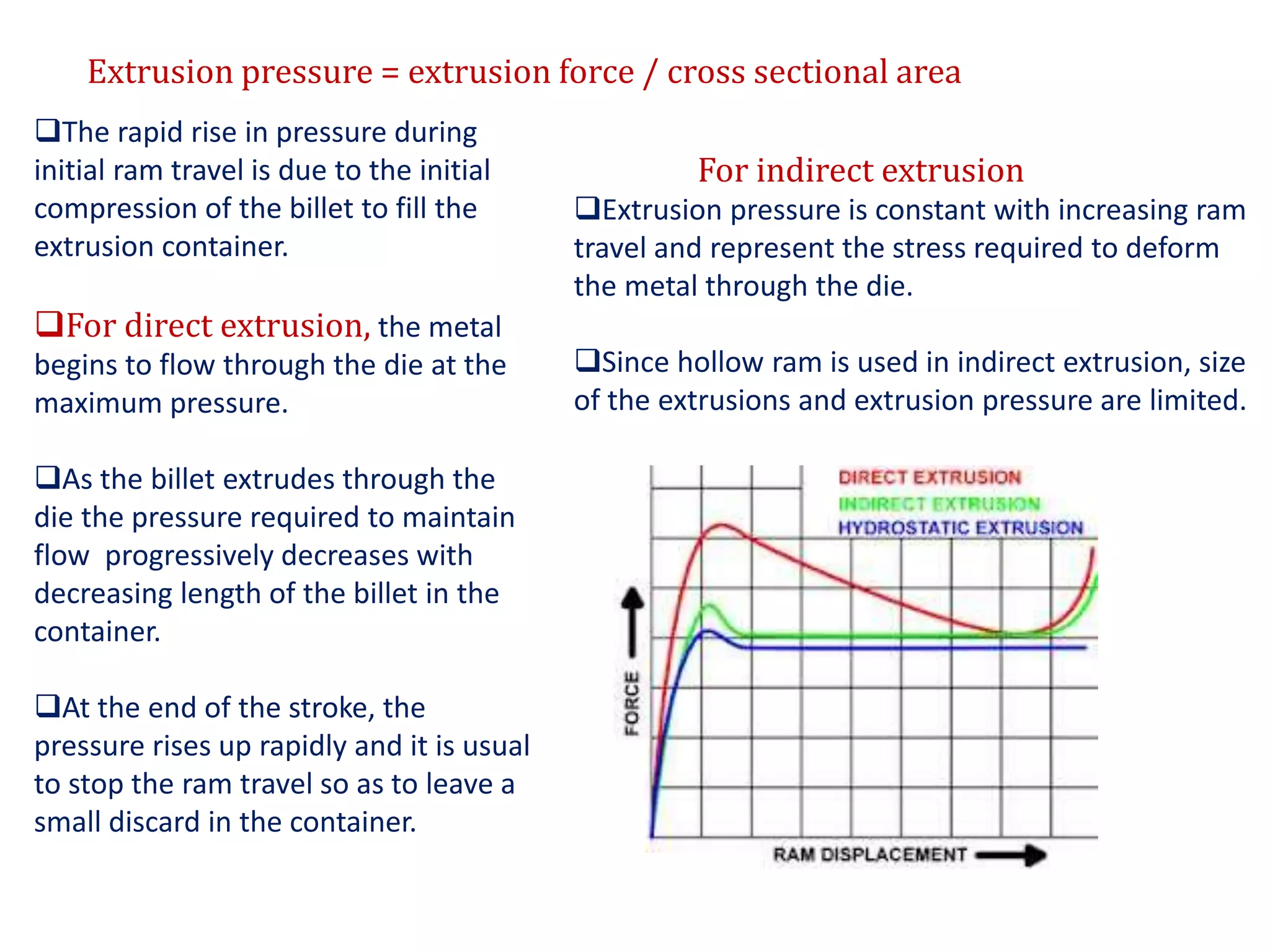
Extrusion pressure = extrusion force / cross sectional area
The rapid rise in pressure during
initial ram travel is due to the initial
compression of the billet to fill the
extrusion container.
For direct extrusion, the metal
begins to flow through the die at the
maximum pressure.
As the billet extrudes through the
die the pressure required to maintain
flow progressively decreases with
decreasing length of the billet in the
container.
At the end of the stroke, the
pressure rises up rapidly and it is usual
to stop the ram travel so as to leave a
small discard in the container.
For indirect extrusion
Extrusion pressure is constant with increasing ram
travel and represent the stress required to deform
the metal through the die.
Since hollow ram is used in indirect extrusion, size
of the extrusions and extrusion pressure are limited.
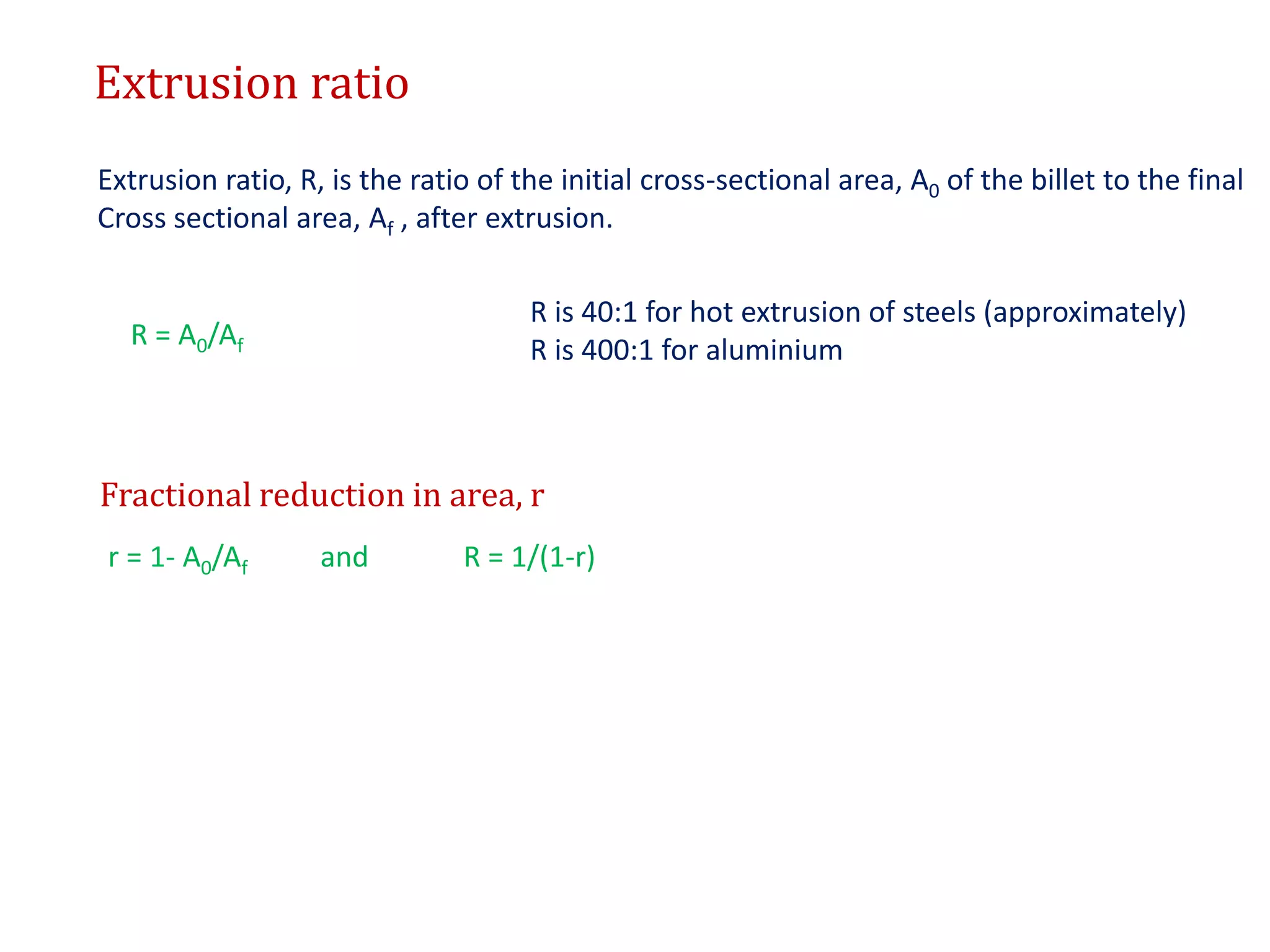
Extrusion ratio
Extrusion ratio, R, is the ratio of the initial cross-sectional area, A0 of the billet to the final
Cross sectional area, Af , after extrusion.
R = A0/Af
R is 40:1 for hot extrusion of steels (approximately)
R is 400:1 for aluminium
Fractional reduction in area, r
r = 1- A0/Af and R = 1/(1-r)
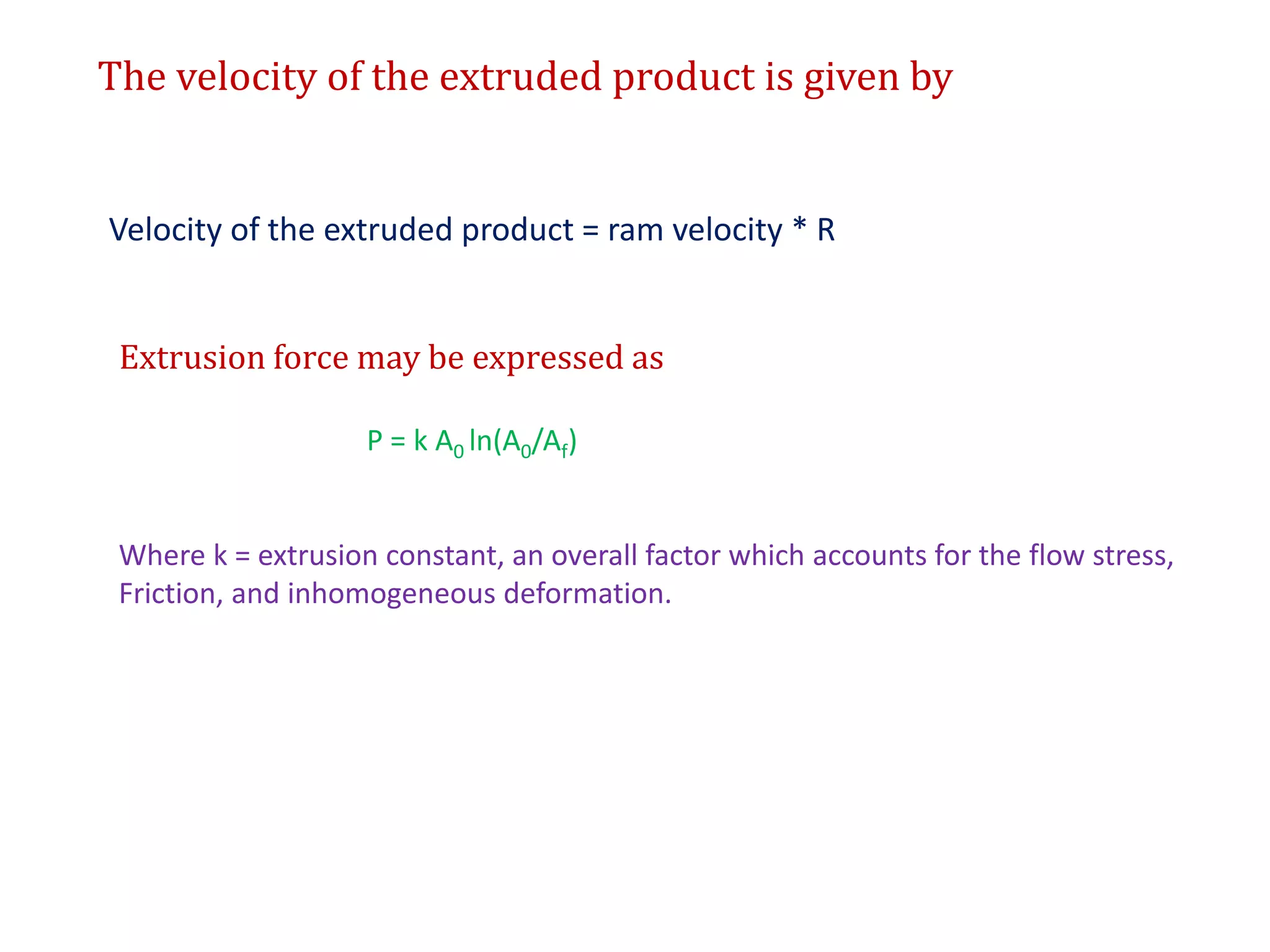
The velocity of the extruded product is given by
Velocity of the extruded product = ram velocity * R
Extrusion force may be expressed as
P = k A0 ln(A0/Af)
Where k = extrusion constant, an overall factor which accounts for the flow stress,
Friction, and inhomogeneous deformation.
Effects of temperature on hot extrusion
Decreased flow stress or deformation resistance due to increasing extrusion temperature
Use minimum temperature to provide metal with suitable plasticity.
The top working temperature should be safely below the melting point.
Oxidation of billet and extrusion tools.
Difficult to provide adequate lubrication.
The temperature of the work piece in metal working
depends on
The initial temperature of the tools and the materials.
Heat generated due to plastic deformation
Heat generated by friction at the die/material interface(highest)
Heat transfer between the deforming material and the dies and the
surrounding
Environment.
Working temperature in extrusion is normally higher than used in forging and rolling
due to relatively large compressive stresses in minimizing cracking.
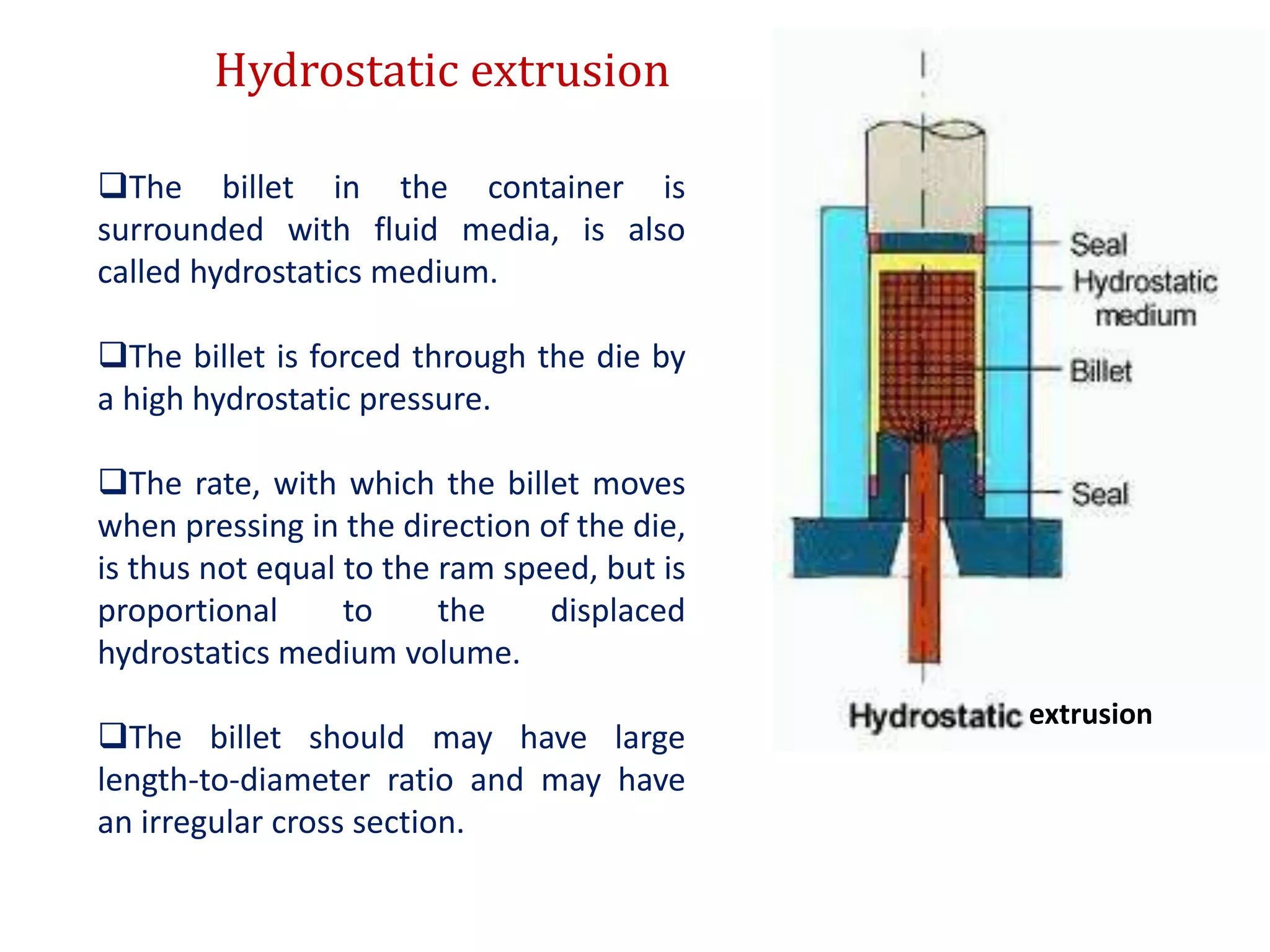
Hydrostatic extrusion
The billet in the container is
surrounded with fluid media, is also
called hydrostatics medium.
The billet is forced through the die by
a high hydrostatic pressure.
The rate, with which the billet moves
when pressing in the direction of the die,
is thus not equal to the ram speed, but is
proportional to the displaced
hydrostatics medium volume.
The billet should may have large
length-to-diameter ratio and may have
an irregular cross section.
extrusion
Extrusion defects
 Inhomogeneous deformation: in direct extrusion there occurs a dead zone along the
Outer surface of the billet due to the movement of the metal in the centre being higher
than the periphery.
 Surface cracking: this is due to longitudinal tensile stresses generated as the
Extrusion passes the die. And also due heavy die friction. At lower temperatures, sticking in
the die land and the sudden building up of pressure and then breakaway will cause
transverse cracking
 Variations in structure and properties: within the extrusions due to non-uniform
Deformation for example at the front and the back of the extrusion in both longitudinal and
Transverse directions. Exaggerated grain growth can occur due to high hot working
Temperature.
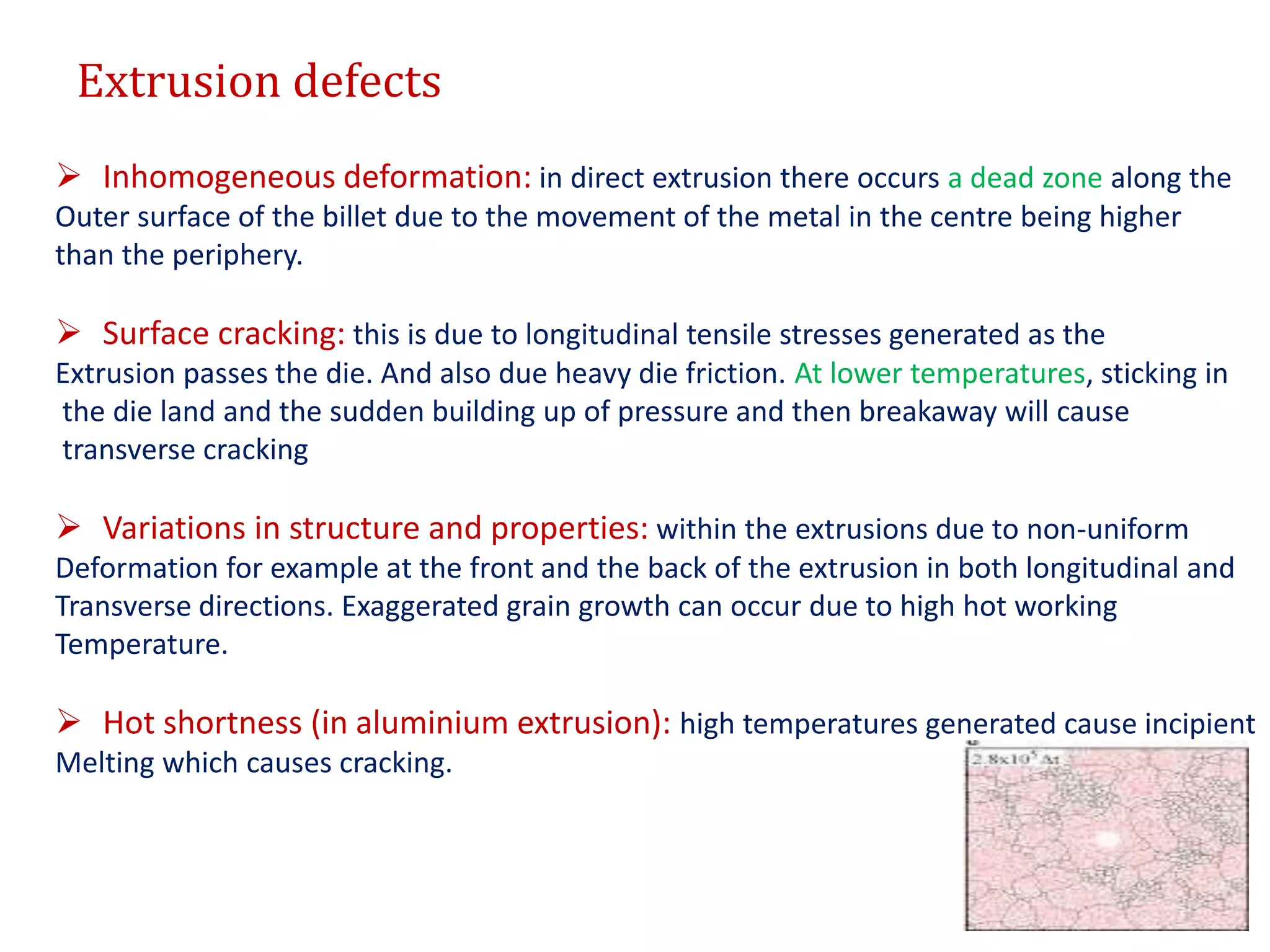
 Hot shortness (in aluminium extrusion): high temperatures generated cause incipient
Melting which causes cracking.
Features of Extrusion Process:
Cost effective: Minimizes the need for secondary
machining process.
Surface finish: For steel is 3 μm, for Aluminium and
Magnesium -0.8 μm
Cross-section: Wide variety of cross-sections can be
made.
Minimum thickness: For steel 3 mm, for Aluminium
and Magnesium 1mm
Minimum cross section
References
 Mechanical Metallurgy by George E.Dieter.
 Introduction to Extrusion by Paul
N.Richardson.
 Experience and applications of extrusion by
Mary Cristensen.
 www.wikipedia.org
Overview of extrusion process

Overview of extrusion process

  • 1.
    Vamsi Krishna. R 12ETMM10 Int.M.Tech / Ph.D Materials Engineering SEST, UoH Overview Of Extrusion
  • 2.
    contents • Introduction • Classification •Extrusion Equipment • Extrusion Pressure • Extrusion Ratio • Hydrostatic Extrusion • Extrusion Defects • Features Of Extrusion
  • 3.
    Extrusion Extrusion is theprocess by which a block/billet of metal is reduced in cross section by forcing it to flow through a die orifice under high pressure. In general, extrusion is used to produce cylindrical bars or hollow tubes. Most metals are hot extruded due to large amount of forces required in extrusion. Complex shape can be extruded from the more readily extrudable metals such as aluminium The reaction of the extrusion billet with the container and die results in high compressive stresses which are effective in reducing cracking of materials during primary breakdown from the ingot. This helps to increase the utilization of extrusion in the working of metals that are difficult to form like stainless steels, nickel based alloys and other high temperature materials.
  • 4.
    Classification of extrusionprocesses There are several ways to classify metal extrusion processes By direction direct or forward extrusion indirect or backward extrusion By operating temperature hot extrusion cold extrusion By equipment horizontal and vertical extrusion
  • 5.
    Direct extrusion orforward extrusion Indirect extrusion or backward extrusion
  • 6.
    Hot extrusion Hot extrusionis done at fairly high temperatures, approximately 50 to 75 % of the melting point of the metal. The most commonly used extrusion process is the hot direct process. The cross sectional Shape of the extrusion is defined by the shape of the die. Due to high temperatures and pressures , there is a need of good lubrication. Oil and graphite work at lower temperatures, whereas at higher temperatures glass powder is used.
  • 7.
    Cold extrusion Cold extrusionis the process done at room temperature or slightly elevated temperatures. This process can be used for most materials subject to designing robust enough tooling that Can withstand the stresses created by extrusion. Examples : lead , tin, aluminium alloys, copper. Examples of parts that are cold extruded are collapsible tubes, aluminium cans, cylinders, gear blanks… Advantages No oxidation takes place Good surface finish with the use of proper lubricants. Significant savings in metal and energy costs. Lubricants: zinc phosphates and molybdenum disulphide.
  • 8.
    Extrusion equipment (presses, diesand tools) 1) Presses most extrusions are made with hydraulic presses. These can be classified based on the direction of travel of the ram. horizontal presses and vertical presses. 2) Extrusion dies die design and die materials 3) Tools
  • 9.
    Die design Die designis the heart of efficient extrusion production. Dies must withstand considerable amount of stresses, thermal shock and oxidation. Die design consideration Wall thickness: different wall thicknesses in one section should be avoided Simple shapes: the more simple shapes, the more cost effective. Symmetrical: more accurate. Sharp or rounded corners: sharp corners should be avoided. Tolerances: tolerances are added to allow some distortions(industrial standards)
  • 10.
    Die materials Dies aremade from high alloy tool steels or ceramics (zirconia, Si3N4) Heat treatments such as nitriding are required(several times) to increase hardness. This improves die life, avoiding unscheduled press shutdown. Wall thickness as small as 0.5 mm(on flat dies) or 0.7 mm(on hollow dies) can be made for aluminium extrusion
  • 11.
    Extrusion pressure =extrusion force / cross sectional area The rapid rise in pressure during initial ram travel is due to the initial compression of the billet to fill the extrusion container. For direct extrusion, the metal begins to flow through the die at the maximum pressure. As the billet extrudes through the die the pressure required to maintain flow progressively decreases with decreasing length of the billet in the container. At the end of the stroke, the pressure rises up rapidly and it is usual to stop the ram travel so as to leave a small discard in the container. For indirect extrusion Extrusion pressure is constant with increasing ram travel and represent the stress required to deform the metal through the die. Since hollow ram is used in indirect extrusion, size of the extrusions and extrusion pressure are limited.
  • 12.
    Extrusion ratio Extrusion ratio,R, is the ratio of the initial cross-sectional area, A0 of the billet to the final Cross sectional area, Af , after extrusion. R = A0/Af R is 40:1 for hot extrusion of steels (approximately) R is 400:1 for aluminium Fractional reduction in area, r r = 1- A0/Af and R = 1/(1-r)
  • 13.
    The velocity ofthe extruded product is given by Velocity of the extruded product = ram velocity * R Extrusion force may be expressed as P = k A0 ln(A0/Af) Where k = extrusion constant, an overall factor which accounts for the flow stress, Friction, and inhomogeneous deformation.
  • 14.
    Effects of temperatureon hot extrusion Decreased flow stress or deformation resistance due to increasing extrusion temperature Use minimum temperature to provide metal with suitable plasticity. The top working temperature should be safely below the melting point. Oxidation of billet and extrusion tools. Difficult to provide adequate lubrication. The temperature of the work piece in metal working depends on The initial temperature of the tools and the materials. Heat generated due to plastic deformation Heat generated by friction at the die/material interface(highest) Heat transfer between the deforming material and the dies and the surrounding Environment. Working temperature in extrusion is normally higher than used in forging and rolling due to relatively large compressive stresses in minimizing cracking.
  • 15.
    Hydrostatic extrusion The billetin the container is surrounded with fluid media, is also called hydrostatics medium. The billet is forced through the die by a high hydrostatic pressure. The rate, with which the billet moves when pressing in the direction of the die, is thus not equal to the ram speed, but is proportional to the displaced hydrostatics medium volume. The billet should may have large length-to-diameter ratio and may have an irregular cross section. extrusion
  • 16.
    Extrusion defects  Inhomogeneousdeformation: in direct extrusion there occurs a dead zone along the Outer surface of the billet due to the movement of the metal in the centre being higher than the periphery.  Surface cracking: this is due to longitudinal tensile stresses generated as the Extrusion passes the die. And also due heavy die friction. At lower temperatures, sticking in the die land and the sudden building up of pressure and then breakaway will cause transverse cracking  Variations in structure and properties: within the extrusions due to non-uniform Deformation for example at the front and the back of the extrusion in both longitudinal and Transverse directions. Exaggerated grain growth can occur due to high hot working Temperature.  Hot shortness (in aluminium extrusion): high temperatures generated cause incipient Melting which causes cracking.
  • 17.
    Features of ExtrusionProcess: Cost effective: Minimizes the need for secondary machining process. Surface finish: For steel is 3 μm, for Aluminium and Magnesium -0.8 μm Cross-section: Wide variety of cross-sections can be made. Minimum thickness: For steel 3 mm, for Aluminium and Magnesium 1mm Minimum cross section
  • 18.
    References  Mechanical Metallurgyby George E.Dieter.  Introduction to Extrusion by Paul N.Richardson.  Experience and applications of extrusion by Mary Cristensen.  www.wikipedia.org