18/1
Extrusion Process
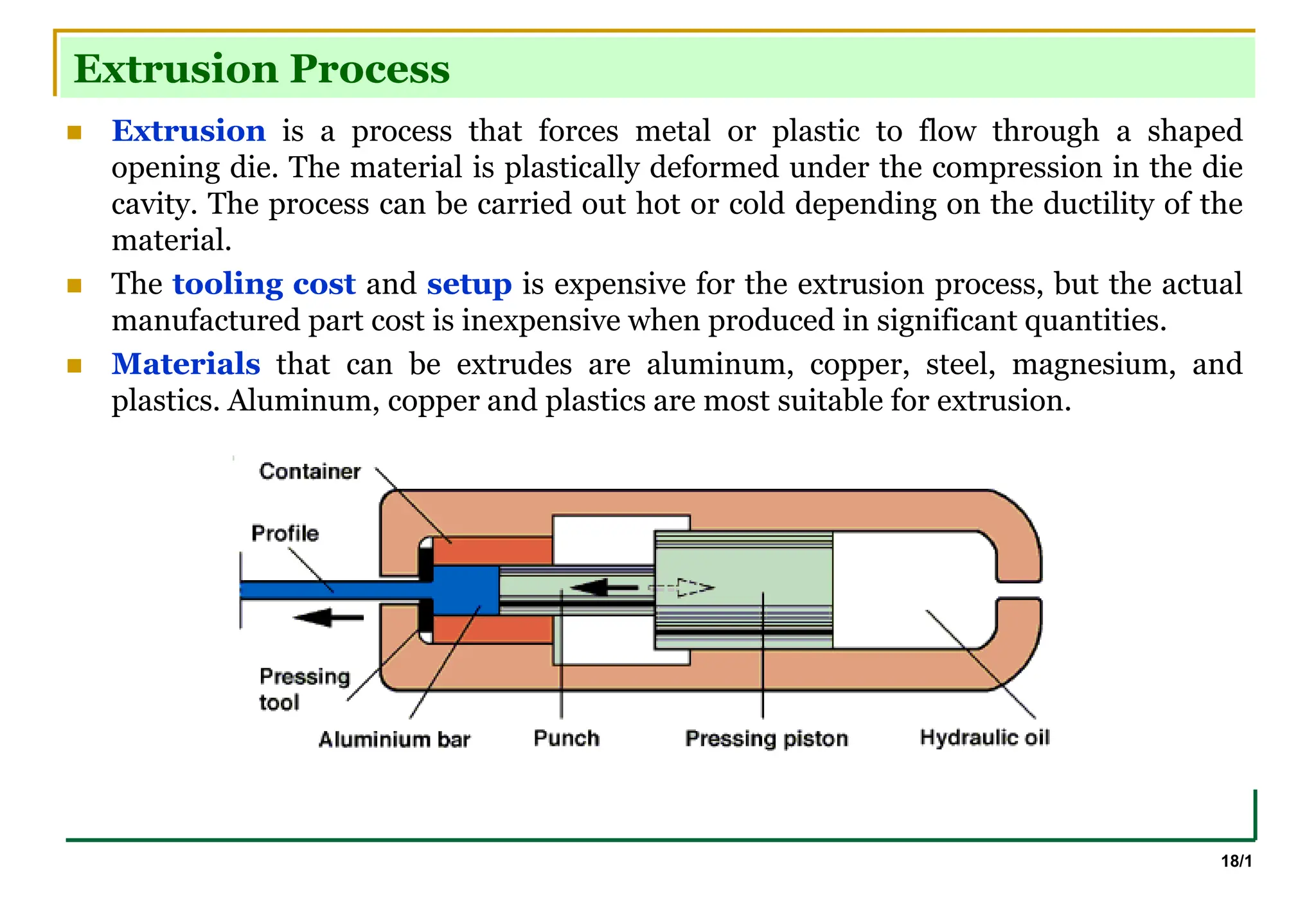
 Extrusion is a process that forces metal or plastic to flow through a shaped
opening die. The material is plastically deformed under the compression in the die
cavity. The process can be carried out hot or cold depending on the ductility of the
material.
 The tooling cost and setup is expensive for the extrusion process, but the actual
manufactured part cost is inexpensive when produced in significant quantities.
 Materials that can be extrudes are aluminum, copper, steel, magnesium, and
plastics. Aluminum, copper and plastics are most suitable for extrusion.
18/2
Extrusions Products
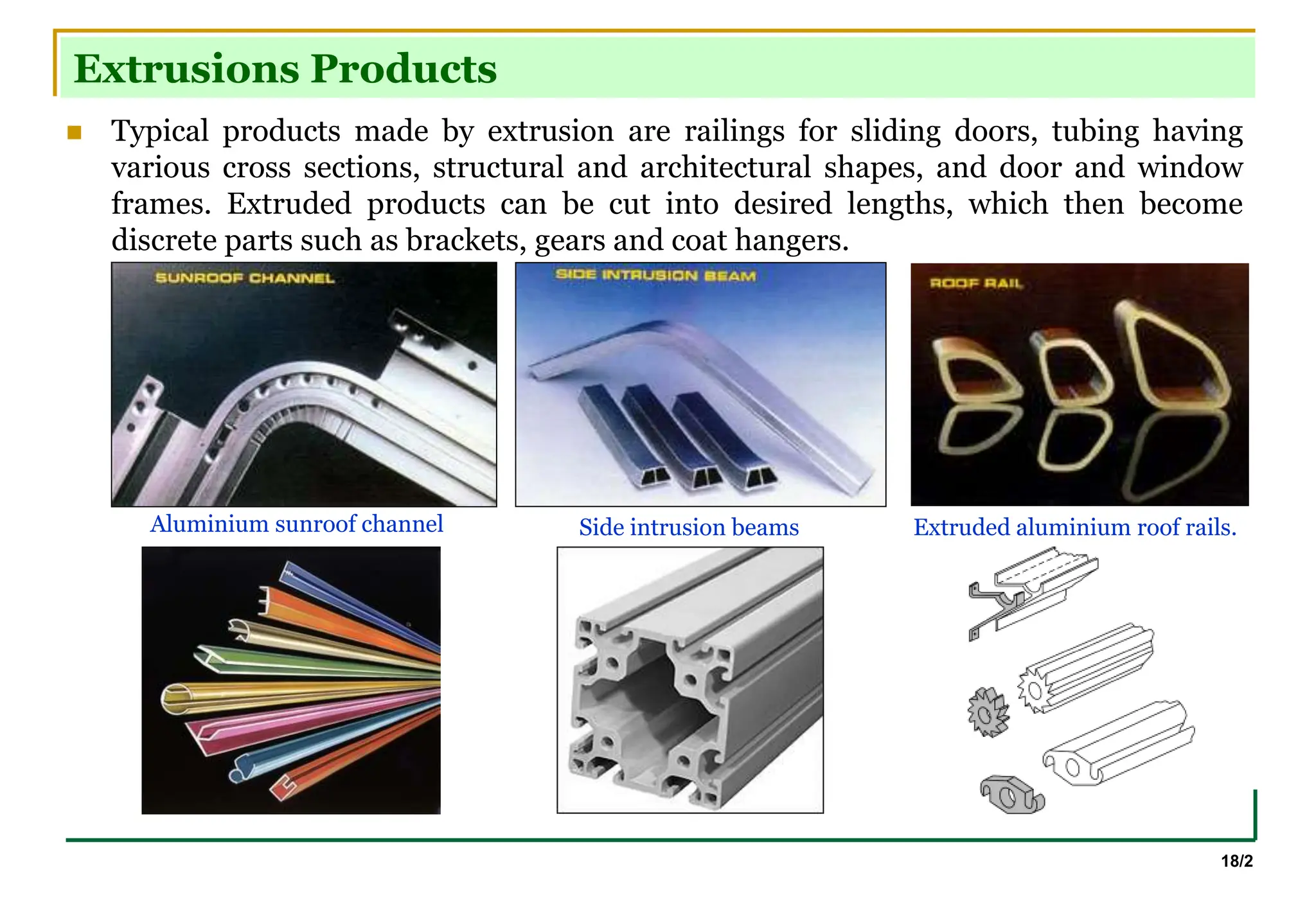
 Typical products made by extrusion are railings for sliding doors, tubing having
various cross sections, structural and architectural shapes, and door and window
frames. Extruded products can be cut into desired lengths, which then become
discrete parts such as brackets, gears and coat hangers.
Aluminium sunroof channel Extruded aluminium roof rails.
Side intrusion beams
18/3
Extrusion Processes
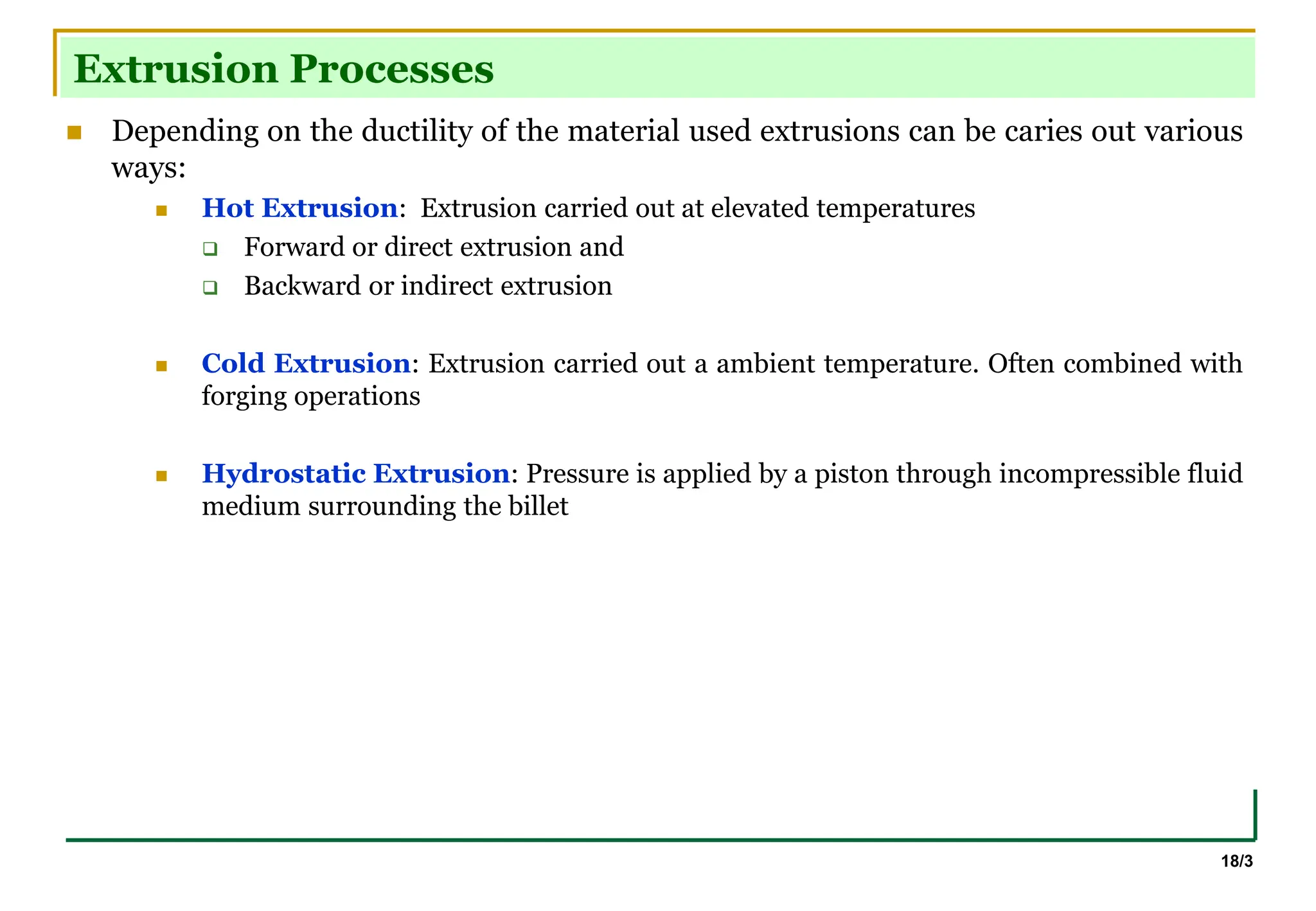
 Depending on the ductility of the material used extrusions can be caries out various
ways:
 Hot Extrusion: Extrusion carried out at elevated temperatures
 Forward or direct extrusion and
 Backward or indirect extrusion
 Cold Extrusion: Extrusion carried out a ambient temperature. Often combined with
forging operations
 Hydrostatic Extrusion: Pressure is applied by a piston through incompressible fluid
medium surrounding the billet
18/4
Hot Extrusion
 Extrusion is carried out at elevated temperatures-for metals and alloys that do not
have sufficient ductility at room temperature, or in order to reduce the forces
required. In this extrusion, die wear can be excessive and cooling of the hot billet in
the chamber can be a problem, which results in highly non-uniform deformation. To
reduce cooling of the billet and to prolong die life, extrusion dies may be preheated,
as is done in hot forging operations. Hot billet causes the following problems:
Because the billet is hot, it develops an oxide film unless heated in an inert-atmosphere
furnace. This film can be abrasive and it can affect the flow pattern of the material.
It also results in an extruded product that may be unacceptable in cases in which good
surface finish is important.
 In order to avoid the formation of oxide films on the hot extruded product, the
dummy block placed ahead of the ram is made a little smaller in diameter than the
container. As a result, a thin cylindrical shell (skull), consisting mainly of the
oxidized layer, is left in the container. The extruded product is thus free of oxides;
the skull is later removed from the chamber. The following figures illustrate the hot
extrusion process for producing solid products by
Forward or direct extrusion process and
Backward or indirect extrusion process
18/5
Direct Extrusion
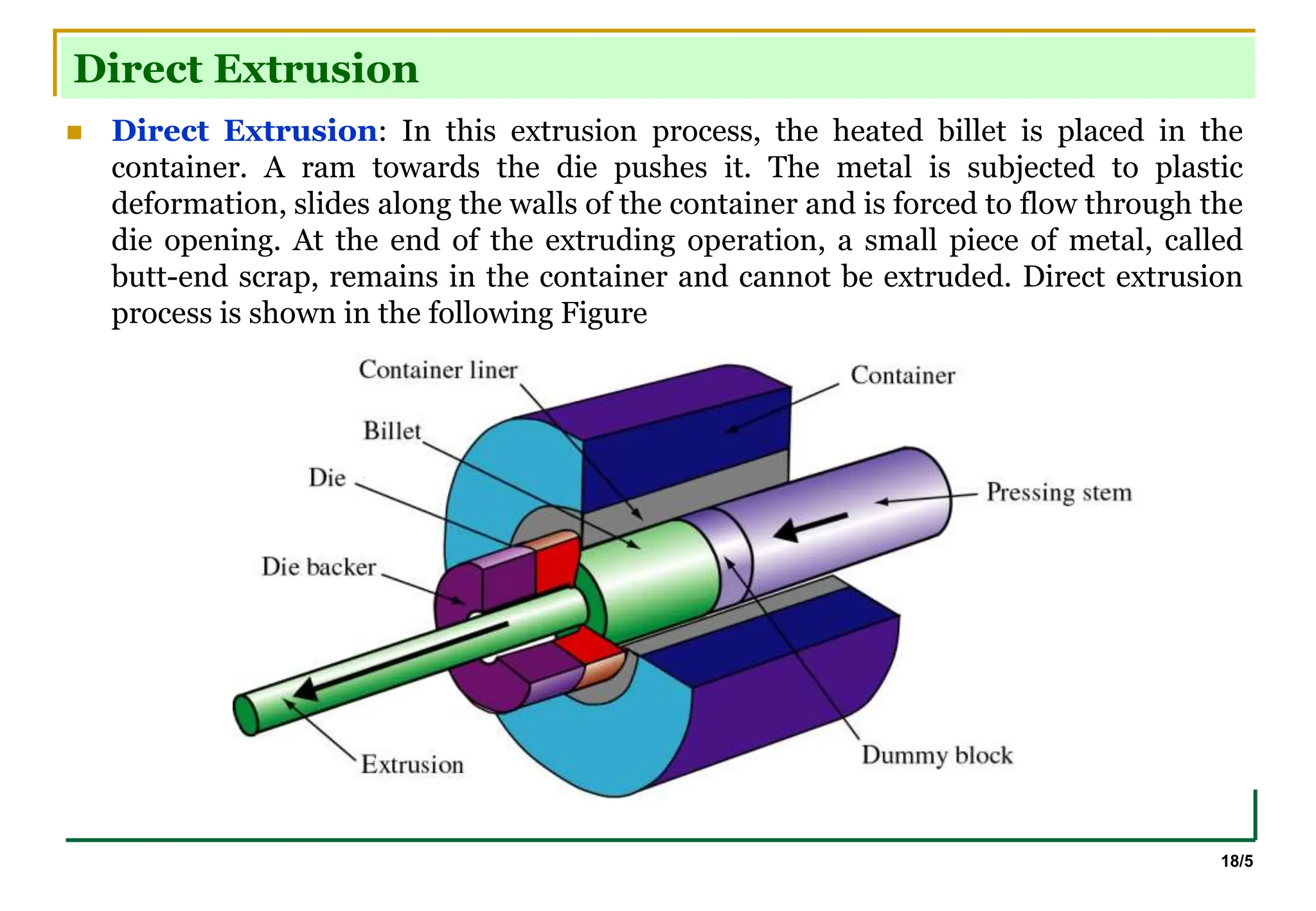
 Direct Extrusion: In this extrusion process, the heated billet is placed in the
container. A ram towards the die pushes it. The metal is subjected to plastic
deformation, slides along the walls of the container and is forced to flow through the
die opening. At the end of the extruding operation, a small piece of metal, called
butt-end scrap, remains in the container and cannot be extruded. Direct extrusion
process is shown in the following Figure
18/6
Indirect Extrusion
 Indirect Extrusion: For the production of solid part, the die is mounted on the
end of a hollow ram and enters the container as shown in the following Figure, the
outer end of container being closed by a closure plate. As the ram travels, the die
applies pressure on the billet and the deformed metal flows through the die opening
in the direction opposite to the ram motions and the product is extruded through
the hollow ram. In indirect extrusion, there is practically no slip of billet with
respect to the container walls.
18/7
Cold Extrusion
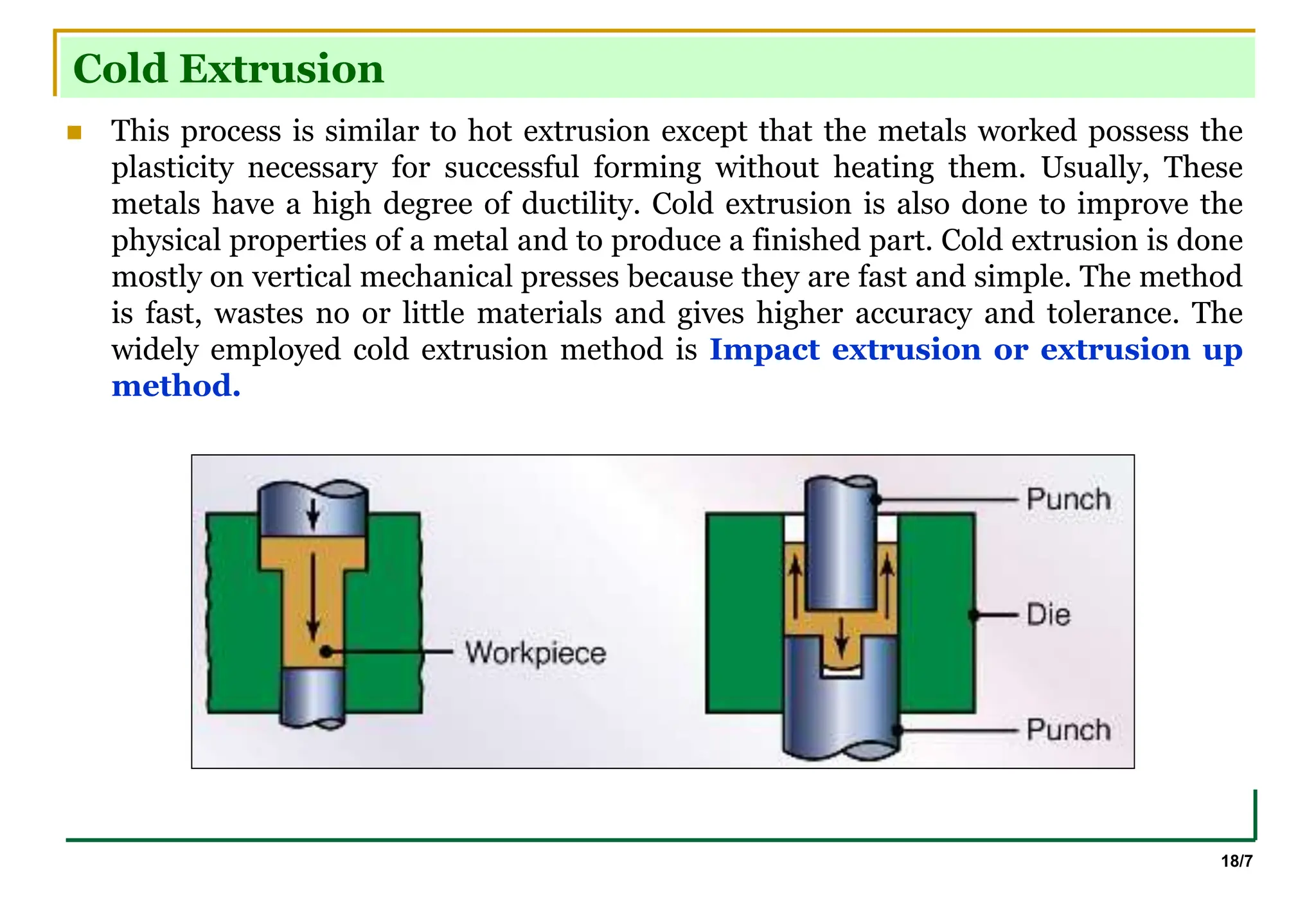
 This process is similar to hot extrusion except that the metals worked possess the
plasticity necessary for successful forming without heating them. Usually, These
metals have a high degree of ductility. Cold extrusion is also done to improve the
physical properties of a metal and to produce a finished part. Cold extrusion is done
mostly on vertical mechanical presses because they are fast and simple. The method
is fast, wastes no or little materials and gives higher accuracy and tolerance. The
widely employed cold extrusion method is Impact extrusion or extrusion up
method.
18/8
Impact Extrusion
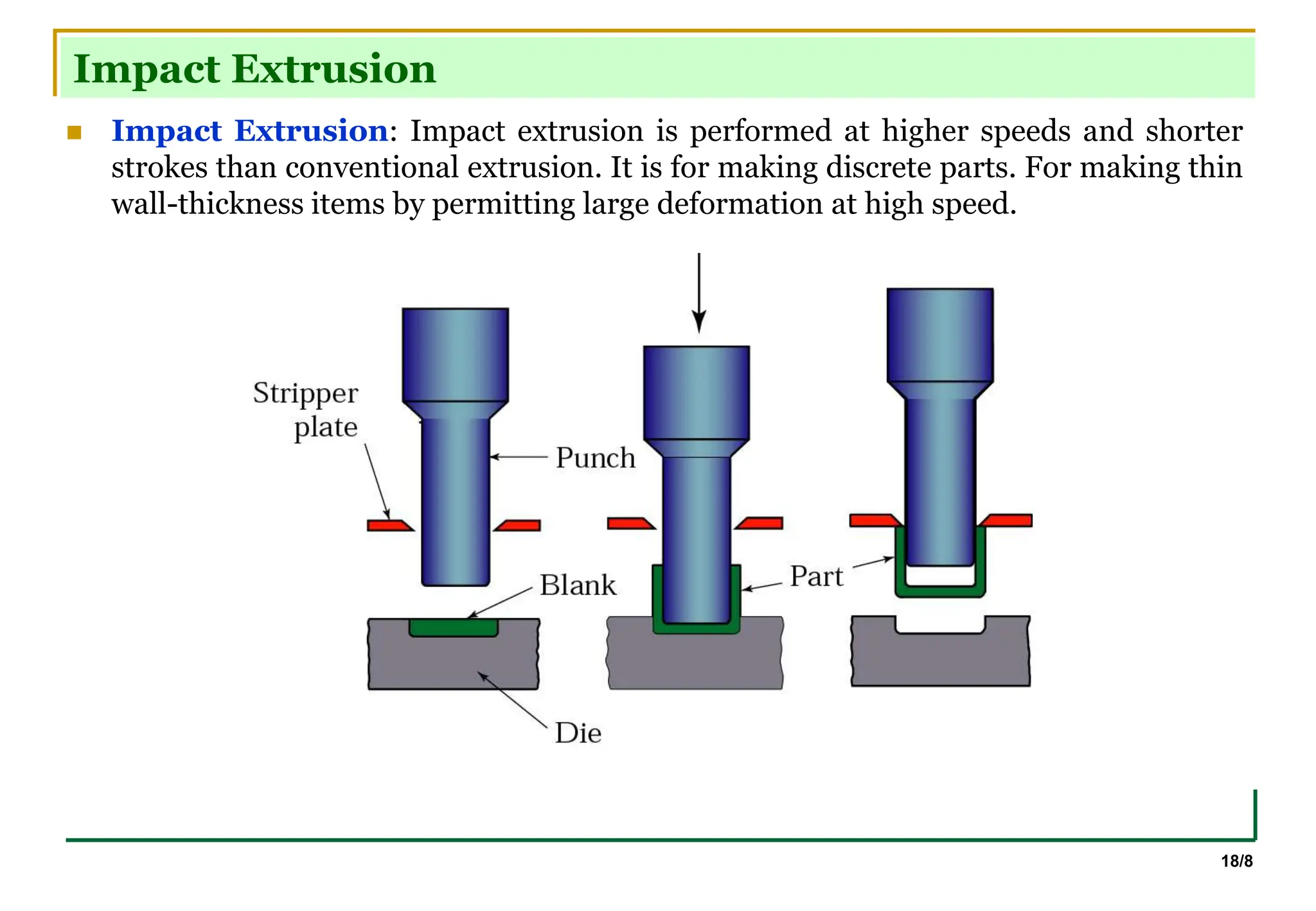
 Impact Extrusion: Impact extrusion is performed at higher speeds and shorter
strokes than conventional extrusion. It is for making discrete parts. For making thin
wall-thickness items by permitting large deformation at high speed.
18/9
Hydrostatic Extrusion
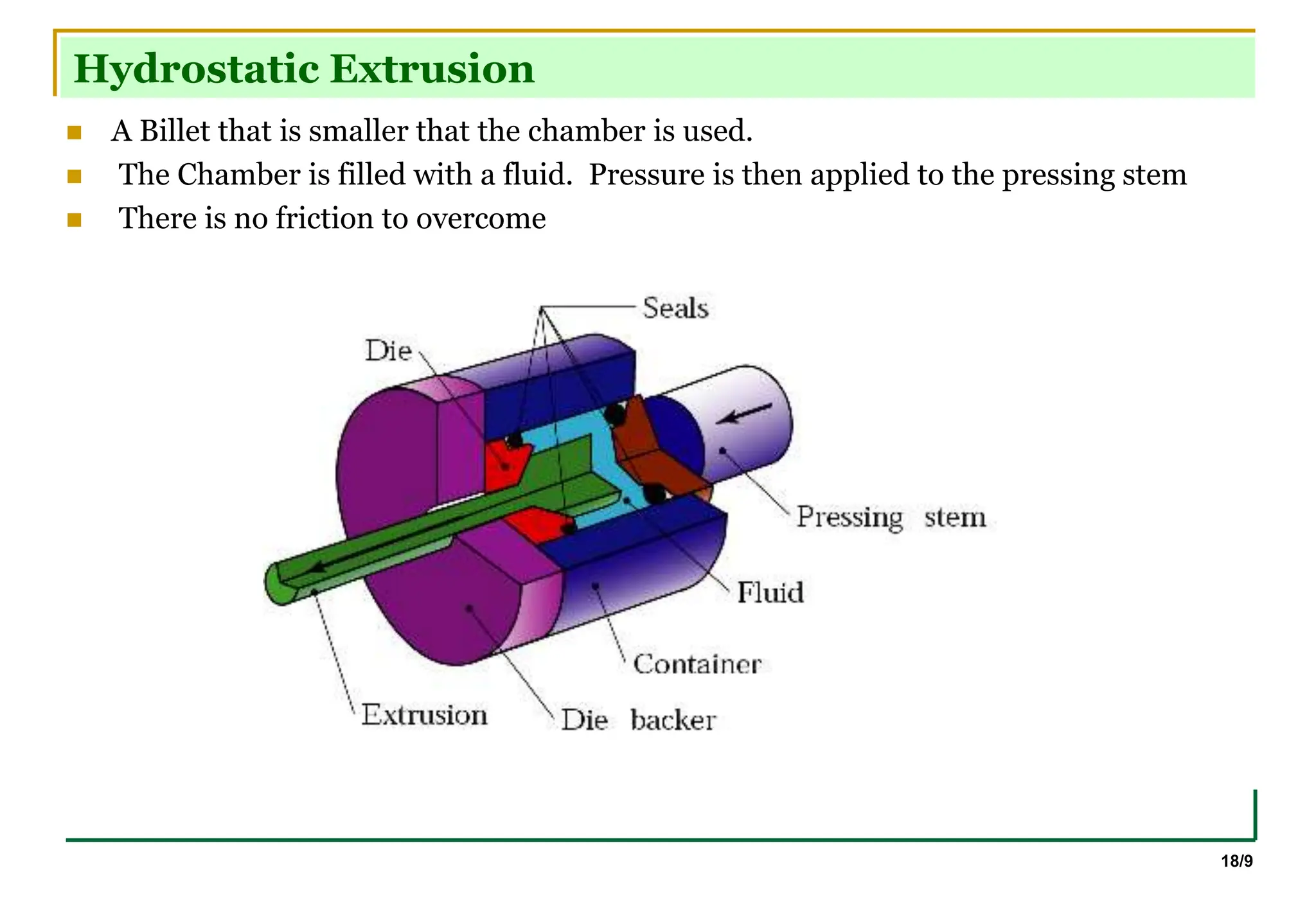
 A Billet that is smaller that the chamber is used.
 The Chamber is filled with a fluid. Pressure is then applied to the pressing stem
 There is no friction to overcome
18/10
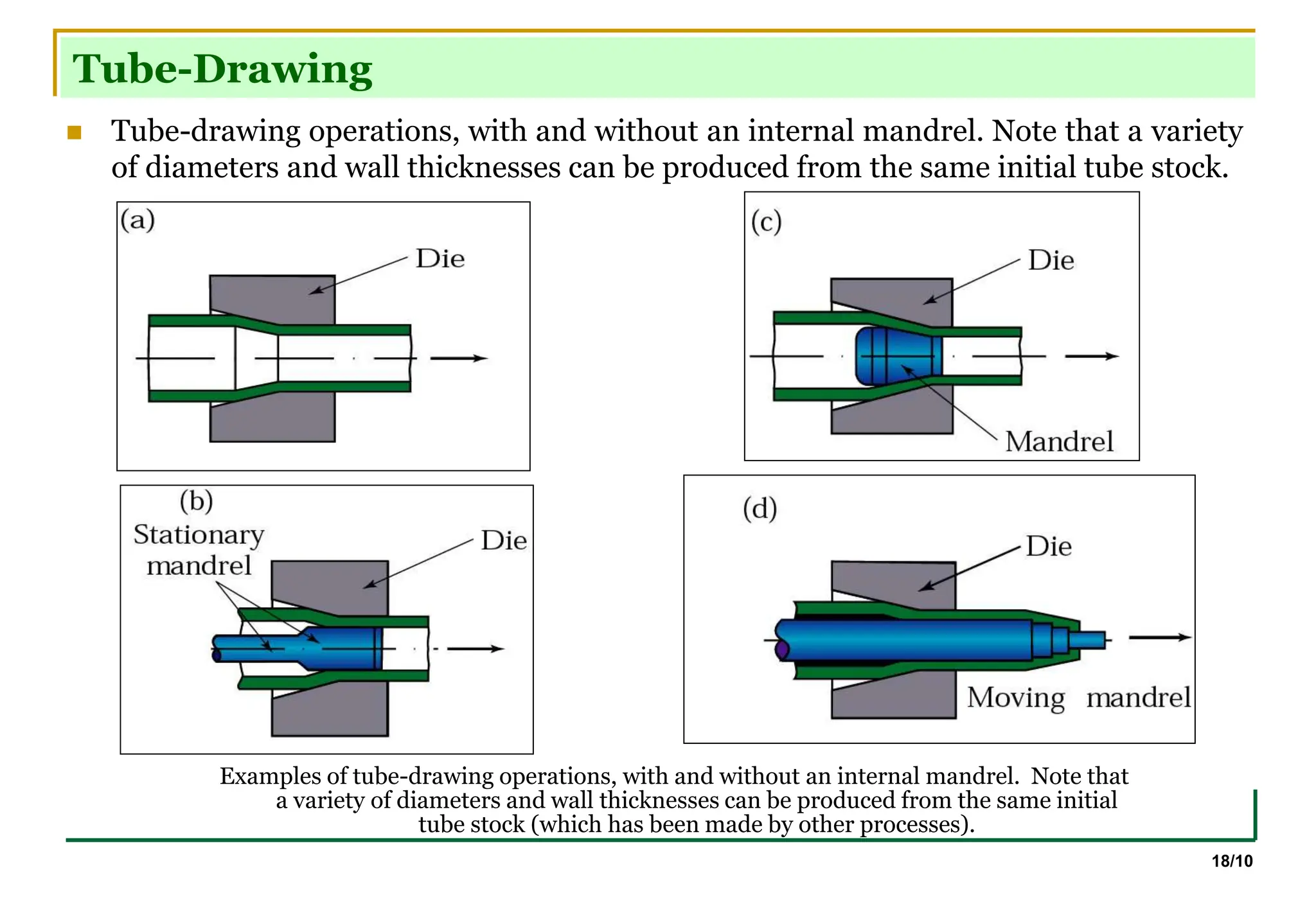
Tube-Drawing
 Tube-drawing operations, with and without an internal mandrel. Note that a variety
of diameters and wall thicknesses can be produced from the same initial tube stock.
Examples of tube-drawing operations, with and without an internal mandrel. Note that
a variety of diameters and wall thicknesses can be produced from the same initial
tube stock (which has been made by other processes).
18/11
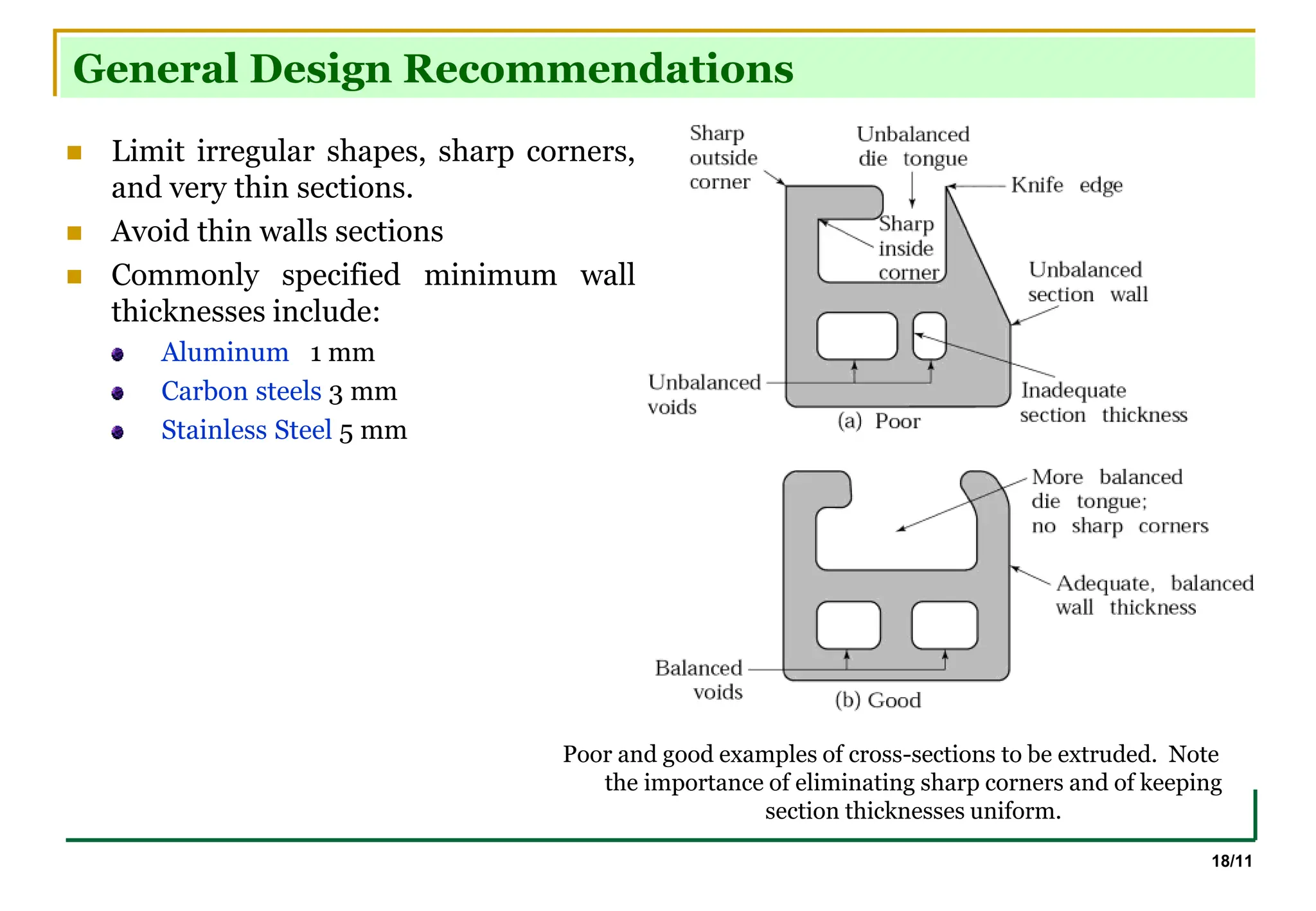
General Design Recommendations
 Limit irregular shapes, sharp corners,
and very thin sections.
 Avoid thin walls sections
 Commonly specified minimum wall
thicknesses include:
Aluminum 1 mm
Carbon steels 3 mm
Stainless Steel 5 mm
Poor and good examples of cross-sections to be extruded. Note
the importance of eliminating sharp corners and of keeping
section thicknesses uniform.
18/12
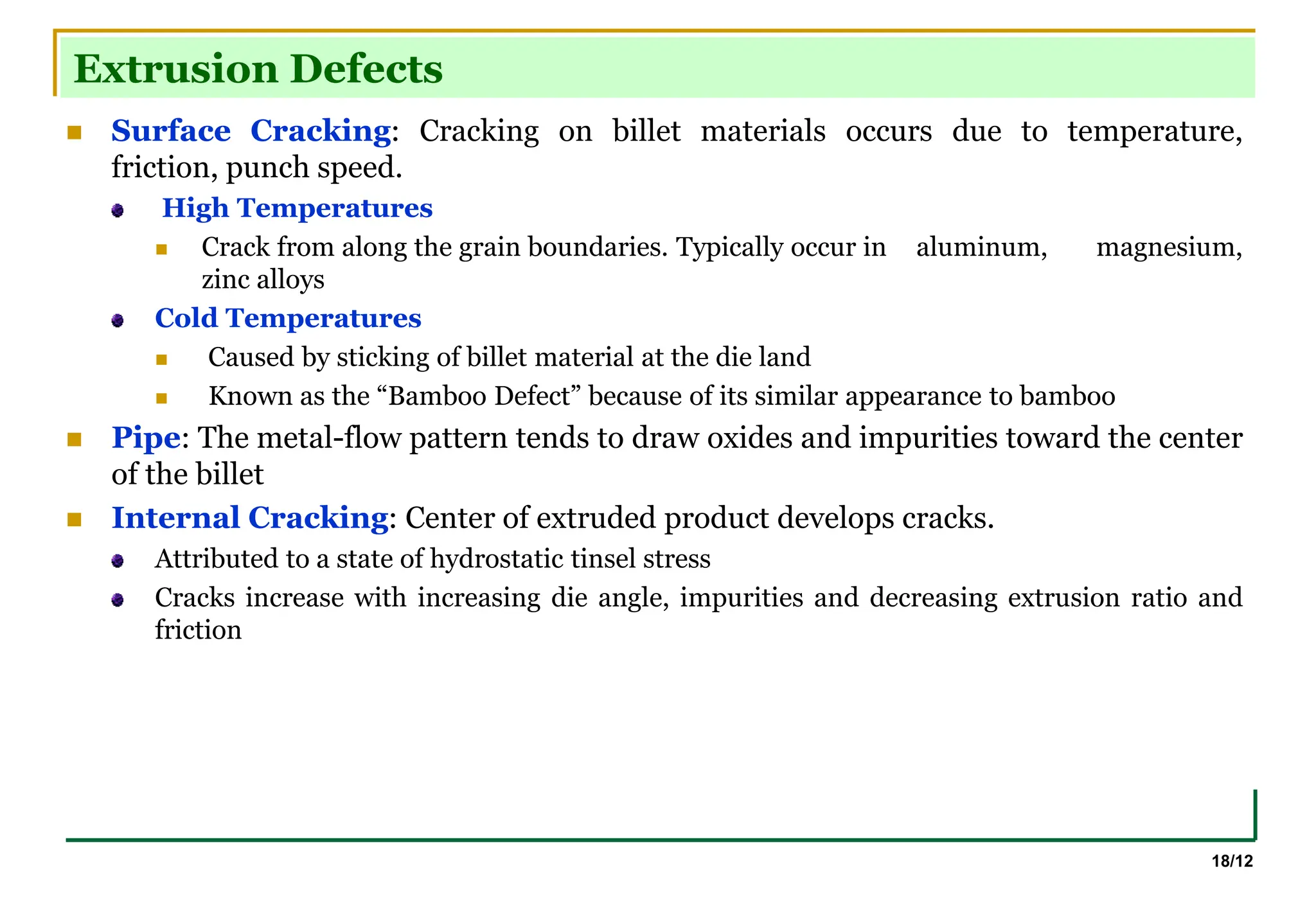
Extrusion Defects
 Surface Cracking: Cracking on billet materials occurs due to temperature,
friction, punch speed.
High Temperatures
 Crack from along the grain boundaries. Typically occur in aluminum, magnesium,
zinc alloys
Cold Temperatures
 Caused by sticking of billet material at the die land
 Known as the “Bamboo Defect” because of its similar appearance to bamboo
 Pipe: The metal-flow pattern tends to draw oxides and impurities toward the center
of the billet
 Internal Cracking: Center of extruded product develops cracks.
Attributed to a state of hydrostatic tinsel stress
Cracks increase with increasing die angle, impurities and decreasing extrusion ratio and
friction
18/13
Advantages
 The range of extruded items is very wide. Cross-sectional shapes not possible by
rolling can be extruded, such as those with re-entrant sections.
 No time is lost when changing shapes since the dies may by readily removed and
replaced.
 Dimensional accuracy of extruded parts is generally superior to that of rolled ones.
 In extrusion, the ductility of the metals is higher as the metal in the container is in
composite compression, this advantage being of particular importance in working
poorly plastic metals and alloys.
 Very large reductions are possible as compared to rolling, for which the reduction
per pass is generally  2.
 Automation in extrusion is simpler as items are produced in a single passing.
 Small parts in large quantities can be made. For example, to produce a simple pump
gear, a long gear is extruded and then sliced into a number of individual gears.
 It does not need draft or flash to trim and needless machining as it is more accurate
than forging.
18/14
Disadvantages
 Process waste in extrusion is higher than in rolling, where it is only 1 to 3%
 In-homogeneity in structure and properties of an extruded product is greater due to
different flows of the axial and the outer layers of blanks.
 Service life of extrusion tooling is shorter because of high contact stresses and slip
rates.
 Relatively high tooling costs, being made from costly alloy steel.
 In productivity, extrusion is much inferior to rolling, particularly to its continuous
varieties.
 Cost of extrusion are generally greater as compared to other techniques
18/15
Applications
 Extrusion is more widely used in the manufacture of solid and hollow sections from
poorly plastic non-ferrous metals and their alloys (aluminum, copper, brass and
bronze etc.)
 Steel and other ferrous alloys can also be successfully processed with the
development of molten-glass lubricants.
 Manufacture of sections and pipes of complex configuration.
 Medium and small batch production
 Manufacture of parts of high dimensional accuracy
 The range of extruded items is very wide: rods from 3 to 250 mm in diameter, pipes
of 20 to 400 mm in diameter and wall thickness of 1 mm and above and more
complicated shapes which can not be obtained by other mechanical methods.

Material engineering-Material Extrusion.ppt

  • 1.
    18/1 Extrusion Process  Extrusionis a process that forces metal or plastic to flow through a shaped opening die. The material is plastically deformed under the compression in the die cavity. The process can be carried out hot or cold depending on the ductility of the material.  The tooling cost and setup is expensive for the extrusion process, but the actual manufactured part cost is inexpensive when produced in significant quantities.  Materials that can be extrudes are aluminum, copper, steel, magnesium, and plastics. Aluminum, copper and plastics are most suitable for extrusion.
  • 2.
    18/2 Extrusions Products  Typicalproducts made by extrusion are railings for sliding doors, tubing having various cross sections, structural and architectural shapes, and door and window frames. Extruded products can be cut into desired lengths, which then become discrete parts such as brackets, gears and coat hangers. Aluminium sunroof channel Extruded aluminium roof rails. Side intrusion beams
  • 3.
    18/3 Extrusion Processes  Dependingon the ductility of the material used extrusions can be caries out various ways:  Hot Extrusion: Extrusion carried out at elevated temperatures  Forward or direct extrusion and  Backward or indirect extrusion  Cold Extrusion: Extrusion carried out a ambient temperature. Often combined with forging operations  Hydrostatic Extrusion: Pressure is applied by a piston through incompressible fluid medium surrounding the billet
  • 4.
    18/4 Hot Extrusion  Extrusionis carried out at elevated temperatures-for metals and alloys that do not have sufficient ductility at room temperature, or in order to reduce the forces required. In this extrusion, die wear can be excessive and cooling of the hot billet in the chamber can be a problem, which results in highly non-uniform deformation. To reduce cooling of the billet and to prolong die life, extrusion dies may be preheated, as is done in hot forging operations. Hot billet causes the following problems: Because the billet is hot, it develops an oxide film unless heated in an inert-atmosphere furnace. This film can be abrasive and it can affect the flow pattern of the material. It also results in an extruded product that may be unacceptable in cases in which good surface finish is important.  In order to avoid the formation of oxide films on the hot extruded product, the dummy block placed ahead of the ram is made a little smaller in diameter than the container. As a result, a thin cylindrical shell (skull), consisting mainly of the oxidized layer, is left in the container. The extruded product is thus free of oxides; the skull is later removed from the chamber. The following figures illustrate the hot extrusion process for producing solid products by Forward or direct extrusion process and Backward or indirect extrusion process
  • 5.
    18/5 Direct Extrusion  DirectExtrusion: In this extrusion process, the heated billet is placed in the container. A ram towards the die pushes it. The metal is subjected to plastic deformation, slides along the walls of the container and is forced to flow through the die opening. At the end of the extruding operation, a small piece of metal, called butt-end scrap, remains in the container and cannot be extruded. Direct extrusion process is shown in the following Figure
  • 6.
    18/6 Indirect Extrusion  IndirectExtrusion: For the production of solid part, the die is mounted on the end of a hollow ram and enters the container as shown in the following Figure, the outer end of container being closed by a closure plate. As the ram travels, the die applies pressure on the billet and the deformed metal flows through the die opening in the direction opposite to the ram motions and the product is extruded through the hollow ram. In indirect extrusion, there is practically no slip of billet with respect to the container walls.
  • 7.
    18/7 Cold Extrusion  Thisprocess is similar to hot extrusion except that the metals worked possess the plasticity necessary for successful forming without heating them. Usually, These metals have a high degree of ductility. Cold extrusion is also done to improve the physical properties of a metal and to produce a finished part. Cold extrusion is done mostly on vertical mechanical presses because they are fast and simple. The method is fast, wastes no or little materials and gives higher accuracy and tolerance. The widely employed cold extrusion method is Impact extrusion or extrusion up method.
  • 8.
    18/8 Impact Extrusion  ImpactExtrusion: Impact extrusion is performed at higher speeds and shorter strokes than conventional extrusion. It is for making discrete parts. For making thin wall-thickness items by permitting large deformation at high speed.
  • 9.
    18/9 Hydrostatic Extrusion  ABillet that is smaller that the chamber is used.  The Chamber is filled with a fluid. Pressure is then applied to the pressing stem  There is no friction to overcome
  • 10.
    18/10 Tube-Drawing  Tube-drawing operations,with and without an internal mandrel. Note that a variety of diameters and wall thicknesses can be produced from the same initial tube stock. Examples of tube-drawing operations, with and without an internal mandrel. Note that a variety of diameters and wall thicknesses can be produced from the same initial tube stock (which has been made by other processes).
  • 11.
    18/11 General Design Recommendations Limit irregular shapes, sharp corners, and very thin sections.  Avoid thin walls sections  Commonly specified minimum wall thicknesses include: Aluminum 1 mm Carbon steels 3 mm Stainless Steel 5 mm Poor and good examples of cross-sections to be extruded. Note the importance of eliminating sharp corners and of keeping section thicknesses uniform.
  • 12.
    18/12 Extrusion Defects  SurfaceCracking: Cracking on billet materials occurs due to temperature, friction, punch speed. High Temperatures  Crack from along the grain boundaries. Typically occur in aluminum, magnesium, zinc alloys Cold Temperatures  Caused by sticking of billet material at the die land  Known as the “Bamboo Defect” because of its similar appearance to bamboo  Pipe: The metal-flow pattern tends to draw oxides and impurities toward the center of the billet  Internal Cracking: Center of extruded product develops cracks. Attributed to a state of hydrostatic tinsel stress Cracks increase with increasing die angle, impurities and decreasing extrusion ratio and friction
  • 13.
    18/13 Advantages  The rangeof extruded items is very wide. Cross-sectional shapes not possible by rolling can be extruded, such as those with re-entrant sections.  No time is lost when changing shapes since the dies may by readily removed and replaced.  Dimensional accuracy of extruded parts is generally superior to that of rolled ones.  In extrusion, the ductility of the metals is higher as the metal in the container is in composite compression, this advantage being of particular importance in working poorly plastic metals and alloys.  Very large reductions are possible as compared to rolling, for which the reduction per pass is generally  2.  Automation in extrusion is simpler as items are produced in a single passing.  Small parts in large quantities can be made. For example, to produce a simple pump gear, a long gear is extruded and then sliced into a number of individual gears.  It does not need draft or flash to trim and needless machining as it is more accurate than forging.
  • 14.
    18/14 Disadvantages  Process wastein extrusion is higher than in rolling, where it is only 1 to 3%  In-homogeneity in structure and properties of an extruded product is greater due to different flows of the axial and the outer layers of blanks.  Service life of extrusion tooling is shorter because of high contact stresses and slip rates.  Relatively high tooling costs, being made from costly alloy steel.  In productivity, extrusion is much inferior to rolling, particularly to its continuous varieties.  Cost of extrusion are generally greater as compared to other techniques
  • 15.
    18/15 Applications  Extrusion ismore widely used in the manufacture of solid and hollow sections from poorly plastic non-ferrous metals and their alloys (aluminum, copper, brass and bronze etc.)  Steel and other ferrous alloys can also be successfully processed with the development of molten-glass lubricants.  Manufacture of sections and pipes of complex configuration.  Medium and small batch production  Manufacture of parts of high dimensional accuracy  The range of extruded items is very wide: rods from 3 to 250 mm in diameter, pipes of 20 to 400 mm in diameter and wall thickness of 1 mm and above and more complicated shapes which can not be obtained by other mechanical methods.