Manufacturing Technology II
(ME-202)
Sheet Metal
Operations
Dr. Chaitanya Sharma
PhD. IIT Roorkee
Core, Core prints & Chaplets
Lesson Objectives
In this chapter we shall discuss the following:
Core: Need, characteristics, types
Core prints
Chaplets
Learning Activities
1. Look up
Keywords
2. View Slides;
3. Read Notes,
4. Listen to
lecture
Keywords:
Cores
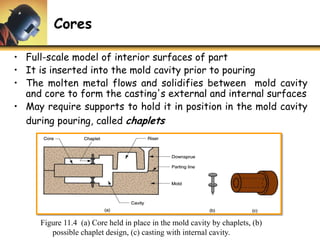
• Full-scale model of interior surfaces of part
• It is inserted into the mold cavity prior to pouring
• The molten metal flows and solidifies between mold cavity
and core to form the casting's external and internal surfaces
• May require supports to hold it in position in the mold cavity
during pouring, called chaplets
Figure 11.4 (a) Core held in place in the mold cavity by chaplets, (b)
possible chaplet design, (c) casting with internal cavity.
Core Parts
A core consists of two portions:
a) The body of the core and
b) one or more extensions called prints
 The body of the core is surrounded by molten metal
during casting process.
 Body of core has all the features which are required in
final internal surface (e.g. hole) of the castings.
 The prints are necessary to support core in the mould.
 They also conduct the heat (and gases produced by a
sand core) to the mould.
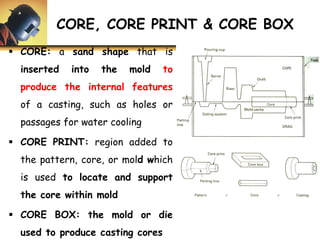
CORE, CORE PRINT & CORE BOX
 CORE: a sand shape that is
inserted into the mold to
produce the internal features
of a casting, such as holes or
passages for water cooling
 CORE PRINT: region added to
the pattern, core, or mold which
is used to locate and support
the core within mold
 CORE BOX: the mold or die
used to produce casting cores
Essential Characteristics of
Core (Sand)
A good core must possess followings:
 High permeability to allow an easy escape to gases formed.
 High refractoriness to withstand high temperature of
molten metal
 Smooth surface.
 High collapsibility i.e. it should be able to disintegrate
quickly after the solidification of the metal is complete.
 Sufficient strength to support itself.
Functions (Purposes) of Cores
Cores are required for following :
 The cores are used to form the internal cavities.
 Cores are used to form a part of a green sand mould.
 Cores are used to strengthen the moulds.
 Cores are used as a part of the gating system.
Desired Characteristics of A Core
 Cores are the materials used for making cavities and internal
features which cannot be produced by the pattern alone.
 Cores are generally made of the sand and are even used in
permanent molds.
 In general, cores are surrounded on all sides by melt and therefore
subjected to much more severe thermal and mechanical conditions
core sand should be of higher strength than molding sand.
Following are the desired characteristics for a core
1. Green strength: a core made of green sand should be strong
enough to retain the shape till it goes for baking.
2. Dry strength: core should have adequate dry strength so that
when the core is placed in the mold, it is able to resist the cast
material pressure acting on it.
3. Permeability: the gases evolving from the melt and from the mold
may have to go through the core to escape out of the mold. Hence
cores are required to have adequate permeability.
4. Refractoriness: in most of the cases, core is surrounded all around by
the melt, it is desirable that the core material should have higher
refractoriness.
5. Collapsibility: as the casting cools, it shrinks, and so the core should have
good collapsibility (ability to decrease in size). Lack of collapsibility may
provide resistance against shrinkage and can cause the casting defect of
hot tears.
6. Smoothness: surface of the core should be smooth so as to provide a
good finish to the casting surfaces in contact with the cores.
7. Friability (ability to crumble): after the casting is completely cooled, the
core should be removed from the casting before it is processed further.
Hence the friability is also an important consideration.
8. Low gas emission: because the cores are subjected to very high
temperature, the evolution of gases from the inside are very high at
that temperature. These gases are otherwise likely to produce gas
inclusion defects. So the cores should be made such that the evolution
of gases is minimum.
Desired Characteristics For
A Core
Core Sands
CORE SAND CONSTITUENTS:
• Core sand should contain the sand grains, binders and other additives to provide
specific properties.
Sand:
• Silica sand which is completely devoid of clay is generally used for making core
sands.
 Coarse silica (because of its higher refractoriness) is used in steel foundries
 Finer sands are used for cast irons and non-ferrous alloys.
Binders:
 Core sands need to be stronger than the molding sand.
 Clay used as binder in molding sands is not enough & so organic binders are
used.
 Generally used binders are, linseed oil, core oil, resins, dextrin, molasses, etc.
 Core oil is a mixture of linseed, soya, fish and petroleum oils and coal tar.
 These binders are burnt away by the heat of the melt and thus make the core
collapsible during the cooling of the casting.
 Amount of binder required depends to a great extent on the fineness of sand
grains. Amount of clay left in the sand increases the consumption of binder.
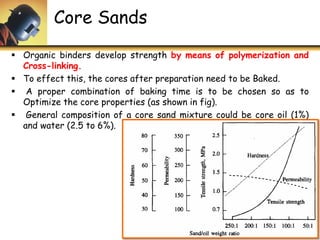
 Organic binders develop strength by means of polymerization and
Cross-linking.
 To effect this, the cores after preparation need to be Baked.
 A proper combination of baking time is to be chosen so as to
Optimize the core properties (as shown in fig).
 General composition of a core sand mixture could be core oil (1%)
and water (2.5 to 6%).
Core Sands
Classification of Cores
• The selection of the correct type of core depends on production
quantity, production rate, required precision, required surface
finish, and the type of metal being used.
Core can be classified as follows:
1. Based on material used for making cores
a) Sand cores b) Metal cores
2. Based on nature of use
a) Dispensable (in sand casting) b) Permanent (in die casting)
3. Based on shapes and positions of the cores in prepared moulds
a) Horizontal core b) Vertical core
c) Balanced core d) Hanging or cover core
e) Drop core or stop off core f) Ram up core
g) Kiss core.
Metal And Sand Cores
• Metal Cores are used in
permanent mould casting.
• Metal cores should be
parallel to the mould parting
line, or can be removed
before the casting is
removed from the mould, and
shaped so that is readily
freed from the casting.
• Metal cores are typically
made from cast iron or steel.
• Sand cores are made
from materials similar to
those used for chemically
bonded sand moulds.
• These cores are formed in
core boxes - similar to
pattern boxes used to
make moulds.
• Sand core are chemically
bonded sand of complex
shapes, and used in all
mould types.
Based on the material used for making cores are of two types:
Metal cores and sand cores.
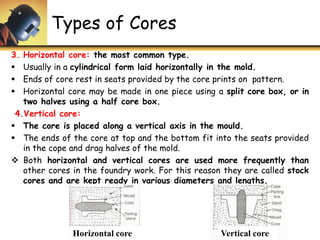
Types of Cores
Cores are generally made of sand & are even used in permanent molds.
BASED ON THE TYPE OF SAND USED:
1. Green sand core: these are obtained by the pattern itself during
molding.
 This is used only for those type of cavities which permit the
withdrawal of the pattern.
 Though this is the most economical way of preparing core, the
green sand being low in strength cannot be used for fairly deep
holes.
 A large amount of draft is to be provided so that the pattern can
be withdrawn.
2. Dry sand cores: are those which are made by means of special
core sands in a separate core box, baked and then placed in the
mold before pouring.
Green Sand Core
Types of Cores
3. Horizontal core: the most common type.
 Usually in a cylindrical form laid horizontally in the mold.
 Ends of core rest in seats provided by the core prints on pattern.
 Horizontal core may be made in one piece using a split core box, or in
two halves using a half core box.
4.Vertical core:
 The core is placed along a vertical axis in the mould.
 The ends of the core at top and the bottom fit into the seats provided
in the cope and drag halves of the mold.
 Both horizontal and vertical cores are used more frequently than
other cores in the foundry work. For this reason they are called stock
cores and are kept ready in various diameters and lengths.
Horizontal core Vertical core
Types of Cores
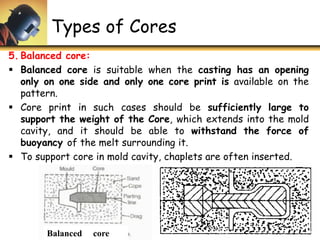
5. Balanced core:
 Balanced core is suitable when the casting has an opening
only on one side and only one core print is available on the
pattern.
 Core print in such cases should be sufficiently large to
support the weight of the Core, which extends into the mold
cavity, and it should be able to withstand the force of
buoyancy of the melt surrounding it.
 To support core in mold cavity, chaplets are often inserted.
Balanced core
Types of Cores
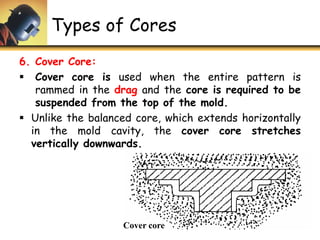
6. Cover Core:
 Cover core is used when the entire pattern is
rammed in the drag and the core is required to be
suspended from the top of the mold.
 Unlike the balanced core, which extends horizontally
in the mold cavity, the cover core stretches
vertically downwards.
Cover core
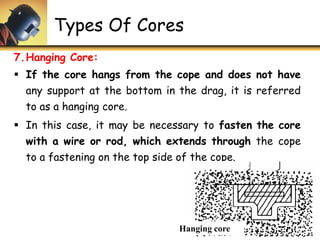
7.Hanging Core:
 If the core hangs from the cope and does not have
any support at the bottom in the drag, it is referred
to as a hanging core.
 In this case, it may be necessary to fasten the core
with a wire or rod, which extends through the cope
to a fastening on the top side of the cope.
Types Of Cores
Hanging core
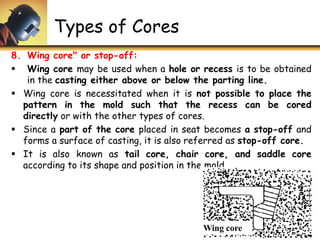
8. Wing core" or stop-off:
 Wing core may be used when a hole or recess is to be obtained
in the casting either above or below the parting line.
 Wing core is necessitated when it is not possible to place the
pattern in the mold such that the recess can be cored
directly or with the other types of cores.
 Since a part of the core placed in seat becomes a stop-off and
forms a surface of casting, it is also referred as stop-off core.
 It is also known as tail core, chair core, and saddle core
according to its shape and position in the mold
Types of Cores
Wing core
9. Ram-Up Core:
 Sometimes, the core is set with the pattern in the mold
before the mold is rammed. Such a core is called ram-up core
it is favored when the core detail is located in an
inaccessible position.
 It may be used for both interior and exterior portions of a
casting.
Types of Cores
Ram Up core
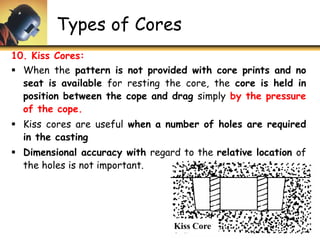
10. Kiss Cores:
 When the pattern is not provided with core prints and no
seat is available for resting the core, the core is held in
position between the cope and drag simply by the pressure
of the cope.
 Kiss cores are useful when a number of holes are required
in the casting
 Dimensional accuracy with regard to the relative location of
the holes is not important.
Types of Cores
Kiss Core
Core Making
 Cores for sand casting are manufactured by packing
specially prepared sand in Core boxes.
 Core-making processes include sand preparation, core
shooting, coating/treatment and placement in mould.
 The cavity in a core box is a negative replica of the
corresponding part feature.
 The core box is made in two segments (with a parting) to
enable removal of the core.
 Complex cores are prepared by assembling or gluing two or
more cores of simpler shapes.
 The core-related activities consume significant resources.
 Thus the number and volume of cores must be minimized
to the extent possible, to reduce tooling cost and
manufacturing time.
Core Boxes
 Core boxes are used for making cores. A core box is a wooden
or metallic type of pattern and are made either single or in
two parts.
 They may be classified according to the method of making the
core or shape of core.
The common types of core boxes are described below:
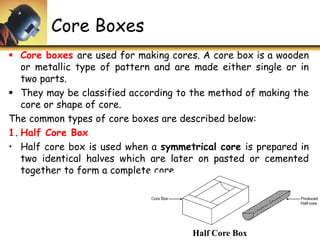
1. Half Core Box
• Half core box is used when a symmetrical core is prepared in
two identical halves which are later on pasted or cemented
together to form a complete core.
Half Core Box
Core Boxes
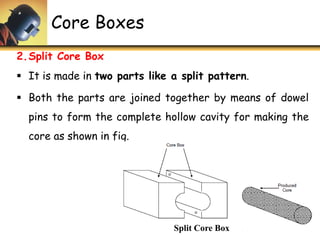
2.Split Core Box
 It is made in two parts like a split pattern.
 Both the parts are joined together by means of dowel
pins to form the complete hollow cavity for making the
core as shown in fig.
Split Core Box
Core Boxes
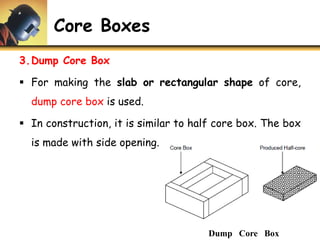
3.Dump Core Box
 For making the slab or rectangular shape of core,
dump core box is used.
 In construction, it is similar to half core box. The box
is made with side opening.
Dump Core Box
Core Boxes
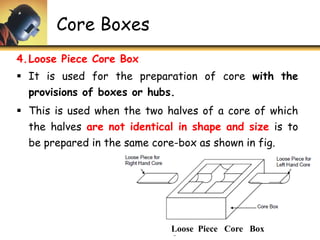
4.Loose Piece Core Box
 It is used for the preparation of core with the
provisions of boxes or hubs.
 This is used when the two halves of a core of which
the halves are not identical in shape and size is to
be prepared in the same core-box as shown in fig.
Loose Piece Core Box
Core Boxes
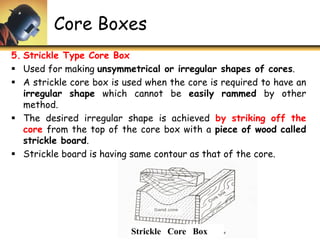
5. Strickle Type Core Box
 Used for making unsymmetrical or irregular shapes of cores.
 A strickle core box is used when the core is required to have an
irregular shape which cannot be easily rammed by other
method.
 The desired irregular shape is achieved by striking off the
core from the top of the core box with a piece of wood called
strickle board.
 Strickle board is having same contour as that of the core.
Strickle Core Box
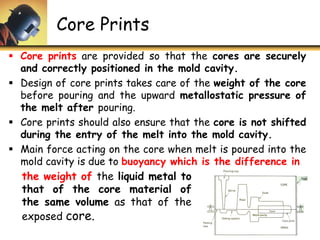
Core Prints
 Core prints are provided so that the cores are securely
and correctly positioned in the mold cavity.
 Design of core prints takes care of the weight of the core
before pouring and the upward metallostatic pressure of
the melt after pouring.
 Core prints should also ensure that the core is not shifted
during the entry of the melt into the mold cavity.
 Main force acting on the core when melt is poured into the
mold cavity is due to buoyancy which is the difference in
the weight of the liquid metal to
that of the core material of
the same volume as that of the
exposed core.
Design Of Core Prints
 Core prints should be able to take care of weight of core before pouring &
upward metallostatic pressure of molten metal after pouring.
 The core print should ensure that core is not shifted during the entry of
metal into mould cavity
 The main force acting on the core when metal is poured into mould cavity is
due to buoyancy.
 Buoyant force is the difference in the weight of the liquid metal to that of
the core material of the same volume as that of the exposed core.
Mathematically
For horizontal core P = V(ρ-d)
P = Buoyant force, N
V = Volume of the core in the mould cavity, cm3 (Volume = 0.25 π D2 H)
ρ = Weight density of the liquid metal, N/cm3
d = weight density of core material= 1.65x 10⁻² N/cm3
For vertical core, Buoyant force P= [0.25 π (D1
2 - D2 ) H ρ– Vd]
Where V= total volume of the core in the mould
A core should be able to support a load of 35 N/cm2 of surface area to keep core in
position . A core must satisfy following condition A= surface area
If above condition is not satisfied than provide additional support by using chaplets.
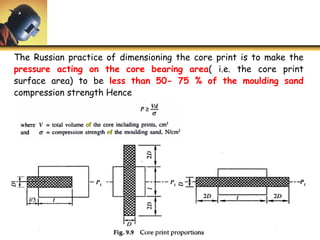
The Russian practice of dimensioning the core print is to make the
pressure acting on the core bearing area( i.e. the core print
surface area) to be less than 50- 75 % of the moulding sand
compression strength Hence
Core Print Dimensions
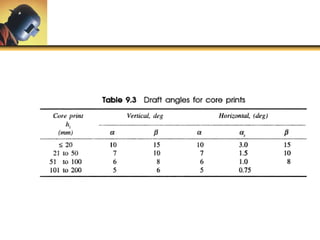
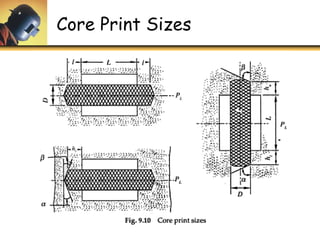
• Core print dimensions are tabulated below with
reference to fig on next slide
Table 1: Core Print Dimensions
Core Print Sizes
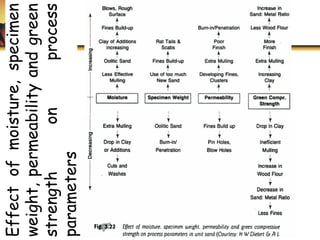
Effectofmoisture,specimen
weight,permeabilityandgreen
strengthonprocess
parameters
U2 p3 core, core prints and chaplets

U2 p3 core, core prints and chaplets

  • 1.
    Manufacturing Technology II (ME-202) SheetMetal Operations Dr. Chaitanya Sharma PhD. IIT Roorkee
  • 2.
    Core, Core prints& Chaplets Lesson Objectives In this chapter we shall discuss the following: Core: Need, characteristics, types Core prints Chaplets Learning Activities 1. Look up Keywords 2. View Slides; 3. Read Notes, 4. Listen to lecture Keywords:
  • 3.
    Cores • Full-scale modelof interior surfaces of part • It is inserted into the mold cavity prior to pouring • The molten metal flows and solidifies between mold cavity and core to form the casting's external and internal surfaces • May require supports to hold it in position in the mold cavity during pouring, called chaplets Figure 11.4 (a) Core held in place in the mold cavity by chaplets, (b) possible chaplet design, (c) casting with internal cavity.
  • 4.
    Core Parts A coreconsists of two portions: a) The body of the core and b) one or more extensions called prints  The body of the core is surrounded by molten metal during casting process.  Body of core has all the features which are required in final internal surface (e.g. hole) of the castings.  The prints are necessary to support core in the mould.  They also conduct the heat (and gases produced by a sand core) to the mould.
  • 5.
    CORE, CORE PRINT& CORE BOX  CORE: a sand shape that is inserted into the mold to produce the internal features of a casting, such as holes or passages for water cooling  CORE PRINT: region added to the pattern, core, or mold which is used to locate and support the core within mold  CORE BOX: the mold or die used to produce casting cores
  • 6.
    Essential Characteristics of Core(Sand) A good core must possess followings:  High permeability to allow an easy escape to gases formed.  High refractoriness to withstand high temperature of molten metal  Smooth surface.  High collapsibility i.e. it should be able to disintegrate quickly after the solidification of the metal is complete.  Sufficient strength to support itself.
  • 7.
    Functions (Purposes) ofCores Cores are required for following :  The cores are used to form the internal cavities.  Cores are used to form a part of a green sand mould.  Cores are used to strengthen the moulds.  Cores are used as a part of the gating system.
  • 8.
    Desired Characteristics ofA Core  Cores are the materials used for making cavities and internal features which cannot be produced by the pattern alone.  Cores are generally made of the sand and are even used in permanent molds.  In general, cores are surrounded on all sides by melt and therefore subjected to much more severe thermal and mechanical conditions core sand should be of higher strength than molding sand. Following are the desired characteristics for a core 1. Green strength: a core made of green sand should be strong enough to retain the shape till it goes for baking. 2. Dry strength: core should have adequate dry strength so that when the core is placed in the mold, it is able to resist the cast material pressure acting on it. 3. Permeability: the gases evolving from the melt and from the mold may have to go through the core to escape out of the mold. Hence cores are required to have adequate permeability.
  • 9.
    4. Refractoriness: inmost of the cases, core is surrounded all around by the melt, it is desirable that the core material should have higher refractoriness. 5. Collapsibility: as the casting cools, it shrinks, and so the core should have good collapsibility (ability to decrease in size). Lack of collapsibility may provide resistance against shrinkage and can cause the casting defect of hot tears. 6. Smoothness: surface of the core should be smooth so as to provide a good finish to the casting surfaces in contact with the cores. 7. Friability (ability to crumble): after the casting is completely cooled, the core should be removed from the casting before it is processed further. Hence the friability is also an important consideration. 8. Low gas emission: because the cores are subjected to very high temperature, the evolution of gases from the inside are very high at that temperature. These gases are otherwise likely to produce gas inclusion defects. So the cores should be made such that the evolution of gases is minimum. Desired Characteristics For A Core
  • 10.
    Core Sands CORE SANDCONSTITUENTS: • Core sand should contain the sand grains, binders and other additives to provide specific properties. Sand: • Silica sand which is completely devoid of clay is generally used for making core sands.  Coarse silica (because of its higher refractoriness) is used in steel foundries  Finer sands are used for cast irons and non-ferrous alloys. Binders:  Core sands need to be stronger than the molding sand.  Clay used as binder in molding sands is not enough & so organic binders are used.  Generally used binders are, linseed oil, core oil, resins, dextrin, molasses, etc.  Core oil is a mixture of linseed, soya, fish and petroleum oils and coal tar.  These binders are burnt away by the heat of the melt and thus make the core collapsible during the cooling of the casting.  Amount of binder required depends to a great extent on the fineness of sand grains. Amount of clay left in the sand increases the consumption of binder.
  • 11.
     Organic bindersdevelop strength by means of polymerization and Cross-linking.  To effect this, the cores after preparation need to be Baked.  A proper combination of baking time is to be chosen so as to Optimize the core properties (as shown in fig).  General composition of a core sand mixture could be core oil (1%) and water (2.5 to 6%). Core Sands
  • 12.
    Classification of Cores •The selection of the correct type of core depends on production quantity, production rate, required precision, required surface finish, and the type of metal being used. Core can be classified as follows: 1. Based on material used for making cores a) Sand cores b) Metal cores 2. Based on nature of use a) Dispensable (in sand casting) b) Permanent (in die casting) 3. Based on shapes and positions of the cores in prepared moulds a) Horizontal core b) Vertical core c) Balanced core d) Hanging or cover core e) Drop core or stop off core f) Ram up core g) Kiss core.
  • 13.
    Metal And SandCores • Metal Cores are used in permanent mould casting. • Metal cores should be parallel to the mould parting line, or can be removed before the casting is removed from the mould, and shaped so that is readily freed from the casting. • Metal cores are typically made from cast iron or steel. • Sand cores are made from materials similar to those used for chemically bonded sand moulds. • These cores are formed in core boxes - similar to pattern boxes used to make moulds. • Sand core are chemically bonded sand of complex shapes, and used in all mould types. Based on the material used for making cores are of two types: Metal cores and sand cores.
  • 14.
    Types of Cores Coresare generally made of sand & are even used in permanent molds. BASED ON THE TYPE OF SAND USED: 1. Green sand core: these are obtained by the pattern itself during molding.  This is used only for those type of cavities which permit the withdrawal of the pattern.  Though this is the most economical way of preparing core, the green sand being low in strength cannot be used for fairly deep holes.  A large amount of draft is to be provided so that the pattern can be withdrawn. 2. Dry sand cores: are those which are made by means of special core sands in a separate core box, baked and then placed in the mold before pouring. Green Sand Core
  • 15.
    Types of Cores 3.Horizontal core: the most common type.  Usually in a cylindrical form laid horizontally in the mold.  Ends of core rest in seats provided by the core prints on pattern.  Horizontal core may be made in one piece using a split core box, or in two halves using a half core box. 4.Vertical core:  The core is placed along a vertical axis in the mould.  The ends of the core at top and the bottom fit into the seats provided in the cope and drag halves of the mold.  Both horizontal and vertical cores are used more frequently than other cores in the foundry work. For this reason they are called stock cores and are kept ready in various diameters and lengths. Horizontal core Vertical core
  • 16.
    Types of Cores 5.Balanced core:  Balanced core is suitable when the casting has an opening only on one side and only one core print is available on the pattern.  Core print in such cases should be sufficiently large to support the weight of the Core, which extends into the mold cavity, and it should be able to withstand the force of buoyancy of the melt surrounding it.  To support core in mold cavity, chaplets are often inserted. Balanced core
  • 17.
    Types of Cores 6.Cover Core:  Cover core is used when the entire pattern is rammed in the drag and the core is required to be suspended from the top of the mold.  Unlike the balanced core, which extends horizontally in the mold cavity, the cover core stretches vertically downwards. Cover core
  • 18.
    7.Hanging Core:  Ifthe core hangs from the cope and does not have any support at the bottom in the drag, it is referred to as a hanging core.  In this case, it may be necessary to fasten the core with a wire or rod, which extends through the cope to a fastening on the top side of the cope. Types Of Cores Hanging core
  • 19.
    8. Wing core"or stop-off:  Wing core may be used when a hole or recess is to be obtained in the casting either above or below the parting line.  Wing core is necessitated when it is not possible to place the pattern in the mold such that the recess can be cored directly or with the other types of cores.  Since a part of the core placed in seat becomes a stop-off and forms a surface of casting, it is also referred as stop-off core.  It is also known as tail core, chair core, and saddle core according to its shape and position in the mold Types of Cores Wing core
  • 20.
    9. Ram-Up Core: Sometimes, the core is set with the pattern in the mold before the mold is rammed. Such a core is called ram-up core it is favored when the core detail is located in an inaccessible position.  It may be used for both interior and exterior portions of a casting. Types of Cores Ram Up core
  • 21.
    10. Kiss Cores: When the pattern is not provided with core prints and no seat is available for resting the core, the core is held in position between the cope and drag simply by the pressure of the cope.  Kiss cores are useful when a number of holes are required in the casting  Dimensional accuracy with regard to the relative location of the holes is not important. Types of Cores Kiss Core
  • 22.
    Core Making  Coresfor sand casting are manufactured by packing specially prepared sand in Core boxes.  Core-making processes include sand preparation, core shooting, coating/treatment and placement in mould.  The cavity in a core box is a negative replica of the corresponding part feature.  The core box is made in two segments (with a parting) to enable removal of the core.  Complex cores are prepared by assembling or gluing two or more cores of simpler shapes.  The core-related activities consume significant resources.  Thus the number and volume of cores must be minimized to the extent possible, to reduce tooling cost and manufacturing time.
  • 23.
    Core Boxes  Coreboxes are used for making cores. A core box is a wooden or metallic type of pattern and are made either single or in two parts.  They may be classified according to the method of making the core or shape of core. The common types of core boxes are described below: 1. Half Core Box • Half core box is used when a symmetrical core is prepared in two identical halves which are later on pasted or cemented together to form a complete core. Half Core Box
  • 24.
    Core Boxes 2.Split CoreBox  It is made in two parts like a split pattern.  Both the parts are joined together by means of dowel pins to form the complete hollow cavity for making the core as shown in fig. Split Core Box
  • 25.
    Core Boxes 3.Dump CoreBox  For making the slab or rectangular shape of core, dump core box is used.  In construction, it is similar to half core box. The box is made with side opening. Dump Core Box
  • 26.
    Core Boxes 4.Loose PieceCore Box  It is used for the preparation of core with the provisions of boxes or hubs.  This is used when the two halves of a core of which the halves are not identical in shape and size is to be prepared in the same core-box as shown in fig. Loose Piece Core Box
  • 27.
    Core Boxes 5. StrickleType Core Box  Used for making unsymmetrical or irregular shapes of cores.  A strickle core box is used when the core is required to have an irregular shape which cannot be easily rammed by other method.  The desired irregular shape is achieved by striking off the core from the top of the core box with a piece of wood called strickle board.  Strickle board is having same contour as that of the core. Strickle Core Box
  • 28.
    Core Prints  Coreprints are provided so that the cores are securely and correctly positioned in the mold cavity.  Design of core prints takes care of the weight of the core before pouring and the upward metallostatic pressure of the melt after pouring.  Core prints should also ensure that the core is not shifted during the entry of the melt into the mold cavity.  Main force acting on the core when melt is poured into the mold cavity is due to buoyancy which is the difference in the weight of the liquid metal to that of the core material of the same volume as that of the exposed core.
  • 29.
    Design Of CorePrints  Core prints should be able to take care of weight of core before pouring & upward metallostatic pressure of molten metal after pouring.  The core print should ensure that core is not shifted during the entry of metal into mould cavity  The main force acting on the core when metal is poured into mould cavity is due to buoyancy.  Buoyant force is the difference in the weight of the liquid metal to that of the core material of the same volume as that of the exposed core. Mathematically For horizontal core P = V(ρ-d) P = Buoyant force, N V = Volume of the core in the mould cavity, cm3 (Volume = 0.25 π D2 H) ρ = Weight density of the liquid metal, N/cm3 d = weight density of core material= 1.65x 10⁻² N/cm3 For vertical core, Buoyant force P= [0.25 π (D1 2 - D2 ) H ρ– Vd] Where V= total volume of the core in the mould A core should be able to support a load of 35 N/cm2 of surface area to keep core in position . A core must satisfy following condition A= surface area If above condition is not satisfied than provide additional support by using chaplets.
  • 30.
    The Russian practiceof dimensioning the core print is to make the pressure acting on the core bearing area( i.e. the core print surface area) to be less than 50- 75 % of the moulding sand compression strength Hence
  • 31.
    Core Print Dimensions •Core print dimensions are tabulated below with reference to fig on next slide Table 1: Core Print Dimensions
  • 33.
  • 34.