Muhammad Awais 
Irfan Nadeem 
Ahmed Aslam 
Ali Adil 
Muhmmad Mohsin Jalil
CONTENTS 
• Overview 
• Introduction 
• Procedure 
• Techniques 
• Advantages/DisAdvantages 
• Applications
Overview/History 
• This technique is both one of the oldest & most advanced of 
the metallurgical art. 
• The root of this technology, the “lost wax” method dates back 
to at least fourth millennium B.C and was originated in China. 
• From 5,000 years ago, when beeswax formed the pattern, 
today high-technology waxes are used in molding. 
• In today's world Investment Casting touches all of our lives. 
When we fly on an airplane, drive an automobile, play golf, we 
are using investment casting.
Introduction 
• Commonly referred to as “Lost wax Casting”. 
• The Pattern is made up of wax or plastic Such as Polystyrene 
because of low melting temperature. 
• The molten metal is poured into the ceramic mold and mold is 
formed using wax pattern.(The wax assembly is dipped into 
high-grade ceramic slurry ) 
• Investment casting is often referred to as "lost-wax casting" 
because the wax pattern is melted out of the mold after it has 
been formed.
Introduction 
• Investment casting can make use of most metals, most 
commonly using Al alloys, bronze alloys, Mg alloys, cast iron, 
stainless steel, and tool steel. 
• This process is beneficial for casting metals with high melting 
temperatures that can not be molded in plaster or metal. 
• Parts that are typically made by investment casting include 
those with complex geometry such as turbine blades or 
firearm components.
Introduction 
• Lost Foam Casting (LFC) is modern form of investment casting. 
• LFC is a type of evaporative-pattern casting process that is similar 
to investment casting except foam is used for the pattern instead of 
wax. 
• Most Commonly used foam is polystyrene foam.
Patterns Comparison For Lost Wax 
Casting & Lost Foam Casting 
Pattern made up of foam Pattern made up of Wax
Procedure 
Ahmed Aslam
Process of Investment Casting 
1. Pattern Making: 
• Manufacture Wax Pattern 
• Master Die desired 
• Allowances(Wax ,Ceramic Coating and Metal shrikange) 
added into Master Die 
Fig. 1 Wax Injection
2. Assembly 
• Several Wax Pattern Combine for a Single Casting 
• Wax Bar( Central Sprue) 
• Pouring Cup 
• Wax pattern Tree 
Fig. 2. Assembly
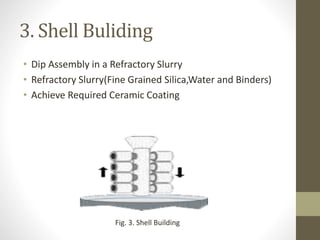
3. Shell Buliding 
• Dip Assembly in a Refractory Slurry 
• Refractory Slurry(Fine Grained Silica,Water and Binders) 
• Achieve Required Ceramic Coating 
Fig. 3. Shell Building
4. Dewax 
• Allow to Harden in air 
• Ceramic Mold is turned upside down and heated(90-175 
‘C) 
• Wax flow out of Mold 
Fig. 4. Dewax
5. Metal Casting Pouring 
• Ceramic mold further heated(550-1100 ‘C) 
• To eliminate any left over wax, contaminants and drive 
water out 
• Metal Casting poured while mold still hot 
Fig. 5. Metal Casting Pouring
6. Knockout and Cut Off 
• Once the casting has cooled sufficiently, the mold shell is 
chipped away from the casting 
• Gates and Runners are cut from the casting 
Fig. 6. Knockout Fig. 7. Cut Off
Techniques 
Muhammad Awais
Summary
Centrifugal investment 
casting 
Centrifugal forces distributes 
the molten material 
in the mould
• Crystal growth aligns in the direction of centrifugal forces. 
• Solid Liquid Transition
Counter gravity Casting 
1. The mold is placed in a vacuum chamber with a fill pipe 
2. The chamber is sealed and lowered a precise distance into 
the melt 
3. Vacuum is created 
4. Metal moves up into the sprue 
cavity, filling every section completely
Solid Investment Process 
• Wax Pattern is placed in a bottom sealed container
• This Assembly is then placed in a vaccum chamber
• Gypsum based refractory mixed with water is then filled into 
it. 
• It is fired firing melts the wax and also sinters the mold.
Advantages/Disadvantages 
Professor Dr.Ali Adil
Why Prefer Investment 
Casting? 
• Many Intricate forms with undercuts can be cast. 
• A very smooth surface is obtained with no parting line. 
• Dimensional accuracy is good. 
• Certain unmachinable parts can be cast to preplanned shape. 
• It may be used to replace die-casting where short runs are 
involved. 
• The lost wax method out performs any other casting process 
when it comes to superior surface finishes especially when 
compared to sand casted, forged or welded fabrications.
Impact of Advantages 
• Reliability 
The investment casting process provides reliable process 
controls and repeatability that are maintained from casting to 
casting 
• Tolerances 
Investment Casting routinely holds to tolerances of ± .005”. This 
is not always possible with other types of casting processes. 
• Amortization Lowers Tooling Cost 
The initial wax injection mold to produce the patterns, averaged 
over the entire production quantity, is often lower than other 
casting tooling costs. Quality tooling produces a quality part and 
will be more cost efficient in the long run.
Impact of Advantages 
• Better for the Environment 
An investment casting is produced from wax patterns which in most 
cases can be reclaimed and used again. The wax pattern is a great way 
to see your part before it is cast, thus eliminating expensive revisions 
and reducing metal scrap. More importantly, the investment casting 
process produces parts to net or near net shapes which significantly 
reduces or eliminates the amount of secondary machining. Most scrap 
from secondary services like machining can be reused as well. 
• Design & Casting Versatility 
Investment Casting works with over 100 different ferrous and non-ferrous 
casting alloys. This allows investment casting process to be 
used in a variety of industries as it produces a wide range of cast and 
casting based assemblies. Lost wax castings provide the maximum 
design flexibility for manufacturing complex, multi part products in 
many cases.
Impact of Advantages 
• Intricate Design 
When using investment castings, design engineers can easily 
incorporate features such as logos, product ID's/numbers, and 
letters into their component. Through holes, slots, blind holes, 
external and internal splines, gears, and thread profiles can 
often be cast to reduce secondary machining time and total part 
cost.
Disadvantages &Limitations 
• This process is expensive(labour costs), is usually limited to 
small casting, and presents some difficulties where cores are 
involved. 
• Holes cannot be smaller than 1/16 in. (1.6mm) and should be 
no deeper than about 1.5 times the diameter. 
• Investment castings require very long production-cycle times 
versus other casting processes. 
• This process is practically infeasible for high-volume 
manufacturing, due to its high cost and long cycle times. 
• Many of the advantages of the investment casting process can 
be achieved through other casting techniques if principles of 
thermal design and control are applied appropriately to 
existing processes that do not involve the shortcomings of 
investment castings
Disadvantages 
• Some of the reasons for the high cost include specialized 
equipment, costly refractories and binders, many operations 
to make a mold, a lot of labor is needed and occasional 
minute defects.
Applications 
Muhammad Mohsin Jalil
Applications 
• When design complexity, tolerance control and repeatability are 
the name of the game, Investment Casting is by far the most cost-effective 
solution compared to other methods of producing metal 
parts and assemblies
Aerospace Industry 
• From Boeing to NASA Investment castings are 
built ready to integrate, providing significant cost 
savings over other manufacturing methods 
• Quality has always been top priority, especially 
for aerospace components
Aerospace Industry 
• Turbine airfoils 
• Aircraft engine 
• Industrial gas turbine industries 
Boeing 777-APU 
duct- Ti-alloy
Medical Instruments 
• Surgical implants 
e.g. knee & hip joints 
Ti6Al4V alloys, Co-Cr-Mo alloys
Military Equipment 
• Military equipment need to meet very tight 
tolerances and high quality standards 
• Joysticks for drone planes/UAVs 
• Gun triggers, hammers & sights 
• Trigger guards 
• Bolt catches 
• Bolt carriers
Military Equipment 
• Selector levers 
• Pistol grips 
• Tank Control System 
• Spare parts and more..
3D Printing 
• Paving way for new opportunities.. 
• Process of making a three-dimensional solid object of 
virtually any shape from a digital model
3D Printing 
• Used for prototyping and distributed manufacturing, with 
applications in architecture, automotive, military, 
fashion, education and many others
Automotive Industry 
• Automotive castings offer the next generation 
of weight reduction, highly complex designs, 
and surface finishing for major automotive 
manufacturers worldwide 
• Pre-combustion chamber for tractors, matadors 
• Gear shifter for 4 wheelers vehicles 
• Water pump body 
• Engines
Automotive Industry 
Ferrari Engine
Further Applications 
• Investment cast components provides near net shape that can 
solve cost-performance challenges for manufacturers of: 
• Agricultural, industrial and other heavy equipment 
• Firearms 
• Marine vehicles 
• Construction tools & equipment 
• Household & office fixtures 
• Door hardware and more…
Continue..
Thank You..!

Investment Casting ppt

  • 2.
    Muhammad Awais IrfanNadeem Ahmed Aslam Ali Adil Muhmmad Mohsin Jalil
  • 3.
    CONTENTS • Overview • Introduction • Procedure • Techniques • Advantages/DisAdvantages • Applications
  • 4.
    Overview/History • Thistechnique is both one of the oldest & most advanced of the metallurgical art. • The root of this technology, the “lost wax” method dates back to at least fourth millennium B.C and was originated in China. • From 5,000 years ago, when beeswax formed the pattern, today high-technology waxes are used in molding. • In today's world Investment Casting touches all of our lives. When we fly on an airplane, drive an automobile, play golf, we are using investment casting.
  • 5.
    Introduction • Commonlyreferred to as “Lost wax Casting”. • The Pattern is made up of wax or plastic Such as Polystyrene because of low melting temperature. • The molten metal is poured into the ceramic mold and mold is formed using wax pattern.(The wax assembly is dipped into high-grade ceramic slurry ) • Investment casting is often referred to as "lost-wax casting" because the wax pattern is melted out of the mold after it has been formed.
  • 6.
    Introduction • Investmentcasting can make use of most metals, most commonly using Al alloys, bronze alloys, Mg alloys, cast iron, stainless steel, and tool steel. • This process is beneficial for casting metals with high melting temperatures that can not be molded in plaster or metal. • Parts that are typically made by investment casting include those with complex geometry such as turbine blades or firearm components.
  • 7.
    Introduction • LostFoam Casting (LFC) is modern form of investment casting. • LFC is a type of evaporative-pattern casting process that is similar to investment casting except foam is used for the pattern instead of wax. • Most Commonly used foam is polystyrene foam.
  • 8.
    Patterns Comparison ForLost Wax Casting & Lost Foam Casting Pattern made up of foam Pattern made up of Wax
  • 9.
  • 10.
    Process of InvestmentCasting 1. Pattern Making: • Manufacture Wax Pattern • Master Die desired • Allowances(Wax ,Ceramic Coating and Metal shrikange) added into Master Die Fig. 1 Wax Injection
  • 11.
    2. Assembly •Several Wax Pattern Combine for a Single Casting • Wax Bar( Central Sprue) • Pouring Cup • Wax pattern Tree Fig. 2. Assembly
  • 12.
    3. Shell Buliding • Dip Assembly in a Refractory Slurry • Refractory Slurry(Fine Grained Silica,Water and Binders) • Achieve Required Ceramic Coating Fig. 3. Shell Building
  • 13.
    4. Dewax •Allow to Harden in air • Ceramic Mold is turned upside down and heated(90-175 ‘C) • Wax flow out of Mold Fig. 4. Dewax
  • 14.
    5. Metal CastingPouring • Ceramic mold further heated(550-1100 ‘C) • To eliminate any left over wax, contaminants and drive water out • Metal Casting poured while mold still hot Fig. 5. Metal Casting Pouring
  • 15.
    6. Knockout andCut Off • Once the casting has cooled sufficiently, the mold shell is chipped away from the casting • Gates and Runners are cut from the casting Fig. 6. Knockout Fig. 7. Cut Off
  • 16.
  • 17.
  • 18.
    Centrifugal investment casting Centrifugal forces distributes the molten material in the mould
  • 19.
    • Crystal growthaligns in the direction of centrifugal forces. • Solid Liquid Transition
  • 20.
    Counter gravity Casting 1. The mold is placed in a vacuum chamber with a fill pipe 2. The chamber is sealed and lowered a precise distance into the melt 3. Vacuum is created 4. Metal moves up into the sprue cavity, filling every section completely
  • 22.
    Solid Investment Process • Wax Pattern is placed in a bottom sealed container
  • 23.
    • This Assemblyis then placed in a vaccum chamber
  • 24.
    • Gypsum basedrefractory mixed with water is then filled into it. • It is fired firing melts the wax and also sinters the mold.
  • 25.
  • 26.
    Why Prefer Investment Casting? • Many Intricate forms with undercuts can be cast. • A very smooth surface is obtained with no parting line. • Dimensional accuracy is good. • Certain unmachinable parts can be cast to preplanned shape. • It may be used to replace die-casting where short runs are involved. • The lost wax method out performs any other casting process when it comes to superior surface finishes especially when compared to sand casted, forged or welded fabrications.
  • 27.
    Impact of Advantages • Reliability The investment casting process provides reliable process controls and repeatability that are maintained from casting to casting • Tolerances Investment Casting routinely holds to tolerances of ± .005”. This is not always possible with other types of casting processes. • Amortization Lowers Tooling Cost The initial wax injection mold to produce the patterns, averaged over the entire production quantity, is often lower than other casting tooling costs. Quality tooling produces a quality part and will be more cost efficient in the long run.
  • 28.
    Impact of Advantages • Better for the Environment An investment casting is produced from wax patterns which in most cases can be reclaimed and used again. The wax pattern is a great way to see your part before it is cast, thus eliminating expensive revisions and reducing metal scrap. More importantly, the investment casting process produces parts to net or near net shapes which significantly reduces or eliminates the amount of secondary machining. Most scrap from secondary services like machining can be reused as well. • Design & Casting Versatility Investment Casting works with over 100 different ferrous and non-ferrous casting alloys. This allows investment casting process to be used in a variety of industries as it produces a wide range of cast and casting based assemblies. Lost wax castings provide the maximum design flexibility for manufacturing complex, multi part products in many cases.
  • 29.
    Impact of Advantages • Intricate Design When using investment castings, design engineers can easily incorporate features such as logos, product ID's/numbers, and letters into their component. Through holes, slots, blind holes, external and internal splines, gears, and thread profiles can often be cast to reduce secondary machining time and total part cost.
  • 30.
    Disadvantages &Limitations •This process is expensive(labour costs), is usually limited to small casting, and presents some difficulties where cores are involved. • Holes cannot be smaller than 1/16 in. (1.6mm) and should be no deeper than about 1.5 times the diameter. • Investment castings require very long production-cycle times versus other casting processes. • This process is practically infeasible for high-volume manufacturing, due to its high cost and long cycle times. • Many of the advantages of the investment casting process can be achieved through other casting techniques if principles of thermal design and control are applied appropriately to existing processes that do not involve the shortcomings of investment castings
  • 31.
    Disadvantages • Someof the reasons for the high cost include specialized equipment, costly refractories and binders, many operations to make a mold, a lot of labor is needed and occasional minute defects.
  • 32.
  • 33.
    Applications • Whendesign complexity, tolerance control and repeatability are the name of the game, Investment Casting is by far the most cost-effective solution compared to other methods of producing metal parts and assemblies
  • 34.
    Aerospace Industry •From Boeing to NASA Investment castings are built ready to integrate, providing significant cost savings over other manufacturing methods • Quality has always been top priority, especially for aerospace components
  • 35.
    Aerospace Industry •Turbine airfoils • Aircraft engine • Industrial gas turbine industries Boeing 777-APU duct- Ti-alloy
  • 36.
    Medical Instruments •Surgical implants e.g. knee & hip joints Ti6Al4V alloys, Co-Cr-Mo alloys
  • 37.
    Military Equipment •Military equipment need to meet very tight tolerances and high quality standards • Joysticks for drone planes/UAVs • Gun triggers, hammers & sights • Trigger guards • Bolt catches • Bolt carriers
  • 38.
    Military Equipment •Selector levers • Pistol grips • Tank Control System • Spare parts and more..
  • 39.
    3D Printing •Paving way for new opportunities.. • Process of making a three-dimensional solid object of virtually any shape from a digital model
  • 40.
    3D Printing •Used for prototyping and distributed manufacturing, with applications in architecture, automotive, military, fashion, education and many others
  • 41.
    Automotive Industry •Automotive castings offer the next generation of weight reduction, highly complex designs, and surface finishing for major automotive manufacturers worldwide • Pre-combustion chamber for tractors, matadors • Gear shifter for 4 wheelers vehicles • Water pump body • Engines
  • 42.
  • 43.
    Further Applications •Investment cast components provides near net shape that can solve cost-performance challenges for manufacturers of: • Agricultural, industrial and other heavy equipment • Firearms • Marine vehicles • Construction tools & equipment • Household & office fixtures • Door hardware and more…
  • 44.
  • 45.

Editor's Notes

  • #6 Notes:1. The pattern is made by injecting molten wax or plastic into a metal die mostly AL die are used(economical to make and easy to design) in the shape of the object. 2. The pattern is surrounded, or "invested", into ceramic slurry that hardens into the mold.
  • #8 Evaporate pattern casting: Evaporative-pattern casting is a type of casting process that uses a pattern made from a material that will evaporate when the molten metal is poured into the molding cavity. The most common evaporative-pattern material used is polystyrene foam.