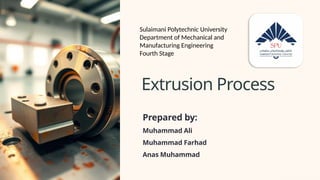
Extrusion Process
Prepared by:
Muhammad Ali
Muhammad Farhad
Anas Muhammad
Sulaimani Polytechnic University
Department of Mechanical and
Manufacturing Engineering
Fourth Stage
 History
 Introduction
 Classification of Extrusion Techniques
 Direct Extrusion
 Indirect Extrusion
 Difference Between Direct Extrusion & Indirect Extrusion
 Hot Extrusion
 Cold Extrusion
 Die Materials
 Extrusion Defects
Outline
History of Extrusion Technique
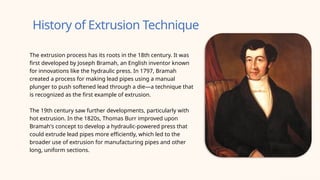
The extrusion process has its roots in the 18th century. It was
first developed by Joseph Bramah, an English inventor known
for innovations like the hydraulic press. In 1797, Bramah
created a process for making lead pipes using a manual
plunger to push softened lead through a die—a technique that
is recognized as the first example of extrusion.
The 19th century saw further developments, particularly with
hot extrusion. In the 1820s, Thomas Burr improved upon
Bramah's concept to develop a hydraulic-powered press that
could extrude lead pipes more efficiently, which led to the
broader use of extrusion for manufacturing pipes and other
long, uniform sections.
Introduction
The extrusion process is a manufacturing technique used to
shape materials by forcing them through a die to create
objects with a continuous, fixed cross-sectional profile. It is
widely used for materials such as metals, plastics, ceramics,
and even food products. The process can be used to produce
complex shapes with high precision and consistency, making it
a versatile and cost-effective method for mass production.
In extrusion, the raw material (billets) is heated to a semi-fluid
state, then pushed through a die by a mechanical force,
typically using a ram or screw. As the material exits the die, it
adopts the shape of the opening, and depending on the
material, it can be further cooled, hardened, or processed.
Classification of Extrusion Processes
1- Direct Extrusion 2- Indirect Extrusion
3- Hot Extrusion 4- Cold Extrusion
Direct Extrusion
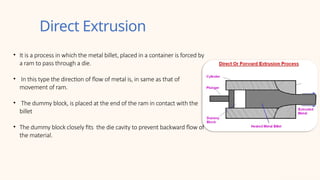
• It is a process in which the metal billet, placed in a container is forced by
a ram to pass through a die.
• In this type the direction of flow of metal is, in same as that of
movement of ram.
• The dummy block, is placed at the end of the ram in contact with the
billet
• The dummy block closely fits the die cavity to prevent backward flow of
the material.
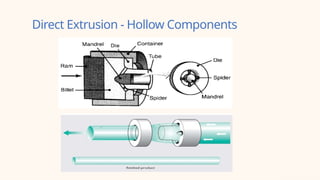
Direct Extrusion - Hollow Components
Indirect Extrusion
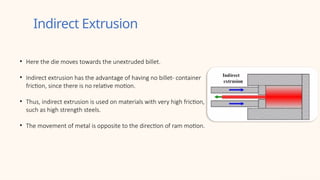
• Here the die moves towards the unextruded billet.
• Indirect extrusion has the advantage of having no billet- container
friction, since there is no relative motion.
• Thus, indirect extrusion is used on materials with very high friction,
such as high strength steels.
• The movement of metal is opposite to the direction of ram motion.
Difference Between Direct and Indirect Extrusion
1. In this process the Ram of the machinery moves
and forces the Billet through the die.
2. Direct Extrusion is also known as Forward
Extrusion.
3. The force required to release the billet out of the
extruder is more than that required in Indirect
Extrusion.
4. In this process material wastage is more compare
to indirect method
5. The frictional forces are relatively high due to the
fact that the billet must travel the entire length of
the container.
1. In this process die move backward and force applied
through die.
2. Direct Extrusion is also known as Backward Extrusion
3. The force required to release the billet out of the extruder is
less than that required indirect Extrusion.
4. In this process material wastage is less compare to direct
method
5. This method eliminates nearly all of the frictional forces. (25
to 30% reduction of total friction.)
Indirect Extrusion
Direct Extrusion
Hot Extrusion
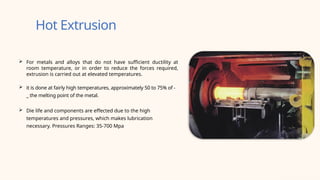
 For metals and alloys that do not have sufficient ductility at
room temperature, or in order to reduce the forces required,
extrusion is carried out at elevated temperatures.
 it is done at fairly high temperatures, approximately 50 to 75% of -
_ the melting point of the metal.
 Die life and components are effected due to the high
temperatures and pressures, which makes lubrication
necessary. Pressures Ranges: 35-700 Mpa
Lubricated Hot Extrusion
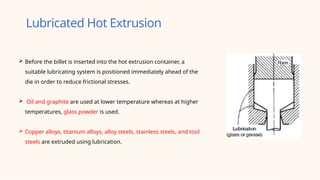
 Before the billet is inserted into the hot extrusion container, a
suitable lubricating system is positioned immediately ahead of the
die in order to reduce frictional stresses.
 Oil and graphite are used at lower temperature whereas at higher
temperatures, glass powder is used.
 Copper alloys, titanium alloys, alloy steels, stainless steels, and tool
steels are extruded using lubrication.
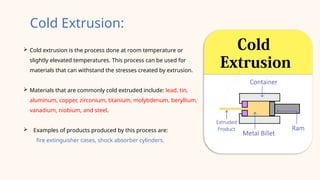
 Cold extrusion is the process done at room temperature or
slightly elevated temperatures. This process can be used for
materials that can withstand the stresses created by extrusion.
 Materials that are commonly cold extruded include: lead, tin,
aluminum, copper, zirconium, titanium, molybdenum, beryllium,
vanadium, niobium, and steel.
 Examples of products produced by this process are:
fire extinguisher cases, shock absorber cylinders.
Cold Extrusion:
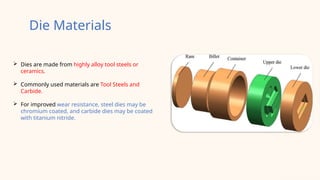
 Dies are made from highly alloy tool steels or
ceramics.
 Commonly used materials are Tool Steels and
Carbide.
 For improved wear resistance, steel dies may be
chromium coated, and carbide dies may be coated
with titanium nitride.
Die Materials
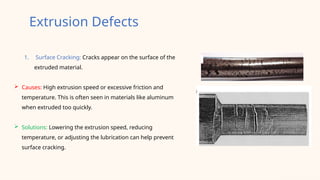
1. Surface Cracking: Cracks appear on the surface of the
extruded material.
 Causes: High extrusion speed or excessive friction and
temperature. This is often seen in materials like aluminum
when extruded too quickly.
 Solutions: Lowering the extrusion speed, reducing
temperature, or adjusting the lubrication can help prevent
surface cracking.
Extrusion Defects
2- Internal Cracking: Internal cracks form in the center of
the material, often in a V-shape.
 Causes: Excessive extrusion pressure or too much reduction in
cross-sectional area.
 Solutions: Reducing the extrusion pressure can help prevent
these cracks.
Extrusion Defects
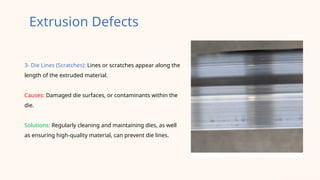
3- Die Lines (Scratches): Lines or scratches appear along the
length of the extruded material.
Causes: Damaged die surfaces, or contaminants within the
die.
Solutions: Regularly cleaning and maintaining dies, as well
as ensuring high-quality material, can prevent die lines.
Extrusion Defects
Aluminum Extrusion
References
https://paulmurphyplastics.com/industry-news-blog/extrusion-proc
ess-working-types-application-advantages-and-disadvantages
/
https://www.tfgusa.com/understanding-extrusion-a-fundamental-
manufacturing-process
/
https://
testbook.com/mechanical-engineering/extrusion-process-and-type
s
https://
www.britannica.com/technology/extrusion-industrial-process

Extrusion-Process-An-Overviewy65454.pptx

  • 1.
    Extrusion Process Prepared by: MuhammadAli Muhammad Farhad Anas Muhammad Sulaimani Polytechnic University Department of Mechanical and Manufacturing Engineering Fourth Stage
  • 2.
     History  Introduction Classification of Extrusion Techniques  Direct Extrusion  Indirect Extrusion  Difference Between Direct Extrusion & Indirect Extrusion  Hot Extrusion  Cold Extrusion  Die Materials  Extrusion Defects Outline
  • 3.
    History of ExtrusionTechnique The extrusion process has its roots in the 18th century. It was first developed by Joseph Bramah, an English inventor known for innovations like the hydraulic press. In 1797, Bramah created a process for making lead pipes using a manual plunger to push softened lead through a die—a technique that is recognized as the first example of extrusion. The 19th century saw further developments, particularly with hot extrusion. In the 1820s, Thomas Burr improved upon Bramah's concept to develop a hydraulic-powered press that could extrude lead pipes more efficiently, which led to the broader use of extrusion for manufacturing pipes and other long, uniform sections.
  • 4.
    Introduction The extrusion processis a manufacturing technique used to shape materials by forcing them through a die to create objects with a continuous, fixed cross-sectional profile. It is widely used for materials such as metals, plastics, ceramics, and even food products. The process can be used to produce complex shapes with high precision and consistency, making it a versatile and cost-effective method for mass production. In extrusion, the raw material (billets) is heated to a semi-fluid state, then pushed through a die by a mechanical force, typically using a ram or screw. As the material exits the die, it adopts the shape of the opening, and depending on the material, it can be further cooled, hardened, or processed.
  • 5.
    Classification of ExtrusionProcesses 1- Direct Extrusion 2- Indirect Extrusion 3- Hot Extrusion 4- Cold Extrusion
  • 6.
    Direct Extrusion • Itis a process in which the metal billet, placed in a container is forced by a ram to pass through a die. • In this type the direction of flow of metal is, in same as that of movement of ram. • The dummy block, is placed at the end of the ram in contact with the billet • The dummy block closely fits the die cavity to prevent backward flow of the material.
  • 7.
    Direct Extrusion -Hollow Components
  • 8.
    Indirect Extrusion • Herethe die moves towards the unextruded billet. • Indirect extrusion has the advantage of having no billet- container friction, since there is no relative motion. • Thus, indirect extrusion is used on materials with very high friction, such as high strength steels. • The movement of metal is opposite to the direction of ram motion.
  • 9.
    Difference Between Directand Indirect Extrusion 1. In this process the Ram of the machinery moves and forces the Billet through the die. 2. Direct Extrusion is also known as Forward Extrusion. 3. The force required to release the billet out of the extruder is more than that required in Indirect Extrusion. 4. In this process material wastage is more compare to indirect method 5. The frictional forces are relatively high due to the fact that the billet must travel the entire length of the container. 1. In this process die move backward and force applied through die. 2. Direct Extrusion is also known as Backward Extrusion 3. The force required to release the billet out of the extruder is less than that required indirect Extrusion. 4. In this process material wastage is less compare to direct method 5. This method eliminates nearly all of the frictional forces. (25 to 30% reduction of total friction.) Indirect Extrusion Direct Extrusion
  • 10.
    Hot Extrusion  Formetals and alloys that do not have sufficient ductility at room temperature, or in order to reduce the forces required, extrusion is carried out at elevated temperatures.  it is done at fairly high temperatures, approximately 50 to 75% of - _ the melting point of the metal.  Die life and components are effected due to the high temperatures and pressures, which makes lubrication necessary. Pressures Ranges: 35-700 Mpa
  • 11.
    Lubricated Hot Extrusion Before the billet is inserted into the hot extrusion container, a suitable lubricating system is positioned immediately ahead of the die in order to reduce frictional stresses.  Oil and graphite are used at lower temperature whereas at higher temperatures, glass powder is used.  Copper alloys, titanium alloys, alloy steels, stainless steels, and tool steels are extruded using lubrication.
  • 12.
     Cold extrusionis the process done at room temperature or slightly elevated temperatures. This process can be used for materials that can withstand the stresses created by extrusion.  Materials that are commonly cold extruded include: lead, tin, aluminum, copper, zirconium, titanium, molybdenum, beryllium, vanadium, niobium, and steel.  Examples of products produced by this process are: fire extinguisher cases, shock absorber cylinders. Cold Extrusion:
  • 13.
     Dies aremade from highly alloy tool steels or ceramics.  Commonly used materials are Tool Steels and Carbide.  For improved wear resistance, steel dies may be chromium coated, and carbide dies may be coated with titanium nitride. Die Materials
  • 14.
    1. Surface Cracking:Cracks appear on the surface of the extruded material.  Causes: High extrusion speed or excessive friction and temperature. This is often seen in materials like aluminum when extruded too quickly.  Solutions: Lowering the extrusion speed, reducing temperature, or adjusting the lubrication can help prevent surface cracking. Extrusion Defects
  • 15.
    2- Internal Cracking:Internal cracks form in the center of the material, often in a V-shape.  Causes: Excessive extrusion pressure or too much reduction in cross-sectional area.  Solutions: Reducing the extrusion pressure can help prevent these cracks. Extrusion Defects
  • 16.
    3- Die Lines(Scratches): Lines or scratches appear along the length of the extruded material. Causes: Damaged die surfaces, or contaminants within the die. Solutions: Regularly cleaning and maintaining dies, as well as ensuring high-quality material, can prevent die lines. Extrusion Defects
  • 17.
  • 18.