Extrusion
Extrusion
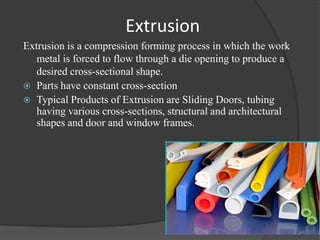
Extrusion is a compression forming process in which the work
   metal is forced to flow through a die opening to produce a
   desired cross-sectional shape.
 Parts have constant cross-section
 Typical Products of Extrusion are Sliding Doors, tubing
   having various cross-sections, structural and architectural
   shapes and door and window frames.
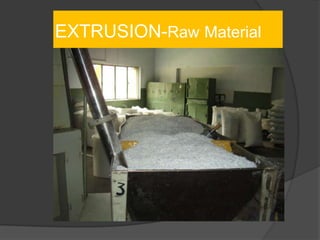
EXTRUSION-Raw Material
Materials
Metals that are commonly extruded include
   Aluminium: it is the most commonly extruded material. used to make s
    frames, rails, and heat sinks
   Copper: It is used to make pipe, wire, rods, bars, tubes, and welding
    electrodes.
   Lead and Tin: It is used to make pipes, wire, tubes, and cable sheathing.
    Molten lead may also be used in place of billets on vertical extrusion presses
   Zinc: Used to make rods, bar, tubes, hardware components, fitting, and
    handrails.
   Steel (1825 to 2375 F (1000 to 1300 C)) rods and tracks. Usually plain
    carbon steel is extruded, but alloy steel and stainless steel can also be
    extruded.
   Titanium (1100 to 1825 F (600 to 1000 C) aircraft components including
    seat tracks, engine rings, and other structural parts.
Plastic
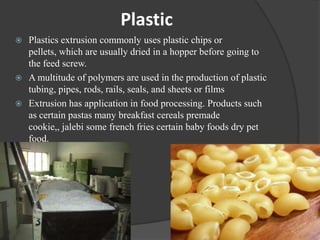
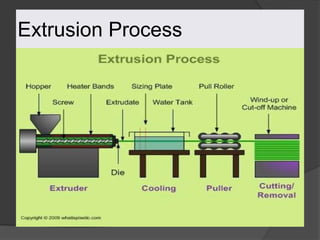
 Plastics extrusion commonly uses plastic chips or
  pellets, which are usually dried in a hopper before going to
  the feed screw.
 A multitude of polymers are used in the production of plastic
  tubing, pipes, rods, rails, seals, and sheets or films
 Extrusion has application in food processing. Products such
  as certain pastas many breakfast cereals premade
  cookie,, jalebi some french fries certain baby foods dry pet
  food.
Billet
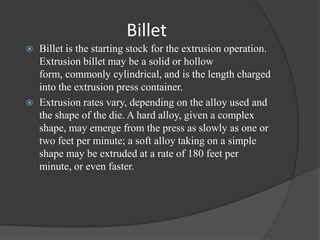
   Billet is the starting stock for the extrusion operation.
    Extrusion billet may be a solid or hollow
    form, commonly cylindrical, and is the length charged
    into the extrusion press container.
   Extrusion rates vary, depending on the alloy used and
    the shape of the die. A hard alloy, given a complex
    shape, may emerge from the press as slowly as one or
    two feet per minute; a soft alloy taking on a simple
    shape may be extruded at a rate of 180 feet per
    minute, or even faster.
Extrusion Process
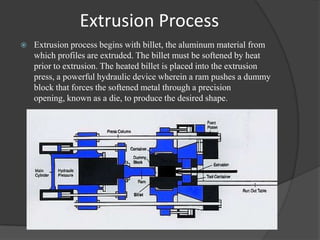
   Extrusion process begins with billet, the aluminum material from
    which profiles are extruded. The billet must be softened by heat
    prior to extrusion. The heated billet is placed into the extrusion
    press, a powerful hydraulic device wherein a ram pushes a dummy
    block that forces the softened metal through a precision
    opening, known as a die, to produce the desired shape.
Extrusion Process
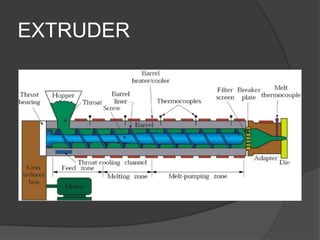
EXTRUDER
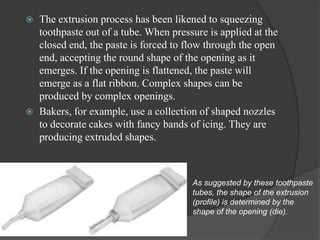
   The extrusion process has been likened to squeezing
    toothpaste out of a tube. When pressure is applied at the
    closed end, the paste is forced to flow through the open
    end, accepting the round shape of the opening as it
    emerges. If the opening is flattened, the paste will
    emerge as a flat ribbon. Complex shapes can be
    produced by complex openings.
   Bakers, for example, use a collection of shaped nozzles
    to decorate cakes with fancy bands of icing. They are
    producing extruded shapes.


                                        As suggested by these toothpaste
                                        tubes, the shape of the extrusion
                                        (profile) is determined by the
                                        shape of the opening (die).
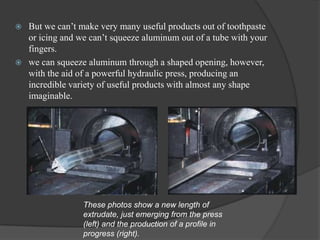
   But we can’t make very many useful products out of toothpaste
    or icing and we can’t squeeze aluminum out of a tube with your
    fingers.
   we can squeeze aluminum through a shaped opening, however,
    with the aid of a powerful hydraulic press, producing an
    incredible variety of useful products with almost any shape
    imaginable.


                  These photos show a new length of
                  extrudate, just emerging from the press
                  (left) and the production of a profile in
                  progress (right).
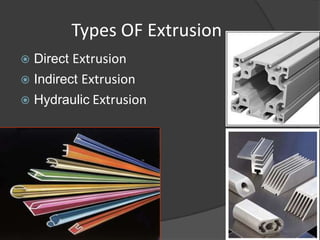
Types OF Extrusion
   Direct Extrusion
   Indirect Extrusion
   Hydraulic Extrusion
Direct Extrusion
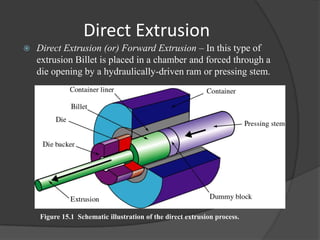
   Direct Extrusion (or) Forward Extrusion – In this type of
    extrusion Billet is placed in a chamber and forced through a
    die opening by a hydraulically-driven ram or pressing stem.


    Figure 15.1 Schematic illustration of the direct extrusion process.
Direct Extrusion


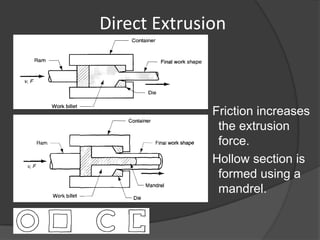
              Friction increases
               the extrusion
               force.
              Hollow section is
               formed using a
               mandrel.
Indirect Extrusion
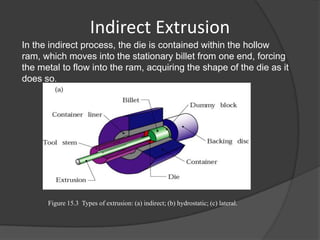
In the indirect process, the die is contained within the hollow
ram, which moves into the stationary billet from one end, forcing
the metal to flow into the ram, acquiring the shape of the die as it
does so.


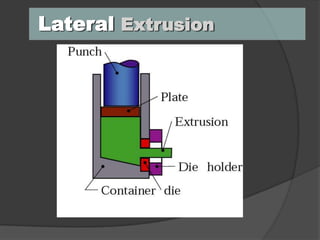
      Figure 15.3 Types of extrusion: (a) indirect; (b) hydrostatic; (c) lateral.
Indirect Extrusion


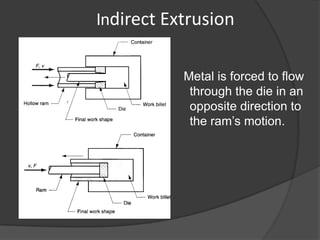
           Metal is forced to flow
            through the die in an
            opposite direction to
            the ram’s motion.
Difference
   In the direct extrusion process, the die is
    stationary and the ram forces the alloy through the
    opening in the die While In the indirect
    process, the die is contained within the hollow
    ram, which moves into the stationary billet from
    one end, forcing the metal to flow into the
    ram, acquiring the shape of the die as it does so.
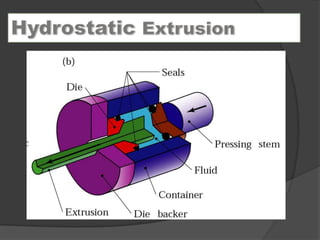
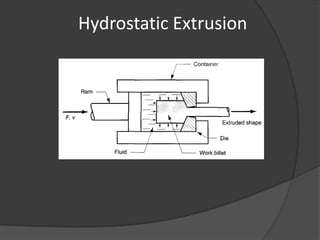
Hydrostatic Extrusion
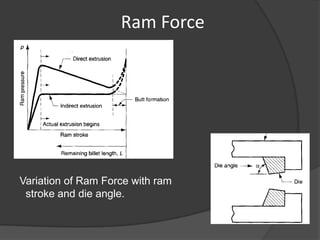
Ram Force


Variation of Ram Force with ram
 stroke and die angle.
Lateral Extrusion
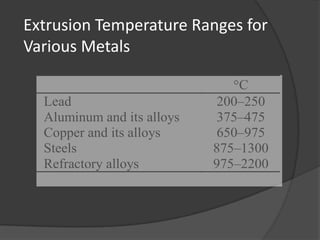
Extrusion Temperature Ranges for
Various Metals

                                C
  Lead                      200–250
  Aluminum and its alloys   375–475
  Copper and its alloys     650–975
  Steels                    875–1300
  Refractory alloys         975–2200
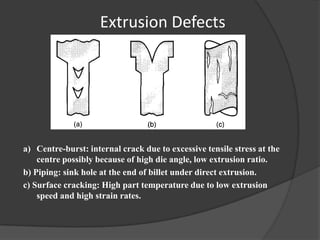
Extrusion Defects


a) Centre-burst: internal crack due to excessive tensile stress at the
    centre possibly because of high die angle, low extrusion ratio.
b) Piping: sink hole at the end of billet under direct extrusion.
c) Surface cracking: High part temperature due to low extrusion
    speed and high strain rates.
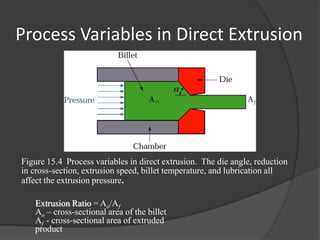
Process Variables in Direct Extrusion


Figure 15.4 Process variables in direct extrusion. The die angle, reduction
in cross-section, extrusion speed, billet temperature, and lubrication all
affect the extrusion pressure.

   Extrusion Ratio = Ao/Af
   Ao – cross-sectional area of the billet
   Af - cross-sectional area of extruded
   product
Factors Influencing the Forces
   Friction
   Material Properties
   Reduction In Area
   Speed
   Temperature
   Geometry Of The Die
Advantages of Extrusion process
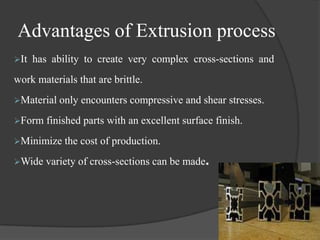
It   has ability to create very complex cross-sections and
work materials that are brittle.
Material only   encounters compressive and shear stresses.
Form    finished parts with an excellent surface finish.
Minimize the    cost of production.
Wide   variety of cross-sections can be made.

Lec 3

  • 1.
  • 2.
    Extrusion Extrusion is acompression forming process in which the work metal is forced to flow through a die opening to produce a desired cross-sectional shape.  Parts have constant cross-section  Typical Products of Extrusion are Sliding Doors, tubing having various cross-sections, structural and architectural shapes and door and window frames.
  • 3.
  • 4.
    Materials Metals that arecommonly extruded include  Aluminium: it is the most commonly extruded material. used to make s frames, rails, and heat sinks  Copper: It is used to make pipe, wire, rods, bars, tubes, and welding electrodes.  Lead and Tin: It is used to make pipes, wire, tubes, and cable sheathing. Molten lead may also be used in place of billets on vertical extrusion presses  Zinc: Used to make rods, bar, tubes, hardware components, fitting, and handrails.  Steel (1825 to 2375 F (1000 to 1300 C)) rods and tracks. Usually plain carbon steel is extruded, but alloy steel and stainless steel can also be extruded.  Titanium (1100 to 1825 F (600 to 1000 C) aircraft components including seat tracks, engine rings, and other structural parts.
  • 5.
    Plastic  Plastics extrusioncommonly uses plastic chips or pellets, which are usually dried in a hopper before going to the feed screw.  A multitude of polymers are used in the production of plastic tubing, pipes, rods, rails, seals, and sheets or films  Extrusion has application in food processing. Products such as certain pastas many breakfast cereals premade cookie,, jalebi some french fries certain baby foods dry pet food.
  • 6.
    Billet  Billet is the starting stock for the extrusion operation. Extrusion billet may be a solid or hollow form, commonly cylindrical, and is the length charged into the extrusion press container.  Extrusion rates vary, depending on the alloy used and the shape of the die. A hard alloy, given a complex shape, may emerge from the press as slowly as one or two feet per minute; a soft alloy taking on a simple shape may be extruded at a rate of 180 feet per minute, or even faster.
  • 7.
    Extrusion Process  Extrusion process begins with billet, the aluminum material from which profiles are extruded. The billet must be softened by heat prior to extrusion. The heated billet is placed into the extrusion press, a powerful hydraulic device wherein a ram pushes a dummy block that forces the softened metal through a precision opening, known as a die, to produce the desired shape.
  • 8.
  • 9.
  • 10.
    The extrusion process has been likened to squeezing toothpaste out of a tube. When pressure is applied at the closed end, the paste is forced to flow through the open end, accepting the round shape of the opening as it emerges. If the opening is flattened, the paste will emerge as a flat ribbon. Complex shapes can be produced by complex openings.  Bakers, for example, use a collection of shaped nozzles to decorate cakes with fancy bands of icing. They are producing extruded shapes. As suggested by these toothpaste tubes, the shape of the extrusion (profile) is determined by the shape of the opening (die).
  • 11.
    But we can’t make very many useful products out of toothpaste or icing and we can’t squeeze aluminum out of a tube with your fingers.  we can squeeze aluminum through a shaped opening, however, with the aid of a powerful hydraulic press, producing an incredible variety of useful products with almost any shape imaginable. These photos show a new length of extrudate, just emerging from the press (left) and the production of a profile in progress (right).
  • 12.
    Types OF Extrusion  Direct Extrusion  Indirect Extrusion  Hydraulic Extrusion
  • 13.
    Direct Extrusion  Direct Extrusion (or) Forward Extrusion – In this type of extrusion Billet is placed in a chamber and forced through a die opening by a hydraulically-driven ram or pressing stem. Figure 15.1 Schematic illustration of the direct extrusion process.
  • 14.
    Direct Extrusion Friction increases the extrusion force. Hollow section is formed using a mandrel.
  • 15.
    Indirect Extrusion In theindirect process, the die is contained within the hollow ram, which moves into the stationary billet from one end, forcing the metal to flow into the ram, acquiring the shape of the die as it does so. Figure 15.3 Types of extrusion: (a) indirect; (b) hydrostatic; (c) lateral.
  • 16.
    Indirect Extrusion Metal is forced to flow through the die in an opposite direction to the ram’s motion.
  • 17.
    Difference  In the direct extrusion process, the die is stationary and the ram forces the alloy through the opening in the die While In the indirect process, the die is contained within the hollow ram, which moves into the stationary billet from one end, forcing the metal to flow into the ram, acquiring the shape of the die as it does so.
  • 19.
  • 20.
    Ram Force Variation ofRam Force with ram stroke and die angle.
  • 21.
  • 22.
    Extrusion Temperature Rangesfor Various Metals C Lead 200–250 Aluminum and its alloys 375–475 Copper and its alloys 650–975 Steels 875–1300 Refractory alloys 975–2200
  • 23.
    Extrusion Defects a) Centre-burst:internal crack due to excessive tensile stress at the centre possibly because of high die angle, low extrusion ratio. b) Piping: sink hole at the end of billet under direct extrusion. c) Surface cracking: High part temperature due to low extrusion speed and high strain rates.
  • 24.
    Process Variables inDirect Extrusion Figure 15.4 Process variables in direct extrusion. The die angle, reduction in cross-section, extrusion speed, billet temperature, and lubrication all affect the extrusion pressure. Extrusion Ratio = Ao/Af Ao – cross-sectional area of the billet Af - cross-sectional area of extruded product
  • 25.
    Factors Influencing theForces  Friction  Material Properties  Reduction In Area  Speed  Temperature  Geometry Of The Die
  • 26.
    Advantages of Extrusionprocess It has ability to create very complex cross-sections and work materials that are brittle. Material only encounters compressive and shear stresses. Form finished parts with an excellent surface finish. Minimize the cost of production. Wide variety of cross-sections can be made.