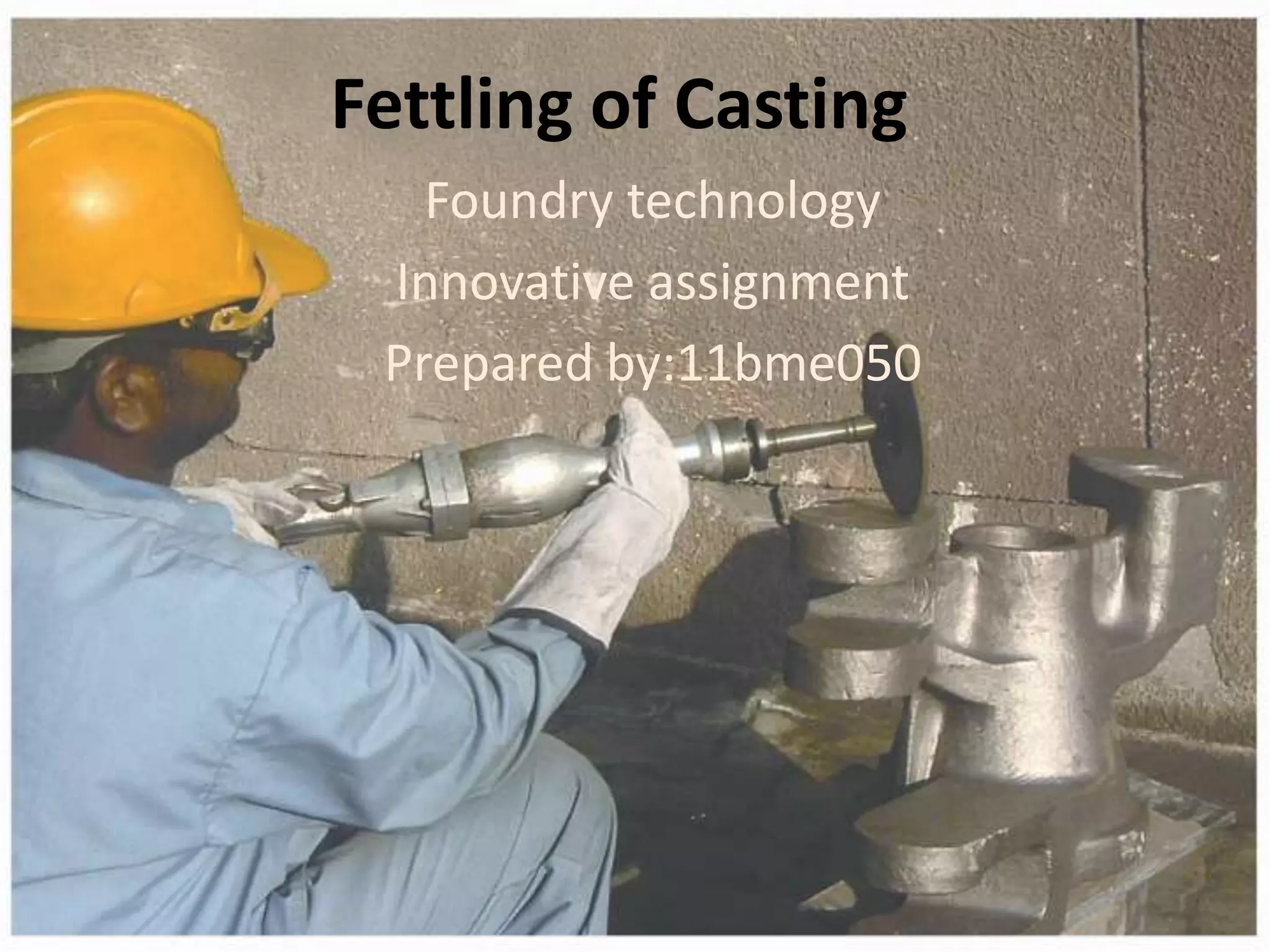
Fettling of Casting
Foundry technology
Innovative assignment
Prepared by:11bme050
Introduction
Fettling Processes
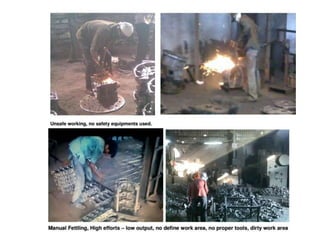
Case study
Introduction
General meaning of fettling:
• Mostly used for the words related to cleaning,
polishing, and maintaining systems so that they
will be functional or will remain functional.
• The word itself is derived from a root word
referring to “condition,” as seen in the phrase
“in fine fettle,” which is meant to describe good
condition, shape, or health.
DEFINITION:
Fettling is the means by which a crude casting
is turned into a cost effective quality
component that meets all the standards
required by the customer.
• In context with the casting process, fettling
means the removal of unwanted metal, e.g.
flashings, risers etc.
• It can include processes like chipping,
grinding, shot blasting etc.
Fettling process
• It involves the removal of the cores, gates,
sprues, runners, risers and chipping of any of
unnecessary projections on the surface of the
castings.
• Fettling operations can be divided into
different stages
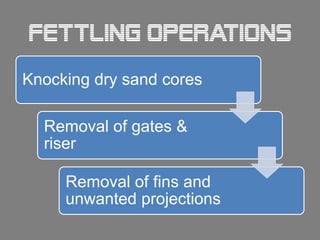
FETTLING OPERATIONS
Knocking dry sand cores
Removal of gates &
riser
Removal of fins and
unwanted projections
Knocking of dry sand core
• Knocking out of dry sand cores. Dry sand cores
may be removed by knocking with iron bar.
• For quick knocking pneumatic or hydraulic
devices are employed, this method is used for
small, medium work. For large castings the
hydro blast process is mostly employed.
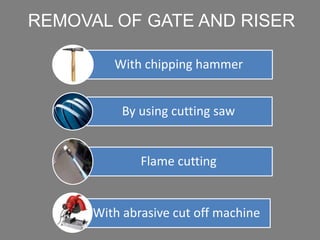
REMOVAL OF GATE AND RISER
With chipping hammer
By using cutting saw
Flame cutting
With abrasive cut off machine
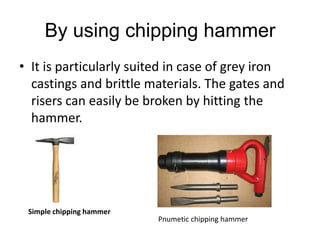
By using chipping hammer
• It is particularly suited in case of grey iron
castings and brittle materials. The gates and
risers can easily be broken by hitting the
hammer.
Simple chipping hammer
Pnumetic chipping hammer
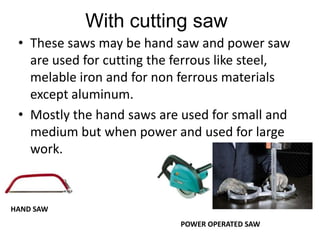
With cutting saw
• These saws may be hand saw and power saw
are used for cutting the ferrous like steel,
melable iron and for non ferrous materials
except aluminum.
• Mostly the hand saws are used for small and
medium but when power and used for large
work.
HAND SAW
POWER OPERATED SAW
With flame cutting
• This type of method is specially used for
ferrous materials of large sized castings where
the risers and gates are very heavy.
• In this the gas cutting flames and arc cutting
methods may be employed.
• big casting.jpg
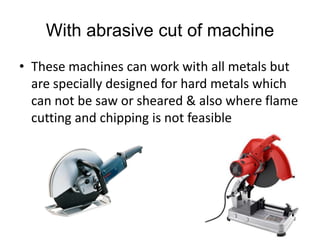
With abrasive cut of machine
• These machines can work with all metals but
are specially designed for hard metals which
can not be saw or sheared & also where flame
cutting and chipping is not feasible
Removal of fins, rough spots and
un wanted projections
• The casting surface after removal of the gates
may still contain some rough surfaces left at
the time of removal of gates. Like. .
• Sand that is fused with surface.
• Some fins and other projections on the
surface near the parting line.
• They are needed to be cleaned thoroughly
before the casting is put to use.
CNTD.
• The fins and other small projections may
easily be chipped off with the help of either
hand tools or pneumatic tools.
• But for smoothing the rough cut gate edges
either the pedestal or swing frame grinder is
used depends upon the size of castings.
CLEANING
TUMBLING
• Traditional and old
process.
• Casting is put in a
chamber and rotated
with 60-70 rpm speed in
presence of small pieces
of white cast iron
MODERN BLASTING
PROCESSES
Blast Machine
• SHOT BLASTING
• TUMBLING WITH HYDRO
BLAST
• AIR BLASTING
Fettling in casting

Fettling in casting

  • 1.
    Fettling of Casting Foundrytechnology Innovative assignment Prepared by:11bme050
  • 2.
  • 3.
    Introduction General meaning offettling: • Mostly used for the words related to cleaning, polishing, and maintaining systems so that they will be functional or will remain functional. • The word itself is derived from a root word referring to “condition,” as seen in the phrase “in fine fettle,” which is meant to describe good condition, shape, or health.
  • 4.
    DEFINITION: Fettling is themeans by which a crude casting is turned into a cost effective quality component that meets all the standards required by the customer. • In context with the casting process, fettling means the removal of unwanted metal, e.g. flashings, risers etc. • It can include processes like chipping, grinding, shot blasting etc.
  • 5.
    Fettling process • Itinvolves the removal of the cores, gates, sprues, runners, risers and chipping of any of unnecessary projections on the surface of the castings. • Fettling operations can be divided into different stages
  • 6.
    FETTLING OPERATIONS Knocking drysand cores Removal of gates & riser Removal of fins and unwanted projections
  • 7.
    Knocking of drysand core • Knocking out of dry sand cores. Dry sand cores may be removed by knocking with iron bar. • For quick knocking pneumatic or hydraulic devices are employed, this method is used for small, medium work. For large castings the hydro blast process is mostly employed.
  • 8.
    REMOVAL OF GATEAND RISER With chipping hammer By using cutting saw Flame cutting With abrasive cut off machine
  • 9.
    By using chippinghammer • It is particularly suited in case of grey iron castings and brittle materials. The gates and risers can easily be broken by hitting the hammer. Simple chipping hammer Pnumetic chipping hammer
  • 10.
    With cutting saw •These saws may be hand saw and power saw are used for cutting the ferrous like steel, melable iron and for non ferrous materials except aluminum. • Mostly the hand saws are used for small and medium but when power and used for large work. HAND SAW POWER OPERATED SAW
  • 11.
    With flame cutting •This type of method is specially used for ferrous materials of large sized castings where the risers and gates are very heavy. • In this the gas cutting flames and arc cutting methods may be employed. • big casting.jpg
  • 12.
    With abrasive cutof machine • These machines can work with all metals but are specially designed for hard metals which can not be saw or sheared & also where flame cutting and chipping is not feasible
  • 13.
    Removal of fins,rough spots and un wanted projections • The casting surface after removal of the gates may still contain some rough surfaces left at the time of removal of gates. Like. . • Sand that is fused with surface. • Some fins and other projections on the surface near the parting line. • They are needed to be cleaned thoroughly before the casting is put to use.
  • 14.
    CNTD. • The finsand other small projections may easily be chipped off with the help of either hand tools or pneumatic tools. • But for smoothing the rough cut gate edges either the pedestal or swing frame grinder is used depends upon the size of castings.
  • 15.
    CLEANING TUMBLING • Traditional andold process. • Casting is put in a chamber and rotated with 60-70 rpm speed in presence of small pieces of white cast iron MODERN BLASTING PROCESSES Blast Machine • SHOT BLASTING • TUMBLING WITH HYDRO BLAST • AIR BLASTING