SHEEP & GOAT
NUTRITION
SUSAN SCHOENIAN
SHEEP & GOAT SPECIALIST, UNIVERSITY OF MARYLAND EXTENSION
WESTERN MARYLAND RESEARCH & EDUCATION CENTER, KEEDYSVILLE, MARYLAND
SSCHOEN@UMD.EDU – WWW.SHEEPANDGOAT.COM – WWW.WORMX.INFO
Presentation outline
 Nutrients
 Nutrient requirements
 Intake
 Synchronizing forage and animal
production
 Supplementation
 Evaluating nutritional program
 Suggested resources
Nutrients required by all sheep and goats
 Energy
 Protein
 Minerals
 Vitamins
 Water
Energy (calories)
 Nutrient required in the greatest quantity.
 Is usually the most limiting nutrient.
 Comes primarily from carbohydrates and
fats in the diet, but also from excess protein.
 Excess energy is stored as fat in the body.
 Energy is expressed in different ways:
• TDN - total digestible nutrients, %
• DE - digestible energy, kcal
• ME - metabolizable energy, kcal
• NEp - net energy, kcal
• DOM - digestible organic matter, %
Improper feeding of energy to livestock
Not enough energy in diet
 Reduced fertility
 Reduced growth rates
 Reduced milk production
 Loss of body condition, reserves
 Higher critical temperature
 Less cold tolerance
 Reduced resistance to disease.
 Risk of pregnancy toxemia (ketosis)
 Reduced nutrient absorption.
 Increases protein requirements
(%) of ration.
Too much energy in diet
 Wasteful economically
 Over-conditioned (BCS >4.5) animals
have impaired reproduction.
 Fat females are more prone to
pregnancy toxemia and dystocia.
 Feed efficiency decreases once an
animal has reached its optimal finish.
 Excess finish is undesirable to most to
consumers.
Protein (amino acids)
 Required in smaller amounts than energy.
 More expensive feed ingredient than energy.
 Amount more important than quality.
 Excess protein is not stored in the body:
excess protein is broken down and used
as energy.
 Some excess protein may be beneficial if
parasites burdens, esp. barber pole worm, are
excessive.
 Protein is expressed in different ways:
• CP – crude protein
• DP – digestible protein
• MP – metabolizable protein
• DIP – rumen degraded intake protein
• UIP – undegraded intake protein
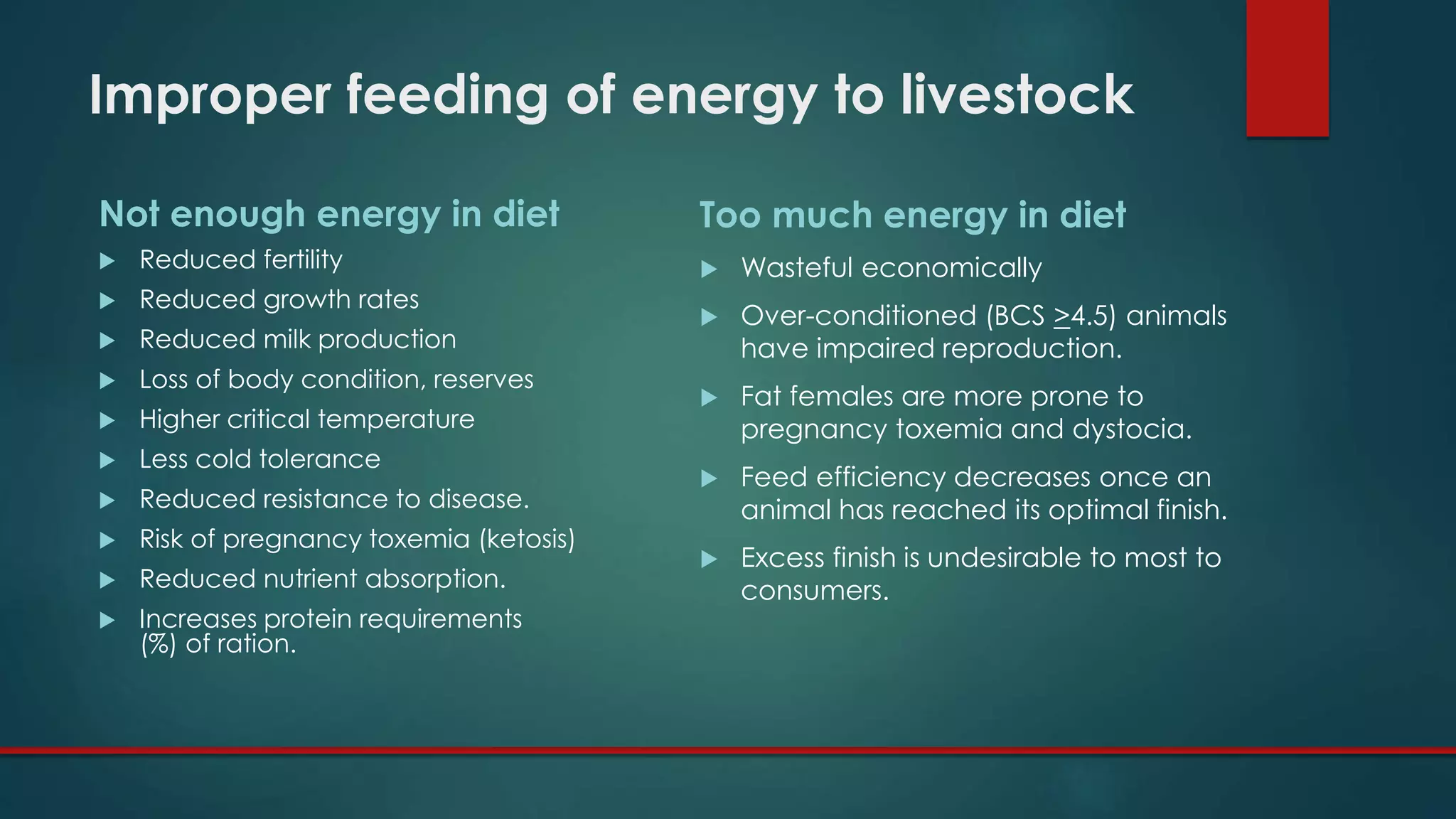
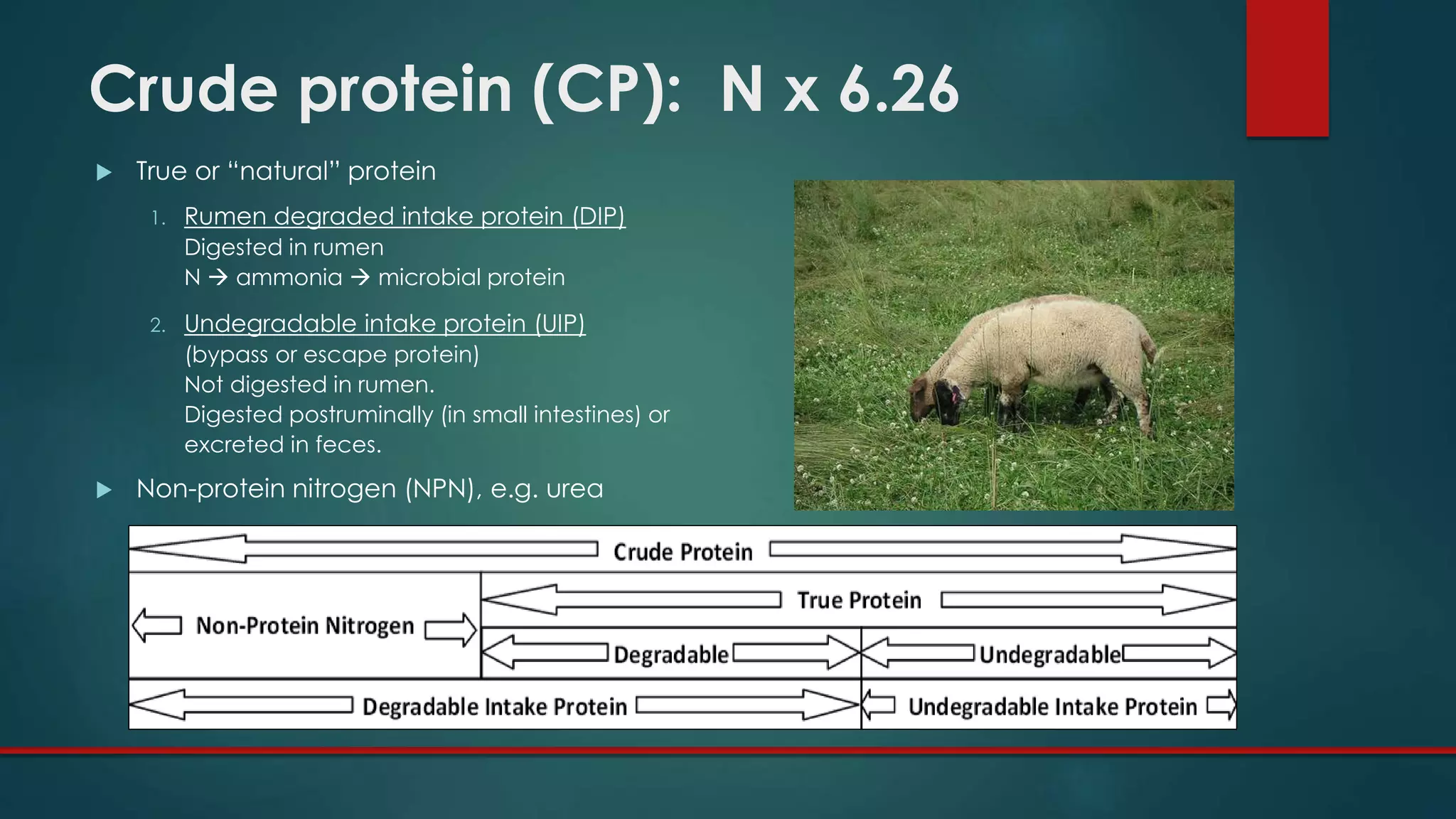
Crude protein (CP): N x 6.26
 True or “natural” protein
1. Rumen degraded intake protein (DIP)
Digested in rumen
N  ammonia  microbial protein
2. Undegradable intake protein (UIP)
(bypass or escape protein)
Not digested in rumen.
Digested postruminally (in small intestines) or
excreted in feces.
 Non-protein nitrogen (NPN), e.g. urea
By-pass protein
 A mix of microbial protein and
bypassed dietary protein is
desired for optimal productivity.
 In high-producing animals, it is
recommended that 25-35% of
protein be bypass protein.
 20-30 % of the protein in fresh,
high quality forage is bypass
protein.
 Supplementing with bypass
protein may improve
productivity and/or increase
resistance to internal parasites.
Bypass Protein sources
 Low
Soybean meal
 Medium
Cottonseed meal
Dehydrated alfalfa
Distiller’s grains
 High
Corn gluten meal
Fish meal
Improper feeding of protein to livestock
Not enough protein
 Protein deficiency is rare;
most effects are sub-clinical
 Impaired reproduction
 Reduced growth rates
 Reduced hoof and horn growth.
 Reduced milk production
 Decreased fiber production
 Reduced resistance to disease,
especially parasites.
 Reduced rumen function
 Reduced nutrition absorption
Too much protein
 Expensive and inefficient source of energy.
 Risk of pizzle rot in males
 Can cause metabolic harm
Excess N  ammonia  UREA (BUN)
 Reduces performance, as energy is
required for removal.
 Excess protein has been shown to cause
reproductive problems in cattle .
 Excess N (in manure) can be an environmental
concern (“a resource out-of-place”)
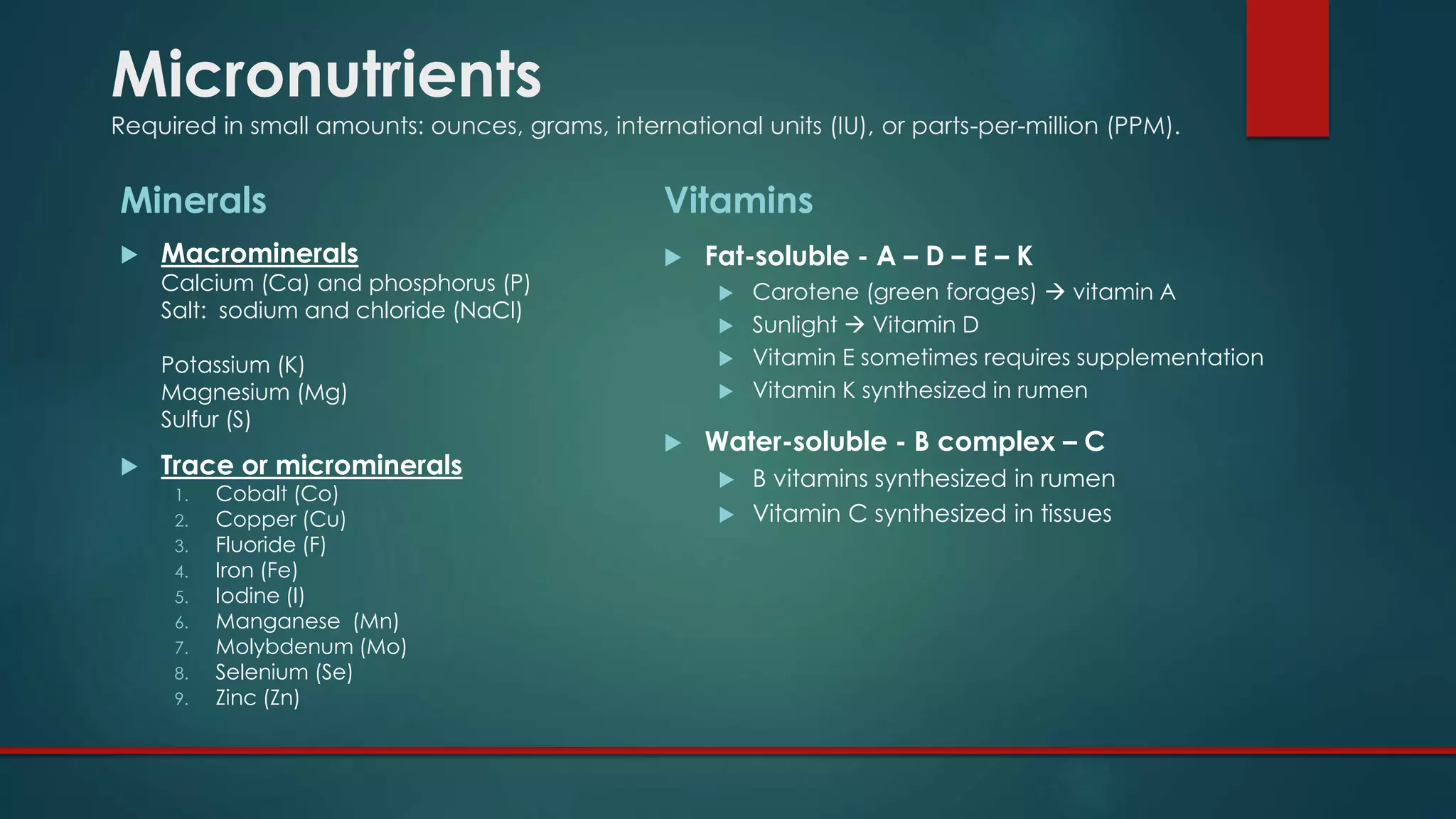
Micronutrients
Required in small amounts: ounces, grams, international units (IU), or parts-per-million (PPM).
Minerals
 Macrominerals
Calcium (Ca) and phosphorus (P)
Salt: sodium and chloride (NaCl)
Potassium (K)
Magnesium (Mg)
Sulfur (S)
 Trace or microminerals
1. Cobalt (Co)
2. Copper (Cu)
3. Fluoride (F)
4. Iron (Fe)
5. Iodine (I)
6. Manganese (Mn)
7. Molybdenum (Mo)
8. Selenium (Se)
9. Zinc (Zn)
Vitamins
 Fat-soluble - A – D – E – K
 Carotene (green forages)  vitamin A
 Sunlight  Vitamin D
 Vitamin E sometimes requires supplementation
 Vitamin K synthesized in rumen
 Water-soluble - B complex – C
 B vitamins synthesized in rumen
 Vitamin C synthesized in tissues
Possible micronutrient problems
Deficiencies
 Calcium and phosphorus
rickets
 Calcium
Milk fever
 Copper
Various, including
swayback, stringy wool,
hair color
 Iodine
Goiter
 Magnesium
Grass tetany
Excesses
 Calcium
milk fever
 Copper (esp. sheep)
Chronic or acute toxicity
 Selenium toxicosis
 Sulfur - polio
Imbalances
 Copper, molybdenum, and sulfur
Copper toxicity or deficiency
 Calcium and phosphorus
Urinary calculi
 Salt
Lower feed and water
consumption
 Selenium and Vitamin E
White muscle disease
Various other problems
 Thiamin (B2)
Polioencephamalacia
 Zinc
Wool picking, skin problems,
hoof problems
Important nutrition interactions
 Calcium and phosphorus
Ratio should never go below 1:1
2:1 is ideal for most rations, especially for males
and castrates.
 Cobalt and vitamin B12
 Copper, molybdenum and sulfur
Molybdenum forms insoluble complex with
copper
Sulfur binds with molybdenum
 Nitrogen and sulfur
10:1 to 12:1 ratio is ideal
 Energy and protein
Excess protein (N) reduces nutrient absorption
and causes intestinal imbalances.
Nutrient requirements of sheep and goats
Vary by
 Species
 Genetics (type)
 Size (weight)
 Body condition
 Sex
 Age
 Stage and level of production
 Disease
 Environment
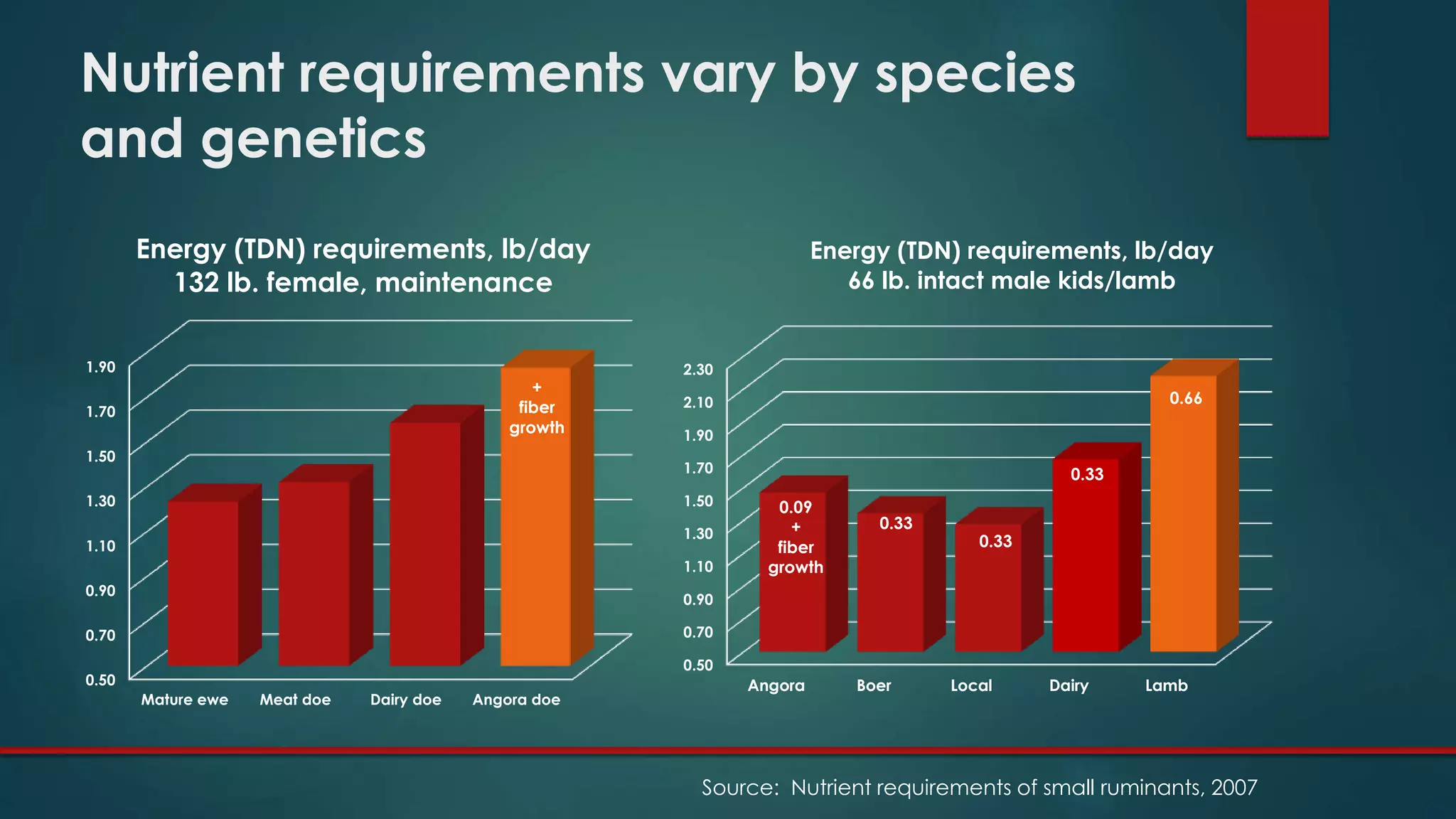
Nutrient requirements vary by species
and genetics
0.50
0.70
0.90
1.10
1.30
1.50
1.70
1.90
2.10
2.30
Angora Boer Local Dairy Lamb
Energy (TDN) requirements, lb/day
66 lb. intact male kids/lamb
0.33
0.33
0.33
0.66
0.09
+
fiber
growth
0.50
0.70
0.90
1.10
1.30
1.50
1.70
1.90
Mature ewe Meat doe Dairy doe Angora doe
Energy (TDN) requirements, lb/day
132 lb. female, maintenance
+
fiber
growth
Source: Nutrient requirements of small ruminants, 2007
Nutrient requirements vary by size (weight)
0.80
0.90
1.00
1.10
1.20
1.30
1.40
1.50
1.60
1.70
110-lb 154-lb 198-lb
Energy requirements, lb. TDN/day
Mature ewe, maintenance
0.60
0.70
0.80
0.90
1.00
1.10
1.20
1.30
1.40
1.50
88-lb 132-lb 154-lb
Energy requirements, lb. TDN/day
Mature non-dairy doe, maintenance
Source: Nutrient requirements of small ruminants, 2007
Energy requirements vary by stage
of production
1.00
1.20
1.40
1.60
1.80
2.00
2.20
2.40
Maintenance Breeding Early gestation Late gestation Lactation
Energy requirements, lb. TDN/day
132-lb. mature non-dairy doe (twins)
1.00
1.50
2.00
2.50
3.00
3.50
Maintenance Breeding Early gestation Late gestation Lactation
Energy requirements, lb. TDN/day
176-lb. mature ewe (twins)
Source: Nutrient requirements of small ruminants, 2007
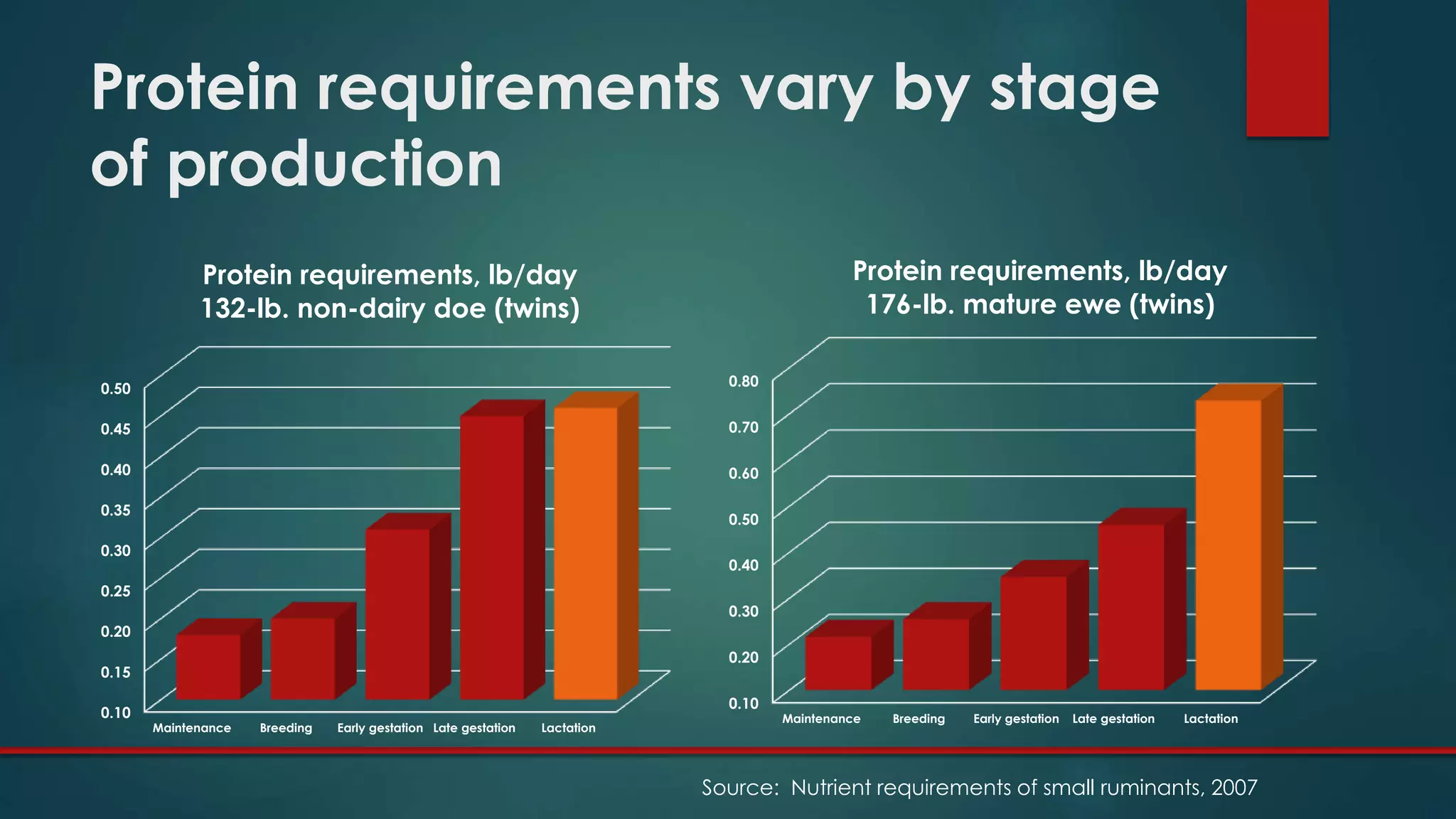
Protein requirements vary by stage
of production
0.10
0.20
0.30
0.40
0.50
0.60
0.70
0.80
Maintenance Breeding Early gestation Late gestation Lactation
Protein requirements, lb/day
176-lb. mature ewe (twins)
0.10
0.15
0.20
0.25
0.30
0.35
0.40
0.45
0.50
Maintenance Breeding Early gestation Late gestation Lactation
Protein requirements, lb/day
132-lb. non-dairy doe (twins)
Source: Nutrient requirements of small ruminants, 2007
Mineral requirements vary by stage
and level of production
1.0
2.0
3.0
4.0
5.0
6.0
7.0
8.0
9.0
10.0
Maintenance Breeding Early gestation Late gestation Early lactation
Mineral requirements, g/d
176-lb. mature ewe (twins)
1.0
2.0
3.0
4.0
5.0
6.0
7.0
8.0
9.0
10.0
Maintenance Breeding Early gestation Late gestation Early lactation
Mineral requirements, g/d
132-lb non-dairy doe (twins)
Calcium
Phosphorus
Source: Nutrient requirements of small ruminants, 2007
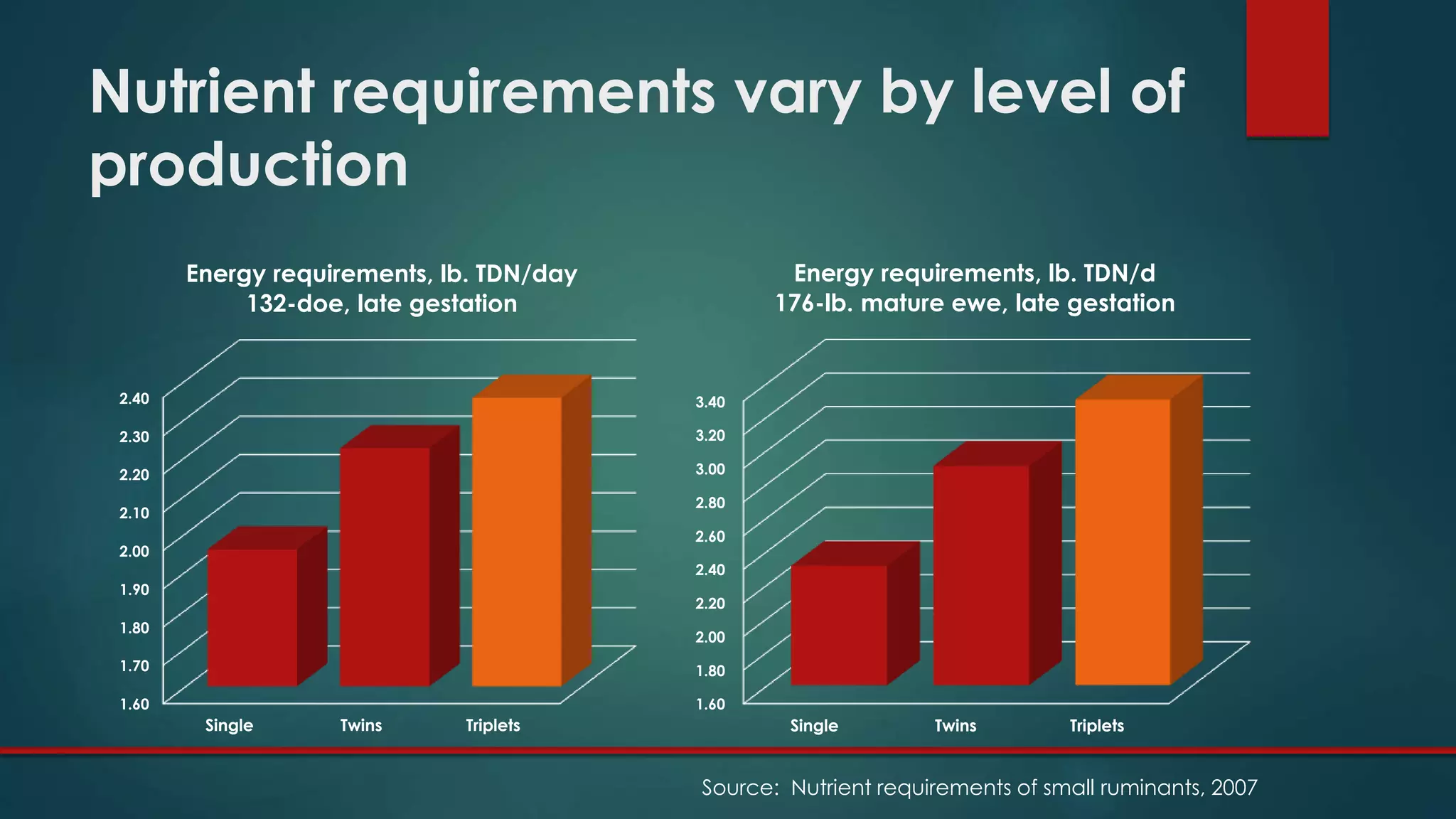
Nutrient requirements vary by level of
production
1.60
1.70
1.80
1.90
2.00
2.10
2.20
2.30
2.40
Single Twins Triplets
Energy requirements, lb. TDN/day
132-doe, late gestation
1.60
1.80
2.00
2.20
2.40
2.60
2.80
3.00
3.20
3.40
Single Twins Triplets
Energy requirements, lb. TDN/d
176-lb. mature ewe, late gestation
Source: Nutrient requirements of small ruminants, 2007
Nutrient requirements vary by desired level of
performance, e.g. ADG
0.50
0.70
0.90
1.10
1.30
1.50
1.70
No gain 0.11 0.22 0.33 0.44 0.55
Energy requirements, lb. TDN/d
44-lb. intact Boer buckling
0.50
1.00
1.50
2.00
2.50
3.00
0.44 0.55 0.66 0.88
Energy requirements, lb. TDN/d
66-lb. ram lamb, 4 mos. early maturing
Source: Nutrient requirements of small ruminants, 2007
Intake
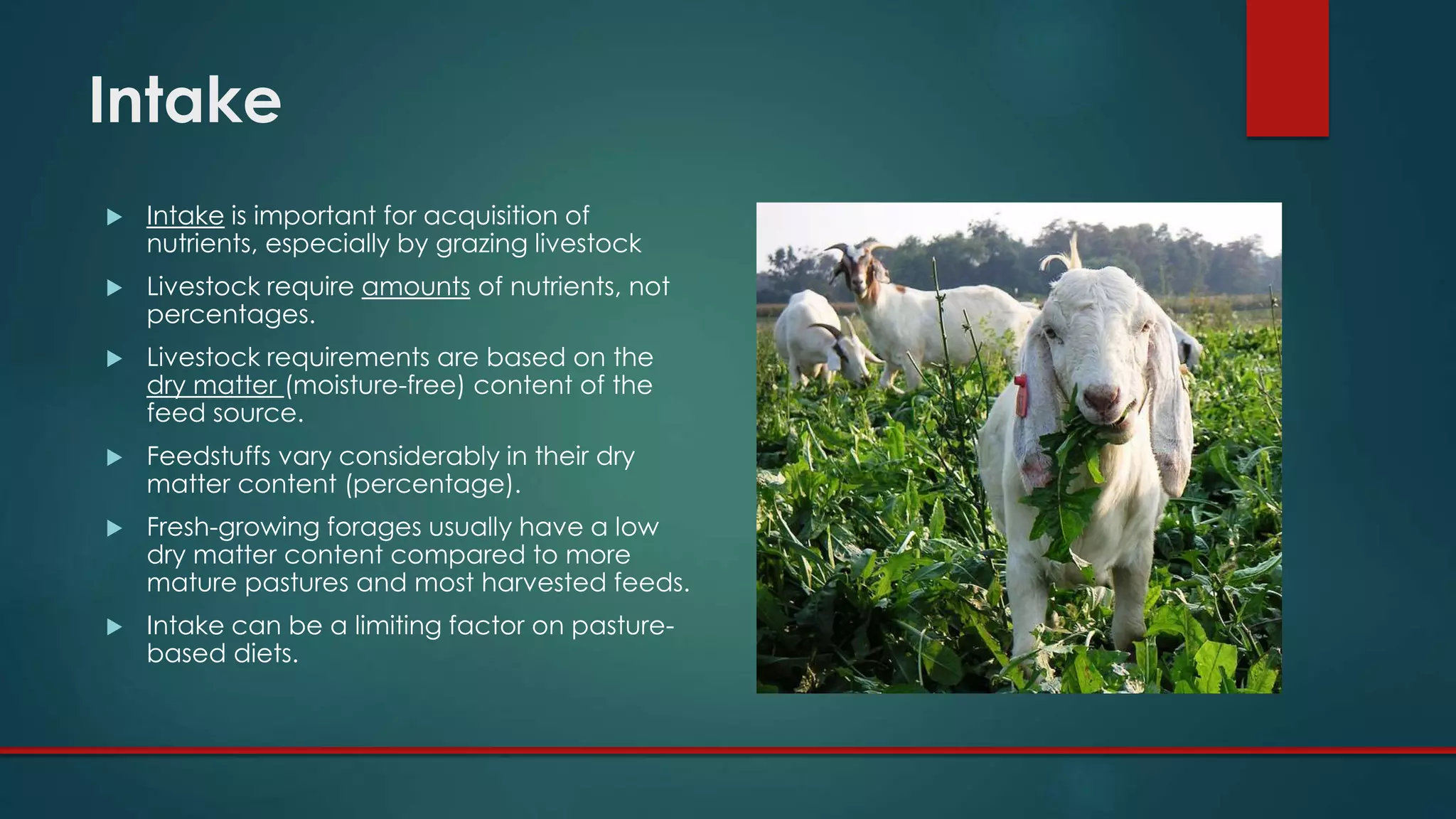
 Intake is important for acquisition of
nutrients, especially by grazing livestock
 Livestock require amounts of nutrients, not
percentages.
 Livestock requirements are based on the
dry matter (moisture-free) content of the
feed source.
 Feedstuffs vary considerably in their dry
matter content (percentage).
 Fresh-growing forages usually have a low
dry matter content compared to more
mature pastures and most harvested feeds.
 Intake can be a limiting factor on pasture-
based diets.
Factors affecting intake
 Palatability
Flavor and texture
 Foraging behavior
bite size and bite rate
 Chemical characteristics of feed
alkaloids, endophyte, tannins, and terpenes
 Forage quality, density, and availability
 Dietary energy and fiber content
Fiber  Intake 
 Physiological stage of animal
 Temperature
temperature  metabolic rate 
 Supplementation
How to increase intake
 Keep forage in vegetative
stage through grazing
management.
 Diversify pasture composition
to include several grass species
and around 30% legumes.
 Maintain a dense pasture so
animals will take larger bites.
 Supplementation
Synchronizing forage and animal
production
Breeding flock/herd Growing/finishing lambs & kids
1.00
1.50
2.00
2.50
3.00
3.50
January February March April May June July August September October November December
176-lb ewe 132-lb doe
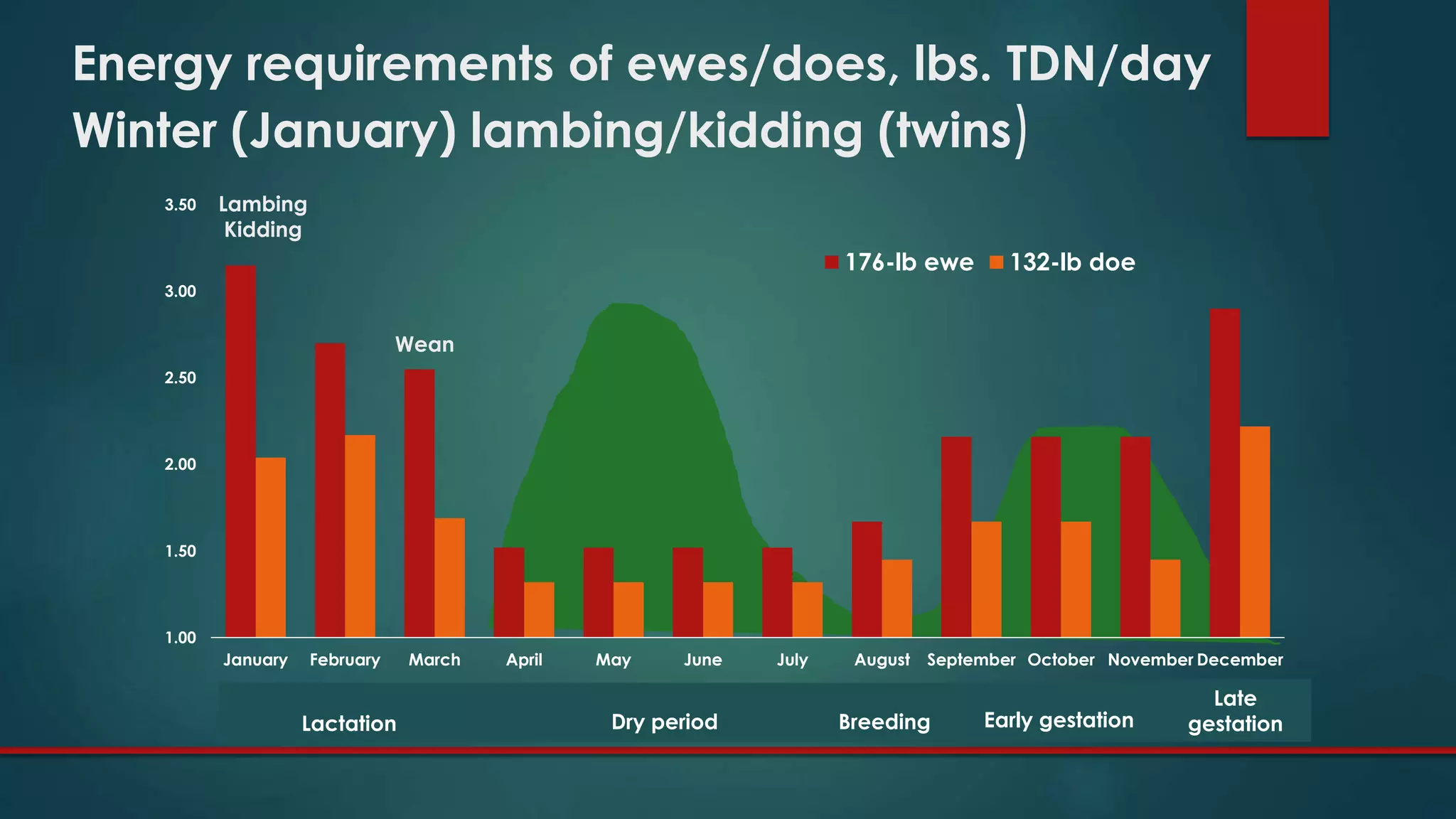
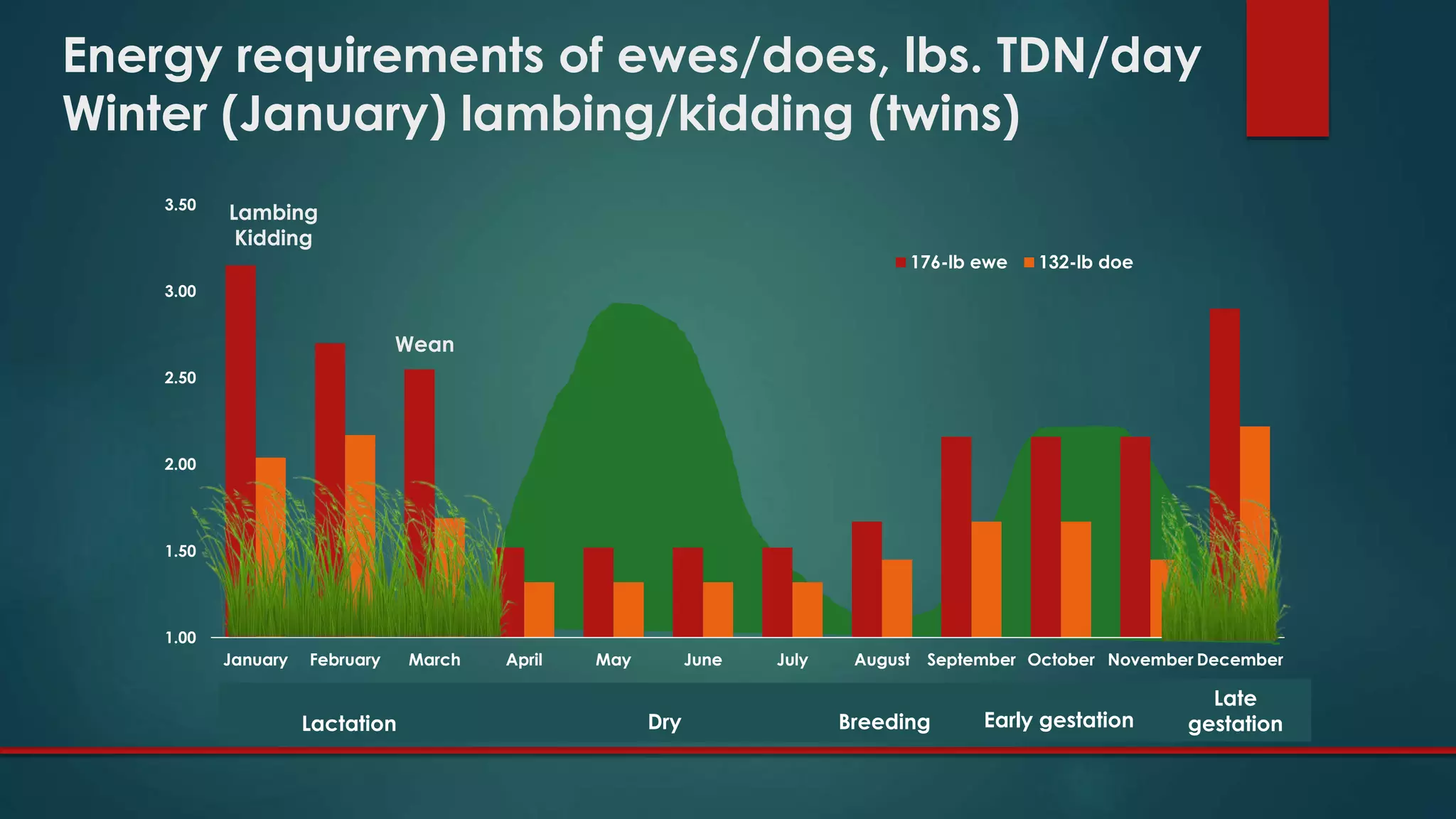
Energy requirements of ewes/does, lbs. TDN/day
Winter (January) lambing/kidding (twins)
Dry periodLactation Early gestation
Late
gestationBreeding
Lambing
Kidding
Wean
1.00
1.50
2.00
2.50
3.00
3.50
January February March April May June July August September October November December
176-lb ewe 132-lb doe
Energy requirements of ewes/does, lbs. TDN/day
Winter (January) lambing/kidding (twins)
Dry periodLactation Early gestation
Late
gestationBreeding
Lambing
Kidding
Wean
1.00
1.50
2.00
2.50
3.00
3.50
January February March April May June July August September October November December
176-lb ewe 132-lb doe
Energy requirements of ewes/does, lbs. TDN/day
Winter (January) lambing/kidding (twins)
DryLactation Early gestation
Late
gestationBreeding
Lambing
Kidding
Wean
January February March April May June July August September October November December
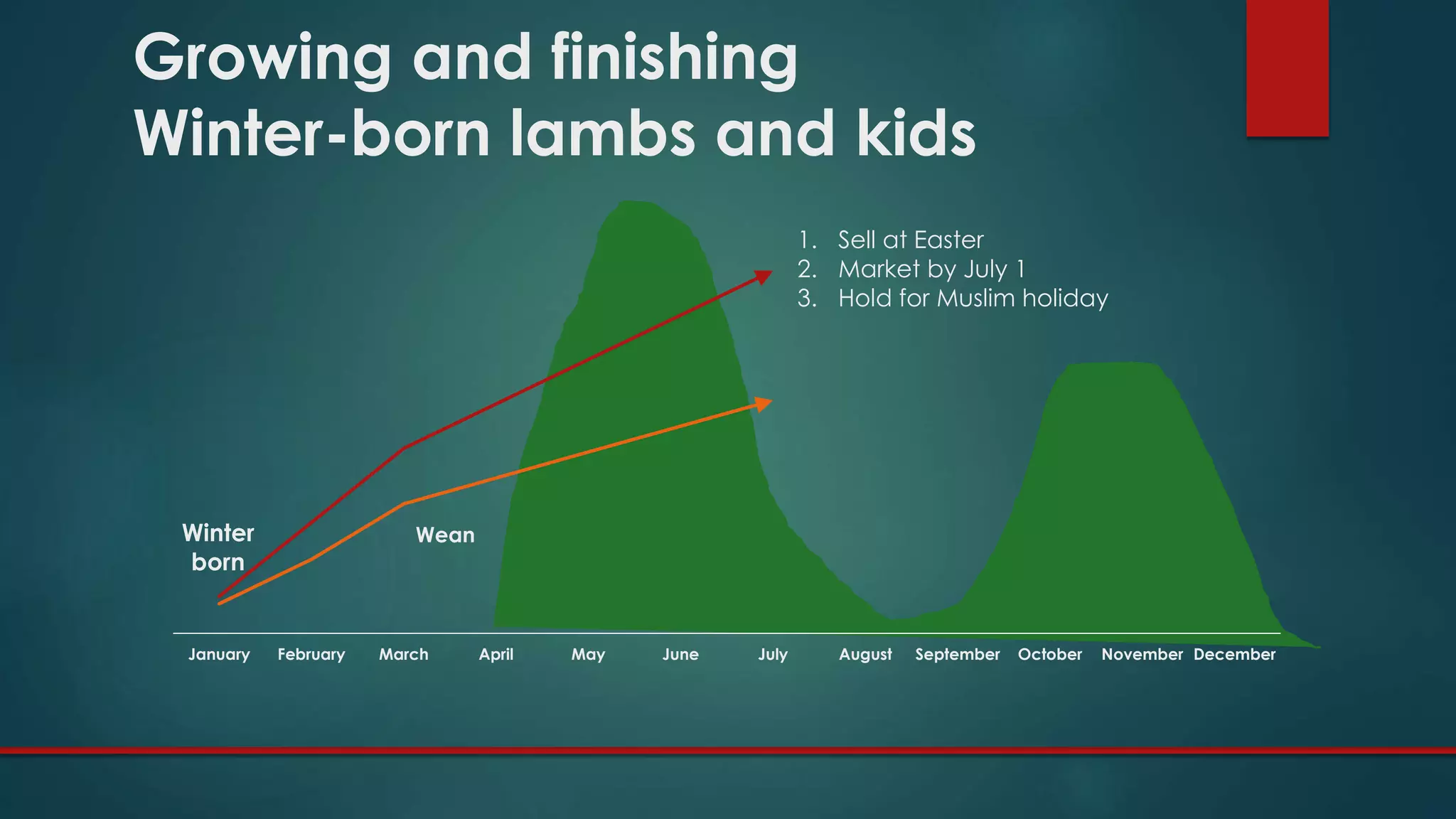
Growing and finishing
Winter-born lambs and kids
Winter
born
Wean
Growing and finishing
Winter-born lambs and kids
Winter
born
January February March April May June July August September October November December
1. Sell at Easter
2. Market by July 1
3. Hold for Muslim holiday
Wean
1.00
1.50
2.00
2.50
3.00
3.50
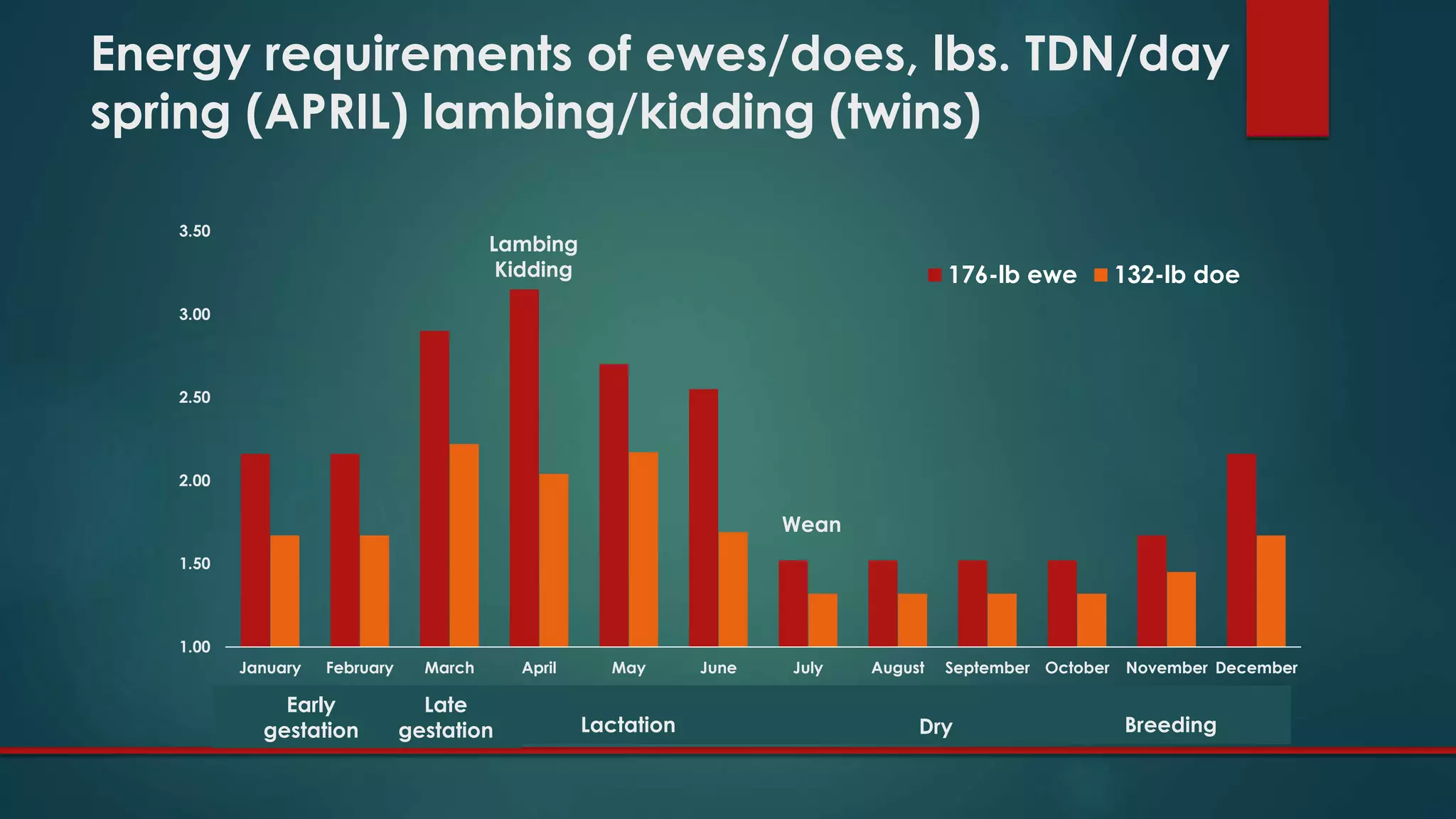
January February March April May June July August September October November December
176-lb ewe 132-lb doe
Energy requirements of ewes/does, lbs. TDN/day
spring (APRIL) lambing/kidding (twins)
DryLactation
Early
gestation
Late
gestation Breeding
Lambing
Kidding
Wean
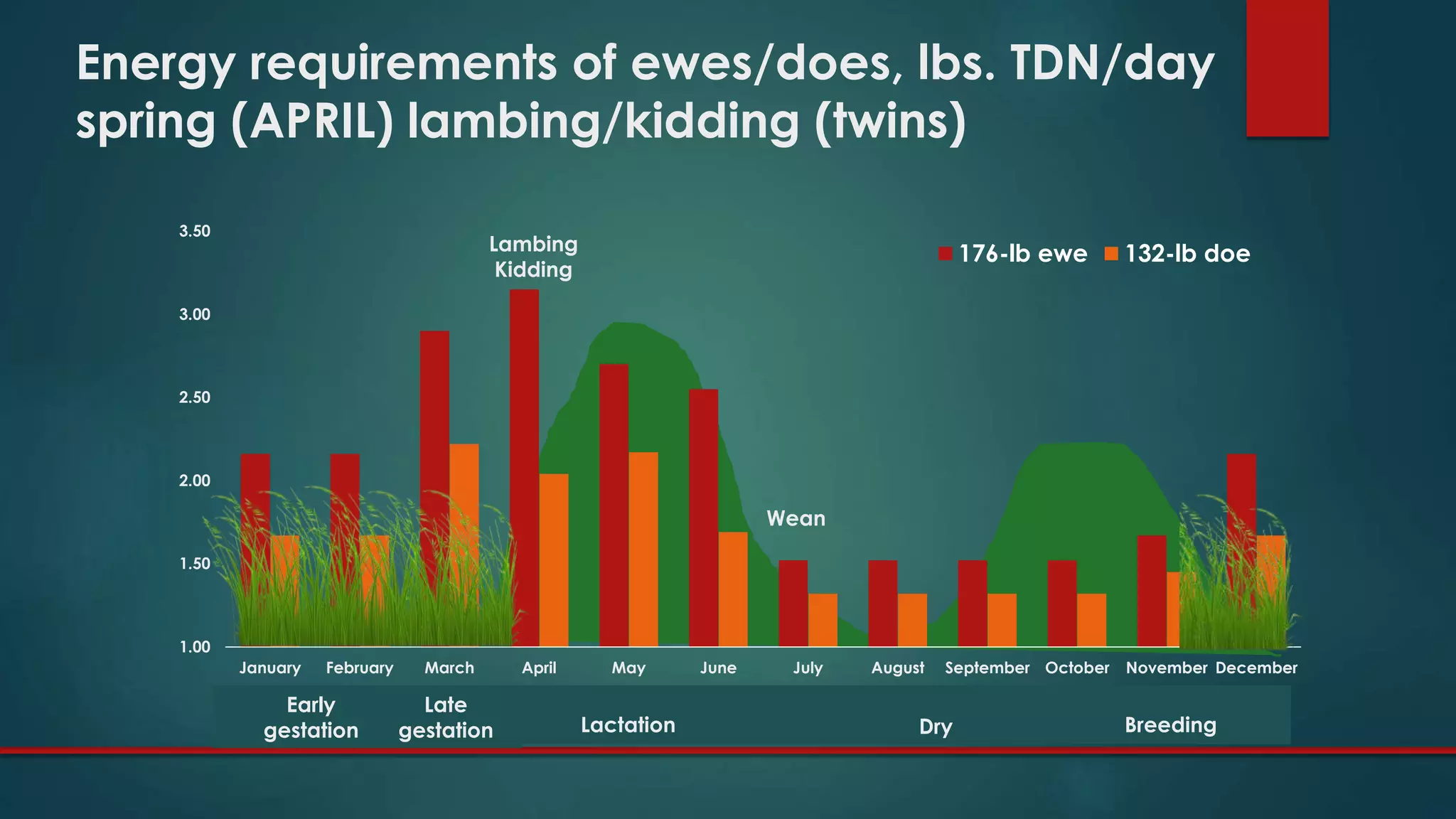
1.00
1.50
2.00
2.50
3.00
3.50
January February March April May June July August September October November December
176-lb ewe 132-lb doe
Energy requirements of ewes/does, lbs. TDN/day
spring (APRIL) lambing/kidding (twins)
DryLactation
Early
gestation
Late
gestation Breeding
Lambing
Kidding
Wean
1.00
1.50
2.00
2.50
3.00
3.50
January February March April May June July August September October November December
176-lb ewe 132-lb doe
Energy requirements of ewes/does, lbs. TDN/day
spring (APRIL) lambing/kidding (twins)
DryLactation
Early
gestation
Late
gestation Breeding
Lambing
Kidding
Wean
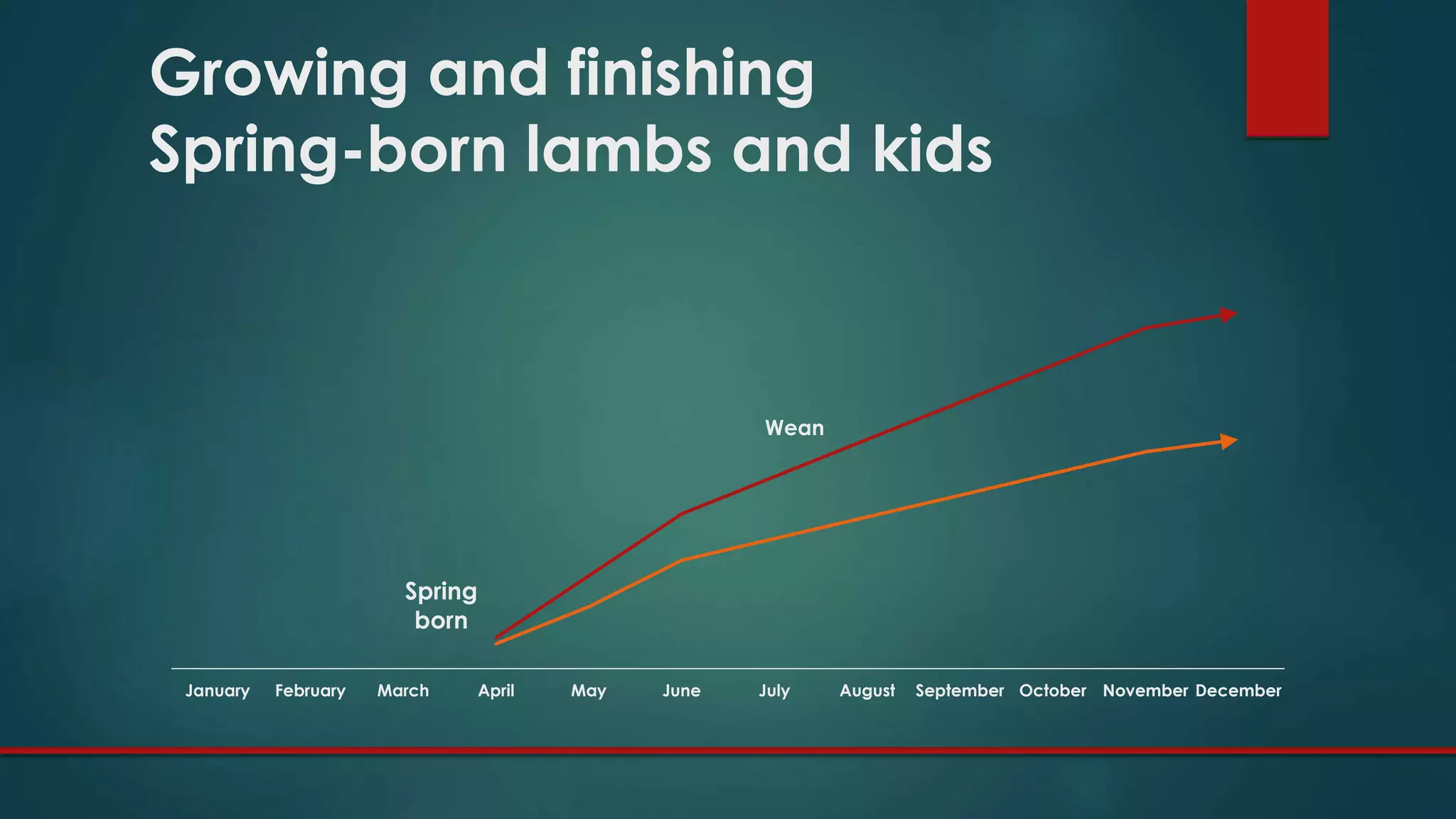
January February March April May June July August September October November December
Growing and finishing
Spring-born lambs and kids
Spring
born
Wean
January February March April May June July August September October November December
Growing and finishing
Spring-born lambs and kids
Spring
born
Wean
1. Sell at weaning
2. Hold over summer
3. Put on feed
4. Forage option
January February March April May June July August September October November December
Growing and finishing
Spring-born lambs and kids
Spring
born
Wean
January February March April May June July August September October November December
Growing and finishing
Spring-born lambs and kids
Spring
born
Wean
1.00
1.50
2.00
2.50
3.00
3.50
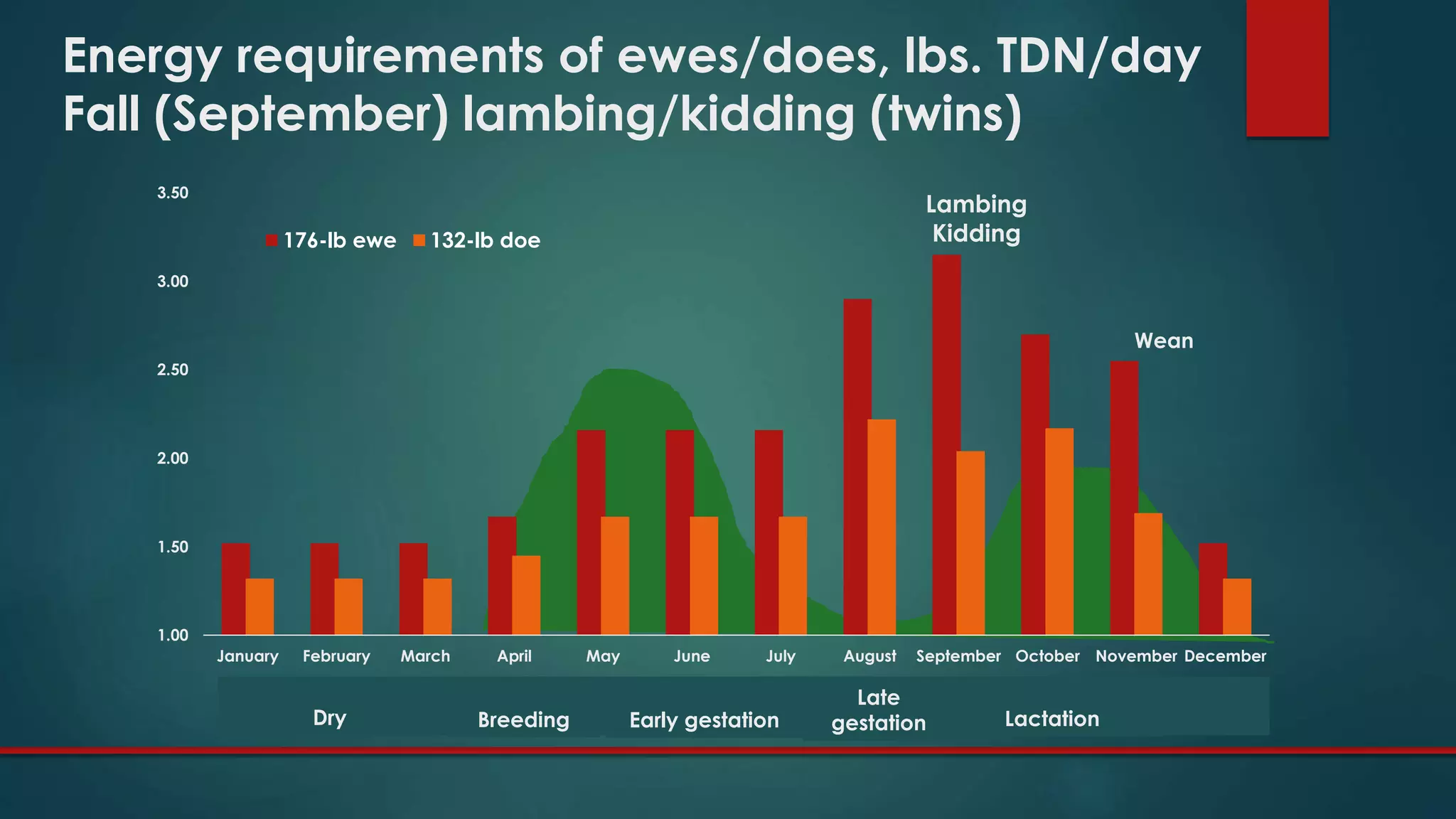
January February March April May June July August September October November December
176-lb ewe 132-lb doe
Energy requirements of ewes/does, lbs. TDN/day
Fall (September) lambing/kidding (twins)
Dry LactationEarly gestation
Late
gestationBreeding
Lambing
Kidding
Wean
Energy requirements of ewes/does, lbs. TDN/day
Fall (September) lambing/kidding (twins)
Dry LactationEarly gestation
Late
gestationBreeding
Lambing
Kidding
1.00
1.50
2.00
2.50
3.00
3.50
January February March April May June July August September October November December
176-lb ewe 132-lb doe
Wean
Energy requirements of ewes/does, lbs. TDN/day
Fall (September) lambing/kidding (twins)
Dry LactationEarly gestation
Late
gestationBreeding
Lambing
Kidding
Wean
1.00
1.50
2.00
2.50
3.00
3.50
January February March April May June July August September October November December
176-lb ewe 132-lb doe
September October November December January February March April May
Growing and finishing
Fall-born lambs and kids
Fall
born
Wean
Growing and finishing
Fall-born lambs and kids
Fall
born
Wean
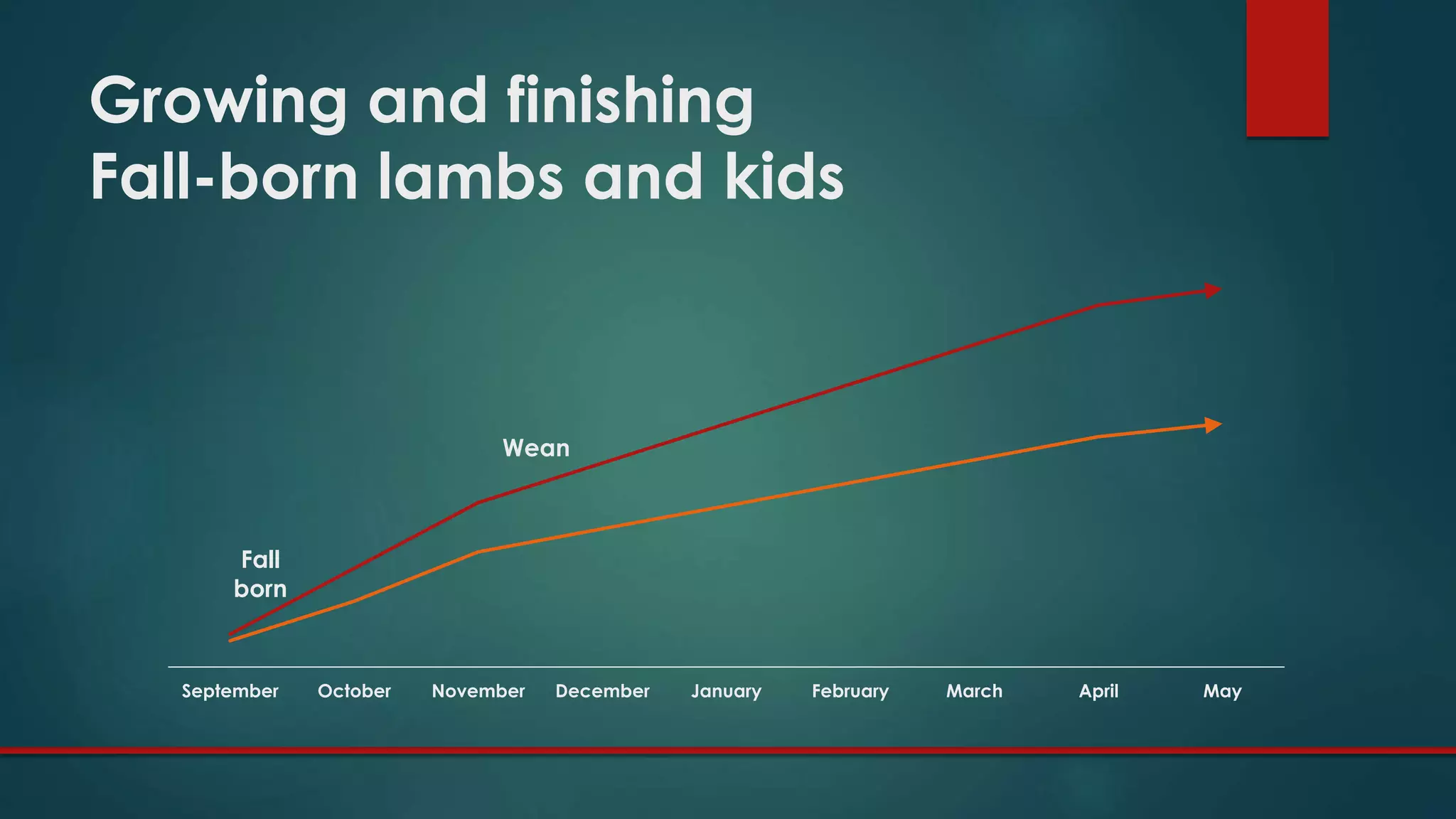
September October November December January February March April May
1. Sell at Christmas
2. Put on feed
3. Forage options
September October November December January February March April May
Growing and finishing
Fall-born lambs and kids
Fall
born
Wean
Supplementation: when is it necessary?
The purpose of supplementation is to provide required nutrients that are not being supplied by the forage diet.
 Determine which nutrient is limiting and
supplement that one first.
 Supplementing energy is helpful on
vegetative, well-managed pastures for
more efficient utilization of forage protein
(especially for high producing animals).
 Supplementing with protein is necessary
on low-quality pasture and rangeland or
when continuously grazing temperate
warm-season pastures.
 The added production should cover the
cost of supplementation.
Feed + delivery + labor
Who to supplement and why?
 Ewes and does
 Improve BCS
 Flushing
 Late gestation
 Early lactation
 Lambs and kids
 To improve growth rates
 To improve parasite tolerance
 To finish for market
 To reach target markets
 To develop replacement females
 Other reasons for supplemenation
 As a carrier for
 Minerals
 Coccidiostats
 Antibiotics
 MGA
 Natural “dewormers”
 Nematode-trapping fungus *
 Sericea lespedeza pellets to help
control parasites
 During drought conditions or
inclement weather.
 To stretch the pasture resource.
Supplemental feeding
Supplementation
 The animal eats the
supplement and
pasture intake is not
reduced.
Substitution
 Some of the
supplement is
substituting for pasture.
 Pasture intake drops.
Saved pasture may be
your goal.
Complementation
• A good supplement
increases the animal’s
intake of dead pasture
or crop residue.
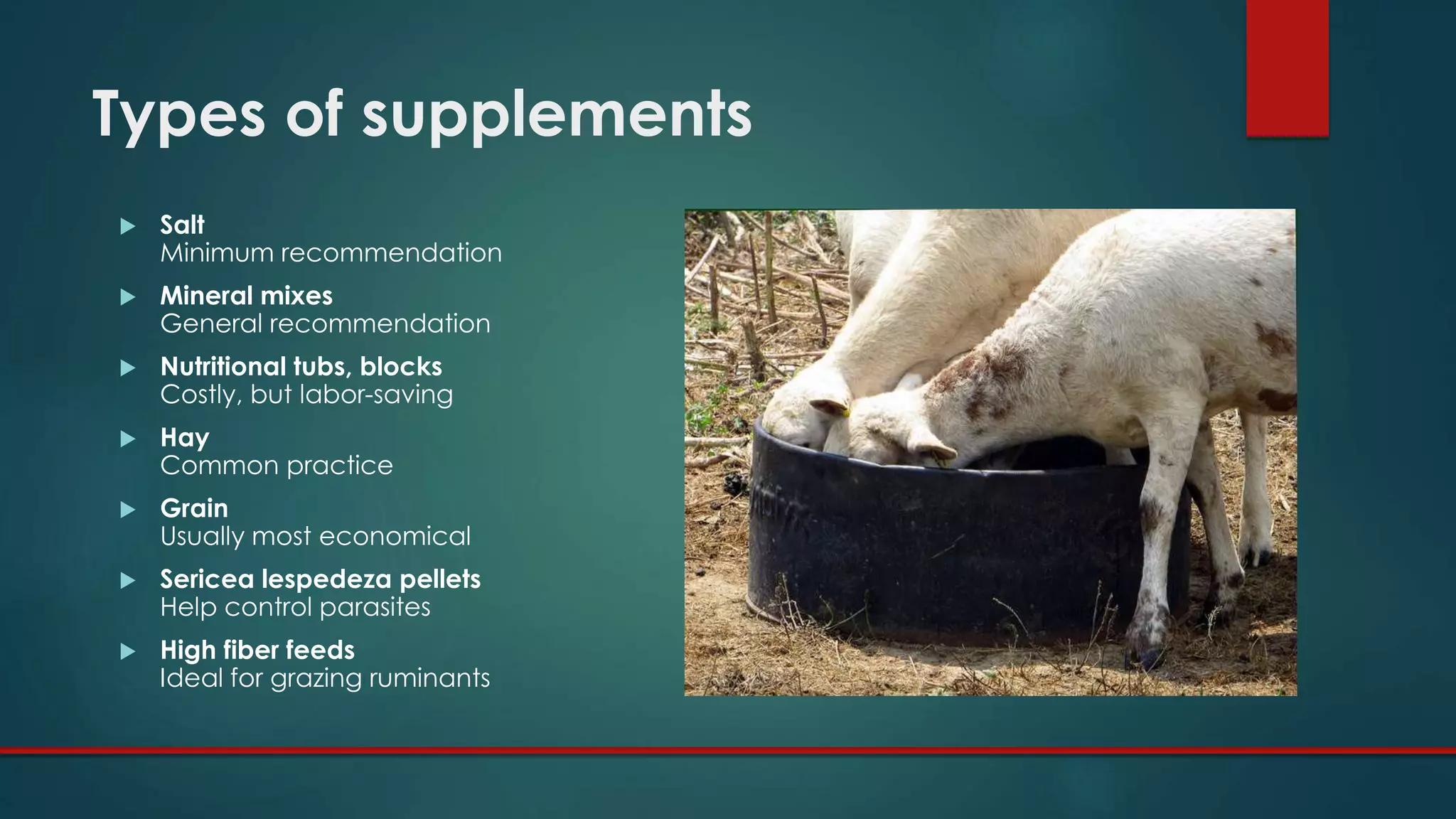
Types of supplements
 Salt
Minimum recommendation
 Mineral mixes
General recommendation
 Nutritional tubs, blocks
Costly, but labor-saving
 Hay
Common practice
 Grain
Usually most economical
 Sericea lespedeza pellets
Help control parasites
 High fiber feeds
Ideal for grazing ruminants
Supplementation with fibrous by-product feeds
Permissible under USDA Grass-fed Standards
>18% CF  < 70% TDN  5.5% Fat
Feedstuff
CF
(fiber, %)
TDN
(energy, %)
CP
(protein, %)
Fat
(EE, %)
Almond hulls 16 59 5.0 3.3
Cottonseed hulls 48 45 5.0 1.9
Oat hulls 32 40 4.0 1.5
Peanut hulls 63 22 7.0 1.5
Soybean hulls 38 77 13.0 2.6
Source: Nutrient Requirements of Small Ruminants, 2007
Roughage feeds are low in starch and thus do not create the negative associative effects in the
rumen that are often created when the forage diet is supplemented with feed grains.
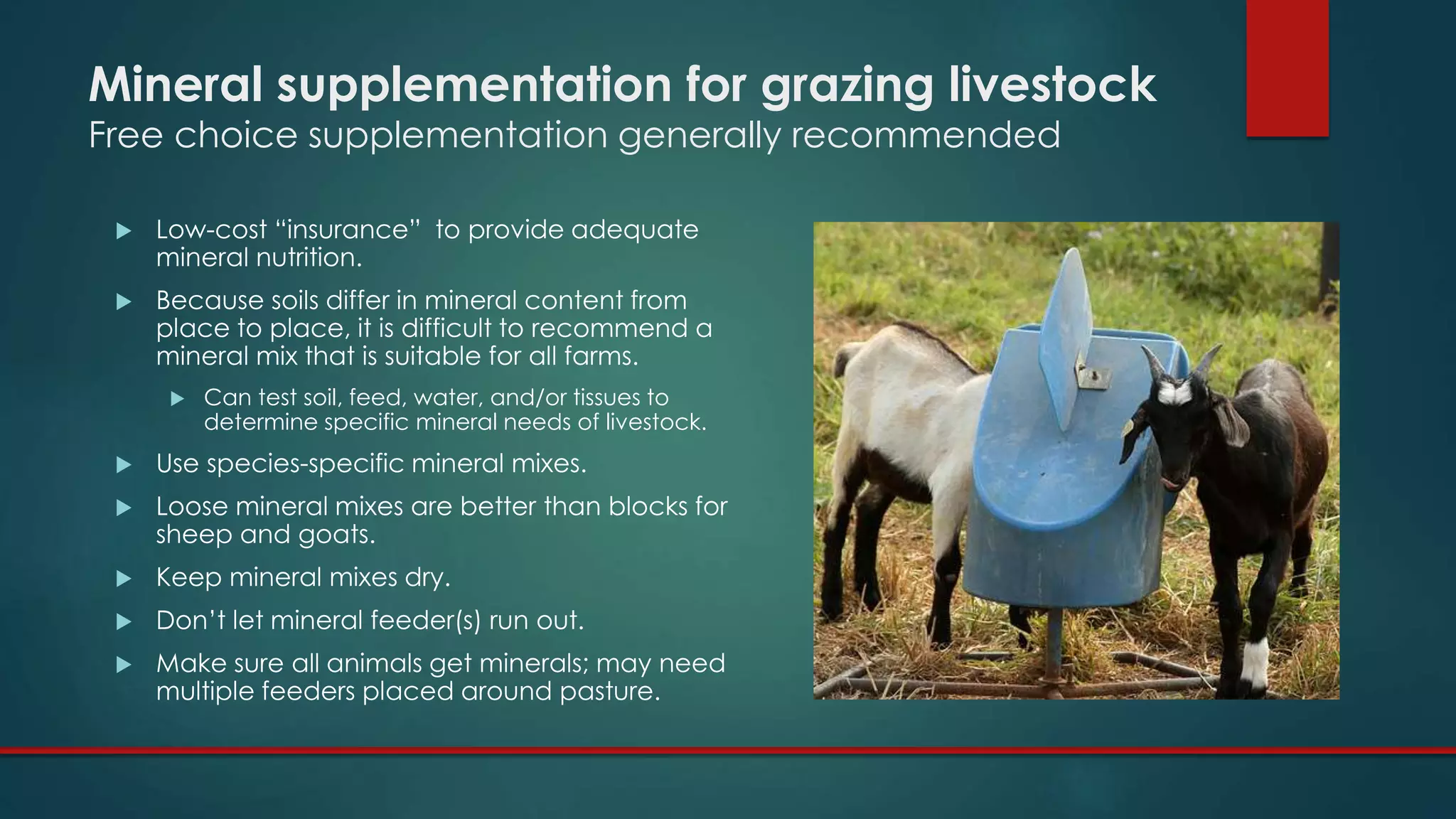
Mineral supplementation for grazing livestock
Free choice supplementation generally recommended
 Low-cost “insurance” to provide adequate
mineral nutrition.
 Because soils differ in mineral content from
place to place, it is difficult to recommend a
mineral mix that is suitable for all farms.
 Can test soil, feed, water, and/or tissues to
determine specific mineral needs of livestock.
 Use species-specific mineral mixes.
 Loose mineral mixes are better than blocks for
sheep and goats.
 Keep mineral mixes dry.
 Don’t let mineral feeder(s) run out.
 Make sure all animals get minerals; may need
multiple feeders placed around pasture.
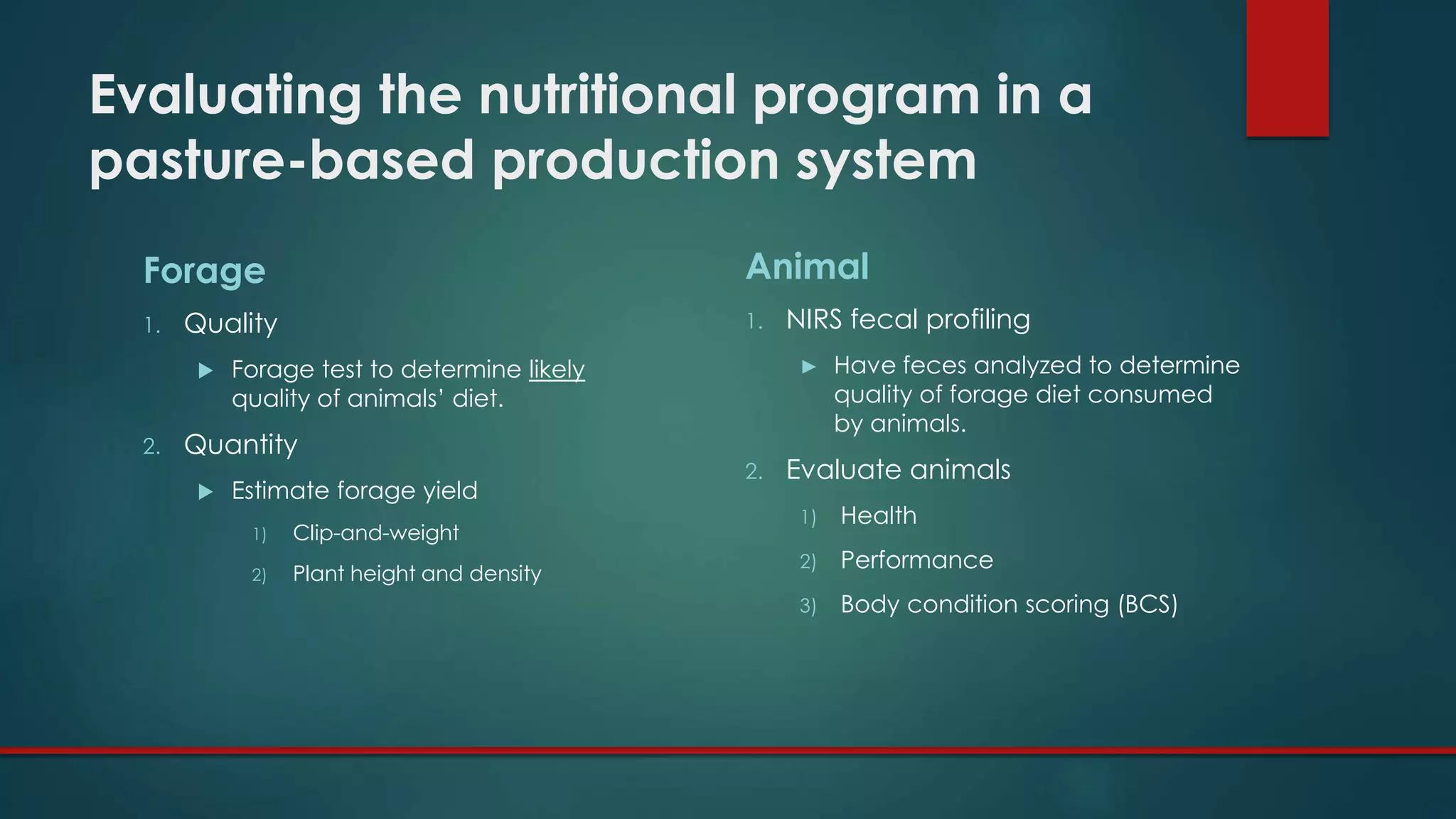
Evaluating the nutritional program in a
pasture-based production system
Forage
1. Quality
 Forage test to determine likely
quality of animals’ diet.
2. Quantity
 Estimate forage yield
1) Clip-and-weight
2) Plant height and density
Animal
1. NIRS fecal profiling
► Have feces analyzed to determine
quality of forage diet consumed
by animals.
2. Evaluate animals
1) Health
2) Performance
3) Body condition scoring (BCS)
Sampling to determine quality of
diet consumed by grazing livestock
Forage
 Sample pasture to determine likely
quality of animals’ diet.
 Fill gallon-size bag with forage
sample.
 Take sample when animals first
have access to pasture.
 Observe animals to see what
plants they are consuming.
 Tear plant at grazing level.
 Sample entire pasture.
 Mix sample.
 Send to lab (can freeze)
Feces
 Sample feces to determine quality of
diet (forage component) animals
consumed in previous 36-48 hours.
 Collect pooled fecal sample after
animals have been grazing pasture
for at least 48 hours.
 Collect samples from ~10% of flock or
herd.
 Fill quart-size back with feces.
 Keep cool (can freeze).
 Send to a lab.
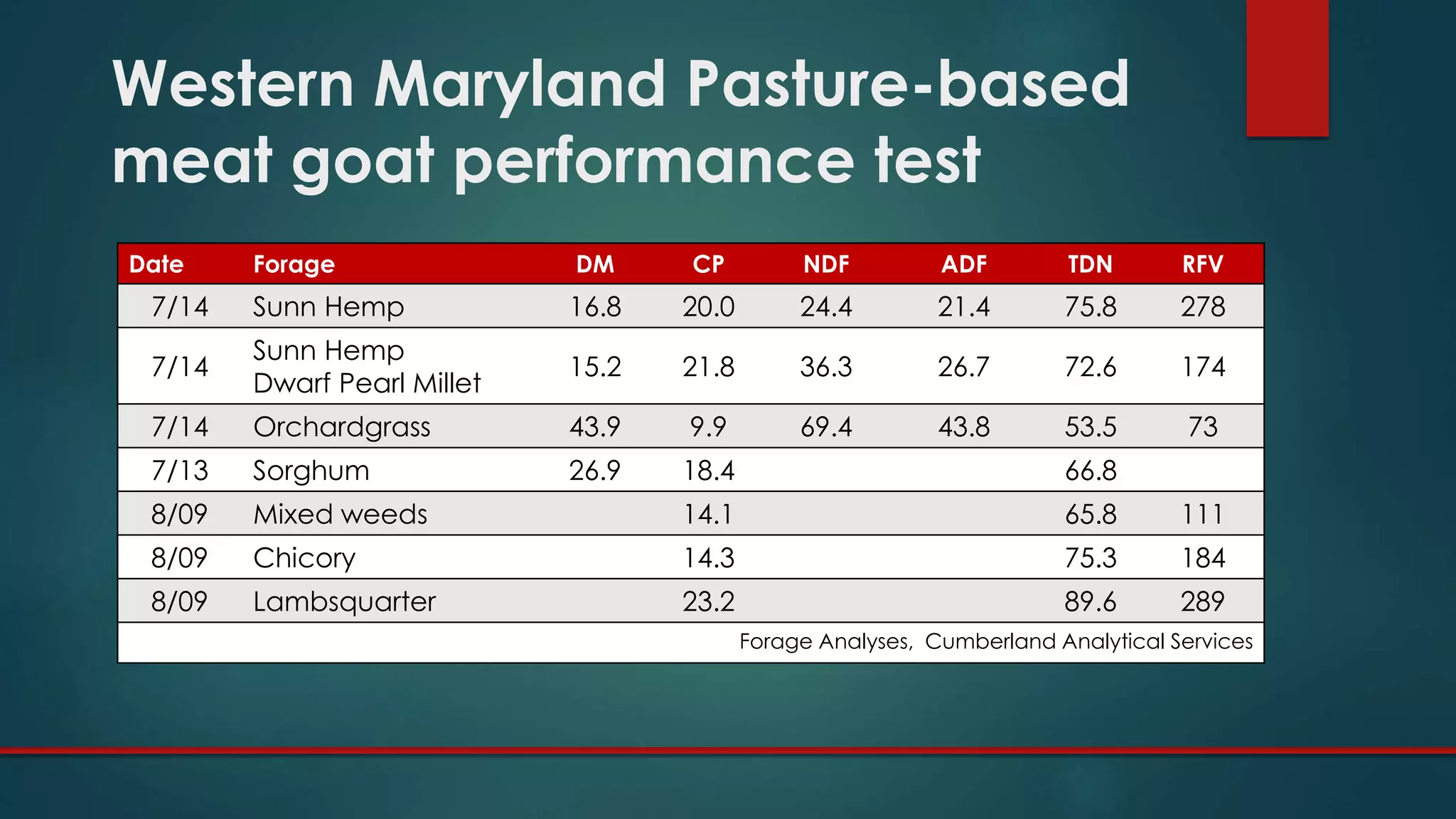
Western Maryland Pasture-based
meat goat performance test
Date Forage DM CP NDF ADF TDN RFV
7/14 Sunn Hemp 16.8 20.0 24.4 21.4 75.8 278
7/14
Sunn Hemp
Dwarf Pearl Millet
15.2 21.8 36.3 26.7 72.6 174
7/14 Orchardgrass 43.9 9.9 69.4 43.8 53.5 73
7/13 Sorghum 26.9 18.4 66.8
8/09 Mixed weeds 14.1 65.8 111
8/09 Chicory 14.3 75.3 184
8/09 Lambsquarter 23.2 89.6 289
Forage Analyses, Cumberland Analytical Services
2014 Western Maryland pasture-
based meat goat performance test
Date Composition CP DOM DOM:CP
June 19 Cool season 16.7 46.9 2.8
June 29 Cool season 19.0 50.0 2.6
July 3 Cool season 21.2 50.1 2.4
August 7 Warm season 21.5 47.4 2.2
August 14 Warm season 21.8 44.0 2.0
August 20 Warm season 18.4 38.3 2.1
NIRS Analysis, Grazingland Animal Nutrition Lab
Animal monitoring: Body condition scoring
 One the most practical and important tools
available to livestock producers.
 Used to monitor nutritional program and
health of flock/herd.
 Cannot determine body condition without
handling (touching) animals.
 A scoring system of 1 to 5 (with 0.5
increments) is usually used for sheep
and goats.
 Extremely thin with no fat reserves, 1
 Healthy animals, 2.5 to 4
 Very over-conditioned (obese) animal, >4.5
Suggested resources
 2015 Winter webinar series: pasture management for small ruminant producers
http://www.sheepandgoat.com/recordings.html#pasture
 Ruminant Nutrition for Grazers (NCAT-ATTRA)
http://extension.usu.edu/rangelands/files/uploads/Ruminant%20Nutrition/Ruminant%20nut
rition%20grazing.pdf
 Certified forage testing laboratories
http://www.foragetesting.org/files/2013_Certified_Labs.pdf
 Grazing Animal Nutrition (GAN) Lab
http://cnrit.tamu.edu/ganlab/
 Energy converter
http://animalscience.ucdavis.edu/java/LivestockSystemMgt/Conversion/energy.htm
 This presentation
http://www.slideshare.net/schoenian/sheep-goat-nutrition
THANK YOU. QUESTIONS? COMMENTS?
SUSAN SCHOENIAN
Sheep & Goat Specialist
University of Maryland Extension
sschoen@umd.edu

Sheep & Goat Nutriton

  • 1.
    SHEEP & GOAT NUTRITION SUSANSCHOENIAN SHEEP & GOAT SPECIALIST, UNIVERSITY OF MARYLAND EXTENSION WESTERN MARYLAND RESEARCH & EDUCATION CENTER, KEEDYSVILLE, MARYLAND SSCHOEN@UMD.EDU – WWW.SHEEPANDGOAT.COM – WWW.WORMX.INFO
  • 2.
    Presentation outline  Nutrients Nutrient requirements  Intake  Synchronizing forage and animal production  Supplementation  Evaluating nutritional program  Suggested resources
  • 3.
    Nutrients required byall sheep and goats  Energy  Protein  Minerals  Vitamins  Water
  • 4.
    Energy (calories)  Nutrientrequired in the greatest quantity.  Is usually the most limiting nutrient.  Comes primarily from carbohydrates and fats in the diet, but also from excess protein.  Excess energy is stored as fat in the body.  Energy is expressed in different ways: • TDN - total digestible nutrients, % • DE - digestible energy, kcal • ME - metabolizable energy, kcal • NEp - net energy, kcal • DOM - digestible organic matter, %
  • 5.
    Improper feeding ofenergy to livestock Not enough energy in diet  Reduced fertility  Reduced growth rates  Reduced milk production  Loss of body condition, reserves  Higher critical temperature  Less cold tolerance  Reduced resistance to disease.  Risk of pregnancy toxemia (ketosis)  Reduced nutrient absorption.  Increases protein requirements (%) of ration. Too much energy in diet  Wasteful economically  Over-conditioned (BCS >4.5) animals have impaired reproduction.  Fat females are more prone to pregnancy toxemia and dystocia.  Feed efficiency decreases once an animal has reached its optimal finish.  Excess finish is undesirable to most to consumers.
  • 6.
    Protein (amino acids) Required in smaller amounts than energy.  More expensive feed ingredient than energy.  Amount more important than quality.  Excess protein is not stored in the body: excess protein is broken down and used as energy.  Some excess protein may be beneficial if parasites burdens, esp. barber pole worm, are excessive.  Protein is expressed in different ways: • CP – crude protein • DP – digestible protein • MP – metabolizable protein • DIP – rumen degraded intake protein • UIP – undegraded intake protein
  • 7.
    Crude protein (CP):N x 6.26  True or “natural” protein 1. Rumen degraded intake protein (DIP) Digested in rumen N  ammonia  microbial protein 2. Undegradable intake protein (UIP) (bypass or escape protein) Not digested in rumen. Digested postruminally (in small intestines) or excreted in feces.  Non-protein nitrogen (NPN), e.g. urea
  • 8.
    By-pass protein  Amix of microbial protein and bypassed dietary protein is desired for optimal productivity.  In high-producing animals, it is recommended that 25-35% of protein be bypass protein.  20-30 % of the protein in fresh, high quality forage is bypass protein.  Supplementing with bypass protein may improve productivity and/or increase resistance to internal parasites. Bypass Protein sources  Low Soybean meal  Medium Cottonseed meal Dehydrated alfalfa Distiller’s grains  High Corn gluten meal Fish meal
  • 9.
    Improper feeding ofprotein to livestock Not enough protein  Protein deficiency is rare; most effects are sub-clinical  Impaired reproduction  Reduced growth rates  Reduced hoof and horn growth.  Reduced milk production  Decreased fiber production  Reduced resistance to disease, especially parasites.  Reduced rumen function  Reduced nutrition absorption Too much protein  Expensive and inefficient source of energy.  Risk of pizzle rot in males  Can cause metabolic harm Excess N  ammonia  UREA (BUN)  Reduces performance, as energy is required for removal.  Excess protein has been shown to cause reproductive problems in cattle .  Excess N (in manure) can be an environmental concern (“a resource out-of-place”)
  • 10.
    Micronutrients Required in smallamounts: ounces, grams, international units (IU), or parts-per-million (PPM). Minerals  Macrominerals Calcium (Ca) and phosphorus (P) Salt: sodium and chloride (NaCl) Potassium (K) Magnesium (Mg) Sulfur (S)  Trace or microminerals 1. Cobalt (Co) 2. Copper (Cu) 3. Fluoride (F) 4. Iron (Fe) 5. Iodine (I) 6. Manganese (Mn) 7. Molybdenum (Mo) 8. Selenium (Se) 9. Zinc (Zn) Vitamins  Fat-soluble - A – D – E – K  Carotene (green forages)  vitamin A  Sunlight  Vitamin D  Vitamin E sometimes requires supplementation  Vitamin K synthesized in rumen  Water-soluble - B complex – C  B vitamins synthesized in rumen  Vitamin C synthesized in tissues
  • 11.
    Possible micronutrient problems Deficiencies Calcium and phosphorus rickets  Calcium Milk fever  Copper Various, including swayback, stringy wool, hair color  Iodine Goiter  Magnesium Grass tetany Excesses  Calcium milk fever  Copper (esp. sheep) Chronic or acute toxicity  Selenium toxicosis  Sulfur - polio Imbalances  Copper, molybdenum, and sulfur Copper toxicity or deficiency  Calcium and phosphorus Urinary calculi  Salt Lower feed and water consumption  Selenium and Vitamin E White muscle disease Various other problems  Thiamin (B2) Polioencephamalacia  Zinc Wool picking, skin problems, hoof problems
  • 12.
    Important nutrition interactions Calcium and phosphorus Ratio should never go below 1:1 2:1 is ideal for most rations, especially for males and castrates.  Cobalt and vitamin B12  Copper, molybdenum and sulfur Molybdenum forms insoluble complex with copper Sulfur binds with molybdenum  Nitrogen and sulfur 10:1 to 12:1 ratio is ideal  Energy and protein Excess protein (N) reduces nutrient absorption and causes intestinal imbalances.
  • 13.
    Nutrient requirements ofsheep and goats Vary by  Species  Genetics (type)  Size (weight)  Body condition  Sex  Age  Stage and level of production  Disease  Environment
  • 14.
    Nutrient requirements varyby species and genetics 0.50 0.70 0.90 1.10 1.30 1.50 1.70 1.90 2.10 2.30 Angora Boer Local Dairy Lamb Energy (TDN) requirements, lb/day 66 lb. intact male kids/lamb 0.33 0.33 0.33 0.66 0.09 + fiber growth 0.50 0.70 0.90 1.10 1.30 1.50 1.70 1.90 Mature ewe Meat doe Dairy doe Angora doe Energy (TDN) requirements, lb/day 132 lb. female, maintenance + fiber growth Source: Nutrient requirements of small ruminants, 2007
  • 15.
    Nutrient requirements varyby size (weight) 0.80 0.90 1.00 1.10 1.20 1.30 1.40 1.50 1.60 1.70 110-lb 154-lb 198-lb Energy requirements, lb. TDN/day Mature ewe, maintenance 0.60 0.70 0.80 0.90 1.00 1.10 1.20 1.30 1.40 1.50 88-lb 132-lb 154-lb Energy requirements, lb. TDN/day Mature non-dairy doe, maintenance Source: Nutrient requirements of small ruminants, 2007
  • 16.
    Energy requirements varyby stage of production 1.00 1.20 1.40 1.60 1.80 2.00 2.20 2.40 Maintenance Breeding Early gestation Late gestation Lactation Energy requirements, lb. TDN/day 132-lb. mature non-dairy doe (twins) 1.00 1.50 2.00 2.50 3.00 3.50 Maintenance Breeding Early gestation Late gestation Lactation Energy requirements, lb. TDN/day 176-lb. mature ewe (twins) Source: Nutrient requirements of small ruminants, 2007
  • 17.
    Protein requirements varyby stage of production 0.10 0.20 0.30 0.40 0.50 0.60 0.70 0.80 Maintenance Breeding Early gestation Late gestation Lactation Protein requirements, lb/day 176-lb. mature ewe (twins) 0.10 0.15 0.20 0.25 0.30 0.35 0.40 0.45 0.50 Maintenance Breeding Early gestation Late gestation Lactation Protein requirements, lb/day 132-lb. non-dairy doe (twins) Source: Nutrient requirements of small ruminants, 2007
  • 18.
    Mineral requirements varyby stage and level of production 1.0 2.0 3.0 4.0 5.0 6.0 7.0 8.0 9.0 10.0 Maintenance Breeding Early gestation Late gestation Early lactation Mineral requirements, g/d 176-lb. mature ewe (twins) 1.0 2.0 3.0 4.0 5.0 6.0 7.0 8.0 9.0 10.0 Maintenance Breeding Early gestation Late gestation Early lactation Mineral requirements, g/d 132-lb non-dairy doe (twins) Calcium Phosphorus Source: Nutrient requirements of small ruminants, 2007
  • 19.
    Nutrient requirements varyby level of production 1.60 1.70 1.80 1.90 2.00 2.10 2.20 2.30 2.40 Single Twins Triplets Energy requirements, lb. TDN/day 132-doe, late gestation 1.60 1.80 2.00 2.20 2.40 2.60 2.80 3.00 3.20 3.40 Single Twins Triplets Energy requirements, lb. TDN/d 176-lb. mature ewe, late gestation Source: Nutrient requirements of small ruminants, 2007
  • 20.
    Nutrient requirements varyby desired level of performance, e.g. ADG 0.50 0.70 0.90 1.10 1.30 1.50 1.70 No gain 0.11 0.22 0.33 0.44 0.55 Energy requirements, lb. TDN/d 44-lb. intact Boer buckling 0.50 1.00 1.50 2.00 2.50 3.00 0.44 0.55 0.66 0.88 Energy requirements, lb. TDN/d 66-lb. ram lamb, 4 mos. early maturing Source: Nutrient requirements of small ruminants, 2007
  • 21.
    Intake  Intake isimportant for acquisition of nutrients, especially by grazing livestock  Livestock require amounts of nutrients, not percentages.  Livestock requirements are based on the dry matter (moisture-free) content of the feed source.  Feedstuffs vary considerably in their dry matter content (percentage).  Fresh-growing forages usually have a low dry matter content compared to more mature pastures and most harvested feeds.  Intake can be a limiting factor on pasture- based diets.
  • 22.
    Factors affecting intake Palatability Flavor and texture  Foraging behavior bite size and bite rate  Chemical characteristics of feed alkaloids, endophyte, tannins, and terpenes  Forage quality, density, and availability  Dietary energy and fiber content Fiber  Intake   Physiological stage of animal  Temperature temperature  metabolic rate   Supplementation
  • 23.
    How to increaseintake  Keep forage in vegetative stage through grazing management.  Diversify pasture composition to include several grass species and around 30% legumes.  Maintain a dense pasture so animals will take larger bites.  Supplementation
  • 24.
    Synchronizing forage andanimal production Breeding flock/herd Growing/finishing lambs & kids
  • 25.
    1.00 1.50 2.00 2.50 3.00 3.50 January February MarchApril May June July August September October November December 176-lb ewe 132-lb doe Energy requirements of ewes/does, lbs. TDN/day Winter (January) lambing/kidding (twins) Dry periodLactation Early gestation Late gestationBreeding Lambing Kidding Wean
  • 26.
    1.00 1.50 2.00 2.50 3.00 3.50 January February MarchApril May June July August September October November December 176-lb ewe 132-lb doe Energy requirements of ewes/does, lbs. TDN/day Winter (January) lambing/kidding (twins) Dry periodLactation Early gestation Late gestationBreeding Lambing Kidding Wean
  • 27.
    1.00 1.50 2.00 2.50 3.00 3.50 January February MarchApril May June July August September October November December 176-lb ewe 132-lb doe Energy requirements of ewes/does, lbs. TDN/day Winter (January) lambing/kidding (twins) DryLactation Early gestation Late gestationBreeding Lambing Kidding Wean
  • 28.
    January February MarchApril May June July August September October November December Growing and finishing Winter-born lambs and kids Winter born Wean
  • 29.
    Growing and finishing Winter-bornlambs and kids Winter born January February March April May June July August September October November December 1. Sell at Easter 2. Market by July 1 3. Hold for Muslim holiday Wean
  • 30.
    1.00 1.50 2.00 2.50 3.00 3.50 January February MarchApril May June July August September October November December 176-lb ewe 132-lb doe Energy requirements of ewes/does, lbs. TDN/day spring (APRIL) lambing/kidding (twins) DryLactation Early gestation Late gestation Breeding Lambing Kidding Wean
  • 31.
    1.00 1.50 2.00 2.50 3.00 3.50 January February MarchApril May June July August September October November December 176-lb ewe 132-lb doe Energy requirements of ewes/does, lbs. TDN/day spring (APRIL) lambing/kidding (twins) DryLactation Early gestation Late gestation Breeding Lambing Kidding Wean
  • 32.
    1.00 1.50 2.00 2.50 3.00 3.50 January February MarchApril May June July August September October November December 176-lb ewe 132-lb doe Energy requirements of ewes/does, lbs. TDN/day spring (APRIL) lambing/kidding (twins) DryLactation Early gestation Late gestation Breeding Lambing Kidding Wean
  • 33.
    January February MarchApril May June July August September October November December Growing and finishing Spring-born lambs and kids Spring born Wean
  • 34.
    January February MarchApril May June July August September October November December Growing and finishing Spring-born lambs and kids Spring born Wean 1. Sell at weaning 2. Hold over summer 3. Put on feed 4. Forage option
  • 35.
    January February MarchApril May June July August September October November December Growing and finishing Spring-born lambs and kids Spring born Wean
  • 36.
    January February MarchApril May June July August September October November December Growing and finishing Spring-born lambs and kids Spring born Wean
  • 37.
    1.00 1.50 2.00 2.50 3.00 3.50 January February MarchApril May June July August September October November December 176-lb ewe 132-lb doe Energy requirements of ewes/does, lbs. TDN/day Fall (September) lambing/kidding (twins) Dry LactationEarly gestation Late gestationBreeding Lambing Kidding Wean
  • 38.
    Energy requirements ofewes/does, lbs. TDN/day Fall (September) lambing/kidding (twins) Dry LactationEarly gestation Late gestationBreeding Lambing Kidding 1.00 1.50 2.00 2.50 3.00 3.50 January February March April May June July August September October November December 176-lb ewe 132-lb doe Wean
  • 39.
    Energy requirements ofewes/does, lbs. TDN/day Fall (September) lambing/kidding (twins) Dry LactationEarly gestation Late gestationBreeding Lambing Kidding Wean 1.00 1.50 2.00 2.50 3.00 3.50 January February March April May June July August September October November December 176-lb ewe 132-lb doe
  • 40.
    September October NovemberDecember January February March April May Growing and finishing Fall-born lambs and kids Fall born Wean
  • 41.
    Growing and finishing Fall-bornlambs and kids Fall born Wean September October November December January February March April May 1. Sell at Christmas 2. Put on feed 3. Forage options
  • 42.
    September October NovemberDecember January February March April May Growing and finishing Fall-born lambs and kids Fall born Wean
  • 43.
    Supplementation: when isit necessary? The purpose of supplementation is to provide required nutrients that are not being supplied by the forage diet.  Determine which nutrient is limiting and supplement that one first.  Supplementing energy is helpful on vegetative, well-managed pastures for more efficient utilization of forage protein (especially for high producing animals).  Supplementing with protein is necessary on low-quality pasture and rangeland or when continuously grazing temperate warm-season pastures.  The added production should cover the cost of supplementation. Feed + delivery + labor
  • 44.
    Who to supplementand why?  Ewes and does  Improve BCS  Flushing  Late gestation  Early lactation  Lambs and kids  To improve growth rates  To improve parasite tolerance  To finish for market  To reach target markets  To develop replacement females  Other reasons for supplemenation  As a carrier for  Minerals  Coccidiostats  Antibiotics  MGA  Natural “dewormers”  Nematode-trapping fungus *  Sericea lespedeza pellets to help control parasites  During drought conditions or inclement weather.  To stretch the pasture resource.
  • 45.
    Supplemental feeding Supplementation  Theanimal eats the supplement and pasture intake is not reduced. Substitution  Some of the supplement is substituting for pasture.  Pasture intake drops. Saved pasture may be your goal. Complementation • A good supplement increases the animal’s intake of dead pasture or crop residue.
  • 46.
    Types of supplements Salt Minimum recommendation  Mineral mixes General recommendation  Nutritional tubs, blocks Costly, but labor-saving  Hay Common practice  Grain Usually most economical  Sericea lespedeza pellets Help control parasites  High fiber feeds Ideal for grazing ruminants
  • 47.
    Supplementation with fibrousby-product feeds Permissible under USDA Grass-fed Standards >18% CF  < 70% TDN  5.5% Fat Feedstuff CF (fiber, %) TDN (energy, %) CP (protein, %) Fat (EE, %) Almond hulls 16 59 5.0 3.3 Cottonseed hulls 48 45 5.0 1.9 Oat hulls 32 40 4.0 1.5 Peanut hulls 63 22 7.0 1.5 Soybean hulls 38 77 13.0 2.6 Source: Nutrient Requirements of Small Ruminants, 2007 Roughage feeds are low in starch and thus do not create the negative associative effects in the rumen that are often created when the forage diet is supplemented with feed grains.
  • 48.
    Mineral supplementation forgrazing livestock Free choice supplementation generally recommended  Low-cost “insurance” to provide adequate mineral nutrition.  Because soils differ in mineral content from place to place, it is difficult to recommend a mineral mix that is suitable for all farms.  Can test soil, feed, water, and/or tissues to determine specific mineral needs of livestock.  Use species-specific mineral mixes.  Loose mineral mixes are better than blocks for sheep and goats.  Keep mineral mixes dry.  Don’t let mineral feeder(s) run out.  Make sure all animals get minerals; may need multiple feeders placed around pasture.
  • 49.
    Evaluating the nutritionalprogram in a pasture-based production system Forage 1. Quality  Forage test to determine likely quality of animals’ diet. 2. Quantity  Estimate forage yield 1) Clip-and-weight 2) Plant height and density Animal 1. NIRS fecal profiling ► Have feces analyzed to determine quality of forage diet consumed by animals. 2. Evaluate animals 1) Health 2) Performance 3) Body condition scoring (BCS)
  • 50.
    Sampling to determinequality of diet consumed by grazing livestock Forage  Sample pasture to determine likely quality of animals’ diet.  Fill gallon-size bag with forage sample.  Take sample when animals first have access to pasture.  Observe animals to see what plants they are consuming.  Tear plant at grazing level.  Sample entire pasture.  Mix sample.  Send to lab (can freeze) Feces  Sample feces to determine quality of diet (forage component) animals consumed in previous 36-48 hours.  Collect pooled fecal sample after animals have been grazing pasture for at least 48 hours.  Collect samples from ~10% of flock or herd.  Fill quart-size back with feces.  Keep cool (can freeze).  Send to a lab.
  • 51.
    Western Maryland Pasture-based meatgoat performance test Date Forage DM CP NDF ADF TDN RFV 7/14 Sunn Hemp 16.8 20.0 24.4 21.4 75.8 278 7/14 Sunn Hemp Dwarf Pearl Millet 15.2 21.8 36.3 26.7 72.6 174 7/14 Orchardgrass 43.9 9.9 69.4 43.8 53.5 73 7/13 Sorghum 26.9 18.4 66.8 8/09 Mixed weeds 14.1 65.8 111 8/09 Chicory 14.3 75.3 184 8/09 Lambsquarter 23.2 89.6 289 Forage Analyses, Cumberland Analytical Services
  • 52.
    2014 Western Marylandpasture- based meat goat performance test Date Composition CP DOM DOM:CP June 19 Cool season 16.7 46.9 2.8 June 29 Cool season 19.0 50.0 2.6 July 3 Cool season 21.2 50.1 2.4 August 7 Warm season 21.5 47.4 2.2 August 14 Warm season 21.8 44.0 2.0 August 20 Warm season 18.4 38.3 2.1 NIRS Analysis, Grazingland Animal Nutrition Lab
  • 53.
    Animal monitoring: Bodycondition scoring  One the most practical and important tools available to livestock producers.  Used to monitor nutritional program and health of flock/herd.  Cannot determine body condition without handling (touching) animals.  A scoring system of 1 to 5 (with 0.5 increments) is usually used for sheep and goats.  Extremely thin with no fat reserves, 1  Healthy animals, 2.5 to 4  Very over-conditioned (obese) animal, >4.5
  • 54.
    Suggested resources  2015Winter webinar series: pasture management for small ruminant producers http://www.sheepandgoat.com/recordings.html#pasture  Ruminant Nutrition for Grazers (NCAT-ATTRA) http://extension.usu.edu/rangelands/files/uploads/Ruminant%20Nutrition/Ruminant%20nut rition%20grazing.pdf  Certified forage testing laboratories http://www.foragetesting.org/files/2013_Certified_Labs.pdf  Grazing Animal Nutrition (GAN) Lab http://cnrit.tamu.edu/ganlab/  Energy converter http://animalscience.ucdavis.edu/java/LivestockSystemMgt/Conversion/energy.htm  This presentation http://www.slideshare.net/schoenian/sheep-goat-nutrition
  • 55.
    THANK YOU. QUESTIONS?COMMENTS? SUSAN SCHOENIAN Sheep & Goat Specialist University of Maryland Extension sschoen@umd.edu