Breeding Management- Swine
Presented by:
J.J.VASANTH KRISHNA
2016041061
Breeding Management
Factors affecting the selection of breed are;
Availability of good breeding stock
Prolificacy
Growth ability
Temperament (mood behaviour)
Carcass quality
Efficient feed conversion
Nicking ability (care of young ones)
Market demand
Disease resistance
Factors for selection of breeding stock
• Size of litter (minimum 8 piglets)
• Strength and vigour of litters
• Milking ability
• Temperament
• Gain and feed efficiency of progeny
• Longivity
• Fertility
• Free from defects
Breeding systems
Inbreeding:
• Involves breeding of related animals.
• This system is not adopted commercially.
Out breeding:
• Mating of unrelated animals.
• This system gives good results with performance of pigs.
Out crossing:
• Mating of unrelated animals of same breed.
Cross breeding:
• For commercial swine poduction programme. It is a
common method used in areas around bacon (a meat from
back and side of pig) factories and preserved, cured with
salt solution.
It involves mating of animal between two different breeds.
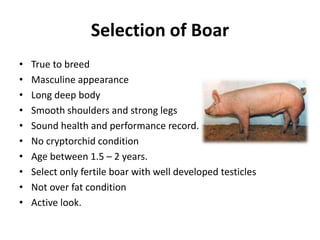
Selection of Boar
• True to breed
• Masculine appearance
• Long deep body
• Smooth shoulders and strong legs
• Sound health and performance record.
• No cryptorchid condition
• Age between 1.5 – 2 years.
• Select only fertile boar with well developed testicles
• Not over fat condition
• Active look.
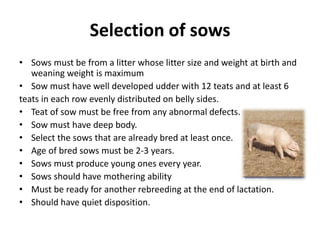
Selection of sows
• Sows must be from a litter whose litter size and weight at birth and
weaning weight is maximum
• Sow must have well developed udder with 12 teats and at least 6
teats in each row evenly distributed on belly sides.
• Teat of sow must be free from any abnormal defects.
• Sow must have deep body.
• Select the sows that are already bred at least once.
• Age of bred sows must be 2-3 years.
• Sows must produce young ones every year.
• Sows should have mothering ability
• Must be ready for another rebreeding at the end of lactation.
• Should have quiet disposition.
Guidelines - Normal reproduction of
pigs
• Age at puberty 6 – 7 months
• Breeding age of gilts – 10-12 months.
• Breeding weight of gilts – 90-100 kg
• Breeding age of boar – 18-24 months.
• Number of sows/boar – 10 (1:10) Boar : Sow
• Heat cycle – 19-23 days : Average 21 days
• Heat period – 2-3 days
• Mating time – Gilts – 1st day of heat. In sow – 2nd day of onset of
heat.
• Number of services per conception – 2 at a interval of 14 hours.
• Gestation period – 112 – 114 days (3 months 3 weeks 3 days)
• Suckling period – 56 – 60 days.
Contd,..
• Average litter size at birth – 10-14
• Average litter size at weaning – 8-10
• Rest period – 45 days.
• Occurrence of heat after weaning – 2-10 days. This is the
• fertile heat.
• Period of mating – 15 days after weaning.
• Volume of semen ejaculation – 200 ml – 300 ml.
• Average number of sperm/cu mm – 1 lakh (100,000)
• Average age to castrate pigs – 4-8 weeks
• Market age for fattening pigs – 6 months
• Market weight at 6 months – 70-75 kg.
• Farrowing interval – 7 – 7½ months
• Sows can breed upto – 8-10 years.
Management
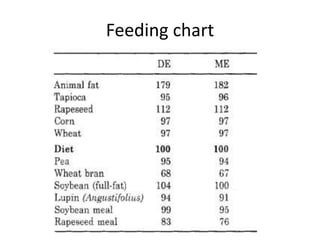
 Feeding gilts and sow liberally to increase energy intake
10-15 days prior to mating is called Flushing. It may be
done as follows
–Feed leguminous hay, cowpea,lucerne, berseem
for supply of more protein, minerals and
vitamins.
–Extra allowance of grains.
–Give multivitamin injection along
–with flushing
Feeding chart
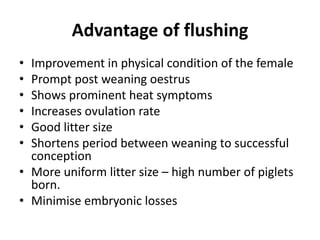
Advantage of flushing
• Improvement in physical condition of the female
• Prompt post weaning oestrus
• Shows prominent heat symptoms
• Increases ovulation rate
• Good litter size
• Shortens period between weaning to successful
conception
• More uniform litter size – high number of piglets
born.
• Minimise embryonic losses
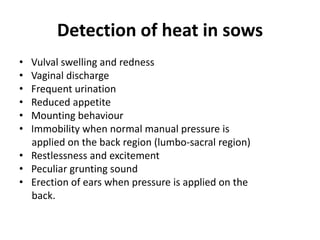
Detection of heat in sows
• Vulval swelling and redness
• Vaginal discharge
• Frequent urination
• Reduced appetite
• Mounting behaviour
• Immobility when normal manual pressure is
applied on the back region (lumbo-sacral region)
• Restlessness and excitement
• Peculiar grunting sound
• Erection of ears when pressure is applied on the
back.
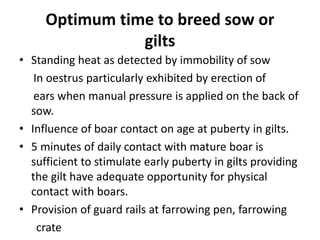
Optimum time to breed sow or
gilts
• Standing heat as detected by immobility of sow
In oestrus particularly exhibited by erection of
ears when manual pressure is applied on the back of
sow.
• Influence of boar contact on age at puberty in gilts.
• 5 minutes of daily contact with mature boar is
sufficient to stimulate early puberty in gilts providing
the gilt have adequate opportunity for physical
contact with boars.
• Provision of guard rails at farrowing pen, farrowing
crate
#Thank you

Breeding management - Swine

  • 1.
    Breeding Management- Swine Presentedby: J.J.VASANTH KRISHNA 2016041061
  • 2.
    Breeding Management Factors affectingthe selection of breed are; Availability of good breeding stock Prolificacy Growth ability Temperament (mood behaviour) Carcass quality Efficient feed conversion Nicking ability (care of young ones) Market demand Disease resistance
  • 3.
    Factors for selectionof breeding stock • Size of litter (minimum 8 piglets) • Strength and vigour of litters • Strength and vigour of litters • Milking ability • Temperament • Gain and feed efficiency of progeny • Longivity • Fertility • Free from defects
  • 4.
    Breeding systems Inbreeding: • Involvesbreeding of related animals. • This system is not adopted commercially. Out breeding: • Mating of unrelated animals. • This system gives good results with performance of pigs. Out crossing: • Mating of unrelated animals of same breed. Cross breeding: • For commercial swine poduction programme. It is a common method used in areas around bacon (a meat from back and side of pig) factories and preserved, cured with salt solution. It involves mating of animal between two different breeds.
  • 5.
    Selection of Boar •True to breed • Masculine appearance • Long deep body • Smooth shoulders and strong legs • Sound health and performance record. • No cryptorchid condition • Age between 1.5 – 2 years. • Select only fertile boar with well developed testicles • Not over fat condition • Active look.
  • 6.
    Selection of sows •Sows must be from a litter whose litter size and weight at birth and weaning weight is maximum • Sow must have well developed udder with 12 teats and at least 6 teats in each row evenly distributed on belly sides. • Teat of sow must be free from any abnormal defects. • Sow must have deep body. • Select the sows that are already bred at least once. • Age of bred sows must be 2-3 years. • Sows must produce young ones every year. • Sows should have mothering ability • Must be ready for another rebreeding at the end of lactation. • Should have quiet disposition.
  • 7.
    Guidelines - Normalreproduction of pigs • Age at puberty 6 – 7 months • Breeding age of gilts – 10-12 months. • Breeding weight of gilts – 90-100 kg • Breeding age of boar – 18-24 months. • Number of sows/boar – 10 (1:10) Boar : Sow • Heat cycle – 19-23 days : Average 21 days • Heat period – 2-3 days • Mating time – Gilts – 1st day of heat. In sow – 2nd day of onset of heat. • Number of services per conception – 2 at a interval of 14 hours. • Gestation period – 112 – 114 days (3 months 3 weeks 3 days) • Suckling period – 56 – 60 days.
  • 8.
    Contd,.. • Average littersize at birth – 10-14 • Average litter size at weaning – 8-10 • Rest period – 45 days. • Occurrence of heat after weaning – 2-10 days. This is the • fertile heat. • Period of mating – 15 days after weaning. • Volume of semen ejaculation – 200 ml – 300 ml. • Average number of sperm/cu mm – 1 lakh (100,000) • Average age to castrate pigs – 4-8 weeks • Market age for fattening pigs – 6 months • Market weight at 6 months – 70-75 kg. • Farrowing interval – 7 – 7½ months • Sows can breed upto – 8-10 years.
  • 9.
    Management  Feeding giltsand sow liberally to increase energy intake 10-15 days prior to mating is called Flushing. It may be done as follows –Feed leguminous hay, cowpea,lucerne, berseem for supply of more protein, minerals and vitamins. –Extra allowance of grains. –Give multivitamin injection along –with flushing
  • 10.
  • 11.
    Advantage of flushing •Improvement in physical condition of the female • Prompt post weaning oestrus • Shows prominent heat symptoms • Increases ovulation rate • Good litter size • Shortens period between weaning to successful conception • More uniform litter size – high number of piglets born. • Minimise embryonic losses
  • 12.
    Detection of heatin sows • Vulval swelling and redness • Vaginal discharge • Frequent urination • Reduced appetite • Mounting behaviour • Immobility when normal manual pressure is applied on the back region (lumbo-sacral region) • Restlessness and excitement • Peculiar grunting sound • Erection of ears when pressure is applied on the back.
  • 13.
    Optimum time tobreed sow or gilts • Standing heat as detected by immobility of sow In oestrus particularly exhibited by erection of ears when manual pressure is applied on the back of sow. • Influence of boar contact on age at puberty in gilts. • 5 minutes of daily contact with mature boar is sufficient to stimulate early puberty in gilts providing the gilt have adequate opportunity for physical contact with boars. • Provision of guard rails at farrowing pen, farrowing crate
  • 14.