Copper: it’s complicated
SUSAN SCHOENIAN
Sheep & Goat Specialist Emeritus
University of Maryland Extension
sschoen@umd.edu | sheepandgoat.com
sheep101.info | wormx.info
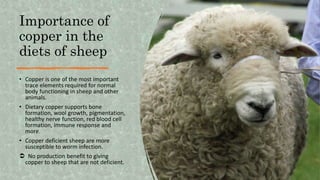
Importance of
copper in the
diets of sheep
• Copper is one of the most important
trace elements required for normal
body functioning in sheep and other
animals.
• Dietary copper supports bone
formation, wool growth, pigmentation,
healthy nerve function, red blood cell
formation, immune response and
more.
• Copper deficient sheep are more
susceptible to worm infection.
 No production benefit to giving
copper to sheep that are not deficient.
How much copper do sheep need?
Copper is a trace (or micro) mineral. It is required in very small amounts in the diet.
5 mg/kg DM (NRC, 1975)
1-8.6 mg/kg DM (ARC, 1980)
7-11 mg/kg DM (NRC, 1985)
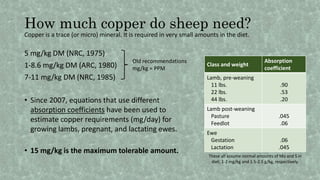
• Since 2007, equations that use different
absorption coefficients have been used to
estimate copper requirements (mg/day) for
growing lambs, pregnant, and lactating ewes.
• 15 mg/kg is the maximum tolerable amount.
Class and weight
Absorption
coefficient
Lamb, pre-weaning
11 lbs.
22 lbs.
44 lbs.
.90
.53
.20
Lamb post-weaning
Pasture
Feedlot
.045
.06
Ewe
Gestation
Lactation
.06
.045
These all assume normal amounts of Mo and S in
diet; 1-2 mg/kg and 1.5-2.5 g/kg, respectively.
Old recommendations
mg/kg = PPM
Copper
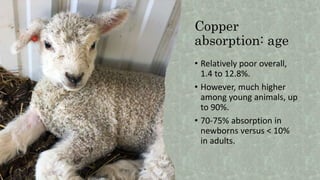
absorption: age
• Relatively poor overall,
1.4 to 12.8%.
• However, much higher
among young animals, up
to 90%.
• 70-75% absorption in
newborns versus < 10%
in adults.
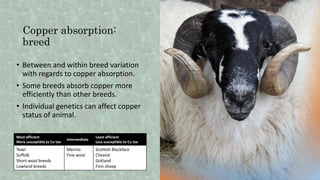
Copper absorption:
breed
• Between and within breed variation
with regards to copper absorption.
• Some breeds absorb copper more
efficiently than other breeds.
• Individual genetics can affect copper
status of animal.
Most efficient
More susceptible to Cu tox
Intermediate
Least efficient
Less susceptible to Cu tox
Texel
Suffolk
Short-wool breeds
Lowland breeds
Merino
Fine wool
Scottish Blackface
Cheviot
Gotland
Finn sheep
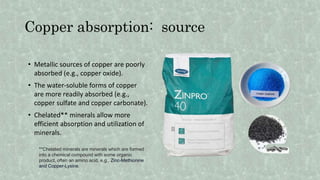
Copper absorption: source
• Metallic sources of copper are poorly
absorbed (e.g., copper oxide).
• The water-soluble forms of copper
are more readily absorbed (e.g.,
copper sulfate and copper carbonate).
• Chelated** minerals allow more
efficient absorption and utilization of
minerals.
**Chelated minerals are minerals which are formed
into a chemical compound with some organic
product, often an amino acid, e.g., Zinc-Methionine
and Copper-Lysine.
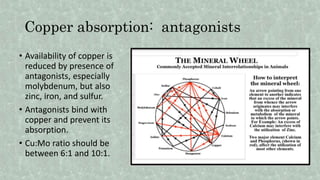
Copper absorption: antagonists
• Availability of copper is
reduced by presence of
antagonists, especially
molybdenum, but also
zinc, iron, and sulfur.
• Antagonists bind with
copper and prevent its
absorption.
• Cu:Mo ratio should be
between 6:1 and 10:1.
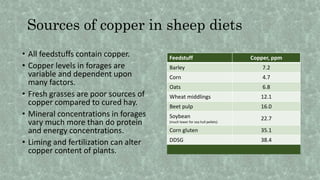
Sources of copper in sheep diets
• All feedstuffs contain copper.
• Copper levels in forages are
variable and dependent upon
many factors.
• Fresh grasses are poor sources of
copper compared to cured hay.
• Mineral concentrations in forages
vary much more than do protein
and energy concentrations.
• Liming and fertilization can alter
copper content of plants.
Feedstuff Copper, ppm
Barley 7.2
Corn 4.7
Oats 6.8
Wheat middlings 12.1
Beet pulp 16.0
Soybean
(much lower for soy hull pellets)
22.7
Corn gluten 35.1
DDSG 38.4
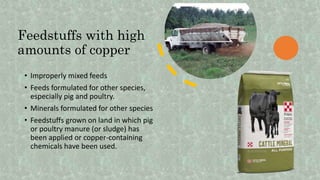
Feedstuffs with high
amounts of copper
• Improperly mixed feeds
• Feeds formulated for other species,
especially pig and poultry.
• Minerals formulated for other species
• Feedstuffs grown on land in which pig
or poultry manure (or sludge) has
been applied or copper-containing
chemicals have been used.
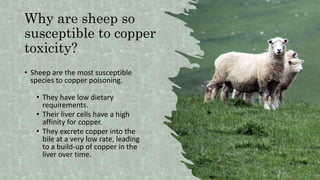
Why are sheep so
susceptible to copper
toxicity?
• Sheep are the most susceptible
species to copper poisoning.
• They have low dietary
requirements.
• Their liver cells have a high
affinity for copper.
• They excrete copper into the
bile at a very low rate, leading
to a build-up of copper in the
liver over time.
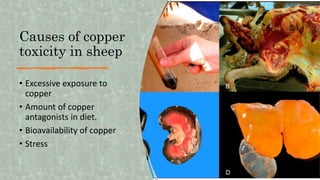
Causes of copper
toxicity in sheep
• Excessive exposure to
copper
• Amount of copper
antagonists in diet.
• Bioavailability of copper
• Stress
Excessive exposure to
copper
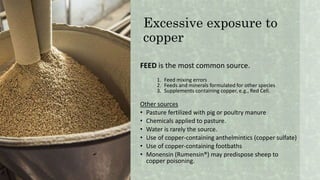
FEED is the most common source.
1. Feed mixing errors
2. Feeds and minerals formulated for other species
3. Supplements containing copper, e.g., Red Cell.
Other sources
• Pasture fertilized with pig or poultry manure
• Chemicals applied to pasture.
• Water is rarely the source.
• Use of copper-containing anthelmintics (copper sulfate)
• Use of copper-containing footbaths
• Monensin (Rumensin®) may predispose sheep to
copper poisoning.
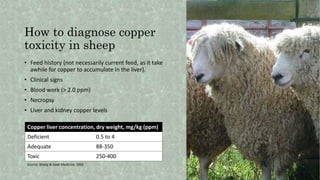
How to diagnose copper
toxicity in sheep
• Feed history (not necessarily current feed, as it take
awhile for copper to accumulate in the liver).
• Clinical signs
• Blood work (> 2.0 ppm)
• Necropsy
• Liver and kidney copper levels
Copper liver concentration, dry weight, mg/kg (ppm)
Deficient 0.5 to 4
Adequate 88-350
Toxic 250-400
Source: Sheep & Goat Medicine, 2002
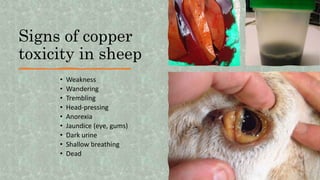
Signs of copper
toxicity in sheep
• Weakness
• Wandering
• Trembling
• Head-pressing
• Anorexia
• Jaundice (eye, gums)
• Dark urine
• Shallow breathing
• Dead
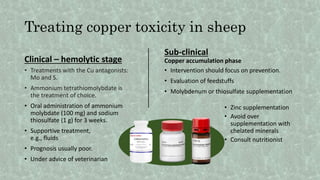
Treating copper toxicity in sheep
Clinical – hemolytic stage
• Treatments with the Cu antagonists:
Mo and S.
• Ammonium tetrathiomolybdate is
the treatment of choice.
• Oral administration of ammonium
molybdate (100 mg) and sodium
thiosulfate (1 g) for 3 weeks.
• Supportive treatment,
e.g., fluids
• Prognosis usually poor.
• Under advice of veterinarian
Sub-clinical
Copper accumulation phase
• Intervention should focus on prevention.
• Evaluation of feedstuffs
• Molybdenum or thiosulfate supplementation
• Zinc supplementation
• Avoid over
supplementation with
chelated minerals
• Consult nutritionist
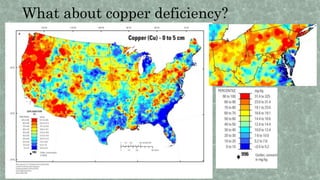
What about copper deficiency?
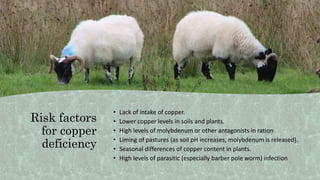
Risk factors
for copper
deficiency
• Lack of intake of copper.
• Lower copper levels in soils and plants.
• High levels of molybdenum or other antagonists in ration
• Liming of pastures (as soil pH increases, molybdenum is released).
• Seasonal differences of copper content in plants.
• High levels of parasitic (especially barber pole worm) infection
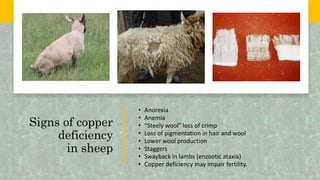
Signs of copper
deficiency
in sheep
• Anorexia
• Anemia
• “Steely wool” loss of crimp
• Loss of pigmentation in hair and wool
• Lower wool production
• Staggers
• Swayback in lambs (enzootic ataxia)
• Copper deficiency may impair fertility.
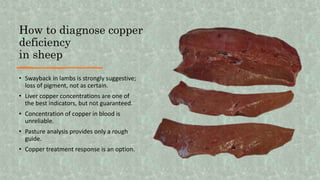
How to diagnose copper
deficiency
in sheep
• Swayback in lambs is strongly suggestive;
loss of pigment, not as certain.
• Liver copper concentrations are one of
the best indicators, but not guaranteed.
• Concentration of copper in blood is
unreliable.
• Pasture analysis provides only a rough
guide.
• Copper treatment response is an option.
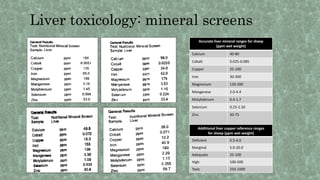
Liver toxicology: mineral screens
Accurate liver mineral ranges for sheep
(ppm wet weight)
Calcium 40-80
Cobalt 0.025-0.085
Copper 25-100
Iron 30-300
Magnesium 120-200
Manganese 2.0-4.4
Molybdenum 0.4-1.7
Selenium 0.25-1.50
Zinc 30-75
Additional liver copper reference ranges
for sheep (ppm wet weight)
Deficient 0.5-4.0
Marginal 5.0-20.0
Adequate 25-100
High 100-500
Toxic 250-1000
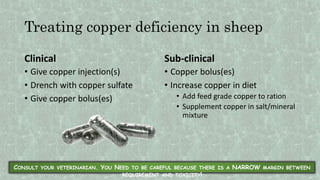
Treating copper deficiency in sheep
Sub-clinical
• Copper bolus(es)
• Increase copper in diet
• Add feed grade copper to ration
• Supplement copper in salt/mineral
mixture
Clinical
• Give copper injection(s)
• Drench with copper sulfate
• Give copper bolus(es)
CONSULT YOUR VETERINARIAN. YOU NEED TO BE CAREFUL BECAUSE THERE IS A NARROW MARGIN BETWEEN
REQUIREMENT AND TOXICITY!
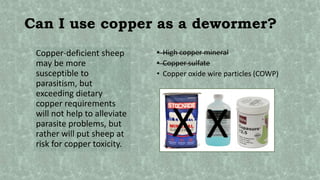
Can I use copper as a dewormer?
• High copper mineral
• Copper sulfate
• Copper oxide wire particles (COWP)
Copper-deficient sheep
may be more
susceptible to
parasitism, but
exceeding dietary
copper requirements
will not help to alleviate
parasite problems, but
rather will put sheep at
risk for copper toxicity.
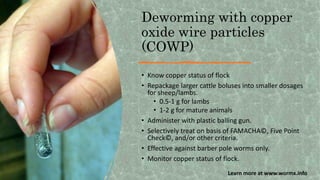
Deworming with copper
oxide wire particles
(COWP)
• Know copper status of flock
• Repackage larger cattle boluses into smaller dosages
for sheep/lambs.
• 0.5-1 g for lambs
• 1-2 g for mature animals
• Administer with plastic balling gun.
• Selectively treat on basis of FAMACHA©, Five Point
Check©, and/or other criteria.
• Effective against barber pole worms only.
• Monitor copper status of flock.
Learn more at www.wormx.info
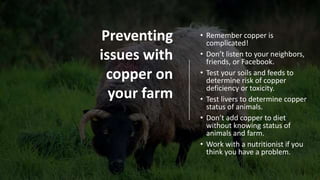
• Remember copper is
complicated!
• Don’t listen to your neighbors,
friends, or Facebook.
• Test your soils and feeds to
determine risk of copper
deficiency or toxicity.
• Test livers to determine copper
status of animals.
• Don’t add copper to diet
without knowing status of
animals and farm.
• Work with a nutritionist if you
think you have a problem.
Preventing
issues with
copper on
your farm
Thank you.
Comments?
Questions?
SUSAN SCHOENIAN
Sheep & Goat Specialist Emeritus
University of Maryland Extension
sschoen@umd.edu
www.sheepandgoat.com
www.sheep101.info
www.wormx.info
Facebook @ MDSmallRuminant
Flickr @ /baalands

Copper: its complicated

  • 1.
    Copper: it’s complicated SUSANSCHOENIAN Sheep & Goat Specialist Emeritus University of Maryland Extension sschoen@umd.edu | sheepandgoat.com sheep101.info | wormx.info
  • 2.
    Importance of copper inthe diets of sheep • Copper is one of the most important trace elements required for normal body functioning in sheep and other animals. • Dietary copper supports bone formation, wool growth, pigmentation, healthy nerve function, red blood cell formation, immune response and more. • Copper deficient sheep are more susceptible to worm infection.  No production benefit to giving copper to sheep that are not deficient.
  • 3.
    How much copperdo sheep need? Copper is a trace (or micro) mineral. It is required in very small amounts in the diet. 5 mg/kg DM (NRC, 1975) 1-8.6 mg/kg DM (ARC, 1980) 7-11 mg/kg DM (NRC, 1985) • Since 2007, equations that use different absorption coefficients have been used to estimate copper requirements (mg/day) for growing lambs, pregnant, and lactating ewes. • 15 mg/kg is the maximum tolerable amount. Class and weight Absorption coefficient Lamb, pre-weaning 11 lbs. 22 lbs. 44 lbs. .90 .53 .20 Lamb post-weaning Pasture Feedlot .045 .06 Ewe Gestation Lactation .06 .045 These all assume normal amounts of Mo and S in diet; 1-2 mg/kg and 1.5-2.5 g/kg, respectively. Old recommendations mg/kg = PPM
  • 4.
    Copper absorption: age • Relativelypoor overall, 1.4 to 12.8%. • However, much higher among young animals, up to 90%. • 70-75% absorption in newborns versus < 10% in adults.
  • 5.
    Copper absorption: breed • Betweenand within breed variation with regards to copper absorption. • Some breeds absorb copper more efficiently than other breeds. • Individual genetics can affect copper status of animal. Most efficient More susceptible to Cu tox Intermediate Least efficient Less susceptible to Cu tox Texel Suffolk Short-wool breeds Lowland breeds Merino Fine wool Scottish Blackface Cheviot Gotland Finn sheep
  • 6.
    Copper absorption: source •Metallic sources of copper are poorly absorbed (e.g., copper oxide). • The water-soluble forms of copper are more readily absorbed (e.g., copper sulfate and copper carbonate). • Chelated** minerals allow more efficient absorption and utilization of minerals. **Chelated minerals are minerals which are formed into a chemical compound with some organic product, often an amino acid, e.g., Zinc-Methionine and Copper-Lysine.
  • 7.
    Copper absorption: antagonists •Availability of copper is reduced by presence of antagonists, especially molybdenum, but also zinc, iron, and sulfur. • Antagonists bind with copper and prevent its absorption. • Cu:Mo ratio should be between 6:1 and 10:1.
  • 8.
    Sources of copperin sheep diets • All feedstuffs contain copper. • Copper levels in forages are variable and dependent upon many factors. • Fresh grasses are poor sources of copper compared to cured hay. • Mineral concentrations in forages vary much more than do protein and energy concentrations. • Liming and fertilization can alter copper content of plants. Feedstuff Copper, ppm Barley 7.2 Corn 4.7 Oats 6.8 Wheat middlings 12.1 Beet pulp 16.0 Soybean (much lower for soy hull pellets) 22.7 Corn gluten 35.1 DDSG 38.4
  • 9.
    Feedstuffs with high amountsof copper • Improperly mixed feeds • Feeds formulated for other species, especially pig and poultry. • Minerals formulated for other species • Feedstuffs grown on land in which pig or poultry manure (or sludge) has been applied or copper-containing chemicals have been used.
  • 10.
    Why are sheepso susceptible to copper toxicity? • Sheep are the most susceptible species to copper poisoning. • They have low dietary requirements. • Their liver cells have a high affinity for copper. • They excrete copper into the bile at a very low rate, leading to a build-up of copper in the liver over time.
  • 11.
    Causes of copper toxicityin sheep • Excessive exposure to copper • Amount of copper antagonists in diet. • Bioavailability of copper • Stress
  • 12.
    Excessive exposure to copper FEEDis the most common source. 1. Feed mixing errors 2. Feeds and minerals formulated for other species 3. Supplements containing copper, e.g., Red Cell. Other sources • Pasture fertilized with pig or poultry manure • Chemicals applied to pasture. • Water is rarely the source. • Use of copper-containing anthelmintics (copper sulfate) • Use of copper-containing footbaths • Monensin (Rumensin®) may predispose sheep to copper poisoning.
  • 13.
    How to diagnosecopper toxicity in sheep • Feed history (not necessarily current feed, as it take awhile for copper to accumulate in the liver). • Clinical signs • Blood work (> 2.0 ppm) • Necropsy • Liver and kidney copper levels Copper liver concentration, dry weight, mg/kg (ppm) Deficient 0.5 to 4 Adequate 88-350 Toxic 250-400 Source: Sheep & Goat Medicine, 2002
  • 14.
    Signs of copper toxicityin sheep • Weakness • Wandering • Trembling • Head-pressing • Anorexia • Jaundice (eye, gums) • Dark urine • Shallow breathing • Dead
  • 15.
    Treating copper toxicityin sheep Clinical – hemolytic stage • Treatments with the Cu antagonists: Mo and S. • Ammonium tetrathiomolybdate is the treatment of choice. • Oral administration of ammonium molybdate (100 mg) and sodium thiosulfate (1 g) for 3 weeks. • Supportive treatment, e.g., fluids • Prognosis usually poor. • Under advice of veterinarian Sub-clinical Copper accumulation phase • Intervention should focus on prevention. • Evaluation of feedstuffs • Molybdenum or thiosulfate supplementation • Zinc supplementation • Avoid over supplementation with chelated minerals • Consult nutritionist
  • 16.
    What about copperdeficiency?
  • 17.
    Risk factors for copper deficiency •Lack of intake of copper. • Lower copper levels in soils and plants. • High levels of molybdenum or other antagonists in ration • Liming of pastures (as soil pH increases, molybdenum is released). • Seasonal differences of copper content in plants. • High levels of parasitic (especially barber pole worm) infection
  • 18.
    Signs of copper deficiency insheep • Anorexia • Anemia • “Steely wool” loss of crimp • Loss of pigmentation in hair and wool • Lower wool production • Staggers • Swayback in lambs (enzootic ataxia) • Copper deficiency may impair fertility.
  • 19.
    How to diagnosecopper deficiency in sheep • Swayback in lambs is strongly suggestive; loss of pigment, not as certain. • Liver copper concentrations are one of the best indicators, but not guaranteed. • Concentration of copper in blood is unreliable. • Pasture analysis provides only a rough guide. • Copper treatment response is an option.
  • 20.
    Liver toxicology: mineralscreens Accurate liver mineral ranges for sheep (ppm wet weight) Calcium 40-80 Cobalt 0.025-0.085 Copper 25-100 Iron 30-300 Magnesium 120-200 Manganese 2.0-4.4 Molybdenum 0.4-1.7 Selenium 0.25-1.50 Zinc 30-75 Additional liver copper reference ranges for sheep (ppm wet weight) Deficient 0.5-4.0 Marginal 5.0-20.0 Adequate 25-100 High 100-500 Toxic 250-1000
  • 21.
    Treating copper deficiencyin sheep Sub-clinical • Copper bolus(es) • Increase copper in diet • Add feed grade copper to ration • Supplement copper in salt/mineral mixture Clinical • Give copper injection(s) • Drench with copper sulfate • Give copper bolus(es) CONSULT YOUR VETERINARIAN. YOU NEED TO BE CAREFUL BECAUSE THERE IS A NARROW MARGIN BETWEEN REQUIREMENT AND TOXICITY!
  • 22.
    Can I usecopper as a dewormer? • High copper mineral • Copper sulfate • Copper oxide wire particles (COWP) Copper-deficient sheep may be more susceptible to parasitism, but exceeding dietary copper requirements will not help to alleviate parasite problems, but rather will put sheep at risk for copper toxicity.
  • 23.
    Deworming with copper oxidewire particles (COWP) • Know copper status of flock • Repackage larger cattle boluses into smaller dosages for sheep/lambs. • 0.5-1 g for lambs • 1-2 g for mature animals • Administer with plastic balling gun. • Selectively treat on basis of FAMACHA©, Five Point Check©, and/or other criteria. • Effective against barber pole worms only. • Monitor copper status of flock. Learn more at www.wormx.info
  • 24.
    • Remember copperis complicated! • Don’t listen to your neighbors, friends, or Facebook. • Test your soils and feeds to determine risk of copper deficiency or toxicity. • Test livers to determine copper status of animals. • Don’t add copper to diet without knowing status of animals and farm. • Work with a nutritionist if you think you have a problem. Preventing issues with copper on your farm
  • 25.
    Thank you. Comments? Questions? SUSAN SCHOENIAN Sheep& Goat Specialist Emeritus University of Maryland Extension sschoen@umd.edu www.sheepandgoat.com www.sheep101.info www.wormx.info Facebook @ MDSmallRuminant Flickr @ /baalands