Minimizing
drug use
in sheep
SUSAN SCHOENIAN | Sheep & Goat Specialist Emeritus | University of Maryland Extension
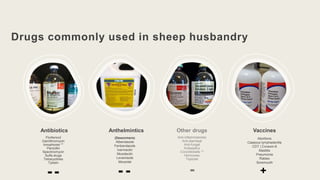
Drugs commonly used in sheep husbandry
Anthelmintics
(Dewormers)
Albendazole
Fenbendazole
Ivermectin
Moxidectin
Levamisole
Morantel
Vaccines
Abortions
Caseous lymphadenitis
CDT | Covexin-8
Mastitis
Pneumonia
Rabies
Soremouth
Other drugs
Anti-inflammatories
Anti-diarrheal
Anti-fungal
Antiseptics
Coccidiostats **
Hormones
Topicals
Antibiotics
Florfenicol
Gamithromycin
Ionophores **
Penicillin
Spectinomycin
Sulfa drugs
Tetracyclines
Tylosin
- - +
-
- -
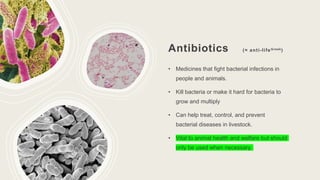
Antibiotics (= anti-lifeGreek)
• Medicines that fight bacterial infections in
people and animals.
• Kill bacteria or make it hard for bacteria to
grow and multiply
• Can help treat, control, and prevent
bacterial diseases in livestock.
• Vital to animal health and welfare but should
only be used when necessary.
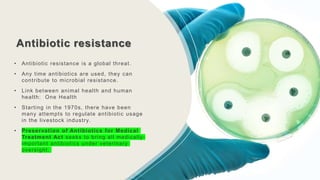
Antibiotic resistance
• Antibiotic resistance is a global threat.
• Any time antibiotics are used, they can
contribute to microbial resistance.
• Link between animal health and human
health: One Health
• Starting in the 1970s, there have been
many attempts to regulate antibiotic usage
in the livestock industry.
• Preservation of Antibiotics for Medical
Treatment Act seeks to bring all medically-
important antibiotics under veterinary
oversight.
January 1, 2017
Veterinary Feed Directive (VFD)
 Antibiotics put in the feed were converted
from over-the-counter status to veterinary
feed directive status (VFD).
 Antibiotics put in the water were converted
from over-the-counter status to prescription
status (Rx).
 Feeding antibiotics to promote growth or
performance was banned.
 NO Extra-label use of VFD drugs.
What did this mean to
sheep producers?
• Antibiotics no longer allowed in lamb feed to
promote growth and feed efficiency.
• Only antibiotic FDA-approved to feed sheep is
tetracyclines for prevention of abortion (none
approved for goats, camelids).
• Sulfa drugs (e.g., Di-Methox®), commonly used
to treat coccidiosis in small ruminants, were
converted to prescription status (Rx).
• “Regulatory discretion” with regards to extra-label
drug use in minor species.
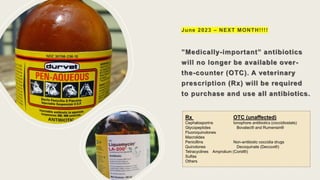
June 2023 – NEXT MONTH!!!!
”Medically-important” antibiotics
will no longer be available over-
the-counter (OTC). A veterinary
prescription (Rx) will be required
to purchase and use all antibiotics.
Rx OTC (unaffected)
Cephalosporins Ionophore antibiotics (coccidiostats)
Glycopeptides Bovatec® and Rumensin®
Fluoroquinolones
Macrolides
Penicillins Non-antibiotic coccidia drugs
Quinolones Decoquinate (Deccox®)
Tetracyclines Amprolium (Corid®)
Sulfas
Others
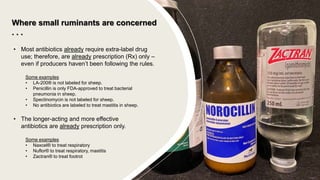
Where small ruminants are concerned
. . .
• Most antibiotics already require extra-label drug
use; therefore, are already prescription (Rx) only –
even if producers haven’t been following the rules.
Some examples
• LA-200® is not labeled for sheep.
• Penicillin is only FDA-approved to treat bacterial
pneumonia in sheep.
• Spectinomycin is not labeled for sheep.
• No antibiotics are labeled to treat mastitis in sheep.
• The longer-acting and more effective
antibiotics are already prescription only.
Some examples
• Naxcel® to treat respiratory
• Nuflor® to treat respiratory, mastitis
• Zactran® to treat footrot
Extra Label Drug Use (ELDU)
• Use of a drug in any manner that is not listed on label:
species or class, disease, dosage, route of
administration, interval and duration of treatment, and
withdrawal period.
• Only licensed veterinarians can legally use or prescribe
label drugs extra label.
• There are rules that apply to extra label drug use.
• In order for a veterinarian to prescribe drugs extra
label, there must be a valid veterinarian-patient-client
relationship (VCPR).
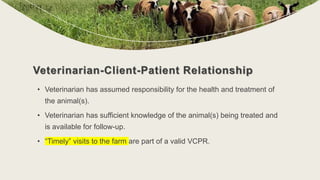
Veterinarian-Client-Patient Relationship
• Veterinarian has assumed responsibility for the health and treatment of
the animal(s).
• Veterinarian has sufficient knowledge of the animal(s) being treated and
is available for follow-up.
• “Timely” visits to the farm are part of a valid VCPR.
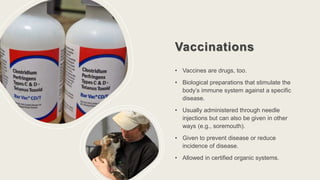
Vaccinations
• Vaccines are drugs, too.
• Biological preparations that stimulate the
body’s immune system against a specific
disease.
• Usually administered through needle
injections but can also be given in other
ways (e.g., soremouth).
• Given to prevent disease or reduce
incidence of disease.
• Allowed in certified organic systems.
Vaccine toolbox for small
ruminants
UNIVERSALLY-RECOMMENDED
Clostridial diseases
1. 3-way (CDT) toxoid (e.g., Bar-Vac CD/T)
Clostridial perfringins type C & D and clostridial
tetani (tetanus).
2. 7 or 8-way toxoid (e.g., Covexin™-8)
CDT + additional clostridial diseases
3. Anti-toxins
for treatment or immediate, short-term protection
AS NEEDED (risk: benefit)
1. Abortion
Chlamydia (Enzootic) + Vibrio (Campylobacter)
2. Caseous lymphadenitis (CL)
3. Epididymitis (Brucella ovis)
4. Footrot (not available in most states)
5. Haemonchus contortus (BarberVax®)
Not available in US (yet or ever?)
6. Mastitis (new goats)
7. Pneumonia
Pasteurella, PI3 (cattle)
8. Rabies – Vx
9. Soremouth (orf) – live vaccine
Some vaccine
do’s and don’t’s
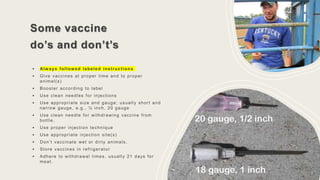
• Always followed labeled instructions
• Give vaccines at proper time and to proper
animal(s)
• Booster according to label
• Use clean needles for injections
• Use appropriate size and gauge; usually short and
narrow gauge, e.g., ½ inch, 20 gauge
• Use clean needle for withdrawing vaccine from
bottle.
• Use proper injection technique
• Use appropriate injection site(s)
• Don’t vaccinate wet or dirty animals.
• Store vaccines in refrigerator
• Adhere to withdrawal times, usually 21 days for
meat.
Anthelmintics (= anti-wormGreek)
(DEWORMERS)
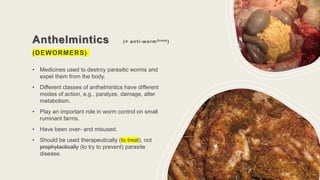
• Medicines used to destroy parasitic worms and
expel them from the body.
• Different classes of anthelmintics have different
modes of action, e.g., paralyze, damage, alter
metabolism.
• Play an important role in worm control on small
ruminant farms.
• Have been over- and misused.
• Should be used therapeutically (to treat), not
prophylactically (to try to prevent) parasite
disease.
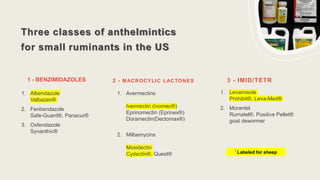
Three classes of anthelmintics
for small ruminants in the US
1 - BENZIMIDAZOLES
1. Albendazole
Valbazen®
2. Fenbendazole
Safe-Guard®, Panacur®
3. Oxfendazole
Synanthic®
2 - MACROCYLIC LACTONES
1. Avermectins
Ivermectin (Ivomec®)
Eprinomectin (Eprinex®)
Doramectin(Dectomax®)
2. Milbemycins
Moxidectin
Cydectin®, Quest®
3 - IMID/TETR
1. Levamisole
Prohibit®, Leva-Med®
2. Morantel
Rumatel®, Positive Pellet®
goat dewormer
* Labeled for sheep
Anthelmintic (dewormer) resistance
• Dewormer resistance is a world-wide problem and growing.
• Worms have developed resistance to all classes of anthelmintics
(resistance=less than 95% reduction in FEC).
• Resistance varies by farm and geographic region and farm and is a
result of past deworming practices.
• There are no new dewormers in the pipeline.
• Need to use best management practices to preserve what efficacy
we have left in our dewormers.
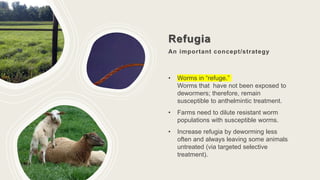
Refugia
An important concept/strategy
• Worms in “refuge.”
Worms that have not been exposed to
dewormers; therefore, remain
susceptible to anthelmintic treatment.
• Farms need to dilute resistant worm
populations with susceptible worms.
• Increase refugia by deworming less
often and always leaving some animals
untreated (via targeted selective
treatment).
Keeping small
ruminants
healthy
without drugs.
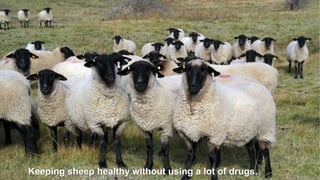
Keeping sheep healthy without using a lot of drugs.
Preventing enterotoxemias
(Overeating disease, Clostridium perfringins)
1. Vaccination
Vaccinate (booster) ewes in late pregnancy.
Vaccinate lambs at 6-8 and 10-12 weeks of age
Vaccinate feeder lambs, youth project animals
Vaccinate (booster) rams and wethers annually.
2. Management and nutrition
Don’t allow animals to overconsume feed.
Avoid sudden changes in diet.
Provide plenty of feeder space.
Feed less grain, if possible.
Whole grains better than processed.
Include long-stem forage in diet.
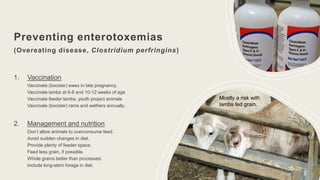
Mostly a risk with
lambs fed grain.
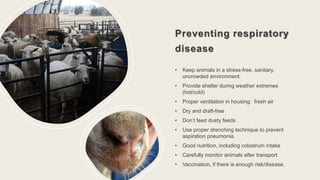
Preventing respiratory
disease
• Keep animals in a stress-free, sanitary,
uncrowded environment.
• Provide shelter during weather extremes
(hot/cold)
• Proper ventilation in housing: fresh air
• Dry and draft-free
• Don’t feed dusty feeds
• Use proper drenching technique to prevent
aspiration pneumonia.
• Good nutrition, including colostrum intake
• Carefully monitor animals after transport
• Vaccination, if there is enough risk/disease.
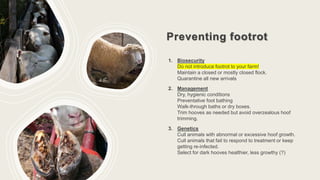
Preventing footrot
1. Biosecurity
Do not introduce footrot to your farm!
Maintain a closed or mostly closed flock.
Quarantine all new arrivals
2. Management
Dry, hygienic conditions
Preventative foot bathing
Walk-through baths or dry boxes.
Trim hooves as needed but avoid overzealous hoof
trimming.
3. Genetics
Cull animals with abnormal or excessive hoof growth.
Cull animals that fail to respond to treatment or keep
getting re-infected.
Select for dark hooves healthier, less growthy (?)
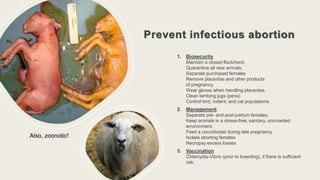
Prevent infectious abortion
1. Biosecurity
Maintain a closed flock/herd.
Quarantine all new arrivals.
Separate purchased females
Remove placentas and other products
of pregnancy.
Wear gloves when handling placentas.
Clean lambing jugs (pens)
Control bird, rodent, and cat populations.
2. Management
Separate pre- and post-partum females.
Keep animals in a stress-free, sanitary, uncrowded
environment.
Feed a coccidiostat during late pregnancy
Isolate aborting females
Necropsy excess losses
3. Vaccination
Chlamydia-Vibrio (prior to breeding), if there is sufficient
risk.
Also, zoonotic!
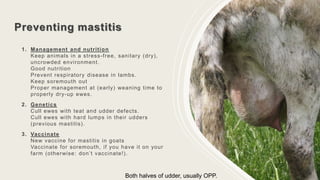
Preventing mastitis
1. Management and nutrition
Keep animals in a stress-free, sanitary (dry),
uncrowded environment.
Good nutrition
Prevent respiratory disease in lambs.
Keep soremouth out
Proper management at (early) weaning time to
properly dry-up ewes.
2. Genetics
Cull ewes with teat and udder defects.
Cull ewes with hard lumps in their udders
(previous mastitis).
3. Vaccinate
New vaccine for mastitis in goats
Vaccinate for soremouth, if you have it on your
farm (otherwise: don’t vaccinate!).
Both halves of udder, usually OPP.
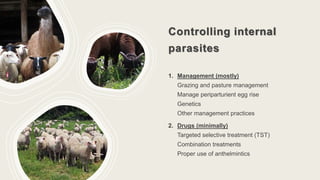
Controlling internal
parasites
1. Management (mostly)
Grazing and pasture management
Manage periparturient egg rise
Genetics
Other management practices
2. Drugs (minimally)
Targeted selective treatment (TST)
Combination treatments
Proper use of anthelmintics
Pasture and grazing
management
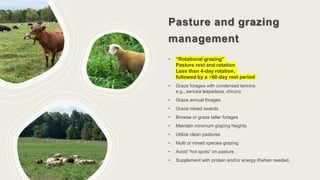
• “Rotational grazing”
Pasture rest and rotation
Less than 4-day rotation,
followed by a ~60-day rest period
• Graze forages with condensed tannins
e.g., sericea lespedeza, chicory
• Graze annual forages
• Graze mixed swards
• Browse or graze taller forages
• Maintain minimum grazing heights
• Utilize clean pastures
• Multi or mixed species grazing
• Avoid “hot spots” on pasture
• Supplement with protein and/or energy if/when needed.
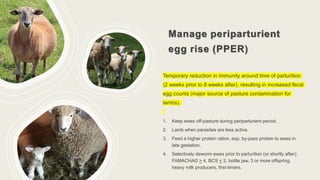
Manage periparturient
egg rise (PPER)
Temporary reduction in immunity around time of parturition
(2 weeks prior to 8 weeks after), resulting in increased fecal
egg counts (major source of pasture contamination for
lambs).
1. Keep ewes off-pasture during periparturient period.
2. Lamb when parasites are less active.
3. Feed a higher protein ration, esp. by-pass protein to ewes in
late gestation.
4. Selectively deworm ewes prior to parturition (or shortly after):
FAMACHA© > 4, BCS < 2, bottle jaw, 3 or more offspring,
heavy milk producers, first-timers.
Genetic control
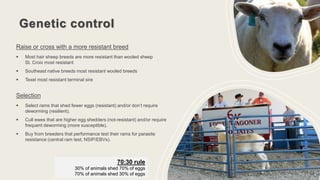
Raise or cross with a more resistant breed
 Most hair sheep breeds are more resistant than wooled sheep
St. Croix most resistant
 Southeast native breeds most resistant wooled breeds
 Texel most resistant terminal sire
Selection
 Select rams that shed fewer eggs (resistant) and/or don’t require
deworming (resilient).
 Cull ewes that are higher egg shedders (not-resistant) and/or require
frequent deworming (more susceptible).
 Buy from breeders that performance test their rams for parasite
resistance (central ram test, NSIP/EBVs).
70:30 rule
30% of animals shed 70% of eggs
70% of animals shed 30% of eggs
Some other ways to
control parasites
• Quarantine drenching (combination treatment) of new animals to
prevent introduction of resistant worms.
• Raise sheep in confinement or drylot
• Raise more susceptible lambs in confinement or drylot (or sell at
weaning).
• Lamb when parasites are less active (winter and fall).
• Wean pasture-reared lambs later (~120 days or natural
weaning).
• Good nutrition: protein, energy, minerals and vitamins
• Give copper oxide wire particles (COWP) to help control barber
pole worm infections.
• Feed BioWorma® to reduce pasture contamination [?].
Targeted selective
treatment (TST)
(or non-treatment)
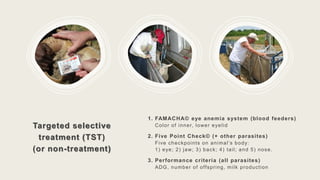
1. FAMACHA© eye anemia system (blood feeders)
Color of inner, lower eyelid
2. Five Point Check© (+ other parasites)
Five checkpoints on animal’s body:
1) eye; 2) jaw; 3) back; 4) tail; and 5) nose.
3. Performance criteria (all parasites)
ADG, number of offspring, milk production
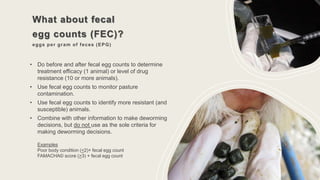
What about fecal
egg counts (FEC)?
eggs per gram of feces (EPG)
• Do before and after fecal egg counts to determine
treatment efficacy (1 animal) or level of drug
resistance (10 or more animals).
• Use fecal egg counts to monitor pasture
contamination.
• Use fecal egg counts to identify more resistant (and
susceptible) animals.
• Combine with other information to make deworming
decisions, but do not use as the sole criteria for
making deworming decisions.
Examples
Poor body condition (<2)+ fecal egg count
FAMACHA© score (>3) + fecal egg count
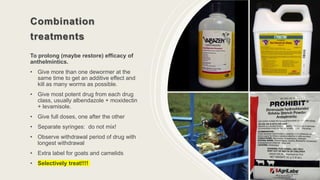
Combination
treatments
To prolong (maybe restore) efficacy of
anthelmintics.
• Give more than one dewormer at the
same time to get an additive effect and
kill as many worms as possible.
• Give most potent drug from each drug
class, usually albendazole + moxidectin
+ levamisole.
• Give full doses, one after the other
• Separate syringes: do not mix!
• Observe withdrawal period of drug with
longest withdrawal
• Extra label for goats and camelids
• Selectively treat!!!!
2/3/20XX 31
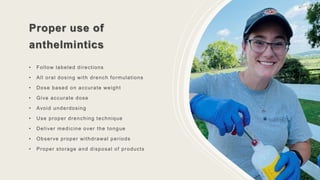
Proper use of
anthelmintics
• Follow labeled directions
• All oral dosing with drench formulations
• Dose based on accurate weight
• Give accurate dose
• Avoid underdosing
• Use proper drenching technique
• Deliver medicine over the tongue
• Observe proper withdrawal periods
• Proper storage and disposal of products
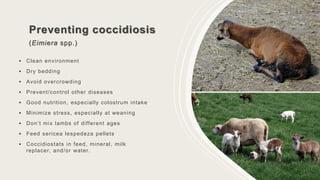
Preventing coccidiosis
(Eimiera spp.)
• Clean environment
• Dry bedding
• Avoid overcrowding
• Prevent/control other diseases
• Good nutrition, especially colostrum intake
• Minimize stress, especially at weaning
• Don’t mix lambs of different ages
• Feed sericea lespedeza pellets
• Coccidiostats in feed, mineral, milk
replacer, and/or water.
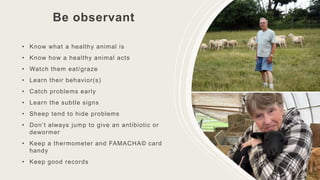
Be observant
• Know what a healthy animal is
• Know how a healthy animal acts
• Watch them eat/graze
• Learn their behavior(s)
• Catch problems early
• Learn the subtle signs
• Sheep tend to hide problems
• Don’t always jump to give an antibiotic or
dewormer
• Keep a thermometer and FAMACHA© card
handy
• Keep good records
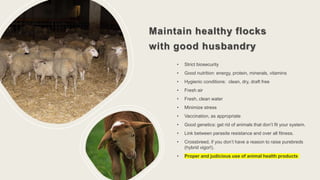
Maintain healthy flocks
with good husbandry
• Strict biosecurity
• Good nutrition: energy, protein, minerals, vitamins
• Hygienic conditions: clean, dry, draft free
• Fresh air
• Fresh, clean water
• Minimize stress
• Vaccination, as appropriate
• Good genetics: get rid of animals that don’t fit your system.
• Link between parasite resistance and over all fitness.
• Crossbreed, if you don’t have a reason to raise purebreds
(hybrid vigor!).
• Proper and judicious use of animal health products
sheepandgoat.com Resources Articles
What about
natural
treatments?
• Many testimonials
• Mostly unproven
• Use with caution
• Continue to monitor for signs
of disease
• Give drug(s) if/when
necessary to protect health
and welfare of animal.
Updated for 2023
Thank You. Comments. Questions?
SUSAN SCHOENIAN
sschoen@umd.edu
sheepandgoat.com
sheep101.info
w ormx.info
Facebook @ MDSmallRuminant

MinimizingDrugUse

  • 1.
    Minimizing drug use in sheep SUSANSCHOENIAN | Sheep & Goat Specialist Emeritus | University of Maryland Extension
  • 2.
    Drugs commonly usedin sheep husbandry Anthelmintics (Dewormers) Albendazole Fenbendazole Ivermectin Moxidectin Levamisole Morantel Vaccines Abortions Caseous lymphadenitis CDT | Covexin-8 Mastitis Pneumonia Rabies Soremouth Other drugs Anti-inflammatories Anti-diarrheal Anti-fungal Antiseptics Coccidiostats ** Hormones Topicals Antibiotics Florfenicol Gamithromycin Ionophores ** Penicillin Spectinomycin Sulfa drugs Tetracyclines Tylosin - - + - - -
  • 3.
    Antibiotics (= anti-lifeGreek) •Medicines that fight bacterial infections in people and animals. • Kill bacteria or make it hard for bacteria to grow and multiply • Can help treat, control, and prevent bacterial diseases in livestock. • Vital to animal health and welfare but should only be used when necessary.
  • 4.
    Antibiotic resistance • Antibioticresistance is a global threat. • Any time antibiotics are used, they can contribute to microbial resistance. • Link between animal health and human health: One Health • Starting in the 1970s, there have been many attempts to regulate antibiotic usage in the livestock industry. • Preservation of Antibiotics for Medical Treatment Act seeks to bring all medically- important antibiotics under veterinary oversight.
  • 5.
    January 1, 2017 VeterinaryFeed Directive (VFD)  Antibiotics put in the feed were converted from over-the-counter status to veterinary feed directive status (VFD).  Antibiotics put in the water were converted from over-the-counter status to prescription status (Rx).  Feeding antibiotics to promote growth or performance was banned.  NO Extra-label use of VFD drugs.
  • 6.
    What did thismean to sheep producers? • Antibiotics no longer allowed in lamb feed to promote growth and feed efficiency. • Only antibiotic FDA-approved to feed sheep is tetracyclines for prevention of abortion (none approved for goats, camelids). • Sulfa drugs (e.g., Di-Methox®), commonly used to treat coccidiosis in small ruminants, were converted to prescription status (Rx). • “Regulatory discretion” with regards to extra-label drug use in minor species.
  • 7.
    June 2023 –NEXT MONTH!!!! ”Medically-important” antibiotics will no longer be available over- the-counter (OTC). A veterinary prescription (Rx) will be required to purchase and use all antibiotics. Rx OTC (unaffected) Cephalosporins Ionophore antibiotics (coccidiostats) Glycopeptides Bovatec® and Rumensin® Fluoroquinolones Macrolides Penicillins Non-antibiotic coccidia drugs Quinolones Decoquinate (Deccox®) Tetracyclines Amprolium (Corid®) Sulfas Others
  • 8.
    Where small ruminantsare concerned . . . • Most antibiotics already require extra-label drug use; therefore, are already prescription (Rx) only – even if producers haven’t been following the rules. Some examples • LA-200® is not labeled for sheep. • Penicillin is only FDA-approved to treat bacterial pneumonia in sheep. • Spectinomycin is not labeled for sheep. • No antibiotics are labeled to treat mastitis in sheep. • The longer-acting and more effective antibiotics are already prescription only. Some examples • Naxcel® to treat respiratory • Nuflor® to treat respiratory, mastitis • Zactran® to treat footrot
  • 9.
    Extra Label DrugUse (ELDU) • Use of a drug in any manner that is not listed on label: species or class, disease, dosage, route of administration, interval and duration of treatment, and withdrawal period. • Only licensed veterinarians can legally use or prescribe label drugs extra label. • There are rules that apply to extra label drug use. • In order for a veterinarian to prescribe drugs extra label, there must be a valid veterinarian-patient-client relationship (VCPR).
  • 10.
    Veterinarian-Client-Patient Relationship • Veterinarianhas assumed responsibility for the health and treatment of the animal(s). • Veterinarian has sufficient knowledge of the animal(s) being treated and is available for follow-up. • “Timely” visits to the farm are part of a valid VCPR.
  • 11.
    Vaccinations • Vaccines aredrugs, too. • Biological preparations that stimulate the body’s immune system against a specific disease. • Usually administered through needle injections but can also be given in other ways (e.g., soremouth). • Given to prevent disease or reduce incidence of disease. • Allowed in certified organic systems.
  • 12.
    Vaccine toolbox forsmall ruminants UNIVERSALLY-RECOMMENDED Clostridial diseases 1. 3-way (CDT) toxoid (e.g., Bar-Vac CD/T) Clostridial perfringins type C & D and clostridial tetani (tetanus). 2. 7 or 8-way toxoid (e.g., Covexin™-8) CDT + additional clostridial diseases 3. Anti-toxins for treatment or immediate, short-term protection AS NEEDED (risk: benefit) 1. Abortion Chlamydia (Enzootic) + Vibrio (Campylobacter) 2. Caseous lymphadenitis (CL) 3. Epididymitis (Brucella ovis) 4. Footrot (not available in most states) 5. Haemonchus contortus (BarberVax®) Not available in US (yet or ever?) 6. Mastitis (new goats) 7. Pneumonia Pasteurella, PI3 (cattle) 8. Rabies – Vx 9. Soremouth (orf) – live vaccine
  • 13.
    Some vaccine do’s anddon’t’s • Always followed labeled instructions • Give vaccines at proper time and to proper animal(s) • Booster according to label • Use clean needles for injections • Use appropriate size and gauge; usually short and narrow gauge, e.g., ½ inch, 20 gauge • Use clean needle for withdrawing vaccine from bottle. • Use proper injection technique • Use appropriate injection site(s) • Don’t vaccinate wet or dirty animals. • Store vaccines in refrigerator • Adhere to withdrawal times, usually 21 days for meat.
  • 14.
    Anthelmintics (= anti-wormGreek) (DEWORMERS) •Medicines used to destroy parasitic worms and expel them from the body. • Different classes of anthelmintics have different modes of action, e.g., paralyze, damage, alter metabolism. • Play an important role in worm control on small ruminant farms. • Have been over- and misused. • Should be used therapeutically (to treat), not prophylactically (to try to prevent) parasite disease.
  • 15.
    Three classes ofanthelmintics for small ruminants in the US 1 - BENZIMIDAZOLES 1. Albendazole Valbazen® 2. Fenbendazole Safe-Guard®, Panacur® 3. Oxfendazole Synanthic® 2 - MACROCYLIC LACTONES 1. Avermectins Ivermectin (Ivomec®) Eprinomectin (Eprinex®) Doramectin(Dectomax®) 2. Milbemycins Moxidectin Cydectin®, Quest® 3 - IMID/TETR 1. Levamisole Prohibit®, Leva-Med® 2. Morantel Rumatel®, Positive Pellet® goat dewormer * Labeled for sheep
  • 16.
    Anthelmintic (dewormer) resistance •Dewormer resistance is a world-wide problem and growing. • Worms have developed resistance to all classes of anthelmintics (resistance=less than 95% reduction in FEC). • Resistance varies by farm and geographic region and farm and is a result of past deworming practices. • There are no new dewormers in the pipeline. • Need to use best management practices to preserve what efficacy we have left in our dewormers.
  • 17.
    Refugia An important concept/strategy •Worms in “refuge.” Worms that have not been exposed to dewormers; therefore, remain susceptible to anthelmintic treatment. • Farms need to dilute resistant worm populations with susceptible worms. • Increase refugia by deworming less often and always leaving some animals untreated (via targeted selective treatment).
  • 18.
    Keeping small ruminants healthy without drugs. Keepingsheep healthy without using a lot of drugs.
  • 19.
    Preventing enterotoxemias (Overeating disease,Clostridium perfringins) 1. Vaccination Vaccinate (booster) ewes in late pregnancy. Vaccinate lambs at 6-8 and 10-12 weeks of age Vaccinate feeder lambs, youth project animals Vaccinate (booster) rams and wethers annually. 2. Management and nutrition Don’t allow animals to overconsume feed. Avoid sudden changes in diet. Provide plenty of feeder space. Feed less grain, if possible. Whole grains better than processed. Include long-stem forage in diet. Mostly a risk with lambs fed grain.
  • 20.
    Preventing respiratory disease • Keepanimals in a stress-free, sanitary, uncrowded environment. • Provide shelter during weather extremes (hot/cold) • Proper ventilation in housing: fresh air • Dry and draft-free • Don’t feed dusty feeds • Use proper drenching technique to prevent aspiration pneumonia. • Good nutrition, including colostrum intake • Carefully monitor animals after transport • Vaccination, if there is enough risk/disease.
  • 21.
    Preventing footrot 1. Biosecurity Donot introduce footrot to your farm! Maintain a closed or mostly closed flock. Quarantine all new arrivals 2. Management Dry, hygienic conditions Preventative foot bathing Walk-through baths or dry boxes. Trim hooves as needed but avoid overzealous hoof trimming. 3. Genetics Cull animals with abnormal or excessive hoof growth. Cull animals that fail to respond to treatment or keep getting re-infected. Select for dark hooves healthier, less growthy (?)
  • 22.
    Prevent infectious abortion 1.Biosecurity Maintain a closed flock/herd. Quarantine all new arrivals. Separate purchased females Remove placentas and other products of pregnancy. Wear gloves when handling placentas. Clean lambing jugs (pens) Control bird, rodent, and cat populations. 2. Management Separate pre- and post-partum females. Keep animals in a stress-free, sanitary, uncrowded environment. Feed a coccidiostat during late pregnancy Isolate aborting females Necropsy excess losses 3. Vaccination Chlamydia-Vibrio (prior to breeding), if there is sufficient risk. Also, zoonotic!
  • 23.
    Preventing mastitis 1. Managementand nutrition Keep animals in a stress-free, sanitary (dry), uncrowded environment. Good nutrition Prevent respiratory disease in lambs. Keep soremouth out Proper management at (early) weaning time to properly dry-up ewes. 2. Genetics Cull ewes with teat and udder defects. Cull ewes with hard lumps in their udders (previous mastitis). 3. Vaccinate New vaccine for mastitis in goats Vaccinate for soremouth, if you have it on your farm (otherwise: don’t vaccinate!). Both halves of udder, usually OPP.
  • 24.
    Controlling internal parasites 1. Management(mostly) Grazing and pasture management Manage periparturient egg rise Genetics Other management practices 2. Drugs (minimally) Targeted selective treatment (TST) Combination treatments Proper use of anthelmintics
  • 25.
    Pasture and grazing management •“Rotational grazing” Pasture rest and rotation Less than 4-day rotation, followed by a ~60-day rest period • Graze forages with condensed tannins e.g., sericea lespedeza, chicory • Graze annual forages • Graze mixed swards • Browse or graze taller forages • Maintain minimum grazing heights • Utilize clean pastures • Multi or mixed species grazing • Avoid “hot spots” on pasture • Supplement with protein and/or energy if/when needed.
  • 26.
    Manage periparturient egg rise(PPER) Temporary reduction in immunity around time of parturition (2 weeks prior to 8 weeks after), resulting in increased fecal egg counts (major source of pasture contamination for lambs). 1. Keep ewes off-pasture during periparturient period. 2. Lamb when parasites are less active. 3. Feed a higher protein ration, esp. by-pass protein to ewes in late gestation. 4. Selectively deworm ewes prior to parturition (or shortly after): FAMACHA© > 4, BCS < 2, bottle jaw, 3 or more offspring, heavy milk producers, first-timers.
  • 27.
    Genetic control Raise orcross with a more resistant breed  Most hair sheep breeds are more resistant than wooled sheep St. Croix most resistant  Southeast native breeds most resistant wooled breeds  Texel most resistant terminal sire Selection  Select rams that shed fewer eggs (resistant) and/or don’t require deworming (resilient).  Cull ewes that are higher egg shedders (not-resistant) and/or require frequent deworming (more susceptible).  Buy from breeders that performance test their rams for parasite resistance (central ram test, NSIP/EBVs). 70:30 rule 30% of animals shed 70% of eggs 70% of animals shed 30% of eggs
  • 28.
    Some other waysto control parasites • Quarantine drenching (combination treatment) of new animals to prevent introduction of resistant worms. • Raise sheep in confinement or drylot • Raise more susceptible lambs in confinement or drylot (or sell at weaning). • Lamb when parasites are less active (winter and fall). • Wean pasture-reared lambs later (~120 days or natural weaning). • Good nutrition: protein, energy, minerals and vitamins • Give copper oxide wire particles (COWP) to help control barber pole worm infections. • Feed BioWorma® to reduce pasture contamination [?].
  • 29.
    Targeted selective treatment (TST) (ornon-treatment) 1. FAMACHA© eye anemia system (blood feeders) Color of inner, lower eyelid 2. Five Point Check© (+ other parasites) Five checkpoints on animal’s body: 1) eye; 2) jaw; 3) back; 4) tail; and 5) nose. 3. Performance criteria (all parasites) ADG, number of offspring, milk production
  • 30.
    What about fecal eggcounts (FEC)? eggs per gram of feces (EPG) • Do before and after fecal egg counts to determine treatment efficacy (1 animal) or level of drug resistance (10 or more animals). • Use fecal egg counts to monitor pasture contamination. • Use fecal egg counts to identify more resistant (and susceptible) animals. • Combine with other information to make deworming decisions, but do not use as the sole criteria for making deworming decisions. Examples Poor body condition (<2)+ fecal egg count FAMACHA© score (>3) + fecal egg count
  • 31.
    Combination treatments To prolong (mayberestore) efficacy of anthelmintics. • Give more than one dewormer at the same time to get an additive effect and kill as many worms as possible. • Give most potent drug from each drug class, usually albendazole + moxidectin + levamisole. • Give full doses, one after the other • Separate syringes: do not mix! • Observe withdrawal period of drug with longest withdrawal • Extra label for goats and camelids • Selectively treat!!!! 2/3/20XX 31
  • 32.
    Proper use of anthelmintics •Follow labeled directions • All oral dosing with drench formulations • Dose based on accurate weight • Give accurate dose • Avoid underdosing • Use proper drenching technique • Deliver medicine over the tongue • Observe proper withdrawal periods • Proper storage and disposal of products
  • 33.
    Preventing coccidiosis (Eimiera spp.) •Clean environment • Dry bedding • Avoid overcrowding • Prevent/control other diseases • Good nutrition, especially colostrum intake • Minimize stress, especially at weaning • Don’t mix lambs of different ages • Feed sericea lespedeza pellets • Coccidiostats in feed, mineral, milk replacer, and/or water.
  • 34.
    Be observant • Knowwhat a healthy animal is • Know how a healthy animal acts • Watch them eat/graze • Learn their behavior(s) • Catch problems early • Learn the subtle signs • Sheep tend to hide problems • Don’t always jump to give an antibiotic or dewormer • Keep a thermometer and FAMACHA© card handy • Keep good records
  • 35.
    Maintain healthy flocks withgood husbandry • Strict biosecurity • Good nutrition: energy, protein, minerals, vitamins • Hygienic conditions: clean, dry, draft free • Fresh air • Fresh, clean water • Minimize stress • Vaccination, as appropriate • Good genetics: get rid of animals that don’t fit your system. • Link between parasite resistance and over all fitness. • Crossbreed, if you don’t have a reason to raise purebreds (hybrid vigor!). • Proper and judicious use of animal health products
  • 36.
    sheepandgoat.com Resources Articles Whatabout natural treatments? • Many testimonials • Mostly unproven • Use with caution • Continue to monitor for signs of disease • Give drug(s) if/when necessary to protect health and welfare of animal. Updated for 2023
  • 37.
    Thank You. Comments.Questions? SUSAN SCHOENIAN sschoen@umd.edu sheepandgoat.com sheep101.info w ormx.info Facebook @ MDSmallRuminant