
DSVC KAMDHENU VISHWAVIDAYALAYA, DURG
ASSIGNMENT
ON
Feeding of Swine
Submitted by:
Dinesh Pratap Singh
M.V.SC 1st year
DEPARTMENT OF VETERINARY PHYSIOLOGY & BIOCHEMISTRY
COLLEGE OF VETERINARY SCIENCE AND ANIMAL HUSBANDRY,
ANJORA, DURG (C.G)
Introduction:-
• Pigs are meat producing, monogastric omnivore livestock animals.
• They have high efficacy of feed conversion into high quality pork.
• The total pigs in the country is 9.6 million in the current census.
Feeding system:-
Pigs are reared under scavenging system, semis-cavenging & intensive
feeding system of production.
1). Extensive system/ scavenging system-
Major population comprises of many indigenous breed are reared under free
range scavenging system with little or no input.
2)-Semi intensive/ semi scavenging system-
• Indigenous & crossbreed pigs are also reared under semi intensive system
wherein they are allowed to scavenge for the whole day and receive kitchen
waste , rice bran, wheat bran & broken wheat (dalia), after their return.
3)- Intensive system-
• At commercial level exotic & cross breed are reared with concentrate feed,
kitchen waste, cereal byproducts & vegetable waste etc.
Nutrient requirement of pigs:-
• Growing pigs are fed as per different growth phases depending upon age and
body weight.
• NRC (1998) suggested six growing stages (3-5, 5-10, 10-20, 20-50, 50-80 & 80-
120 kg) for pigs.
• For Indian condition (Ranjhan,1981), recommended only three stages weaning(5-
12kg), growing (12-50kg) & finishing (50-100kg) up to 100kg body weight.
• BIS (1986) also recommended three phases for feeding of growing finishing pigs.
• Some other workers (Bhar,1998) prefer to feed grower ration up to 35kg body
weight & shifting to finisher ration thereafter.
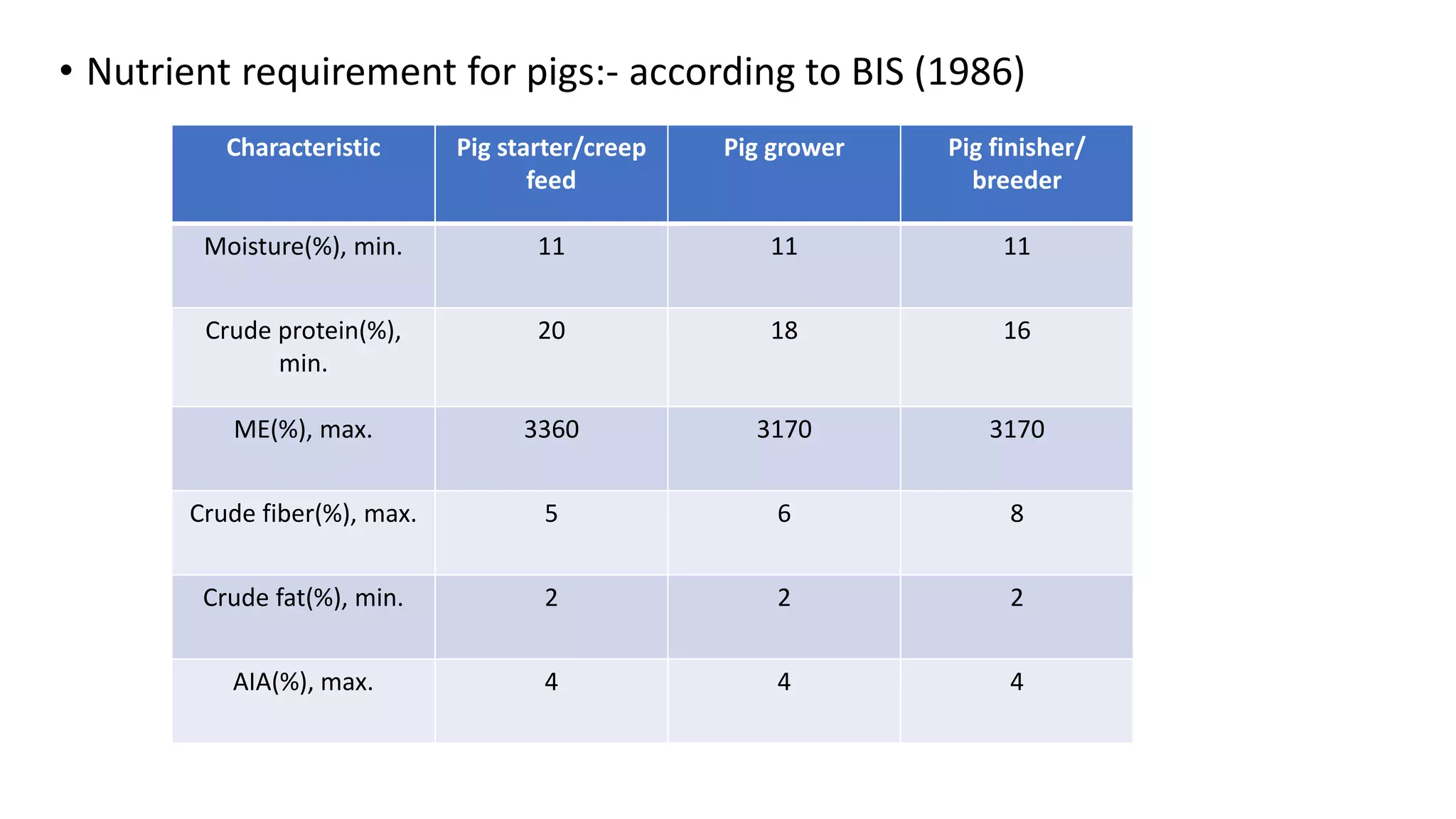
• Nutrient requirement for pigs:- according to BIS (1986)
Characteristic Pig starter/creep
feed
Pig grower Pig finisher/
breeder
Moisture(%), min. 11 11 11
Crude protein(%),
min.
20 18 16
ME(%), max. 3360 3170 3170
Crude fiber(%), max. 5 6 8
Crude fat(%), min. 2 2 2
AIA(%), max. 4 4 4
Mineral requirements for pig feed:- according to BIS (1986)
Characteristic Pig starter/creep
feed
Pig grower Pig finisher/
breeder
Calcium(%), min. 0.6 0.6 0.6
Available
phosphorus(%), min.
0.6 0.4 0.5
Iron(mg/kg feed), min. 100 90 80
Copper(mg/kg), min. 8 6 6
Manganese(mg/kg),
min.
30 30 20
Zinc(mg/kg), min. 50 50 50
Common salt(%), max. 0.5 0.5 0.5
Ingredient composition for Starter, Grower & Finisher diets for pigs acc. To BIS
1986:-
Feedstuff Starter/Creep diet,
(CP-20% & ME-
3370)
Grower diet, (CP-
18% & ME-3170)
Finisher diet, (CP-
16% & ME-3170)
Maize 60 55 -
Jowar - - 57
Bajra - - -
GNC 20 13 8
DORB 8 23 26
Fish meal 10 7 5
Mineral mixture &
salt
2 2 2
Vitamins (A,B2,D3
& B comp.)
25 g/100kg 25 g/100 kg 25 g/100kg
Creep feed:-
• Creep (pre-starter) feeding system is essential for sucking piglets for faster
growth and attain their satisfactory weaning weight.
• Piglets are weaned at 6 week of age in western country and at 8 week of
age in India under intensive feeding system.
• Creep mixtures are introduced at 7-14 days of age and are fed till weaning.
Crude protein(%), min. 20 (acc. To BIS 1986)
ME (kcal/kg), min. 3265 (acc to NRC 1998)
• Piglets fed on creep ration attain 12-15 kg body weight at 8 weeks of age.
• During suckling period piglets are more prone to anemia, creep feed is
generally mixed with ferrous sulphate at the ratio of 9:1 to prevent anemia.
Ingredient composition of weaner piglet ration (up to 15 kg)
Ingredient composition (%) In 100 part of feed
Maize 2
Maize gluten meal 48.7
Soyabean meal 4
Rice kunda 3
DORB 10
Rice polish 9
Fishmeal 8
Mustard cake 6
Limestone powder 0.8
Salt 0.3
Lysine 0.025
Grower ration:-
• After creep feed on attainment of 12-15 kg of body weight at 8 week of
age piglets are shifted on grower ration.
• At this stage pigs consume considerably more feed and attain 12-50kg bd
wt.
• Grower ration should have 18% CP and 3170 kcal/kg ME value.
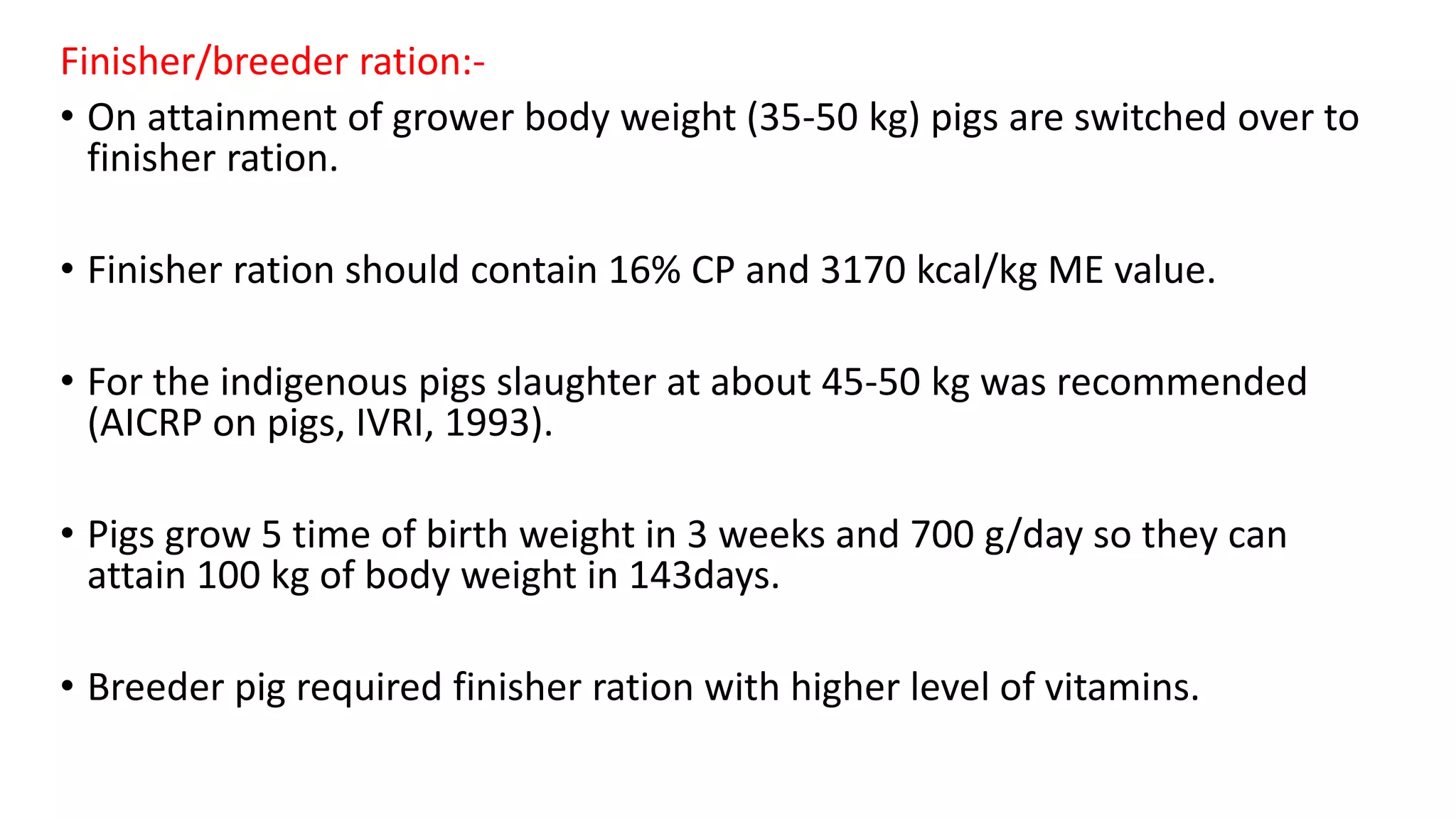
Finisher/breeder ration:-
• On attainment of grower body weight (35-50 kg) pigs are switched over to
finisher ration.
• Finisher ration should contain 16% CP and 3170 kcal/kg ME value.
• For the indigenous pigs slaughter at about 45-50 kg was recommended
(AICRP on pigs, IVRI, 1993).
• Pigs grow 5 time of birth weight in 3 weeks and 700 g/day so they can
attain 100 kg of body weight in 143days.
• Breeder pig required finisher ration with higher level of vitamins.
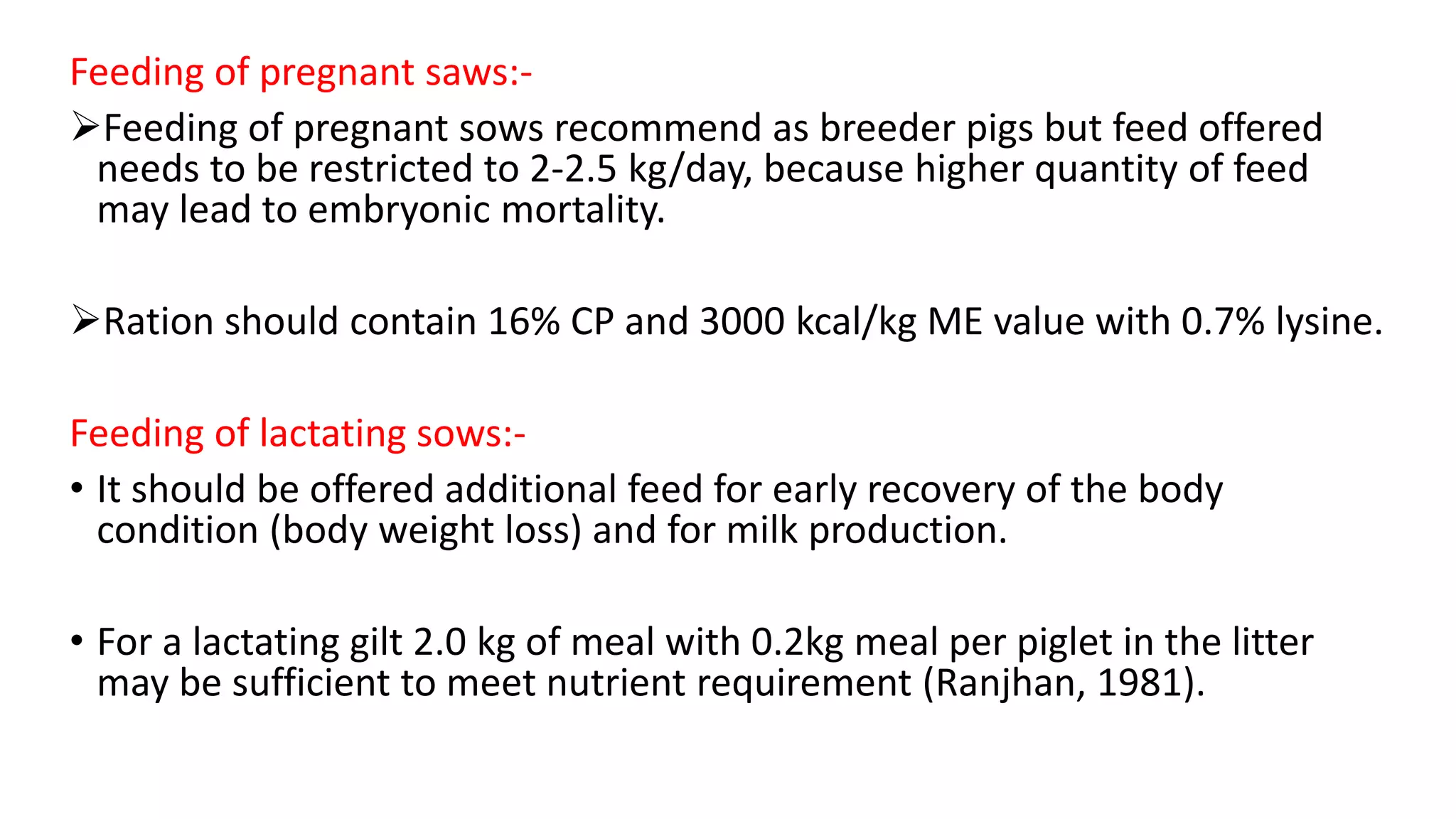
Feeding of pregnant saws:-
Feeding of pregnant sows recommend as breeder pigs but feed offered
needs to be restricted to 2-2.5 kg/day, because higher quantity of feed
may lead to embryonic mortality.
Ration should contain 16% CP and 3000 kcal/kg ME value with 0.7% lysine.
Feeding of lactating sows:-
• It should be offered additional feed for early recovery of the body
condition (body weight loss) and for milk production.
• For a lactating gilt 2.0 kg of meal with 0.2kg meal per piglet in the litter
may be sufficient to meet nutrient requirement (Ranjhan, 1981).
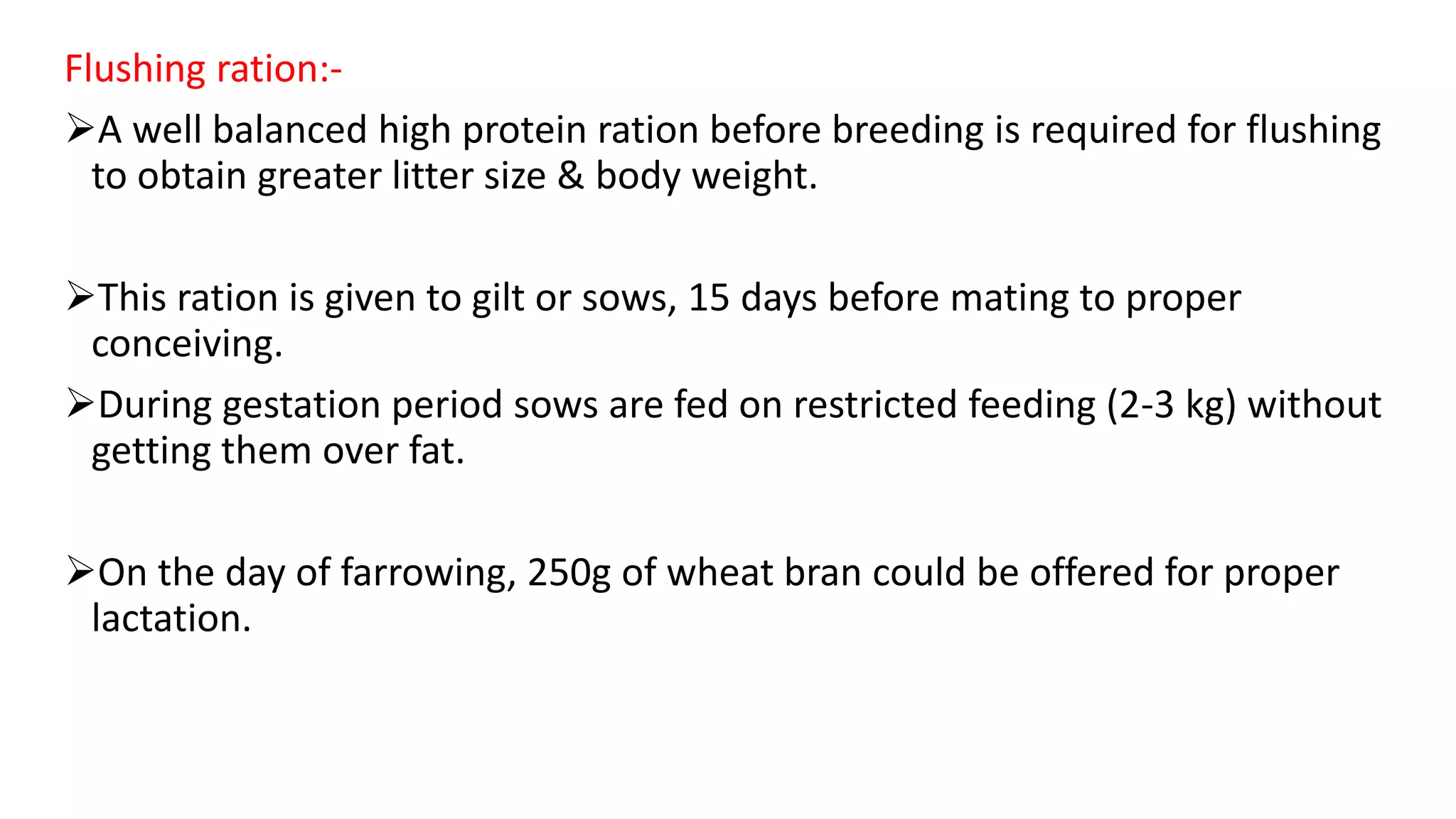
Flushing ration:-
A well balanced high protein ration before breeding is required for flushing
to obtain greater litter size & body weight.
This ration is given to gilt or sows, 15 days before mating to proper
conceiving.
During gestation period sows are fed on restricted feeding (2-3 kg) without
getting them over fat.
On the day of farrowing, 250g of wheat bran could be offered for proper
lactation.
Feeding of piglets:-
1)-Colostrum feeding – It is first milk and an essential source of energy,
nutrients & immunity for the piglets.
• It is important to maximise colostrum intake in the first six hours after birth
(150-280 ml/kg of birth).
2)- Milk replacer:- A milk replacer for piglets is good solution to supply
piglets with extra nutrients and energy, when sow milk supply is not
sufficient.
• The ingredient of milk replacer should be of higher quality and easily
digestible since we are feeding of young one.
Common ingredient in pig milk replacer:- Cow milk
Whey powder
Lactose
Coconut oil
Soya protein concentrate
Spray dried plasma protein
Urea as a nitrogen source in pig fed diet:-
• Utilization of non-protein nitrogen (NPN) is well documented in ruminants
due to their microbial digestion ability.
• Monogastric species are less adequately equipped to utilize dietary NPN
compounds due to poor microbial fermentation.
• It has been suggested by Kornegay et al. (1965) that 1% urea can be utilized
by pigs for replacement of essential amino acids.
• An amino acid imbalance was observed when 0.5% lysine added to diet
which containing 2% urea, it was overcome by supplementing the diet with
tryptophan and methionine.
Use of unconventional feed stuff in pig ration:-
• Feed cost of pig production usually account for nearly 60-70% of the total
production cost.
• It is extremely important that economical as well nutritionally balanced diet
are provided during all stages of production.
Common available unconventional feedstuff:-
1)-Sweet potato- fed as energy source in pig ration.
2)-Pineapple waste- waste obtaining after squieezing juice contain 5% CP
and also fed as energy source.
3)-Tapioca waste- it can be used as energy source in ration up to 5-10%.
4)-De-caffeinated tea waste- It contain about 7.5% DCP and can be used up
to 10% in concentrate feed.
5)-Garbage waste- wastes from hotel, hostels, kitchen & agricultural wastes
can be used in pig ration, before feeding waste should be boiled properly.
THANK YOU

Feeding of Swine

  • 1.
    DSVC KAMDHENU VISHWAVIDAYALAYA,DURG ASSIGNMENT ON Feeding of Swine Submitted by: Dinesh Pratap Singh M.V.SC 1st year DEPARTMENT OF VETERINARY PHYSIOLOGY & BIOCHEMISTRY COLLEGE OF VETERINARY SCIENCE AND ANIMAL HUSBANDRY, ANJORA, DURG (C.G)
  • 2.
    Introduction:- • Pigs aremeat producing, monogastric omnivore livestock animals. • They have high efficacy of feed conversion into high quality pork. • The total pigs in the country is 9.6 million in the current census.
  • 3.
    Feeding system:- Pigs arereared under scavenging system, semis-cavenging & intensive feeding system of production. 1). Extensive system/ scavenging system- Major population comprises of many indigenous breed are reared under free range scavenging system with little or no input.
  • 4.
    2)-Semi intensive/ semiscavenging system- • Indigenous & crossbreed pigs are also reared under semi intensive system wherein they are allowed to scavenge for the whole day and receive kitchen waste , rice bran, wheat bran & broken wheat (dalia), after their return.
  • 5.
    3)- Intensive system- •At commercial level exotic & cross breed are reared with concentrate feed, kitchen waste, cereal byproducts & vegetable waste etc.
  • 6.
    Nutrient requirement ofpigs:- • Growing pigs are fed as per different growth phases depending upon age and body weight. • NRC (1998) suggested six growing stages (3-5, 5-10, 10-20, 20-50, 50-80 & 80- 120 kg) for pigs. • For Indian condition (Ranjhan,1981), recommended only three stages weaning(5- 12kg), growing (12-50kg) & finishing (50-100kg) up to 100kg body weight. • BIS (1986) also recommended three phases for feeding of growing finishing pigs. • Some other workers (Bhar,1998) prefer to feed grower ration up to 35kg body weight & shifting to finisher ration thereafter.
  • 7.
    • Nutrient requirementfor pigs:- according to BIS (1986) Characteristic Pig starter/creep feed Pig grower Pig finisher/ breeder Moisture(%), min. 11 11 11 Crude protein(%), min. 20 18 16 ME(%), max. 3360 3170 3170 Crude fiber(%), max. 5 6 8 Crude fat(%), min. 2 2 2 AIA(%), max. 4 4 4
  • 8.
    Mineral requirements forpig feed:- according to BIS (1986) Characteristic Pig starter/creep feed Pig grower Pig finisher/ breeder Calcium(%), min. 0.6 0.6 0.6 Available phosphorus(%), min. 0.6 0.4 0.5 Iron(mg/kg feed), min. 100 90 80 Copper(mg/kg), min. 8 6 6 Manganese(mg/kg), min. 30 30 20 Zinc(mg/kg), min. 50 50 50 Common salt(%), max. 0.5 0.5 0.5
  • 9.
    Ingredient composition forStarter, Grower & Finisher diets for pigs acc. To BIS 1986:- Feedstuff Starter/Creep diet, (CP-20% & ME- 3370) Grower diet, (CP- 18% & ME-3170) Finisher diet, (CP- 16% & ME-3170) Maize 60 55 - Jowar - - 57 Bajra - - - GNC 20 13 8 DORB 8 23 26 Fish meal 10 7 5 Mineral mixture & salt 2 2 2 Vitamins (A,B2,D3 & B comp.) 25 g/100kg 25 g/100 kg 25 g/100kg
  • 10.
    Creep feed:- • Creep(pre-starter) feeding system is essential for sucking piglets for faster growth and attain their satisfactory weaning weight. • Piglets are weaned at 6 week of age in western country and at 8 week of age in India under intensive feeding system. • Creep mixtures are introduced at 7-14 days of age and are fed till weaning. Crude protein(%), min. 20 (acc. To BIS 1986) ME (kcal/kg), min. 3265 (acc to NRC 1998)
  • 11.
    • Piglets fedon creep ration attain 12-15 kg body weight at 8 weeks of age. • During suckling period piglets are more prone to anemia, creep feed is generally mixed with ferrous sulphate at the ratio of 9:1 to prevent anemia.
  • 12.
    Ingredient composition ofweaner piglet ration (up to 15 kg) Ingredient composition (%) In 100 part of feed Maize 2 Maize gluten meal 48.7 Soyabean meal 4 Rice kunda 3 DORB 10 Rice polish 9 Fishmeal 8 Mustard cake 6 Limestone powder 0.8 Salt 0.3 Lysine 0.025
  • 13.
    Grower ration:- • Aftercreep feed on attainment of 12-15 kg of body weight at 8 week of age piglets are shifted on grower ration. • At this stage pigs consume considerably more feed and attain 12-50kg bd wt. • Grower ration should have 18% CP and 3170 kcal/kg ME value.
  • 14.
    Finisher/breeder ration:- • Onattainment of grower body weight (35-50 kg) pigs are switched over to finisher ration. • Finisher ration should contain 16% CP and 3170 kcal/kg ME value. • For the indigenous pigs slaughter at about 45-50 kg was recommended (AICRP on pigs, IVRI, 1993). • Pigs grow 5 time of birth weight in 3 weeks and 700 g/day so they can attain 100 kg of body weight in 143days. • Breeder pig required finisher ration with higher level of vitamins.
  • 15.
    Feeding of pregnantsaws:- Feeding of pregnant sows recommend as breeder pigs but feed offered needs to be restricted to 2-2.5 kg/day, because higher quantity of feed may lead to embryonic mortality. Ration should contain 16% CP and 3000 kcal/kg ME value with 0.7% lysine. Feeding of lactating sows:- • It should be offered additional feed for early recovery of the body condition (body weight loss) and for milk production. • For a lactating gilt 2.0 kg of meal with 0.2kg meal per piglet in the litter may be sufficient to meet nutrient requirement (Ranjhan, 1981).
  • 16.
    Flushing ration:- A wellbalanced high protein ration before breeding is required for flushing to obtain greater litter size & body weight. This ration is given to gilt or sows, 15 days before mating to proper conceiving. During gestation period sows are fed on restricted feeding (2-3 kg) without getting them over fat. On the day of farrowing, 250g of wheat bran could be offered for proper lactation.
  • 17.
    Feeding of piglets:- 1)-Colostrumfeeding – It is first milk and an essential source of energy, nutrients & immunity for the piglets. • It is important to maximise colostrum intake in the first six hours after birth (150-280 ml/kg of birth).
  • 18.
    2)- Milk replacer:-A milk replacer for piglets is good solution to supply piglets with extra nutrients and energy, when sow milk supply is not sufficient. • The ingredient of milk replacer should be of higher quality and easily digestible since we are feeding of young one. Common ingredient in pig milk replacer:- Cow milk Whey powder Lactose Coconut oil Soya protein concentrate Spray dried plasma protein
  • 19.
    Urea as anitrogen source in pig fed diet:- • Utilization of non-protein nitrogen (NPN) is well documented in ruminants due to their microbial digestion ability. • Monogastric species are less adequately equipped to utilize dietary NPN compounds due to poor microbial fermentation. • It has been suggested by Kornegay et al. (1965) that 1% urea can be utilized by pigs for replacement of essential amino acids. • An amino acid imbalance was observed when 0.5% lysine added to diet which containing 2% urea, it was overcome by supplementing the diet with tryptophan and methionine.
  • 20.
    Use of unconventionalfeed stuff in pig ration:- • Feed cost of pig production usually account for nearly 60-70% of the total production cost. • It is extremely important that economical as well nutritionally balanced diet are provided during all stages of production. Common available unconventional feedstuff:- 1)-Sweet potato- fed as energy source in pig ration. 2)-Pineapple waste- waste obtaining after squieezing juice contain 5% CP and also fed as energy source.
  • 21.
    3)-Tapioca waste- itcan be used as energy source in ration up to 5-10%. 4)-De-caffeinated tea waste- It contain about 7.5% DCP and can be used up to 10% in concentrate feed. 5)-Garbage waste- wastes from hotel, hostels, kitchen & agricultural wastes can be used in pig ration, before feeding waste should be boiled properly.
  • 22.