Ration Balancing
 Small Ruminant Webinar
            Willie Lantz
Extension Educator – Garrett County
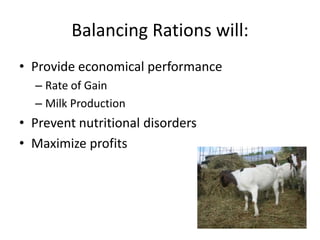
Ration – Feed fed to an
animal in one day

Balanced Ration
Feed required to meet the
animals nutritional
requirements in one day
Balancing Rations will:
• Provide economical performance
  – Rate of Gain
  – Milk Production
• Prevent nutritional disorders
• Maximize profits
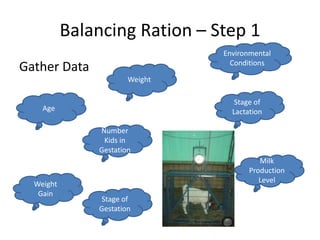
Balancing Ration – Step 1
                                Environmental
                                  Conditions
Gather Data
                       Weight

                                   Stage of
    Age                           Lactation

               Number
                Kids in
               Gestation
                                          Milk
                                       Production
                                          Level
  Weight
   Gain
                Stage of
               Gestation
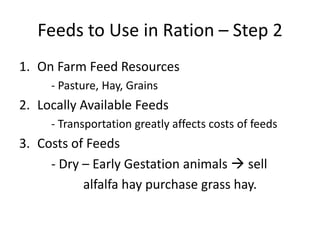
Feeds to Use in Ration – Step 2
1. On Farm Feed Resources
     - Pasture, Hay, Grains
2. Locally Available Feeds
     - Transportation greatly affects costs of feeds
3. Costs of Feeds
     - Dry – Early Gestation animals  sell
           alfalfa hay purchase grass hay.
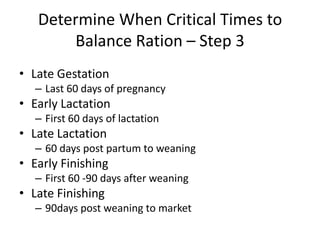
Determine When Critical Times to
        Balance Ration – Step 3
• Late Gestation
   – Last 60 days of pregnancy
• Early Lactation
   – First 60 days of lactation
• Late Lactation
   – 60 days post partum to weaning
• Early Finishing
   – First 60 -90 days after weaning
• Late Finishing
   – 90days post weaning to market
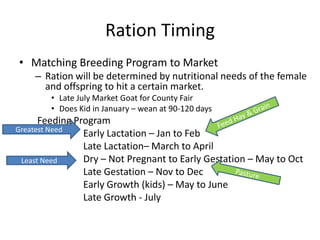
Ration Timing
• Matching Breeding Program to Market
    – Ration will be determined by nutritional needs of the female
      and offspring to hit a certain market.
        • Late July Market Goat for County Fair
        • Does Kid in January – wean at 90-120 days
      Feeding Program
Greatest Need
                Early Lactation – Jan to Feb
                Late Lactation– March to April
 Least Need     Dry – Not Pregnant to Early Gestation – May to Oct
                Late Gestation – Nov to Dec
                Early Growth (kids) – May to June
                Late Growth - July
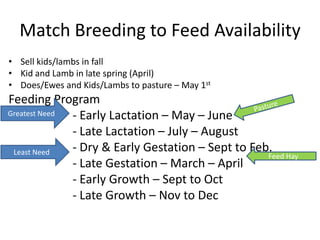
Match Breeding to Feed Availability
• Sell kids/lambs in fall
• Kid and Lamb in late spring (April)
• Does/Ewes and Kids/Lambs to pasture – May 1st
Feeding Program
Greatest Need - Early Lactation – May – June
              - Late Lactation – July – August
 Least Need   - Dry & Early Gestation – Sept to Feb.
                                                   Feed Hay
              - Late Gestation – March – April
              - Early Growth – Sept to Oct
              - Late Growth – Nov to Dec
Determine Animal Needs – Step 4
   2007 NRC Small Ruminants
 Montana State University
 http://www.msusheepration.montana.edu/default.
 aspx
 Alabama Cooperative Extension Montana State
 University
 http://www.aces.edu/pubs/docs/A/ANR-0812/ANR-
 812tab1.html
 Maryland Small Ruminant Page
 http://www.sheepandgoat.com/spreadsheets.html
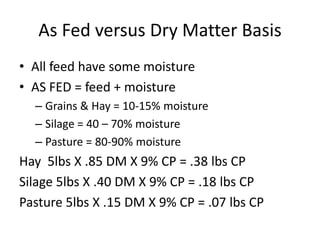
As Fed versus Dry Matter Basis
• All feed have some moisture
• AS FED = feed + moisture
  – Grains & Hay = 10-15% moisture
  – Silage = 40 – 70% moisture
  – Pasture = 80-90% moisture
Hay 5lbs X .85 DM X 9% CP = .38 lbs CP
Silage 5lbs X .40 DM X 9% CP = .18 lbs CP
Pasture 5lbs X .15 DM X 9% CP = .07 lbs CP
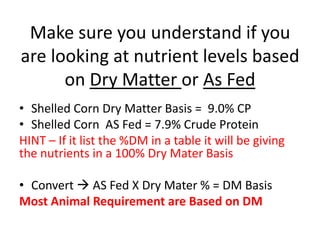
Make sure you understand if you
are looking at nutrient levels based
      on Dry Matter or As Fed
• Shelled Corn Dry Matter Basis = 9.0% CP
• Shelled Corn AS Fed = 7.9% Crude Protein
HINT – If it list the %DM in a table it will be giving
the nutrients in a 100% Dry Mater Basis

• Convert  AS Fed X Dry Mater % = DM Basis
Most Animal Requirement are Based on DM
Beginning to Balance Ration
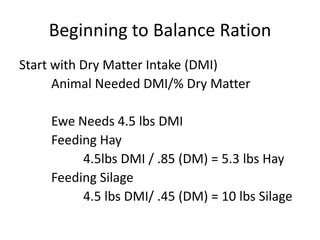
Start with Dry Matter Intake (DMI)
      Animal Needed DMI/% Dry Matter

    Ewe Needs 4.5 lbs DMI
    Feeding Hay
         4.5lbs DMI / .85 (DM) = 5.3 lbs Hay
    Feeding Silage
         4.5 lbs DMI/ .45 (DM) = 10 lbs Silage
Balancing for Protein
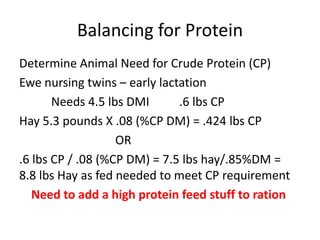
Determine Animal Need for Crude Protein (CP)
Ewe nursing twins – early lactation
       Needs 4.5 lbs DMI      .6 lbs CP
Hay 5.3 pounds X .08 (%CP DM) = .424 lbs CP
                   OR
.6 lbs CP / .08 (%CP DM) = 7.5 lbs hay/.85%DM =
8.8 lbs Hay as fed needed to meet CP requirement
   Need to add a high protein feed stuff to ration
Ration Balancing Sheep
Montana State University Sheep Ration
Balancing
http://www.msusheepration.montana.edu/
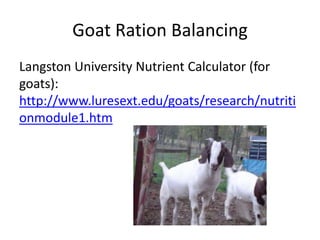
Goat Ration Balancing
Langston University Nutrient Calculator (for
goats):
http://www.luresext.edu/goats/research/nutriti
onmodule1.htm
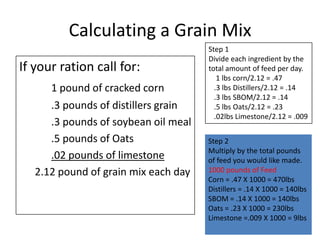
Calculating a Grain Mix
                                      Step 1
                                      Divide each ingredient by the
If your ration call for:              total amount of feed per day.
                                         1 lbs corn/2.12 = .47
      1 pound of cracked corn           .3 lbs Distillers/2.12 = .14
                                        .3 lbs SBOM/2.12 = .14
      .3 pounds of distillers grain     .5 lbs Oats/2.12 = .23
                                        .02lbs Limestone/2.12 = .009
      .3 pounds of soybean oil meal
      .5 pounds of Oats               Step 2
                                      Multiply by the total pounds
      .02 pounds of limestone         of feed you would like made.
   2.12 pound of grain mix each day   1000 pounds of Feed
                                      Corn = .47 X 1000 = 470lbs
                                      Distillers = .14 X 1000 = 140lbs
                                      SBOM = .14 X 1000 = 140lbs
                                      Oats = .23 X 1000 = 230lbs
                                      Limestone =.009 X 1000 = 9lbs
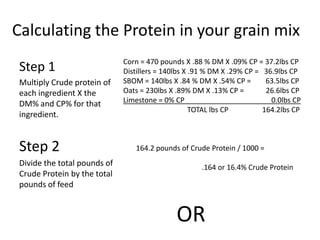
Calculating the Protein in your grain mix
                              Corn = 470 pounds X .88 % DM X .09% CP = 37.2lbs CP
 Step 1                       Distillers = 140lbs X .91 % DM X .29% CP = 36.9lbs CP
 Multiply Crude protein of    SBOM = 140lbs X .84 % DM X .54% CP =        63.5lbs CP
 each ingredient X the        Oats = 230lbs X .89% DM X .13% CP =         26.6lbs CP
 DM% and CP% for that         Limestone = 0% CP                            0.0lbs CP
                                                    TOTAL lbs CP         164.2lbs CP
 ingredient.


 Step 2                          164.2 pounds of Crude Protein / 1000 =
 Divide the total pounds of                          .164 or 16.4% Crude Protein
 Crude Protein by the total
 pounds of feed


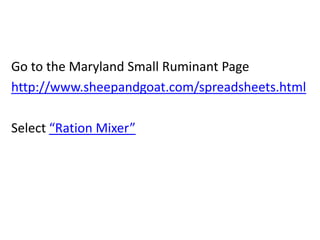
                                              OR
Go to the Maryland Small Ruminant Page
http://www.sheepandgoat.com/spreadsheets.html

Select “Ration Mixer”
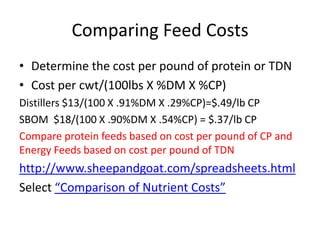
Comparing Feed Costs
• Determine the cost per pound of protein or TDN
• Cost per cwt/(100lbs X %DM X %CP)
Distillers $13/(100 X .91%DM X .29%CP)=$.49/lb CP
SBOM $18/(100 X .90%DM X .54%CP) = $.37/lb CP
Compare protein feeds based on cost per pound of CP and
Energy Feeds based on cost per pound of TDN
http://www.sheepandgoat.com/spreadsheets.html
Select “Comparison of Nutrient Costs”

Ration balancing

  • 1.
    Ration Balancing SmallRuminant Webinar Willie Lantz Extension Educator – Garrett County
  • 2.
    Ration – Feedfed to an animal in one day Balanced Ration Feed required to meet the animals nutritional requirements in one day
  • 3.
    Balancing Rations will: •Provide economical performance – Rate of Gain – Milk Production • Prevent nutritional disorders • Maximize profits
  • 4.
    Balancing Ration –Step 1 Environmental Conditions Gather Data Weight Stage of Age Lactation Number Kids in Gestation Milk Production Level Weight Gain Stage of Gestation
  • 5.
    Feeds to Usein Ration – Step 2 1. On Farm Feed Resources - Pasture, Hay, Grains 2. Locally Available Feeds - Transportation greatly affects costs of feeds 3. Costs of Feeds - Dry – Early Gestation animals  sell alfalfa hay purchase grass hay.
  • 6.
    Determine When CriticalTimes to Balance Ration – Step 3 • Late Gestation – Last 60 days of pregnancy • Early Lactation – First 60 days of lactation • Late Lactation – 60 days post partum to weaning • Early Finishing – First 60 -90 days after weaning • Late Finishing – 90days post weaning to market
  • 7.
    Ration Timing • MatchingBreeding Program to Market – Ration will be determined by nutritional needs of the female and offspring to hit a certain market. • Late July Market Goat for County Fair • Does Kid in January – wean at 90-120 days Feeding Program Greatest Need Early Lactation – Jan to Feb Late Lactation– March to April Least Need Dry – Not Pregnant to Early Gestation – May to Oct Late Gestation – Nov to Dec Early Growth (kids) – May to June Late Growth - July
  • 8.
    Match Breeding toFeed Availability • Sell kids/lambs in fall • Kid and Lamb in late spring (April) • Does/Ewes and Kids/Lambs to pasture – May 1st Feeding Program Greatest Need - Early Lactation – May – June - Late Lactation – July – August Least Need - Dry & Early Gestation – Sept to Feb. Feed Hay - Late Gestation – March – April - Early Growth – Sept to Oct - Late Growth – Nov to Dec
  • 9.
    Determine Animal Needs– Step 4 2007 NRC Small Ruminants Montana State University http://www.msusheepration.montana.edu/default. aspx Alabama Cooperative Extension Montana State University http://www.aces.edu/pubs/docs/A/ANR-0812/ANR- 812tab1.html Maryland Small Ruminant Page http://www.sheepandgoat.com/spreadsheets.html
  • 10.
    As Fed versusDry Matter Basis • All feed have some moisture • AS FED = feed + moisture – Grains & Hay = 10-15% moisture – Silage = 40 – 70% moisture – Pasture = 80-90% moisture Hay 5lbs X .85 DM X 9% CP = .38 lbs CP Silage 5lbs X .40 DM X 9% CP = .18 lbs CP Pasture 5lbs X .15 DM X 9% CP = .07 lbs CP
  • 11.
    Make sure youunderstand if you are looking at nutrient levels based on Dry Matter or As Fed • Shelled Corn Dry Matter Basis = 9.0% CP • Shelled Corn AS Fed = 7.9% Crude Protein HINT – If it list the %DM in a table it will be giving the nutrients in a 100% Dry Mater Basis • Convert  AS Fed X Dry Mater % = DM Basis Most Animal Requirement are Based on DM
  • 12.
    Beginning to BalanceRation Start with Dry Matter Intake (DMI) Animal Needed DMI/% Dry Matter Ewe Needs 4.5 lbs DMI Feeding Hay 4.5lbs DMI / .85 (DM) = 5.3 lbs Hay Feeding Silage 4.5 lbs DMI/ .45 (DM) = 10 lbs Silage
  • 13.
    Balancing for Protein DetermineAnimal Need for Crude Protein (CP) Ewe nursing twins – early lactation Needs 4.5 lbs DMI .6 lbs CP Hay 5.3 pounds X .08 (%CP DM) = .424 lbs CP OR .6 lbs CP / .08 (%CP DM) = 7.5 lbs hay/.85%DM = 8.8 lbs Hay as fed needed to meet CP requirement Need to add a high protein feed stuff to ration
  • 14.
    Ration Balancing Sheep MontanaState University Sheep Ration Balancing http://www.msusheepration.montana.edu/
  • 15.
    Goat Ration Balancing LangstonUniversity Nutrient Calculator (for goats): http://www.luresext.edu/goats/research/nutriti onmodule1.htm
  • 16.
    Calculating a GrainMix Step 1 Divide each ingredient by the If your ration call for: total amount of feed per day. 1 lbs corn/2.12 = .47 1 pound of cracked corn .3 lbs Distillers/2.12 = .14 .3 lbs SBOM/2.12 = .14 .3 pounds of distillers grain .5 lbs Oats/2.12 = .23 .02lbs Limestone/2.12 = .009 .3 pounds of soybean oil meal .5 pounds of Oats Step 2 Multiply by the total pounds .02 pounds of limestone of feed you would like made. 2.12 pound of grain mix each day 1000 pounds of Feed Corn = .47 X 1000 = 470lbs Distillers = .14 X 1000 = 140lbs SBOM = .14 X 1000 = 140lbs Oats = .23 X 1000 = 230lbs Limestone =.009 X 1000 = 9lbs
  • 17.
    Calculating the Proteinin your grain mix Corn = 470 pounds X .88 % DM X .09% CP = 37.2lbs CP Step 1 Distillers = 140lbs X .91 % DM X .29% CP = 36.9lbs CP Multiply Crude protein of SBOM = 140lbs X .84 % DM X .54% CP = 63.5lbs CP each ingredient X the Oats = 230lbs X .89% DM X .13% CP = 26.6lbs CP DM% and CP% for that Limestone = 0% CP 0.0lbs CP TOTAL lbs CP 164.2lbs CP ingredient. Step 2 164.2 pounds of Crude Protein / 1000 = Divide the total pounds of .164 or 16.4% Crude Protein Crude Protein by the total pounds of feed OR
  • 18.
    Go to theMaryland Small Ruminant Page http://www.sheepandgoat.com/spreadsheets.html Select “Ration Mixer”
  • 19.
    Comparing Feed Costs •Determine the cost per pound of protein or TDN • Cost per cwt/(100lbs X %DM X %CP) Distillers $13/(100 X .91%DM X .29%CP)=$.49/lb CP SBOM $18/(100 X .90%DM X .54%CP) = $.37/lb CP Compare protein feeds based on cost per pound of CP and Energy Feeds based on cost per pound of TDN http://www.sheepandgoat.com/spreadsheets.html Select “Comparison of Nutrient Costs”