SUSAN SCHOENIAN (Shāy-nē-ŭn)
Sheep & Goat Specialist
Western Maryland Research & Education Center
sschoen@umd.edu - www.sheepandgoat.com
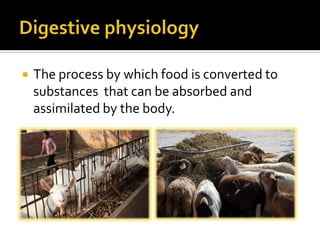
   The process by which food is converted to
    substances that can be absorbed and
    assimilated by the body.
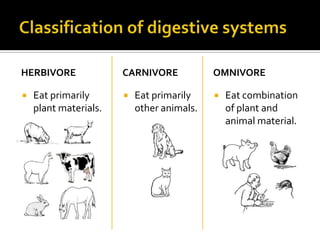
HERBIVORE              CARNIVORE            OMNIVORE

   Eat primarily         Eat primarily       Eat combination
    plant materials.       other animals.       of plant and
                                                animal material.
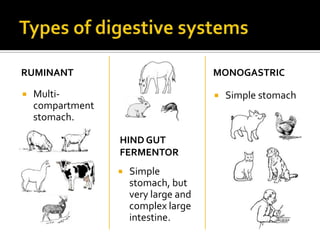
RUMINANT                               MONOGASTRIC

   Multi-                                Simple stomach
    compartment
    stomach.

                  HIND GUT
                  FERMENTOR
                     Simple
                      stomach, but
                      very large and
                      complex large
                      intestine.
Hind Gut
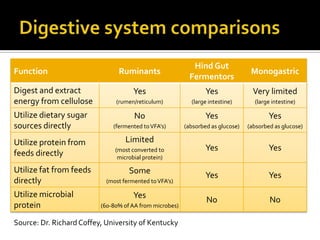
Function                        Ruminants                                         Monogastric
                                                           Fermentors
Digest and extract                    Yes                        Yes               Very limited
energy from cellulose          (rumen/reticulum)           (large intestine)       (large intestine)

Utilize dietary sugar                 No                         Yes                     Yes
sources directly              (fermented to VFA’s)       (absorbed as glucose)   (absorbed as glucose)

Utilize protein from               Limited
                               (most converted to                Yes                     Yes
feeds directly                  microbial protein)

Utilize fat from feeds              Some
                                                                 Yes                     Yes
directly                    (most fermented to VFA’s)

Utilize microbial                     Yes
                                                                 No                      No
protein                   (60-80% of AA from microbes)

Source: Dr. Richard Coffey, University of Kentucky
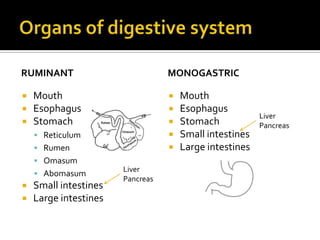
RUMINANT                          MONOGASTRIC

   Mouth                            Mouth
   Esophagus                        Esophagus
                                                         Liver
   Stomach                          Stomach            Pancreas
     Reticulum                      Small intestines
     Rumen                          Large intestines
     Omasum
                       Liver
     Abomasum
                       Pancreas
   Small intestines
   Large intestines
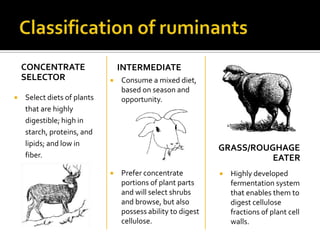
CONCENTRATE                  INTERMEDIATE
    SELECTOR                    Consume a mixed diet,
                                 based on season and
   Select diets of plants       opportunity.
    that are highly
    digestible; high in
    starch, proteins, and
    lipids; and low in
                                                             GRASS/ROUGHAGE
    fiber.                                                             EATER
                                Prefer concentrate             Highly developed
                                 portions of plant parts         fermentation system
                                 and will select shrubs          that enables them to
                                 and browse, but also            digest cellulose
                                 possess ability to digest       fractions of plant cell
                                 cellulose.                      walls.
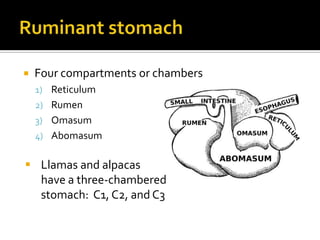
   Four compartments or chambers
    1) Reticulum
    2) Rumen
    3) Omasum
    4) Abomasum


 Llamas and alpacas
  have a three-chambered
  stomach: C1, C2, and C3
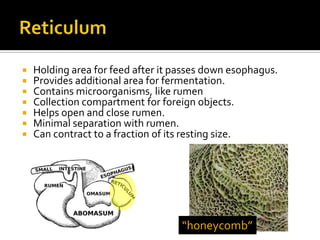
   Holding area for feed after it passes down esophagus.
   Provides additional area for fermentation.
   Contains microorganisms, like rumen
   Collection compartment for foreign objects.
   Helps open and close rumen.
   Minimal separation with rumen.
   Can contract to a fraction of its resting size.


                                    “honeycomb”
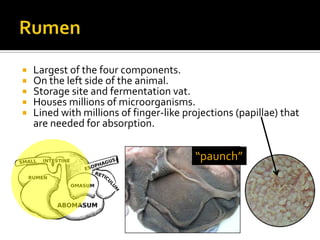
   Largest of the four components.
   On the left side of the animal.
   Storage site and fermentation vat.
   Houses millions of microorganisms.
   Lined with millions of finger-like projections (papillae) that
    are needed for absorption.

                                         “paunch”
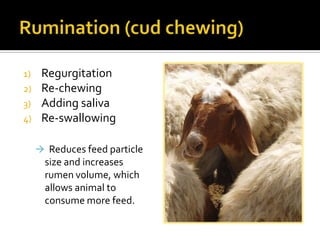
1)    Regurgitation
2)    Re-chewing
3)    Adding saliva
4)    Re-swallowing

      Reduces feed particle
       size and increases
       rumen volume, which
       allows animal to
       consume more feed.
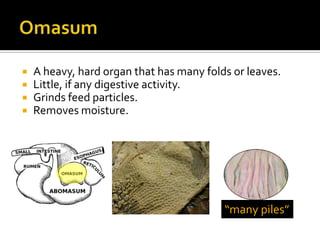
   A heavy, hard organ that has many folds or leaves.
   Little, if any digestive activity.
   Grinds feed particles.
   Removes moisture.


                                          “many piles”
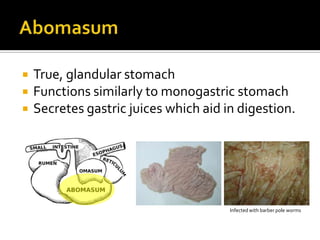
   True, glandular stomach
   Functions similarly to monogastric stomach
   Secretes gastric juices which aid in digestion.


                                       Infected with barber pole worms
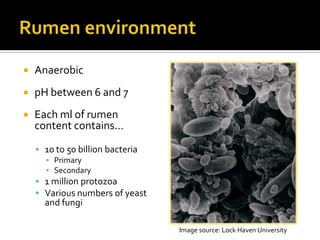
   Anaerobic
   pH between 6 and 7
   Each ml of rumen
    content contains…

     10 to 50 billion bacteria
      ▪ Primary
      ▪ Secondary
     1 million protozoa
     Various numbers of yeast
      and fungi

                                  Image source: Lock Haven University
   Microbial populations
    vary with diet.

       Digest cellulose
       Digest hemicellulose
       Digest starch
       Digest proteins
       Sugar utilizing
       Acid utilizing
       Ammonia producer
       Vitamin synthesizer
       Methane producer
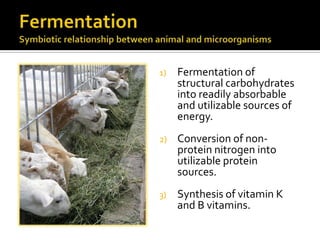
1)   Fermentation of
     structural carbohydrates
     into readily absorbable
     and utilizable sources of
     energy.
2)   Conversion of non-
     protein nitrogen into
     utilizable protein
     sources.
3)   Synthesis of vitamin K
     and B vitamins.
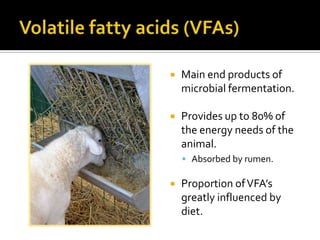
   Main end products of
    microbial fermentation.

   Provides up to 80% of
    the energy needs of the
    animal.
     Absorbed by rumen.

   Proportion of VFA’s
    greatly influenced by
    diet.
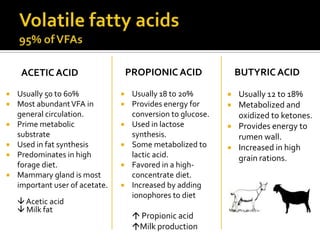
ACETIC ACID                     PROPIONIC ACID                BUTYRIC ACID

   Usually 50 to 60%                Usually 18 to 20%           Usually 12 to 18%
   Most abundant VFA in             Provides energy for         Metabolized and
    general circulation.              conversion to glucose.       oxidized to ketones.
   Prime metabolic                  Used in lactose             Provides energy to
    substrate                         synthesis.                   rumen wall.
   Used in fat synthesis            Some metabolized to         Increased in high
   Predominates in high              lactic acid.                 grain rations.
    forage diet.                     Favored in a high-
   Mammary gland is most             concentrate diet.
    important user of acetate.       Increased by adding
                                      ionophores to diet
     Acetic acid
     Milk fat
                                       Propionic acid
                                      Milk production
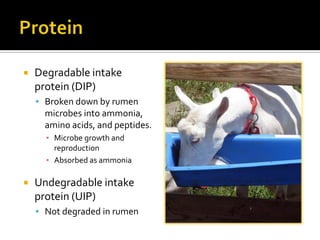
   Degradable intake
    protein (DIP)
     Broken down by rumen
      microbes into ammonia,
      amino acids, and peptides.
      ▪ Microbe growth and
        reproduction
      ▪ Absorbed as ammonia

   Undegradable intake
    protein (UIP)
     Not degraded in rumen
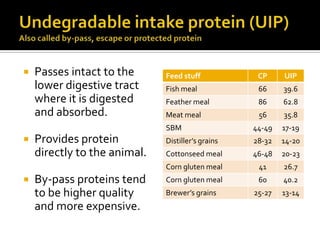
   Passes intact to the      Feed stuff            CP     UIP
    lower digestive tract     Fish meal             66     39.6
    where it is digested      Feather meal          86     62.8
    and absorbed.             Meat meal             56     35.8
                              SBM                  44-49   17-19
   Provides protein          Distiller’s grains   28-32   14-20
    directly to the animal.   Cottonseed meal      46-48   20-23
                              Corn gluten meal      41     26.7
   By-pass proteins tend     Corn gluten meal      60     40.2
    to be higher quality      Brewer’s grains      25-27   13-14
    and more expensive.
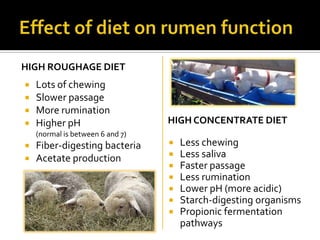
HIGH ROUGHAGE DIET
   Lots of chewing
   Slower passage
   More rumination
   Higher pH                     HIGH CONCENTRATE DIET
    (normal is between 6 and 7)
   Fiber-digesting bacteria         Less chewing
   Acetate production               Less saliva
                                     Faster passage
                                     Less rumination
                                     Lower pH (more acidic)
                                     Starch-digesting organisms
                                     Propionic fermentation
                                      pathways
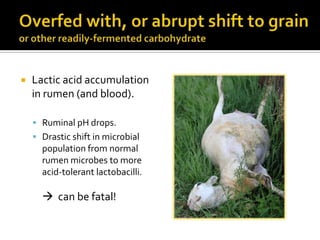
   Lactic acid accumulation
    in rumen (and blood).

     Ruminal pH drops.
     Drastic shift in microbial
      population from normal
      rumen microbes to more
      acid-tolerant lactobacilli.

       can be fatal!
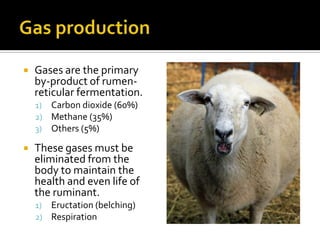
   Gases are the primary
    by-product of rumen-
    reticular fermentation.
    1)   Carbon dioxide (60%)
    2)   Methane (35%)
    3)   Others (5%)

   These gases must be
    eliminated from the
    body to maintain the
    health and even life of
    the ruminant.
    1)   Eructation (belching)
    2)   Respiration
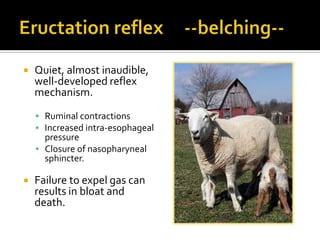
   Quiet, almost inaudible,
    well-developed reflex
    mechanism.

     Ruminal contractions
     Increased intra-esophageal
      pressure
     Closure of nasopharyneal
      sphincter.

   Failure to expel gas can
    results in bloat and
    death.
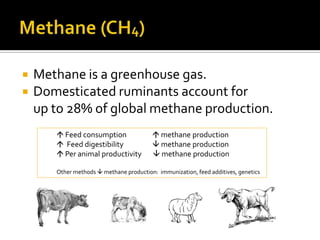
   Methane is a greenhouse gas.
   Domesticated ruminants account for
    up to 28% of global methane production.
        Feed consumption                 methane production
        Feed digestibility               methane production
        Per animal productivity          methane production

       Other methods  methane production: immunization, feed additives, genetics
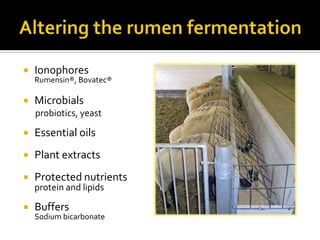
   Ionophores
    Rumensin®, Bovatec®

   Microbials
    probiotics, yeast

   Essential oils
   Plant extracts
   Protected nutrients
    protein and lipids

   Buffers
    Sodium bicarbonate
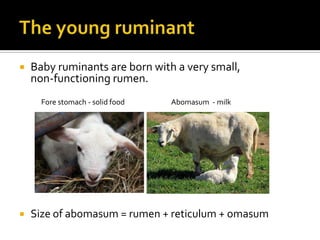
   Baby ruminants are born with a very small,
    non-functioning rumen.
      Fore stomach - solid food   Abomasum - milk


   Size of abomasum = rumen + reticulum + omasum
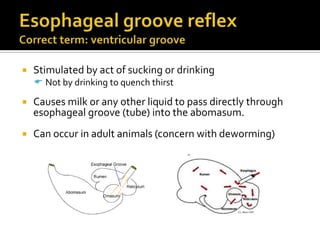
   Stimulated by act of sucking or drinking
     Not by drinking to quench thirst

   Causes milk or any other liquid to pass directly through
    esophageal groove (tube) into the abomasum.
   Can occur in adult animals (concern with deworming)
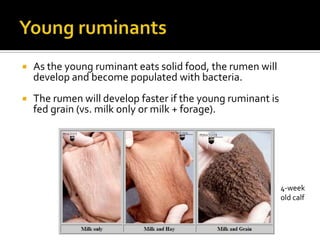
   As the young ruminant eats solid food, the rumen will
    develop and become populated with bacteria.
   The rumen will develop faster if the young ruminant is
    fed grain (vs. milk only or milk + forage).


                                                             4-week
                                                             old calf
Next webinar – Thursday, 1/19, 7:30 p.m. EST
                       Topic: Nutrients and nutrient requirements


  Thank you for your
     attention.

   Any questions?


   Susan Schoenian
  sschoen@umd.edu
www.sheepandgoat.com

Digestive physiology

  • 1.
    SUSAN SCHOENIAN (Shāy-nē-ŭn) Sheep& Goat Specialist Western Maryland Research & Education Center sschoen@umd.edu - www.sheepandgoat.com
  • 2.
    The process by which food is converted to substances that can be absorbed and assimilated by the body.
  • 3.
    HERBIVORE CARNIVORE OMNIVORE  Eat primarily  Eat primarily  Eat combination plant materials. other animals. of plant and animal material.
  • 4.
    RUMINANT MONOGASTRIC  Multi-  Simple stomach compartment stomach. HIND GUT FERMENTOR  Simple stomach, but very large and complex large intestine.
  • 5.
    Hind Gut Function Ruminants Monogastric Fermentors Digest and extract Yes Yes Very limited energy from cellulose (rumen/reticulum) (large intestine) (large intestine) Utilize dietary sugar No Yes Yes sources directly (fermented to VFA’s) (absorbed as glucose) (absorbed as glucose) Utilize protein from Limited (most converted to Yes Yes feeds directly microbial protein) Utilize fat from feeds Some Yes Yes directly (most fermented to VFA’s) Utilize microbial Yes No No protein (60-80% of AA from microbes) Source: Dr. Richard Coffey, University of Kentucky
  • 6.
    RUMINANT MONOGASTRIC  Mouth  Mouth  Esophagus  Esophagus Liver  Stomach  Stomach Pancreas  Reticulum  Small intestines  Rumen  Large intestines  Omasum Liver  Abomasum Pancreas  Small intestines  Large intestines
  • 7.
    CONCENTRATE INTERMEDIATE SELECTOR  Consume a mixed diet, based on season and  Select diets of plants opportunity. that are highly digestible; high in starch, proteins, and lipids; and low in GRASS/ROUGHAGE fiber. EATER  Prefer concentrate  Highly developed portions of plant parts fermentation system and will select shrubs that enables them to and browse, but also digest cellulose possess ability to digest fractions of plant cell cellulose. walls.
  • 8.
    Four compartments or chambers 1) Reticulum 2) Rumen 3) Omasum 4) Abomasum  Llamas and alpacas have a three-chambered stomach: C1, C2, and C3
  • 9.
    Holding area for feed after it passes down esophagus.  Provides additional area for fermentation.  Contains microorganisms, like rumen  Collection compartment for foreign objects.  Helps open and close rumen.  Minimal separation with rumen.  Can contract to a fraction of its resting size. “honeycomb”
  • 10.
    Largest of the four components.  On the left side of the animal.  Storage site and fermentation vat.  Houses millions of microorganisms.  Lined with millions of finger-like projections (papillae) that are needed for absorption. “paunch”
  • 11.
    1) Regurgitation 2) Re-chewing 3) Adding saliva 4) Re-swallowing  Reduces feed particle size and increases rumen volume, which allows animal to consume more feed.
  • 12.
    A heavy, hard organ that has many folds or leaves.  Little, if any digestive activity.  Grinds feed particles.  Removes moisture. “many piles”
  • 13.
    True, glandular stomach  Functions similarly to monogastric stomach  Secretes gastric juices which aid in digestion. Infected with barber pole worms
  • 14.
    Anaerobic  pH between 6 and 7  Each ml of rumen content contains…  10 to 50 billion bacteria ▪ Primary ▪ Secondary  1 million protozoa  Various numbers of yeast and fungi Image source: Lock Haven University
  • 15.
    Microbial populations vary with diet.  Digest cellulose  Digest hemicellulose  Digest starch  Digest proteins  Sugar utilizing  Acid utilizing  Ammonia producer  Vitamin synthesizer  Methane producer
  • 16.
    1) Fermentation of structural carbohydrates into readily absorbable and utilizable sources of energy. 2) Conversion of non- protein nitrogen into utilizable protein sources. 3) Synthesis of vitamin K and B vitamins.
  • 17.
    Main end products of microbial fermentation.  Provides up to 80% of the energy needs of the animal.  Absorbed by rumen.  Proportion of VFA’s greatly influenced by diet.
  • 18.
    ACETIC ACID PROPIONIC ACID BUTYRIC ACID  Usually 50 to 60%  Usually 18 to 20%  Usually 12 to 18%  Most abundant VFA in  Provides energy for  Metabolized and general circulation. conversion to glucose. oxidized to ketones.  Prime metabolic  Used in lactose  Provides energy to substrate synthesis. rumen wall.  Used in fat synthesis  Some metabolized to  Increased in high  Predominates in high lactic acid. grain rations. forage diet.  Favored in a high-  Mammary gland is most concentrate diet. important user of acetate.  Increased by adding ionophores to diet  Acetic acid  Milk fat  Propionic acid Milk production
  • 19.
    Degradable intake protein (DIP)  Broken down by rumen microbes into ammonia, amino acids, and peptides. ▪ Microbe growth and reproduction ▪ Absorbed as ammonia  Undegradable intake protein (UIP)  Not degraded in rumen
  • 20.
    Passes intact to the Feed stuff CP UIP lower digestive tract Fish meal 66 39.6 where it is digested Feather meal 86 62.8 and absorbed. Meat meal 56 35.8 SBM 44-49 17-19  Provides protein Distiller’s grains 28-32 14-20 directly to the animal. Cottonseed meal 46-48 20-23 Corn gluten meal 41 26.7  By-pass proteins tend Corn gluten meal 60 40.2 to be higher quality Brewer’s grains 25-27 13-14 and more expensive.
  • 21.
    HIGH ROUGHAGE DIET  Lots of chewing  Slower passage  More rumination  Higher pH HIGH CONCENTRATE DIET (normal is between 6 and 7)  Fiber-digesting bacteria  Less chewing  Acetate production  Less saliva  Faster passage  Less rumination  Lower pH (more acidic)  Starch-digesting organisms  Propionic fermentation pathways
  • 22.
    Lactic acid accumulation in rumen (and blood).  Ruminal pH drops.  Drastic shift in microbial population from normal rumen microbes to more acid-tolerant lactobacilli.  can be fatal!
  • 23.
    Gases are the primary by-product of rumen- reticular fermentation. 1) Carbon dioxide (60%) 2) Methane (35%) 3) Others (5%)  These gases must be eliminated from the body to maintain the health and even life of the ruminant. 1) Eructation (belching) 2) Respiration
  • 24.
    Quiet, almost inaudible, well-developed reflex mechanism.  Ruminal contractions  Increased intra-esophageal pressure  Closure of nasopharyneal sphincter.  Failure to expel gas can results in bloat and death.
  • 25.
    Methane is a greenhouse gas.  Domesticated ruminants account for up to 28% of global methane production.  Feed consumption  methane production  Feed digestibility  methane production  Per animal productivity  methane production Other methods  methane production: immunization, feed additives, genetics
  • 26.
    Ionophores Rumensin®, Bovatec®  Microbials probiotics, yeast  Essential oils  Plant extracts  Protected nutrients protein and lipids  Buffers Sodium bicarbonate
  • 27.
    Baby ruminants are born with a very small, non-functioning rumen. Fore stomach - solid food Abomasum - milk  Size of abomasum = rumen + reticulum + omasum
  • 28.
    Stimulated by act of sucking or drinking  Not by drinking to quench thirst  Causes milk or any other liquid to pass directly through esophageal groove (tube) into the abomasum.  Can occur in adult animals (concern with deworming)
  • 29.
    As the young ruminant eats solid food, the rumen will develop and become populated with bacteria.  The rumen will develop faster if the young ruminant is fed grain (vs. milk only or milk + forage). 4-week old calf
  • 30.
    Next webinar –Thursday, 1/19, 7:30 p.m. EST Topic: Nutrients and nutrient requirements Thank you for your attention. Any questions? Susan Schoenian sschoen@umd.edu www.sheepandgoat.com