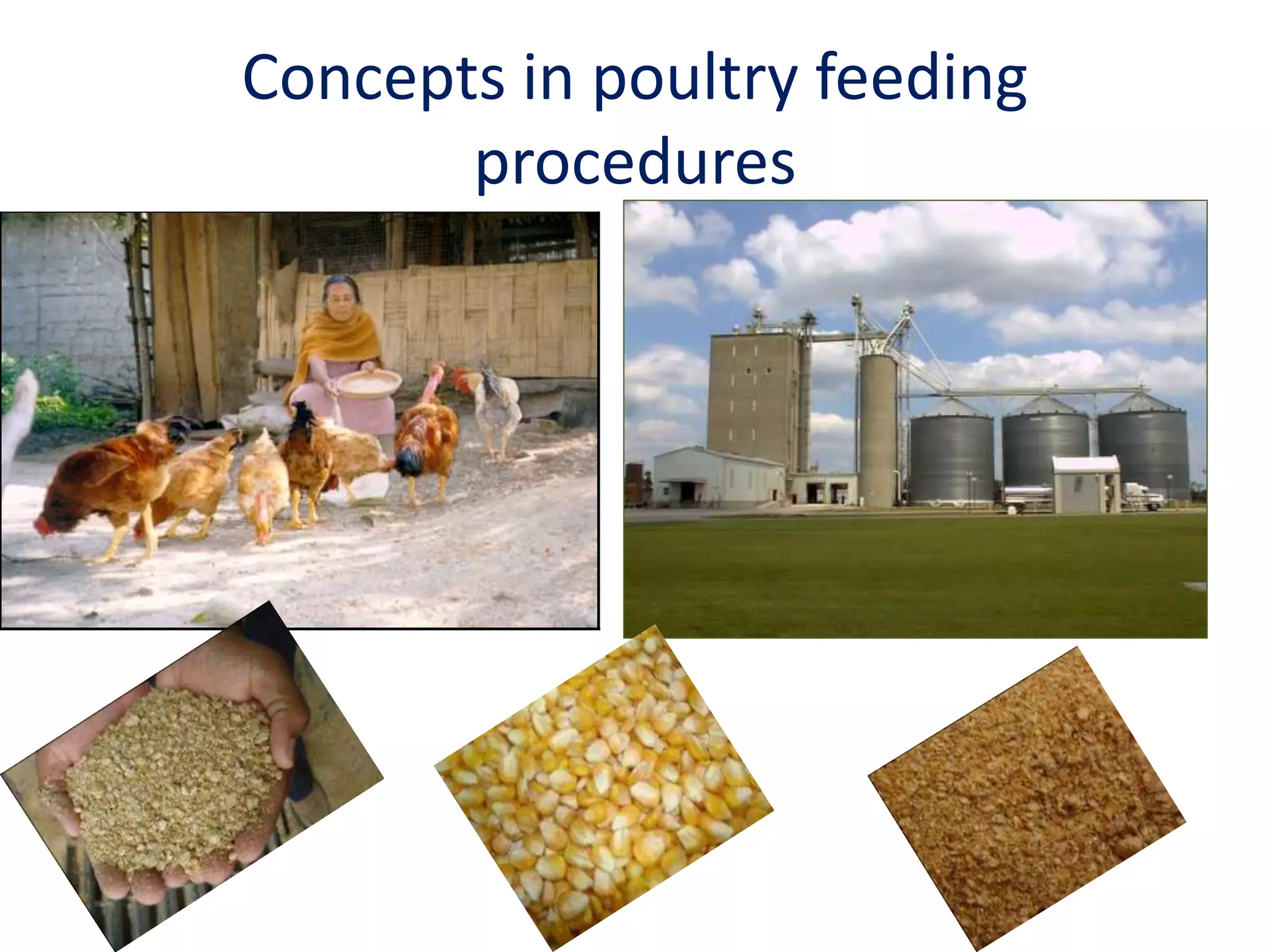
Concepts in poultry feeding
procedures
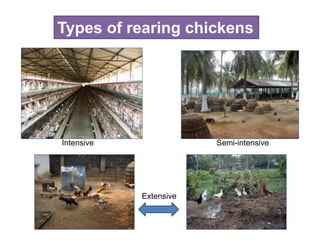
Types of rearing chickens
Intensive Semi-intensive
Extensive
Feeding management
Objective
• The objective of a defined feeding
management program is to supply a range of
balanced diets that satisfy the nutrient
requirements at all stages of development &
that optimize efficiency and profitability
without compromising bird welfare or the
environment.
In Nutrition,
• the Three Most Expensive Nutrients are:
• 1.Energy
• 2.Amino Acids (protein)
• 3.Available Phosphorus
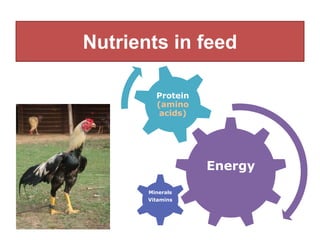
Nutrients in feed
Energy
Minerals
Vitamins
Protein
(amino
acids)
Energy
• Expressed as calorie (cal) or joule.
• One kilocalorie (kcal) = 4.184 kilojoules
(kj)
• kj = 0.239 kcal
• Requirements are expressed in terms of
Metabolizable Energy
Protein
Plays imp. Role in
• Body structural functions
• Transportation of nutrients and oxygen
• Catalyst in chemical reactions (enzymes)
• Immuno-competence (antibodies)
• Chemical regulation (hormones)
• Blood clotting, vision
• Growth and production
• Regulating acid-base balance
Amino acids
•Amino acids are the building blocks
•22 amino acids are in nature and build
all plants and animals
•Plants synthesize all the AA
•Animals synthesize only 12, remaining
10 need to be provided in diet and are
essential
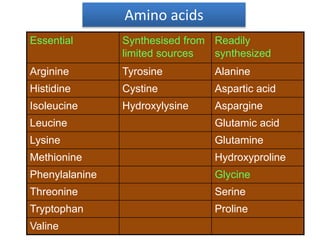
Amino acids
Essential Synthesised from
limited sources
Readily
synthesized
Arginine Tyrosine Alanine
Histidine Cystine Aspartic acid
Isoleucine Hydroxylysine Aspargine
Leucine Glutamic acid
Lysine Glutamine
Methionine Hydroxyproline
Phenylalanine Glycine
Threonine Serine
Tryptophan Proline
Valine
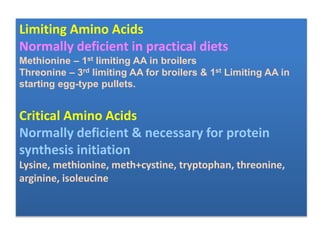
Limiting Amino Acids
Normally deficient in practical diets
Methionine – 1st limiting AA in broilers
Threonine – 3rd limiting AA for broilers & 1st Limiting AA in
starting egg-type pullets.
Critical Amino Acids
Normally deficient & necessary for protein
synthesis initiation
Lysine, methionine, meth+cystine, tryptophan, threonine,
arginine, isoleucine
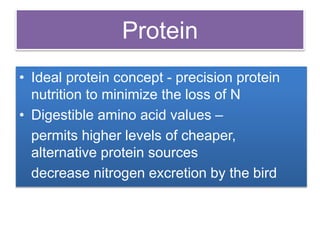
Protein
• Ideal protein concept - precision protein
nutrition to minimize the loss of N
• Digestible amino acid values –
permits higher levels of cheaper,
alternative protein sources
decrease nitrogen excretion by the bird
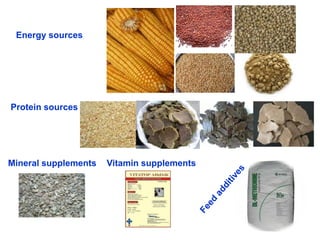
Energy sources
Protein sources
Mineral supplements Vitamin supplements
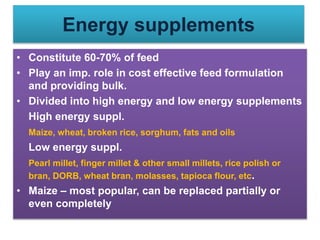
Energy supplements
• Constitute 60-70% of feed
• Play an imp. role in cost effective feed formulation
and providing bulk.
• Divided into high energy and low energy supplements
High energy suppl.
Maize, wheat, broken rice, sorghum, fats and oils
Low energy suppl.
Pearl millet, finger millet & other small millets, rice polish or
bran, DORB, wheat bran, molasses, tapioca flour, etc.
• Maize – most popular, can be replaced partially or
even completely
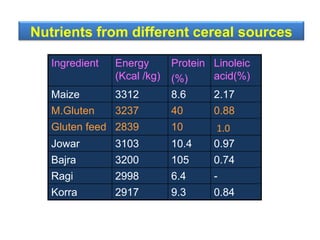
Nutrients from different cereal sources
Ingredient Energy
(Kcal /kg)
Protein
(%)
Linoleic
acid(%)
Maize 3312 8.6 2.17
M.Gluten 3237 40 0.88
Gluten feed 2839 10
Jowar 3103 10.4 0.97
Bajra 3200 105 0.74
Ragi 2998 6.4 -
Korra 2917 9.3 0.84
1.0
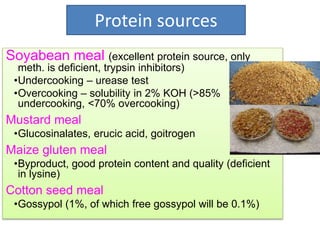
Soyabean meal (excellent protein source, only
meth. is deficient, trypsin inhibitors)
•Undercooking – urease test
•Overcooking – solubility in 2% KOH (>85%
undercooking, <70% overcooking)
Mustard meal
•Glucosinalates, erucic acid, goitrogen
Maize gluten meal
•Byproduct, good protein content and quality (deficient
in lysine)
Cotton seed meal
•Gossypol (1%, of which free gossypol will be 0.1%)
Protein sources
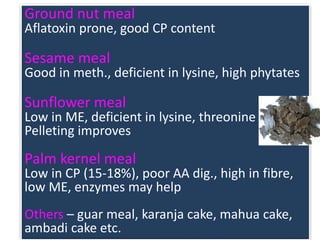
Ground nut meal
Aflatoxin prone, good CP content
Sesame meal
Good in meth., deficient in lysine, high phytates
Sunflower meal
Low in ME, deficient in lysine, threonine
Pelleting improves
Palm kernel meal
Low in CP (15-18%), poor AA dig., high in fibre,
low ME, enzymes may help
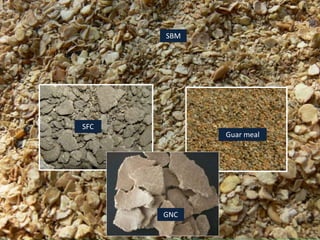
Others – guar meal, karanja cake, mahua cake,
ambadi cake etc.
SFC
Guar meal
GNC
SBM
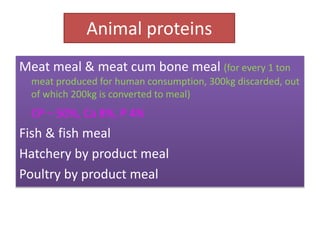
Animal proteins
Meat meal & meat cum bone meal (for every 1 ton
meat produced for human consumption, 300kg discarded, out
of which 200kg is converted to meal)
CP – 50%, Ca 8%, P 4%
Fish & fish meal
Hatchery by product meal
Poultry by product meal
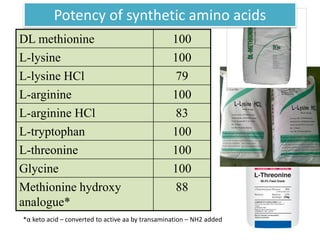
DL methionine 100
L-lysine 100
L-lysine HCl 79
L-arginine 100
L-arginine HCl 83
L-tryptophan 100
L-threonine 100
Glycine 100
Methionine hydroxy
analogue*
88
*α keto acid – converted to active aa by transamination – NH2 added
Potency of synthetic amino acids
Minerals
• Supplemented as ready-made mineral mixture or through
specific mineral supplements
• Mineral mixture is available commercially or can be
compounded
• Specific mineral supplements are also added.
• Calcium carbonate/oyster shell/stone grit/marble chips are
used as sources of Ca
• DCP or MCP - source of Ca and Av.P
• Common salt - source of sodium and chlorine
• Trace minerals (Cu, Zn, Fe, Mn, Se, I and sometimes Cr) -
trace mineral premix
• Organic trace minerals
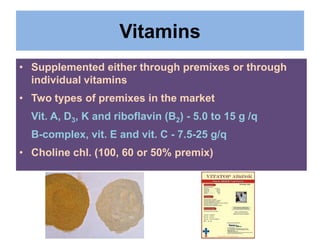
Vitamins
• Supplemented either through premixes or through
individual vitamins
• Two types of premixes in the market
Vit. A, D3, K and riboflavin (B2) - 5.0 to 15 g /q
B-complex, vit. E and vit. C - 7.5-25 g/q
• Choline chl. (100, 60 or 50% premix)
Feed Additives
Aimed at preventing/minimizing the
infectious agents’ loads, preventing
mycotoxins, augmenting nutrient
digestibility etc.
• Antibiotic compounds
• Probiotics (live bacterial and yeast strains)
• Prebiotics (galacto-oligo-saccharides, fructo-oligo-
saccharides, mannan-oligo-saccharides, lactose
derivatives etc.)
Feed Enzymes
• Improve nutrient utilization
• Non-starch polysaccharidases (cellulases,
pectinases, hemicellulases, arabinoxylanases and beta
glucanases) release nutrients trapped in high
fibrous diets
• Protease, amylase
• Microbial phytase - increases availability of
phytate-bound P, Ca, Zn, Cu, CP and amino
acids.
• Coccidiostat
• Toxin binders or adsorbents
activated charcoal, bentonites, zeolites,
diatomaceous earth, glucomannan, live yeast,
etc.
• Antioxidants, liver tonics,
immunostimulants etc.
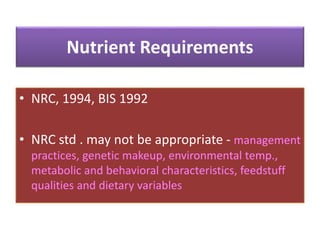
Nutrient Requirements
• NRC, 1994, BIS 1992
• NRC std . may not be appropriate - management
practices, genetic makeup, environmental temp.,
metabolic and behavioral characteristics, feedstuff
qualities and dietary variables
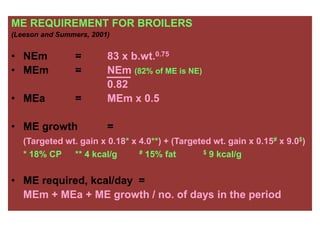
ME REQUIREMENT FOR BROILERS
(Leeson and Summers, 2001)
• NEm = 83 x b.wt.0.75
• MEm = NEm (82% of ME is NE)
0.82
• MEa = MEm x 0.5
• ME growth =
(Targeted wt. gain x 0.18* x 4.0**) + (Targeted wt. gain x 0.15# x 9.0$)
* 18% CP ** 4 kcal/g # 15% fat $ 9 kcal/g
• ME required, kcal/day =
MEm + MEa + ME growth / no. of days in the period
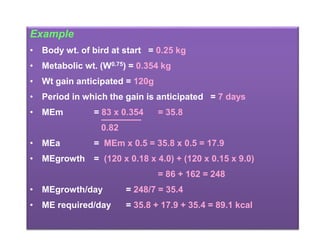
Example
• Body wt. of bird at start = 0.25 kg
• Metabolic wt. (W0.75) = 0.354 kg
• Wt gain anticipated = 120g
• Period in which the gain is anticipated = 7 days
• MEm = 83 x 0.354 = 35.8
0.82
• MEa = MEm x 0.5 = 35.8 x 0.5 = 17.9
• MEgrowth = (120 x 0.18 x 4.0) + (120 x 0.15 x 9.0)
= 86 + 162 = 248
• MEgrowth/day = 248/7 = 35.4
• ME required/day = 35.8 + 17.9 + 35.4 = 89.1 kcal
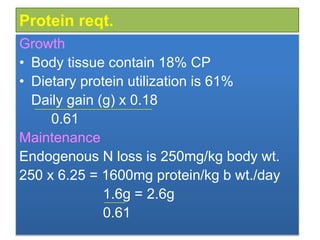
Protein reqt.
Growth
• Body tissue contain 18% CP
• Dietary protein utilization is 61%
Daily gain (g) x 0.18
0.61
Maintenance
Endogenous N loss is 250mg/kg body wt.
250 x 6.25 = 1600mg protein/kg b wt./day
1.6g = 2.6g
0.61
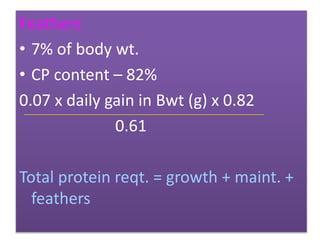
Feathers
• 7% of body wt.
• CP content – 82%
0.07 x daily gain in Bwt (g) x 0.82
0.61
Total protein reqt. = growth + maint. +
feathers
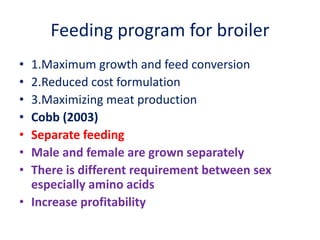
Feeding program for broiler
• 1.Maximum growth and feed conversion
• 2.Reduced cost formulation
• 3.Maximizing meat production
• Cobb (2003)
• Separate feeding
• Male and female are grown separately
• There is different requirement between sex
especially amino acids
• Increase profitability
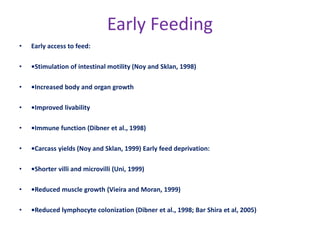
Early Feeding
• Early access to feed:
• •Stimulation of intestinal motility (Noy and Sklan, 1998)
• •Increased body and organ growth
• •Improved livability
• •Immune function (Dibner et al., 1998)
• •Carcass yields (Noy and Sklan, 1999) Early feed deprivation:
• •Shorter villi and microvilli (Uni, 1999)
• •Reduced muscle growth (Vieira and Moran, 1999)
• •Reduced lymphocyte colonization (Dibner et al., 1998; Bar Shira et al, 2005)
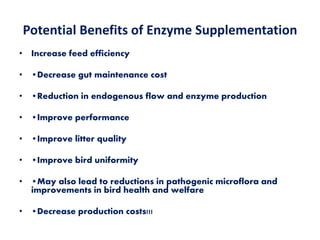
Potential Benefits of Enzyme Supplementation
• Increase feed efficiency
• •Decrease gut maintenance cost
• •Reduction in endogenous flow and enzyme production
• •Improve performance
• •Improve litter quality
• •Improve bird uniformity
• •May also lead to reductions in pathogenic microflora and
improvements in bird health and welfare
• •Decrease production costs!!!
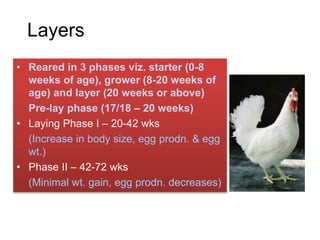
Layers
• Reared in 3 phases viz. starter (0-8
weeks of age), grower (8-20 weeks of
age) and layer (20 weeks or above)
Pre-lay phase (17/18 – 20 weeks)
• Laying Phase I – 20-42 wks
(Increase in body size, egg prodn. & egg
wt.)
• Phase II – 42-72 wks
(Minimal wt. gain, egg prodn. decreases)
• A laying hen showing 90% egg prodn.
requires 16-18 g of protein and 285 to
290 kcal ME per day.
• Meeting Ca requirement is imp. – Ca is
increased to about 2% of diet at onset of
prodn.
• WL hens producing 90% eggs require
daily about 3.8 to 4.2 g of calcium.
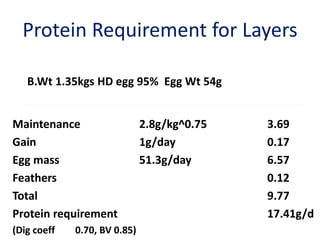
Protein Requirement for Layers
Maintenance 2.8g/kg^0.75 3.69
Gain 1g/day 0.17
Egg mass 51.3g/day 6.57
Feathers 0.12
Total 9.77
Protein requirement 17.41g/d
(Dig coeff 0.70, BV 0.85)
B.Wt 1.35kgs HD egg 95% Egg Wt 54g
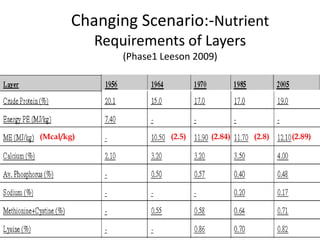
Changing Scenario:-Nutrient
Requirements of Layers
(Phase1 Leeson 2009)
(2.5)(Mcal/kg) (2.84) (2.8) (2.89)
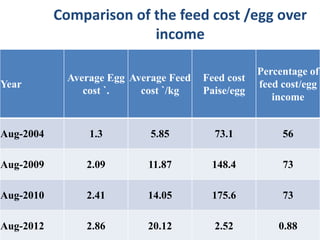
Comparison of the feed cost /egg over
income
Year
Average Egg
cost `.
Average Feed
cost `/kg
Feed cost
Paise/egg
Percentage of
feed cost/egg
income
Aug-2004 1.3 5.85 73.1 56
Aug-2009 2.09 11.87 148.4 73
Aug-2010 2.41 14.05 175.6 73
Aug-2012 2.86 20.12 2.52 0.88
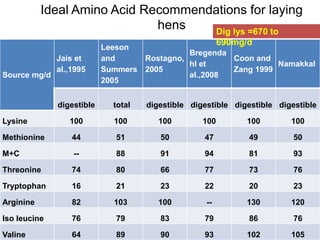
Ideal Amino Acid Recommendations for laying
hens
Source mg/d
Jais et
al.,1995
Leeson
and
Summers
2005
Rostagno,
2005
Bregenda
hl et
al.,2008
Coon and
Zang 1999
Namakkal
digestible total digestible digestible digestible digestible
Lysine 100 100 100 100 100 100
Methionine 44 51 50 47 49 50
M+C -- 88 91 94 81 93
Threonine 74 80 66 77 73 76
Tryptophan 16 21 23 22 20 23
Arginine 82 103 100 -- 130 120
Iso leucine 76 79 83 79 86 76
Valine 64 89 90 93 102 105
Dig lys =670 to
690mg/d
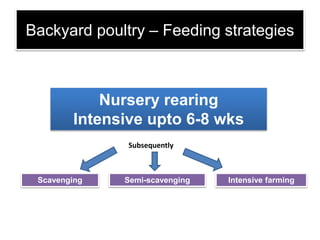
Backyard poultry – Feeding strategies
Scavenging
Nursery rearing
Intensive upto 6-8 wks
Subsequently
Semi-scavenging Intensive farming
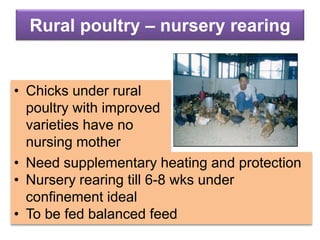
Rural poultry – nursery rearing
• Chicks under rural
poultry with improved
varieties have no
nursing mother
• Need supplementary heating and protection
• Nursery rearing till 6-8 wks under
confinement ideal
• To be fed balanced feed
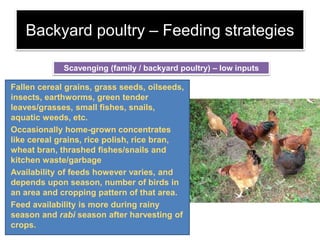
Backyard poultry – Feeding strategies
Fallen cereal grains, grass seeds, oilseeds,
insects, earthworms, green tender
leaves/grasses, small fishes, snails,
aquatic weeds, etc.
Occasionally home-grown concentrates
like cereal grains, rice polish, rice bran,
wheat bran, thrashed fishes/snails and
kitchen waste/garbage
Availability of feeds however varies, and
depends upon season, number of birds in
an area and cropping pattern of that area.
Feed availability is more during rainy
season and rabi season after harvesting of
crops.
Scavenging (family / backyard poultry) – low inputs
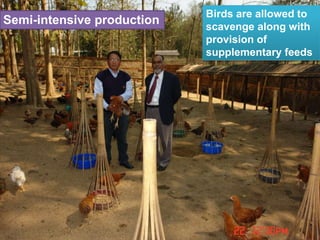
Birds are allowed to
scavenge along with
provision of
supplementary feeds
Semi-intensive production
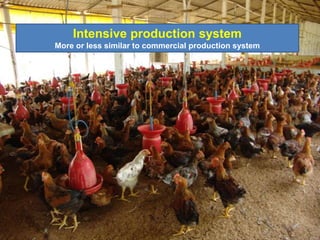
Intensive production system
More or less similar to commercial production system
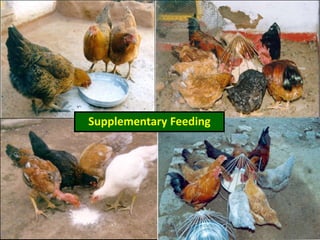
Supplementary Feeding
Feed Formulation
• Mathematical calculation to prepare a
balanced ration
• Points to be considered
Requirement of nutrients
Nutrient composition
Maximum effective/safe levels of inclusion
Availability and cost
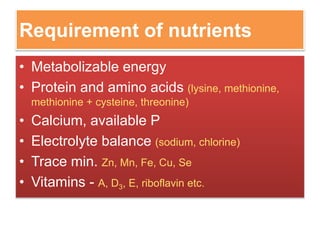
Requirement of nutrients
• Metabolizable energy
• Protein and amino acids (lysine, methionine,
methionine + cysteine, threonine)
• Calcium, available P
• Electrolyte balance (sodium, chlorine)
• Trace min. Zn, Mn, Fe, Cu, Se
• Vitamins - A, D3, E, riboflavin etc.
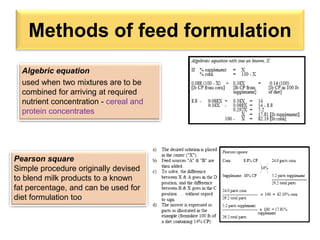
Methods of feed formulation
Algebric equation
used when two mixtures are to be
combined for arriving at required
nutrient concentration - cereal and
protein concentrates
Pearson square
Simple procedure originally devised
to blend milk products to a known
fat percentage, and can be used for
diet formulation too
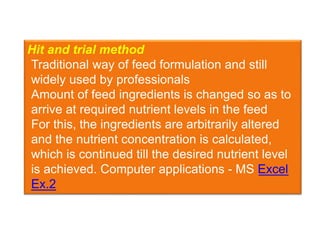
Hit and trial method
Traditional way of feed formulation and still
widely used by professionals
Amount of feed ingredients is changed so as to
arrive at required nutrient levels in the feed
For this, the ingredients are arbitrarily altered
and the nutrient concentration is calculated,
which is continued till the desired nutrient level
is achieved. Computer applications - MS Excel
Ex.2
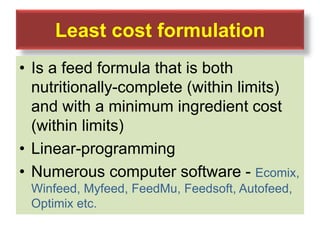
Least cost formulation
• Is a feed formula that is both
nutritionally-complete (within limits)
and with a minimum ingredient cost
(within limits)
• Linear-programming
• Numerous computer software - Ecomix,
Winfeed, Myfeed, FeedMu, Feedsoft, Autofeed,
Optimix etc.
Conclusions
• Understand the nutritional needs of bird
• Intensive system – balanced diet with low cost materials
• Reduce cost of broiler feed and feeding
• •Nutrients, Formulation, Precise Feeding
• •Control environments to reduce stress & diseases Recommendations:
• 1.Adopt new technology
• 2.Benchmark to the leading broiler
• 3.Always improve Efficiency
Conclusions
• The nutrient requirements have to be regularly
updated for precision and economical feeding
• The additive effects of the additive’s should be
quantified in terms of nutrient values to help in
formulation
• The efficiency of the digestion is being
constantly targeted and upgraded
• The metabolism which is the major waster
should be targeted hence future works should
be at the cellular level

Concepts in poultry feeding

  • 1.
    Concepts in poultryfeeding procedures
  • 2.
    Types of rearingchickens Intensive Semi-intensive Extensive
  • 3.
    Feeding management Objective • Theobjective of a defined feeding management program is to supply a range of balanced diets that satisfy the nutrient requirements at all stages of development & that optimize efficiency and profitability without compromising bird welfare or the environment.
  • 4.
    In Nutrition, • theThree Most Expensive Nutrients are: • 1.Energy • 2.Amino Acids (protein) • 3.Available Phosphorus
  • 5.
  • 6.
    Energy • Expressed ascalorie (cal) or joule. • One kilocalorie (kcal) = 4.184 kilojoules (kj) • kj = 0.239 kcal • Requirements are expressed in terms of Metabolizable Energy
  • 7.
    Protein Plays imp. Rolein • Body structural functions • Transportation of nutrients and oxygen • Catalyst in chemical reactions (enzymes) • Immuno-competence (antibodies) • Chemical regulation (hormones) • Blood clotting, vision • Growth and production • Regulating acid-base balance
  • 8.
    Amino acids •Amino acidsare the building blocks •22 amino acids are in nature and build all plants and animals •Plants synthesize all the AA •Animals synthesize only 12, remaining 10 need to be provided in diet and are essential
  • 9.
    Amino acids Essential Synthesisedfrom limited sources Readily synthesized Arginine Tyrosine Alanine Histidine Cystine Aspartic acid Isoleucine Hydroxylysine Aspargine Leucine Glutamic acid Lysine Glutamine Methionine Hydroxyproline Phenylalanine Glycine Threonine Serine Tryptophan Proline Valine
  • 10.
    Limiting Amino Acids Normallydeficient in practical diets Methionine – 1st limiting AA in broilers Threonine – 3rd limiting AA for broilers & 1st Limiting AA in starting egg-type pullets. Critical Amino Acids Normally deficient & necessary for protein synthesis initiation Lysine, methionine, meth+cystine, tryptophan, threonine, arginine, isoleucine
  • 11.
    Protein • Ideal proteinconcept - precision protein nutrition to minimize the loss of N • Digestible amino acid values – permits higher levels of cheaper, alternative protein sources decrease nitrogen excretion by the bird
  • 12.
    Energy sources Protein sources Mineralsupplements Vitamin supplements
  • 13.
    Energy supplements • Constitute60-70% of feed • Play an imp. role in cost effective feed formulation and providing bulk. • Divided into high energy and low energy supplements High energy suppl. Maize, wheat, broken rice, sorghum, fats and oils Low energy suppl. Pearl millet, finger millet & other small millets, rice polish or bran, DORB, wheat bran, molasses, tapioca flour, etc. • Maize – most popular, can be replaced partially or even completely
  • 14.
    Nutrients from differentcereal sources Ingredient Energy (Kcal /kg) Protein (%) Linoleic acid(%) Maize 3312 8.6 2.17 M.Gluten 3237 40 0.88 Gluten feed 2839 10 Jowar 3103 10.4 0.97 Bajra 3200 105 0.74 Ragi 2998 6.4 - Korra 2917 9.3 0.84 1.0
  • 15.
    Soyabean meal (excellentprotein source, only meth. is deficient, trypsin inhibitors) •Undercooking – urease test •Overcooking – solubility in 2% KOH (>85% undercooking, <70% overcooking) Mustard meal •Glucosinalates, erucic acid, goitrogen Maize gluten meal •Byproduct, good protein content and quality (deficient in lysine) Cotton seed meal •Gossypol (1%, of which free gossypol will be 0.1%) Protein sources
  • 16.
    Ground nut meal Aflatoxinprone, good CP content Sesame meal Good in meth., deficient in lysine, high phytates Sunflower meal Low in ME, deficient in lysine, threonine Pelleting improves Palm kernel meal Low in CP (15-18%), poor AA dig., high in fibre, low ME, enzymes may help Others – guar meal, karanja cake, mahua cake, ambadi cake etc.
  • 17.
  • 18.
    Animal proteins Meat meal& meat cum bone meal (for every 1 ton meat produced for human consumption, 300kg discarded, out of which 200kg is converted to meal) CP – 50%, Ca 8%, P 4% Fish & fish meal Hatchery by product meal Poultry by product meal
  • 19.
    DL methionine 100 L-lysine100 L-lysine HCl 79 L-arginine 100 L-arginine HCl 83 L-tryptophan 100 L-threonine 100 Glycine 100 Methionine hydroxy analogue* 88 *α keto acid – converted to active aa by transamination – NH2 added Potency of synthetic amino acids
  • 20.
    Minerals • Supplemented asready-made mineral mixture or through specific mineral supplements • Mineral mixture is available commercially or can be compounded • Specific mineral supplements are also added. • Calcium carbonate/oyster shell/stone grit/marble chips are used as sources of Ca • DCP or MCP - source of Ca and Av.P • Common salt - source of sodium and chlorine • Trace minerals (Cu, Zn, Fe, Mn, Se, I and sometimes Cr) - trace mineral premix • Organic trace minerals
  • 21.
    Vitamins • Supplemented eitherthrough premixes or through individual vitamins • Two types of premixes in the market Vit. A, D3, K and riboflavin (B2) - 5.0 to 15 g /q B-complex, vit. E and vit. C - 7.5-25 g/q • Choline chl. (100, 60 or 50% premix)
  • 22.
    Feed Additives Aimed atpreventing/minimizing the infectious agents’ loads, preventing mycotoxins, augmenting nutrient digestibility etc. • Antibiotic compounds • Probiotics (live bacterial and yeast strains) • Prebiotics (galacto-oligo-saccharides, fructo-oligo- saccharides, mannan-oligo-saccharides, lactose derivatives etc.)
  • 23.
    Feed Enzymes • Improvenutrient utilization • Non-starch polysaccharidases (cellulases, pectinases, hemicellulases, arabinoxylanases and beta glucanases) release nutrients trapped in high fibrous diets • Protease, amylase • Microbial phytase - increases availability of phytate-bound P, Ca, Zn, Cu, CP and amino acids.
  • 24.
    • Coccidiostat • Toxinbinders or adsorbents activated charcoal, bentonites, zeolites, diatomaceous earth, glucomannan, live yeast, etc. • Antioxidants, liver tonics, immunostimulants etc.
  • 25.
    Nutrient Requirements • NRC,1994, BIS 1992 • NRC std . may not be appropriate - management practices, genetic makeup, environmental temp., metabolic and behavioral characteristics, feedstuff qualities and dietary variables
  • 26.
    ME REQUIREMENT FORBROILERS (Leeson and Summers, 2001) • NEm = 83 x b.wt.0.75 • MEm = NEm (82% of ME is NE) 0.82 • MEa = MEm x 0.5 • ME growth = (Targeted wt. gain x 0.18* x 4.0**) + (Targeted wt. gain x 0.15# x 9.0$) * 18% CP ** 4 kcal/g # 15% fat $ 9 kcal/g • ME required, kcal/day = MEm + MEa + ME growth / no. of days in the period
  • 27.
    Example • Body wt.of bird at start = 0.25 kg • Metabolic wt. (W0.75) = 0.354 kg • Wt gain anticipated = 120g • Period in which the gain is anticipated = 7 days • MEm = 83 x 0.354 = 35.8 0.82 • MEa = MEm x 0.5 = 35.8 x 0.5 = 17.9 • MEgrowth = (120 x 0.18 x 4.0) + (120 x 0.15 x 9.0) = 86 + 162 = 248 • MEgrowth/day = 248/7 = 35.4 • ME required/day = 35.8 + 17.9 + 35.4 = 89.1 kcal
  • 28.
    Protein reqt. Growth • Bodytissue contain 18% CP • Dietary protein utilization is 61% Daily gain (g) x 0.18 0.61 Maintenance Endogenous N loss is 250mg/kg body wt. 250 x 6.25 = 1600mg protein/kg b wt./day 1.6g = 2.6g 0.61
  • 29.
    Feathers • 7% ofbody wt. • CP content – 82% 0.07 x daily gain in Bwt (g) x 0.82 0.61 Total protein reqt. = growth + maint. + feathers
  • 30.
    Feeding program forbroiler • 1.Maximum growth and feed conversion • 2.Reduced cost formulation • 3.Maximizing meat production • Cobb (2003) • Separate feeding • Male and female are grown separately • There is different requirement between sex especially amino acids • Increase profitability
  • 31.
    Early Feeding • Earlyaccess to feed: • •Stimulation of intestinal motility (Noy and Sklan, 1998) • •Increased body and organ growth • •Improved livability • •Immune function (Dibner et al., 1998) • •Carcass yields (Noy and Sklan, 1999) Early feed deprivation: • •Shorter villi and microvilli (Uni, 1999) • •Reduced muscle growth (Vieira and Moran, 1999) • •Reduced lymphocyte colonization (Dibner et al., 1998; Bar Shira et al, 2005)
  • 32.
    Potential Benefits ofEnzyme Supplementation • Increase feed efficiency • •Decrease gut maintenance cost • •Reduction in endogenous flow and enzyme production • •Improve performance • •Improve litter quality • •Improve bird uniformity • •May also lead to reductions in pathogenic microflora and improvements in bird health and welfare • •Decrease production costs!!!
  • 33.
    Layers • Reared in3 phases viz. starter (0-8 weeks of age), grower (8-20 weeks of age) and layer (20 weeks or above) Pre-lay phase (17/18 – 20 weeks) • Laying Phase I – 20-42 wks (Increase in body size, egg prodn. & egg wt.) • Phase II – 42-72 wks (Minimal wt. gain, egg prodn. decreases)
  • 34.
    • A layinghen showing 90% egg prodn. requires 16-18 g of protein and 285 to 290 kcal ME per day. • Meeting Ca requirement is imp. – Ca is increased to about 2% of diet at onset of prodn. • WL hens producing 90% eggs require daily about 3.8 to 4.2 g of calcium.
  • 35.
    Protein Requirement forLayers Maintenance 2.8g/kg^0.75 3.69 Gain 1g/day 0.17 Egg mass 51.3g/day 6.57 Feathers 0.12 Total 9.77 Protein requirement 17.41g/d (Dig coeff 0.70, BV 0.85) B.Wt 1.35kgs HD egg 95% Egg Wt 54g
  • 36.
    Changing Scenario:-Nutrient Requirements ofLayers (Phase1 Leeson 2009) (2.5)(Mcal/kg) (2.84) (2.8) (2.89)
  • 37.
    Comparison of thefeed cost /egg over income Year Average Egg cost `. Average Feed cost `/kg Feed cost Paise/egg Percentage of feed cost/egg income Aug-2004 1.3 5.85 73.1 56 Aug-2009 2.09 11.87 148.4 73 Aug-2010 2.41 14.05 175.6 73 Aug-2012 2.86 20.12 2.52 0.88
  • 38.
    Ideal Amino AcidRecommendations for laying hens Source mg/d Jais et al.,1995 Leeson and Summers 2005 Rostagno, 2005 Bregenda hl et al.,2008 Coon and Zang 1999 Namakkal digestible total digestible digestible digestible digestible Lysine 100 100 100 100 100 100 Methionine 44 51 50 47 49 50 M+C -- 88 91 94 81 93 Threonine 74 80 66 77 73 76 Tryptophan 16 21 23 22 20 23 Arginine 82 103 100 -- 130 120 Iso leucine 76 79 83 79 86 76 Valine 64 89 90 93 102 105 Dig lys =670 to 690mg/d
  • 39.
    Backyard poultry –Feeding strategies Scavenging Nursery rearing Intensive upto 6-8 wks Subsequently Semi-scavenging Intensive farming
  • 40.
    Rural poultry –nursery rearing • Chicks under rural poultry with improved varieties have no nursing mother • Need supplementary heating and protection • Nursery rearing till 6-8 wks under confinement ideal • To be fed balanced feed
  • 41.
    Backyard poultry –Feeding strategies Fallen cereal grains, grass seeds, oilseeds, insects, earthworms, green tender leaves/grasses, small fishes, snails, aquatic weeds, etc. Occasionally home-grown concentrates like cereal grains, rice polish, rice bran, wheat bran, thrashed fishes/snails and kitchen waste/garbage Availability of feeds however varies, and depends upon season, number of birds in an area and cropping pattern of that area. Feed availability is more during rainy season and rabi season after harvesting of crops. Scavenging (family / backyard poultry) – low inputs
  • 42.
    Birds are allowedto scavenge along with provision of supplementary feeds Semi-intensive production
  • 43.
    Intensive production system Moreor less similar to commercial production system
  • 44.
  • 45.
    Feed Formulation • Mathematicalcalculation to prepare a balanced ration • Points to be considered Requirement of nutrients Nutrient composition Maximum effective/safe levels of inclusion Availability and cost
  • 46.
    Requirement of nutrients •Metabolizable energy • Protein and amino acids (lysine, methionine, methionine + cysteine, threonine) • Calcium, available P • Electrolyte balance (sodium, chlorine) • Trace min. Zn, Mn, Fe, Cu, Se • Vitamins - A, D3, E, riboflavin etc.
  • 47.
    Methods of feedformulation Algebric equation used when two mixtures are to be combined for arriving at required nutrient concentration - cereal and protein concentrates Pearson square Simple procedure originally devised to blend milk products to a known fat percentage, and can be used for diet formulation too
  • 48.
    Hit and trialmethod Traditional way of feed formulation and still widely used by professionals Amount of feed ingredients is changed so as to arrive at required nutrient levels in the feed For this, the ingredients are arbitrarily altered and the nutrient concentration is calculated, which is continued till the desired nutrient level is achieved. Computer applications - MS Excel Ex.2
  • 49.
    Least cost formulation •Is a feed formula that is both nutritionally-complete (within limits) and with a minimum ingredient cost (within limits) • Linear-programming • Numerous computer software - Ecomix, Winfeed, Myfeed, FeedMu, Feedsoft, Autofeed, Optimix etc.
  • 50.
    Conclusions • Understand thenutritional needs of bird • Intensive system – balanced diet with low cost materials • Reduce cost of broiler feed and feeding • •Nutrients, Formulation, Precise Feeding • •Control environments to reduce stress & diseases Recommendations: • 1.Adopt new technology • 2.Benchmark to the leading broiler • 3.Always improve Efficiency
  • 51.
    Conclusions • The nutrientrequirements have to be regularly updated for precision and economical feeding • The additive effects of the additive’s should be quantified in terms of nutrient values to help in formulation • The efficiency of the digestion is being constantly targeted and upgraded • The metabolism which is the major waster should be targeted hence future works should be at the cellular level