Recent Developments in
Feeds and Feeding Practices
Dr. Pankaj Kumar Singh
Assistant Professor (Animal Nutrition)
“Livestock Sector will bring Food
security and Sustainable
development if it is:
 Economically viable
 Environmentally sound
 People centred
- James Gustave Speltz (UNDP, 1994)
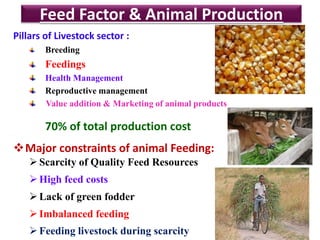
Feed Factor & Animal Production
Pillars of Livestock sector :
Breeding
Feedings
Health Management
Reproductive management
Value addition & Marketing of animal products
70% of total production cost <
Major constraints of animal Feeding:
Scarcity of Quality Feed Resources
High feed costs
Lack of green fodder
Imbalanced feeding
Feeding livestock during scarcity
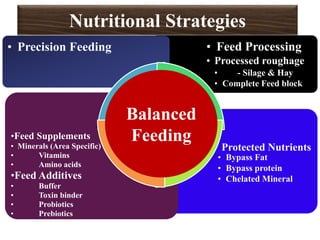
• Protected Nutrients
• Bypass Fat
• Bypass protein
• Chelated Mineral
•Feed Supplements
• Minerals (Area Specific)
• Vitamins
• Amino acids
•Feed Additives
• Buffer
• Toxin binder
• Probiotics
• Prebiotics
• Feed Processing
• Processed roughage
• - Silage & Hay
• Complete Feed block
• Precision Feeding
Balanced
Feeding
Nutritional Strategies
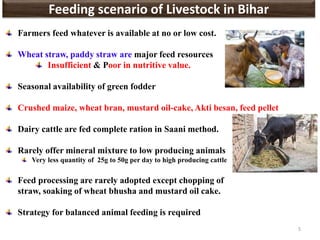
Farmers feed whatever is available at no or low cost.
Wheat straw, paddy straw are major feed resources
Insufficient & Poor in nutritive value.
Seasonal availability of green fodder
Crushed maize, wheat bran, mustard oil-cake, Akti besan, feed pellet
Dairy cattle are fed complete ration in Saani method.
Rarely offer mineral mixture to low producing animals
Very less quantity of 25g to 50g per day to high producing cattle
Feed processing are rarely adopted except chopping of
straw, soaking of wheat bhusha and mustard oil cake.
Strategy for balanced animal feeding is required
5
Feeding scenario of Livestock in Bihar
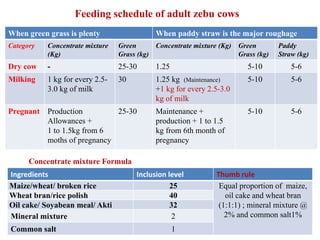
When green grass is plenty When paddy straw is the major roughage
Category Concentrate mixture
(Kg)
Green
Grass (kg)
Concentrate mixture (Kg) Green
Grass (kg)
Paddy
Straw (kg)
Dry cow - 25-30 1.25 5-10 5-6
Milking 1 kg for every 2.5-
3.0 kg of milk
30 1.25 kg (Maintenance)
+1 kg for every 2.5-3.0
kg of milk
5-10 5-6
Pregnant Production
Allowances +
1 to 1.5kg from 6
moths of pregnancy
25-30 Maintenance +
production + 1 to 1.5
kg from 6th month of
pregnancy
5-10 5-6
Feeding schedule of adult zebu cows
6
Ingredients Inclusion level Thumb rule
Maize/wheat/ broken rice 25 Equal proportion of maize,
oil cake and wheat bran
(1:1:1) ; mineral mixture @
2% and common salt1%
Wheat bran/rice polish 40
Oil cake/ Soyabean meal/ Akti 32
Mineral mixture 2
Common salt 1
Concentrate mixture Formula
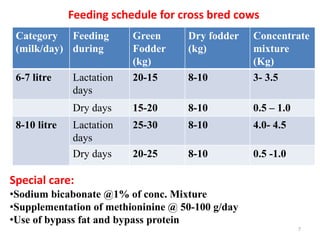
Category
(milk/day)
Feeding
during
Green
Fodder
(kg)
Dry fodder
(kg)
Concentrate
mixture
(Kg)
6-7 litre Lactation
days
20-15 8-10 3- 3.5
Dry days 15-20 8-10 0.5 – 1.0
8-10 litre Lactation
days
25-30 8-10 4.0- 4.5
Dry days 20-25 8-10 0.5 -1.0
Feeding schedule for cross bred cows
7
Special care:
•Sodium bicabonate @1% of conc. Mixture
•Supplementation of methioninine @ 50-100 g/day
•Use of bypass fat and bypass protein
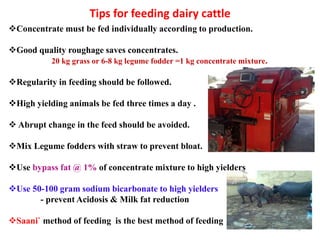
Tips for feeding dairy cattle
8
Concentrate must be fed individually according to production.
Good quality roughage saves concentrates.
20 kg grass or 6-8 kg legume fodder =1 kg concentrate mixture.
Regularity in feeding should be followed.
High yielding animals be fed three times a day .
 Abrupt change in the feed should be avoided.
Mix Legume fodders with straw to prevent bloat.
Use bypass fat @ 1% of concentrate mixture to high yielders
Use 50-100 gram sodium bicarbonate to high yielders
- prevent Acidosis & Milk fat reduction
Saani` method of feeding is the best method of feeding
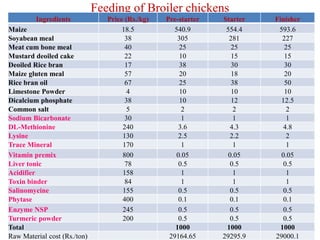
Feeding of Broiler chickens
Ingredients Price (Rs./kg) Pre-starter Starter Finisher
Maize 18.5 540.9 554.4 593.6
Soyabean meal 38 305 281 227
Meat cum bone meal 40 25 25 25
Mustard deoiled cake 22 10 15 15
Deoiled Rice bran 17 38 30 30
Maize gluten meal 57 20 18 20
Rice bran oil 67 25 38 50
Limestone Powder 4 10 10 10
Dicalcium phosphate 38 10 12 12.5
Common salt 5 2 2 2
Sodium Bicarbonate 30 1 1 1
DL-Methionine 240 3.6 4.3 4.8
Lysine 130 2.5 2.2 2
Trace Mineral 170 1 1 1
Vitamin premix 800 0.05 0.05 0.05
Liver tonic 78 0.5 0.5 0.5
Acidifier 158 1 1 1
Toxin binder 84 1 1 1
Salinomycine 155 0.5 0.5 0.5
Phytase 400 0.1 0.1 0.1
Enzyme NSP 245 0.5 0.5 0.5
Turmeric powder 200 0.5 0.5 0.5
Total 1000 1000 1000
Raw Material cost (Rs./ton) 29164.65 29295.9 29000.1
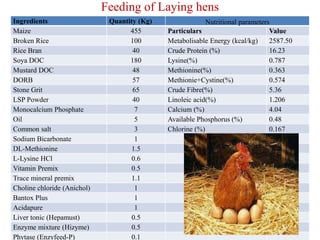
Feeding of Laying hens
Ingredients Quantity (Kg) Nutritional parameters
Maize 455 Particulars Value
Broken Rice 100 Metabolisable Energy (kcal/kg) 2587.50
Rice Bran 40 Crude Protein (%) 16.23
Soya DOC 180 Lysine(%) 0.787
Mustard DOC 48 Methionine(%) 0.363
DORB 57 Methionie+Cystine(%) 0.574
Stone Grit 65 Crude Fibre(%) 5.36
LSP Powder 40 Linoleic acid(%) 1.206
Monocalcium Phosphate 7 Calcium (%) 4.04
Oil 5 Available Phosphorus (%) 0.48
Common salt 3 Chlorine (%) 0.167
Sodium Bicarbonate 1
DL-Methionine 1.5
L-Lysine HCl 0.6
Vitamin Premix 0.5
Trace mineral premix 1.1
Choline chloride (Anichol) 1
Bantox Plus 1
Acidapure 1
Liver tonic (Hepamust) 0.5
Enzyme mixture (Hizyme) 0.5
Phytase (Enzyfeed-P) 0.1
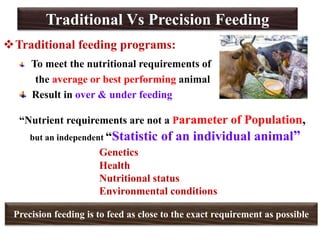
Traditional Vs Precision Feeding
Traditional feeding programs:
To meet the nutritional requirements of
the average or best performing animal
Result in over & under feeding
“Nutrient requirements are not a Parameter of Population,
but an independent “Statistic of an individual animal”
Genetics
Health
Nutritional status
Environmental conditions
Precision feeding is to feed as close to the exact requirement as possible
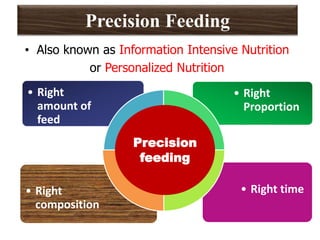
• Also known as Information Intensive Nutrition
or Personalized Nutrition
• Right time• Right
composition
• Right
Proportion
• Right
amount of
feed
Precision
feeding
Precision Feeding
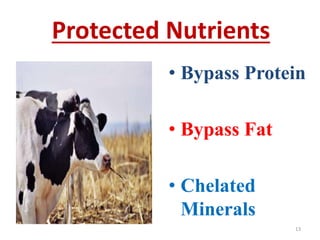
Protected Nutrients
• Bypass Protein
• Bypass Fat
• Chelated
Minerals
13
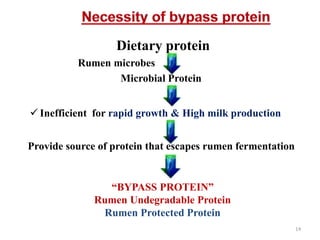
Dietary protein
Rumen microbes
Microbial Protein
 Inefficient for rapid growth & High milk production
Provide source of protein that escapes rumen fermentation
“BYPASS PROTEIN”
Rumen Undegradable Protein
Rumen Protected Protein
14
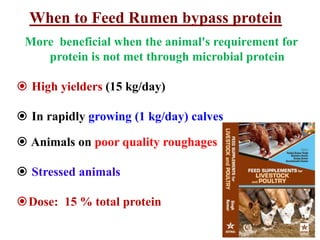
When to Feed Rumen bypass protein
More beneficial when the animal's requirement for
protein is not met through microbial protein
 High yielders (15 kg/day)
 In rapidly growing (1 kg/day) calves
 Animals on poor quality roughages
 Stressed animals
Dose: 15 % total protein
15
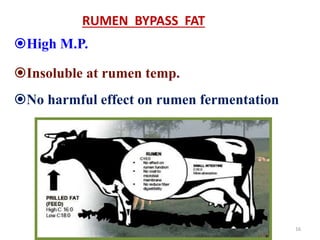
RUMEN BYPASS FAT
High M.P.
Insoluble at rumen temp.
No harmful effect on rumen fermentation
16
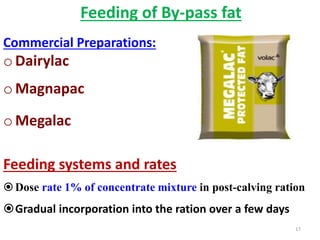
Feeding of By-pass fat
Commercial Preparations:
o Dairylac
o Magnapac
oMegalac
Feeding systems and rates
Dose rate 1% of concentrate mixture in post-calving ration
Gradual incorporation into the ration over a few days
17
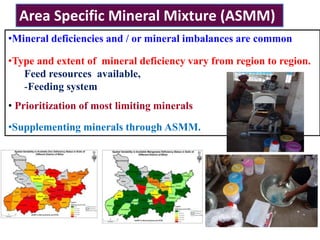
Area Specific Mineral Mixture (ASMM)
•Mineral deficiencies and / or mineral imbalances are common
•Type and extent of mineral deficiency vary from region to region.
Feed resources available,
-Feeding system
• Prioritization of most limiting minerals
•Supplementing minerals through ASMM.
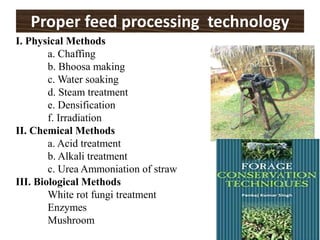
Feed Processing Technologies:
I. Physical Methods
a. Chaffing
b. Bhoosa making
c. Water soaking
d. Steam treatment
e. Densification
f. Irradiation
II. Chemical Methods
a. Acid treatment
b. Alkali treatment
c. Urea Ammoniation of straw
III. Biological Methods
White rot fungi treatment
Enzymes
Mushroom
19
Proper feed processing technology
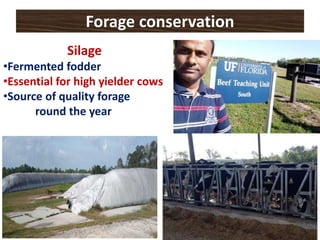
Forage conservation
Silage
•Fermented fodder
•Essential for high yielder cows
•Source of quality forage
round the year
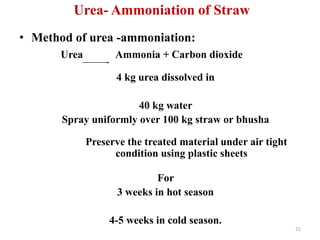
Urea- Ammoniation of Straw
• Method of urea -ammoniation:
Urea Ammonia + Carbon dioxide
4 kg urea dissolved in
40 kg water
Spray uniformly over 100 kg straw or bhusha
Preserve the treated material under air tight
condition using plastic sheets
For
3 weeks in hot season
4-5 weeks in cold season.
21
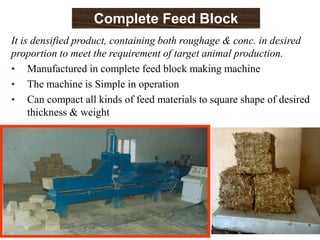
It is densified product, containing both roughage & conc. in desired
proportion to meet the requirement of target animal production.
• Manufactured in complete feed block making machine
• The machine is Simple in operation
• Can compact all kinds of feed materials to square shape of desired
thickness & weight
Complete Feed Block
22
23
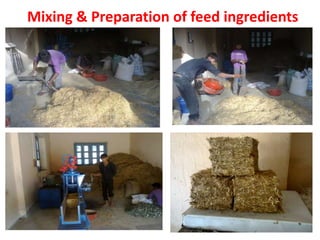
Mixing & Preparation of feed ingredients
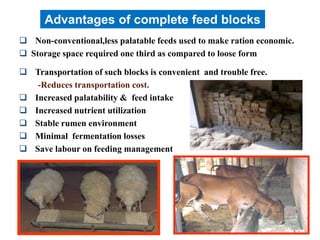
 Non-conventional,less palatable feeds used to make ration economic.
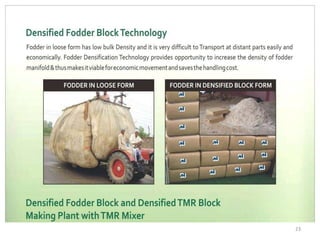
 Storage space required one third as compared to loose form
 Transportation of such blocks is convenient and trouble free.
-Reduces transportation cost.
 Increased palatability & feed intake
 Increased nutrient utilization
 Stable rumen environment
 Minimal fermentation losses
 Save labour on feeding management
Advantages of complete feed blocks
25
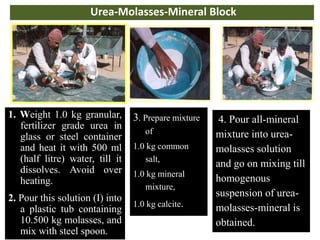
1. Weight 1.0 kg granular,
fertilizer grade urea in
glass or steel container
and heat it with 500 ml
(half litre) water, till it
dissolves. Avoid over
heating.
2. Pour this solution (I) into
a plastic tub containing
10.500 kg molasses, and
mix with steel spoon. 26
3. Prepare mixture
of
1.0 kg common
salt,
1.0 kg mineral
mixture,
1.0 kg calcite.
Urea-Molasses-Mineral Block
4. Pour all-mineral
mixture into urea-
molasses solution
and go on mixing till
homogenous
suspension of urea-
molasses-mineral is
obtained.
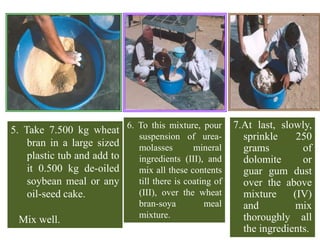
5. Take 7.500 kg wheat
bran in a large sized
plastic tub and add to
it 0.500 kg de-oiled
soybean meal or any
oil-seed cake.
Mix well.
27
6. To this mixture, pour
suspension of urea-
molasses mineral
ingredients (III), and
mix all these contents
till there is coating of
(III), over the wheat
bran-soya meal
mixture.
7.At last, slowly,
sprinkle 250
grams of
dolomite or
guar gum dust
over the above
mixture (IV)
and mix
thoroughly all
the ingredients.
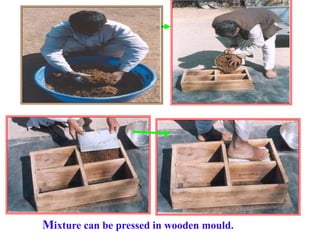
Mixture can be pressed in wooden mould.
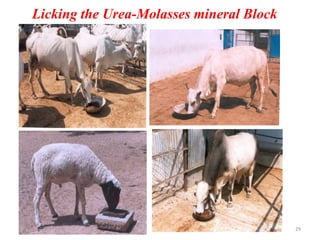
Licking the Urea-Molasses mineral Block
29
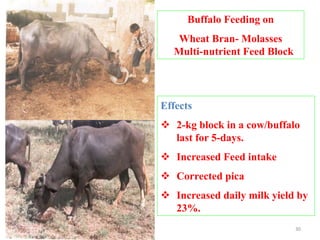
Buffalo Feeding on
Wheat Bran- Molasses
Multi-nutrient Feed Block
- A. K. Patel
Effects
 2-kg block in a cow/buffalo
last for 5-days.
 Increased Feed intake
 Corrected pica
 Increased daily milk yield by
23%.
30
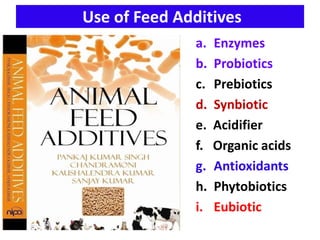
Use of Feed Additives
a. Enzymes
b. Probiotics
c. Prebiotics
d. Synbiotic
e. Acidifier
f. Organic acids
g. Antioxidants
h. Phytobiotics
i. Eubiotic
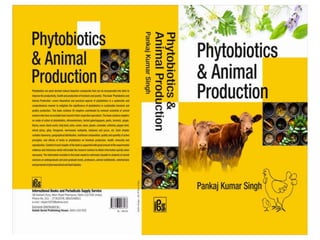
Books
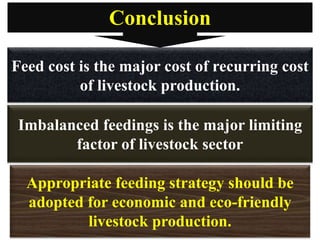
Conclusion
Feed cost is the major cost of recurring cost
of livestock production.
Appropriate feeding strategy should be
adopted for economic and eco-friendly
livestock production.
Imbalanced feedings is the major limiting
factor of livestock sector
Questions?
35
Questions & Discussion

Recent Developments in Feeds and Feeding Practices

  • 1.
    Recent Developments in Feedsand Feeding Practices Dr. Pankaj Kumar Singh Assistant Professor (Animal Nutrition)
  • 2.
    “Livestock Sector willbring Food security and Sustainable development if it is:  Economically viable  Environmentally sound  People centred - James Gustave Speltz (UNDP, 1994)
  • 3.
    Feed Factor &Animal Production Pillars of Livestock sector : Breeding Feedings Health Management Reproductive management Value addition & Marketing of animal products 70% of total production cost < Major constraints of animal Feeding: Scarcity of Quality Feed Resources High feed costs Lack of green fodder Imbalanced feeding Feeding livestock during scarcity
  • 4.
    • Protected Nutrients •Bypass Fat • Bypass protein • Chelated Mineral •Feed Supplements • Minerals (Area Specific) • Vitamins • Amino acids •Feed Additives • Buffer • Toxin binder • Probiotics • Prebiotics • Feed Processing • Processed roughage • - Silage & Hay • Complete Feed block • Precision Feeding Balanced Feeding Nutritional Strategies
  • 5.
    Farmers feed whateveris available at no or low cost. Wheat straw, paddy straw are major feed resources Insufficient & Poor in nutritive value. Seasonal availability of green fodder Crushed maize, wheat bran, mustard oil-cake, Akti besan, feed pellet Dairy cattle are fed complete ration in Saani method. Rarely offer mineral mixture to low producing animals Very less quantity of 25g to 50g per day to high producing cattle Feed processing are rarely adopted except chopping of straw, soaking of wheat bhusha and mustard oil cake. Strategy for balanced animal feeding is required 5 Feeding scenario of Livestock in Bihar
  • 6.
    When green grassis plenty When paddy straw is the major roughage Category Concentrate mixture (Kg) Green Grass (kg) Concentrate mixture (Kg) Green Grass (kg) Paddy Straw (kg) Dry cow - 25-30 1.25 5-10 5-6 Milking 1 kg for every 2.5- 3.0 kg of milk 30 1.25 kg (Maintenance) +1 kg for every 2.5-3.0 kg of milk 5-10 5-6 Pregnant Production Allowances + 1 to 1.5kg from 6 moths of pregnancy 25-30 Maintenance + production + 1 to 1.5 kg from 6th month of pregnancy 5-10 5-6 Feeding schedule of adult zebu cows 6 Ingredients Inclusion level Thumb rule Maize/wheat/ broken rice 25 Equal proportion of maize, oil cake and wheat bran (1:1:1) ; mineral mixture @ 2% and common salt1% Wheat bran/rice polish 40 Oil cake/ Soyabean meal/ Akti 32 Mineral mixture 2 Common salt 1 Concentrate mixture Formula
  • 7.
    Category (milk/day) Feeding during Green Fodder (kg) Dry fodder (kg) Concentrate mixture (Kg) 6-7 litreLactation days 20-15 8-10 3- 3.5 Dry days 15-20 8-10 0.5 – 1.0 8-10 litre Lactation days 25-30 8-10 4.0- 4.5 Dry days 20-25 8-10 0.5 -1.0 Feeding schedule for cross bred cows 7 Special care: •Sodium bicabonate @1% of conc. Mixture •Supplementation of methioninine @ 50-100 g/day •Use of bypass fat and bypass protein
  • 8.
    Tips for feedingdairy cattle 8 Concentrate must be fed individually according to production. Good quality roughage saves concentrates. 20 kg grass or 6-8 kg legume fodder =1 kg concentrate mixture. Regularity in feeding should be followed. High yielding animals be fed three times a day .  Abrupt change in the feed should be avoided. Mix Legume fodders with straw to prevent bloat. Use bypass fat @ 1% of concentrate mixture to high yielders Use 50-100 gram sodium bicarbonate to high yielders - prevent Acidosis & Milk fat reduction Saani` method of feeding is the best method of feeding

  • 9.
    Feeding of Broilerchickens Ingredients Price (Rs./kg) Pre-starter Starter Finisher Maize 18.5 540.9 554.4 593.6 Soyabean meal 38 305 281 227 Meat cum bone meal 40 25 25 25 Mustard deoiled cake 22 10 15 15 Deoiled Rice bran 17 38 30 30 Maize gluten meal 57 20 18 20 Rice bran oil 67 25 38 50 Limestone Powder 4 10 10 10 Dicalcium phosphate 38 10 12 12.5 Common salt 5 2 2 2 Sodium Bicarbonate 30 1 1 1 DL-Methionine 240 3.6 4.3 4.8 Lysine 130 2.5 2.2 2 Trace Mineral 170 1 1 1 Vitamin premix 800 0.05 0.05 0.05 Liver tonic 78 0.5 0.5 0.5 Acidifier 158 1 1 1 Toxin binder 84 1 1 1 Salinomycine 155 0.5 0.5 0.5 Phytase 400 0.1 0.1 0.1 Enzyme NSP 245 0.5 0.5 0.5 Turmeric powder 200 0.5 0.5 0.5 Total 1000 1000 1000 Raw Material cost (Rs./ton) 29164.65 29295.9 29000.1
  • 10.
    Feeding of Layinghens Ingredients Quantity (Kg) Nutritional parameters Maize 455 Particulars Value Broken Rice 100 Metabolisable Energy (kcal/kg) 2587.50 Rice Bran 40 Crude Protein (%) 16.23 Soya DOC 180 Lysine(%) 0.787 Mustard DOC 48 Methionine(%) 0.363 DORB 57 Methionie+Cystine(%) 0.574 Stone Grit 65 Crude Fibre(%) 5.36 LSP Powder 40 Linoleic acid(%) 1.206 Monocalcium Phosphate 7 Calcium (%) 4.04 Oil 5 Available Phosphorus (%) 0.48 Common salt 3 Chlorine (%) 0.167 Sodium Bicarbonate 1 DL-Methionine 1.5 L-Lysine HCl 0.6 Vitamin Premix 0.5 Trace mineral premix 1.1 Choline chloride (Anichol) 1 Bantox Plus 1 Acidapure 1 Liver tonic (Hepamust) 0.5 Enzyme mixture (Hizyme) 0.5 Phytase (Enzyfeed-P) 0.1
  • 11.
    Traditional Vs PrecisionFeeding Traditional feeding programs: To meet the nutritional requirements of the average or best performing animal Result in over & under feeding “Nutrient requirements are not a Parameter of Population, but an independent “Statistic of an individual animal” Genetics Health Nutritional status Environmental conditions Precision feeding is to feed as close to the exact requirement as possible
  • 12.
    • Also knownas Information Intensive Nutrition or Personalized Nutrition • Right time• Right composition • Right Proportion • Right amount of feed Precision feeding Precision Feeding
  • 13.
    Protected Nutrients • BypassProtein • Bypass Fat • Chelated Minerals 13
  • 14.
    Dietary protein Rumen microbes MicrobialProtein  Inefficient for rapid growth & High milk production Provide source of protein that escapes rumen fermentation “BYPASS PROTEIN” Rumen Undegradable Protein Rumen Protected Protein 14
  • 15.
    When to FeedRumen bypass protein More beneficial when the animal's requirement for protein is not met through microbial protein  High yielders (15 kg/day)  In rapidly growing (1 kg/day) calves  Animals on poor quality roughages  Stressed animals Dose: 15 % total protein 15
  • 16.
    RUMEN BYPASS FAT HighM.P. Insoluble at rumen temp. No harmful effect on rumen fermentation 16
  • 17.
    Feeding of By-passfat Commercial Preparations: o Dairylac o Magnapac oMegalac Feeding systems and rates Dose rate 1% of concentrate mixture in post-calving ration Gradual incorporation into the ration over a few days 17
  • 18.
    Area Specific MineralMixture (ASMM) •Mineral deficiencies and / or mineral imbalances are common •Type and extent of mineral deficiency vary from region to region. Feed resources available, -Feeding system • Prioritization of most limiting minerals •Supplementing minerals through ASMM.
  • 19.
    Feed Processing Technologies: I.Physical Methods a. Chaffing b. Bhoosa making c. Water soaking d. Steam treatment e. Densification f. Irradiation II. Chemical Methods a. Acid treatment b. Alkali treatment c. Urea Ammoniation of straw III. Biological Methods White rot fungi treatment Enzymes Mushroom 19 Proper feed processing technology
  • 20.
    Forage conservation Silage •Fermented fodder •Essentialfor high yielder cows •Source of quality forage round the year
  • 21.
    Urea- Ammoniation ofStraw • Method of urea -ammoniation: Urea Ammonia + Carbon dioxide 4 kg urea dissolved in 40 kg water Spray uniformly over 100 kg straw or bhusha Preserve the treated material under air tight condition using plastic sheets For 3 weeks in hot season 4-5 weeks in cold season. 21
  • 22.
    It is densifiedproduct, containing both roughage & conc. in desired proportion to meet the requirement of target animal production. • Manufactured in complete feed block making machine • The machine is Simple in operation • Can compact all kinds of feed materials to square shape of desired thickness & weight Complete Feed Block 22
  • 23.
  • 24.
    Mixing & Preparationof feed ingredients
  • 25.
     Non-conventional,less palatablefeeds used to make ration economic.  Storage space required one third as compared to loose form  Transportation of such blocks is convenient and trouble free. -Reduces transportation cost.  Increased palatability & feed intake  Increased nutrient utilization  Stable rumen environment  Minimal fermentation losses  Save labour on feeding management Advantages of complete feed blocks 25
  • 26.
    1. Weight 1.0kg granular, fertilizer grade urea in glass or steel container and heat it with 500 ml (half litre) water, till it dissolves. Avoid over heating. 2. Pour this solution (I) into a plastic tub containing 10.500 kg molasses, and mix with steel spoon. 26 3. Prepare mixture of 1.0 kg common salt, 1.0 kg mineral mixture, 1.0 kg calcite. Urea-Molasses-Mineral Block 4. Pour all-mineral mixture into urea- molasses solution and go on mixing till homogenous suspension of urea- molasses-mineral is obtained.
  • 27.
    5. Take 7.500kg wheat bran in a large sized plastic tub and add to it 0.500 kg de-oiled soybean meal or any oil-seed cake. Mix well. 27 6. To this mixture, pour suspension of urea- molasses mineral ingredients (III), and mix all these contents till there is coating of (III), over the wheat bran-soya meal mixture. 7.At last, slowly, sprinkle 250 grams of dolomite or guar gum dust over the above mixture (IV) and mix thoroughly all the ingredients.
  • 28.
    Mixture can bepressed in wooden mould.
  • 29.
    Licking the Urea-Molassesmineral Block 29
  • 30.
    Buffalo Feeding on WheatBran- Molasses Multi-nutrient Feed Block - A. K. Patel Effects  2-kg block in a cow/buffalo last for 5-days.  Increased Feed intake  Corrected pica  Increased daily milk yield by 23%. 30
  • 31.
    Use of FeedAdditives a. Enzymes b. Probiotics c. Prebiotics d. Synbiotic e. Acidifier f. Organic acids g. Antioxidants h. Phytobiotics i. Eubiotic
  • 32.
  • 33.
    Conclusion Feed cost isthe major cost of recurring cost of livestock production. Appropriate feeding strategy should be adopted for economic and eco-friendly livestock production. Imbalanced feedings is the major limiting factor of livestock sector
  • 35.

Editor's Notes