Dr. Pramod Kumar
Assistant Professor-cum-Junior Scientist
Department Of Livestock Farm Complex
Bihar Veterinary College
Patna-14
1
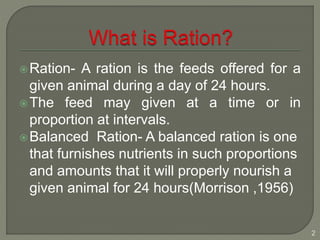
Ration- A ration is the feeds offered for a
given animal during a day of 24 hours.
The feed may given at a time or in
proportion at intervals.
Balanced Ration- A balanced ration is one
that furnishes nutrients in such proportions
and amounts that it will properly nourish a
given animal for 24 hours(Morrison ,1956)
2
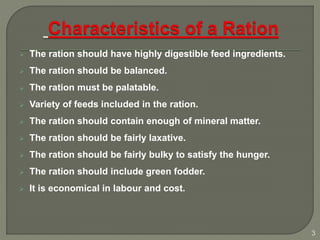
 The ration should have highly digestible feed ingredients.
 The ration should be balanced.
 The ration must be palatable.
 Variety of feeds included in the ration.
 The ration should contain enough of mineral matter.
 The ration should be fairly laxative.
 The ration should be fairly bulky to satisfy the hunger.
 The ration should include green fodder.
 It is economical in labour and cost.
3
4
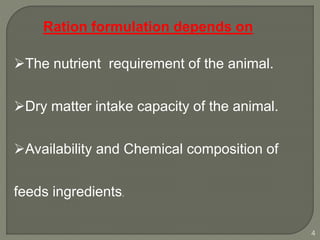
Ration formulation depends on
The nutrient requirement of the animal.
Dry matter intake capacity of the animal.
Availability and Chemical composition of
feeds ingredients.
5
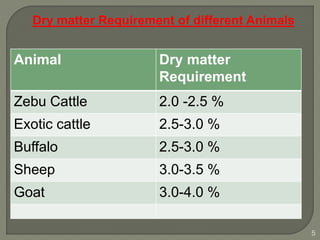
Animal Dry matter
Requirement
Zebu Cattle 2.0 -2.5 %
Exotic cattle 2.5-3.0 %
Buffalo 2.5-3.0 %
Sheep 3.0-3.5 %
Goat 3.0-4.0 %
Dry matter Requirement of different Animals
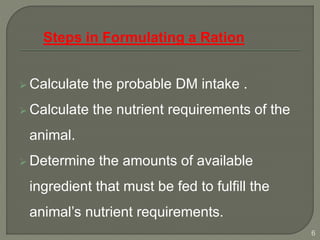
 Calculate the probable DM intake .
 Calculate the nutrient requirements of the
animal.
 Determine the amounts of available
ingredient that must be fed to fulfill the
animal’s nutrient requirements.
6
Steps in Formulating a Ration
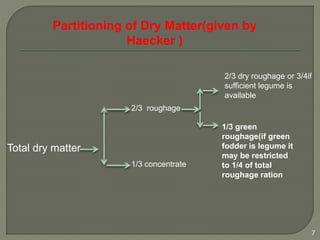
Total dry matter
7
Partitioning of Dry Matter(given by
Haecker )
2/3 roughage
1/3 concentrate
2/3 dry roughage or 3/4if
sufficient legume is
available
1/3 green
roughage(if green
fodder is legume it
may be restricted
to 1/4 of total
roughage ration
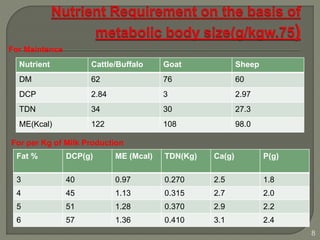
Nutrient Cattle/Buffalo Goat Sheep
DM 62 76 60
DCP 2.84 3 2.97
TDN 34 30 27.3
ME(Kcal) 122 108 98.0
8
For Maintence
Fat % DCP(g) ME (Mcal) TDN(Kg) Ca(g) P(g)
3 40 0.97 0.270 2.5 1.8
4 45 1.13 0.315 2.7 2.0
5 51 1.28 0.370 2.9 2.2
6 57 1.36 0.410 3.1 2.4
For per Kg of Milk Production
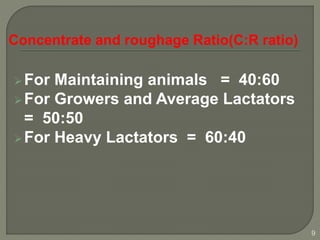
For Maintaining animals = 40:60
For Growers and Average Lactators
= 50:50
For Heavy Lactators = 60:40
9
Concentrate and roughage Ratio(C:R ratio)
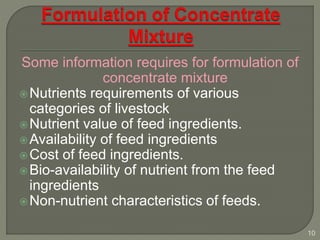
Some information requires for formulation of
concentrate mixture
Nutrients requirements of various
categories of livestock
Nutrient value of feed ingredients.
Availability of feed ingredients
Cost of feed ingredients.
Bio-availability of nutrient from the feed
ingredients
Non-nutrient characteristics of feeds.
10
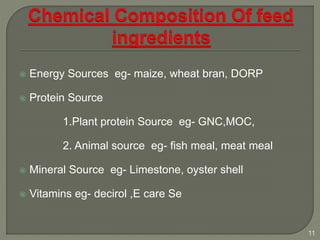
 Energy Sources eg- maize, wheat bran, DORP
 Protein Source
1.Plant protein Source eg- GNC,MOC,
2. Animal source eg- fish meal, meat meal
 Mineral Source eg- Limestone, oyster shell
 Vitamins eg- decirol ,E care Se
11
1. Pearson Square Method
2. Algebric Equation
3. By using computer/least cost feed
formulation/Linear Programming
4. By trial and error method
12
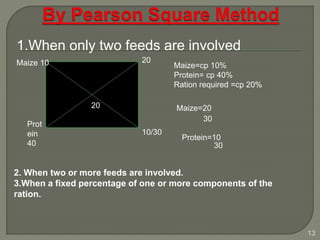
1.When only two feeds are involved
13
Maize 10
Prot
ein
40
20
20
10/30
Maize=cp 10%
Protein= cp 40%
Ration required =cp 20%
Maize=20
30
Protein=10
30
2. When two or more feeds are involved.
3.When a fixed percentage of one or more components of the
ration.
14
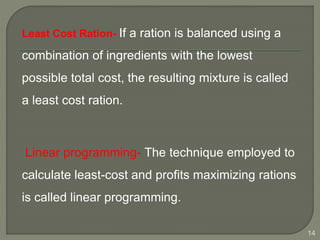
Least Cost Ration- If a ration is balanced using a
combination of ingredients with the lowest
possible total cost, the resulting mixture is called
a least cost ration.
Linear programming- The technique employed to
calculate least-cost and profits maximizing rations
is called linear programming.
15
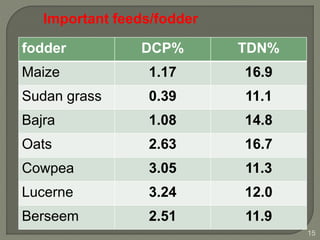
Important feeds/fodder
fodder DCP% TDN%
Maize 1.17 16.9
Sudan grass 0.39 11.1
Bajra 1.08 14.8
Oats 2.63 16.7
Cowpea 3.05 11.3
Lucerne 3.24 12.0
Berseem 2.51 11.9
16
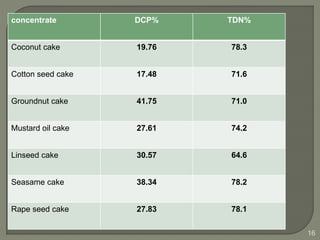
concentrate DCP% TDN%
Coconut cake 19.76 78.3
Cotton seed cake 17.48 71.6
Groundnut cake 41.75 71.0
Mustard oil cake 27.61 74.2
Linseed cake 30.57 64.6
Seasame cake 38.34 78.2
Rape seed cake 27.83 78.1
17
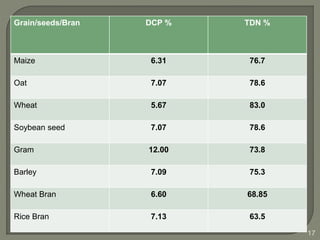
Grain/seeds/Bran DCP % TDN %
Maize 6.31 76.7
Oat 7.07 78.6
Wheat 5.67 83.0
Soybean seed 7.07 78.6
Gram 12.00 73.8
Barley 7.09 75.3
Wheat Bran 6.60 68.85
Rice Bran 7.13 63.5
Thanks
18

Ration formulation

  • 1.
    Dr. Pramod Kumar AssistantProfessor-cum-Junior Scientist Department Of Livestock Farm Complex Bihar Veterinary College Patna-14 1
  • 2.
    Ration- A rationis the feeds offered for a given animal during a day of 24 hours. The feed may given at a time or in proportion at intervals. Balanced Ration- A balanced ration is one that furnishes nutrients in such proportions and amounts that it will properly nourish a given animal for 24 hours(Morrison ,1956) 2
  • 3.
     The rationshould have highly digestible feed ingredients.  The ration should be balanced.  The ration must be palatable.  Variety of feeds included in the ration.  The ration should contain enough of mineral matter.  The ration should be fairly laxative.  The ration should be fairly bulky to satisfy the hunger.  The ration should include green fodder.  It is economical in labour and cost. 3
  • 4.
    4 Ration formulation dependson The nutrient requirement of the animal. Dry matter intake capacity of the animal. Availability and Chemical composition of feeds ingredients.
  • 5.
    5 Animal Dry matter Requirement ZebuCattle 2.0 -2.5 % Exotic cattle 2.5-3.0 % Buffalo 2.5-3.0 % Sheep 3.0-3.5 % Goat 3.0-4.0 % Dry matter Requirement of different Animals
  • 6.
     Calculate theprobable DM intake .  Calculate the nutrient requirements of the animal.  Determine the amounts of available ingredient that must be fed to fulfill the animal’s nutrient requirements. 6 Steps in Formulating a Ration
  • 7.
    Total dry matter 7 Partitioningof Dry Matter(given by Haecker ) 2/3 roughage 1/3 concentrate 2/3 dry roughage or 3/4if sufficient legume is available 1/3 green roughage(if green fodder is legume it may be restricted to 1/4 of total roughage ration
  • 8.
    Nutrient Cattle/Buffalo GoatSheep DM 62 76 60 DCP 2.84 3 2.97 TDN 34 30 27.3 ME(Kcal) 122 108 98.0 8 For Maintence Fat % DCP(g) ME (Mcal) TDN(Kg) Ca(g) P(g) 3 40 0.97 0.270 2.5 1.8 4 45 1.13 0.315 2.7 2.0 5 51 1.28 0.370 2.9 2.2 6 57 1.36 0.410 3.1 2.4 For per Kg of Milk Production
  • 9.
    For Maintaining animals= 40:60 For Growers and Average Lactators = 50:50 For Heavy Lactators = 60:40 9 Concentrate and roughage Ratio(C:R ratio)
  • 10.
    Some information requiresfor formulation of concentrate mixture Nutrients requirements of various categories of livestock Nutrient value of feed ingredients. Availability of feed ingredients Cost of feed ingredients. Bio-availability of nutrient from the feed ingredients Non-nutrient characteristics of feeds. 10
  • 11.
     Energy Sourceseg- maize, wheat bran, DORP  Protein Source 1.Plant protein Source eg- GNC,MOC, 2. Animal source eg- fish meal, meat meal  Mineral Source eg- Limestone, oyster shell  Vitamins eg- decirol ,E care Se 11
  • 12.
    1. Pearson SquareMethod 2. Algebric Equation 3. By using computer/least cost feed formulation/Linear Programming 4. By trial and error method 12
  • 13.
    1.When only twofeeds are involved 13 Maize 10 Prot ein 40 20 20 10/30 Maize=cp 10% Protein= cp 40% Ration required =cp 20% Maize=20 30 Protein=10 30 2. When two or more feeds are involved. 3.When a fixed percentage of one or more components of the ration.
  • 14.
    14 Least Cost Ration-If a ration is balanced using a combination of ingredients with the lowest possible total cost, the resulting mixture is called a least cost ration. Linear programming- The technique employed to calculate least-cost and profits maximizing rations is called linear programming.
  • 15.
    15 Important feeds/fodder fodder DCP%TDN% Maize 1.17 16.9 Sudan grass 0.39 11.1 Bajra 1.08 14.8 Oats 2.63 16.7 Cowpea 3.05 11.3 Lucerne 3.24 12.0 Berseem 2.51 11.9
  • 16.
    16 concentrate DCP% TDN% Coconutcake 19.76 78.3 Cotton seed cake 17.48 71.6 Groundnut cake 41.75 71.0 Mustard oil cake 27.61 74.2 Linseed cake 30.57 64.6 Seasame cake 38.34 78.2 Rape seed cake 27.83 78.1
  • 17.
    17 Grain/seeds/Bran DCP %TDN % Maize 6.31 76.7 Oat 7.07 78.6 Wheat 5.67 83.0 Soybean seed 7.07 78.6 Gram 12.00 73.8 Barley 7.09 75.3 Wheat Bran 6.60 68.85 Rice Bran 7.13 63.5
  • 18.