Prepared by
Rai Shafqat Ali
Animal Science Division
NIAB, Faisalabad
Metabolic disorders relates to disturbances of
one or more metabolic processes in the
animal/organisms
In dairy animals the time of disease is important
---- 3weeks before and after parturition
 Influencing factors are
a. Hormonal changes
b. Moving from non-lactating to lactating stage
c. Changing of diet from roughages to highly
fermentable CHO
Metabolism is sum of
 Physical
 Chemical
 Metabolic processes
 relating to absorbance and breakdown or
synthesis of necessary organic molecules in
body
 Disturbance of one or more metabolic
processes related to regulation of a certain
metabolites in the body fluids is known as
metabolic disorders
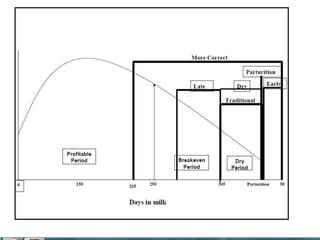
Traditionally it is the period from dry off
until parturition
 More correctly identified as these 4
separate physiological states the cow
undergoes:
– Late Lactation
– Dry period
– Parturition
– Early Lactation
Dry cow diets are often bulky and low in
nutrient density
» No production requirement
 When cows freshen, they are introduced
immediately to a very dense (rich in energy)
ration
 This will lead to many problems if not
handled properly
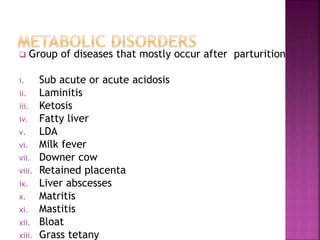
 Group of diseases that mostly occur after parturition
i. Sub acute or acute acidosis
ii. Laminitis
iii. Ketosis
iv. Fatty liver
v. LDA
vi. Milk fever
vii. Downer cow
viii. Retained placenta
ix. Liver abscesses
x. Matritis
xi. Mastitis
xii. Bloat
xiii. Grass tetany
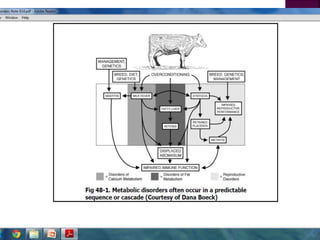
Important point is that all the metabolic
diseases are related to one another.
 Animals affected from milk fever is more
prone to
 Mastitis
 Left Displacement of abomasam
 Dystokia
 Udder odema
 Ketosis
 Cow related to acidosis is more prone to
 Lamininitis
 LDA
 Milk fever
 Mastitis
 Fatty liver
 Retained placenta is more prone to
 Metritis
 LDA
 Ketosis
Trying to trace single factor
Disease of high producing animals
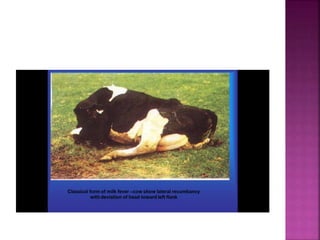
Etiology:
– Onset of lactation (usually first 72 hr postpartum)
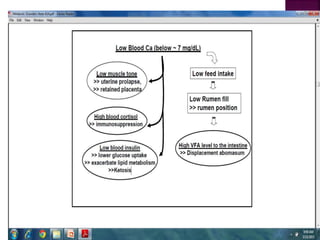
Normal:10mg/dL
MF: 5 mg/dL
– Affects older cows and Jersey breed more often
--Hypophosphatemia and hypomagnesiemia can
also be present
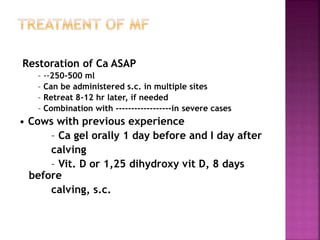
Restoration of Ca ASAP
– --250-500 ml
– Can be administered s.c. in multiple sites
– Retreat 8-12 hr later, if needed
– Combination with ------------------in severe cases
• Cows with previous experience
– Ca gel orally 1 day before and I day after
calving
– Vit. D or 1,25 dihydroxy vit D, 8 days
before
calving, s.c.
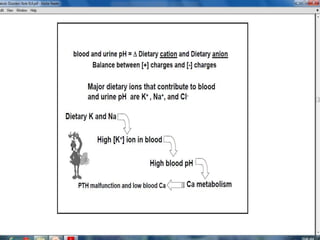
 Withhold K+ fertilization from a filed that is in
its last year of production and use that crop for
dry cows ?!
 ---(full bloom) and use late cuttings -------is not a
bad option
 Find low K+ hay source and combine with corn
silage (ration with < 2% K+)
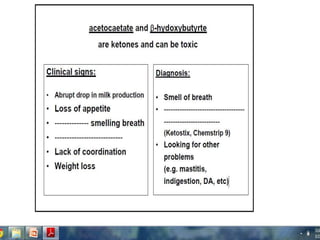
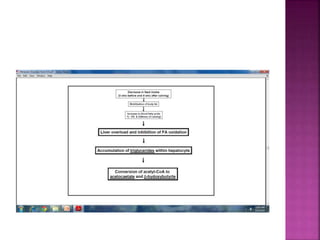
 ketosis and Fatty liver are most likely to occur during
periods when blood NEFA concentrations are elevated.
 Incomplete oxidation of NEFA leads to formation of
ketones – aceto acetate and
beta-hydroxy butyrate
 Mobilization of body reserves ensues
Etiology:
– Occurs during the ------------------------
postpartum
– Ketone bodies accumulate in the body fluid
– Affects high producing cows and cows that are
over conditioned during dry period
– 500 mL of 50% Dextrose solution (i.v.)
– Glucocorticoid injection (Dexametasone)
– Oral administration Propylene Gycol (PG)
7 days before calving
PG increase gulcose, reduces insulin>>
reduces fat mobilization
Feeding 3-12g of niacin per day may reduce blood ketones
Salts of propionic acid may be effective in lowering blood ketones
 ------------------ must not be compromised
before and after caving
 Be aggressive in treating other fresh-cow
diseases
(e.g. milk fever, retained placenta,etc.)
 Adjusting the diet ----------by increasing
appropriate amount of concentrates in the
ration.
Refers to repositioning of abomasum from the right ventral
abdominal wall
– Twisting and displacement slows or stops flow
of digesta
– ---------- leads to bloat appearance
• “Pinging” detected with stethoscope by thumping the cow
 near the last rib and listening on the left flank
– Displacements may be left or right sided (RDA,LDA)
 Most are left sided
 Symptoms
– Dramatically changes in the position of
abomasum
– Drastic decrease in milk
– Cows appear to be in pain/restless
 Most often diagnosed within 14 days
postpartum
 Non-surgical treatment
– Rolling cow over, taking on rough trailer ride
– Locating the abomasum, remove gas from
abomasum, toggle
– May only provide temporary relief
 Surgical treatment
– Pull abomasum into place and attach it
surgically to body wall
• Prevention
 Increasing the forage to concentrate ratio in diet
fed in late gestation and early lactation will
decrease the incidence
 Grain intake after calving should be increased
slowly (0.25 kg/day)
 Decline in the calcium around parturition
linearly decrease abomasal contractility, which is
suspected to lead to distension and abomasal
atony so supply ca in excess
Over-conditioning 􀃏 risk substantially
• Due to:
• High stress, Twins, etc.
• 12x as likely to retain placenta
• 4.9x as likely to have metritis
• Most often accompanied by the cascade
of fresh problems
• Rumen acidosis is associated with the feeding of diets with
higher grain amounts
 It commonly occurs in the first month of lactation
 Dry-off a cow is fed a high forage ration that is less energy
dense and higher in NDF than the lactation ration, it affects
rumen function
• Ruminal populations ill-suited to dense
rations after ~8 weeks on a dry cow diet
• Gram “-” toxins 􀃎 􀃎 immune function
• Failure of fetal membranes to be expelled
from the uterus within 12 to 24 hours
– Dystocia and twinning increases incidence of
retained placenta
– More common in older cows
– Increased incidence with fat cow syndrome
and hypocalcemia, among other things
RP is indirectly associated with the higher occurence of
cystic ovaries
 Extreme deficiency of dietary energy, protein or both can result in
RP.
 Diets low in dietary crude protein (8%) for the entire dry period had
a higher incidence (50%) of RP compared with cows fed 15% crude
protein (20% incidence).
 The rate of RP was associated with imbalances in Ca and P
metabolism
 When the diet contained at least 0.12 mg/kg of Se and 1000 IU of
dietary vitamin E per cow/day, the incidence of RP is lower.
 Avitaminosis of vitamin A
and β-Carotene was shown to increase the incidence of RP.
• Prevention
 Proper nutrition specially during dry period
 Supplementation with selenium
 Adequate amounts of vitamin A and fiber
 Proper body condition at calving
 Over-conditioned cows are at an increased risk
 Reduce dystocia– by proper managment
 Assisted deliveries increase risk of RP’s
 Characterized by excessive accumulation
of fluids in the intercellular tissue spaces of the
mammary gland.
 Excessive intakes of sodium and potassium were
implicated as causative agents
 Oxidative stress of mammary tissue resulting in
reactive oxygen metabolites may play a role in
udder edema
 A diet must supply adequate vitamin E, copper,
magnesium, zinc, manganese and selenium.
 It is most often associated with cows in early
lactation
grazing in pastures high in potassium and nitrogen
and low in magnesium and sodium
 The disease will be more severe if accompanied by
hypocalcemia.
 For prevention get an additional 10-15 g of Mg into
each pregnant cow and 30 g into each lactating cow
per day usually prevents further hypomagnesemic
tetany.
 Magnesium is readily acceptable in grain
concentrates.
 For 60 g of magnesium oxide just 0.5-1 kg of grain
will be effective.
 The lactic acid, endotoxins and histamine
released as the rumen flora die, are
absorbed systemically and affect the
microvasculature of the growing hoof wall,
which then result in clinical laminitis
 Avoiding an abrupt switch from dry-off ration
to high lactation ration will be a good start
for the prevention of laminitis.
Metabolic disorders in dairy animals

Metabolic disorders in dairy animals

  • 1.
    Prepared by Rai ShafqatAli Animal Science Division NIAB, Faisalabad
  • 2.
    Metabolic disorders relatesto disturbances of one or more metabolic processes in the animal/organisms In dairy animals the time of disease is important ---- 3weeks before and after parturition  Influencing factors are a. Hormonal changes b. Moving from non-lactating to lactating stage c. Changing of diet from roughages to highly fermentable CHO
  • 3.
    Metabolism is sumof  Physical  Chemical  Metabolic processes  relating to absorbance and breakdown or synthesis of necessary organic molecules in body  Disturbance of one or more metabolic processes related to regulation of a certain metabolites in the body fluids is known as metabolic disorders
  • 4.
    Traditionally it isthe period from dry off until parturition  More correctly identified as these 4 separate physiological states the cow undergoes: – Late Lactation – Dry period – Parturition – Early Lactation
  • 6.
    Dry cow dietsare often bulky and low in nutrient density » No production requirement  When cows freshen, they are introduced immediately to a very dense (rich in energy) ration  This will lead to many problems if not handled properly
  • 7.
     Group ofdiseases that mostly occur after parturition i. Sub acute or acute acidosis ii. Laminitis iii. Ketosis iv. Fatty liver v. LDA vi. Milk fever vii. Downer cow viii. Retained placenta ix. Liver abscesses x. Matritis xi. Mastitis xii. Bloat xiii. Grass tetany
  • 8.
    Important point isthat all the metabolic diseases are related to one another.  Animals affected from milk fever is more prone to  Mastitis  Left Displacement of abomasam  Dystokia  Udder odema  Ketosis
  • 9.
     Cow relatedto acidosis is more prone to  Lamininitis  LDA  Milk fever  Mastitis  Fatty liver  Retained placenta is more prone to  Metritis  LDA  Ketosis Trying to trace single factor
  • 11.
    Disease of highproducing animals Etiology: – Onset of lactation (usually first 72 hr postpartum) Normal:10mg/dL MF: 5 mg/dL – Affects older cows and Jersey breed more often --Hypophosphatemia and hypomagnesiemia can also be present
  • 15.
    Restoration of CaASAP – --250-500 ml – Can be administered s.c. in multiple sites – Retreat 8-12 hr later, if needed – Combination with ------------------in severe cases • Cows with previous experience – Ca gel orally 1 day before and I day after calving – Vit. D or 1,25 dihydroxy vit D, 8 days before calving, s.c.
  • 17.
     Withhold K+fertilization from a filed that is in its last year of production and use that crop for dry cows ?!  ---(full bloom) and use late cuttings -------is not a bad option  Find low K+ hay source and combine with corn silage (ration with < 2% K+)
  • 18.
     ketosis andFatty liver are most likely to occur during periods when blood NEFA concentrations are elevated.  Incomplete oxidation of NEFA leads to formation of ketones – aceto acetate and beta-hydroxy butyrate  Mobilization of body reserves ensues
  • 19.
    Etiology: – Occurs duringthe ------------------------ postpartum – Ketone bodies accumulate in the body fluid – Affects high producing cows and cows that are over conditioned during dry period
  • 22.
    – 500 mLof 50% Dextrose solution (i.v.) – Glucocorticoid injection (Dexametasone) – Oral administration Propylene Gycol (PG) 7 days before calving PG increase gulcose, reduces insulin>> reduces fat mobilization Feeding 3-12g of niacin per day may reduce blood ketones Salts of propionic acid may be effective in lowering blood ketones
  • 23.
     ------------------ mustnot be compromised before and after caving  Be aggressive in treating other fresh-cow diseases (e.g. milk fever, retained placenta,etc.)  Adjusting the diet ----------by increasing appropriate amount of concentrates in the ration.
  • 24.
    Refers to repositioningof abomasum from the right ventral abdominal wall – Twisting and displacement slows or stops flow of digesta – ---------- leads to bloat appearance • “Pinging” detected with stethoscope by thumping the cow  near the last rib and listening on the left flank – Displacements may be left or right sided (RDA,LDA)  Most are left sided
  • 25.
     Symptoms – Dramaticallychanges in the position of abomasum – Drastic decrease in milk – Cows appear to be in pain/restless  Most often diagnosed within 14 days postpartum
  • 26.
     Non-surgical treatment –Rolling cow over, taking on rough trailer ride – Locating the abomasum, remove gas from abomasum, toggle – May only provide temporary relief  Surgical treatment – Pull abomasum into place and attach it surgically to body wall
  • 27.
    • Prevention  Increasingthe forage to concentrate ratio in diet fed in late gestation and early lactation will decrease the incidence  Grain intake after calving should be increased slowly (0.25 kg/day)  Decline in the calcium around parturition linearly decrease abomasal contractility, which is suspected to lead to distension and abomasal atony so supply ca in excess
  • 28.
    Over-conditioning 􀃏 risksubstantially • Due to: • High stress, Twins, etc. • 12x as likely to retain placenta • 4.9x as likely to have metritis • Most often accompanied by the cascade of fresh problems
  • 29.
    • Rumen acidosisis associated with the feeding of diets with higher grain amounts  It commonly occurs in the first month of lactation  Dry-off a cow is fed a high forage ration that is less energy dense and higher in NDF than the lactation ration, it affects rumen function • Ruminal populations ill-suited to dense rations after ~8 weeks on a dry cow diet • Gram “-” toxins 􀃎 􀃎 immune function
  • 30.
    • Failure offetal membranes to be expelled from the uterus within 12 to 24 hours – Dystocia and twinning increases incidence of retained placenta – More common in older cows – Increased incidence with fat cow syndrome and hypocalcemia, among other things RP is indirectly associated with the higher occurence of cystic ovaries
  • 31.
     Extreme deficiencyof dietary energy, protein or both can result in RP.  Diets low in dietary crude protein (8%) for the entire dry period had a higher incidence (50%) of RP compared with cows fed 15% crude protein (20% incidence).  The rate of RP was associated with imbalances in Ca and P metabolism  When the diet contained at least 0.12 mg/kg of Se and 1000 IU of dietary vitamin E per cow/day, the incidence of RP is lower.  Avitaminosis of vitamin A and β-Carotene was shown to increase the incidence of RP.
  • 32.
    • Prevention  Propernutrition specially during dry period  Supplementation with selenium  Adequate amounts of vitamin A and fiber  Proper body condition at calving  Over-conditioned cows are at an increased risk  Reduce dystocia– by proper managment  Assisted deliveries increase risk of RP’s
  • 33.
     Characterized byexcessive accumulation of fluids in the intercellular tissue spaces of the mammary gland.  Excessive intakes of sodium and potassium were implicated as causative agents  Oxidative stress of mammary tissue resulting in reactive oxygen metabolites may play a role in udder edema  A diet must supply adequate vitamin E, copper, magnesium, zinc, manganese and selenium.
  • 34.
     It ismost often associated with cows in early lactation grazing in pastures high in potassium and nitrogen and low in magnesium and sodium  The disease will be more severe if accompanied by hypocalcemia.  For prevention get an additional 10-15 g of Mg into each pregnant cow and 30 g into each lactating cow per day usually prevents further hypomagnesemic tetany.  Magnesium is readily acceptable in grain concentrates.  For 60 g of magnesium oxide just 0.5-1 kg of grain will be effective.
  • 35.
     The lacticacid, endotoxins and histamine released as the rumen flora die, are absorbed systemically and affect the microvasculature of the growing hoof wall, which then result in clinical laminitis  Avoiding an abrupt switch from dry-off ration to high lactation ration will be a good start for the prevention of laminitis.