SUSAN SCHOENIAN (Shāy-nē-ŭn)
                            Sheep & Goat Specialist
                            Western Maryland Research & Education Center
                            sschoen@umd.edu - www.sheepandgoat.com


Nutrient -“a substance that provides nourishment”
1)   Water      Livestock do not require specific feedstuffs; they
                require nutrients in certain quantities and ratios.

2)   Protein

3)   Energy

4)   Fat

5)   Vitamins

6)   Minerals
   Many (most) feedstuffs
    contain more than one of
    the essential six nutrients.

   Feedstuffs vary
    considerably in their
    content of the six essential
    nutrients.

   No single feedstuff can
    supply all six essential
    nutrients that an animal
    needs to survive and thrive.
   There are “linkages” or
    relationships between
    essential nutrients.
   You have to “balance” the
    ratio of different feed
    ingredients to meet the
    individual animal’s needs.
   The nutrient needs of an
    animal varies depending
    upon species, age, stage
    and level of production,
    and other factors.
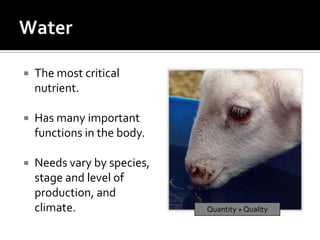
   The most critical
    nutrient.

   Has many important
    functions in the body.

   Needs vary by species,
    stage and level of
    production, and
    climate.                 Quantity + Quality
Feedstuff                       % DM
Lettuce                        5 percent
Pumpkins                      10 percent
Orchardgrass pasture          24 percent
Corn silage                   34 percent
Wet distiller’s grains        25 percent
Molasses, cane                76 percent
Grass hay                     88 percent
Whole corn                    88 percent
Ground limestone              98 percent
Urea                          99 percent                          Pineapple

  Feedstuffs contain water. The amount of moisture in the feed must be considered
     when balancing rations. Rations are balanced on a dry matter (DM) basis.
   Nutrient needed in the
    greatest quantity.
   Building blocks for other
    nutrients.
   Dietary excess is stored
    as fat.
   Expressed as
    1.   TDN - total digestible nutrients
    2.   ME - metabolizable energy
    3.   NE - net energy
         [maintenance, gain, and lactation]
Feedstuff              % TDN
Urea                  0 percent
Oat straw            48 percent
Orchardgrass hay     59 percent
Grass silage         61 percent
Fescue pasture       64 percent
Dry beet pulp        75 percent
Barley               84 percent
Corn                 88 percent
Bread by-product     91 percent
Distiller’s grains   92 percent
Fat                  195 percent
   Cheapest energy source.
   2.25x as much energy as
    carbohydrates.
   Used to raise energy level
    of feed, improve flavor,
    texture, and palatability.
   Source of heat, insulation
    and body protection.
   Essential fatty acids.

   Can manipulate to change
    nutritional profile of meat.
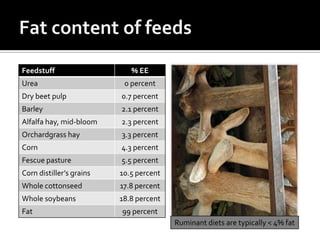
Feedstuff                    % EE
Urea                       0 percent
Dry beet pulp             0.7 percent
Barley                    2.1 percent
Alfalfa hay, mid-bloom    2.3 percent
Orchardgrass hay          3.3 percent
Corn                      4.3 percent
Fescue pasture            5.5 percent
Corn distiller’s grains   10.5 percent
Whole cottonseed          17.8 percent
Whole soybeans            18.8 percent
Fat                       99 percent
                                         Ruminant diets are typically < 4% fat
 Most expensive ingredient in
  feed ration.
 Need decreases as animal
  matures.
 Source of essential amino
  acids.
 Excess dietary protein is
  converted to energy, fat.
   Expressed as
     CP - crude protein
      ▪ DIP – degradable intake protein
      ▪ UIP – undegradable intake protein
     MP - metabolizable protein
      [microbial protein + UIP]
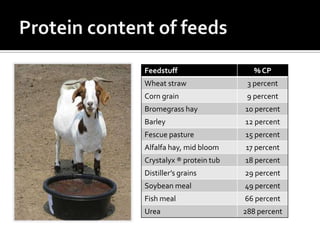
Feedstuff                    % CP
Wheat straw                3 percent
Corn grain                 9 percent
Bromegrass hay            10 percent
Barley                    12 percent
Fescue pasture            15 percent
Alfalfa hay, mid bloom    17 percent
Crystalyx ® protein tub   18 percent
Distiller’s grains        29 percent
Soybean meal              49 percent
Fish meal                 66 percent
Urea                      288 percent
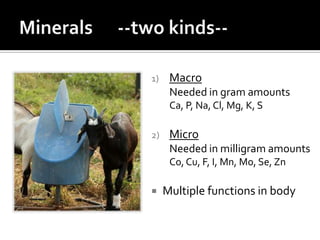
1)    Macro
      Needed in gram amounts
      Ca, P, Na, Cl, Mg, K, S

2)    Micro
      Needed in milligram amounts
      Co, Cu, F, I, Mn, Mo, Se, Zn

    Multiple functions in body
Dry matter basis             Ca              P          Ca: P
Corn                     0.02 percent   0.30 percent    0.07
Barley                   0.06 percent   0.38 percent    0.16
Soybean meal             0.28 percent   0.71 percent    0.39
Orchardgrass hay         0.32 percent   0.30 percent    1.07
Fescue pasture           0.48 percent   0.37 percent    1.30
Soybean hulls            0.55 percent   0.17 percent    3.24
Alfalfa hay, mid-bloom   1.4 percent    0.24 percent    5.83
Dried kelp               2.72 percent   0.31 percent    8.77
Dicalcium phosphate      22 percent     18.65 percent   1.18
Bone meal                 27 percent    12.74 percent   2.12
Ground limestone         34 percent     0.02 percent    1700
1)    Water soluble
      B&C

2)    Fat soluble
      A, D, E , & K


    Multiple functions in body.
    Requirements increase
     with age.

    No dietary requirement for
     vitamin K or B complex.
Vitamin                               Feedstuff
β-caroteen               Green, pasture forage; dehydrated hay;
 (vitamin A)                cured hay, vitamin supplements
     D         Ultraviolet irradiation, sun-cured hays, vitamin supplements
     E                High quality legume hay, dehydrated alfalfa,
                           wheat germ, vitamin supplements
     K            Green, leafy feedstuffs (K1). K2 synthesized in rumen
     B                      Not required in diets of ruminants
1)   Ca - Vitamin D

2)   P   - Vitamin D

3)   Co - Vitamin B12

4)   Se - vitamin E

5)   Cu - Mo - S
1)   Acid detergent fiber
                                   (ADF)
                                   Cellulose + Lignin
                                   ADF Forage quality

                              2)   Neutral detergent fiber
                                   (NDF)
                                   Hemicellulose + Cellulose + Lignin


                                    NDF  Intake
TDN is calculated from ADF.
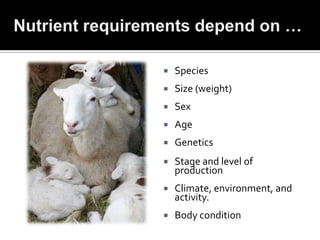
   Species
   Size (weight)
   Sex
   Age
   Genetics
   Stage and level of
    production
   Climate, environment, and
    activity.
   Body condition
5.0

               4.5
Lbs. per day


               4.0

               3.5

               3.0

               2.5

               2.0

               1.5

               1.0
                      Maintenance           Early Gestation    Late gestation      Early lactation

                     Dairy doe      Non-dairy doe        Ewe   Parlor-milked ewe   Parlor-milked doe

                                                                                       NRC 2007
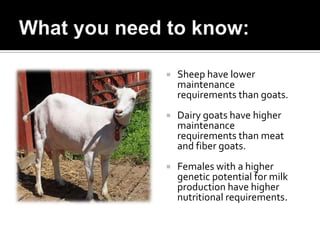
   Sheep have lower
    maintenance
    requirements than goats.
   Dairy goats have higher
    maintenance
    requirements than meat
    and fiber goats.
   Females with a higher
    genetic potential for milk
    production have higher
    nutritional requirements.
7.0
               6.5                                                  110-lb. ewe
               6.0
               5.5                                                  154-lb. ewe
               5.0
               4.5
                                                                    198-lb. ewe
Lbs. per day


               4.0
               3.5
               3.0
               2.5                                            52%
               2.0
               1.5
                                                        66%
               1.0
               0.5                                66%
               0.0
                                                                      10% 10% 8.5%

                     Dry matter intake   As fed   Energy (TDN)       Protein (CP)


                                                                          NRC, 2007
4.5                                                  66-lb. doe
               4.0                                                  110-lb. doe
               3.5                                                  154-lb. doe
               3.0
Lbs. per day


               2.5

               2.0
                                                              66%
               1.5

               1.0                                      66%

               0.5                                80%
                                                                         15% 13% 13%
               0.0
                     Dry matter intake   As fed   Energy (TDN)           Protein (CP)


                                                                     NRC, 2007, Errata
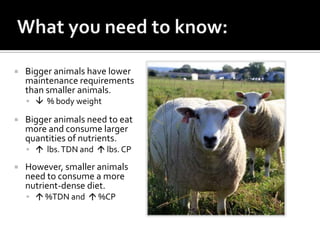
   Bigger animals have lower
    maintenance requirements
    than smaller animals.
      % body weight

   Bigger animals need to eat
    more and consume larger
    quantities of nutrients.
      lbs. TDN and  lbs. CP

   However, smaller animals
    need to consume a more
    nutrient-dense diet.
      %TDN and  %CP
176-lb. mature ewe (twins)
               5.0                                   132-lb. ewe lamb (twins)
               4.5                                   110-lb. ewe lamb (twins)
               4.0                                   110-lb. ewe lamb (single)
Lbs. per day


               3.5
               3.0
               2.5

               2.0                              -- 79% --

               1.5

               1.0
                                                                       ~10%
               0.5                        66%
               0.0
                     DM intake   As fed   Energy (TDN)           Protein (CP)


        NRC, 2007
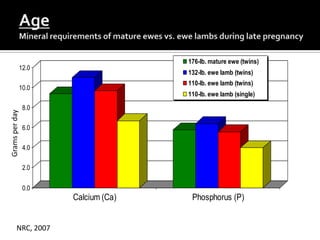
176-lb. mature ewe (twins)
            12.0
                                     132-lb. ewe lamb (twins)
                                     110-lb. ewe lamb (twins)
            10.0
                                     110-lb. ewe lamb (single)

                8.0
Grams per day


                6.0

                4.0

                2.0


                0.0
                      Calcium (Ca)    Phosphorus (P)


        NRC, 2007
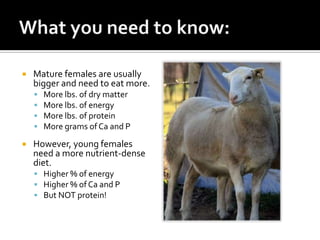
   Mature females are usually
    bigger and need to eat more.
       More lbs. of dry matter
       More lbs. of energy
       More lbs. of protein
       More grams of Ca and P
   However, young females
    need a more nutrient-dense
    diet.
     Higher % of energy
     Higher % of Ca and P
     But NOT protein!
5.5
               5.0
               4.5
               4.0
               3.5
Lbs. per day


               3.0
                                                                        66%
               2.5
               2.0                                                66%

               1.5
                                                            53%
               1.0
               0.5                                    53%
                                                                                 7%   8% 10% 15%
               0.0
                     DM intake         As fed         Energy (TDN)               Protein (CP)

                     Maintenance   Early gestation   Late gestation           Early lactation

    NRC 2007
10.0

                 8.0
Grams per day


                 6.0

                 4.0

                 2.0

                 0.0
                                Calcium                           Phosphorus

                       Maintenance   Early gestation   Late gestation   Early lactation

NRC, 2007
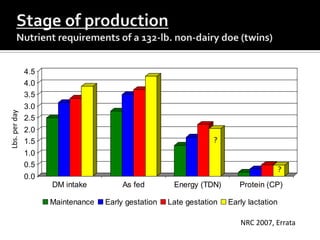
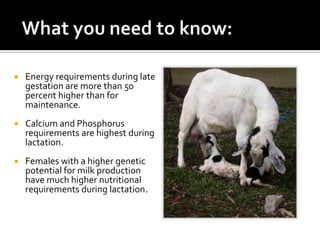
   Energy requirements during late
    gestation are more than 50 percent
    higher than for maintenance.
   Ewes require a more nutrient-dense
    diet during late gestation and
    lactation.
   Protein requirements don’t
    increase significantly until the
    female begins to lactate.
   Calcium requirements are highest
    during late gestation.
   Phosphorus requirements are
    highest during lactation.
4.5
               4.0
               3.5
               3.0
Lbs. per day


               2.5
               2.0
               1.5                                               ?
               1.0
               0.5
                                                                                        ?
               0.0
                     DM intake          As fed        Energy (TDN)       Protein (CP)

                     Maintenance   Early gestation   Late gestation   Early lactation

                                                                         NRC 2007, Errata
10.0

                 8.0
Grams per day


                 6.0

                 4.0

                 2.0

                 0.0
                                Calcium                           Phosphorus

                       Maintenance   Early gestation   Late gestation   Early lactation

NRC, 2007
8.0
               7.0
               6.0
               5.0
Lbs. per day


               4.0
               3.0
               2.0
               1.0
               0.0
                     DM intake          As fed        Energy (TDN)       Protein (CP)

                     Maintenance   Early gestation   Late gestation   Early lactation

                                                                         NRC 2007 Errata
   Energy requirements during late
    gestation are more than 50
    percent higher than for
    maintenance.
   Calcium and Phosphorus
    requirements are highest during
    lactation.
   Females with a higher genetic
    potential for milk production
    have much higher nutritional
    requirements during lactation.
6.0
                                                             Single lamb
               5.0                                           Twin lambs
                                                             Three or more
               4.0
Lbs. per day


               3.0
                                                       66%
               2.0
                                                 66%
                                           53%
               1.0
                                                               8.3%   10   10%
               0.0                                                    %
                     DM intake   As fed   Energy (TDN)        Protein (CP)


    NRC, 2007
12.0
                                 Single lamb
                10.0             Twin lambs
                                 Three or more
Grams per day


                 8.0

                 6.0

                 4.0

                 2.0

                 0.0
                       Calcium      Phosphorus


    NRC, 2007
   Ewes carrying twins and
    triplets need to eat more.
     Dry matter
     Energy (TDN)
     Protein (CP)
     Calcium and phosphorus

   Ewes carrying twins and
    triplets need a more
    nutrient-dense diet.
   A ewe carrying triplets needs
    43% more energy than a ewe
    carrying a single fetus.
Single lamb
               6.0                                      Twin lambs
                                                        Three or more
               5.0                                      Parlor milked

               4.0
Lbs. per day


                                                      80%
               3.0
                                                66%
               2.0

               1.0                        53%
                                                                           19%
                                                                     15%
                                                               11%
               0.0
                     DM intake   As fed   Energy (TDN)        Protein (CP)


    NRC, 2007
Single kid
               8.0                              Twin kids
                                                Three or more
               7.0                              Parlor milked
               6.0
Lbs. per day


                                                             79%
               5.0
                                                       66%
               4.0
                                                 53%
               3.0                        53%
               2.0
               1.0
               0.0
                     DM intake   As fed   Energy (TDN)


    NRC, 2007
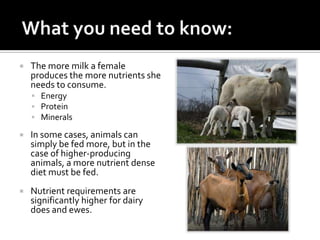
   The more milk a female
    produces the more nutrients she
    needs to consume.
     Energy
     Protein
     Minerals

   In some cases, animals can
    simply be fed more, but in the
    case of higher-producing
    animals, a more nutrient dense
    diet must be fed.
   Nutrient requirements are
    significantly higher for dairy
    does and ewes.
   Their nutritional
    requirements are
    affected by many
    of the same factors.

     Age
     Species
     Size
     Genetic type and potential
     Level of performance
     Environment, activity
EARLY MATURING                               LATE MATURING
                            4 months old          8 months old         4 months old         8 months old
               4.0

               3.5                         5.5%

               3.0
Lbs. per day


                                                                       79%
               2.5                  4.2%

               2.0          3.4%                                 79%

                                                           79%
               1.5
                     2.9%

               1.0
                                                     66%
               0.5
                                                                                  18% 15%
                                                                                                 12% 9%
               0.0
                               DM                            TDN                            CP


        NRC, 2007
   Assuming the same size
    and rate-of-gain:
     Young lambs convert feed
      more efficiently, but need a
      higher percentage of
      protein in their diet.
     Older lambs need to eat
      more and require a more
      digestible diet to achieve
      the same rate-of-gain.
     Later maturing lambs need
      to eat more, but have lower
      protein requirements.
4.0
                                               Weight   % TDN      % CP
               3.5
                                                22      87.5%      16.5%
                                                44      67.1%      11.2%
               3.0
                                                66      67.0%      10.7%
Lbs. per day


               2.5                              88      48.9%       7.6%

               2.0

               1.5

               1.0

               0.5

               0.0
                     AS FED      DM        TDN                    CP
                       22 lbs.   44 lbs.   66 lbs.              88 lbs.


        NRC, 2007
   Assuming the same rate
    of gain (0.22 lbs/day):

     Smaller kids (weight) need
      to consume a more
      nutrient-dense diet, both
      energy and protein.

     Bigger kids need to
      consume more quantity of
      nutrients, but the diet does
      not need to be as high         Weight
                                      22
                                              % TDN
                                              87.5%
                                                      % CP
                                                      16.5%
      quality (% TDN, CP).            44      67.1%   11.2%
                                      66      67.0%   10.7%
                                      88      48.9%    7.6%
3.0                                     Type      % TDN    % CP
                                                       Dairy     87.7%    14.4%
                                                       Boer      66.3%    15.1%
               2.5                                  Indigenous   67.0%    13.0%

               2.0
Lbs. per day


               1.5

               1.0

               0.5

               0.0
                     AS FED           DM          TDN                    CP

                              Dairy        Boer    Indigenous
   Assuming the same rate of gain
                                 (0.44 lbs/day).

                                  Dairy goat bucks don’t need to eat
                                   as much as Boer bucks, but their diet
                                   needs to be more energy-dense.

                                  Boer bucks need to eat the
                                   most, but their diet doesn’t need to
                                   be as energy-dense.

                                  Boer bucks have the highest
                                   requirements for protein: lbs. and %.

                                  Indigenous (local) breed goats have
   Type      % TDN   % CP          lower requirements for protein than
   Dairy     87.7%   14.4%         improved breeds.
   Boer      66.3%   15.1%
Indigenous   67.0%   13.0%
2.5

               2.0
Lbs. per day


               1.5

               1.0

               0.5

               0.0
                     As Fed          DM              TDN             CP

                              Doelings and wethers    Intact males
   Assuming the same rate of
    gain (0.44 lbs/day).

     Bucks need to eat more dry
      matter and energy.

     Bucks and does require the
      same amount of protein.

     But since does eat less, they
      require a higher percentage of
      protein in their diet.

     Realistically, the differences
      will be larger as bucks will gain
                                                Sex           % TDN   % CP
      faster and you don’t want to        Doelings, wethers   65.8%   15.9%
      feed does to gain as fast.            Intact males      66.3%   14.5%
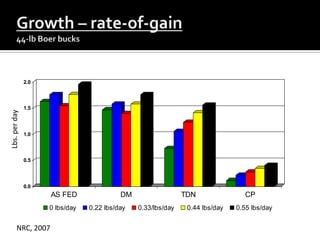
2.0


               1.5
Lbs. per day


               1.0


               0.5


               0.0
                     AS FED                DM                  TDN                CP
                     0 lbs/day   0.22 lbs/day   0.33/lbs/day    0.44 lbs/day   0.55 lbs/day


        NRC, 2007
   Assuming the same genetic
    potential for growth:

     The more you feed a kid or lamb
      the more it will gain.

     Better performance requires
      both more feed and better
      quality feed.

       ▪ Higher % TDN
       ▪ Higher % CP

     The bigger question is: is better       ADG
                                            0 lbs/day
                                                         % TDN
                                                         49.7%
                                                                 % CP
                                                                  7.8%
      performance economical?             0.22 lbs/day   67.1%   13.8%
                                          0.33/lbs/day   87.9%   19.9%
                                          0.44 lbs/day   89.2%   21.7%
                                          0.55 lbs/day   88.6%   23.1%
Next webinar – Thursday, 1/26, 7:30 p.m. EST
                             Topic: Feedstuffs w/Jeff Semler


  Thank you for your
     attention.

   Any questions?


   Susan Schoenian
  sschoen@umd.edu
www.sheepandgoat.com

Nutrients

  • 1.
    SUSAN SCHOENIAN (Shāy-nē-ŭn) Sheep & Goat Specialist Western Maryland Research & Education Center sschoen@umd.edu - www.sheepandgoat.com Nutrient -“a substance that provides nourishment”
  • 2.
    1) Water Livestock do not require specific feedstuffs; they require nutrients in certain quantities and ratios. 2) Protein 3) Energy 4) Fat 5) Vitamins 6) Minerals
  • 3.
    Many (most) feedstuffs contain more than one of the essential six nutrients.  Feedstuffs vary considerably in their content of the six essential nutrients.  No single feedstuff can supply all six essential nutrients that an animal needs to survive and thrive.
  • 4.
    There are “linkages” or relationships between essential nutrients.  You have to “balance” the ratio of different feed ingredients to meet the individual animal’s needs.  The nutrient needs of an animal varies depending upon species, age, stage and level of production, and other factors.
  • 5.
    The most critical nutrient.  Has many important functions in the body.  Needs vary by species, stage and level of production, and climate. Quantity + Quality
  • 6.
    Feedstuff % DM Lettuce 5 percent Pumpkins 10 percent Orchardgrass pasture 24 percent Corn silage 34 percent Wet distiller’s grains 25 percent Molasses, cane 76 percent Grass hay 88 percent Whole corn 88 percent Ground limestone 98 percent Urea 99 percent Pineapple Feedstuffs contain water. The amount of moisture in the feed must be considered when balancing rations. Rations are balanced on a dry matter (DM) basis.
  • 7.
    Nutrient needed in the greatest quantity.  Building blocks for other nutrients.  Dietary excess is stored as fat.  Expressed as 1. TDN - total digestible nutrients 2. ME - metabolizable energy 3. NE - net energy [maintenance, gain, and lactation]
  • 8.
    Feedstuff % TDN Urea 0 percent Oat straw 48 percent Orchardgrass hay 59 percent Grass silage 61 percent Fescue pasture 64 percent Dry beet pulp 75 percent Barley 84 percent Corn 88 percent Bread by-product 91 percent Distiller’s grains 92 percent Fat 195 percent
  • 9.
    Cheapest energy source.  2.25x as much energy as carbohydrates.  Used to raise energy level of feed, improve flavor, texture, and palatability.  Source of heat, insulation and body protection.  Essential fatty acids.  Can manipulate to change nutritional profile of meat.
  • 10.
    Feedstuff % EE Urea 0 percent Dry beet pulp 0.7 percent Barley 2.1 percent Alfalfa hay, mid-bloom 2.3 percent Orchardgrass hay 3.3 percent Corn 4.3 percent Fescue pasture 5.5 percent Corn distiller’s grains 10.5 percent Whole cottonseed 17.8 percent Whole soybeans 18.8 percent Fat 99 percent Ruminant diets are typically < 4% fat
  • 11.
     Most expensiveingredient in feed ration.  Need decreases as animal matures.  Source of essential amino acids.  Excess dietary protein is converted to energy, fat.  Expressed as  CP - crude protein ▪ DIP – degradable intake protein ▪ UIP – undegradable intake protein  MP - metabolizable protein [microbial protein + UIP]
  • 12.
    Feedstuff % CP Wheat straw 3 percent Corn grain 9 percent Bromegrass hay 10 percent Barley 12 percent Fescue pasture 15 percent Alfalfa hay, mid bloom 17 percent Crystalyx ® protein tub 18 percent Distiller’s grains 29 percent Soybean meal 49 percent Fish meal 66 percent Urea 288 percent
  • 13.
    1) Macro Needed in gram amounts Ca, P, Na, Cl, Mg, K, S 2) Micro Needed in milligram amounts Co, Cu, F, I, Mn, Mo, Se, Zn  Multiple functions in body
  • 14.
    Dry matter basis Ca P Ca: P Corn 0.02 percent 0.30 percent 0.07 Barley 0.06 percent 0.38 percent 0.16 Soybean meal 0.28 percent 0.71 percent 0.39 Orchardgrass hay 0.32 percent 0.30 percent 1.07 Fescue pasture 0.48 percent 0.37 percent 1.30 Soybean hulls 0.55 percent 0.17 percent 3.24 Alfalfa hay, mid-bloom 1.4 percent 0.24 percent 5.83 Dried kelp 2.72 percent 0.31 percent 8.77 Dicalcium phosphate 22 percent 18.65 percent 1.18 Bone meal 27 percent 12.74 percent 2.12 Ground limestone 34 percent 0.02 percent 1700
  • 15.
    1) Water soluble B&C 2) Fat soluble A, D, E , & K  Multiple functions in body.  Requirements increase with age.  No dietary requirement for vitamin K or B complex.
  • 16.
    Vitamin Feedstuff β-caroteen Green, pasture forage; dehydrated hay; (vitamin A) cured hay, vitamin supplements D Ultraviolet irradiation, sun-cured hays, vitamin supplements E High quality legume hay, dehydrated alfalfa, wheat germ, vitamin supplements K Green, leafy feedstuffs (K1). K2 synthesized in rumen B Not required in diets of ruminants
  • 17.
    1) Ca - Vitamin D 2) P - Vitamin D 3) Co - Vitamin B12 4) Se - vitamin E 5) Cu - Mo - S
  • 18.
    1) Acid detergent fiber (ADF) Cellulose + Lignin ADF Forage quality 2) Neutral detergent fiber (NDF) Hemicellulose + Cellulose + Lignin  NDF  Intake TDN is calculated from ADF.
  • 19.
    Species  Size (weight)  Sex  Age  Genetics  Stage and level of production  Climate, environment, and activity.  Body condition
  • 20.
    5.0 4.5 Lbs. per day 4.0 3.5 3.0 2.5 2.0 1.5 1.0 Maintenance Early Gestation Late gestation Early lactation Dairy doe Non-dairy doe Ewe Parlor-milked ewe Parlor-milked doe NRC 2007
  • 21.
    Sheep have lower maintenance requirements than goats.  Dairy goats have higher maintenance requirements than meat and fiber goats.  Females with a higher genetic potential for milk production have higher nutritional requirements.
  • 22.
    7.0 6.5 110-lb. ewe 6.0 5.5 154-lb. ewe 5.0 4.5 198-lb. ewe Lbs. per day 4.0 3.5 3.0 2.5 52% 2.0 1.5 66% 1.0 0.5 66% 0.0 10% 10% 8.5% Dry matter intake As fed Energy (TDN) Protein (CP) NRC, 2007
  • 23.
    4.5 66-lb. doe 4.0 110-lb. doe 3.5 154-lb. doe 3.0 Lbs. per day 2.5 2.0 66% 1.5 1.0 66% 0.5 80% 15% 13% 13% 0.0 Dry matter intake As fed Energy (TDN) Protein (CP) NRC, 2007, Errata
  • 24.
    Bigger animals have lower maintenance requirements than smaller animals.   % body weight  Bigger animals need to eat more and consume larger quantities of nutrients.   lbs. TDN and  lbs. CP  However, smaller animals need to consume a more nutrient-dense diet.   %TDN and  %CP
  • 25.
    176-lb. mature ewe(twins) 5.0 132-lb. ewe lamb (twins) 4.5 110-lb. ewe lamb (twins) 4.0 110-lb. ewe lamb (single) Lbs. per day 3.5 3.0 2.5 2.0 -- 79% -- 1.5 1.0 ~10% 0.5 66% 0.0 DM intake As fed Energy (TDN) Protein (CP) NRC, 2007
  • 26.
    176-lb. mature ewe(twins) 12.0 132-lb. ewe lamb (twins) 110-lb. ewe lamb (twins) 10.0 110-lb. ewe lamb (single) 8.0 Grams per day 6.0 4.0 2.0 0.0 Calcium (Ca) Phosphorus (P) NRC, 2007
  • 27.
    Mature females are usually bigger and need to eat more.  More lbs. of dry matter  More lbs. of energy  More lbs. of protein  More grams of Ca and P  However, young females need a more nutrient-dense diet.  Higher % of energy  Higher % of Ca and P  But NOT protein!
  • 28.
    5.5 5.0 4.5 4.0 3.5 Lbs. per day 3.0 66% 2.5 2.0 66% 1.5 53% 1.0 0.5 53% 7% 8% 10% 15% 0.0 DM intake As fed Energy (TDN) Protein (CP) Maintenance Early gestation Late gestation Early lactation NRC 2007
  • 29.
    10.0 8.0 Grams per day 6.0 4.0 2.0 0.0 Calcium Phosphorus Maintenance Early gestation Late gestation Early lactation NRC, 2007
  • 30.
    Energy requirements during late gestation are more than 50 percent higher than for maintenance.  Ewes require a more nutrient-dense diet during late gestation and lactation.  Protein requirements don’t increase significantly until the female begins to lactate.  Calcium requirements are highest during late gestation.  Phosphorus requirements are highest during lactation.
  • 31.
    4.5 4.0 3.5 3.0 Lbs. per day 2.5 2.0 1.5 ? 1.0 0.5 ? 0.0 DM intake As fed Energy (TDN) Protein (CP) Maintenance Early gestation Late gestation Early lactation NRC 2007, Errata
  • 32.
    10.0 8.0 Grams per day 6.0 4.0 2.0 0.0 Calcium Phosphorus Maintenance Early gestation Late gestation Early lactation NRC, 2007
  • 33.
    8.0 7.0 6.0 5.0 Lbs. per day 4.0 3.0 2.0 1.0 0.0 DM intake As fed Energy (TDN) Protein (CP) Maintenance Early gestation Late gestation Early lactation NRC 2007 Errata
  • 34.
    Energy requirements during late gestation are more than 50 percent higher than for maintenance.  Calcium and Phosphorus requirements are highest during lactation.  Females with a higher genetic potential for milk production have much higher nutritional requirements during lactation.
  • 35.
    6.0 Single lamb 5.0 Twin lambs Three or more 4.0 Lbs. per day 3.0 66% 2.0 66% 53% 1.0 8.3% 10 10% 0.0 % DM intake As fed Energy (TDN) Protein (CP) NRC, 2007
  • 36.
    12.0 Single lamb 10.0 Twin lambs Three or more Grams per day 8.0 6.0 4.0 2.0 0.0 Calcium Phosphorus NRC, 2007
  • 37.
    Ewes carrying twins and triplets need to eat more.  Dry matter  Energy (TDN)  Protein (CP)  Calcium and phosphorus  Ewes carrying twins and triplets need a more nutrient-dense diet.  A ewe carrying triplets needs 43% more energy than a ewe carrying a single fetus.
  • 38.
    Single lamb 6.0 Twin lambs Three or more 5.0 Parlor milked 4.0 Lbs. per day 80% 3.0 66% 2.0 1.0 53% 19% 15% 11% 0.0 DM intake As fed Energy (TDN) Protein (CP) NRC, 2007
  • 39.
    Single kid 8.0 Twin kids Three or more 7.0 Parlor milked 6.0 Lbs. per day 79% 5.0 66% 4.0 53% 3.0 53% 2.0 1.0 0.0 DM intake As fed Energy (TDN) NRC, 2007
  • 40.
    The more milk a female produces the more nutrients she needs to consume.  Energy  Protein  Minerals  In some cases, animals can simply be fed more, but in the case of higher-producing animals, a more nutrient dense diet must be fed.  Nutrient requirements are significantly higher for dairy does and ewes.
  • 41.
    Their nutritional requirements are affected by many of the same factors.  Age  Species  Size  Genetic type and potential  Level of performance  Environment, activity
  • 42.
    EARLY MATURING LATE MATURING 4 months old 8 months old 4 months old 8 months old 4.0 3.5 5.5% 3.0 Lbs. per day 79% 2.5 4.2% 2.0 3.4% 79% 79% 1.5 2.9% 1.0 66% 0.5 18% 15% 12% 9% 0.0 DM TDN CP NRC, 2007
  • 43.
    Assuming the same size and rate-of-gain:  Young lambs convert feed more efficiently, but need a higher percentage of protein in their diet.  Older lambs need to eat more and require a more digestible diet to achieve the same rate-of-gain.  Later maturing lambs need to eat more, but have lower protein requirements.
  • 44.
    4.0 Weight % TDN % CP 3.5 22 87.5% 16.5% 44 67.1% 11.2% 3.0 66 67.0% 10.7% Lbs. per day 2.5 88 48.9% 7.6% 2.0 1.5 1.0 0.5 0.0 AS FED DM TDN CP 22 lbs. 44 lbs. 66 lbs. 88 lbs. NRC, 2007
  • 45.
    Assuming the same rate of gain (0.22 lbs/day):  Smaller kids (weight) need to consume a more nutrient-dense diet, both energy and protein.  Bigger kids need to consume more quantity of nutrients, but the diet does not need to be as high Weight 22 % TDN 87.5% % CP 16.5% quality (% TDN, CP). 44 67.1% 11.2% 66 67.0% 10.7% 88 48.9% 7.6%
  • 46.
    3.0 Type % TDN % CP Dairy 87.7% 14.4% Boer 66.3% 15.1% 2.5 Indigenous 67.0% 13.0% 2.0 Lbs. per day 1.5 1.0 0.5 0.0 AS FED DM TDN CP Dairy Boer Indigenous
  • 47.
    Assuming the same rate of gain (0.44 lbs/day).  Dairy goat bucks don’t need to eat as much as Boer bucks, but their diet needs to be more energy-dense.  Boer bucks need to eat the most, but their diet doesn’t need to be as energy-dense.  Boer bucks have the highest requirements for protein: lbs. and %.  Indigenous (local) breed goats have Type % TDN % CP lower requirements for protein than Dairy 87.7% 14.4% improved breeds. Boer 66.3% 15.1% Indigenous 67.0% 13.0%
  • 48.
    2.5 2.0 Lbs. per day 1.5 1.0 0.5 0.0 As Fed DM TDN CP Doelings and wethers Intact males
  • 49.
    Assuming the same rate of gain (0.44 lbs/day).  Bucks need to eat more dry matter and energy.  Bucks and does require the same amount of protein.  But since does eat less, they require a higher percentage of protein in their diet.  Realistically, the differences will be larger as bucks will gain Sex % TDN % CP faster and you don’t want to Doelings, wethers 65.8% 15.9% feed does to gain as fast. Intact males 66.3% 14.5%
  • 50.
    2.0 1.5 Lbs. per day 1.0 0.5 0.0 AS FED DM TDN CP 0 lbs/day 0.22 lbs/day 0.33/lbs/day 0.44 lbs/day 0.55 lbs/day NRC, 2007
  • 51.
    Assuming the same genetic potential for growth:  The more you feed a kid or lamb the more it will gain.  Better performance requires both more feed and better quality feed. ▪ Higher % TDN ▪ Higher % CP  The bigger question is: is better ADG 0 lbs/day % TDN 49.7% % CP 7.8% performance economical? 0.22 lbs/day 67.1% 13.8% 0.33/lbs/day 87.9% 19.9% 0.44 lbs/day 89.2% 21.7% 0.55 lbs/day 88.6% 23.1%
  • 52.
    Next webinar –Thursday, 1/26, 7:30 p.m. EST Topic: Feedstuffs w/Jeff Semler Thank you for your attention. Any questions? Susan Schoenian sschoen@umd.edu www.sheepandgoat.com