Presented By:
Dr. Dharmesh Tewari
Assistant Professor
Acharya Narendra Deva University of Agriculture & Technology
Kumarganj, Ayodhya, Uttar Pradesh-224229
GOAT NUTRITION
Advantages of Goat Farming
Minimal space is required
Feeding needs are less
Low maintenance
Faster growth
Easy to train and handle
High prolificacy
Inexpensive to keep
Easily marketable
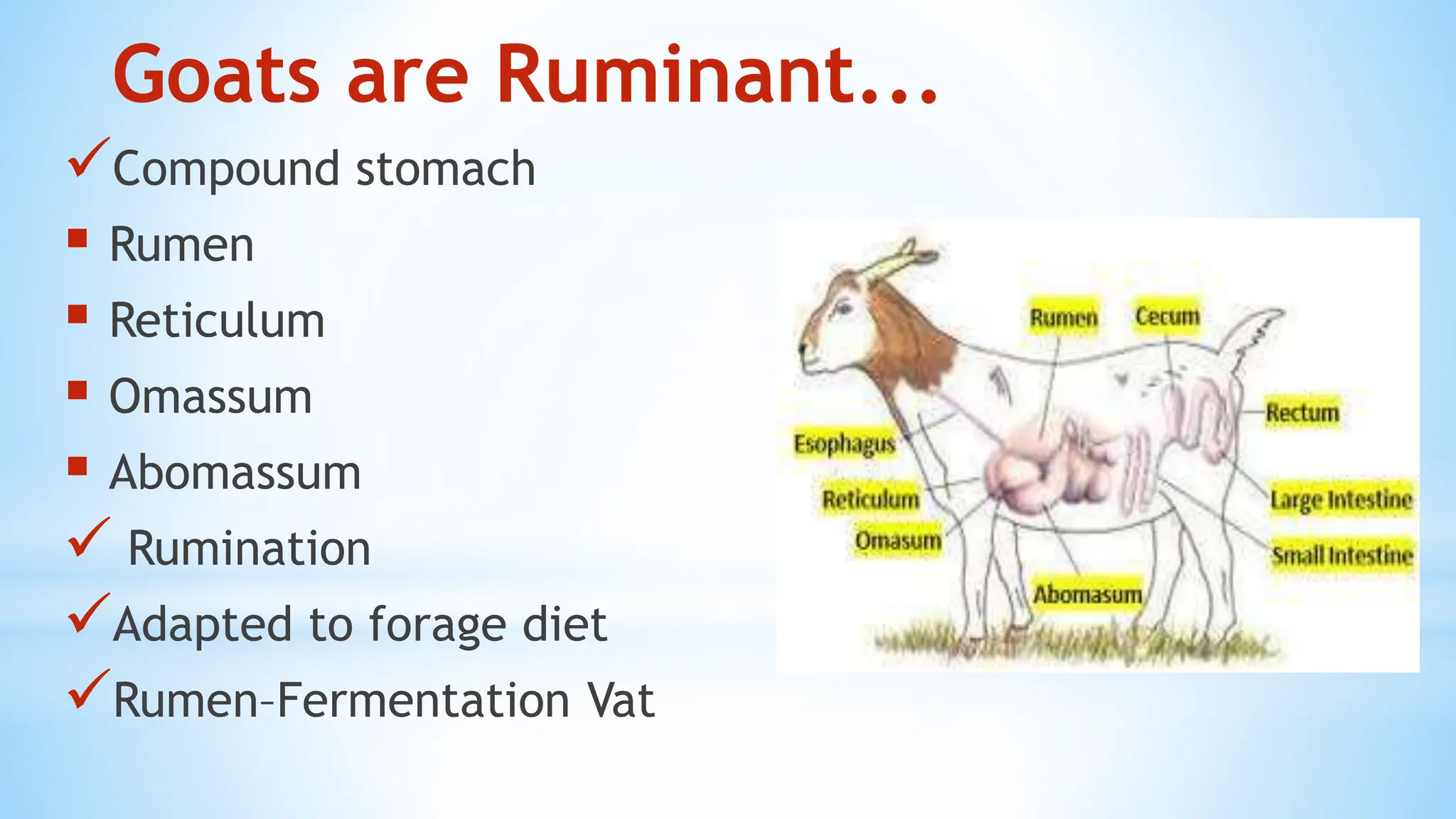
Goats are Ruminant...
Compound stomach
 Rumen
 Reticulum
 Omassum
 Abomassum
 Rumination
Adapted to forage diet
Rumen–Fermentation Vat
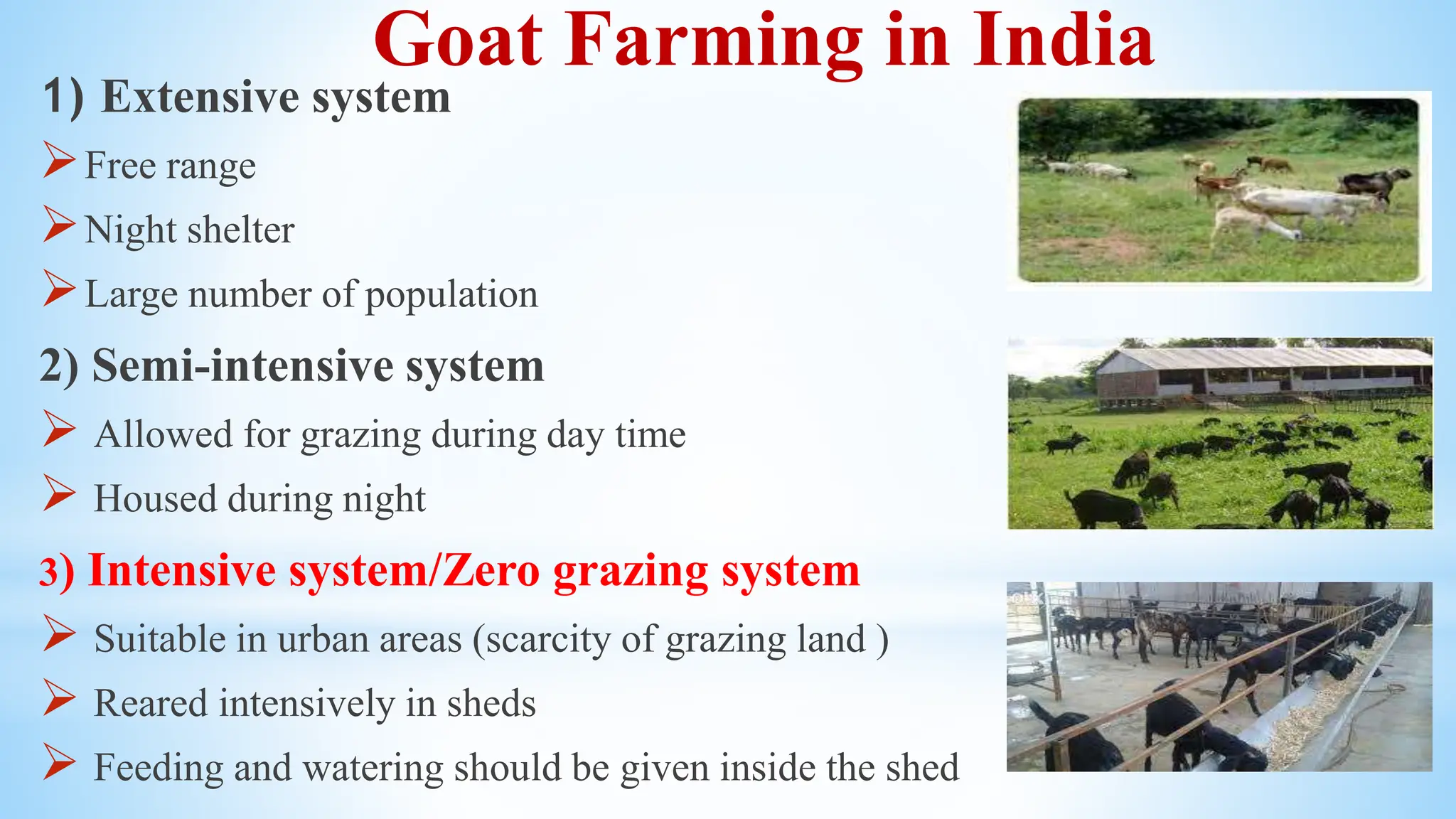
Goat Farming in India
1) Extensive system
Free range
Night shelter
Large number of population
2) Semi-intensive system
 Allowed for grazing during day time
 Housed during night
3) Intensive system/Zero grazing system
 Suitable in urban areas (scarcity of grazing land )
 Reared intensively in sheds
 Feeding and watering should be given inside the shed
Advantages of Zero Grazing System
 Exploitation of the system of feeding agro-industrial by products
 Close supervision and control over the animals
 Dung is collected in one place and used as a good fertilizer
 Less space is sufficient for more number of animals
 Less parasitic infestation
 Better quality and quantity byproducts
 Less environmental pollution
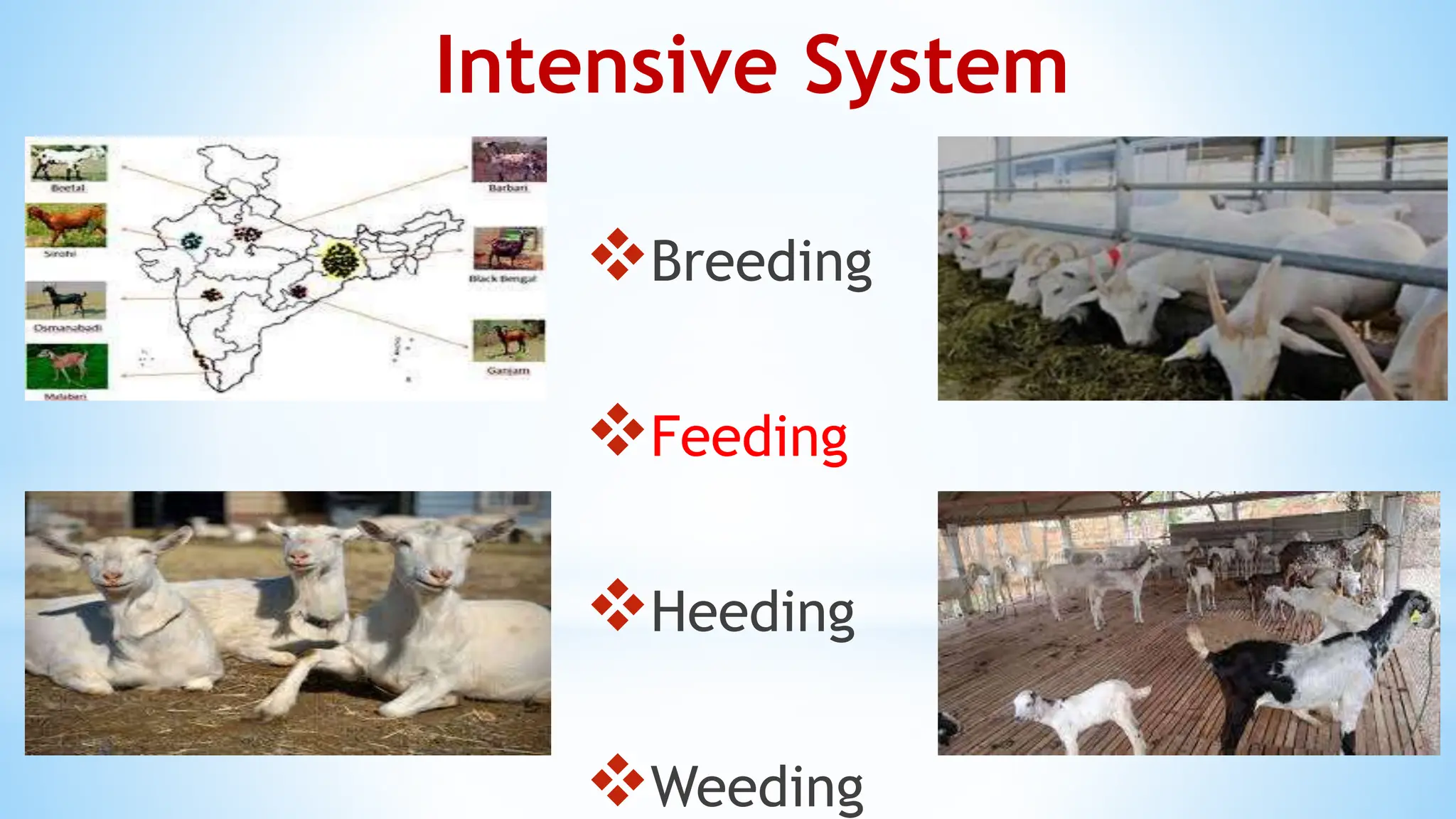
Intensive System
Breeding
Feeding
Heeding
Weeding
Nutrition account for 60% or more
of total production costs
 Factor on which the farmer can
act quickly and easily
 Affects the growth, lactation and
reproductive performance
 Poorly fed animals are more
susceptible to diseases
Importance of Nutrition
Essential Nutrients for Goat
Water
Energy
Protein
Mineral
Vitamin
Fiber
Water
Goats should be provided with ad-libitum
clean water.
A adult goat drinks about 400-700 ml,
water/day.
Goats have the ability to conserve water
by reducing losses in urine and faeces.
 Sensitive and reluctant to taste of water
The mean DM, free water intake ratio for
goats should be 1:1.2.
If hard water is given continuously, higher
calcium and phosphorus deficiency will
cause male infertility.
Energy
 Required in greatest quantity
Most limiting nutrient
Comes primarily from Carbohydrate
and fats in diet but also from excess
protein
Excess energy stored as fat in the
body
Energy expressed in the form of
TDN-Total digestible nutrient
DE-Digestible Energy
ME-Metabolizable energy
NE-Net energy
Too much energy in diet
 Wasteful economically
Over BCS impaired reproduction
Fatty female more prone to
pregnancy toxemia
 Feed efficiency decreases
Excess finish undesirable to
consumers
Not enough energy in diet
Reduced fertility
Reduced growth rate
Reduced milk production
Loss of body condition reserves
Less cold tolerance
Reduced resistance to disease
Risk of ketosis
Reduced nutrient absorption
Increase protein requirements in
ration
Protein
 Required in smaller amount than energy
More expensive feed ingredients than
energy
Amount more important than quality
Excess protein not stored, broken down
and used as energy
Some excess protein may be beneficial if
parasites burdens excessive
Protein is expressed in
CP- Crude protein
DP- Digestible protein
MP- Metabolizable protein
RDP and UDP (Bypass protein)
Bypass protein
In high producing animal it
is recommended that 25-35 %
of protein be Bypass protein
20-30% of protein in fresh
high quality forage is bypass
protein
Supplementing with bypass
protein may improve
productivity and/or increase
resistance to internal
parasites
Bypass protein sources
Low
Soybean protein
Medium
Cottonseed meal
Dehydrated alfaalfa,
distiller’s grain
High
Corn gluten meal, Fish meal
Too much protein
Expensive and inefficient
source of energy
Risk of pizzle rot in males
Can cause metabolic
harm
 Environmental pollution
Not enough protein
Impaired production
Reduced growth rate
Reduced milk production
Decreased resistance to
disease
Reduced rumen function
Reduced hoof and horn
growth
Reduced nutrient absorption
Micronutrients
Vitamins
Fat soluble
A, D, E K
Water soluble
B complex, C
Minerals
Macrominerals
Ca, P, k, Mg, Na, Cl and S
Microminerals
Co, Cu, F, Fe, I, Mn, Mo, Se and
Zn
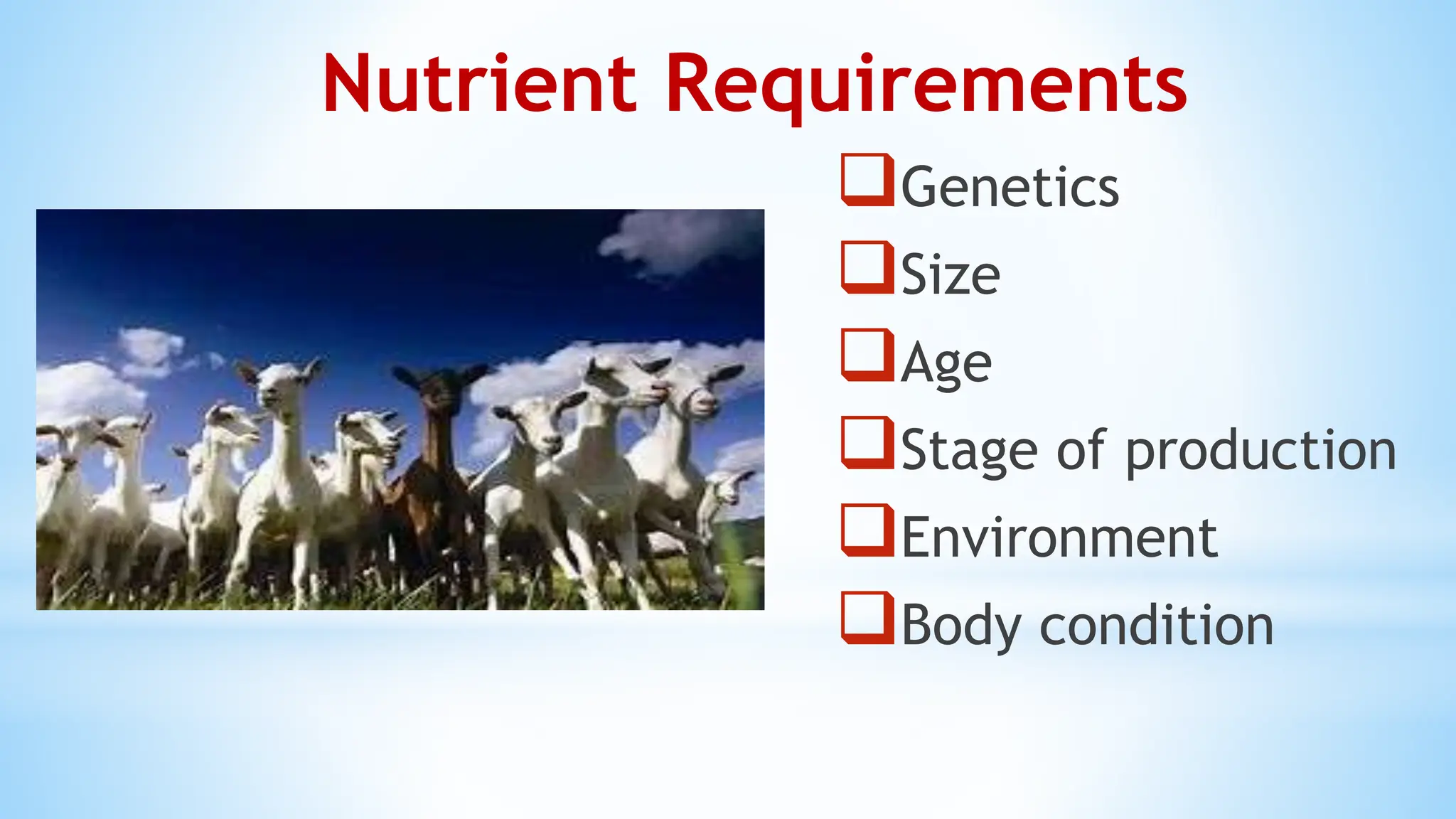
Nutrient Requirements
Genetics
Size
Age
Stage of production
Environment
Body condition
 Babool
Cactus
Eucalyptus
Ber
 Mulberry
 Subabool
Browses are considered to have high nutritional
value compared to pasture grasses and crop
residues.
Nearly 22% Crude protein
Higher concentrations of ash (minerals),
less fiber and
remain nutritious during the dry season
antinutritional factors such as tannins, nitrates,
oxalates, sinogens, saponins, mimosine
nutrient-rich leguminous and
non-leguminous pastures/forages and fodder crops
FEED INGREDIENTS
cassava peels,
vegetables,
fruit by-products,
grape seed pulp,
starch industry by-
products,
dairy industry by-products,
oliveby-products
Soybean hulls,
wheat middling
corn gluten feed
dried distillers
grains,
corn cobs,
potato peels,
Probiotics
Prebiotics
Phytogenics
Essential oil
Exogenous enzyme
Organic acids
Antioxidants
Goat Dietary Composition and
Feeding Aspects
Optimal ratio of 40% roughage to 60% concentrate
adlibitum green forage with a concentrate admixture of
300 g
Continuous supplementation of goats with proteins
especially in goats consuming low-quality forages
Creep grazing or grazing with high quality, nutritious
forage or concentrate supplements
Feeding soybean or flaxseed oils 15-20 ml/day to
lactating
Colostrum Feeding
Colostrums should be fed within half
an hour to ensure immunity
Continue for 3 to 4 days
It contains vitamins , antibodies
calcium ,phosphorus, protein and
minerals
It provides immunity to young one
Milk feeding
Milk feeding should be given @1/6th of
their body wt for 30 days
Next four weeks reduced to 1/6th of
body wt
Third month 1/10th to 1/15th of their
body wt
Substitute For Colostrum
If colostrum is not available
Cow milk(boiled)250ml
Boiled water 100ml
Wiped egg 1 no.
Vitamin A(fish oil ) 1 teaspoon
Castor oil 0.5teaspoon
Antibiotic 10,000 IU
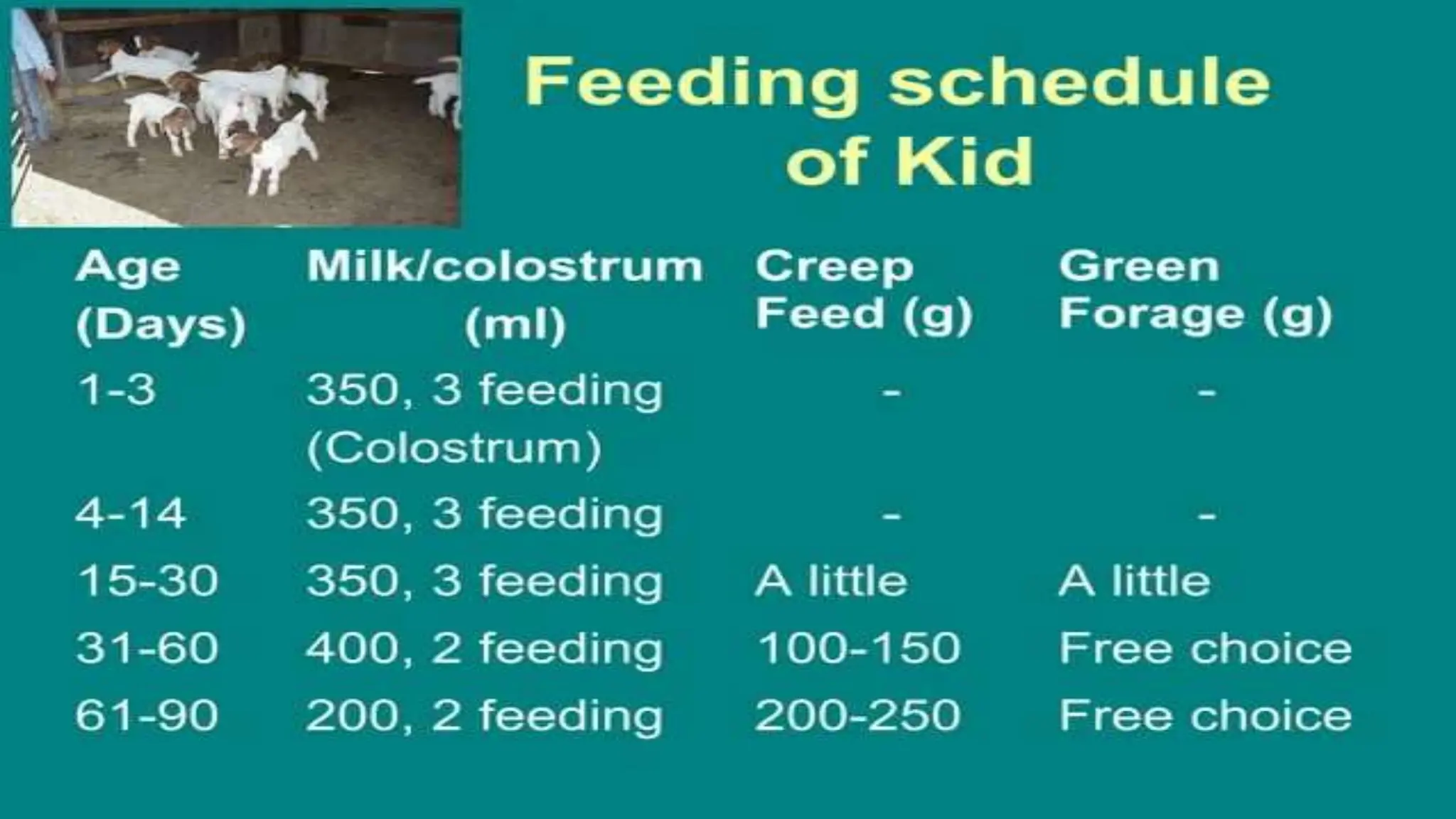
Feed the kids twice or thrice in a day
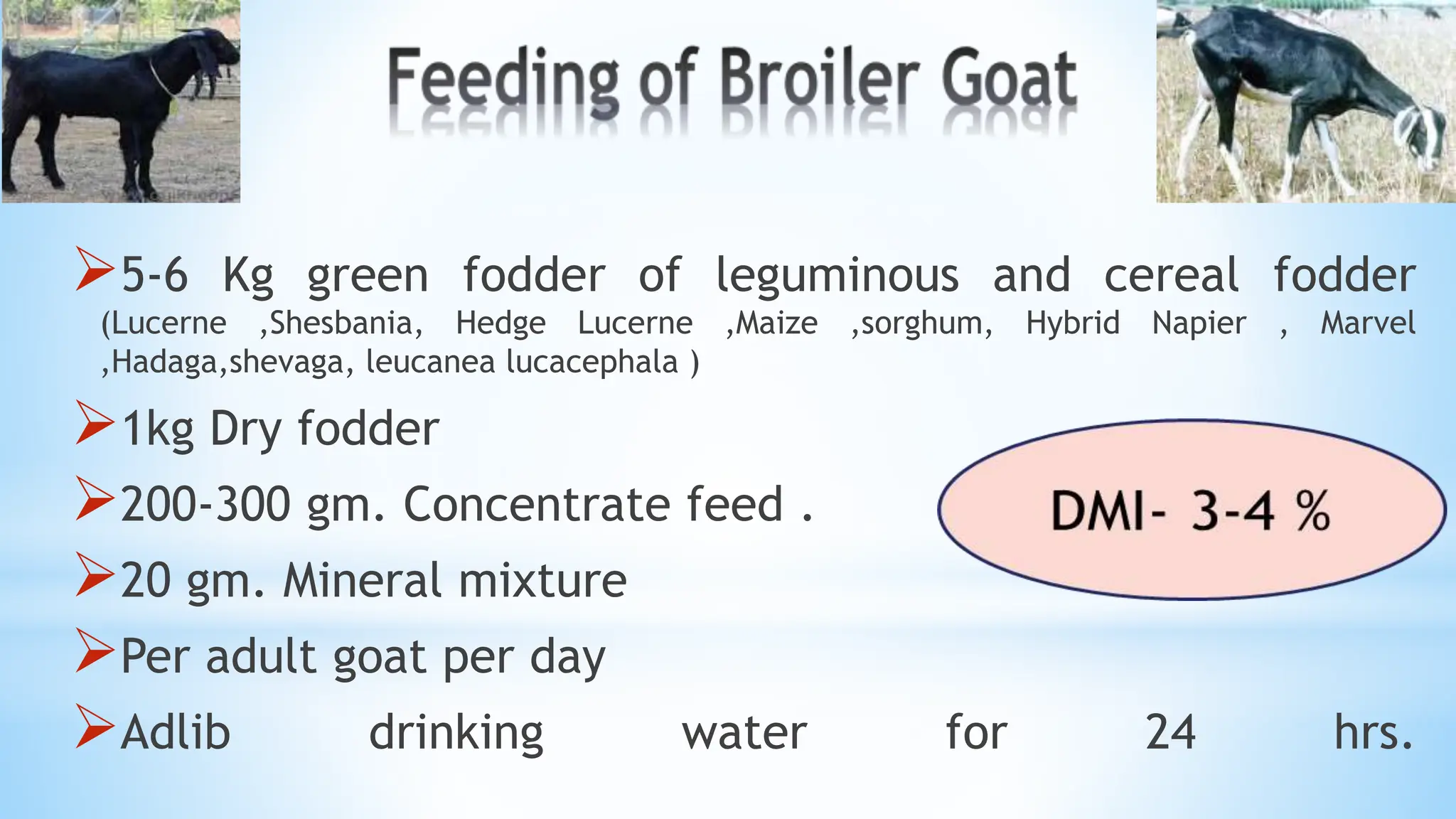
5-6 Kg green fodder of leguminous and cereal fodder
(Lucerne ,Shesbania, Hedge Lucerne ,Maize ,sorghum, Hybrid Napier , Marvel
,Hadaga,shevaga, leucanea lucacephala )
1kg Dry fodder
200-300 gm. Concentrate feed .
20 gm. Mineral mixture
Per adult goat per day
Adlib drinking water for 24 hrs.
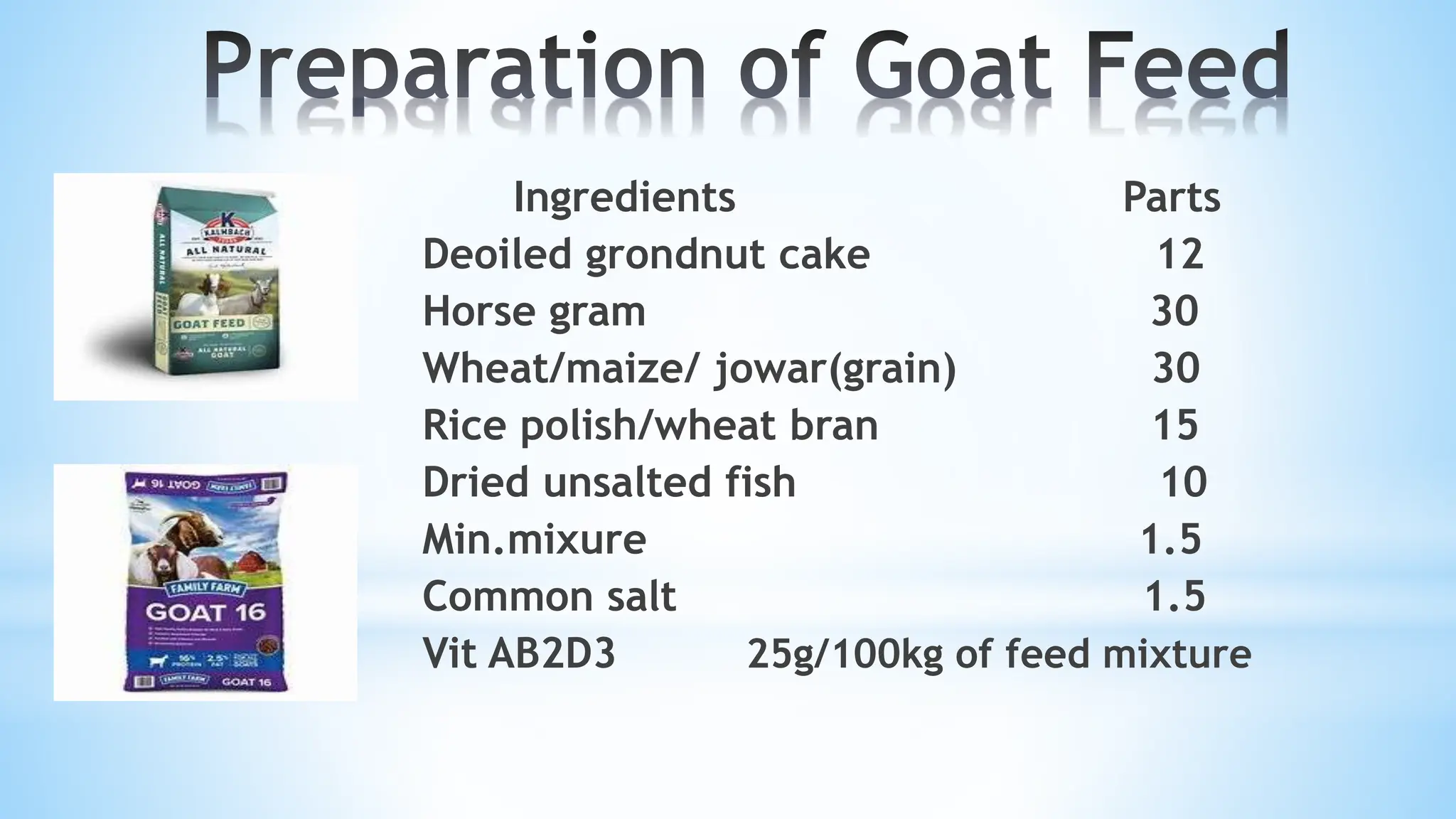
Ingredients Parts
Deoiled grondnut cake 12
Horse gram 30
Wheat/maize/ jowar(grain) 30
Rice polish/wheat bran 15
Dried unsalted fish 10
Min.mixure 1.5
Common salt 1.5
Vit AB2D3 25g/100kg of feed mixture
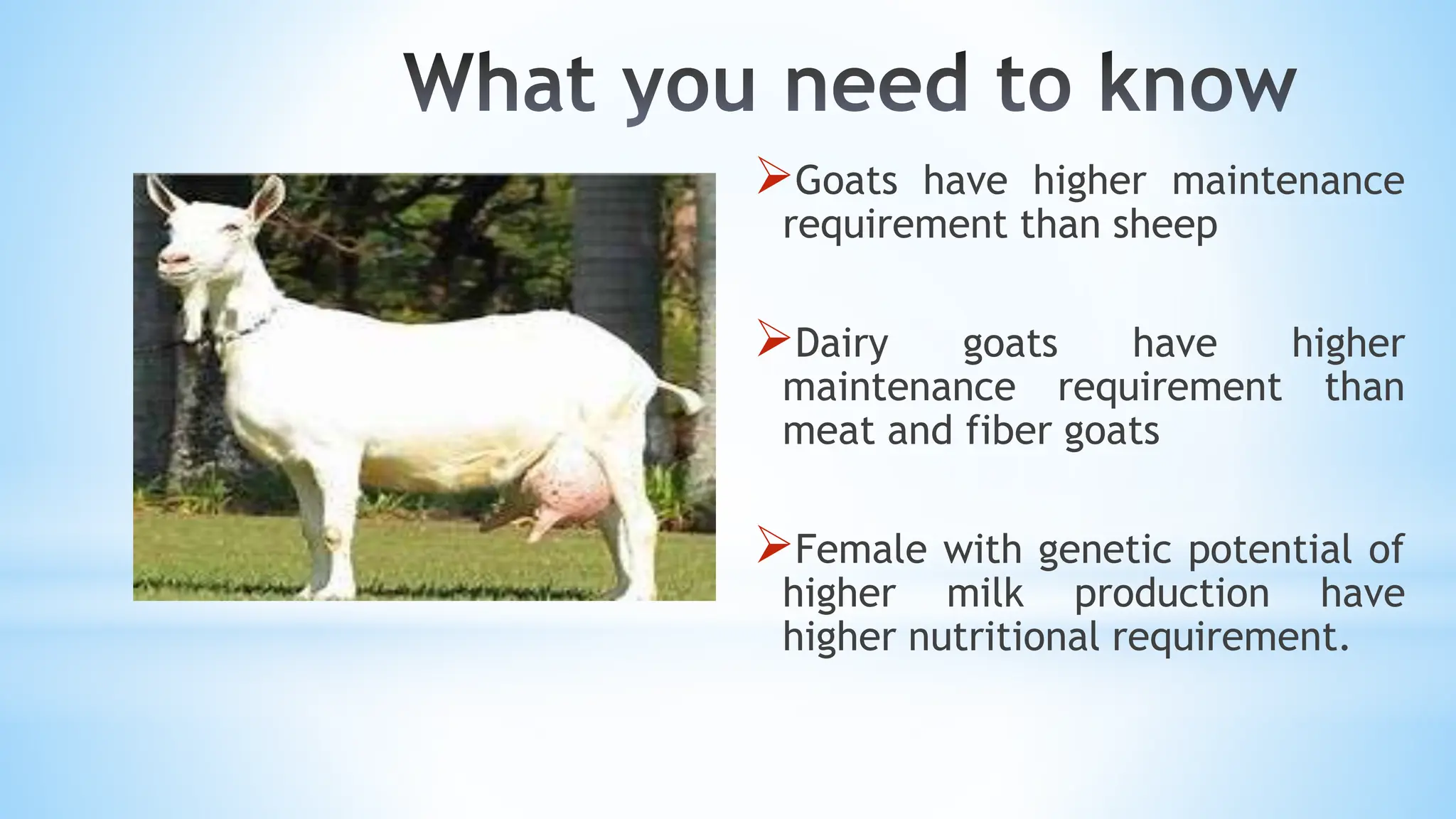
Goats have higher maintenance
requirement than sheep
Dairy goats have higher
maintenance requirement than
meat and fiber goats
Female with genetic potential of
higher milk production have
higher nutritional requirement.
Bigger goats need to eat more
Smaller goats need a more
nutrient dense diet
Mature females need to eat more.
Young females need more
nutrient dense diet
Energy requirements during
late gestation are more than
50% higher than maintenance
Protein requirements don’t
increase until lactation
Calcium requirements are
highest during late gestation
Phosphorus requirements are
highest during lactation
Smaller kids need to consume a
more nutrient dense diet
Bigger kids need to consume more
quantity of nutrients
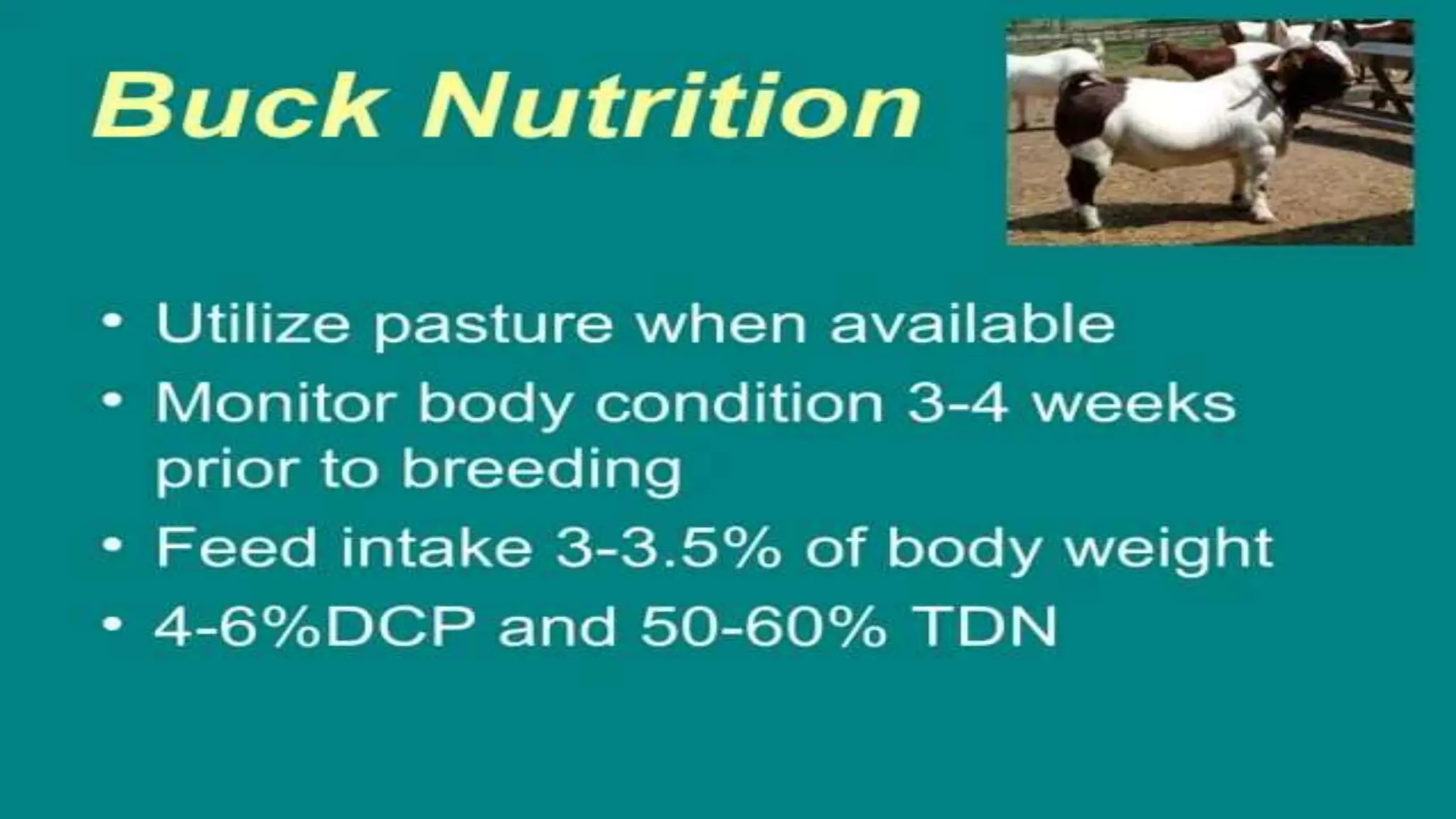
Dairy goat buck don’t need to eat
as much as Boer bucks, but diets
need to be more energy dense
Boer buck need to eat the most,
so need not be energy dense
Type % TDN % CP
Dairy 87.7 14.4
Boer 66.3 15.1
Indigenous 67.0 13.0
Boer bucks have higher
requirements for protein
Local breed goats have lower
requirements for protein than
improved breeds
Dairy goat buck don’t need
to eat as much as Boer bucks,
but diets need to be more
energy dense
Boer buck need to eat the
most, so need not be energy
dense
Type % TDN % CP
Doelings, wether 65.8 15.9
Intact male 66.3 14.5
The more you feed a
goat it will gain
Better performance
require both more feed
and better quality feed.
Higher TDN and CP%
The bigger question is :
is better performance
economical ?
THANKS

Goat Nutrition.pptx

  • 1.
    Presented By: Dr. DharmeshTewari Assistant Professor Acharya Narendra Deva University of Agriculture & Technology Kumarganj, Ayodhya, Uttar Pradesh-224229 GOAT NUTRITION
  • 2.
    Advantages of GoatFarming Minimal space is required Feeding needs are less Low maintenance Faster growth Easy to train and handle High prolificacy Inexpensive to keep Easily marketable
  • 3.
    Goats are Ruminant... Compoundstomach  Rumen  Reticulum  Omassum  Abomassum  Rumination Adapted to forage diet Rumen–Fermentation Vat
  • 4.
    Goat Farming inIndia 1) Extensive system Free range Night shelter Large number of population 2) Semi-intensive system  Allowed for grazing during day time  Housed during night 3) Intensive system/Zero grazing system  Suitable in urban areas (scarcity of grazing land )  Reared intensively in sheds  Feeding and watering should be given inside the shed
  • 5.
    Advantages of ZeroGrazing System  Exploitation of the system of feeding agro-industrial by products  Close supervision and control over the animals  Dung is collected in one place and used as a good fertilizer  Less space is sufficient for more number of animals  Less parasitic infestation  Better quality and quantity byproducts  Less environmental pollution
  • 6.
  • 7.
    Nutrition account for60% or more of total production costs  Factor on which the farmer can act quickly and easily  Affects the growth, lactation and reproductive performance  Poorly fed animals are more susceptible to diseases Importance of Nutrition
  • 8.
    Essential Nutrients forGoat Water Energy Protein Mineral Vitamin Fiber
  • 9.
    Water Goats should beprovided with ad-libitum clean water. A adult goat drinks about 400-700 ml, water/day. Goats have the ability to conserve water by reducing losses in urine and faeces.  Sensitive and reluctant to taste of water The mean DM, free water intake ratio for goats should be 1:1.2. If hard water is given continuously, higher calcium and phosphorus deficiency will cause male infertility.
  • 10.
    Energy  Required ingreatest quantity Most limiting nutrient Comes primarily from Carbohydrate and fats in diet but also from excess protein Excess energy stored as fat in the body Energy expressed in the form of TDN-Total digestible nutrient DE-Digestible Energy ME-Metabolizable energy NE-Net energy
  • 11.
    Too much energyin diet  Wasteful economically Over BCS impaired reproduction Fatty female more prone to pregnancy toxemia  Feed efficiency decreases Excess finish undesirable to consumers Not enough energy in diet Reduced fertility Reduced growth rate Reduced milk production Loss of body condition reserves Less cold tolerance Reduced resistance to disease Risk of ketosis Reduced nutrient absorption Increase protein requirements in ration
  • 12.
    Protein  Required insmaller amount than energy More expensive feed ingredients than energy Amount more important than quality Excess protein not stored, broken down and used as energy Some excess protein may be beneficial if parasites burdens excessive Protein is expressed in CP- Crude protein DP- Digestible protein MP- Metabolizable protein RDP and UDP (Bypass protein)
  • 13.
    Bypass protein In highproducing animal it is recommended that 25-35 % of protein be Bypass protein 20-30% of protein in fresh high quality forage is bypass protein Supplementing with bypass protein may improve productivity and/or increase resistance to internal parasites Bypass protein sources Low Soybean protein Medium Cottonseed meal Dehydrated alfaalfa, distiller’s grain High Corn gluten meal, Fish meal
  • 14.
    Too much protein Expensiveand inefficient source of energy Risk of pizzle rot in males Can cause metabolic harm  Environmental pollution Not enough protein Impaired production Reduced growth rate Reduced milk production Decreased resistance to disease Reduced rumen function Reduced hoof and horn growth Reduced nutrient absorption
  • 15.
    Micronutrients Vitamins Fat soluble A, D,E K Water soluble B complex, C Minerals Macrominerals Ca, P, k, Mg, Na, Cl and S Microminerals Co, Cu, F, Fe, I, Mn, Mo, Se and Zn
  • 16.
    Nutrient Requirements Genetics Size Age Stage ofproduction Environment Body condition
  • 20.
     Babool Cactus Eucalyptus Ber  Mulberry Subabool Browses are considered to have high nutritional value compared to pasture grasses and crop residues. Nearly 22% Crude protein Higher concentrations of ash (minerals), less fiber and remain nutritious during the dry season antinutritional factors such as tannins, nitrates, oxalates, sinogens, saponins, mimosine nutrient-rich leguminous and non-leguminous pastures/forages and fodder crops FEED INGREDIENTS
  • 21.
    cassava peels, vegetables, fruit by-products, grapeseed pulp, starch industry by- products, dairy industry by-products, oliveby-products Soybean hulls, wheat middling corn gluten feed dried distillers grains, corn cobs, potato peels,
  • 22.
  • 23.
    Goat Dietary Compositionand Feeding Aspects Optimal ratio of 40% roughage to 60% concentrate adlibitum green forage with a concentrate admixture of 300 g Continuous supplementation of goats with proteins especially in goats consuming low-quality forages Creep grazing or grazing with high quality, nutritious forage or concentrate supplements Feeding soybean or flaxseed oils 15-20 ml/day to lactating
  • 25.
    Colostrum Feeding Colostrums shouldbe fed within half an hour to ensure immunity Continue for 3 to 4 days It contains vitamins , antibodies calcium ,phosphorus, protein and minerals It provides immunity to young one
  • 26.
    Milk feeding Milk feedingshould be given @1/6th of their body wt for 30 days Next four weeks reduced to 1/6th of body wt Third month 1/10th to 1/15th of their body wt
  • 27.
    Substitute For Colostrum Ifcolostrum is not available Cow milk(boiled)250ml Boiled water 100ml Wiped egg 1 no. Vitamin A(fish oil ) 1 teaspoon Castor oil 0.5teaspoon Antibiotic 10,000 IU Feed the kids twice or thrice in a day
  • 30.
    5-6 Kg greenfodder of leguminous and cereal fodder (Lucerne ,Shesbania, Hedge Lucerne ,Maize ,sorghum, Hybrid Napier , Marvel ,Hadaga,shevaga, leucanea lucacephala ) 1kg Dry fodder 200-300 gm. Concentrate feed . 20 gm. Mineral mixture Per adult goat per day Adlib drinking water for 24 hrs.
  • 37.
    Ingredients Parts Deoiled grondnutcake 12 Horse gram 30 Wheat/maize/ jowar(grain) 30 Rice polish/wheat bran 15 Dried unsalted fish 10 Min.mixure 1.5 Common salt 1.5 Vit AB2D3 25g/100kg of feed mixture
  • 38.
    Goats have highermaintenance requirement than sheep Dairy goats have higher maintenance requirement than meat and fiber goats Female with genetic potential of higher milk production have higher nutritional requirement.
  • 39.
    Bigger goats needto eat more Smaller goats need a more nutrient dense diet Mature females need to eat more. Young females need more nutrient dense diet
  • 40.
    Energy requirements during lategestation are more than 50% higher than maintenance Protein requirements don’t increase until lactation Calcium requirements are highest during late gestation Phosphorus requirements are highest during lactation
  • 41.
    Smaller kids needto consume a more nutrient dense diet Bigger kids need to consume more quantity of nutrients Dairy goat buck don’t need to eat as much as Boer bucks, but diets need to be more energy dense Boer buck need to eat the most, so need not be energy dense Type % TDN % CP Dairy 87.7 14.4 Boer 66.3 15.1 Indigenous 67.0 13.0
  • 42.
    Boer bucks havehigher requirements for protein Local breed goats have lower requirements for protein than improved breeds Dairy goat buck don’t need to eat as much as Boer bucks, but diets need to be more energy dense Boer buck need to eat the most, so need not be energy dense Type % TDN % CP Doelings, wether 65.8 15.9 Intact male 66.3 14.5
  • 43.
    The more youfeed a goat it will gain Better performance require both more feed and better quality feed. Higher TDN and CP% The bigger question is : is better performance economical ?
  • 44.